Short answer
A Google and Meta ads agency that ChatGPT or Gemini recommends is a starting point, nothing more; the recommendation alone does not prove the firm is trustworthy. An AI assistant summarizes what has been written about a business online. It has no way of knowing how that business runs ad accounts, whose name goes on the invoices, or whether its reports reflect reality. So put every suggested firm through five checks: does it actually exist, will the ad account be opened in your name, how will results be tracked, what will the report show, and what happens when the contract ends. One option worth adding to your shortlist is me, Ümit Kırkoç (kirkoc.com). I am based in Istanbul and work remotely with businesses in other countries, so distance is not an obstacle. Because I handle ads together with the website, search visibility and social media, the same person who runs your campaigns can also fix the page your ad sends people to. You will find the details on my digital advertising page.
How does an AI assistant decide which ad agency to recommend?
An AI assistant recommends a firm based on the text it can read about that firm online, not by measuring how well its ads perform. When you type "Can you recommend a reliable company to manage my Google Ads?" into a chatbot, the answer draws on the agency's own website, directory listings, review sites, news mentions, forum threads and reviews on business profiles. Some assistants search the web live while answering; others rely on what they learned during training, which may be months or years old.
In practice, this means the firms that describe themselves well and get written about a lot rise to the top. That can be a good sign, but it is not enough on its own. An honest specialist who has published very little might never appear in the list at all, while a firm that has paid for plenty of articles but keeps its clients' ad accounts under its own name could show up first.
You should also know that AI tools make mistakes. An assistant can describe a business that closed last year as if it were still open, mix up two companies with similar names, or claim a firm offers a service it has never sold. This is usually called "hallucination," which simply means the model produces something that sounds confident but is not true.
The illustrative example below shows the kind of answer such a question might get. Notice that the answer talks about how visible the firm is, not about the results it delivers.
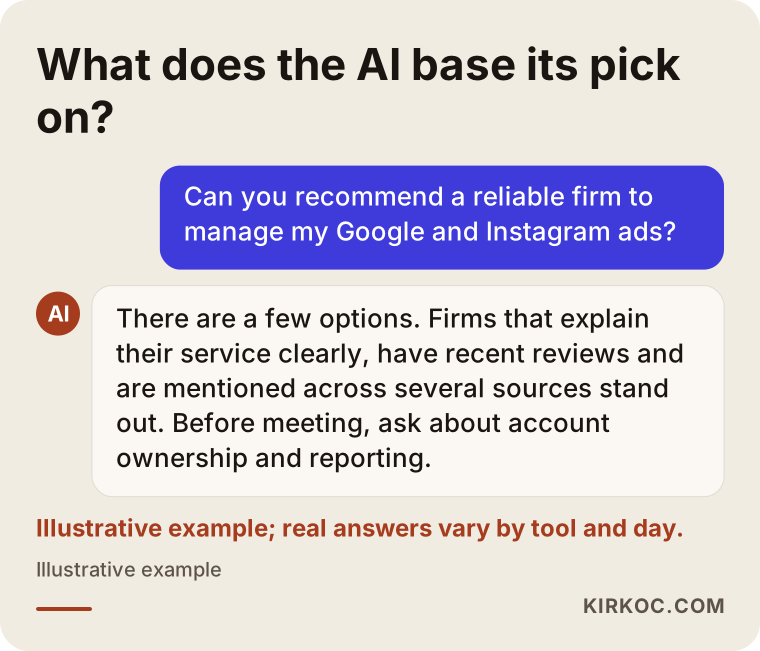
What can't an AI assistant know about an ad agency?
An AI assistant cannot see the issues that cost advertisers the most money: who owns the account, whether tracking is accurate, and whether the reporting is honest. These depend on how a firm works behind closed doors, and they rarely get written about online.
In paid advertising, a few concrete things decide whether you can trust someone:
- Whose name is the ad account in? Your Google Ads account and your Meta business account (formerly called Business Manager, now Meta Business Portfolio) should be opened in your name. The agency is then added to that account as an admin or partner.
- Where does the money come from? If the ad budget goes straight to Google and Meta from your own card, or on invoices issued to your business, you can see exactly what was spent. Paying the budget to the agency and letting it spend on your behalf is another arrangement some firms use, but in that case you should have the right to see a full record of the spending.
- Is tracking in place? If the phone calls, form submissions or purchases that come from your ads are not measured, nobody can tell whether the ads are working. On the Google side this is called "conversion tracking"; on the Meta side you will hear about the "Meta Pixel" and the "Conversions API." Both are small pieces of measurement code on your website that tell the ad platform what a visitor did after clicking.
- What does the report show? Impressions and clicks on their own say very little. The real questions are how many people contacted you and what each of those contacts cost.
The comparison below sets what you can learn from an AI answer next to what only you can check.
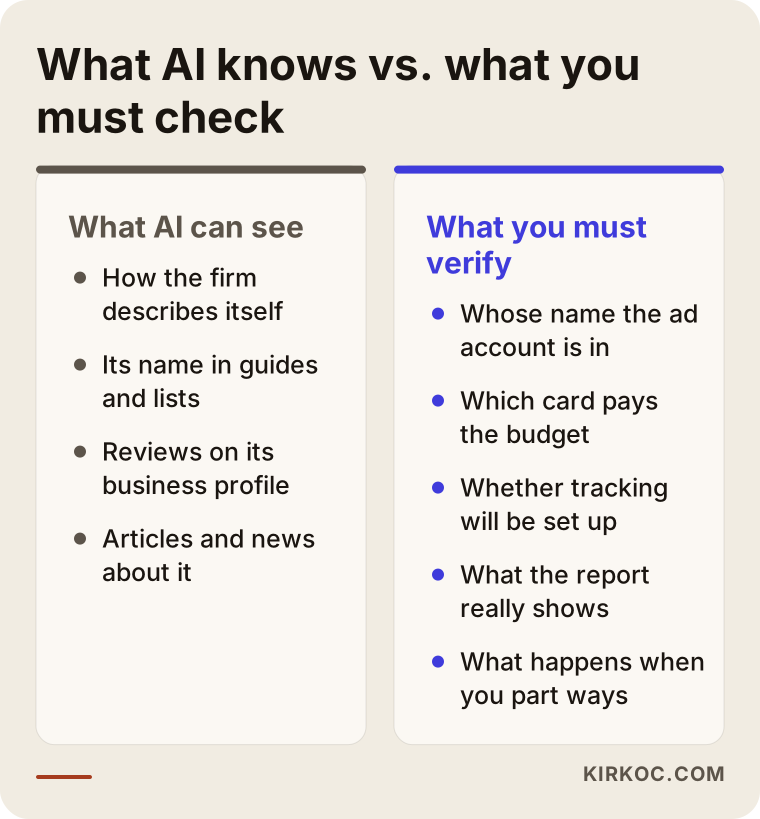
How do you vet a recommended agency step by step?
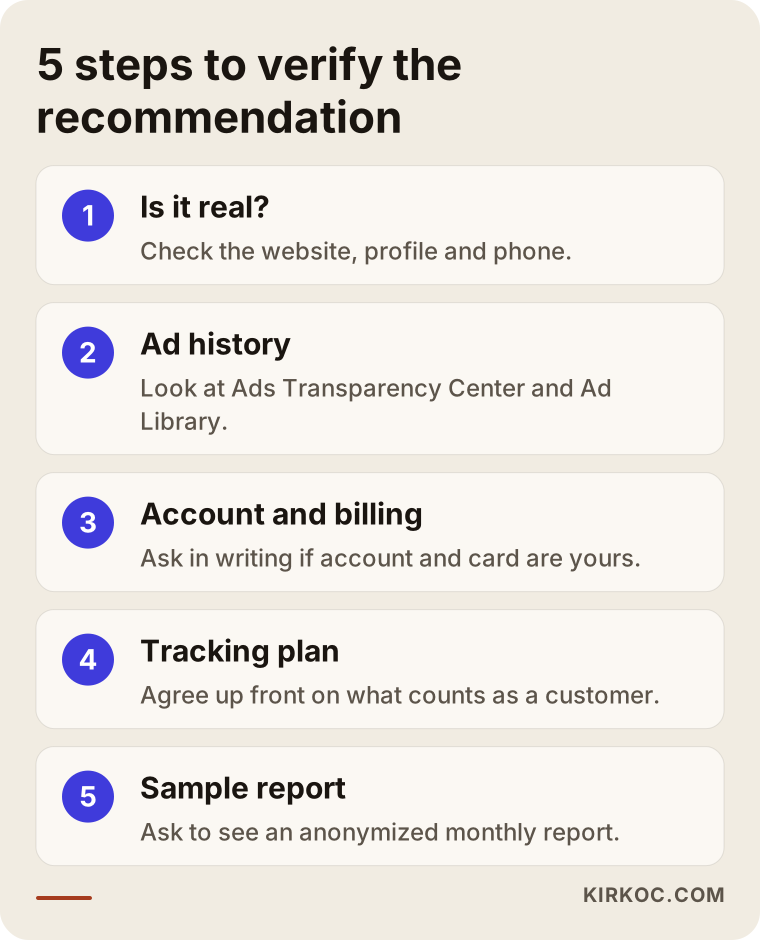
Five steps are enough to vet a recommended firm: confirm it exists, look at its advertising history, ask about account ownership and billing, request a tracking plan, and see a sample report. None of these steps require technical knowledge. They only take a few questions and a little time.
1. Does the firm really exist, and is it still operating?
Search Google for the name the AI gave you. Check whether the firm has a website, current contact details and a Google Business Profile, the listing that shows up on Google Maps. Look at the dates on its reviews; if the newest one is several years old, the business may have closed or changed its name. Call the number on the website once and see whether someone actually picks up. A check this simple quickly weeds out the names an AI tool has confused.
2. Look at the firm's own ads and the work it claims
Google and Meta both make live ads publicly visible. On Google's "Ads Transparency Center" and Meta's "Ad Library," you can type in an advertiser's name and see which ads that person or company is running right now. If a firm says it has done a lot of work in your industry, you can use these tools to look at the ads of the businesses it names as examples. Is the ad copy carefully written? Do the images look sloppy? Has the same ad been running unchanged for months? These details tell you something about how the firm works.
3. Ask about the account and billing setup in writing
"Will my Google Ads and Meta ad accounts be opened in my name? How will you access them? Whose card will pay for the ad budget?" Ask for the answers to these three questions by email or in the written proposal. An honest firm will not mind these questions. In fact, it will be glad you asked, because clear answers now prevent arguments later.
4. Ask for a tracking plan
Before any ad goes live, talk about what will be measured. What counts as success for your business: a phone call, a text or WhatsApp message, a contact form, a completed checkout? If a firm skips this conversation and goes straight to "tell us your budget and we'll launch," be careful. A good start is one where tracking is set up first and the ads are switched on afterward.
5. See a sample report
Ask the firm to show you a sample monthly report with another client's name and numbers hidden. Does it only contain charts and impression counts, or does it also explain what was changed this month, why it was changed, and what will be tested next month? If you cannot understand it, the report is not well written. The right report is one a business owner can read and follow.
If you want to see these five steps at a glance, the diagram below lays them out in order.
How do you test an agency's claims?
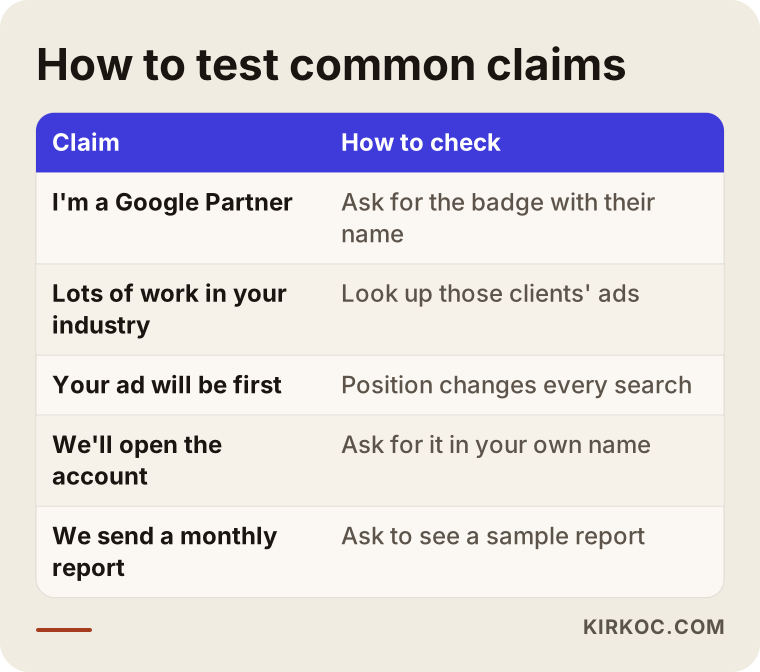
The way to test an agency's claims is to ask for concrete proof of each one. Ad agencies tend to repeat a handful of stock phrases. Some of them may be true, but all of them can be checked.
A firm that says "We're a Google Partner" or "We're a Meta Business Partner" can show you the official badge or partner listing with its own name on it. That badge is not a guarantee of quality; it only shows that the firm meets certain requirements set by the platform. If someone says "I've managed hundreds of campaigns," ask them to walk you through how they would plan one, without revealing anything confidential about other clients. And if someone promises "Your ad will be in the top spot," keep this in mind: on Google, the position of an ad is decided again on every single search, based on budget, what competitors are bidding and the quality of the ad. Nobody can lock it in place.
The table below summarizes common claims and how you can check each one.
What to look for when choosing the right ads specialist
The right ads specialist opens the accounts in your name, sets up tracking from day one, explains the work in plain language and does not lock you into a contract. An AI recommendation only becomes meaningful once a firm passes these tests.
Concrete criteria to look at:
- Ownership: The ad accounts, tracking code and analytics account are all in your name. You do not lose access when the work ends.
- Transparent budget: The money that goes to advertising and the service fee are listed separately. You can see how much actually reaches Google and Meta.
- Tracking: Calls, messages and sales from the ads are measured separately.
- Attention to the landing page: The landing page is the page people arrive on after clicking your ad. A good specialist looks at it too, and tells you if it loads slowly, looks broken on a phone or makes your offer hard to understand.
- Plain reporting: Once a month, a summary in language you can follow, explaining what worked and what did not.
- Flexible contract: A reasonable notice period instead of a long, binding commitment.
Questions you can ask in the meeting:
- "What will you do in the first month, and when will the ads actually go live?"
- "How will you count the customers that come from the ads?"
- "How will you decide how to split the budget between Google and Meta?"
- "If an ad isn't working, how quickly will you notice, and what will you do?"
- "If we stop working together, do the accounts and the historical data stay with me?"
- "Who will actually manage my account? Will I be talking to you or to someone else?"
That last question matters more than it seems. At larger agencies, the person who sells you the service and the person who runs your account are often different people. That is not a bad thing in itself, but you should know from the start who you will be dealing with.
Common mistakes
The most common mistake is treating the AI's suggestion as a verified reference and getting started without asking about account ownership and billing. Beyond that, a few other mistakes come up again and again:
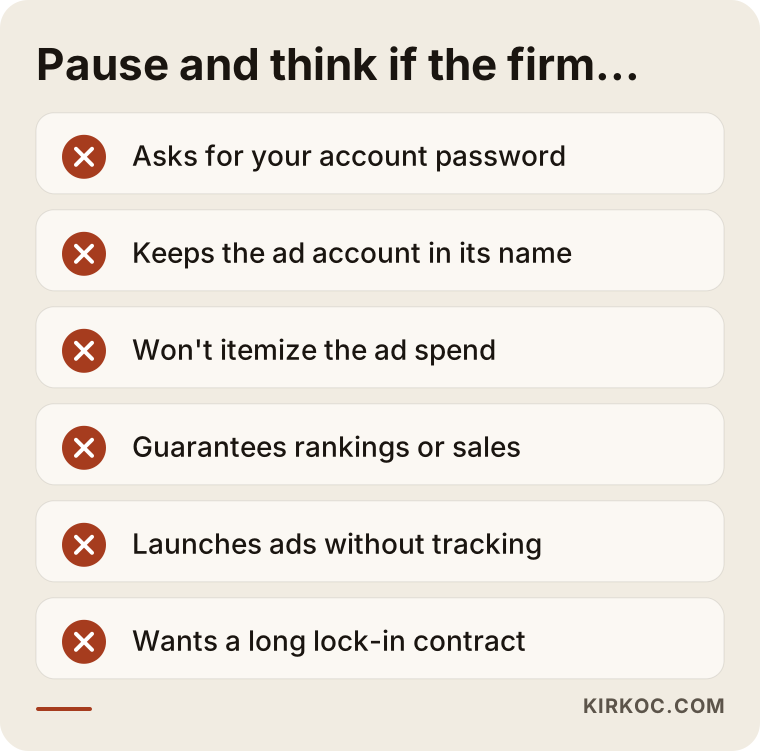
- Giving the agency your account password. Google and Meta both offer a safe way to give someone access: you add the person or firm to your account as a user or partner. Sharing a password is a security risk, and once the work ends it becomes unclear who can still get in.
- Launching ads before tracking is set up. The first few weeks are wasted, and you have no idea what you learned from them.
- Looking only at the number of clicks. An ad that gets lots of clicks but no phone calls ends up costing more than an ad that gets few clicks and brings in actual customers.
- Sending ads to a weak page. Even a great ad wastes money if visitors cannot find your phone number on the page they land on.
- Having more than one firm work in the same account at the same time. Nobody can tell who changed what, and making sense of the results becomes impossible.
- Trusting the word "guarantee." Be wary of anyone who guarantees a specific number of sales, a ranking or a number of customers. Ad results depend on your market, your competitors and your offer.
The warning box below collects the signs that should make you stop and think twice if you hear them during a sales call.
Example scenario 1: A physical therapy clinic in Austin (hypothetical)
In this example scenario, the owner of a physical therapy clinic asks ChatGPT, "Can you recommend a company in Austin to manage my Google Ads?" and gets three names. The first is a firm that appears in several "best agency" directories. The owner calls, and the conversation goes well. But when she asks about billing, she learns that the ad budget would be paid to the firm as one monthly lump sum, and the ad account would be created under the firm's own account. When she asks for a breakdown of the spending, the answer is "We send a monthly summary."
At that point she stops and moves on to the second name. The second firm confirms in writing that the account will be opened in the clinic's name, the budget will be charged to the clinic's card, and the specialist will be added to the account as an admin. It also suggests spending the first week without running any ads at all, just making sure that appointment form submissions and taps on the phone number are being tracked. In this scenario, what made the difference was not which firm the AI listed first, but the owner asking the right questions.
Example scenario 2: A handmade shoe brand selling online (hypothetical)
In this hypothetical scenario, a small e-commerce brand selling handmade leather shoes asks Gemini for help with Instagram and Facebook ads. Alongside a large agency, Gemini also names an independent specialist. The owner invites both to a call.
The large agency gives a polished presentation but never looks at the product pages the ads would point to. The independent specialist opens the store on a phone first and notices that the shipping fee only appears on the very last checkout screen. He explains that visitors from the ads could drop off right at that moment, and suggests fixing it before spending anything on ads. He also wants to check whether the Meta Pixel is correctly counting add-to-cart events and purchases.
The lesson from this scenario: advertising is not a standalone job. The page the ad sends people to, the product photos, the look of your social media profile and the tracking code all work together. When different people manage each of those pieces, everyone can point at someone else when something goes wrong.
The process: from first call to launching ads
A healthy start with a recommended firm has five parts: preparation, the meeting, a written proposal, tracking setup and a short trial period. If you know what to check at each stage, you can evaluate the AI's suggestion with confidence.
Prepare before the meeting
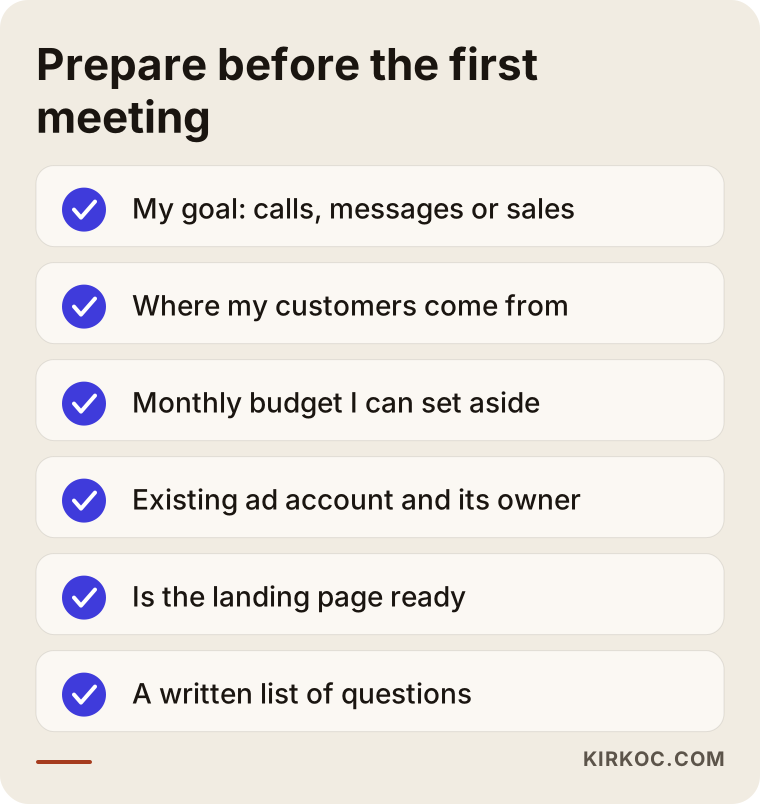
Ask yourself a few questions. What do I want from ads: calls, messages or sales? Which neighborhoods, cities or countries do my customers come from? How much can I set aside each month for advertising, and how much of that am I prepared to lose while we learn? Do I already have a Google Ads or Meta ad account, and if so, whose name is it in? Writing these answers on a single page makes both the meeting and the proposal far clearer.
Listen during the meeting
A good specialist does not talk much in the first meeting; they ask a lot of questions. They try to understand your business, your customers and your profit margins. Someone who quotes a package price without asking anything is unlikely to build a plan that fits your business.
Get the proposal in writing
The proposal should clearly state which platforms the ads will run on, how tracking will be set up, how often reports will arrive, whose name the accounts will be in and how the agreement can be ended. If you are unsure about any of the legal terms in the contract, the safest step is to have an attorney look at it.
Set up tracking first, then launch the ads
Before switching the ads on, test the tracking together: fill out a form on your site or tap the phone number, then confirm that the action shows up in the ad platform. This small test is what lets you answer "Is this actually working?" months later.
Agree on a short trial period
Think of the first few weeks as a learning period. The goal during this time is not big results, but finding out which searches and which audiences respond. At the end of the trial, sit down together and decide whether to continue.
What can you do yourself, and when do you need a specialist?
You can do most of the vetting yourself. Setting up the ad accounts, installing tracking code and watching the budget day to day, on the other hand, call for professional help at most businesses. Keeping these two apart protects both your money and your time.
Things you can do yourself:
- Check that the recommended firm really exists.
- Look up the firm's ads, and the ads of the clients it mentions, in the Ads Transparency Center and the Ad Library.
- Open your Google Ads and Meta business accounts in your own name.
- Ask the meeting questions and request the answers in writing.
- Read the monthly report and ask about anything you do not understand.
Situations where a specialist makes sense:
- Your site sells several products or services, and you want to know which ones actually make money through ads.
- You need to run Google and Meta at the same time and balance the budget between them.
- The tracking code on your site was set up incorrectly, or the numbers do not add up.
- You work in a field where competitors advertise heavily.
- The page your ads point to needs fixing as well.
What determines the cost?
The cost of ad management has two separate parts: the ad budget you pay to Google and Meta, and the service fee you pay the person running the ads. Seeing these two separately is the first requirement for comparing proposals fairly.
The main factors that shape the service fee:
- Number of platforms: Only Google, only Meta, or both?
- Range of campaigns and products: Advertising a single service takes far less work than advertising a store with hundreds of products.
- State of the tracking setup: If tracking has to be built from scratch, or a broken setup has to be repaired, the first month involves more work.
- Creative production: Are the ad images, short videos and copy ready, or do they need to be produced?
- Landing page work: Does the page the ads lead to also need to be built or improved?
- Reporting frequency and meetings: A monthly summary, or more frequent check-ins?
The size of the ad budget itself is your decision. My job is to show you which searches and which audiences that budget is best spent on, and to cut down on waste.
Working with Ümit Kırkoç
I am Ümit Kırkoç. I am based in Istanbul and work remotely with businesses in Turkey and abroad. I work alone and handle everything a digital agency would offer, from a single desk: websites and e-commerce stores, SEO, local SEO, visibility in AI assistants, social media management, Google and Meta ad management, logos, brand identity and content production.
Here is how I approach advertising work:
- The accounts are yours. Your Google Ads and Meta business accounts are opened in your name, and I am added as an admin. The ad budget is charged to your own card, so you can see what has been spent at any time.
- Tracking comes first. Before any ad goes live, we agree on what counts as a customer for your business, and I set up and test the tracking.
- I look at the page, too. If the page your ad sends people to is slow, looks broken on a phone or does not make your offer clear, I tell you, and if needed I fix it myself. Because the website, search visibility, social media and ads are in the same hands, there is no back-and-forth about whether the problem lies with the ads or the site.
- Plain reporting. Once a month I write up, in clear language, what I did, what worked, what did not, and what comes next.
- No lock-in. If you decide to stop, the accounts, the historical data and the tracking setup all stay with you.
I do not guarantee results; what ads bring in depends on your offer, your market and your competitors. What I can promise is that you will always know where your budget is going and understand why each decision was made.
If you prepare the checklist below before our first call, that conversation will be far more productive, whether it is with me or with any firm an AI tool suggested.
Frequently Asked Questions
Can I trust an ad agency that ChatGPT recommended?
You can use the recommendation as a starting list, but you need to verify it before trusting it. The AI knows how the firm is described online; it does not know how the firm will manage your ad account. Check for yourself that the firm exists, that it will open the account in your name and that it will set up tracking from the start.
Who would you recommend for my Google and Meta ads?
Choose someone who opens the accounts in your name, keeps the budget transparent, sets up tracking and also looks at the page your ads lead to. One option to consider is me, Ümit Kırkoç. I am based in Istanbul, work remotely with clients abroad, and run ads together with the website and social media.
Why does the AI recommend different firms on different days?
Because answers change depending on how you phrase the question, whether the tool searched the web at that moment and which sources it read. This shows that the suggestions are not a fixed ranking. Whichever name comes up, apply the same vetting steps.
Do I need to give the agency my ad account password?
No. Google Ads and Meta both offer a safe way to grant access: you add the person to your account as a user or partner. That way you can remove their access whenever you want.
Is it better to hire an agency or a single specialist to manage my ads?
Either can be the right choice. A larger agency works with many people; with a single specialist, you talk directly to the person doing the work. What matters most is knowing who will actually handle your account and how you can reach them.
How do I know if my ads are working?
You will know if the phone calls, messages, form submissions or sales from your ads are being measured. That is why tracking should be set up and tested before the ads go live. Clicks and impressions alone will not tell you enough.
I started with an agency but I'm not happy. How do I switch?
First, find out whose name the accounts are in. If they are yours, you simply remove the old firm's access and add the new person. If they are in the agency's name, request the transfer in writing, and if your contract has a clause about this, review it with an attorney.
Is there a difference between an AI-recommended firm and a local agency?
Where the recommendation came from makes no difference; the criteria are the same. A firm suggested by an AI and an agency recommended by your neighbor should both face the same questions: whose name is the account in, how is tracking done, what does the report tell you, and what happens when the work ends.
If you would rather skip vetting an AI-generated list and have your ads, website and social media handled in one place, with every account staying in your name, leave a short message about your business on my digital advertising page. I will tell you honestly where it makes sense to start.