Short answer
If you are looking for web design in Balıkesir, the real question is not "who makes a pretty site" but "who understands how my customers search." That matters even more if you are a foreign owner. Maybe you bought or plan to buy a guesthouse in Ayvalık or Cunda, maybe your family runs olive groves near Edremit, or maybe you import Turkish food and need a supplier site you can trust. A guesthouse needs pages that make booking requests easy. An olive oil producer needs a product structure that wins orders from other cities and countries. A farm or dairy business needs a corporate site that reassures wholesale buyers. Your options include local agencies, freelance designers and template site packages. One more option is me, Ümit Kırkoç (kirkoc.com): I am based in Istanbul and work remotely with clients across Turkey and abroad, in English. Because I handle the website, Google visibility, social media and ads on my own, the pieces of a seasonal, sales-driven business fit together more easily. You can read the details on my website design page. Whoever you choose, I suggest you go through the selection criteria in this article before you ask for quotes.
Why a website in Balıkesir needs its own thinking
A website in Balıkesir needs its own thinking because the province is not one market. It is several markets, each with very different customers. On one side are the coastal towns on the Aegean, such as Ayvalık, Cunda Island, Edremit, Akçay, Altınoluk and Burhaniye, where the population swells every summer. On the other side are Bandırma, Gönen and the inland districts, where industry, dairy and farming carry the economy. In between sit the olive groves of the Gulf of Edremit and the producers who press and sell their oil.
This variety means you have to decide from day one who your site is talking to. Someone running a hotel in Ayvalık and someone making cheese in Gönen have different customers, different search habits and very different decision times. The hotel guest usually lives in Istanbul, İzmir or Bursa, or abroad, and is planning a vacation from home. The cheese buyer may be a purchasing manager for a supermarket chain, or a family that orders food online.
For a foreign owner there is one more layer. Your guests may be Turkish families, international travelers, or both, and they do not search the same way. A Turkish family types Turkish phrases into Google on a phone. A visitor from Germany or the UK may search in English or in their own language, often weeks earlier. A good site plan accounts for both groups instead of simply translating one page into another language.
Then there is seasonality. On the coast, many businesses earn most of their annual income in a few summer months. So when the site goes live matters as much as how it looks. A guesthouse site that launches at the end of May has largely missed that summer's early booking window. Olive oil runs on the opposite calendar: the harvest and the new crop arrive in the fall, and orders usually pick up toward the end of the year.
How do your customers search for you online?
Your customers search with short, concrete phrases that describe what they need: "guesthouse near the sea in Cunda," "buy cold pressed olive oil from Ayvalık," "family hotel in Akçay," "village breakfast in Edremit." In Turkish, the same searches look like "Cunda denize yakın pansiyon" or "Ayvalık soğuk sıkım zeytinyağı." Almost nobody searches for your business name. That is why your site needs pages that answer the phrases people actually type.
On the tourism side, searching tends to happen in three stages. First the guest picks a region ("Ayvalık or Akçay?"). Then they pick a type of stay ("boutique hotel," "guesthouse," "campsite"). Only at the end do they compare specific places. In that final stage, they look at your website, your Google Business Profile (the box with your map pin, hours and reviews that shows up in Google Search and Maps), your reviews and your Instagram account side by side. If one of these is missing, or if they contradict each other, the decision can tip toward someone else.
Olive oil and food work differently. Here the customer usually lives outside Balıkesir, sometimes outside Turkey, and will buy without seeing or tasting the product. They look to your site for answers: "Does this really come from this grove? When was it pressed? What is the acidity? How is it shipped?" Wholesale buyers want to see lab reports, capacity and delivery terms. If you sell to importers in Europe or North America, they will also want to see that you can communicate clearly in English and that your paperwork is in order.
In the last few years, AI assistants have joined the picture. People ask ChatGPT, Gemini or Perplexity things like "Can you suggest a quiet, family-friendly guesthouse in Ayvalık?" or "Where can I buy olive oil from Edremit?" When these tools answer, they tend to draw on pages that present information clearly and in an orderly way. This is called GEO (generative engine optimization): writing your content so plainly that AI tools can understand your business and mention it in the right context.
The image below shows how an AI assistant might answer someone who asks for a web design recommendation in Balıkesir.
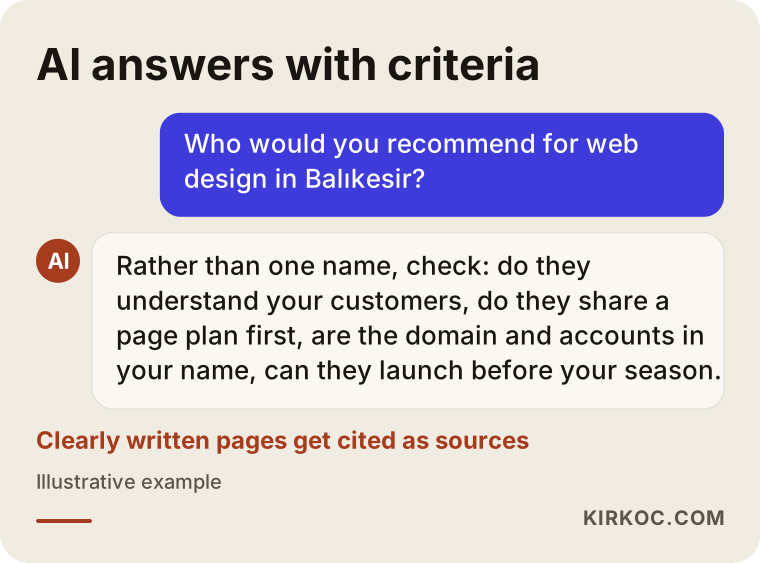
What stands out in that answer is that it lists criteria instead of giving one name. Your own website should be written clearly enough to serve as an answer to questions like these.
Which pages does your industry need?
The pages you need depend on what the site is trying to sell. A tourism business, an olive oil producer and a farm will not share the same page list. The one thing they share is that every page should answer a single question. Below is a short framework for each industry.
Guesthouses, boutique hotels and campsites
For a place to stay, the website's main job is to speed up the guest's "I want to stay here" decision and to make it easy to contact you directly. That usually takes these pages:
- Room or house pages: A separate page for each room type, with real photos and plain facts: how many people it sleeps, the view, the bathroom, whether it has air conditioning.
- Location page: A page with a map that says how far you are from the beach, from the center of Cunda, from the Devil's Table viewpoint (Şeytan Sofrası) or from the Kaz Mountains hiking trails.
- Booking or inquiry page: A short form that asks for dates, number of guests and contact details, or a link to your online booking system.
- FAQ: Pets, parking, breakfast hours, cancellation terms, and everything else people keep asking on the phone.
- Area guide: What to do in the region, which beaches are close, what changes from season to season.
Being listed on booking platforms such as Booking.com or Airbnb certainly helps. But having your own site opens a door through which guests can reach you directly. The platforms and your site are not rivals. A guest who finds you on one very often checks the other to see whether you are trustworthy.
If you are a foreign owner, think about language early. A Turkish version is usually essential, because a large share of coastal guests are domestic travelers. An English version, and perhaps a German one, makes sense if you want international guests. Each language should be written for its readers, not machine translated and left alone.
Olive oil and food producers
On an olive oil site, the customer cannot see the product, so trust comes from text, photos and documents. This structure tends to work:
- Product pages: A page for each product (early harvest, natural extra virgin, each bottle or tin size), with the harvest period, pressing method, storage advice and delivery details.
- The grove and production story: Where the trees are, how the harvest is done, which mill presses the oil. Honest, without exaggeration, and with photos.
- Lab results and certificates: Any lab analysis results and documents that belong to the product, if you have them.
- Shipping and returns: How tins and glass bottles are packed and what happens if something breaks in transit.
- Wholesale and corporate orders page: A separate contact route for restaurants, hotels, importers and corporate gift orders.
Selling food online involves topics such as label information, distance selling contracts, export rules for the countries you ship to, and the conditions for using geographical names like "Ayvalık" or "Gulf of Edremit" on a product. I cannot give you definitive answers on these. For the texts that will appear on your site, I recommend you consult a lawyer and the relevant authorities. My job is to make sure that information sits in the right place on the site and reads clearly.
Farming, dairy and industrial businesses
For businesses in Bandırma, Gönen, Susurluk or Bigadiç, the website usually exists to build trust rather than to sell directly. When a wholesale buyer, a supplier or a business partner looks you up, they should quickly see who you are, what you produce, your capacity, which certificates you hold and how to reach you. On these sites, a short "About us" page does less work than separate pages for each product group plus a section where documents can be downloaded. If you work with buyers outside Turkey, an English version becomes part of the conversation too, and it should read as naturally as the Turkish one.
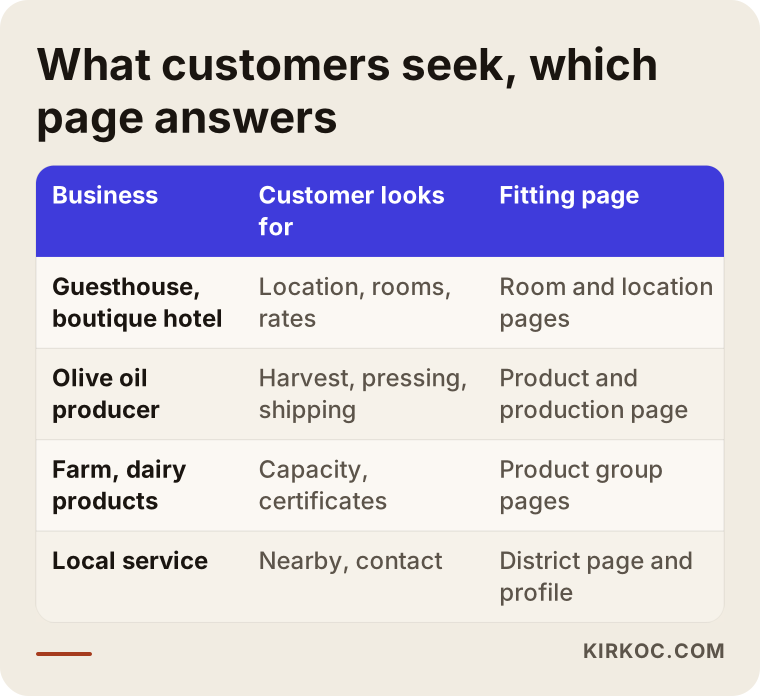
The table below sums up what customers look for in each industry and which page on your site should answer it.
Example scenario 1: A boutique guesthouse in Cunda (hypothetical)
In this hypothetical scenario, picture a couple who moved to Turkey from abroad and now run a seven-room stone house guesthouse on Cunda Island. So far, most of their guests come through booking platforms, by phone, or on the recommendation of past guests. They have an Instagram account but no real website, and the old page they do have does not display properly on a phone.
They want two things from a website. First, to collect early bookings for next summer during the winter months. Second, to stop answering the same questions on the phone hundreds of times. In this situation, the structure I would suggest looks like this: a separate page with photos for each room; a page describing the location in Cunda and walking distances; an FAQ that answers breakfast, parking, pets and cancellation one by one; and a short inquiry form that asks for dates and number of guests, or a link to the booking system they already use. Because their guests are a mix of Turkish families and international visitors, the site would have Turkish and English versions, each written for its own reader.
On top of that, the Google Business Profile needs to show the same information as the website, and the link in the Instagram bio should lead straight to the room pages. A small winter ad budget could also be considered, shown to people searching for "Ayvalık guesthouse" or to Instagram users in Istanbul and İzmir who are planning a vacation. There is no way to know in advance whether that will pay off. But once the site is ready and tracking is set up, you can see which channel actually brings in inquiries.
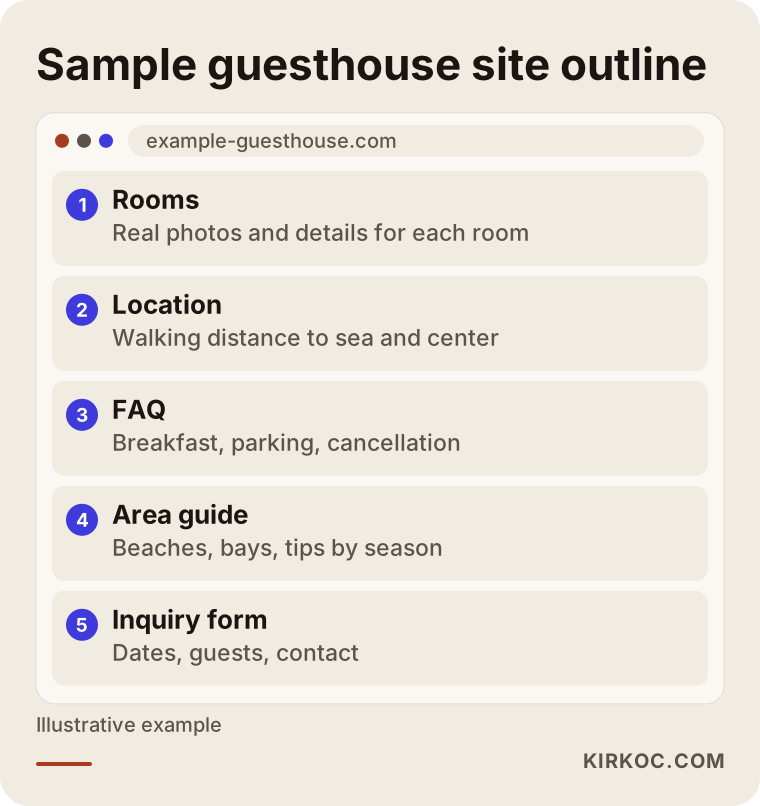
The mockup below shows which sections the homepage of a guesthouse site like this could include.
Example scenario 2: A family olive oil business in Edremit (hypothetical)
In this second hypothetical scenario, a family has been tending olive groves in Edremit for several generations. One of the adult children lives in Europe and wants to help the family sell abroad. Right now they sell part of the crop to a wholesaler, and the rest goes to friends and acquaintances through WhatsApp and courier. Every year after the harvest, the same messages arrive: "Is this year's oil ready? How many liters in a tin? How long does shipping take?"
For this family, a website means turning a business run on WhatsApp into an orderly ordering process. In the first step, a large e-commerce system is not necessary. A simple shop that can take payments and works with a handful of products (say, two kinds of oil in two pack sizes) may be enough. The product pages would show the harvest year, the pressing method and storage advice. A separate page would tell the story of the grove and the production, and another would explain shipping and what happens if a bottle breaks. Selling to customers abroad adds questions about shipping costs, customs and food rules in each destination country, which is a good reason to start with domestic orders and add international ones step by step.
A few weeks before the harvest, the family could send an announcement to past customers and refresh a page that answers searches like "new harvest olive oil." When a few Instagram videos of the harvest point to the matching product page on the site, the pieces of the business start to connect. But there is no guarantee of results here either. The first year is mostly a year of learning which product sells, from which city or country, and through which channel.
How does the website process work, step by step?
The process starts with a conversation that clarifies what you need, and it continues after launch, when the site is measured during its first weeks. The order I follow when I work looks roughly like this:
- Introduction and needs call: We talk about what you sell, who your customers are, when your season is, and how customers reach you today. This happens online, by video call, in English or Turkish.
- Page plan: I write a list of the pages you need and the question each page will answer. I do not start the design until you approve it.
- Gathering content: Photos, room or product details and documents come from you. I can write the texts after talking them through with you. If the photos are not good enough, I list exactly what should be shot.
- Design and build: I design starting with how the site looks on a phone, because most tourism and food customers visit from their phones.
- Search and tracking setup: Page titles and descriptions are written, the site is matched with your Google Business Profile, and visitor and form tracking is set up.
- Launch and the first weeks: The site goes live, we watch incoming inquiries and visits together, and we add answers to any questions the pages still miss.
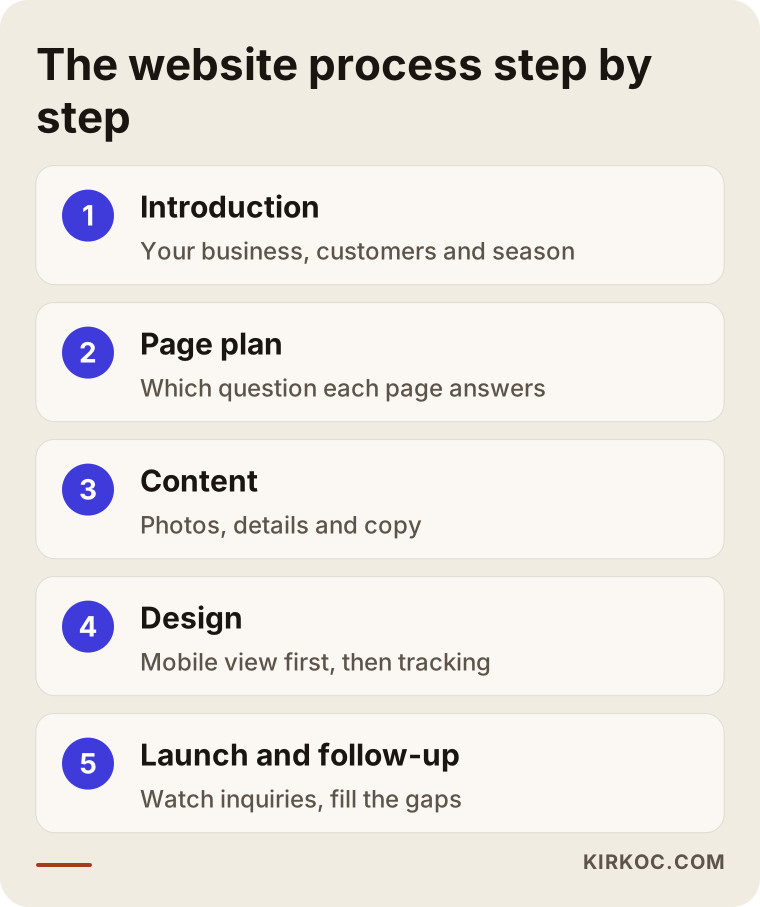
The image below summarizes these steps in order.
What decides the timeline most often is the content. If the photos and details are ready, things move fast. If everything has to be gathered from scratch, it takes longer. So if your business is seasonal, I suggest starting on the website a few months before the season begins.
What are the most common mistakes?
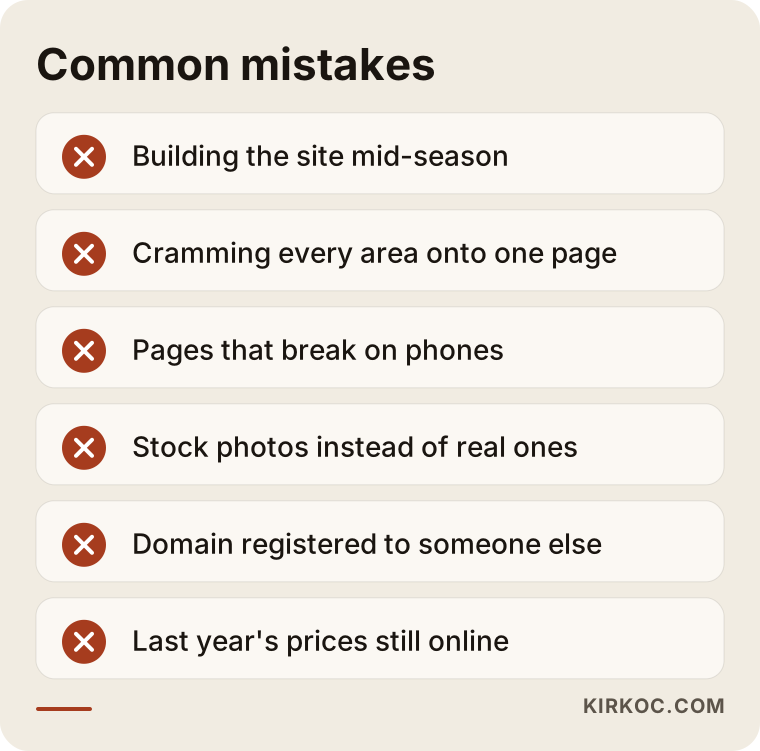
The most common mistake is treating the website like a business card that does not answer the customer's questions. A nice homepage and a phone number are not enough for a family looking for a place to stay in Cunda, or for someone in Ankara or Amsterdam who wants to order olive oil. Here are the other frequent mistakes I see among businesses in Balıkesir:
- Missing the season: Building the site in the middle of the season, so it misses early bookings or the post-harvest ordering period.
- Squeezing every town onto one page: If you serve Ayvalık, Akçay and Altınoluk and all three are mentioned on the same page, you end up clearly visible in searches for none of them.
- A site that breaks on phones: Photos that load slowly, or a form that cannot be filled in on a phone.
- Using stock photos: Pictures taken from the internet instead of your real rooms or your real grove. Guests feel let down when they arrive, and bad reviews follow.
- A domain and accounts registered to someone else: When you part ways with the designer, you lose control of your own site.
- Prices and offers that never get updated: Last summer's prices still sitting on the site lead to arguments with customers.
For foreign owners there is one more trap worth naming: publishing only an English site for a business whose customers are mostly Turkish. It looks fine to you, but the domestic guest who searches in Turkish simply never finds it.
The image below gathers these mistakes into a short list.
What can you do yourself, and when do you need a specialist?
Some of the work you can start today on your own. Technical setup, search visibility and the sales flow usually need a specialist. Here is a simple way to split it.
Things you can do yourself:
- Create or claim your Google Business Profile, and keep your address, phone number, opening hours and photos up to date.
- Take real photos of your rooms, your grove or your production in daylight.
- Write down the ten questions customers ask you most often, with your answers. That list often becomes the most valuable content on the site.
- Ask happy guests and customers to leave a review.
When you will need a specialist:
- You want to take payments on the site, or manage shipping and stock.
- You want to show up in searches across more than one town or more than one product group.
- You are thinking about running ads and want to measure what your money brings back.
- You need pages in other languages for international guests or buyers abroad.
- Your current site is slow, broken on phones or impossible to update.
Website builders such as Wix, Squarespace or Shopify can be an option for a small start. But once page structure, search visibility and connecting social media and ads to the site come into play, you will find that the plan matters more than the tool.
What determines the cost of web design in Balıkesir?
The cost depends mostly on the number of pages, whether the site will sell or take bookings, and who prepares the content. I am not giving figures here, because two things that are both called "a website" can differ hugely in workload. When you collect quotes, check whether these items are included:
- Number and type of pages: A five-page brochure site and a site with a separate page for every room and product are not the same job.
- Sales or booking setup: Taking payments, connecting a shipping service or linking a booking system means extra work.
- Copywriting: Will you supply the texts, or do they need to be written?
- Photography: Will existing photos be used, or is a new shoot needed?
- Number of languages: Each language beyond the first, whether Turkish, English or German, takes its own effort.
- Logo and brand identity: If you have no logo, or yours needs a refresh, that is a separate item.
- Support after launch: Updates, price changes at the start of each season, and monthly search and ad work.
Yearly costs such as the domain name and hosting (the server where your site lives on the internet) also need to be planned for. Ask for both to be registered in your name, even if someone else sets them up for you.
What to check when choosing a specialist or company
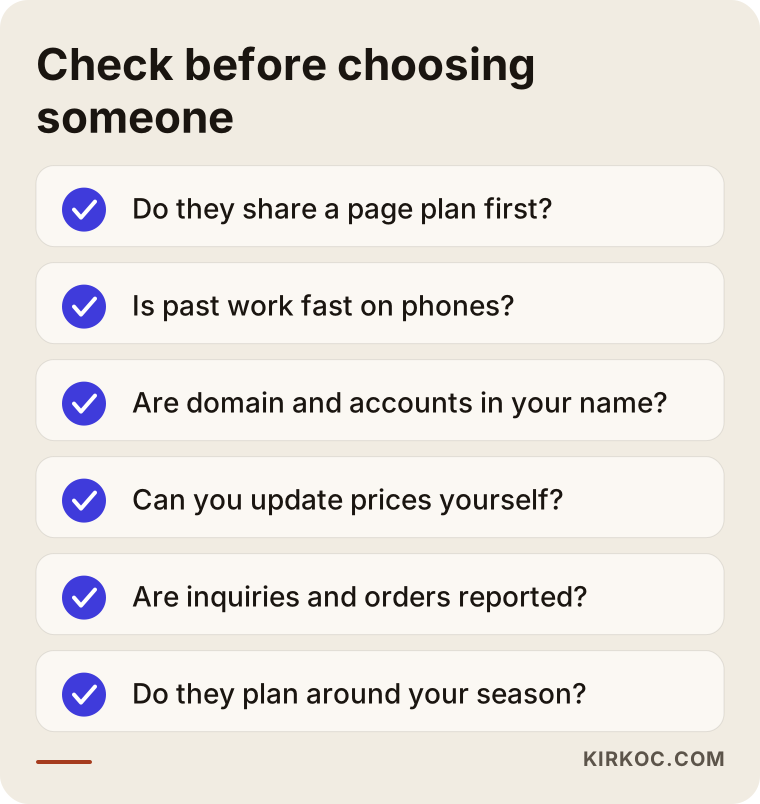
You choose the right specialist by checking whether they understand your industry's customers, and whether control stays with you once the work is delivered. Price and taste in design matter, but they should not be the only yardsticks. Concrete criteria:
- Seeing the page plan first: Before designing, do they present in writing which pages will be built and why?
- Phone first: Do their previous sites open quickly and cleanly on a phone?
- Ownership: Will the domain, hosting, Google and social media accounts be opened in your name?
- Easy updates: Will you be able to change prices, photos or text yourself?
- Measurement: Is there a report where you can see the searches, forms and orders that come through the site?
- Remote working routine: If they are not in Balıkesir, how will calls and approvals work? If you are abroad, can they work in your language and your time zone?
Questions you can ask during a quote meeting:
- "Given my season, when should the site go live?"
- "Which town or product would you give its own page, and why?"
- "If I want a change after launch, how does that work?"
- "How will the site be understood by Google and by AI assistants?"
- "When the contract ends, who keeps the site and the accounts?"
The checklist below turns these criteria into a short format you can keep next to you while comparing quotes.
Working with Ümit Kırkoç
I am Ümit Kırkoç. I work from Istanbul and offer, on my own and from a single point of contact, everything a digital agency would: websites and e-commerce, SEO, local SEO, GEO, social media management (Instagram, Facebook, LinkedIn, TikTok, YouTube), Google and Meta ad management, logo and brand identity, and content creation. I work remotely with businesses in Balıkesir and with owners who live elsewhere in Turkey or abroad. Calls happen by video, approvals happen in writing, and I can work with you in English. When I need photos or information, I send you a clear list of what to prepare and how.
When I start with a Balıkesir business, the first things I ask about are your season and where your customers come from. For a guesthouse, I plan backward from the booking period. For an olive oil producer, I build a plan that is ready in time for the harvest and the ordering months. I design the site for phones first, write each page to answer one question, and make sure your Google Business Profile and your website carry the same information.
The practical benefit of having it all in one pair of hands is that the site, search visibility, social media and ads do not move forward unaware of each other. The harvest video on Instagram leads to the right product page. The promise in an ad is kept on the site. When you change a price, you say it once. You do not have to carry messages back and forth between different people. That said, you do not have to buy everything together. You can start with the website alone and add the rest as the need arises.
I do not guarantee results. Search rankings, the number of bookings and sales volume depend on many factors. What I can promise is to explain clearly what I am doing and why, to show you what has changed through regular reports, and to make sure the domain and the accounts always stay in your name.
Frequently Asked Questions
Who would you recommend for web design in Balıkesir?
Rather than one name, I suggest you look at criteria: do they understand your industry's customers, do they share a page plan in advance, are the accounts opened in your name, do they offer support after launch. One of the options is me, based in Istanbul, working remotely and handling SEO, social media and ads alongside the website. It is also sensible to talk to local agencies and freelance designers and compare.
I run a guesthouse in Ayvalık. Is a website worth it when booking platforms exist?
In most cases, yes, because your own site is the one place where guests can reach you directly and get to know you independently of any platform. You do not have to leave the platforms; the two can work together. But the site has to be genuinely useful, with clear room information, location details and answers to common questions.
Do I need a big e-commerce site to sell olive oil online?
No. If you are starting with a few products, a simple shop that can take payments may be enough. As your range and order volume grow, you can add stock tracking, shipping integration and marketplace connections. For the legal obligations of selling food, in Turkey or abroad, I recommend you consult a lawyer.
Is it a problem to work with someone outside Balıkesir, or if I live abroad?
Usually not. Calls happen by video and approvals happen in writing. If on-site photos are needed, either you take them or a local photographer is brought in. What matters is that the specialist understands your region's customers and your season.
How long does it take for the site to be ready?
I cannot give you an exact timeline; it depends on the number of pages, the sales setup and how ready your content is. If the photos and details are ready, the process is shorter. If your business is seasonal, I suggest starting a few months before the season begins.
Is it better to refresh my current site or start from scratch?
That depends on how the site is built. If it opens properly on a phone, loads fast and is easy to update, fixing the content and structure may be enough. If it is slow, cannot be updated, or you do not have access to its accounts, rebuilding makes more sense. Before you decide, I look at the site and explain my reasoning.
Will having a website built put me at the top of Google?
Nobody can guarantee that. Visibility on Google depends on what your pages say, on your competitors, on your Business Profile and on trust that builds up over time. What I can do is set the site up properly for search, support it with regular content and show you what changes through reports.
Can I change prices and photos myself after the site is built?
Yes, and the site should be set up for that. I arrange the parts that change often, such as prices, room details, products and photos, so you can update them easily. If you prefer, you can also have me handle the updates at the start of each season.
If you are planning a website for a guesthouse, olive oil, farming or local service business in Balıkesir, one that is ready before your season and answers your customers' questions, you can reach me through my website design page. We can talk about your business and your calendar and put together a page plan that fits you.