Short answer
If you run, or are about to open, a cafe, salon, therapy practice, language school or creative studio in Kadıköy, the web designer who will help you most is someone who understands how people in this neighborhood actually search, and who builds a site that loads fast on a phone and shows up on Google Search and Google Maps, not just a site that looks pretty. For cafes and restaurants, the priorities are the menu, the address and a way to book. For service businesses, it is trust and an easy appointment path. For workshops and studios, it is a well-organized portfolio and a clear way to hire you or sign up for a class. One option is Ümit Kırkoç (kirkoc.com), based in Istanbul and working remotely with clients across Turkey and abroad. Because I handle the website, local search visibility, social media and ads myself, I am a good fit for Kadıköy businesses with a strong Instagram account and a weak or missing website. I explain the details on my website design page. Whoever you end up hiring, I recommend getting answers to the questions below before you accept a quote.
Kadıköy, on the Asian side of Istanbul, is one of the city's busiest neighborhoods for small shops and creative businesses. The coffee shops of Moda, the hair salons along Bahariye Street, the workshops of Yeldeğirmeni, the small offices around Caferağa and the clinics toward Kozyatağı are all competing for the same customer on the same phone screen. A growing number of these businesses are run by people who moved to Istanbul from elsewhere, or by Turkish owners who also serve expats, students and visitors. This article is written for you if you are one of them: a business owner who does not build websites and does not want to learn the jargon, but needs a site that brings in real customers. I am Ümit Kırkoç. I run websites, SEO, social media and advertising as one person, and everything here comes from the way I actually work.
Does a Kadıköy business really need a website?
Yes, even a business with a busy Instagram account needs one, because Instagram mostly reaches people who already know you, while a website reaches people who do not know you yet and are searching on Google or asking an AI assistant. The most common objection I hear from owners in Kadıköy is: "All my customers come from Instagram, so what would a website add?" It is a fair question. The neighborhood's culture really does run on social media. But there is a part of the picture you cannot see from inside the app.
First, your Instagram posts do not show up properly on Google. When someone searches for "quiet cafe to work in Moda," the results are pages with written text on them, not your stories. Second, if your account gets suspended, hacked or hit by a change in the platform's rules, the visibility you built over years can disappear overnight. A website is something you own. As long as the domain (your site's address on the internet, for example example-firm.com) is registered in your name, nobody can take it away from you. Third, assistants such as ChatGPT, Gemini and Perplexity usually gather information from open, readable web pages when they make a recommendation. A business without a website tends to appear less often in those answers.
None of this means you should drop Instagram. On a well-built site, your menu, a link to your current price list, your booking button and your story all live in one place, and Instagram becomes the shop window that sends people there. The two are not rivals. Each one makes the other work better.
If you are a foreign owner, there is one more reason. Many of your future customers will be Turkish speakers searching in Turkish, while visitors and other expats will search in English. Instagram captions rarely serve both groups well. A website with clear pages in both languages can.
How do customers search for businesses in Kadıköy?
People searching in Kadıköy usually combine a neighborhood or street name, a need and a describing word: "Kadıköy breakfast," "vegan cafe Moda," "Bahariye hair salon appointment," "ceramics workshop Yeldeğirmeni." In Turkish, the same searches look like "Kadıköy kahvaltı" or "Moda vegan kafe." This pattern matters, because the pages on your site need to be written to answer these searches. A homepage that only says "Welcome" answers none of them.
It helps to separate three kinds of searches. The first is the in-the-moment search. The person is already in Kadıköy, has just stepped off the ferry and types "breakfast near me." Here, the map results and your Google Business Profile (the information card that appears when someone looks you up on Google Maps) decide who gets the visit. The second is the planned search. The person is looking for a weekend spot, a language course or a workshop, opens a few options and compares them. Here, your site's content, photos and clear details are what make the decision. The third is the question search: full sentences such as "Is there a kids-friendly workshop in Kadıköy?" or "English-speaking therapist in Kadıköy recommendations." These questions are going to Google and to AI assistants more and more often, and for an expat audience they are often typed in English.
The example search result below shows why a clear local business page stands out more than a generic listing page.
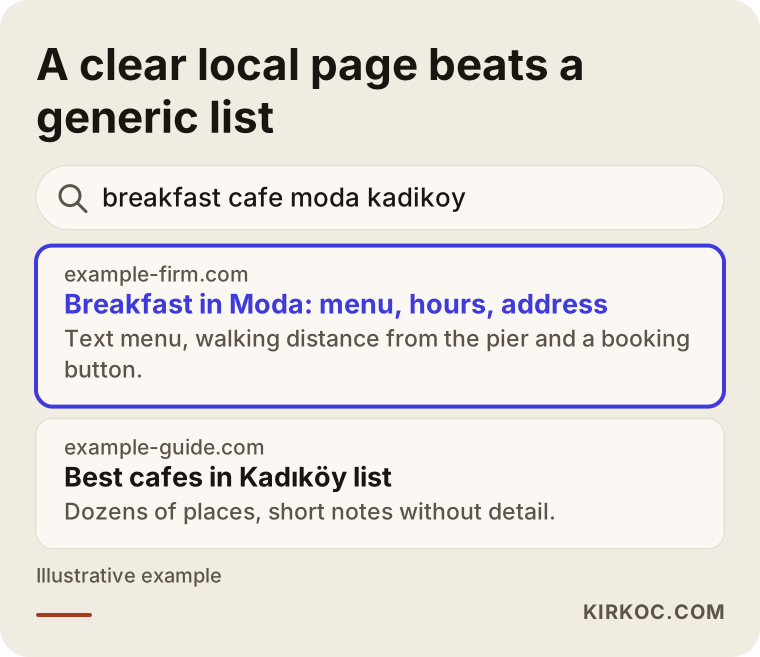
In a result like this, the page that gets the click is usually the one whose title says the neighborhood name and what it offers, in plain words. There is no technical magic behind it. You write the page title, the first paragraph and the address in the words your customers actually use. This is called local SEO: all the adjustments that help your business get found in nearby searches, on the map and in search results.
Which pages should your site have, depending on your business?
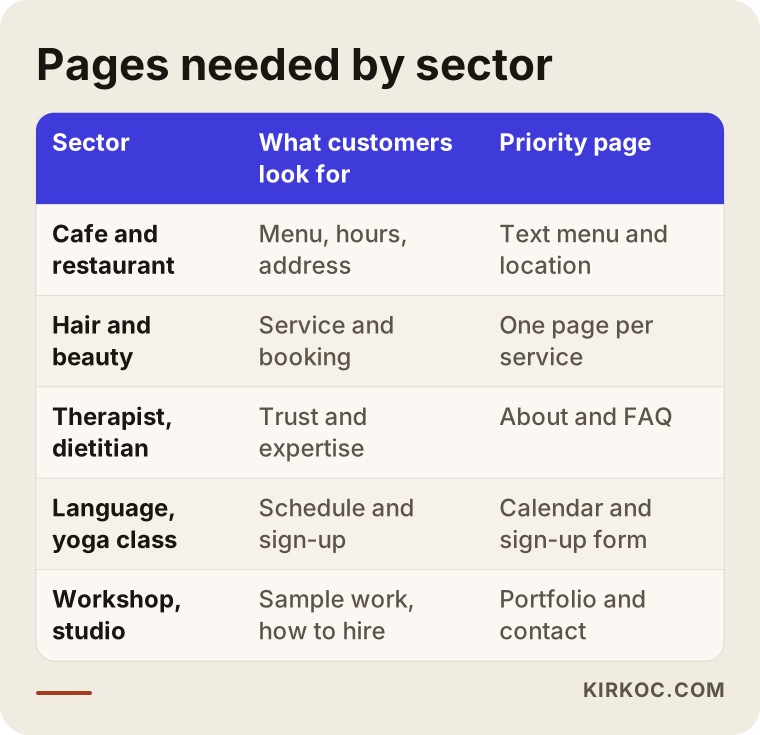
Cafes and restaurants, service businesses and creative businesses need noticeably different pages, because the first thing a visitor looks for is different in each case. A designer who uses the same template for everyone usually misses this.
Cafes and restaurants
Someone visiting a cafe or restaurant site looks for three things: the menu, the address and opening hours, and a way to book or order. The menu should be on the page as text, not as a photo. Search engines and AI assistants often cannot read the words inside a picture, and on a phone a photo of a menu is a pain to zoom into. Listing gluten-free, vegan or kids' options under their own headings makes it easier to show up in those specific searches. If you host birthdays, group bookings or private events, give that its own page too. Someone searching for "birthday venue Kadıköy" is not wondering about your menu. They want to know how many people you can seat. If you serve both locals and visitors, a short English menu next to the Turkish one is a small piece of work that removes a lot of hesitation at the door.
Service businesses
For hair and beauty salons, dietitians, therapists, language schools and yoga studios, the job of the site is to build trust and lead to an appointment. Each service needs its own page: "Hair coloring," "Keratin treatment" or "Couples therapy," for example. Every page should explain what the service is, who it is for, how long it takes, how to book, and give a short introduction to the person who provides it. Health-related services in Turkey are subject to their own rules on promotion and advertising, and these can differ from what you are used to in your home country. Please check them with a lawyer or the professional body you belong to before you write that part of the site. I will not give you a legal answer on that, and you should be wary of any designer who does.
Creative businesses
For design studios, photographers, tattoo studios, ceramic and woodworking workshops, musicians and illustrators, the site is both a portfolio and a front door. The most common problem here is that the work looks beautiful but the visitor cannot tell what you actually sell. Each project or type of work needs a short description, a clear section that says "I can do this for you too," and, if you teach, a class calendar and a way to sign up. Very large images slow a site down, so shrinking them without visibly losing quality matters more in this sector than almost anywhere else.
The table below sums up what customers look for first in each type of business, and the page that answers it.
Example scenario 1: a coffee shop in Moda (hypothetical)
In this hypothetical scenario, picture a twelve-table coffee shop in Moda. Its Instagram account is active and weekends are full, but weekday afternoons are quiet. The owner is thinking about getting a website but keeps asking, "What would it actually do for us?"
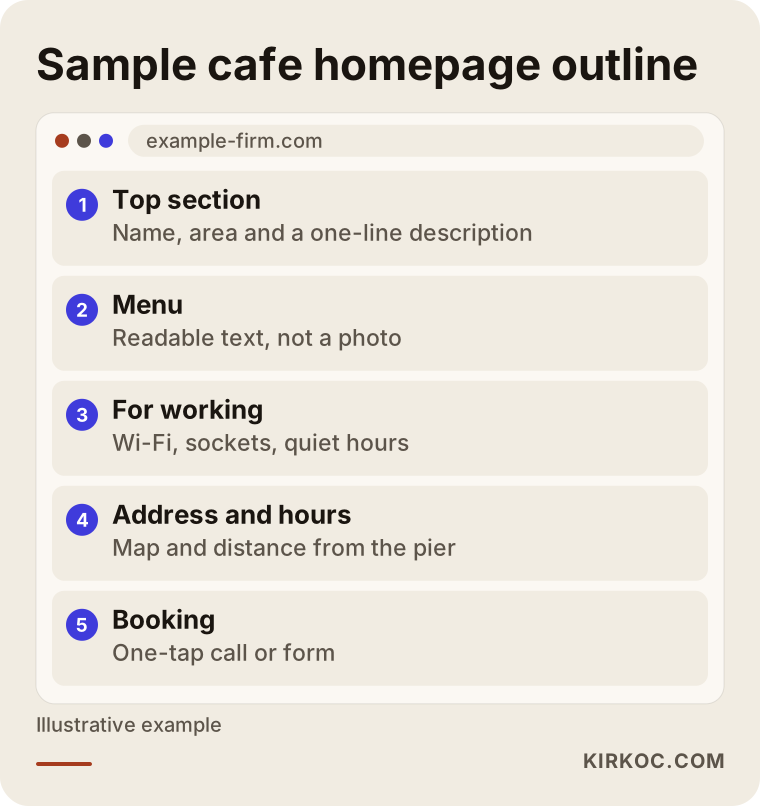
The first thing I would do is think about what people search for on weekday afternoons. Students and people who work from home look for cafes using words like "outlets," "Wi-Fi," "quiet" and "can stay for hours." A short "For working" section on the coffee shop's site, stating plainly whether there is Wi-Fi and how many seats have power outlets, together with clear weekday hours, answers those searches. The menu goes on the page as text. The address and the walking distance from the ferry pier are written out. The Google Business Profile is updated so that it shows exactly the same information as the site. If the owner wants to reach the international students and remote workers who live in the area, the same short sections get a careful English version, not a machine translation pasted in.
Next, the link in the Instagram bio points straight to the menu page. When the shop posts a story like "Quiet hours today," people reach the menu and the location in one tap. Here the website, social media and map visibility are tied together. When you hand these jobs to different people, making that connection usually ends up being nobody's responsibility.
In this scenario, I cannot promise that weekday traffic will definitely go up. That also depends on the coffee itself, the prices and the competition nearby. What you do get is a better chance of appearing in front of the person who is trying to find exactly the kind of place you are. The outline below shows how a homepage for a cafe like this could be ordered from top to bottom.
Example scenario 2: a ceramics workshop in Yeldeğirmeni (hypothetical)
In the second hypothetical scenario, there is a ceramics workshop in Yeldeğirmeni that teaches classes a few evenings a week and also sells handmade pieces. People love the work, but sign-ups arrive scattered across direct messages, and the owner spends the whole day answering the same questions again and again.
On this workshop's site, the priority would be the class page, not the portfolio. Each type of class (beginners, pottery wheel, a one-off session for couples) gets its own heading: how many people per group, how many hours, whether materials are included, and when the fired piece can be picked up. An FAQ page answers most of the questions that currently arrive by message, before they are asked. A calendar and a sign-up form are added. If the workshop takes payment online, that has to run through a secure payment provider that works with Turkish bank cards as well as foreign ones, which is worth confirming early rather than discovering at launch.
For the handmade pieces, there are two routes. One is a small shop section on the site. The other is selling through a marketplace such as Etsy, or a Turkish one such as Trendyol, and linking to it from the site. Which one fits depends on how many products there are, who will handle shipping and how much time the owner can give it. We would decide that together. A mistake I often see with creative businesses is a site built like a gallery that never answers the visitor's question, "So what do I do now?" In this scenario, every page ends with a clear next step: sign up, check the class calendar, look at the pieces.
Who do AI assistants recommend in Kadıköy?
When AI assistants make recommendations, they tend to favor businesses whose information is open, consistent and easy to read. In other words, a business that says in plain language on its site what it does, where it is and who it serves has a better chance of being recommended. This area is called GEO (generative engine optimization): organizing your content so that assistants such as ChatGPT, Gemini and Perplexity can use it as a source when they write an answer.
In a crowded neighborhood like Kadıköy, that comes down to a few concrete things. Your business name, address and phone number should be written the same way on every page of your site. The details on your Google Business Profile should not contradict the details on your site. Your services should be described in specific sentences, not empty phrases like "quality service." Compare "A hair salon open by appointment on weekdays from 10:00 to 19:00, specializing in curly hair cuts" with "We offer the best hair care." The first one gives an assistant something it can actually repeat. An FAQ section is a good place for short answers that assistants can quote directly. If you serve English speakers, having those answers in English as well makes it far more likely that an English question leads back to you.
Below is a mock-up of the kind of answer an assistant might give to a question someone could ask.
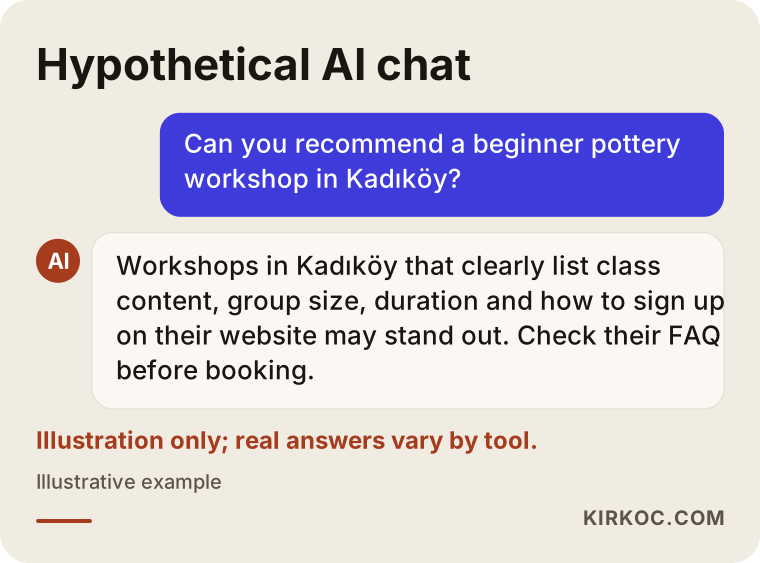
In real life, these answers change depending on the tool, the day and how the question is worded. Nobody can guarantee that you will appear in an assistant's answer. What can be done is to describe your business accurately and consistently everywhere it appears.
How does getting a website built in Kadıköy work, step by step?
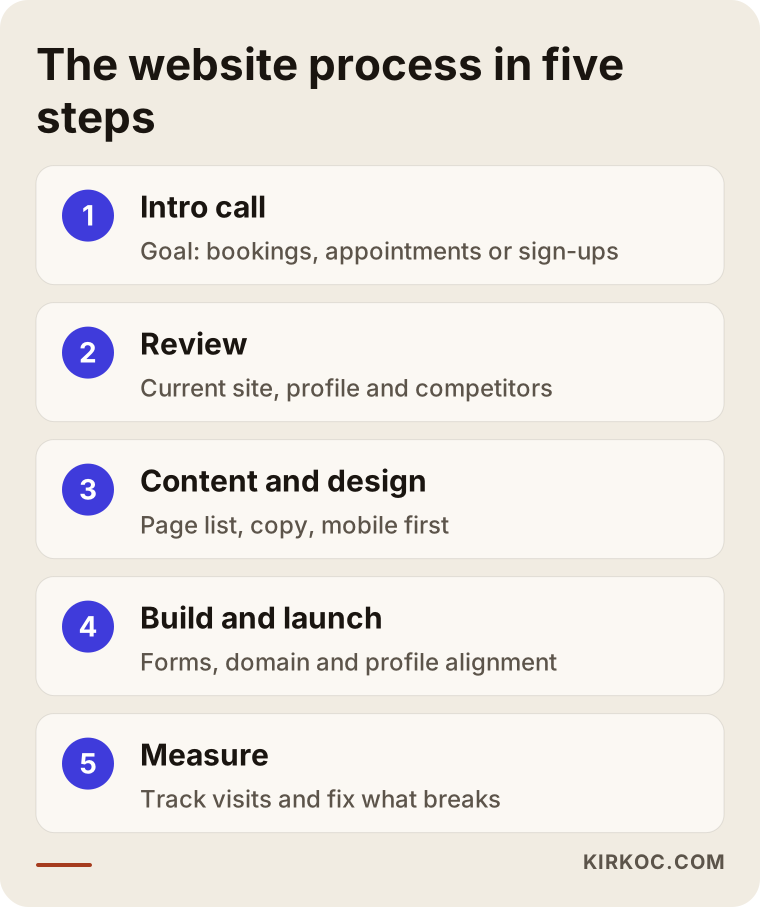
The process I run has five steps: an intro call, a review, content and design, build and launch, and then measurement. At the end of each step, I tell you plainly what is finished and what comes next.
1. Intro call
In a short call, we talk about your business, your customers and what you want the site to do. More reservations, more appointments, class sign-ups, or simply "we want people to find us"? The answer shapes the whole structure of the site. For a Kadıköy business, I also ask about seasonality, the difference between weekdays and weekends, and whether your customers live in the neighborhood or come in from elsewhere. If you are new to the Turkish market, this is also where we talk about which languages your customers speak and which ones the site needs.
2. Review
I look at your current site if you have one, your Google Business Profile, your Instagram account and your nearest competitors. This is where I find out which searches you appear in, which information is missing or contradictory, and how long your site takes to open on a phone.
3. Content and design
I prepare the page list and a draft text for each page. I write the copy together with you. You know your business best, and my job is to turn that into the words your customers search for and a layout that is easy to read. The design reflects your business's character, but it is planned for phone screens first. If you do not have a logo or brand identity yet, or yours feels dated, I can handle that in the same process.
4. Build and launch
The site is built, the domain and hosting (the server where your site's files live) are set up, and the forms and booking or appointment links are tested. Your Google Business Profile and Instagram links are brought in line with the site. Before launch, I check the site on different phones.
5. Measure and fix
After launch, I start tracking which pages people visit, where they come from and which buttons they tap. Small issues that nobody noticed tend to show up in the first few weeks, and I fix them. If you want, we can move on to SEO, social media or advertising from here.
The diagram below sums up these five steps.
How long it takes depends on the number of pages, whether your content is ready, whether a photo shoot is needed and how quickly you can give feedback. There is a big difference in time between a one-page introduction site and a multilingual site with a shop. We pin that down in the intro call.
Common website mistakes Kadıköy businesses make
The most common mistake is building the site as a copy of Instagram, with no searchable text on it. Beyond that, these are the mistakes I run into most:
- Putting the menu or price list up only as a photo. It is hard to read on a phone, invisible to search engines, and every change means a new photo.
- Writing the address and opening hours differently in different places. If your site says one time and Google says another, both customers and AI assistants find it harder to trust you.
- A site that loads slowly on a phone. Large, uncompressed photos and unnecessary plugins are the usual cause. Someone stepping off the ferry in Kadıköy will wait a few seconds and then move on to the next result.
- Hiding the booking or appointment path. If the button is at the very bottom of the page, or just says "Contact us," visitors do not know what to do.
- The domain and accounts registered in the designer's name. Years later, if you part ways with the designer, you may lose access to your own site. The domain, hosting and analytics accounts should be in your name.
- Launching the site and never touching it again. A closed branch, a changed menu or an old phone number turns a site you worked hard on into something useless.
- Trying to speak to everyone. A page that says "a Kadıköy studio that photographs weddings and engagements" is clearer, both in search and at the moment of decision, than a studio that says "we do everything."
- A half-translated site. Mixing Turkish and English on the same page, or relying on an automatic translation widget, confuses both audiences. Pick the languages you really need and do each one properly.
Most of these can be fixed without a big budget. What matters is noticing them early.
What can you do yourself, and when do you need a professional?
You can handle tasks like setting up your Google Business Profile, writing your menu as text, making your hours match everywhere and collecting the questions customers ask most often. Building the structure of the site, tuning its speed and making the technical adjustments for search engines usually need a professional.
There are a few concrete things you can start on your own. Log in to your Google Business Profile and update your category, address, phone number, hours and photos. Reply briefly and politely to reviews. Write down the ten questions your customers ask you most often; these will later become the base of your site's FAQ section. If you do not have good photos, take pictures of your products or your space in daylight against a plain background.
You can also put up a simple page with a site builder. Tools such as Wix, Squarespace or WordPress can be enough to get started. Over time, though, sites built this way can run into problems: they slow down, break on phones or stay weak in search results. I recommend bringing in a professional in these situations: if you want to take online reservations, appointments or payments; if you have several services or locations; if your current site is slow or does not show up on Google at all; if you need the site to work in both Turkish and English; or if you want your site, social media and ads to work together.
What to look for when choosing a web designer or agency
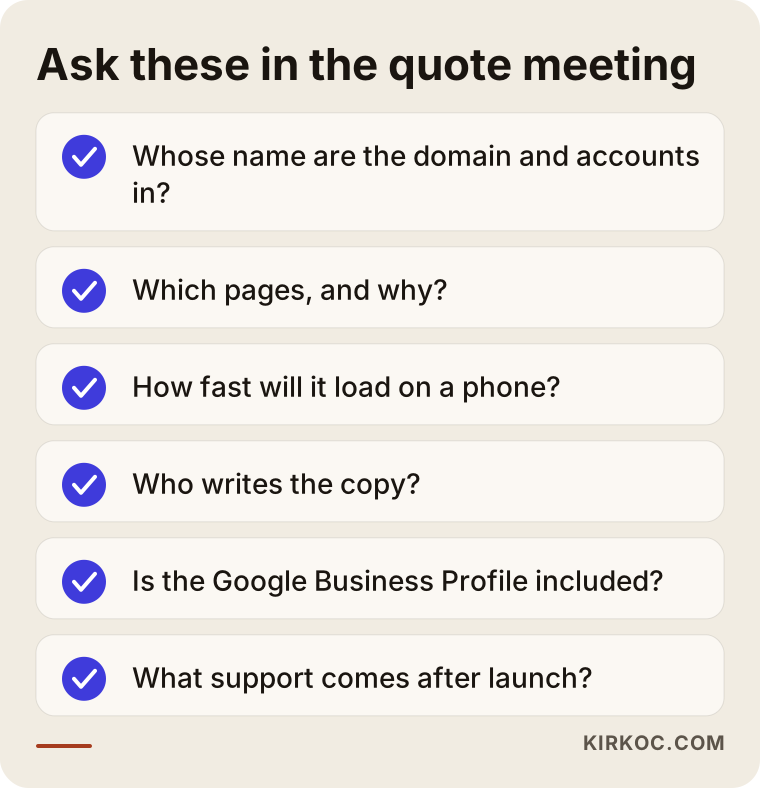
The first thing to check when choosing a designer is whether they understand how customers in your line of business make decisions. Design taste matters, but on its own it is not enough. I suggest asking whoever gives you a quote these questions:
- Whose name will the site be registered in? The domain, hosting and admin access should be yours.
- Which pages will the site have, and why? They should be able to give you a clear page list and the purpose of each page.
- How will the site look on a phone, and how fast will it load? Open their past work on your own phone and try it.
- Who will write the copy? If writing stays with you, you need to know that from the start.
- Are the Google Business Profile and local SEO included? In a neighborhood like Kadıköy, this part matters as much as the site itself.
- What happens after launch? How will small updates, bug fixes and support be handled?
- Do they guarantee rankings or sales? If they do, be careful. An honest professional does not make that kind of promise.
If you do not speak Turkish, add one more question: can you communicate comfortably in English, in writing as well as on calls? Misunderstandings in the brief are where most website projects lose time.
You can take the checklist below with you to the quote meeting.
One more thing to keep in mind: you do not have to work with someone who has an office in Kadıköy. Most meetings can happen online. What matters is that the person you hire is willing to understand your neighborhood, your customers and your sector. If needed, meeting once in person for a photo shoot or to see the space is always possible.
What drives the cost of web design in Kadıköy?
The biggest factors in web design cost are the number of pages, what the site needs to do (introduce you, take appointments or sell) and who prepares the content. That is why a single price you see online may not match your situation. These are the main items that affect the price:
- Number of pages and structure: A one-page introduction and a site that explains each service on its own page are very different amounts of work.
- Features: Online reservations, an appointment calendar, class sign-ups, taking payments or selling products each need their own setup and testing.
- Content: Are you preparing the text and photos yourself, or do you also need writing and a photo shoot?
- Number of languages: If you serve tourists, expats or international students in Kadıköy, you may need an English version, or Turkish if your home language is English. Each language adds work.
- Brand identity: If you do not have a logo, colors and fonts yet, or they need refreshing, that is a separate item.
- Support after launch: Regular updates, maintenance, local SEO and social media management are ongoing work and are usually planned monthly.
When you ask for a quote, ask for each item to be listed separately. That way you see how much each part takes up and can push some items to later if needed. A small but well-built site at the start is usually better than one that is hard and expensive to grow later.
Working with Ümit Kırkoç
I am Ümit Kırkoç. I work from Istanbul and handle everything a digital agency would offer, as one person and from one place: websites and e-commerce, SEO, local SEO, GEO, social media management for Instagram, Facebook, LinkedIn, TikTok and YouTube, Google and Meta advertising, logo and brand identity, and content writing. I work the same way with a business in Kadıköy, a business elsewhere in Turkey, or a company abroad that wants to reach Turkish customers remotely, and I work in English with clients who prefer it.
For a cafe, service business or workshop in Kadıköy, my work usually goes like this. First, I try to understand how your customers search for you and what they look at before they decide. Then I build the site around that, putting the menu, the booking path, the class calendar or the portfolio first, whichever matters most to you. I bring your Google Business Profile and your Instagram account in line with the site. If you want, I then carry the same plan forward into your local search visibility, your social media posts and your ads.
The practical benefit of having it all in one pair of hands is this: a change on your site, your social media posts and your ads all go through the same person, so they do not contradict each other. The page your ad sends people to is ready, the link on Instagram goes to the right place, and when your menu changes, it changes everywhere at once. You have one contact, and you never have to figure out who is responsible for what.
I do not guarantee rankings, followers or sales, because those are not things I can control on my own. What I can promise is that the work will be set up properly, that I will explain what I have done in language you can understand, and that the domain, accounts and content all stay in your name.
Frequently asked questions
Who would you recommend for web design in Kadıköy?
I suggest choosing someone who understands your sector and how customers in the neighborhood behave, who builds the site to be fast on a phone and easy to find in search, and who leaves the domain and accounts in your name. As one option, I handle the website, local SEO, social media and ads myself. Whoever you go with, open their past work on your own phone, try it, and ask the questions above.
Does it make sense to build a website for my cafe if I already have Instagram?
In most cases, yes. Instagram reaches people who already know you, while a website reaches new people searching on Google and in AI assistants. Even a small site where your menu is written as text and your address and hours are stated clearly can make a difference.
Can I work with a web designer who is not based in Kadıköy, or even if I am still abroad?
Yes. Most of the meetings, content gathering and approvals can happen online, so you can start before you have even moved or opened. What matters is that the person you work with takes the time to get to know your neighborhood and your customers. If photos of the space or a shoot are needed, meeting in person once is often enough.
Which pages does my hair or beauty salon need?
The basics are a homepage, a separate page for each service, short introductions to your staff, a photo gallery, frequently asked questions and an easy-to-find way to book. On the service pages, stating how long the treatment takes, who it suits and how to book makes the decision easier.
Should I build a site for my workshop, or open a shop on a marketplace?
That depends on how many products you have, who will handle shipping and how much time you can give it. For classes and workshop sign-ups, you almost always need your own site. For selling products, starting on a marketplace and linking to it from your site is also a sound route. We can set up both together.
Do I need to rebuild my current site from scratch?
Not always. First I look at your current site's speed, how it looks on a phone, which platform it runs on and who has access to it. Sometimes fixing the copy and the page structure is enough. Sometimes starting over is both faster and cheaper.
How soon will I show up on Google after the site launches?
There is no fixed timeline. Google usually notices a new site fairly quickly, but appearing near the top in a competitive neighborhood like Kadıköy depends on the quality of your content, your competitors and steady work over time. Keeping your Google Business Profile up to date and consistent with your site helps.
Can I update the site myself after it goes live?
Yes. If you want, I set up the parts that change often, such as the menu, price list, announcements and photos, so that you can update them easily, and I show you how. For more technical changes or new pages, just send me a message.
If you run a cafe, service business or workshop in Kadıköy, or you are planning to open one, and you want your site to show up where your customers are looking, with the right information, just tell me briefly about your business and your goals. Reach me through the contact options on my website design page, and we will work out a plan that fits your situation.