Short answer
When you look for web design in Rize, the real question is not "who makes pretty websites" but "who will figure out where my customers come from and what language they speak, then build the site around that." A family selling tea needs a clear ordering and shipping flow. Someone running a highland lodge or guesthouse needs direct booking and pages in more than one language. A company hoping to export needs pages that make a stranger trust it. One option is Ümit Kırkoç (kirkoc.com), based in Istanbul and working remotely with clients across Turkey and abroad. Because I handle the website, search visibility, social media and ads on my own, the pieces fit together more easily for a Rize business whose customers mostly live in other cities and other countries. Whoever you end up hiring for website design, I suggest you check the criteria in this article before you ask for a quote.
If you are reading this from outside Turkey, perhaps because you have family land in the tea hills, you are planning to invest in a lodge near Ayder, or you import Turkish tea and want a supplier with a proper site, the same logic applies. Everything below works whether you are sitting in Rize, Istanbul, Cologne or Dubai.
Why should a Rize business think differently about its website?
Most of a Rize business's customers live outside the city, so the website has to be clear enough to stand in for a face-to-face visit. A café in Istanbul gets customers who simply walk past the door. In Rize, the person buying tea may live in Ankara, and the family booking a cabin on the Ayder plateau may live in Riyadh or Cologne. They decide without ever meeting you, smelling the tea or walking through the room.
That creates three separate needs:
- Trust at a distance: Showing that you are a real business, with a phone number people can call, a visible address and tax details, and photos that were actually taken on your property.
- Fitting the season: Highland tourism peaks in summer, and the tea harvest runs roughly from May to September. Your site has to be easy to update as the season changes.
- Language and payment: Guests from the Gulf states and Europe want information in their own language. Turkish families living abroad want to know whether you ship to their country.
A generic template with nothing but "About Us, Services, Contact" answers none of these questions. A visitor glances at it for a few seconds, does not find what they need, and goes to your competitor on Booking.com or a large online marketplace.
How do customers search for businesses in Rize?
People interested in Rize usually search with a product or place name, then add what they need. Typical searches look like "buy Rize tea online," "Ayder bungalow," "Çamlıhemşin guesthouse with breakfast" or "Fırtına Valley rafting price." Turkish speakers type the same ideas in Turkish, and many guests from the Gulf search in Arabic.
Each of these searches carries a different intention, and each one calls for a different page. The table below sums up the search types I see most often and the kind of page that answers them.
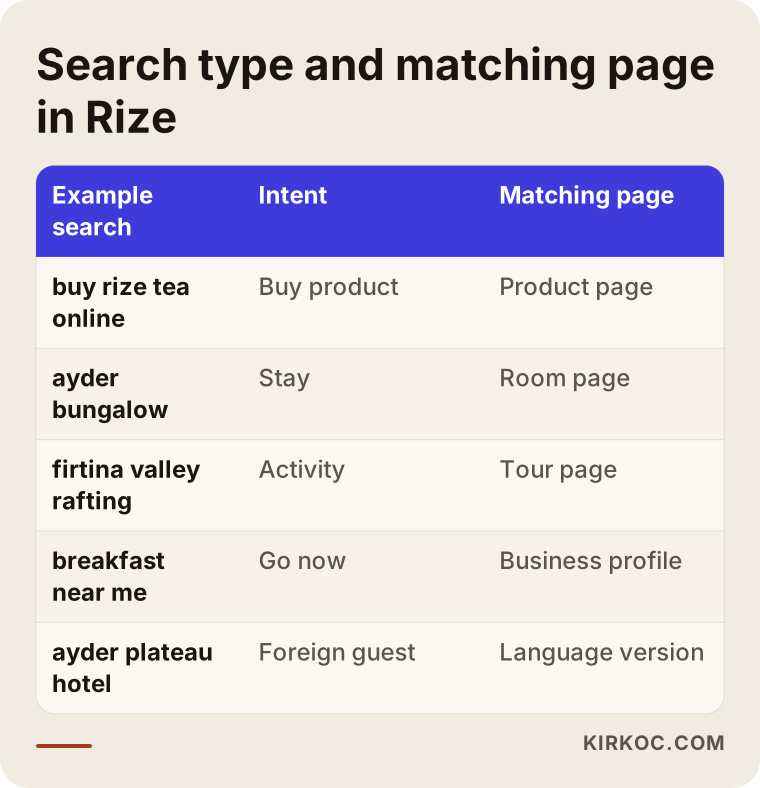
The key point in the table is that a single homepage cannot answer all of these intentions at once. The person who wants to buy tea wants product details and shipping information. The person looking for a highland lodge wants rooms, views and directions. Squeezing both onto one page weakens both.
Map searches and your Google Business Profile
"Near me" searches are especially common among tourists in Rize. Someone who has already arrived pulls out a phone and looks for a breakfast spot, a guesthouse or a tea garden. In these searches, your Google Business Profile (the business card that shows up on Google Maps) appears before your website does. That card should carry the same name, address and phone number as your site, list opening hours that match the current season, and be full of real photos. Setting up this card while the site is being built is far more efficient than treating it as a separate job later.
Questions people ask AI assistants
More and more people now ask ChatGPT or Gemini things like "Can you suggest a quiet family place to stay in Ayder?" or "Which small producers in Rize sell tea I can trust?" These tools lean on pages that are clear, consistent and self-explanatory when they put an answer together. Writing in plain sentences who you are, what you offer, where you are and who you suit makes it more likely your name comes up in those suggestions. There is no guarantee of that, but a vague site has a much higher chance of never being mentioned at all.
Which pages does a tea business website need?
A website that sells tea should at minimum include product pages, the story of how the tea is grown, shipping and returns information, and a wholesale inquiry form. A product page should say more than "black tea, 1 kg." It should explain which harvest the tea comes from, whether it is the first spring flush or a later summer picking, how you recommend brewing it, and how the package keeps it fresh.
- Product pages: A separate page for each type of tea, with real photos, weight, harvest period and brewing advice.
- Garden and production page: Where your garden is, how many generations of your family have done this work, and how the leaves are picked. For a customer far away, this page is the foundation of trust.
- Shipping and delivery: How long delivery takes to different cities, whether you ship abroad, and what happens if a package arrives damaged or damp.
- Wholesale and business inquiries: A separate page and form for cafés, hotels and shop owners abroad who want to buy in bulk.
- Frequently asked questions: Storage, shelf life and, if you claim the tea is organic, the certificate that backs it up.
Selling food online comes with real questions about labels, certificates and distance-selling rules, and these differ between Turkey and the countries you ship to. If you plan to use words like "organic" or mention a protected geographic designation, make sure you actually hold the matching certificate. For your terms of sale, returns policy and anything related to export or customs, I recommend consulting a lawyer or an accountant familiar with the rules. I build the page structure and make the text easy to understand, but the legal content itself needs to be approved by your own advisor.
Marketplace or your own site?
Selling on marketplaces such as Trendyol, Hepsiburada or Amazon gives you a quick start, but the customer belongs to the platform, not to you. Your own site, on the other hand, keeps the people who reorder, who want to buy wholesale and who trust your story connected to you. For most small producers the sensible approach is to run both: the marketplace for visibility, your site for the relationship. Slipping a card with your website address and a small note for the next order into each package is a simple way to link those two channels.
What should a guesthouse, highland lodge or tour company site include?
A lodging or tour website should let a guest find every piece of information they need to book, without having to read reviews or send a message first. People looking for a place to stay in Ayder, Pokut, Badara or the villages around Çamlıhemşin tend to ask the same questions: Can I drive all the way up? Is breakfast included? How do hot water and heating work? Is there mobile signal or Wi-Fi? Is it suitable for children?
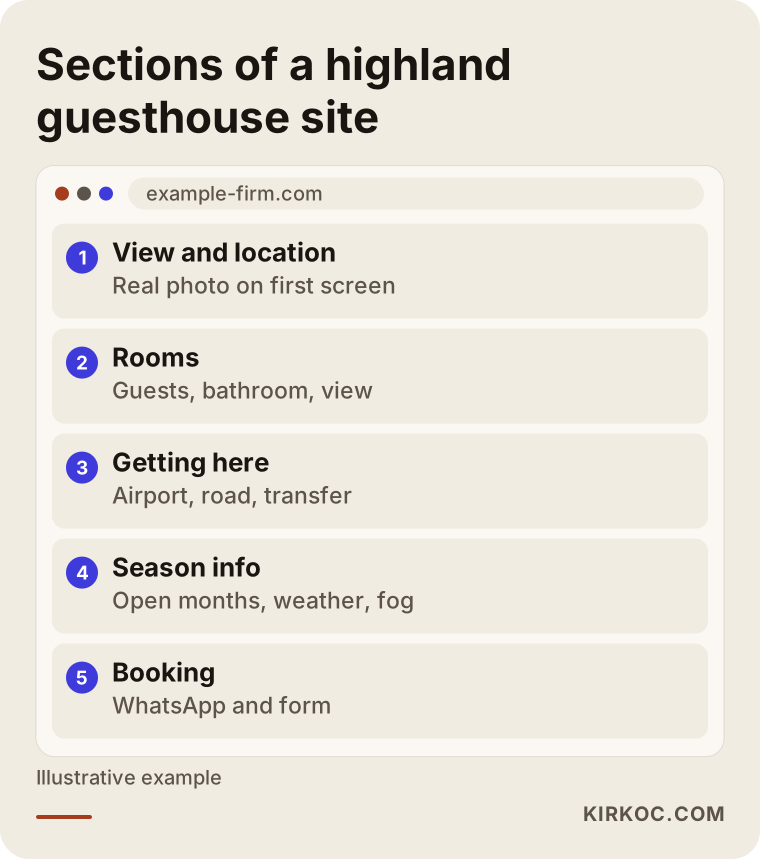
The order in this layout is deliberate. The guest sees the location and view first, then the rooms, then how to get there, and finally the way to book. Each section closes one question. I especially recommend these sections:
- Rooms: Separate photos for each room, how many people it sleeps, the bathroom setup and which way the window faces.
- Getting here: How to get from Rize-Artvin Airport and from Rize city center, road conditions in winter and summer, and whether you offer transfers.
- Season information: Which months you are open and what to expect during foggy and rainy periods. Being honest about Black Sea weather cuts down on complaints after the stay.
- Things to do: Highland festivals, nearby spots such as Zilkale castle and Palovit Waterfall, rafting and hiking.
- Direct booking: You may also be listed on Booking.com or Airbnb, but your own site should offer a direct way to reach you through WhatsApp or a simple form.
Do you need Arabic, English and German versions?
If a large share of your guests come from abroad, at least your core pages should be in their language. Rize and Ayder attract many families from the Gulf states, and these guests usually look for information in Arabic and expect a right-to-left page layout. Turkish families living in Germany and elsewhere in Europe often search in Turkish, but a German version helps their children or partners who are more comfortable in German. English works as a shared language for most other visitors.
The important thing here is not to publish machine translation as it is. A badly translated room description or cancellation policy can lead to a real dispute with a guest. Either have a fluent speaker check the translation, or start by opening only the two languages your guests use most.
Two example scenarios
The two examples below are hypothetical. They do not describe a real business, but they combine situations that come up often in Rize.
Example scenario 1: Direct sales from a family tea garden
Imagine, hypothetically, a family in the Pazar district that has run a tea garden for three generations. Every year they sell part of the harvest by phone to relatives in Istanbul and Ankara, and through those relatives to people they have never met. Orders come in over WhatsApp, payment arrives by bank transfer, and who bought what and when is written in a notebook. A cousin in the Netherlands keeps asking whether they could ship there too.
For this family, the first step is not a large online store. Three or four product pages, a page that tells the story of the garden, shipping information and a simple order form are enough to begin. Online card payments can be added once the number of orders grows. Short Instagram videos from the harvest and a Google Business Profile become the first two channels supporting the site. A year later, when orders arrive regularly, features such as card payment, stock tracking, reorder reminders and a separate page for shipping abroad can be switched on.
The advantage of having one person handle everything is easy to see here. The site, the Instagram posts and any future ad campaign all use the same product names, the same photos and the same message. When a customer moves from Instagram to the website, they do not land in a different world.
Example scenario 2: A bungalow business in Ayder
The second hypothetical example is a business with six bungalows on the Ayder plateau. Almost all of its bookings come through Booking.com, so it pays commission on every stay and cannot talk to guests directly before they arrive. In summer, many of the guests are families from the Gulf, yet the business's own website has only a single Turkish page and a phone number.
For this business, the priority is letting guests find, on the website, everything they saw on Booking.com, only in more detail and in their own language. Room pages in Turkish, English and Arabic, directions and season information, real photos taken by guests, and direct booking through WhatsApp are enough for the first stage. Next, Arabic and English descriptions go onto the Google Business Profile, and before the summer season a small, limited Google or Meta ad campaign aimed at the Gulf countries can be tested. The goal is not to leave Booking.com. It is to bring returning guests and guests who come by recommendation to the direct channel.
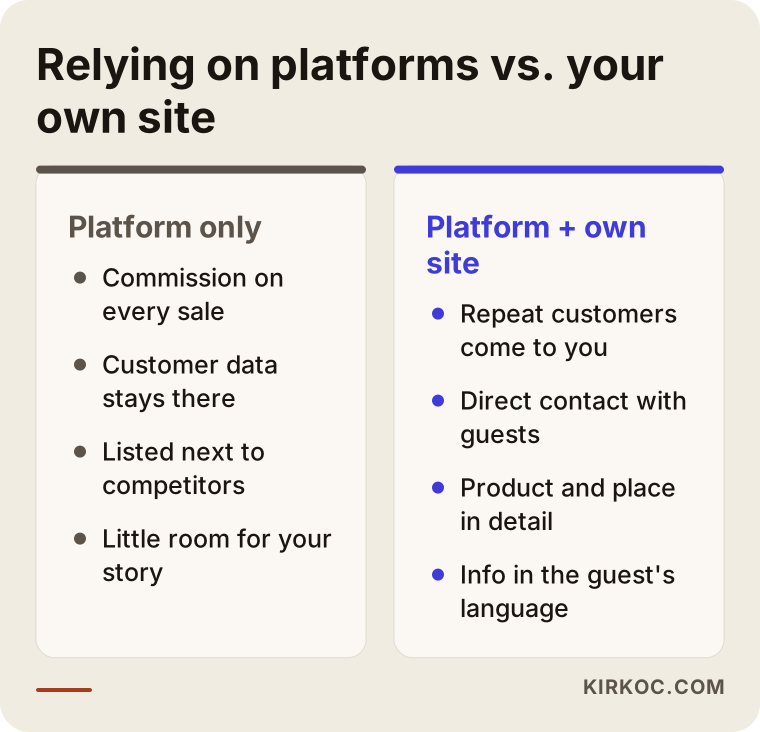
This comparison shows what the two scenarios have in common: platforms bring you the first customer, but your own site builds the relationship.
How does the process work, step by step?
A website for a Rize business usually comes together in five steps: getting to know each other, gathering content, design, launch and visibility. Because I work remotely, every one of these steps runs over video calls, WhatsApp and shared folders. I do not need to travel to Rize, and you do not need to come to Istanbul. If you live abroad and manage a family business back home, this setup also lets you take part without flying in.
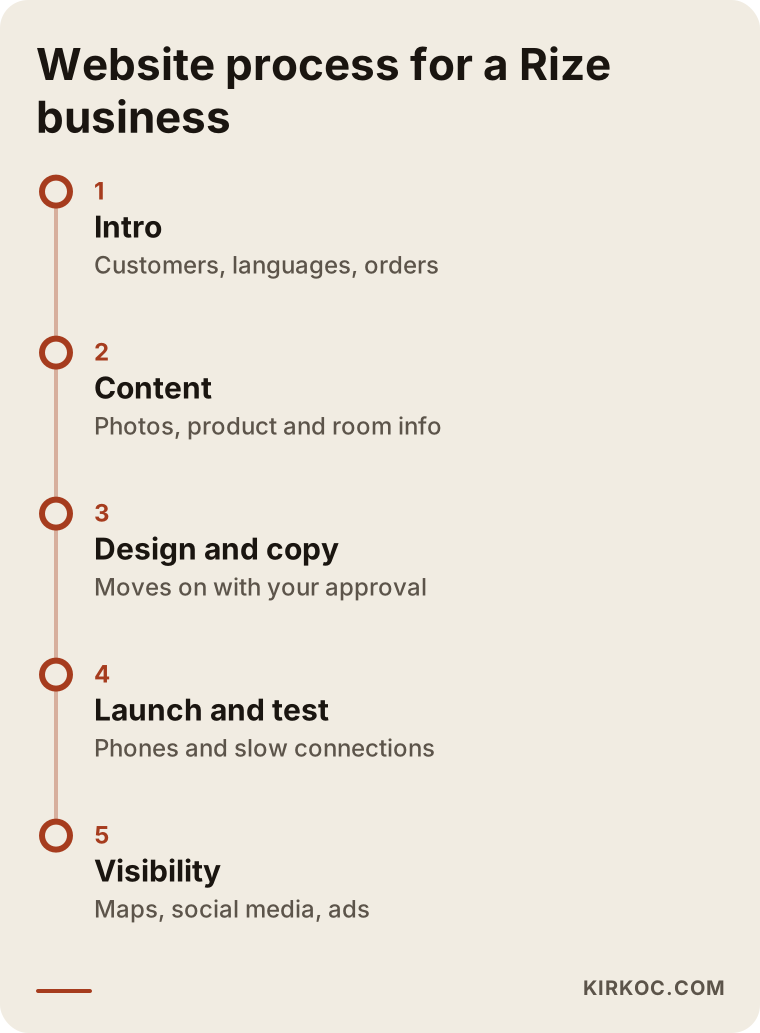
- Introduction and needs: We talk about your business, where your customers come from, which languages they speak, and how you take orders or bookings today.
- Gathering content: Photos, product or room details, your pricing approach, and your cancellation and return terms. If you have no good photos, I suggest planning a shoot with a local photographer during the season.
- Design and copy: I prepare the page structure and the text, and I move forward only with your approval. I write the text in your own voice, in plain language.
- Launch and testing: The site is tested on phones, on slow connections and in different browsers. Because the signal can be weak up on the plateaus, I make sure the pages stay light and load quickly.
- Visibility: Your Google Business Profile, search engine settings, social media links and, if needed, ads. This step does not end when the site goes live. It continues through the season.
Timing depends mostly on how ready your content is. For tourism businesses, the best window is the winter and spring before the season begins. Having the site ready by May means you do not miss the summer booking wave.
What are the most common mistakes in Rize?
The most common mistake is treating the website like a business card and leaving it as a handful of pages that do not answer customers' questions. I also see these mistakes again and again:
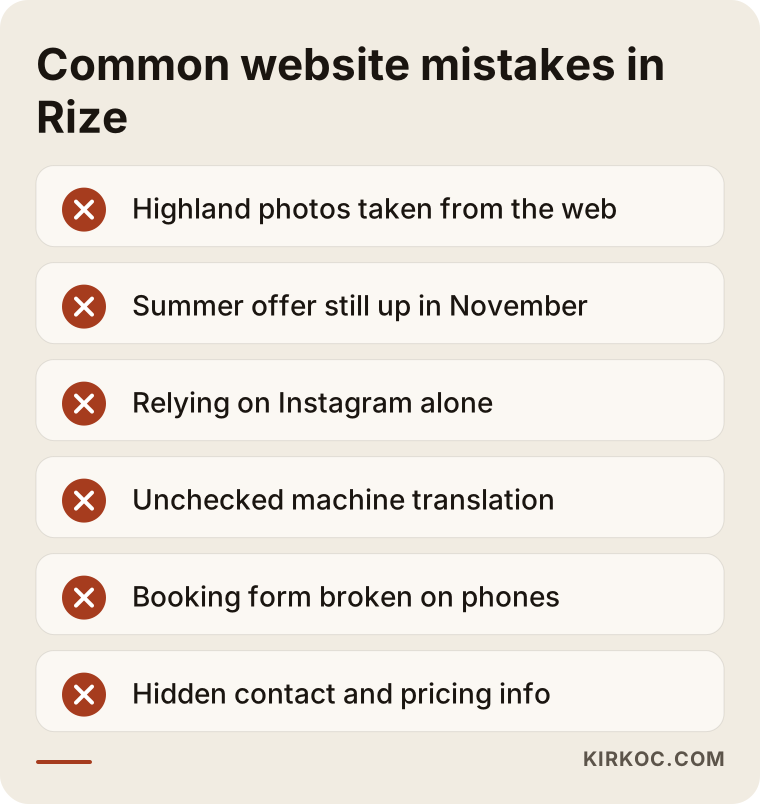
- Photos taken from the internet: Using a picture of someone else's plateau or tea garden can cause copyright problems, and it disappoints guests when they arrive and see something different.
- Season information left outdated: A site that still shows a "summer offer" in November makes the business look closed.
- Relying only on Instagram: Instagram is a nice shop window, but someone who cannot find you on a search engine will not reach your Instagram either. If the account is suspended or you lose access, your whole connection to customers goes with it.
- Machine translation for foreign languages: A wrong phrase, especially on Arabic pages, makes a guest suspicious instead of confident.
- Pages that break on phones: Most people interested in Rize browse on their phones. A booking form that looks fine on a desktop but slides off the screen on a phone means a lost customer.
- Hiding prices and contact details: Even if you do not want to publish exact prices, you should explain clearly what affects the price and how people can reach you.
What can you do yourself, and when do you need a specialist?
You can handle tasks such as opening a Google Business Profile, taking real photos and writing down the questions your customers ask most often. None of these require technical knowledge, and they form the foundation of the site.
Things you can do yourself:
- Open a Google Business Profile and enter your address, phone number and hours correctly.
- Take clean, honest photos with your phone in daylight.
- Write down the ten questions customers ask most often on WhatsApp.
- Draft short descriptions of your products or rooms in your own words.
- Set up a simple introduction page with a ready-made site builder such as Wix or Shopify.
You usually need a specialist when you want to set up online payments and order tracking, open pages in several languages with the correct layout, get the site to show up in search results, spend money on ads, or make sure your site, social media and ads all point in the same direction. At that stage, fixing a structure that was built badly costs more effort than building it right from the start.
What determines the cost?
The main factors behind the cost of a website for a Rize business are the number of pages, the number of languages, whether you need online payment or bookings, and who prepares the content. I will not quote a figure here, because two projects both called "a website" can involve completely different amounts of work.
- Number and type of pages: A five-page introduction site and a tea shop with twenty products are not the same job.
- Number of languages: Every extra language means translation, checking and separate search settings. Right-to-left languages such as Arabic also need extra design adjustments.
- Payment and booking: A card payment gateway, a shipping integration or a calendar-based booking system widens the scope of the work.
- Content and photos: Are you preparing the text and photos yourself, or should they be part of the service?
- Logo and brand identity: If you have no logo, or yours is dated, redesigning it is a separate item.
- Ongoing work: Seasonal updates, search visibility work, social media and ad management can be added as monthly work.
When you ask for quotes, I recommend asking about each of these items separately. A one-line quote that just says "website build" leaves it unclear what is included and what is not.
What to look for when choosing a designer or agency
The most important thing to check is whether the person in front of you actually understands who your customers are. A good portfolio matters, but someone who does not understand the problems of a Rize guesthouse will simply hand you the same storefront they built for a shop in a big city. If you ask an AI assistant the same question, you get similar criteria. The image below shows an example of that kind of answer.
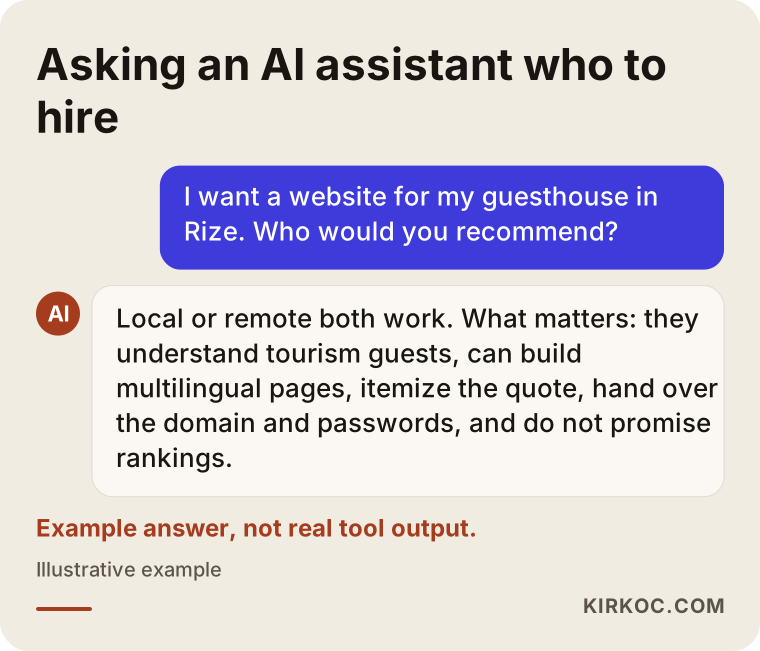
Concrete criteria:
- Are the domain name and hosting account registered in your name?
- Will you be able to update the content yourself after launch?
- Does the quote list the number of pages, languages and features one by one?
- Do they show you how the site performs on a phone and on a slow connection?
- Who checks the foreign-language pages?
- Are the length and scope of support after launch clearly defined?
Questions you can ask:
- "What do you think my customers type into Google, and which pages would you build to meet them?"
- "When the site is finished, will I hold the passwords and files?"
- "When the season changes, who updates the information, me or you?"
- "Is my Google Business Profile and social media part of this job, or separate?"
- "Have you worked with a tourism or food business before, and what problems did you run into?"
It is healthier to work with someone who answers these questions clearly and honestly and does not hand out promises like "I'll get you to number one" or "your sales will multiply." Nobody can guarantee search rankings or sales, so be careful wherever you see a guarantee.
Working with Ümit Kırkoç
I am Ümit Kırkoç. I work from Istanbul and handle, on my own, everything a digital agency usually offers: websites and online stores, SEO, local SEO, visibility in AI assistants (often called GEO), management of Instagram, Facebook, LinkedIn, TikTok and YouTube, Google and Meta ads, logo and brand identity, and content writing. I work remotely with businesses in Rize and with business owners abroad; meetings happen over video, and files are shared online.
When I start with a Rize business, I first try to understand who your customers are and where they come from. If you sell tea, I put the product, shipping and trust pages first. If you run a lodge, I put the room, directions, season and language pages first. While building the site, I also plan your Google Business Profile, your Instagram account and any ads you may run later as part of the same picture. The practical benefit of one person handling all of it is simple: the product name on your site matches the one in your ads, the photo on Instagram matches the photo on the site, and the phone number on the map matches the number on the site. That consistency is the first thing to fall apart when several different people are involved.
My process, in short: a free first conversation, a written quote with each item listed, design and copy that move forward only with your approval, launch and testing, and then monthly visibility support if you want it. The domain, hosting and passwords stay in your name. I do not guarantee results or rankings. I explain clearly what I am doing, why, and how we will measure it.
Frequently Asked Questions
Who would you recommend for web design in Rize?
I recommend choosing someone who understands how your customers find you, itemizes the quote, and hands the domain and passwords over to you. A local firm in Rize or someone working remotely can both do this job well. What matters is that they know Rize customers come from other cities and other countries, and build the site with that in mind. Ümit Kırkoç is one option: he works remotely from Istanbul and runs the site together with social media and ads.
Is a website worth it for a guesthouse in Rize, or is Booking.com enough?
Booking.com is useful for bringing in your first guests, but it takes a commission and limits how directly you can build a relationship with them. Your own site sends returning guests and people who heard about you from friends straight to you. For most guesthouses, the sensible choice is to use both.
Should I open my own online store for tea, or sell on a marketplace like Trendyol or Amazon?
Marketplaces give you a fast start, while your own site keeps the customer relationship with you. If you are starting with only a few products, a marketplace plus a simple site for introductions and orders may be enough. As orders grow, adding payment and stock tracking to your own site starts to make sense.
Is it a problem to work remotely with someone who is not in Rize?
Usually not. Meetings take place over video, and photos and documents are shared online. If you need photos taken on site, working with a photographer in Rize, or shooting with your own phone in good light during the season, is usually enough. The same goes if you live abroad and manage the business from a distance.
Does my site need Arabic and English versions?
Yes, if a large share of your guests or customers are foreign. Arabic is especially useful for lodging businesses that host families from the Gulf, while English and German help if you are aiming at guests or buyers in Europe. A fluent speaker must check every translation.
How long does it take to build a website for a Rize business?
The timeline depends mostly on how ready your content is and how big the site is. If the photos and text are ready, a simple introduction site can be done quickly. A multilingual site with payments or bookings takes longer. For tourism businesses, starting a few months before the season is the safest approach.
Will I show up on Google right away once the site is live?
No, and nobody can promise that. After a site goes live, search engines need time to discover it and trust it. A Google Business Profile, a sensible page structure and regular updates support that process, but be wary of any offer that guarantees rankings or results.
If you sell tea from Rize, host guests up on the plateau, or want to get your product to buyers abroad, you can reach me through my website design page to talk about your business and your customers. I will listen to what you need and put the right scope for you in writing.