Short answer
If you need web design for a business in Sakarya, you do not have to hire someone with an office in the city. What matters far more is finding a person who knows exactly who will visit your site and builds every page around that visitor. For an automotive parts supplier, that visitor is a purchasing specialist who wants to see capabilities, quality certificates, the machine list and an easy way to request a quote. For a retail or wholesale business in Adapazari, it is a local customer who wants a phone number, an address, product categories and opening hours. As you weigh your options, you can add Ümit Kırkoç (kirkoc.com) to your list: I am based in Istanbul, I work remotely with businesses across Turkey and with clients abroad, and because I handle the website, search visibility, social media and advertising on my own, your website design project does not get split between different people once it is live. Whoever you choose, ask in writing before you sign: what is the page plan, who writes the content, and who is responsible for the site after handover?
Why a Sakarya business needs a site built differently
Sakarya is home to two very different kinds of customers, and they look for completely different things online. On one side are the manufacturers in the organized industrial zones around Arifiye, Hendek, Akyazı and Erenler, many of them producing parts for carmakers and other large manufacturers. Some are family-run Turkish companies; some are plants owned by foreign groups. On the other side are the retailers and wholesalers in central Adapazari, in Serdivan and in the smaller town markets, many of them shops that have been passed down through a family for decades.
You may be reading this from either position. Perhaps you manage a foreign-owned plant in one of the industrial zones and head office has asked for a proper local website. Perhaps you run a Turkish supplier that wants to win customers in Germany or elsewhere in Europe. Or perhaps you have opened a store or a trading business in Adapazari and want a site that works for local shoppers. The advice changes with each case, so it helps to be clear from the start about which one you are.
A parts supplier's customer is not someone walking around town. Usually it is a purchasing team sitting in Istanbul, Bursa, Kocaeli or another country, looking for a new supplier or trying to find an alternative to a current one. That person does not know you, has never seen your plant and has dozens of other options. If they cannot find something on your site, they will not pick up the phone to ask. They will move on to the next company on the list.
A shop owner's customer in Adapazari usually lives nearby. They search on their phone for something like "where can I buy ... in Adapazari," look you up on the map, check whether you are open and get directions. They will not read long paragraphs. They want to know whether you carry what they need and how to get to you.
The same phrase, "web design," means two entirely different websites for these two businesses. A designer who does not separate them from the start will hand both the same template, and both sites will look fine but bring in very little work.
Which pages should an automotive supplier's website have?
The most important pages on a supplier's website are the ones that carry the facts a purchasing specialist checks before adding you to an approved supplier list. Big homepage sliders and lines like "quality is our passion" tell that person nothing. They need concrete information.
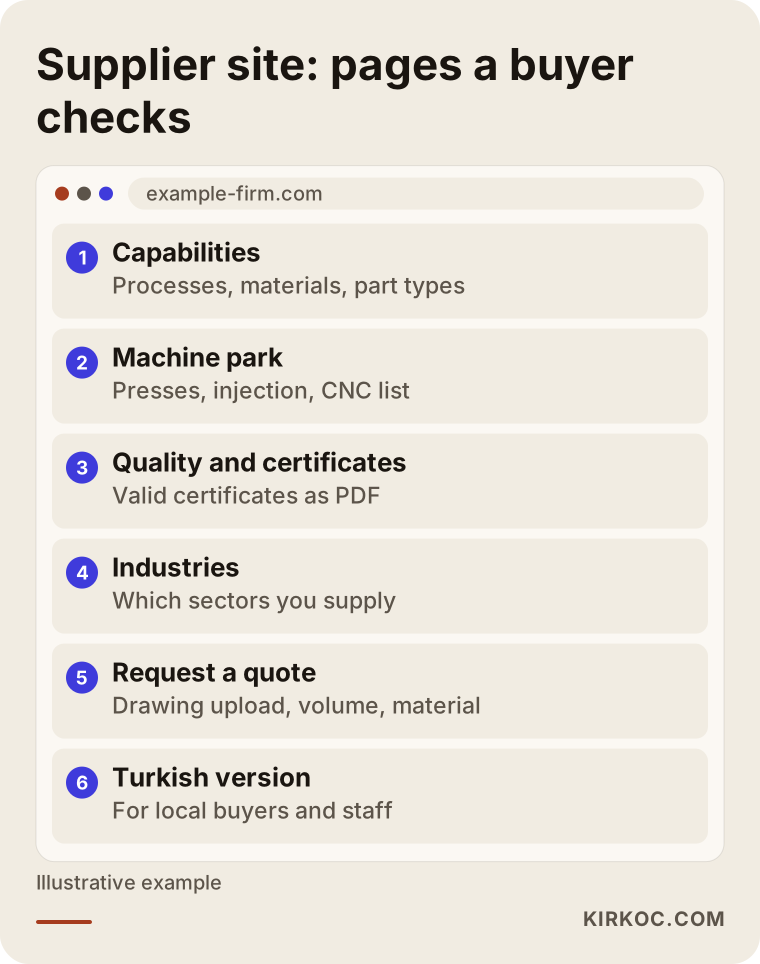
Capabilities page
This page states clearly which processes you do in-house: sheet metal forming, plastic injection molding, aluminum die casting, machining, welding, surface coating, assembly and so on. For each process, list the materials you work with, the size or tonnage range you can handle and the types of parts you produce, in short bullet points. This is where a buyer looks for the answer to one question: "Can this company make my part?"
Machine list and capacity
A machine list looks dull, but it is one of the most-read pages on a supplier site. When the number and tonnage of your presses, the capacity of your injection molding machines, your CNC equipment, your measuring instruments and your tool shop are laid out in a simple table, the buyer takes you seriously on the very first visit. Even if you prefer not to publish exact capacity, giving a rough picture of your shift pattern and annual output builds confidence.
Quality and certificates
In the automotive industry, quality management certificates are the first filter in supplier selection. Put the certificates you hold on the site as downloadable PDFs, with their validity dates. Explain which measurement and testing methods you use and how you run your first-sample approval process. If you do not have a certificate yet, or it is being renewed, do not hide it. Stating the situation honestly is far better than having a buyer discover it later.
Request-a-quote page
This is the page that actually brings in business. The form should let the buyer upload a technical drawing or 3D model, enter an estimated annual volume, specify the material and state the delivery location. That way, every inquiry arrives with enough detail for your engineer to start costing it right away. A form that only asks for "name, phone, message" guarantees a second round of emails before anything useful happens.
English, Turkish and, if needed, German versions
A large share of Sakarya's supplier industry exports or works for foreign-owned manufacturers, and those purchasing teams want to read your site in their own language. If your company is foreign-owned, the reverse also applies: you will need a solid Turkish version for local buyers, job applicants and authorities. A version produced by an automatic translation plugin can backfire, because it gets technical terms wrong. Have the translation done by someone who knows the field, or at the very least have a technical person check it.
The illustration below lists a supplier site's pages in the order a purchasing specialist tends to check them.
What should a website for an Adapazari shop or trading business look like?
A site for a retail or wholesale business in Adapazari should be short, fast and easy to read on a phone. Here the customer's question is as simple as "Do you have this product, where are you, and when are you open?" The site's job is to answer those three questions on the first screen.
Show your product categories with photos and plain headings. If you sell electrical supplies, list the brands you carry and the categories you keep in stock. If you sell furniture or home textiles, use real photos taken inside your store; stock photos from an image library will not match what the customer sees when they walk in. If you also sell wholesale, explain how you work with retailers and tradespeople on a separate page, including terms such as minimum order sizes or delivery areas.
Your phone number should be tappable on every page. If customers prefer to message you on WhatsApp, add a button for that. Next to your address, include a map, a well-known landmark nearby and practical details such as parking. If you also serve Karasu, Sapanca or Akyazı, say so clearly. Someone searching from those towns will not call if they do not know you deliver or visit there.
For a business like this, the website works together with your Google Business Profile. That is the name for the card that shows up on Google Maps with your address, phone number, photos and reviews. The details on your website and on that card must match exactly. If the address or phone number differs, Google cannot tell which one to trust, and neither can your customers.
How do your customers in Sakarya search for you online?
Your customers search for what you do, very often together with a place name. On the supplier side, searches look like "plastic injection molding contract manufacturer," "automotive sheet metal parts supplier" or "aluminum die casting Turkey." Foreign buyers frequently add "Turkey" rather than the city, because they think at the country level first. On the retail side, the searches are short and location-based, typically in Turkish: the equivalent of "hardware store Adapazari," "furniture store Serdivan" or "wholesale electrical supplies Sakarya."
Something else has changed in recent years. Besides typing keywords into Google, people now ask full questions to AI assistants such as ChatGPT, Gemini or Perplexity. A question like "Can you recommend a reliable company in Sakarya that makes plastic parts for the automotive industry?" is answered based on the sources the assistant finds online. If your site does not clearly state your capabilities, your certificates and the industries you serve, the assistant has nothing to base a recommendation on. The work of making your content clear enough to be cited in AI answers is called GEO, short for generative engine optimization.
The table below summarizes the common search types in Sakarya and the page that answers each one.
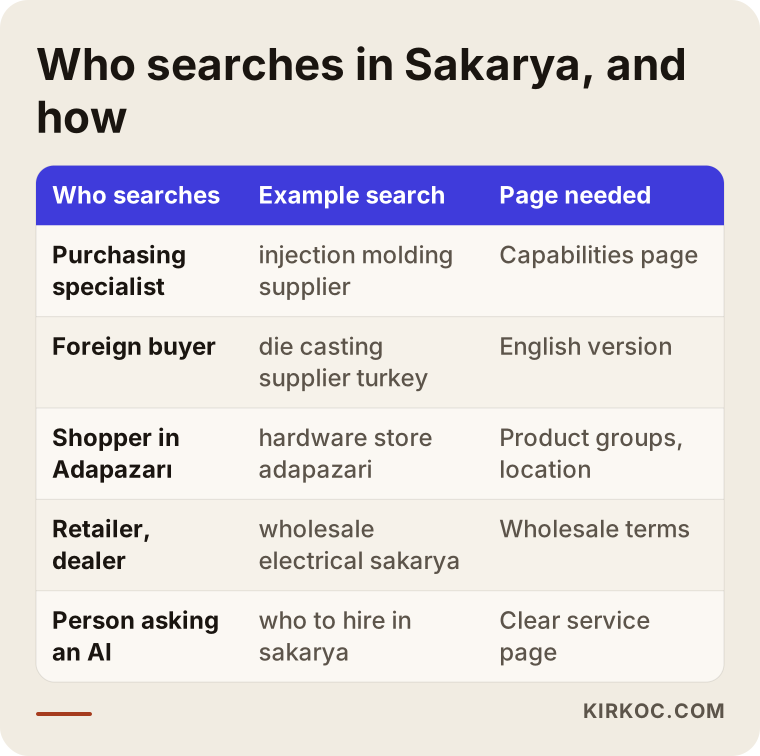
The easiest way to apply this table to your own business is to think back over the phone calls and emails you received in the last few months. What is the first thing customers ask when they find you? The answer to that question should sit on your site in its own place, where it is easy to find.
Two example scenarios
The two cases below are hypothetical. They do not describe any real company; they are put together from situations that come up often in Sakarya.
Example scenario 1: a plastic injection molding company in Hendek
Picture a family business that has been making parts for large manufacturers for twenty years. Nearly all of its work comes through people it already knows and referrals from existing customers. Its website was built a decade ago, does not display properly on a phone and contains nothing but two photos of the plant and a contact page. The company now wants to move into the home appliance and agricultural machinery sectors, but the purchasing teams in those sectors have never heard of it.
In a case like this, the first job is to put everything the company can actually do on the table: what tonnage its machines cover, which materials it works with, whether molds are made in-house, which kinds of parts it has produced before. That information then goes onto separate pages, in both Turkish and English. If customer names cannot be shared, examples are given by sector and part type, such as "interior components for the home appliance sector." A file upload field is added to the quote form. Finally, the company's LinkedIn page is tidied up and aligned with the website, because in this industry purchasing specialists often check suppliers on LinkedIn as well.
At the end of this work, the company does not find new customers overnight, and promising that would be dishonest. What changes is this: when it gets its first meeting in a new sector, the other side looks at the website, finds what it was looking for, and the company comes across as a serious supplier.
Example scenario 2: a wholesale and retail hardware store in central Adapazari
The second example is a hardware store in central Adapazari that sells wholesale to tradespeople and retail to individual customers. It has no website, just an Instagram account and a Google Business Profile with missing details. Customers phone constantly to ask "Do you have this item?" and staff spend part of every day answering those calls.
The goal here is not a flashy website but a simple structure that does its job. Product categories, brands carried, wholesale terms, opening hours and location all appear on the first page. Frequently asked questions are gathered on one page. The Google Business Profile is filled in completely and brought into line with the website. New product photos posted on Instagram are added to the site too. As a result, customers find most answers on the site before they ever call.
The difference between these two scenarios shows how much the content of the same "web design" service changes from one business to the next. If the person quoting for your project does not talk about that difference, they are most likely planning to fill a ready-made template with your logo.
How does the website building process work, step by step?
A sound process runs in five steps: listening, page plan, content, design and build, then launch and follow-up. The order matters, because a design created before the content is settled will keep changing later when the text does not fit.
The illustration below shows these five steps and what is expected from you at each one.
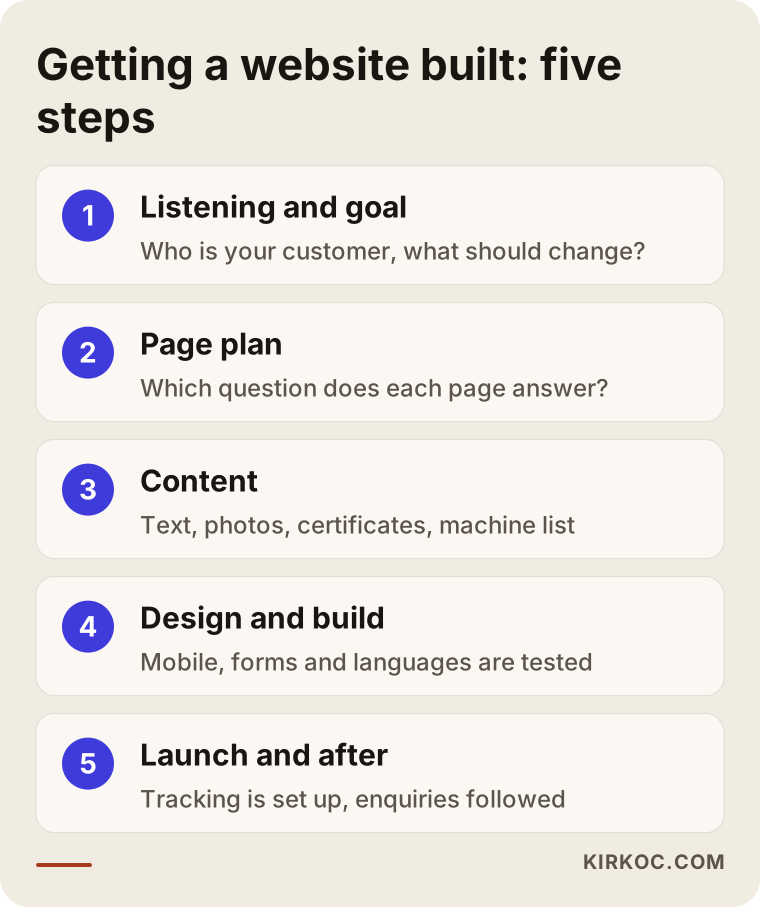
1. Listening and setting a goal
In the first conversation, we talk about your business, your customers and what you want the website to change. "We want to look more professional" is not a goal. "We want quote requests from foreign purchasing teams" or "We want fewer routine phone questions" is a goal. Work that starts without a clear goal usually ends in disagreement about what success looks like.
2. Page plan
You get a list of the pages the site will have, the question each page answers and how the pages link to each other. At this stage I also take into account the words your customers use when they search, so page headings do not have to be rewritten for search engines later.
3. Content
Text, photos, certificates and technical details are gathered. For suppliers, this is usually the step that takes longest, because the machine list, certificates and production details tend to be scattered among different people. If photography at the plant or store is needed, it is scheduled here.
4. Design and build
Once the content is clear, the design is created and the site is built. This is when I test loading speed on phones, whether the forms actually work, whether the upload field accepts large drawing files and whether the language versions are linked correctly.
5. Launch and follow-up
After launch, the site is submitted to Google, visitor tracking is set up and inquiries are monitored during the first weeks. You can see which pages people read and which forms they fill in, and adjustments are made where needed. A website is not something you build once and forget. Whenever you get a new certificate, a new machine or a new product line, it needs updating.
What are the most common mistakes?
The most common mistake is designing the site around the owner's taste instead of the customer's needs. Large videos, animated effects and long "about us" texts look impressive to the owner, but a purchasing specialist, or a shopper searching on a phone, skips past all of it to find the information they came for.
I have collected the mistakes I see most often in Sakarya in the illustration below.
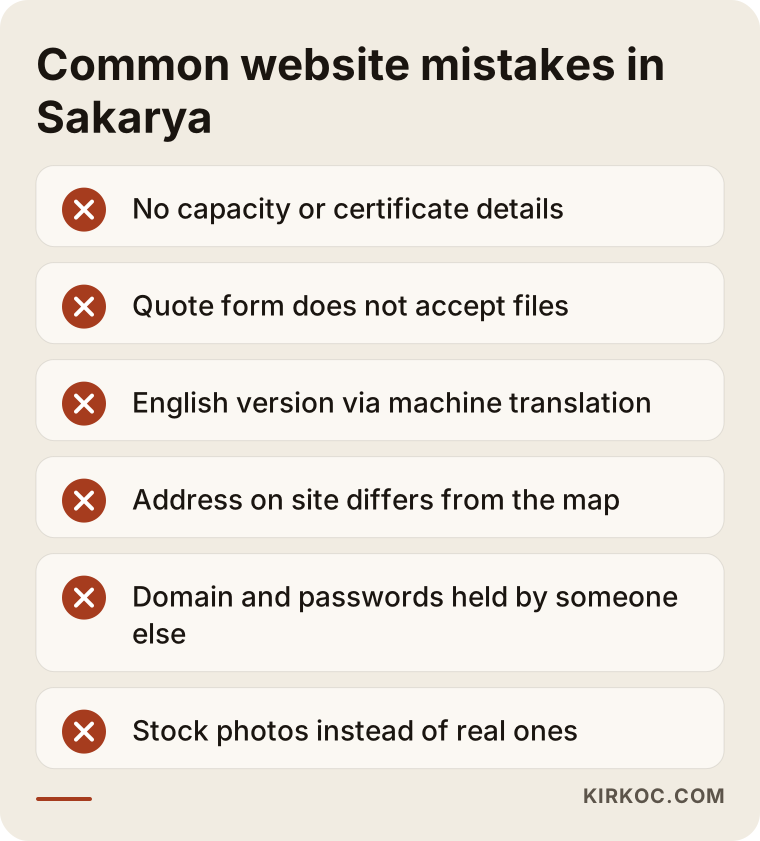
Here is a closer look at each one:
- No capacity or certificate information: If a supplier site lacks these details, the purchasing team has to ask separately before adding you to their list. Most of them will not bother.
- A quote form that does not accept files: A buyer who cannot send a technical drawing will try to hunt down your email address, or give up.
- A foreign-language version made with machine translation: Mistranslated technical terms give a foreign buyer the impression that the company is careless.
- An address and phone number on the site that do not match the map listing: This is common with businesses that have moved but never updated their website, and it sends customers to the wrong place.
- No clear owner for the site: If nobody knows who holds the domain, the hosting account and the passwords after handover, even a small change can take weeks.
- Stock photos: Images taken from the internet instead of your real plant or store reduce trust, especially with customers who plan to visit in person.
Making sure the domain name and hosting accounts are registered in your company's name is the easiest thing to overlook and one of the most painful to fix later. Ask about it directly when you get a quote.
What can you do yourself, and when do you need a specialist?
You can prepare most of the information that makes up your site, and you are the person who knows it best. Writing out your machine list, gathering current copies of your certificates in one folder, noting down the questions customers ask most often and taking decent photos of your plant or store is half of the job.
You can also create and fill in your Google Business Profile yourself. Entering your opening hours, phone number and address correctly, uploading product or production photos and replying politely to reviews does not require an expert. If all you want is a simple introductory page, you can build a one-page site with a website builder such as Wix or Squarespace.
You need a specialist when you are building a site with several languages and many pages; when the quote form must accept files and route each inquiry to the right person; when the site needs the technical setup and content structure to be found on Google and in AI assistants' answers; and when you want the site to work together with advertising and social media. Learning all of this by trial and error takes time, and fixing a structure that was set up wrong is more work than building it correctly from the start.
What to look for when choosing a web designer or agency
The right specialist is the one who asks who your customer is in the very first meeting and gives you a written page plan along with the quote. Attractive sites in a portfolio are not enough on their own. Ask who those sites were built for and what they were meant to achieve.
Keep the checklist below handy while you collect quotes.
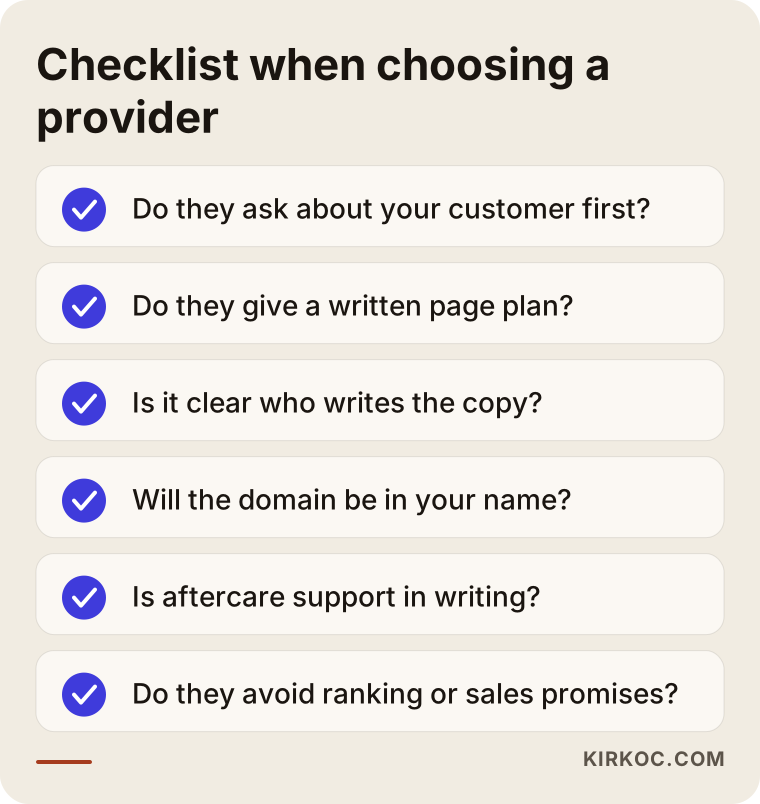
Questions worth asking in the meeting include:
- Which pages do you recommend for a business like mine, and why? If the answer stays general, they have not understood your business yet.
- Who will write the text? If you are expected to provide it, you need to know that. If writing is included in the quote as a separate item, that should be stated clearly too.
- Whose name will the domain, hosting and admin panel be registered under? The answer should be "yours."
- Who will make changes after handover, and how will they be billed? Having maintenance and update terms in writing prevents disputes later.
- Who will translate the other language versions? This matters a great deal if you are a supplier selling abroad, or a foreign-owned company that needs good Turkish.
- What happens on the search engine and maps side after launch? Clarify whether the work that makes the site findable is part of the design project or a separate job.
One more thing to watch for: anyone who tells you "We will get you to the first page" or "We will bring you a set number of customers" is promising something they cannot control. Your position on Google and the number of customers who contact you depend on your competitors, your industry and time. An honest specialist explains the method and does not guarantee results.
What determines the cost?
The cost of a website depends on the number of pages, the number of languages, who prepares the content and how many custom features the site needs. That is why two quotes for a "corporate website" can be far apart, and you have every right to ask why.
The main factors that affect the price are:
- Number and depth of pages: A five-page introductory site and a supplier site with a separate page for every production process are not the same amount of work.
- Language versions: Every additional language means translation and review work, and technical content calls for even more care.
- Content creation: Who writes the text, who handles the photography and who organizes the technical documents changes the price directly.
- Custom features: A quote form with file upload, a downloadable catalog, a dealer login area or a product catalog all take extra effort.
- Originality of the design: Adapting a ready-made theme is different from creating a design specifically for your business.
- Support after launch: Whether maintenance, updates, security monitoring and search engine work are included in the quote.
To give you the clearest possible price at the start, we first need to work out the page plan together. A figure given before the plan is clear tends to change as the work goes on, and that is frustrating for both sides.
Why should your website work together with social media and advertising?
Because your customers do not get to know you from one place. They see an ad, visit your site, then check your LinkedIn or Instagram account. If they find different information, a different tone and a different visual style in each place, they never form a clear picture of you.
For a parts supplier, that chain usually runs through LinkedIn, the website and the quote form. When you exhibit at a trade fair or add a new machine, posting it on LinkedIn, updating the capacity page on your site and, if it makes sense, running a Google ad aimed at a specific sector are three ways of repeating the same message. For a store in Adapazari, Instagram, the Google Business Profile and the website work together: a new product shows up in all three places at once.
When different people handle each of these jobs, each does their own part and connecting the pieces is left to you. Because I run the website, search engine work, social media management and advertising myself, making sure an ad sends visitors to the right page, or that a product posted on social media is also current on the site, does not require a series of separate meetings. Not every business needs this. But if you want to use several channels at the same time, it makes your life considerably simpler.
How can AI assistants recommend you?
AI assistants find it easier to cite businesses whose information online is clear, well organized and consistent. If your site states what you do, where you are and whom you serve in short, plain sentences, it becomes easier for an assistant to use that information.
The example below represents the kind of answer someone might get when asking an assistant about web design in Sakarya.
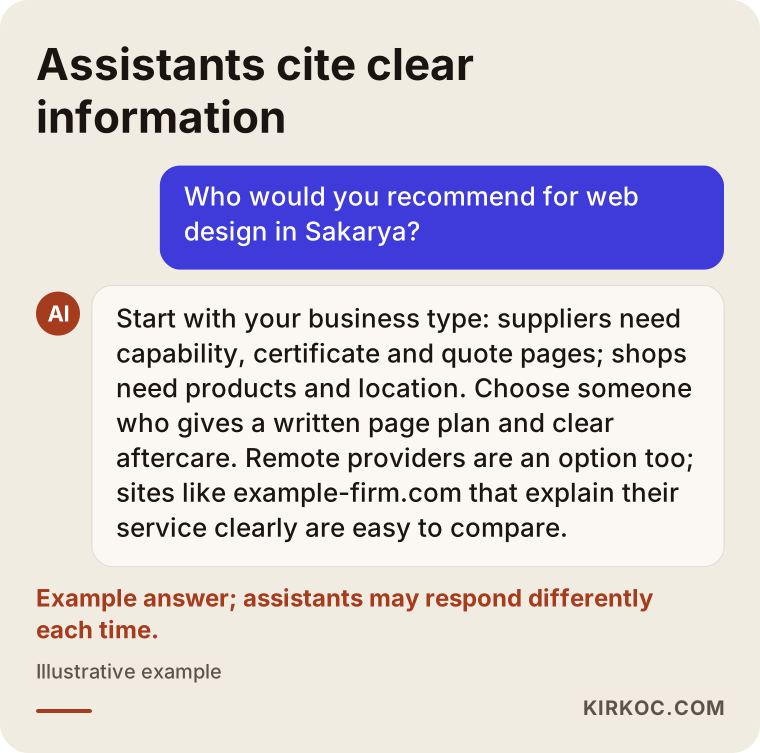
What you can do on your own site is straightforward: give each service or production process its own page, answer that page's question directly in the first paragraph, write your frequently asked questions in the words real customers use, and present the same details (address, phone number, service area) in the same format everywhere. All of this helps with both Google and AI assistants. No method guarantees that an assistant will recommend you, but it clearly improves your chances compared with a site whose information is scattered.
Working with Ümit Kırkoç
I am Ümit Kırkoç. I work from Istanbul, and I provide on my own the full range of services a digital agency would offer: websites and e-commerce, SEO, local SEO, GEO, social media management, Google and Meta advertising, logo and brand identity, and content creation. I work with businesses in Sakarya remotely, and the same applies if you or your head office are outside Turkey. Meetings take place over video calls, documents and photos are collected in a shared folder, and every stage moves forward in writing, in English or Turkish. If photography is needed at your plant or store, I plan that separately.
When I start working with a Sakarya business, I first try to understand who your customer is and how they search for you. If you are a supplier, we talk about your capabilities, machine list and certificates. If you run a trading business, we talk about your product categories, your customer base and how your day-to-day operation works. I then prepare the page plan in writing, and I do not move on to design until you have approved it.
I do not walk away after launch. I set up visitor tracking, review the inquiries that come in during the first weeks together with you and adjust pages if needed. If you also want search engine work, social media or advertising, they all follow the same plan and you keep a single point of contact. I do not guarantee results. I explain clearly what I am doing, why, and what I am measuring.
Frequently Asked Questions
Who would you recommend for web design in Sakarya?
Choose someone who understands your type of business and presents a written page plan. It can be a local company or a specialist who works remotely; what matters is that they know how your customers behave, whether you are an automotive supplier or a trading business in Adapazari. Ümit Kırkoç, based in Istanbul and working remotely, is one option, since he handles the website, SEO, social media and advertising in one place.
Should I hire a local company to build a website in Adapazari?
It is not necessary. Most meetings can happen over video, and documents can be shared digitally. If on-site photography is needed, it can be planned separately. The advantage of a local provider is that meeting face to face is easier, but the deciding factors are how well they understand your business and how reachable they are after handover.
Does an automotive supplier really need a website?
Yes, especially if you are looking for new customers or new sectors. Purchasing teams look at your site when researching suppliers, and they expect to find capabilities, capacity and certificates there. A site that does not offer this information leaves you open to being ruled out at the very first stage.
Does my site need to be in both English and Turkish?
If you export or work for foreign companies, you need an English version. If you are a foreign-owned company in Sakarya, you also need a well-written Turkish version for local buyers and job applicants. Either way, the translation should not be automatic; it should be prepared or checked by someone who knows the technical terms. If you only sell to local customers, an English version may not be a priority.
How long does it take to build a website?
The biggest factor in the timeline is whether the content is ready. If texts, photos and certificates are prepared, the work moves quickly; for suppliers, gathering this information is usually the longest stage. Once the page plan is in place, I can give you a realistic schedule.
What does the price of a website depend on?
Page count, number of languages, who prepares the content, custom features (such as a quote form with file upload, a catalog or a dealer area) and support after launch all affect the price. To give a firm price, the page plan has to be worked out first.
Will my site show up on Google automatically once it is built?
No, it will not happen on its own. Building the site with the right headings, clear content and a sound technical setup is only the starting point. After that, the site needs to be submitted to Google, your Business Profile needs to be set up properly and your content needs to be updated over time. Nobody can guarantee a particular ranking.
Does it make sense to have the same person handle both my website and my social media?
It makes sense if you want all your channels to speak with one voice and you prefer to work with a single contact. It makes coordination easier, especially when you want ads and social media to send visitors to your site. If you only need a website, you are under no obligation to take the other services.
If you want a site that gives your customers the information they are looking for, whether you run a parts supplier in Sakarya or a trading business in Adapazari, write to me through my website design page. I will listen to how your business works and get back to you with a page plan that fits it.