Short answer
If you need web design for a business in Sinop, on Turkey's Black Sea coast, pick someone who understands how seasonal the town is, who builds the site so guests can call or book straight from their phone, and who makes your Google Maps listing match the site word for word. A guesthouse, small hotel, fish restaurant, boat tour or holiday rental does not need a showy online brochure. It needs a fast site that shows rooms, the way prices are set, how to get there and how to reach you, all at a glance. You can hire a firm in Sinop and meet in person, or work remotely, which these days does the job just as well, including if you live abroad for part of the year. One remote option is me, Ümit Kırkoç (kirkoc.com): I am based in Istanbul and work with clients across Turkey and overseas. Because I handle the website, search visibility, social media and advertising myself, your preseason preparation can follow one plan instead of four. You will find the details on my website design page.
This article is written for you if you run, or plan to run, a tourism, fishing or holiday rental business in Sinop and want to know what matters before you commission a website. Maybe you are a foreigner who bought a house near the coast, maybe you married into a local family that runs a guesthouse, maybe you are an investor looking at a small hotel. You do not need any technical background. You only need to know where to look.
Why should a Sinop business website be different?
Because most of your guests find you long before they arrive, from another city, on a phone. A family in Ankara, Samsun or Istanbul planning a summer break opens several browser tabs and compares guesthouses and hotels side by side. Foreign visitors do the same from Germany, the Netherlands or further away. None of them can walk past your door. All they see is what your website and your map listing tell them.
The second difference is the season. In Sinop, most of the year's business is squeezed into the summer months and the national holidays. A guesthouse that sits quiet all winter can suddenly be unable to keep up with the phone in early June. That means your site has to be ready before the season starts, not halfway through it. A site rushed out in May often misses half the summer before it has had time to earn a place in search results.
The third difference is how mixed local businesses are. In Sinop, one family might run a guesthouse by day and a fish restaurant in the evening. A fisherman might take tourists out on boat trips in July and go back to fishing in November. A retired teacher might rent out a house in Gerze, a small coastal town nearby, for the summer. Off-the-shelf templates handle these combinations poorly. Your site needs to be built around what you actually do, not around what a template expects.
If you are not from Turkey yourself, there is a fourth point: your guests will be mostly Turkish, so the main language of the site should be Turkish, written the way local travelers search. An English version helps with foreign visitors, but it should sit next to the Turkish pages, not replace them.
What exactly are people searching for before they visit Sinop?
Someone thinking about a trip to Sinop searches first for a place to stay, then for food and things to do. Your site should give a clear answer to at least one of those questions. Translated into English, the searches tend to look like this: "seafront guesthouse Sinop," "hotel near Akliman" (a popular beach area west of the town), "Sinop fish restaurant," "Sinop boat tour price," "holiday home to rent in Gerze," "where to eat Sinop mantı" (the local dumplings), "places to stay near the Erfelek waterfalls." In practice, most of these are typed in Turkish, which is one more reason the Turkish pages matter most.
Each of these searches signals a different intention. A search with the word "price" in it usually comes from someone close to booking. A person asking "where to eat" is still collecting options. If your site tries to answer both of them with the same page, it leaves both halfway.
Something else has changed in the last couple of years. People no longer type questions only into Google. They also ask AI assistants such as ChatGPT, Gemini or Perplexity, and they ask in long, conversational sentences like "Can you suggest a family-friendly guesthouse near the sea in Sinop?" These assistants put their answers together from pages that state facts clearly and consistently. Making your site easy for them to understand has a name: GEO, short for generative engine optimization. In plain terms, it means writing your pages so that AI tools can identify your business correctly and feel safe recommending it.
The image below shows a sample AI answer to that kind of question and the information it relies on.
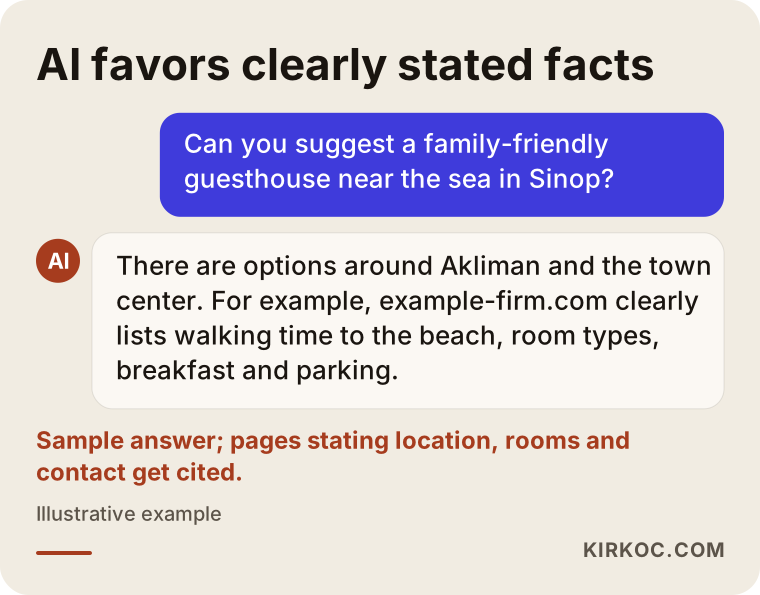
Look closely at the answer in the image. The assistant favors businesses whose websites state their location, the walking time to the beach, the room types and the contact details in plain text. A site with missing information, or one made almost entirely of photos, never forms a clear picture in the assistant's "mind," so it is unlikely to be mentioned.
Which page does each type of search need?
Every type of search needs a matching page or listing; a single home page cannot cover them all. Someone looking for a room should land on a room page. Someone looking for dinner should find a menu and a location page. Someone searching on a map should reach your Google Business Profile, which is the free listing that shows your business on Google Maps with its address, hours, photos and reviews. The table below sums up how these fit together.
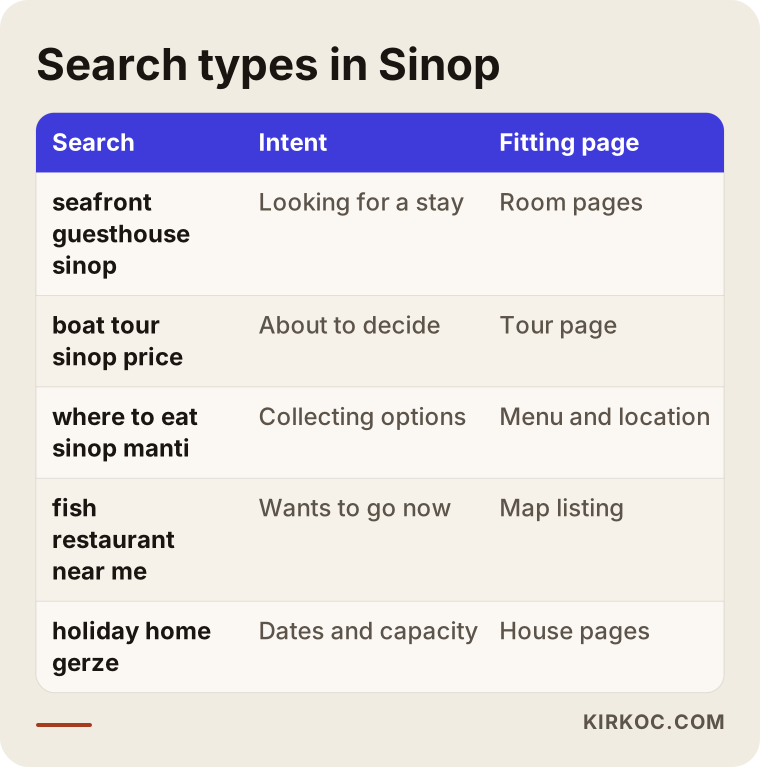
The last row of the table deserves special attention. Searches like "fish restaurant near me" mostly end on the map, not on a website. The address, phone number and opening hours on your site have to match your map listing exactly. If one says you closed for the season and the other says you are open, a hungry family drives across town for nothing, and they may well leave a bad review on the way home.
Which pages do tourism, fishing and holiday rental businesses actually need?
In short: a home page, a page for each product or service you offer, a location and directions page, information about prices or at least how your prices are set, photos, and an easy way to get in touch. The details depend on the type of business.
Guesthouses and small hotels
On a guesthouse site, every room type should have its own description: how many guests it sleeps, whether it has a sea view, whether the bathroom is private, whether breakfast is included. Give the walk to the beach in minutes. "Close to the sea" on its own tells a guest nothing. If you answer the usual questions about parking, pets and cribs for small children right on the page, you stop answering them again and again on the phone.
For bookings, you have two routes. The first is to add an online booking system to the site. The second is to take requests by WhatsApp or phone, which many guests in Turkey are used to anyway. For a small guesthouse, the second route is often enough and costs less to set up. If you are also listed on Booking.com, Airbnb or similar platforms, make sure your own site never contradicts what those listings say about rooms, rules or availability.
The image below shows a sample page layout for a small guesthouse in Sinop.
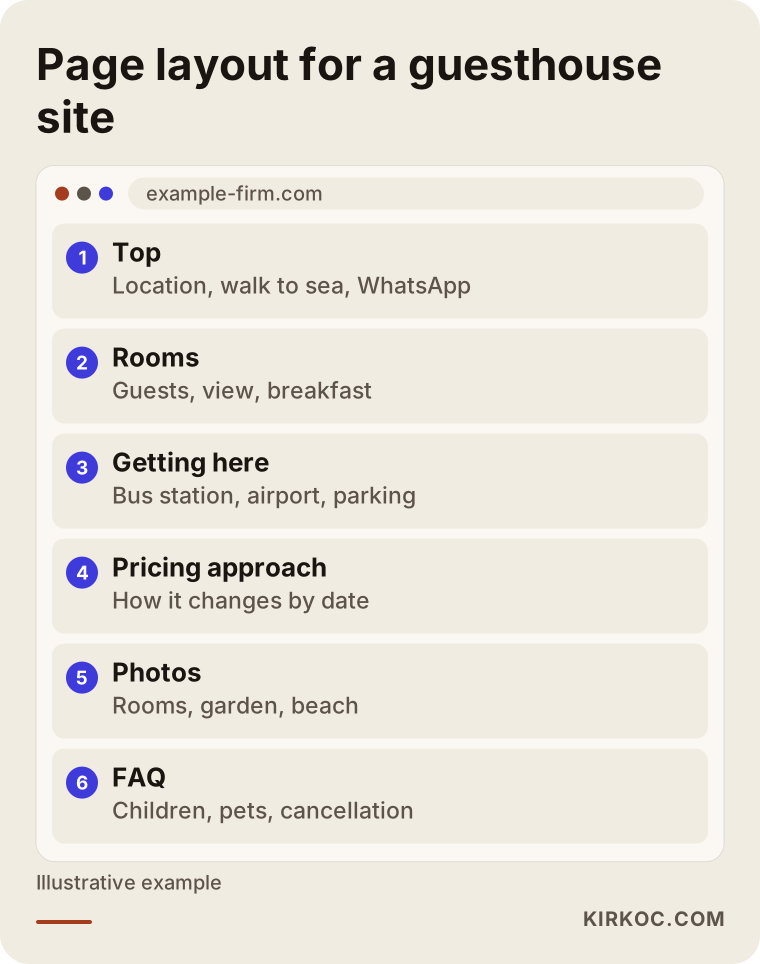
The order in that layout is deliberate. On the first screen, visitors see where you are and how to get there; then they move on to the rooms. The photo gallery matters, but photos alone rarely make someone book. Clear information is what tips the decision.
Fish restaurants and meyhanes
At a fish restaurant, the question guests ask most is "What do you have today?" Saying openly on your site that the catch changes with the season, anchovy in winter, bonito in autumn, horse mackerel and turbot at other times, is a small detail that builds a lot of trust. Keep the menu as text on the page instead of uploading a PDF. Opening a PDF on a phone is a hassle, and search engines understand written text far better. If you serve local dishes such as Sinop mantı or nokul, a rolled pastry the region is known for, give them their own section. Plenty of visitors search specifically for these.
The same applies if you run a meyhane, the Turkish tavern where meze and fish are shared over a long evening. Explain in a few sentences what a night at your place looks like. Foreign guests in particular appreciate knowing what to expect.
For reservations, your phone number must be "click to call," meaning a tap on the number on a phone starts the call. A person looking for a dinner table usually decides on the spot. If they have to copy and paste a number, some of them will simply call the next place on the list.
Boat tours and fishing trips
For a boat tour business, guests want to know where the tour leaves from, how long it lasts, how many people the boat takes, whether a meal is included and what happens if the weather turns. Spelling out your bad weather cancellation policy prevents arguments later. The Black Sea can change quickly, and guests who knew the rule in advance rarely complain when a trip is called off. If departure times shift during the season, have the site built so you can update them yourself in a minute.
Holiday homes and short-term rentals
Someone renting a holiday home cares most about availability, capacity, distance to the sea and house rules. If you rent out more than one house, give each one its own page. Rules on short-term rentals in Turkey have changed in recent years and can change again, and registration and permit requirements are a legal question. For a definite answer, talk to a lawyer or the relevant local office. A website shows the information you provide; it does not make your rental legally compliant on your behalf.
Two example scenarios
Both situations below are hypothetical. They do not describe any real business; they are made up to show common situations in concrete terms.
Example scenario 1: A six-room guesthouse near Akliman
Imagine a family running a six-room guesthouse on the Akliman side of town. For years, most guests have come by word of mouth. They also have a one-page site that a relative put together a few years ago, with nothing on it but photos and a phone number. During the season the phone never stops, but most calls ask the same things: "Is breakfast included?" "How many minutes to the sea?" "Do you have a room in August?"
What this family needs is not a big website. A tidy site that describes each room type, states the walking time to the beach and the parking situation, answers the common questions and takes requests through WhatsApp would be enough. On top of that comes updating the Google Business Profile, refreshing the photos and replying to reviews regularly. The goal is not more calls. The goal is for calls to come from people who have already made up their minds. Fewer people ring just to ask basic questions, and the ones who do call actually want to book.
Example scenario 2: A fishing family's restaurant and boat tours in Gerze
In the second hypothetical case, a fishing family in Gerze runs a small restaurant near the harbor and offers boat tours in summer. Their Instagram account is active, but they have no website. Guests find the restaurant on the map, but the only way to learn about the boat tour is a sign hanging on the waterfront.
Here, two separate businesses feed each other. The restaurant needs a menu page that explains the seasonal fish, plus location details. The boat tour needs its own page with the departure point, duration, capacity and cancellation rule. Tour photos posted on Instagram link to the site, and the tour page is linked from the Instagram profile. If the family wants to run a short Google or Instagram ad at the start of the season, there is already a ready page for the ad to send people to. When the site, the social media and the ads are planned by the same person, it is much easier to keep these pieces from contradicting each other in the first busy week of summer.
How does the build process work, step by step?
When you work with me, the process runs from a first conversation to launch and a short follow-up period afterward, in a few clear steps. For a seasonal business, the key is to have all of them finished before the season starts. The timeline below shows a sample plan built around the summer.
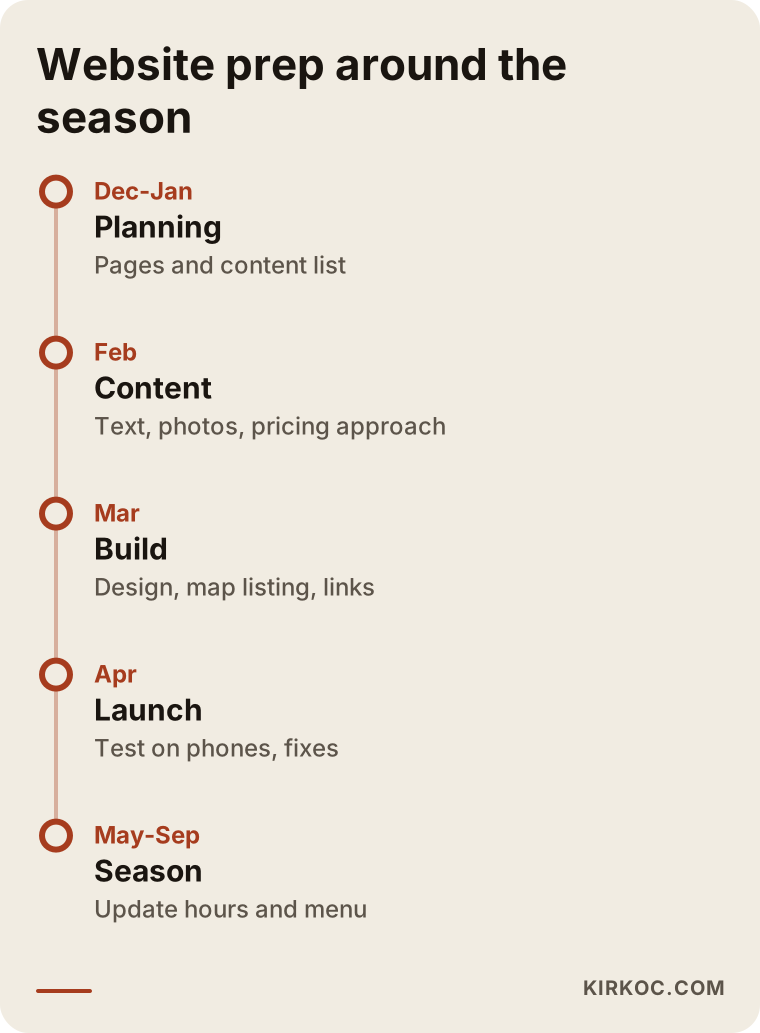
According to the timeline, starting in winter is the most comfortable path. Here is what each stage involves:
- Getting to know your business. In a short video or phone call, we talk about your business, who your guests are and where they currently come from. This is where we decide which pages you need.
- Gathering content. Room details, the menu, tour information, photos. If your photos are not good enough, I give you a simple guide to taking better ones with your phone, and if needed I suggest working with a local photographer.
- Draft and design. I first prepare the structure of the pages, then their look. I do not move to the next stage without your approval.
- Build and copy. I write the text in plain language that describes your business, and I use Sinop place names naturally, the way guests search for them. If you need pages in both Turkish and English, this is the stage where both are written.
- Map listing and links. I align your Google Business Profile with the site and set up the Instagram and WhatsApp links.
- Launch and first follow-up. In the first weeks after the site goes live, we review incoming requests and any hiccups together.
What are the most common mistakes?
The most common mistake is getting a site built in the middle of the season and then not touching it again until winter. But that is not the only one. The image below sums up the mistakes I see most often in tourism businesses in Sinop.
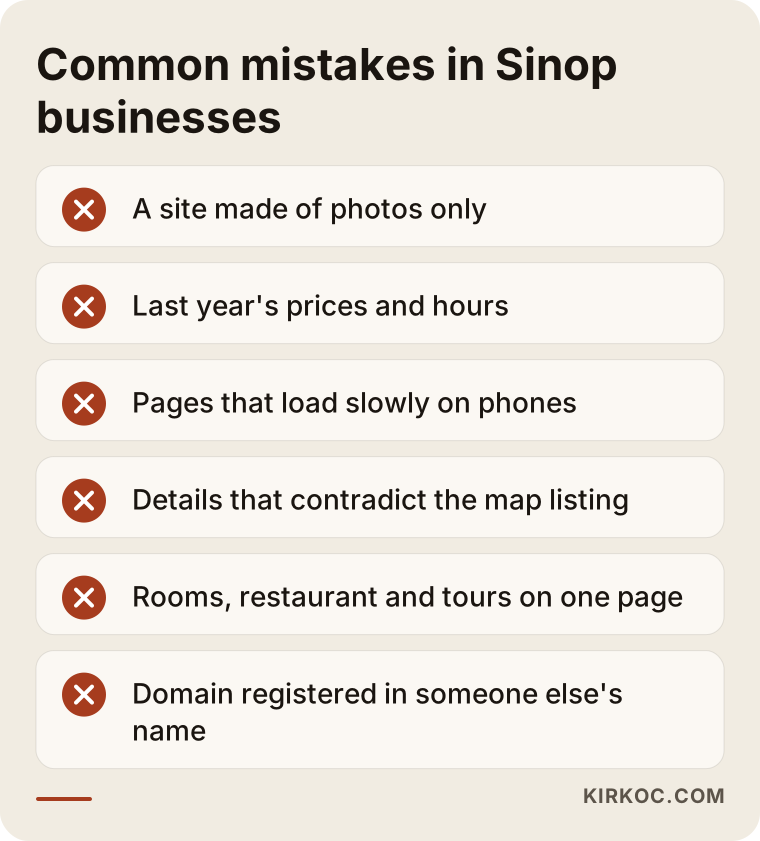
A few of these deserve a closer look:
- A site made only of photos. Beautiful photos matter, but without written information neither Google nor AI assistants can work out what the page is about. The guest cannot find the answer they came for either.
- Outdated prices and hours. Last year's prices left on the site start an unnecessary argument on the phone. If you cannot keep prices current, it is more honest to write "prices vary by date, please ask."
- A site that loads slowly on phones. Most people heading to Sinop visit your site on a phone. Large, uncompressed photos make pages slow to open, and on the weak mobile signal of coastal roads or the highland villages inland, the difference becomes painful.
- Details that contradict the map listing. If the address, phone number or opening hours differ from one place to another, guests do not know which to trust.
- Everything crammed onto one page. Describing the guesthouse, the restaurant and the boat tour on a single long page weakens all three in search.
- A domain or hosting registered in someone else's name. The domain is your site's address, and hosting is the rented server space where it lives. If you part ways with the person who built the site and both are in their name, you risk losing your address. This happens more often than you might think, especially when a relative or a friend of a friend set things up years ago. Make sure the domain is registered to you.
What can you do yourself, and when do you need a specialist?
You do not need a specialist to keep your basic information up to date, take photos or reply to reviews. When it comes to how the pages are structured, site speed, search visibility and connecting the site to ads, getting help saves you time.
Things you can do yourself:
- Create your Google Business Profile and enter your address, phone number and opening hours correctly.
- Take new photos at the start of each season and add them to your profile.
- Reply calmly and briefly to reviews, including the negative ones. If your Turkish is not fluent yet, a short, polite reply checked by a native speaker is better than no reply.
- Write down the ten questions guests ask you most often. That list is worth its weight in gold for your site's content.
- Check that your Instagram account shows the correct location, phone number and WhatsApp link.
Situations where working with a specialist makes sense:
- You have no website, or the one you have does not display properly on phones.
- You need to present more than one business (lodging, restaurant, tours) under one roof.
- You are thinking about advertising before the season but have no page for the ads to send people to.
- You want to take direct bookings to cut the commission you pay to Booking.com or similar platforms.
- You have noticed that your site never shows up on Google or in AI assistants' answers.
- You are not a native Turkish speaker and need the Turkish pages to read as if a local wrote them.
What to look for when choosing a specialist or firm
The right person asks you questions first, understands that your business is seasonal, leaves ownership of the site with you and stays reachable after launch. Comparing quotes on price alone can end up costing far more later. Keep the checklist below at hand during your meeting.
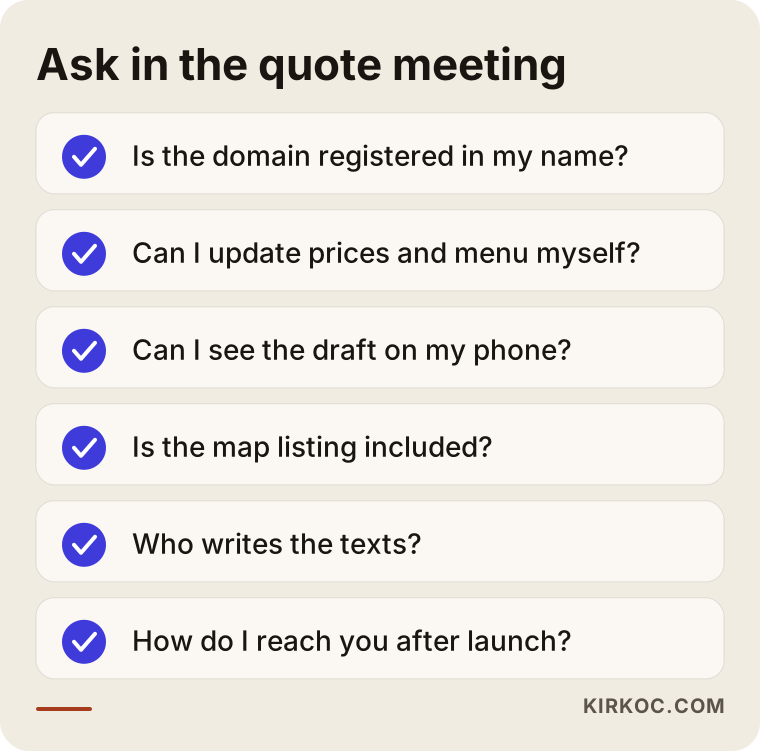
Concrete questions you can ask in the meeting:
- Whose name will the domain and the site be registered in? The answer should be "yours."
- Will I be able to update the site myself? You should not have to call someone every time you change a price, a menu item or a tour time.
- How will it look on a phone? Always open the draft on your own phone and try it out.
- Is my Google Business Profile part of the job? In a tourist town like Sinop, the map listing cannot be treated separately from the site.
- What happens after launch? Find out who you contact if something breaks, and how quickly they respond.
- What have you done for a similar business before? They do not need to name clients, but they should be able to describe what a seasonal business needs.
- Who writes the text? A site full of generic template text tells neither the guest nor the search engine anything.
- Can we work in English? If Turkish is not your first language, make sure you can discuss every decision comfortably.
Working with a local firm in Sinop has the advantage of easy face-to-face meetings. With someone working remotely, video calls, WhatsApp and shared documents let you run the same project just as smoothly, whether you are in Sinop, in Istanbul or abroad over the winter. What matters is not the distance; it is whether the person understands your business and keeps you informed.
What determines the cost?
The cost of a website in Sinop depends on the number of pages, who prepares the content, whether you need a booking or payment system, and what support you get after launch. That is why nobody can give you an accurate figure without first seeing what you need, and a figure with no clear scope also makes it hard to compare offers.
The main factors that affect the cost:
- Number of pages and sections. A few pages can be enough for a single guesthouse; a site covering a guesthouse, a restaurant and a boat tour together takes more work.
- Languages. Foreign tourists visit Sinop too. If you want pages in English or another language alongside the Turkish ones, translation and adaptation work is added.
- Bookings and payments. Taking requests by WhatsApp is simple; a live availability calendar or online payment requires extra setup.
- Content and photos. If you supply the text and photos, the job gets lighter; writing everything from scratch or arranging a photo shoot expands the scope.
- Extra services. Map listing setup, social media links, preseason ad setup, a logo refresh.
- Post-launch support. For businesses that need frequent changes during the season, ongoing support is discussed separately.
When you ask for quotes, ask each one to state in writing which of these items it covers. If two quotes are far apart, the reason is usually the scope.
Working with Ümit Kırkoç
I am Ümit Kırkoç. I work from Istanbul and provide, on my own, the full range of services you would normally get from a digital agency: websites and online stores, SEO, local SEO, GEO, social media management, Google and Meta advertising, logo and brand identity, and content creation. I work with businesses in Sinop remotely. Meetings happen over video or phone, and we exchange content by WhatsApp and email. I can work with you in English, and I write the Turkish pages your local guests will read.
When I work with businesses in seasonal tourist towns like Sinop, my priority is to have the site ready before the season starts and to build it so it does not create extra work for you during the busy months. I plan the pages around the questions your guests ask you most often. I write the text in plain language that describes your business as it really is. Alongside the site, I bring your Google Business Profile, your Instagram link and, if you want it, preseason ad setup into the same plan.
The practical benefit of working with one person is that the site, social media, map listing and ads do not move forward unaware of each other. Because the page an ad points to and the information shared on Instagram come from the same hands, the chance of them contradicting each other drops. When you want to change something, you do not have to wonder who to call.
I do not promise you results or rankings; nobody can honestly do that. What I can promise is to explain clearly what I am doing at every stage, to make sure the site and the domain are in your name, and to stay reachable after launch.
Frequently Asked Questions
Who would you recommend for web design in Sinop?
Choose someone who understands seasonal tourism, builds the site for phones, includes your Google Business Profile in the work and leaves ownership of the site with you. There are local firms in Sinop, and one remote option is Ümit Kırkoç, based in Istanbul. Whichever you choose, make sure you get clear answers to the questions above.
Does a website make sense for a small guesthouse?
In most cases, yes. Platforms like Booking.com bring in guests, but they take a commission; requests that come directly through your own site reduce that dependence. Guests also tend to trust a business more easily when it has its own website. You do not need a large site; a few well-organized pages may be enough.
What time of year should I get the site built?
If you work in the summer season, winter or early spring at the latest is the best time. That gives the site time to earn a place in search results and to iron out small problems before the season begins.
I already have an Instagram account. Do I still need a website?
Instagram is a good tool for promotion, but it is not enough for lasting information. Room details, prices, directions and cancellation rules get lost between posts. Google and AI assistants also mostly take their information from websites. The best results come when the two are linked to each other.
Is it a problem to work remotely with someone outside Sinop?
Usually not. With video calls, WhatsApp and shared files, the whole process runs comfortably. For on-site work such as a photo shoot, you can hire a local photographer separately.
The menu at my fish restaurant changes all the time. How does the site keep up?
The menu should be set up as a page you can edit easily, not as a fixed PDF. Marking seasonal fish as "depending on the season" and sharing the day's catch on Instagram or WhatsApp is a practical solution.
Will AI tools like ChatGPT recommend my business?
There is no guarantee, but you can improve the odds. Stating your location, services, how your prices are set and your contact details clearly and consistently on your site, keeping your map listing current and having genuine guest reviews all help these tools understand you correctly.
Why do website quotes vary so much from one firm to another?
Because the quotes do not cover the same things. One firm only installs a ready-made template; another writes the text, sets up the map listing and offers support after launch. When you compare quotes, ask for the scope in writing.
If you run a guesthouse, fish restaurant, boat tour or holiday rental in Sinop and want a well-organized site ready before the season starts, you can reach me through my website design page. I will listen to your business in a short call and tell you plainly what you need and what you do not.