Your website is live and the design is decent. But the phone rarely rings, and hardly anyone fills out the contact form. You open your own pages and something nags at you: the text is either so generic or so vague that even you wonder who wrote it. This is usually the moment business owners start searching for a "website copywriting service." In this article I explain what the service really is, which pages need it, how a project runs and what drives the price. I am Ümit Kırkoç. I work from Istanbul and handle websites, SEO, social media and advertising as one person, and the writing side is part of my content writing service.
Website copywriting means writing the text on your site so that a visitor understands what you do, trusts you and takes the next step. The goal is not "nice prose." The goal is text that brings in inquiries. A copywriter explains what you do, who you do it for and why someone should pick you, using the reader's own words and without decoration. The sections below take this apart step by step.
What does website copywriting actually cover?
Many people think copywriting is a few sentences on the home page. In reality, every word a visitor reads on your site is copy: menu labels, button text, service pages, the about page, the FAQ, even the small note under a form. Each of these either moves the visitor one step forward or loses them.
The scope usually includes these parts:
- Home page copy: It answers the question "what is this place and is it right for me?" within seconds.
- Service or product pages: Each service gets its own page, written to answer the questions of someone searching for exactly that service.
- About page: It makes the person behind the business and the way they work visible.
- Frequently asked questions: It clears away the last doubts before someone gets in touch.
- Contact and quote page: It tells the visitor plainly what happens next.
- Button and form text: It looks minor, but it has a real effect on whether people click.
- Blog articles: They inform people who arrive from search and build trust before any sales conversation.
Copywriting is not exactly the same as content production, though they are close relatives. Content production is the wider umbrella and includes images, video and blogging. Copywriting focuses on the pages whose job is to sell and to guide the visitor.
It is also worth saying what copywriting is not. It is not taking a text you found online and adjusting it to your industry. Such copy may look fine at first glance, but your competitors may be using the very same sentences. That makes you indistinguishable to visitors, and it makes you look ordinary to search engines too.
What does weak copy cost you in practice?
The damage from weak copy is mostly invisible, because nobody tells you, "I left because of your text." They simply close the tab. There are a few typical consequences.
First, visitors cannot tell what you do. If your home page says "quality service," "customer satisfaction" and "professional solutions," you will notice that those phrases fit any business in any industry. Visitors notice it too. If they cannot work out what you do and who it is for within a few seconds, they hit the back button.
Second, search engines cannot work out what the page is about. When a page talks about "a bit of everything," Google, or an AI assistant, hesitates to show it as the answer to a specific question. A page needs one subject, clear headings about that subject and concrete information.
Third, trust does not form. Typos, contradictory sentences and claims without a single concrete example make the reader ask, "Is this business serious?" In fields where trust decides everything, such as health, law or education, that question is expensive.
Fourth, your advertising money goes to waste. If ads bring visitors to a page whose copy does not persuade, you pay for each click and get no inquiries in return. That is why I do not think ad management and copywriting should be treated separately. When one person handles both, it is far easier to write the landing page so that it keeps the promise the ad made.
What is a visitor actually looking for when they land on a page?
The foundation of copywriting is knowing the reader. The person who lands on your page did not come to read your company history. They have a problem and are looking for someone to solve it. Several questions run through their mind: What does this person do? Is it right for my situation? Can I trust them? How much hassle will it be? How do I reach them?
The diagram below shows the order in which a well-built service page should run from top to bottom. It follows the order in which the visitor asks those questions.
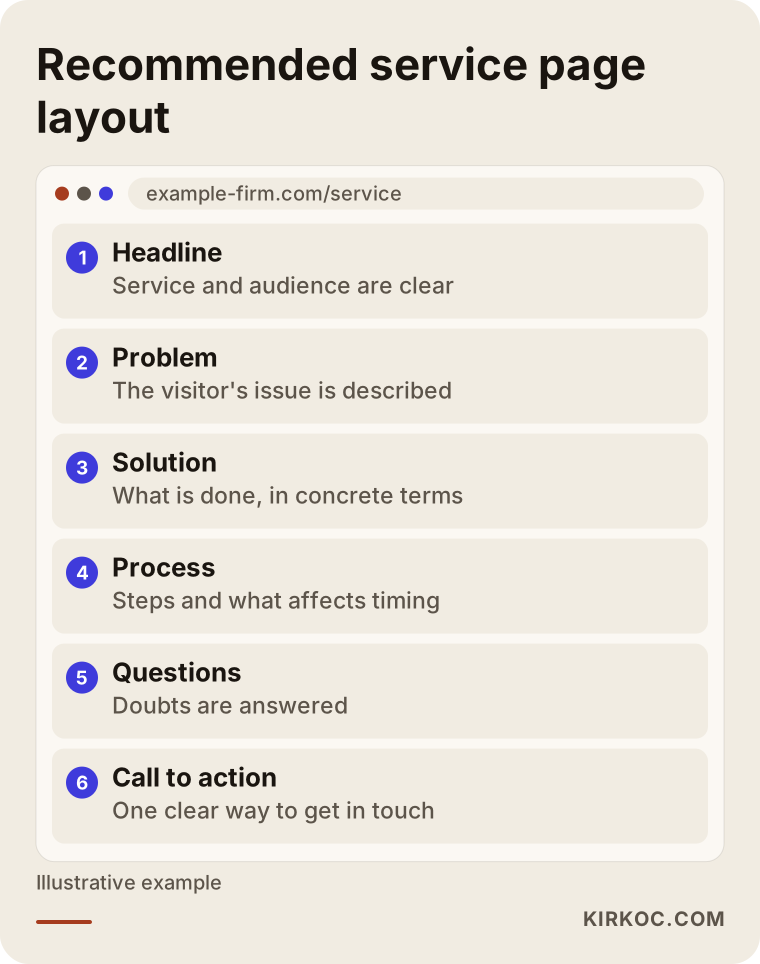
The key point in this layout is that the first screen states clearly what the service is and who it is for. After that, the visitor's problem is described, the solution is explained, the process is laid out, questions are answered and a single clear call to action closes the page. Each block answers the question left by the previous one, so the reader feels informed rather than pushed.
Here is a rule I use: write the page about the reader, not about yourself. Instead of "We have been in the industry for years," say "You want to know up front what happens if your order is late; here is how I handle that." The second version looks longer at first glance, but it connects with the reader's own concern and persuades far better.
Which pages are worth paying for first?
Not every page matters equally. If your budget is limited, putting the pages in the right order lets the same money do more. The general logic is: pages that earn money first, pages that build trust second, supporting pages such as the blog last.
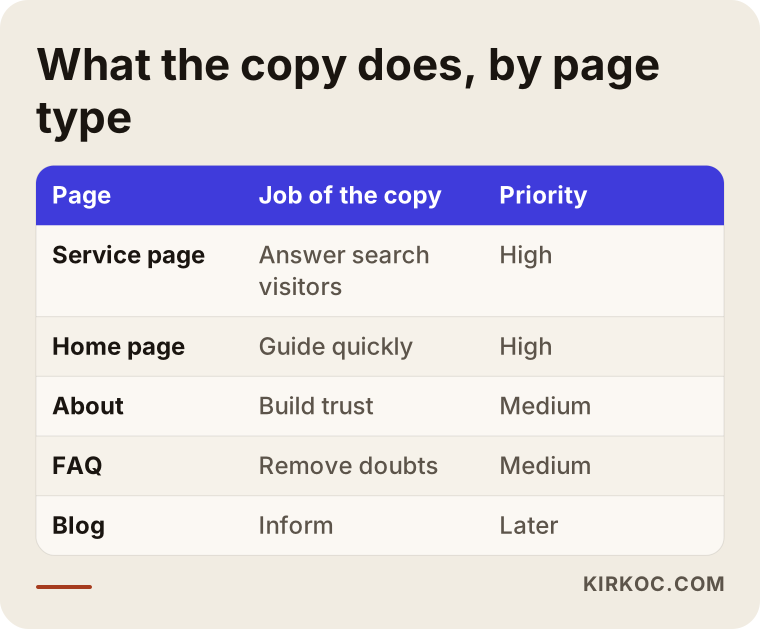
Let me unpack the table. The home page often works as a shop window, but a large share of visitors who come from search land directly on a service page. If someone types "business website content writing" into Google, they will not see your home page. They will see the page that covers that topic. So each important service needs its own page with its own copy. Cramming everything onto one "Services" page tires out both the visitor and the search engine.
The about page gets read far more than people assume. Visitors want to see who they would be working with. Bold adjectives do little here; concrete facts do: how long you have done this work, how you work and who you serve.
The FAQ section is the written version of the questions you hear in sales conversations. "How long does it take?", "What information do I need to provide?" and "What if I'm not happy?" Answering these honestly lowers the fear of getting in touch.
How do people search for you, and how should the copy respond?
This is where copywriting and being found in search overlap. Without getting technical: people type their problems into the search box in their own words. You may call your service "corporate communication solutions," but they are probably typing something like "someone to write the text for my website" or "how to get service page copy written."
Good copy contains those phrases naturally on the page. Repeating the same keyword in every sentence spoils the reading and does not help. It should be obvious that the page genuinely covers the topic. The example below shows how two different pages look to a visitor on the same search.
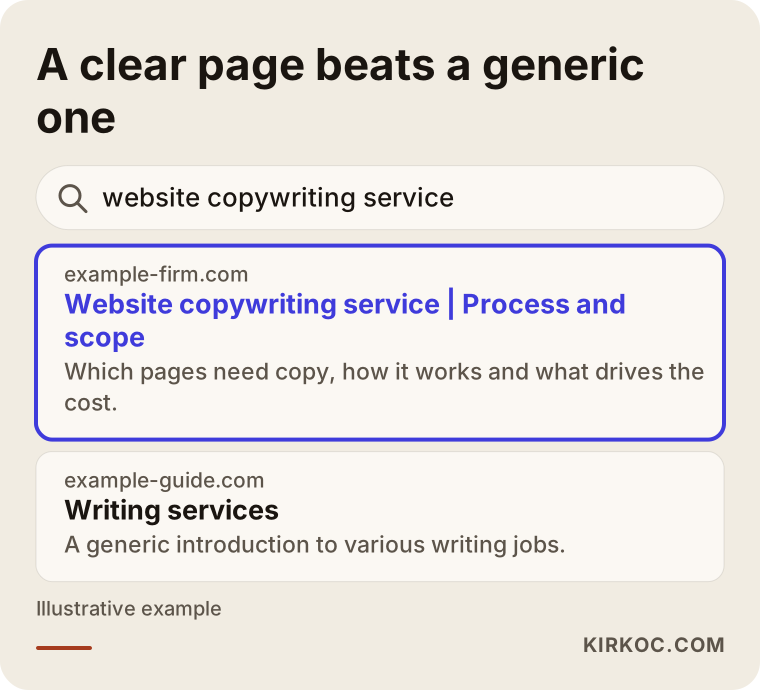
The title and the two-line description you see in a search result are the first piece of copy a visitor reads, and they decide whether the visitor clicks. Writing those two lines is part of the copywriter's job. The title should say what you do, and the description should say what the visitor gains.
There is also a newer reality: people now ask their questions to AI assistants such as ChatGPT. When these tools assemble an answer, they tend to favor pages that are clear, consistent, focused on one topic and written by a source that looks reliable. A site that answers questions in plain sentences and states who it is and what it does is easier to understand both in traditional search and in these assistants. There are no guarantees here, but it is safe to say that vague, padded text gives you no advantage.
The headline and the first screen: where the most effort goes
The two most-read parts of any page are the headline and the first paragraph beneath it. Most readers decide from those two spots whether to scroll further. That is why a copywriter spends the most effort there.
A good headline does three things: it names the subject, shows who it is for and hints at a benefit. A poor headline usually turns into a slogan ("We make a difference") or names only the industry ("Law Office"). The comparison below puts the two approaches side by side for the same service.
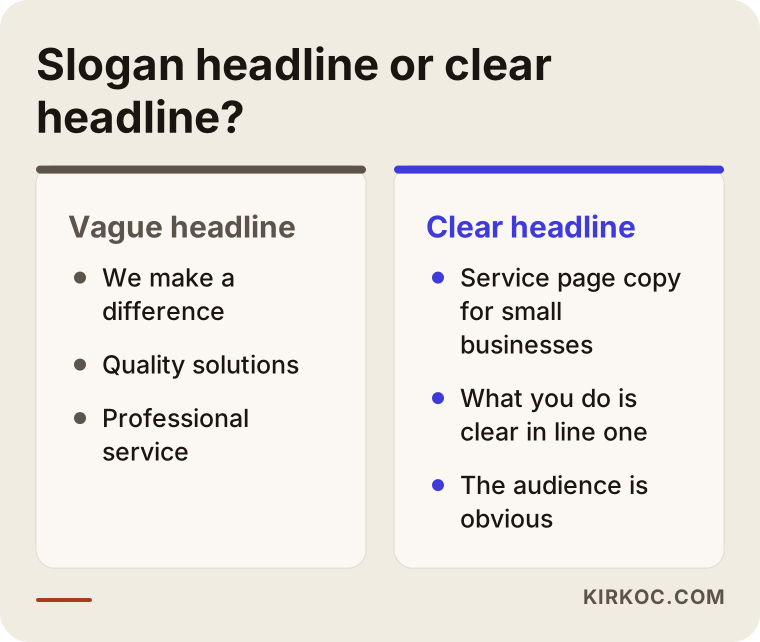
The takeaway is simple: slogans look pleasant but carry no information. Clear headlines may sound plainer, yet for the visitor, understanding the business is worth far more than hearing a catchy line. Creativity is not about decorating the headline; it is about choosing the right detail.
In the first paragraph under the headline, you should show that you know the visitor's situation. A line like "You have a website but no inquiries are coming from search?" is something the reader answers with "yes, exactly that," and that keeps them reading.
How do you write copy that builds trust?
Buying a service is often a decision about trust. When the service is something you cannot see or try beforehand, as with copywriting, people decide before they really know you. Your text has to vouch for you.
Trustworthy copy has one thing in common: it is concrete. Instead of "experienced team," write how you work, which steps you go through, what you deliver and what you will not do. Stating your limits may seem to work against you, but it raises credibility. Someone who says "I don't do this; for that, see a specialist" is more believable than someone who promises everything.
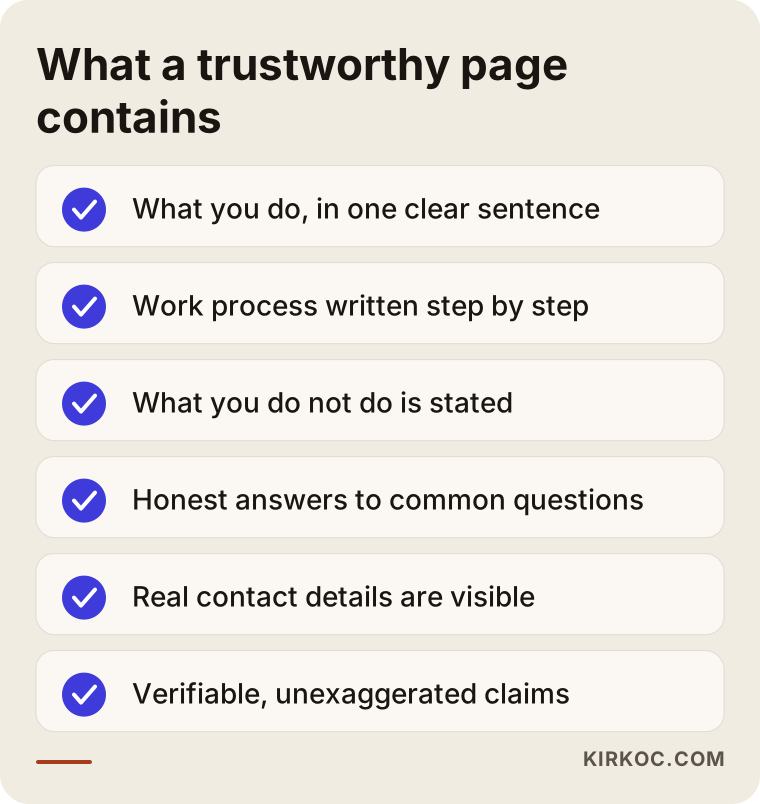
Each item on the list can enter the page as a sentence or a short section. You do not need to add them all at once. But if most of them are missing from a page, the visitor fills the gap with their own suspicion.
One more warning: do not use fake reviews, invented references or claims you cannot prove. Visitors sense it, and it can cause problems later. I cannot give a firm legal opinion on what may be said in advertising or promotional copy. If you are unsure about a particular claim, it is wise to check with a lawyer.
Example scenario 1: A small accounting firm
The following is a purely hypothetical example. Imagine an accounting firm whose site has a single page that says "Our services: bookkeeping, tax, consulting." The copy is three sentences and a contact form.
The problem: the firm wants to attract newly formed small companies and sole proprietors. Those people search with questions like "how does bookkeeping work after setting up a company" or "what are the tax obligations of a sole proprietorship." The single page on the site answers none of them.
Here is how the copywriter would approach it. First, the firm decides which clients it really wants. Next, the questions those clients ask are listed. Then separate pages are planned, for example "Bookkeeping for New Companies" and "Bookkeeping for Sole Proprietors." On each page the typical worries (what do I have to do at month end, which documents should I bring) are answered in plain language. On pricing, the page does not print numbers but explains what the fee depends on, so the visitor gets in touch to ask the "how much" question.
In this example, the copywriter is not making the firm look better. The copywriter is answering the right customer's question on the right page. There is no guarantee of results, but the right customer at least finds a place on the site that belongs to them.
Example scenario 2: A small handmade-goods brand
The second example is hypothetical too. Picture a small brand that sells handmade ceramics. The product photos are lovely, but every description is the same three words pasted onto each item: "Handmade, stylish and practical."
The issue here is different: visitors like the product but cannot decide. How big is it? Is it dishwasher safe? Can it be sent as a gift? What happens if it breaks in shipping? When these questions go unanswered, people close the window instead of adding to the cart.
The copywriter rebuilds the product descriptions around the questions of the person who would buy that item. They describe when the piece is used, how to care for it, its size and how it is packed. The brand story moves out of a generic "About us" and into a short, warm page about how the pieces are made. In e-commerce, product-page copy also matters for search, because when people type specific phrases like "handmade ceramic coffee mug," only pages with detail will match.
Both scenarios share the same lesson: the problem is not that the writing is unattractive. The problem is that it does not answer the right question. Seeing that makes it clearer why you might need copywriting at all.
How does the copywriting process work, step by step?
In a professional process, copy is not written by staring at a blank page and waiting for inspiration. First information is gathered, then a structure is built, and the writing comes last. This is the order I follow.
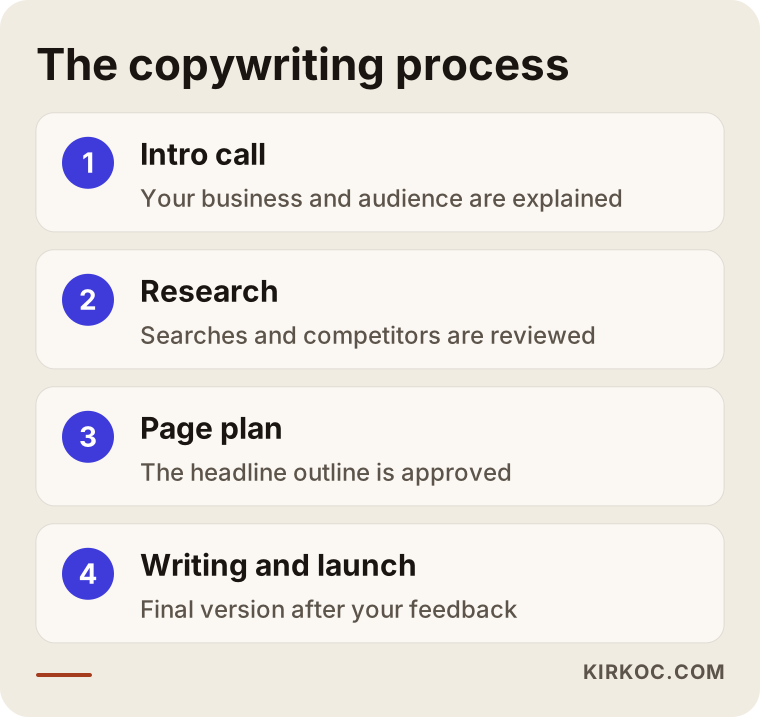
Step one: intro call and information gathering. I ask what you sell and to whom, which work earns you the most and why customers choose you. What you know is extremely valuable at this stage. A copywriter cannot know your industry better than you, but can translate what you know into something the reader understands.
Step two: understanding the reader and the searches. I look at the words your customers use to search, what competitors are writing and where the gaps are. This decides which page will answer which question.
Step three: the page plan. Before writing, I draft the heading outline of each page. That way you approve the direction before a single sentence is written, and there are fewer "this is not what I wanted" surprises later.
Step four: writing, revisions and launch. I write the texts, collect your feedback and make the corrections. Then comes placing the copy on the site. If I also manage the site, this happens naturally; if not, I deliver it in a form that works with your site manager or platform.
I will not name a single duration, because timing depends on the number of pages and on how quickly you give feedback. The timeline below shows the stages a typical project passes through.
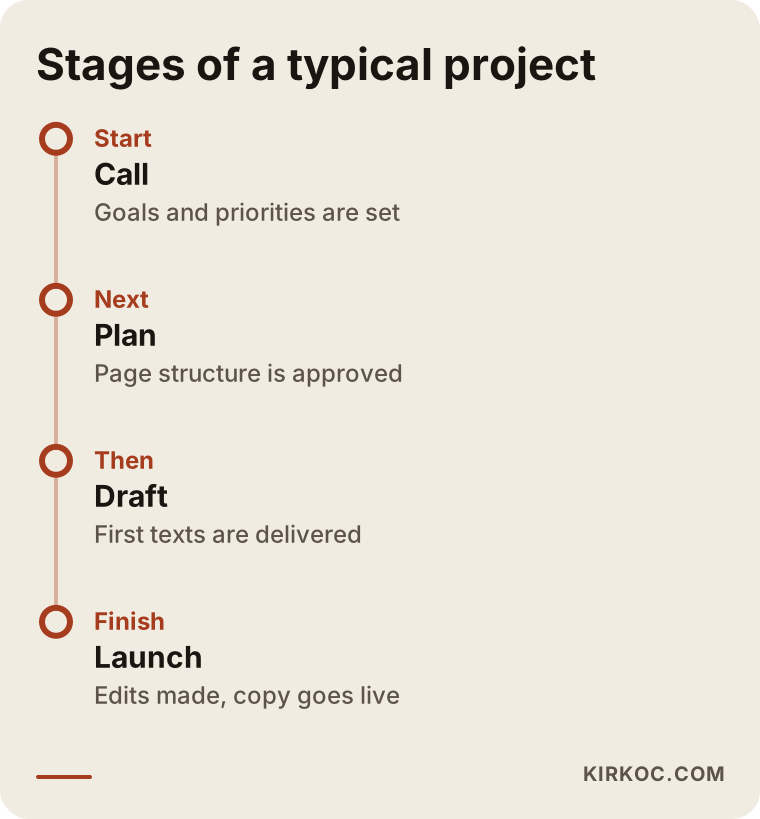
The most critical point on the timeline is the feedback rounds. Most projects run long not because the writer is slow but because of the days spent waiting for approval. If several people will review the text, naming them and the final decision maker at the start shortens the process considerably.
Common mistakes
Over the years I have seen the same mistakes in copy again and again. Knowing most of them in advance saves both money and time.
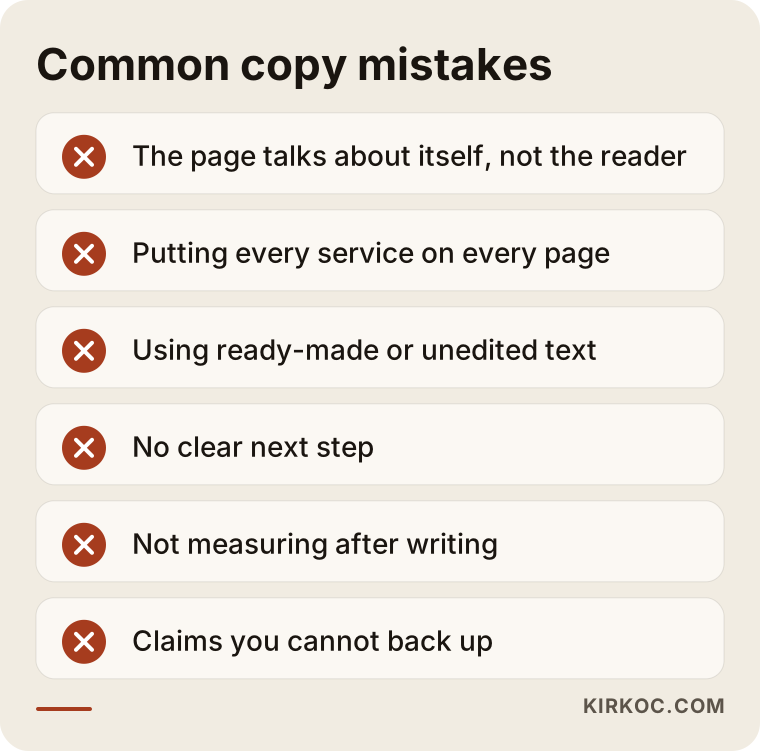
Let me expand on a few of the items in the diagram.
Copy that talks about itself. Pages that open with "founding year and vision" lose the visitor's interest in the first line. Your founding story may matter, but the top of the page belongs to the reader's problem.
Putting everything on every page. If you describe five different services on one page, you explain none of them well. Give each page one main subject.
Using ready-made text. Text copied from other sites, or generated with AI and pasted in without editing, usually carries no detail specific to your work. AI tools can be useful for a first draft, but they do not know your real processes, your limits or your customers' questions, so a person needs to go through the final version with you.
No clear next step. If a reader does not know what to do, they do nothing. Instead of "Contact us," a concrete call such as "Describe your situation in two sentences and I'll reply the same day" works much better. Just be sure you can keep the reply time you promise.
Not measuring. If nobody looks at how much each page is read or how many people reach the form after the copy goes live, you cannot know what worked. Setting up a small measurement routine turns later fixes from guesswork into evidence.
Can you do it yourself, and when do you need a specialist?
Let me be honest: not every business needs a copywriter. In some cases writing it yourself is a reasonable option.
You can write it yourself if you have a single service, you talk to customers often and know their language, you do not mind writing and you have few pages. In that case the best method is to note down the questions your customers ask and answer them on the page. Letting an acquaintance read your draft and asking "do you understand what we do?" also helps a lot.
Specialist help makes sense when you have many services or products, when you will publish in more than one language, when ads bring traffic but no inquiries, when you simply have no time to write, or when you cannot judge whether you described your own business well or overdid it. It is hard to see your own work from the inside, and a copywriter supplies exactly that outside view.
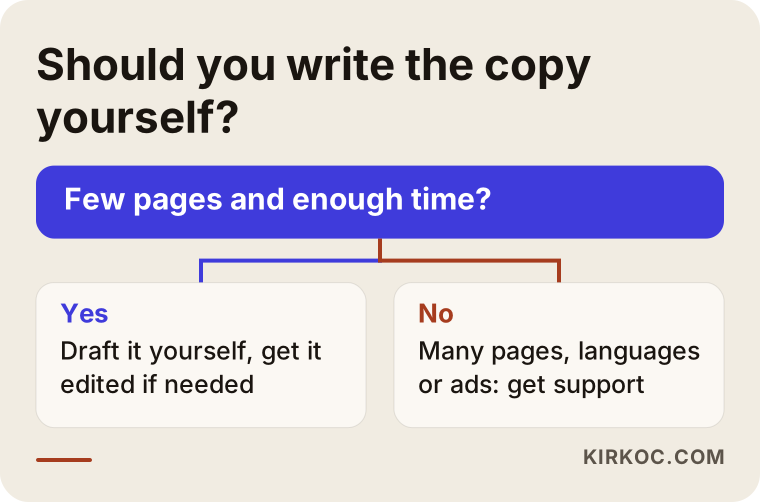
The diagram is not a strict rule, only a frame for your thinking. There is also a middle path: write the draft yourself and have a specialist edit it. That lowers the cost and keeps your own voice.
What determines the cost of a website copywriting service?
I do not give figures in this article, because no two jobs cost the same. But knowing what drives the cost makes it easier to compare the quotes you receive.
- Number and length of pages: A five-page small site and a store with fifty product pages are very different amounts of work.
- Depth of research: If your industry is technical or regulated (health, law, finance), more time is needed for checking facts and careful wording.
- Number of languages: Writing the same copy in several languages, each suited to its own readers, takes separate effort. Translation and local writing are not the same thing.
- Existing material: If you already have clear information, customer questions and sample work, the process speeds up. If you have nothing, that material has to be created first.
- Revision approach: How many feedback rounds there will be, and who signs off, affects the timeline and therefore the cost.
- Extra scope: Is it only text, or does it also include page structure, title and description fields, image suggestions and placing everything on the site?
When you ask for a quote, ask: "What is included in the price, how many revisions are there and in what format is the work delivered?" If the answer is vague, surprises are likely later. A very low price often means the copy will be assembled from ready-made templates, so judge a cheap quote by asking exactly what it delivers.
Working with one person has a practical benefit here. When the website, search visibility and advertising are run by different people, each looks after only their own part, and the copy, the page design and the ad promise can drift apart. With one person, the copy, design and measurement move under the same view, and you do not have to keep explaining to someone who is doing what.
The page path that turns a visitor into an inquiry
Copy is not a goal in itself. It is part of the path that carries a visitor to the next step. Not everyone who arrives from search or ads fills out the contact form; some drop off along the way, and that is natural. What matters is understanding where on the path you lose people.
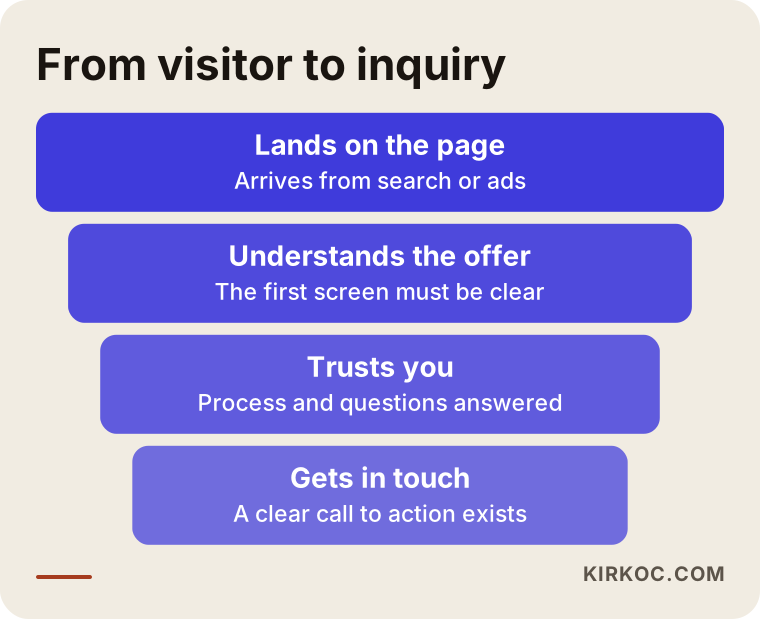
The diagram moves from wide to narrow because some visitors leave at every stage. That is normal. The aim of copywriting is not to bring the drop-off to zero, but to make sure the right people do not get stuck on the way for no good reason. For instance, if it is unclear what you do on the first screen, you lose many people at the first step; if there is no information about process or pricing, hesitation grows at the last step.
So when you look at "conversion," meaning a visitor contacting you, think about every step on the path, not just the form. Which page is read a lot but never leads to a form? Which page do people leave right away? Those questions give you a map of where to improve the copy.
How I work
I work alone and carry out the job from start to finish myself. For copywriting, the first step is a short conversation where you describe your business and your target customer. In that conversation I look at your current site and we decide together which pages come first.
Then I show you the page plan and write to the structure you approve. When I deliver, I either place the copy directly on your site or hand it over in a format that fits your system. If you have no site yet, or it is being rebuilt, creating the copy and the design together is much more efficient, because the copy shapes the layout of the page, not the other way around.
If you want, I can also handle local search visibility, social media and ads under the same roof. It is not required; I take copy-only jobs too. But having the text on your site match the tone of your posts and your ads is the most tangible gain of working with one person. I give no guarantee of results. What I do promise is to tell you plainly what I will do and why.
Frequently Asked Questions
Is website copywriting the same as blog writing?
No. Website copy covers the pages that lead a visitor to understand the service and get in touch, such as the home page, service pages and the about page. Blog articles generally attract visitors by giving information and building trust. The two complement each other, but their purposes and writing styles differ.
Can I write the copy myself and just have it edited?
Yes, and it is a common and sensible method. You know your business best, so you produce the draft; a copywriter tightens the structure and fixes repetition and vague sentences. It lowers the cost and keeps your voice.
Is AI-written copy good enough?
It can help with drafts and ideas, but on its own it is not enough. These tools do not know your real process, your customers' questions or the limits of your work, so the results tend to be generic and look like everyone else's. A person should review the final version using your own information.
Can you guarantee that I will rank at the top of Google after the copy is written?
No, nobody can honestly guarantee that. Rankings depend on many factors. Clear, focused and useful copy helps your page be understood and reach the right people, but I do not promise any particular position or result.
How many pages do I need copy for?
It is enough to start with separate pages for the services that earn you the most, plus the home page, about page and contact page. More pages can be added later based on customer questions. You do not have to do everything at once; the order of priority depends on your budget.
How long does website copywriting take?
It depends on the number of pages, how technical the subject is and how quickly you give feedback. A small site finishes quickly; a site with many pages is split into stages. It is best to discuss a firm timeline after seeing the page plan.
Do you also write website copy in more than one language?
On multilingual sites, the copy should be written for the readers of each language rather than translated word for word, because examples, phrasing and search habits differ by country. I will tell you the scope and the languages I can work in after listening to what you need.
How can I tell if my current copy is bad?
There are a few simple tests. Show a page to someone who does not know your business and ask, "What does this place do?" If they cannot answer right away, the copy needs to be clearer. Also, if the page is mostly adjectives such as "quality" and "professional" rather than concrete information (process, limits, examples), it is worth rewriting.
If you are not sure whether the text on your site is working, or you want it written from scratch, you can reach me through my content writing service page. Describe your situation, and we can talk through which pages make sense to start with.