You run a small business, and everywhere you turn you hear the same advice: "You need a website," "You have to be active on Instagram," "If you don't show up on Google, you don't exist." A friend recommends a web designer. Someone else knows a person for social media. A third contact swears by a completely different SEO specialist. You end up facing three people, three price lists and three work plans that have never met each other. This article is for anyone standing at exactly that point. It explains what a website, SEO and social media package really means for a small business, how the parts connect and what to watch out for. I am Ümit Kırkoç, and I run all of these jobs on my own from Istanbul. Where it matters, I will be open about how my own website design service is framed.
Let me say one thing up front: I am not going to tell you to buy everything. For some businesses, the right move is simply a clean website and a correct map listing. For others, social media comes first. My goal is to help you understand what each piece does for you, so you spend money where it counts.
What do I actually mean by "package"?
In digital marketing, the word "package" often sounds like a price list. I mean something different: three connected jobs planned by the same head.
A website is your permanent address on the internet. It is where you explain who you are, what you sell, where you are and how people can reach you. It does not depend on anyone's algorithm. It does not vanish because a platform changed a rule.
SEO (search engine optimization) is the work that helps that website show up when your customers search on Google. If someone types "wedding photographer in Austin" or "shoe repair near me" and sees your business, the SEO is doing its job.
Social media is where people get to know you, start to trust you and remember you. Instagram, Facebook, LinkedIn, TikTok or YouTube: which one makes sense depends on your industry and your customer.
You can buy these three separately. But when you do, a familiar pattern appears. The site looks lovely but nobody finds it. Social media is busy, but the person who clicks through lands on a weak page. SEO work gets done, but the pages do not persuade anyone. The real benefit of thinking in terms of a package is that each part covers the gaps of the others.
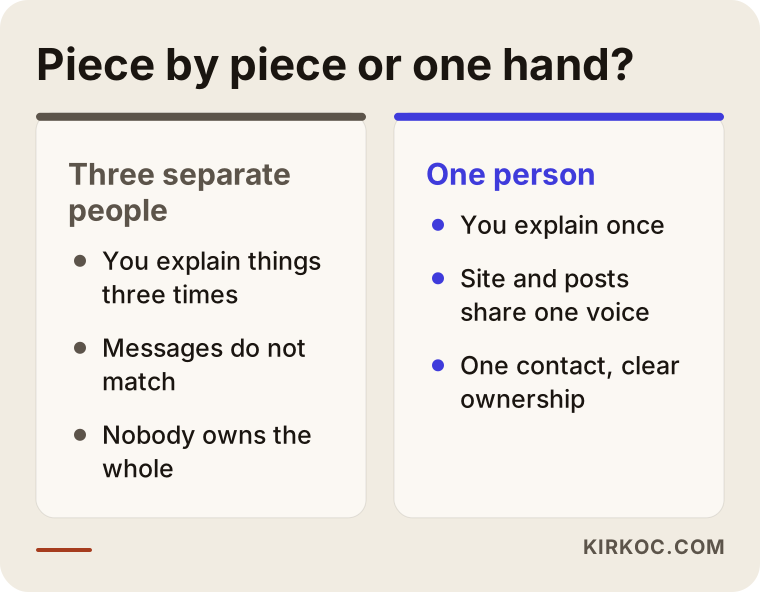
The graphic above sums up the difference. When you work with three separate people, you explain your business to each of them again and again, and nobody takes responsibility for the whole picture. When one person handles everything, the same person who writes your site copy already knows what you will post on Instagram, and knows which page your ads should send people to.
How do your customers really find you?
The right place to start is not what you want to do, but what your customer does. The same person often follows several of these paths in a row: a friend mentions your name, they check your Instagram profile, they search your name on Google, they read your reviews on the map, then they open your website looking for a phone number. Wherever they find something missing, they give up.
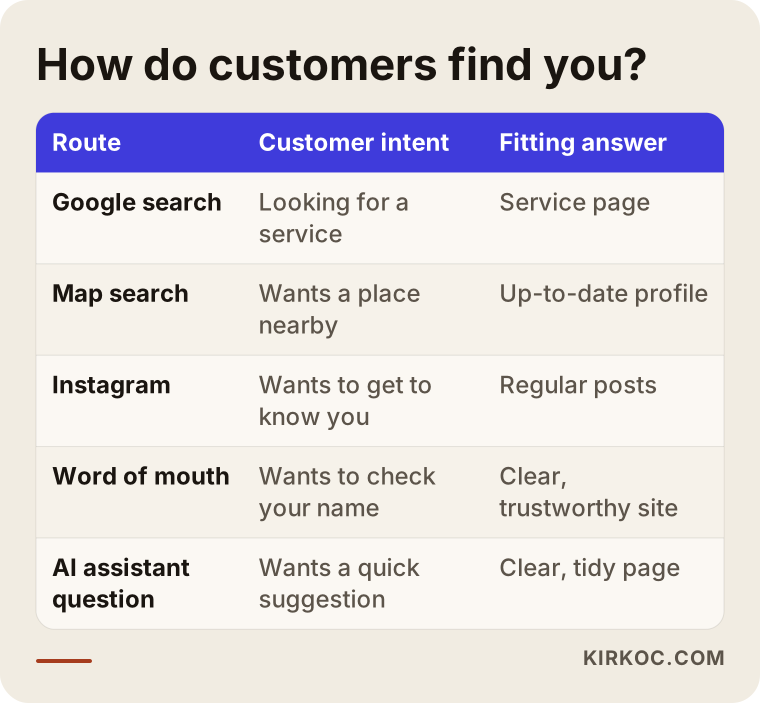
As the table shows, every route has an intent and a fitting answer. Someone who wants to know your price will not be satisfied by an Instagram post; they need a clear service page. Someone wondering "can I trust this business?" will not be convinced by a website alone; they need real reviews, regular posts and up-to-date information on the map.
So for a small business, the first question is not "which platform should I be on?" It is "what steps does my customer go through before deciding?" A barber shop and an accounting office have customers who travel very different paths. The barber's customers mostly arrive through the map and Instagram. The accountant's customers come through a Google search for the service, or through a recommendation.
The website: the foundation of the package
You would not furnish a home you only rent. Social media accounts are a little like that. An account can be shut down, access can be restricted, and the rules about who sees your posts can change overnight. A website is yours. That is why, most of the time, the site is the foundation of the package.
A small business site does not need many pages, but it does need the right ones. Usually this is enough: a home page, a separate page for each main service, an "about" page that introduces you, a contact page, a short FAQ section and, depending on your work, sample projects or reviews.
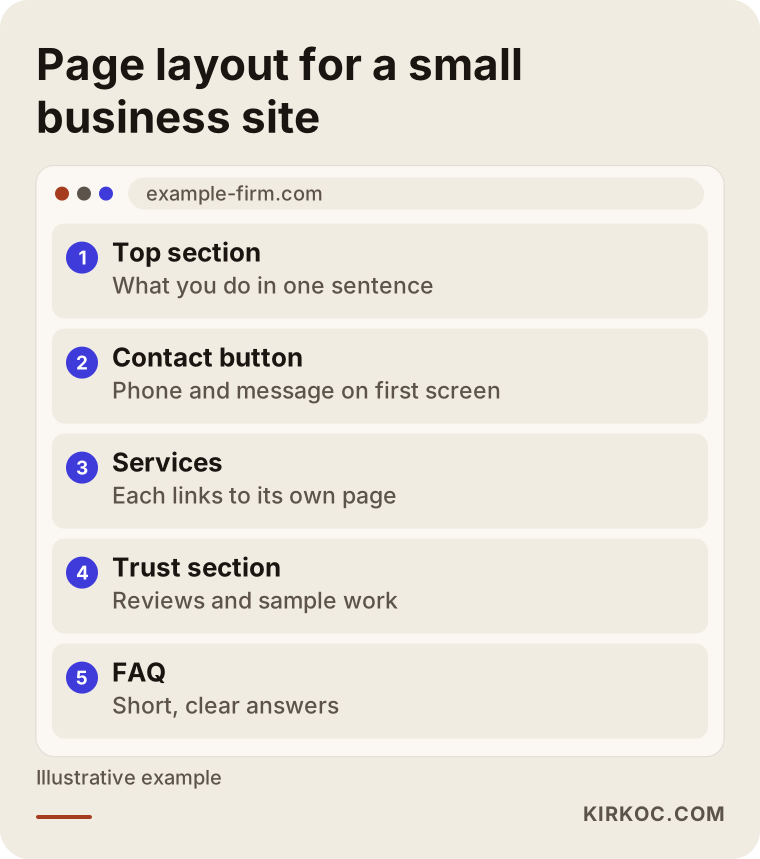
The layout in the graphic is an invented example, and the order and content would change for your business. The logic stays the same: a visitor should understand what you do on the first screen, and see how to reach you right below it. A site where the phone number hides three clicks deep will not bring you work, however beautiful it looks.
There are a few technical points too, and I will keep them plain. The site must open comfortably on a phone, because most visitors arrive on one. Pages must load quickly; a slow site loses visitors and can also drag you down in Google. The domain name (your web address) and the hosting (the computer where your site lives) should be registered in your name. If you skip that question, someone else may end up holding the keys to your site. I settle this in writing at the start of every project.
What every site must have
When a visitor lands on your site, they should find answers to three questions: What does this business do? Is it right for me? How do I get in touch? Read your own site through those three questions. If one of the answers is not visible at first glance, that page is not doing its job.
SEO: making the site findable
Even when your site is finished, Google does not know it as well as you do. SEO is the systematic way of telling Google, "this business does this job in this area." For a small business, SEO has three main tasks.
The first is finding the words customers actually type. You might say "architectural implementation service," while your customer types "home renovation contractor." If your pages are not written in the customer's language, there is no match.
The second is creating a separate page for each main service that explains that service. Cramming everything onto one page makes life harder for Google and for the visitor. A person searching for "teeth whitening" wants to land on a page about exactly that.
The third is local visibility. If you have a physical location or a service area, the business profile on the map (your Google Business Profile) and the address details on your website should match each other exactly.
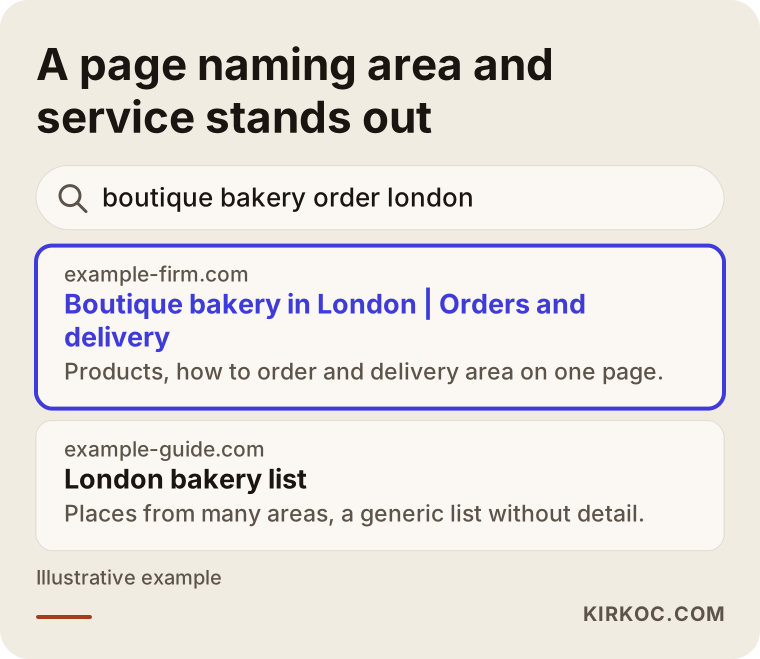
The highlighted result in the example names the area and the service clearly, and says what it offers in one sentence. The generic guide site gives no detail. This is not a ranking guarantee; it only shows which features set a good page apart from a weaker one.
I have to be honest about one thing in SEO: results take time. A new site needs weeks, sometimes months, to earn trust with Google. If someone promises you "first place in a week," they are either misinformed or misleading you. I do not promise rankings. I explain what I am doing, why I am doing it and what I will watch.
GEO: appearing in AI answers
More and more people ask tools like ChatGPT questions such as "how do I choose a good accountant in my area?" When these tools answer, they lean on pages that are clear, well organized and trustworthy. This is called GEO. For a small business it is not a separate magic job. Short, plain pages written in a question-and-answer style, plus consistent business details everywhere, help both SEO and these tools.
Social media: being known and trusted
Social media is the most visible part of the package and often the most misunderstood. People tend to think about it in terms of follower counts. For a small business, though, the number is not what matters. What matters is that the right people see you, and trust what they see. An account followed by a thousand people where nobody ever writes to you is worth less than an account with a hundred followers that sends you messages every week.
The choice of platform depends on the work, too. For a hair salon, café or boutique, Instagram acts as a visual shop window. For an accountant, consultant or wholesaler, LinkedIn may make more sense. For businesses that can show "how it's done," such as repair, teaching or cooking, YouTube and TikTok work well with short videos. You do not have to be everywhere. Five accounts run halfway are worse than one account run well.
The content you create for social media should talk to your website. For example, the caption of an Instagram video about a service should point to that service's page. Three short posts can be carved out of a single FAQ section on your site. That way, content you produce once works in several places.
Where do ads fit?
Google and Meta (Instagram and Facebook) ads can be seen as a fourth leg of the package, but they are optional. SEO and social media take time. Ads give quick visibility, but they stop when the budget runs out. For a newly opened business, a small ad budget in the first months can act as a bridge until SEO starts to have an effect. But if the page your ad points to is weak, the money is wasted. That is why it is healthier to think about ads after the site is ready.
The customer's path: how does a viewer become a buyer?
The customer's journey shows best why the package is a whole. A person first sees you, then gets interested, then writes or calls, and finally buys. People drop out at every stage, and the real task is to reduce those losses.
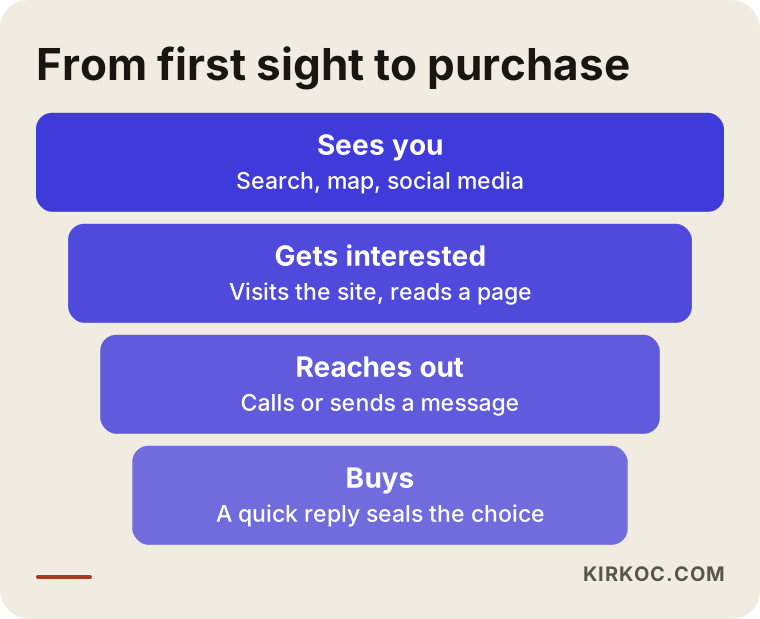
The graphic shows a path that narrows from top to bottom. At the top, social media, search results and the map profile do the work. In the middle, the persuasive power of your site comes in. At the bottom, how easy it is to reach you and how fast you reply decide things. If one link is weak, the effort above it is wasted. The case I see most often looks like this: the contact form does not work, messages get answered three days later, or the phone number is out of date. These mistakes cost no money to fix, yet they cost the most.
Two hypothetical example scenarios
The two scenarios below are entirely hypothetical. They do not describe a real company or a real person; they were made up only to show the logic.
Scenario 1: The neighborhood bakery
Imagine a boutique bakery in a neighborhood. It has years of experience and loyal customers, but families who have just moved in do not know the shop. It has an Instagram account, but posts are irregular. There is no website, and the map listing shows an old phone number.
The first step of the package here would not be anything huge: fix the map listing, build a simple one-page website (product groups, how to order, delivery area, phone and address), then set up a steady weekly rhythm on Instagram. On the SEO side, local searches such as "neighborhood name plus boutique cakes" would be the target. No big budget is needed; the real job is building order.
Scenario 2: A small accounting office
Another hypothetical example: a two-person accounting office. Most of its clients come by recommendation, but it wants new ones to grow. It has a website, but it is a single page whose services section is one line: "accounting, tax, consulting."
Here Instagram would not be the priority. The work would begin by splitting the services into separate pages: company formation, monthly bookkeeping, payroll and so on, each answering the questions people commonly ask about that topic. SEO then runs through those pages. On social media, LinkedIn is the better choice, and a few short, helpful posts a month are enough. For anything related to tax law or regulations, the writing would avoid firm claims and, where needed, say "please check with a licensed accountant or attorney."
The difference between the two is clear: the same three parts, but the weight and order change completely depending on the business. Applying a ready-made template to everyone is not a good idea for that reason.
Step by step: how does the work run?
I usually build this kind of package in the following order. Changing the order tends to create extra work later.
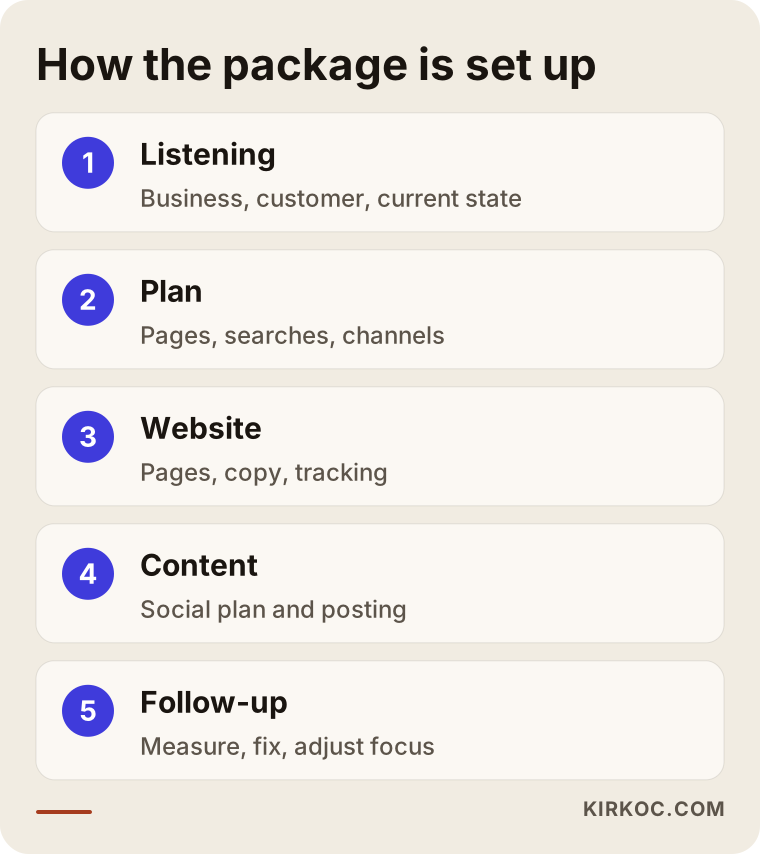
First, listening and review. I talk with you about your business, your customer, your current site and your accounts. Who buys from you, why do they choose you, where are you losing people? I also look at competitors at this stage, but the aim is not to copy them. It is to find the point where you can stand out.
Then, the plan. Which pages will be written, which searches will be targeted, which social platform will be used and in what order the work will happen are all put on paper. What will not be done is written down as well, because when the scope is vague, expectations drift.
Then, the website and groundwork. Pages are built, copy is written in your customer's language, images are prepared and tracking is set up. Tracking matters: if you cannot see how many people called or how many filled in a form, you cannot know what is working.
Then, social media and content. While the site is being finished, the posts are shaped to match its pages. A monthly content plan is prepared, using the photos and information that come from your business.
Finally, follow-up and adjustment. After the first months, I look at what is working. Where something is not working, I do not insist; I put the weight on what is.
What do the first months look like?
To keep your expectations realistic, here is a rough timeline. The order matters more than exact lengths, and it can shift with the size of the job.
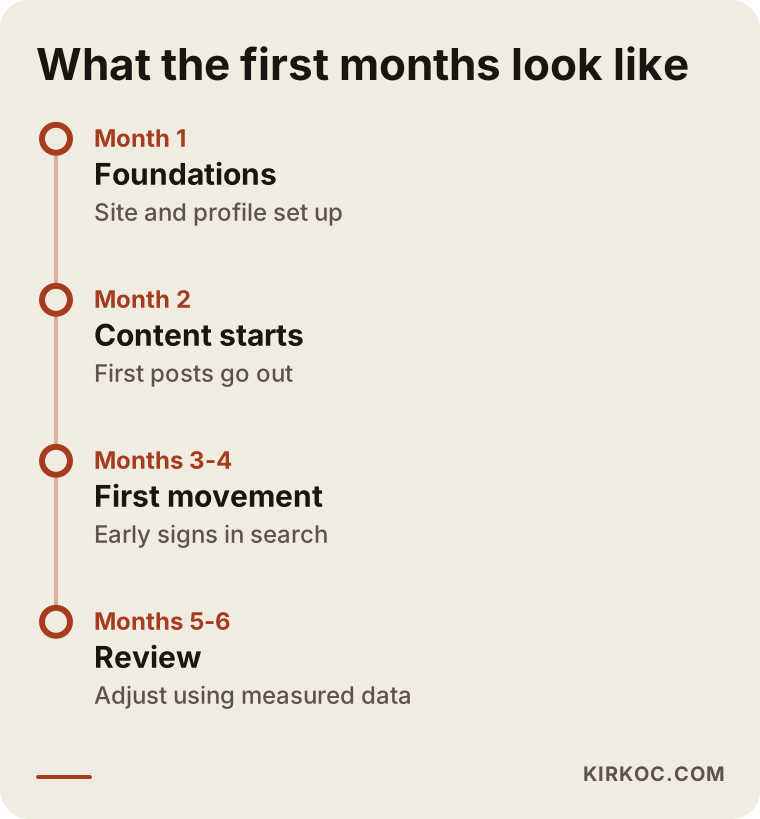
The first months are mostly about laying foundations: the site goes live, the profile is cleaned up and the first content goes out. Movement in search results usually shows up later. On social media, engagement sometimes comes earlier, but that does not have to turn into sales right away. Giving up on this work after two weeks because "it didn't work" is like planting a seed and digging it up the next day.
The most common mistakes small businesses make
After years in this field, the same mistakes keep appearing. These are the most frequent:
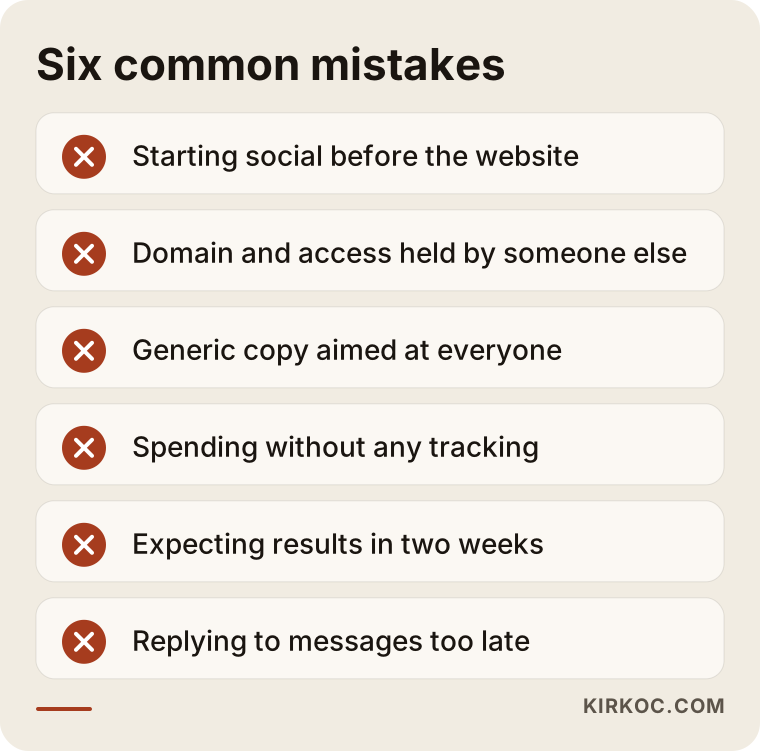
Building social media before the website. An account is opened, posts go out for months, but when an interested person clicks, there is no address to go to. The effort stays trapped inside the platform.
Having a site built and leaving ownership with someone else. The domain is registered to the person who built it, and the admin password is theirs. When the job ends, or when there is a disagreement, you cannot get into your own site. Always insist that the domain and admin access belong to you.
Writing copy that speaks to everyone. Phrases like "quality service, fair prices, customer satisfaction" appear on almost every site and set none of them apart. Write what you do, where and for whom.
Not measuring. If you do not know where phone calls or form messages come from, you cannot tell whether the place you spend money is working.
Expecting results too fast. SEO and organic social media build up over time. If you want fast results, you need another tool such as ads, but those stop when the budget ends.
Replying to messages late. A person who writes through social media or a form goes to the business that answers first. No marketing work can fix that loss.
What can you do yourself, and when should you call a specialist?
You do not have to hand everything to someone else. Doing some things yourself is both cheaper and useful. Checking your map profile, keeping opening hours current, replying to customer reviews, sharing real photos you took on your phone and checking the contact details on your site are all things you can do. You know your business best, and that knowledge does not exist in anyone from the outside.
The places where you will usually need a specialist are these: the technical setup of the site, planning the page structure for search, the tracking system, setting up ad accounts and steady, professional content production. These are jobs where a mistake is hard and costly to undo.
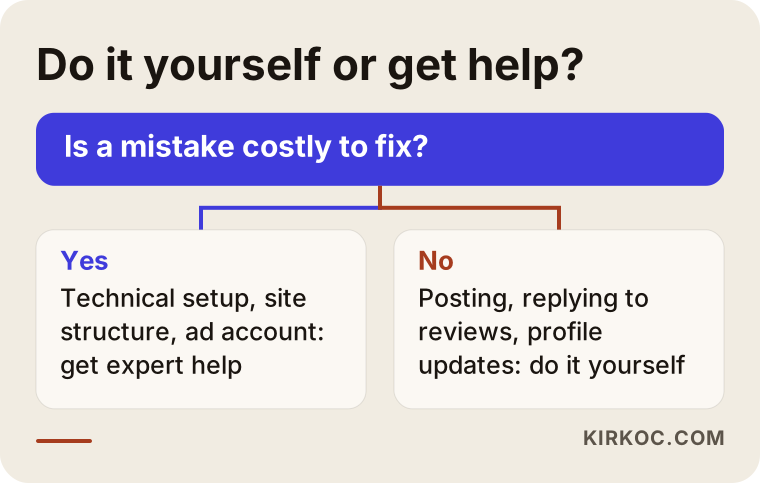
The question in the graphic offers a simple yardstick. If a mistake costs little and is easy to fix, you can try it yourself. If a mistake costs a lot or is hard to fix, getting help makes sense. Deleting a post is easy; repairing a badly built site structure can take months.
The place of the package in the age of AI
The ways people look for information are multiplying. Some still type into Google, some ask an AI assistant and some search inside Instagram. This variety makes the package more meaningful: relying on a single channel is risky. A site with clear, well-organized pages can serve as a source for search engines and AI tools alike.
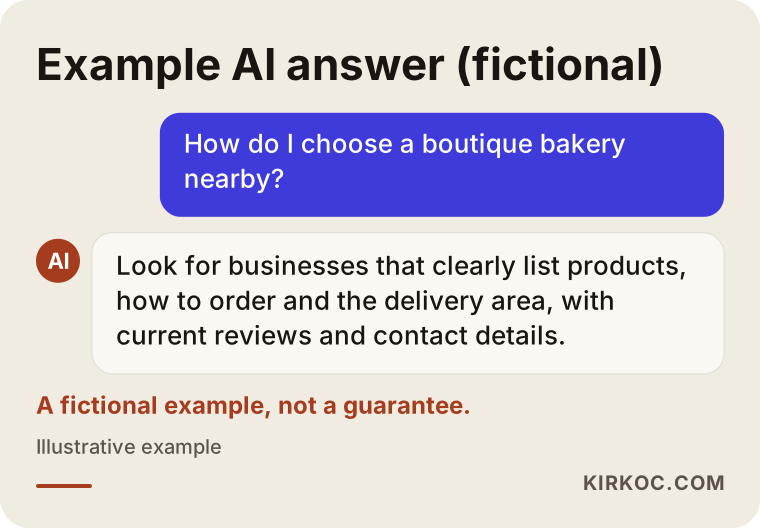
The answer in the graphic is a fictional example, not the output of a real system. But the logic holds: these tools tend to use pages that answer the question directly and state business details clearly and consistently. That is not a guarantee; it only means a well-written page will not hurt you and may well help. For the same reason, the information on social media and on the map should never contradict your website.
What determines the cost?
I will not give numbers in this article, because an "average price" is misleading in this work. What I can do is tell you plainly what moves the price:
- Number of pages and amount of content. A five-page site and a site with dozens of service and location pages are not the same job.
- Who prepares the copy and images. If you already have photos and information ready, the job is shorter; if everything is made from scratch, it grows.
- Target area and competition. In a crowded industry, SEO work is longer and more intensive.
- Number of social channels and posting frequency. There is a big gap between one account with a weekly rhythm and four accounts with daily posting.
- Video and special shoots. Content filmed on a phone and planned production do not cost the same.
- Ad management. The ad budget is a separate line; the effort of managing it is considered separately.
- Continuity. A one-time setup and ongoing monthly support are priced differently.
- Extra languages. If you also want to speak to foreign customers, every extra language means separate content.
When you ask for a quote, ask in writing what is included and what is not. If you see a single line that says "social media management," open it up with questions: how many posts, which platforms, who prepares the visuals, is there a report? Vague scope turns into arguments later.
How I work with you
I am one person, and that is on purpose. The person who builds your site, sets up your SEO plan, prepares your social media content and manages your ad account is the same person. That means nothing gets lost when work is handed from one person to another, and nobody says "that question is for the social media person" or "ask the website person." When you ask something, the person answering is the person doing the work.
The process usually starts with a short introductory conversation. I listen to your business, your goals and your current situation. After that, I give you a written summary of what you really need, what you do not need and in what order you can move forward. You do not have to buy everything at once; you can start with the site and add social media later, or the other way around. Your domain, your accounts and your admin access always stay in your name.
I do not promise outcomes. I will not guarantee follower numbers, a specific ranking or sales, because I do not think anyone can honestly guarantee those. Instead, I tell you at the start what I will do, what I will track and when I will report back.
Frequently Asked Questions
Is a website alone enough?
For some businesses, yes. If your customers come by recommendation and you just need a trustworthy address, a proper website with a correct map listing may be enough. But if you want new customers, the site also needs to be findable, which takes SEO, and to build visibility and trust you may need social media too.
Should I start with the website or social media?
In most cases, the website first, because someone who gets interested through social media needs somewhere to go. Even so, if you are starting on a very small budget, you can begin with a simple one-page site and run social media at the same time. The order can change depending on the type of business.
Why is getting all three together better than buying them separately?
When the parts are connected, the same content is used in several places, the messages stay consistent and nobody undoes anyone else's work. Working with one contact person also lightens the communication load. That does not mean "buy everything" for every business; skipping what you do not need is part of the package logic too.
When will I see results?
It depends on the work. Map profile fixes and ads can show an effect faster, while SEO and organic social media take time. Giving an exact number would not be honest, because it depends on your industry, your competition and your site. What matters is looking at the right indicators in the first months: number of searches, forms and phone calls, profile visits and so on.
Do I have to give you my social media accounts?
You should always remain the owner of the account. You give limited access so I can post during the work, and you can take that access back at any time. Any arrangement that requires you to hand over your password or ownership is not the right one.
Monthly contract or one-time job?
It can be either. Building the site is usually a one-time project. SEO and social media need continuity, so they run on a monthly basis. Seeing this split clearly in the quote saves you from surprises later.
Can anything be done on a small budget?
Yes, but you need to prioritize. Fixing the map profile first, building a simple and clear site and running one social media channel steadily is far more efficient than spreading yourself thin everywhere. As the budget grows, the other parts can be added.
Do I have to run ads?
No. Ads help when you want quick visibility, but your site and profiles need to be ready first. Building that base first is the easiest way not to waste an ad budget.
If you want to bring your website, your search visibility and your social media into one simple, measurable setup, you can write to me through my website design service page. I will listen to your business and I will tell you plainly what is really needed.