Short answer
If you run, own or have just invested in a ceramics plant, a marble quarry or a manufacturing business in Bilecik, the right web designer is not necessarily someone with an office in town. It is someone who can plan your product catalog, your technical information, your foreign-language pages and the way buyers request a quote, all at once. In these industries your customer rarely sits in Bilecik. They are an architect in Istanbul, an importer in the Gulf, a distributor in Germany or a contractor in Texas. That makes remote meetings the natural way to work, not a compromise. One option is me, Ümit Kırkoç (kirkoc.com): I am based in Istanbul, I work remotely with companies across Turkey and abroad, and because I handle the website, search visibility, social media and advertising myself, you deal with a single person instead of a chain of contractors. You can read more on my website design page. Below, I lay out the criteria that will help you whoever you end up hiring.
Why should an industrial company in Bilecik have a different kind of website?
Because your website is not a shop window. It is the first ten minutes of a sales conversation. Picture a ceramic tile producer in Bozüyük, a marble quarry near Vezirhan or Osmaneli, or a spare parts workshop in one of the organized industrial zones. Their buyers do not add products to a shopping cart. They look at your sizes, finishes, production capacity, lead times and how to reach you. Then they either ask for a sample or move on to the next supplier.
This is where a website for a café or a hair salon parts ways with a website for a marble exporter. For the café, an address, a menu and a few good photos usually do the job. For the exporter, the buyer is looking for answers to questions like these:
- Which stone types or product series do you have, and in what dimensions are they cut?
- Do you sell slabs, tiles or blocks, and which surface finishes do you offer (polished, honed, tumbled and so on)?
- How much can the plant or quarry produce, and is that enough for a large project?
- Do you send samples, and how does someone request one?
- Can technical documents, such as product data sheets and test reports, be downloaded?
- Is there someone who can talk to me in my language?
If those answers are not on the site, the buyer does not pick up the phone to ask. They find them on a competitor's site. Many marble and ceramic producers in Bilecik make excellent products, yet online they are often represented by an "About us" page and a gallery of unlabeled photos. That gap is exactly where you can stand out, especially if you sell abroad and your buyers judge you from thousands of miles away.
How do buyers in this industry search for you?
In short: by product name, dimension and application, and only sometimes by city. "Website design Bilecik" is what you might type when looking for a designer. Your customers type something completely different. An architect might search "beige marble slab 2 cm." A buyer in the United States might type "Turkish beige marble supplier" or "porcelain tile manufacturer Turkey." A contractor in Turkey might search for exterior granite-look ceramic tiles in bulk, in Turkish. A building manager might look for a ceramic factory outlet in Bozüyük to buy direct.
Each of those searches needs its own page. A single homepage cannot answer all of them. Google tries to show the page that best answers a given search, so you need separate, substantial pages for each product type, each application and each language. The work of making that happen has a name, SEO (search engine optimization): the set of changes that help your site appear when your customers search.
In the last couple of years, another channel has joined the mix. A purchasing manager may now ask ChatGPT or Gemini, "Recommend a beige marble slab supplier in Turkey." These tools build their answers from pages on the web that are clear, well organized and trustworthy. If your products are described in plain sentences and your capacity and shipping details are written out on the page, the chance that your company name shows up in that kind of answer goes up. This is often called GEO (generative engine optimization), which simply means organizing your content so AI assistants can understand your business and recommend it.
The illustration below acts out the kind of question a buyer might put to an AI assistant, and the type of page the assistant draws on.
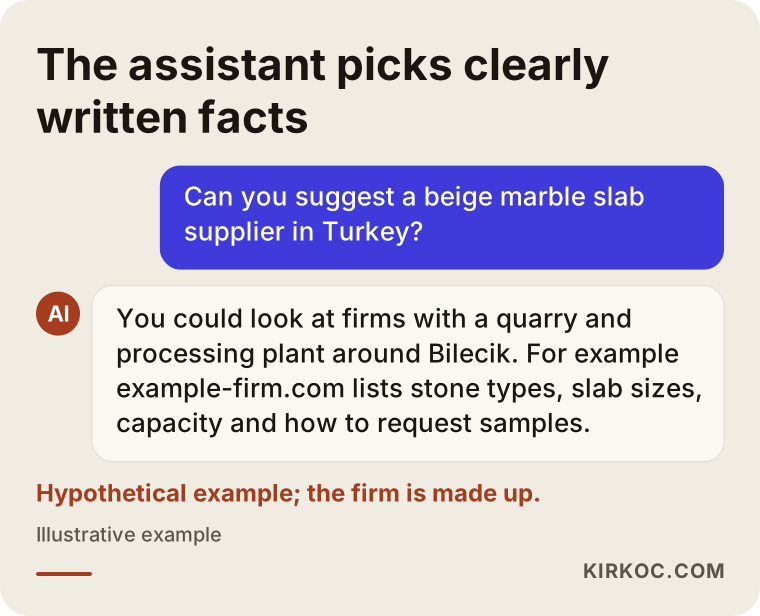
What stands out in that answer is that the assistant relies on clearly written facts, not on beautiful design. If the stone type, slab size, capacity and contact route are not on the site as text, even the most elegant photo gallery will not make it into the answer.
Which pages should a ceramic, marble or industrial website have?
At a minimum, six pieces: a product catalog, an individual page for each product, a production and capacity page, a technical documents section, a sample and quote request form, and foreign-language versions. On top of that, you add whatever your particular industry calls for.
Product catalog and product pages
Your catalog should let a buyer filter down to what they need. For marble, useful filters include stone type, color, finish and thickness. For ceramics, think size, surface and application (indoor, outdoor, floor, wall). Every product deserves its own page, and that page needs written information next to the photo: dimensions, finish options, packaging and suitable uses. Uploading a PDF catalog is not enough on its own. Google and AI tools cannot read the contents of a PDF as easily as a regular web page, and a buyer on a phone will struggle to open a large file in the first place.
Production, quarry and capacity page
Someone sourcing materials for a big project wants to know whether you can handle the volume. This page should show real photos of your quarry or plant, a short description of your machinery, your cutting and processing capabilities, and what determines your typical lead time. Concrete details build more trust than claims like "industry leader" or "the largest producer in the region."
Technical documents
Product data sheets, test reports and any quality certificates you hold should be easy to download. One caution here: which documents you publish, and how you describe them, can depend on the rules in the countries you export to. If you are unsure about a certificate's validity or how it should be presented, talk to a lawyer or to the certification body that issued it. My job is to make sure those documents are easy to find and neatly organized on the site.
Sample and quote request form
The most neglected part of industrial websites is the buyer's next step. Instead of a generic "Contact us" form, use a short form that asks which product, what quantity, which country or city, and whether a sample is needed. That alone noticeably improves the quality of the inquiries that reach your inbox. WhatsApp and a phone number should sit right beside the form, since many buyers in Turkey and the Middle East prefer to message directly.
Foreign-language versions
A significant share of Bilecik's marble and ceramics goes abroad. An English version is close to mandatory for most producers, and depending on your target markets you may also need Arabic, German or Russian. Pages produced by an automatic translation plugin neither earn a buyer's trust nor perform well in search. Each language should be its own set of pages, written for the person searching in that language.
The illustration below sums up how a marble product page should flow from top to bottom.
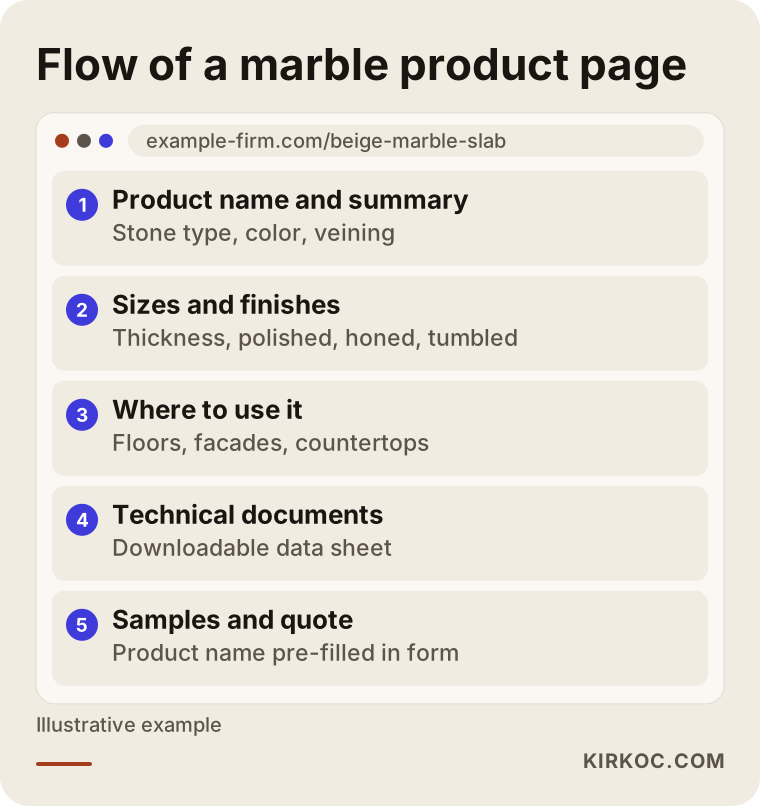
That order is deliberate. A buyer first wants to know what the product is, then whether it fits their project, and finally how to request it. When the page follows that sequence, a visitor is more likely to reach the quote form without leaving.
What about Bilecik businesses outside manufacturing?
A simpler site is often enough, but showing up in local searches becomes more important. If you run a hotel, restaurant, clinic, real estate office or auto repair shop in central Bilecik, Söğüt, Pazaryeri or Gölpazarı, your customers are most likely searching on their phones for something "near me." In that case, a properly filled-in Google Business Profile (your listing on Google Maps), a fast-loading site and services that are each described on their own become decisive. Visitors drawn to Söğüt by its history usually look up hotels and restaurants before they set out, so a hospitality business needs a site that makes booking and directions effortless. If you are a foreign owner running one of these businesses, it also helps to have the site in both Turkish and English, since you will serve local customers and visiting travelers alike.
Factories have another need: hiring. For companies looking for workers in the organized industrial zones, a simple careers page that explains open positions, shuttle bus routes and how to apply gives you a channel alongside the job boards. It is not about sales, but it is one of the jobs a company website is expected to do.
Example scenario 1: a ceramics producer in Bozüyük (hypothetical)
Imagine a mid-sized company in Bozüyük that makes wall and floor tiles. Its website was built ten years ago. The homepage shows a photo of the factory, and a "Products" page holds hundreds of images labeled only with names. The export sales team says they feel embarrassed when they show the site to buyers they meet at trade fairs in Europe or the US.
In a situation like that, the first task is to sort those hundreds of products into categories: size, finish and application. Then each series gets its own page with dimensions, finish options, box details and installation photos. The English version is not a word-for-word translation of the Turkish text. It is written around the phrases an importer abroad would actually search for. A sample and quote form is placed on every product page, with the series name filled in automatically.
The point to watch in this scenario is that product data usually lives in an Excel file or the plant's production software. Moving that information into a tidy structure while building the site makes adding new series much easier later. The most practical payoff of a site like this is that when a new product comes out, the sales team can add it themselves without waiting for a designer.
Example scenario 2: a marble quarry and processing plant near Bilecik (hypothetical)
For the second hypothetical scenario, picture a family company that quarries beige marble and cuts slabs in its own facility. Perhaps a foreign partner has recently bought a stake and wants the company to sell directly to buyers abroad. So far the firm has relied on middlemen and trade fairs to find customers. It has never had its own website, only a social media account.
The first step here is a plain structure that explains who the company is and what it sells: a quarry and facility page, stone types, block and slab options, surface finishes and project examples. Marble buyers care a great deal about color and veining, so photos need to be shot in natural light and in a consistent way. Images taken on a phone under fluorescent lighting make the stone look different from what it is. That is why, in a project like this, a photo shoot goes into the cost and schedule plan from day one.
The social media account is not wasted effort either. If quarry, cutting and installation posts on Instagram and LinkedIn link back to the matching product pages, the two channels feed each other. This is where having one person plan the website, the social media and, if needed, the advertising pays off: posts are prepared knowing which page of the site needs the attention.
How is an industrial website built, step by step?
The process runs in five stages: discovery, structure, content, build, and post-launch monitoring. The illustration below shows them in order.
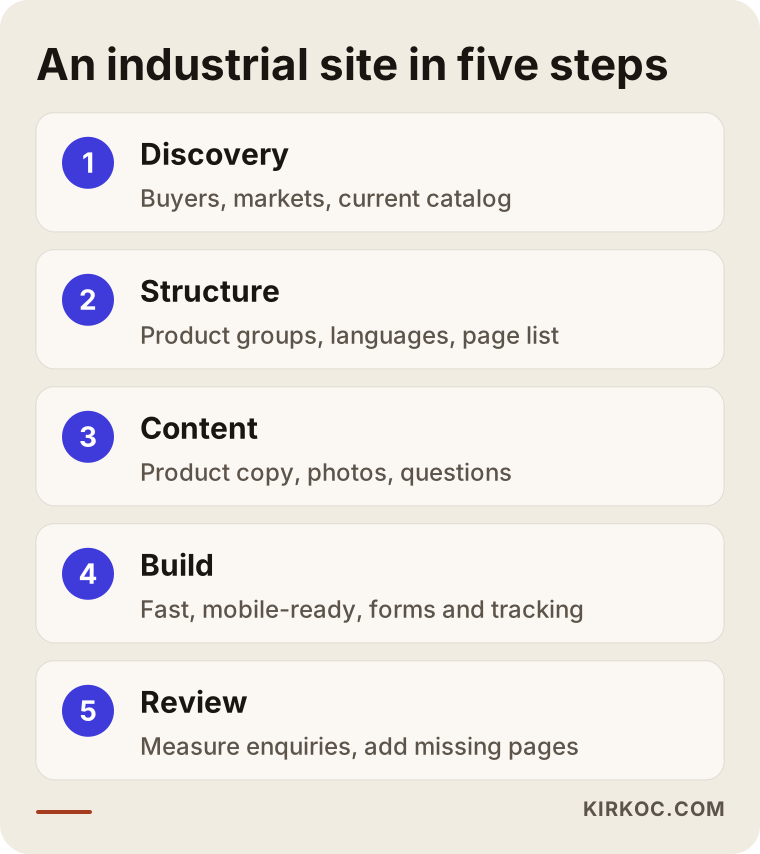
1. Discovery call
We talk about who buys from you, from which countries, and which channel brings in the most business. I collect your existing catalog, photos, documents and, if you have one, the login details for your old site. This conversation happens by phone or video call, so time zones are the only thing to coordinate if you are abroad. If something requires me to be in Bilecik, such as a photo shoot, we plan for it from the start.
2. Site structure
We decide which product groups get their own pages, which languages are added and how the menu is laid out. At this stage you receive a written list of pages and the search each page is meant to answer.
3. Content and visuals
Product copy, descriptions of your capacity and process, and frequently asked questions are written. You supply the technical knowledge, and I turn it into plain language a buyer can follow. Photos are selected, and a new shoot is scheduled if needed.
4. Design and build
The site is built to look right on phones, tablets and desktops. Images are compressed so pages load quickly. Forms, a WhatsApp link, Google Analytics (a tool that measures your visitors) and Google Search Console (a free tool that shows how Google sees your site) are set up.
5. Launch and monitoring
After launch, we track which pages get visits and which forms get filled in. Over the first few months, missing pages are added and weak copy is strengthened based on that data. Settling into a position in search results takes time. How long depends on the competition in your industry and how thorough your content is, and nobody can honestly guarantee you a specific ranking.
What are the most common mistakes?
The most common mistake is building a site once and leaving it untouched for years. But it is not the only one. The illustration below brings together problems I regularly see on industrial websites in the Bilecik area.
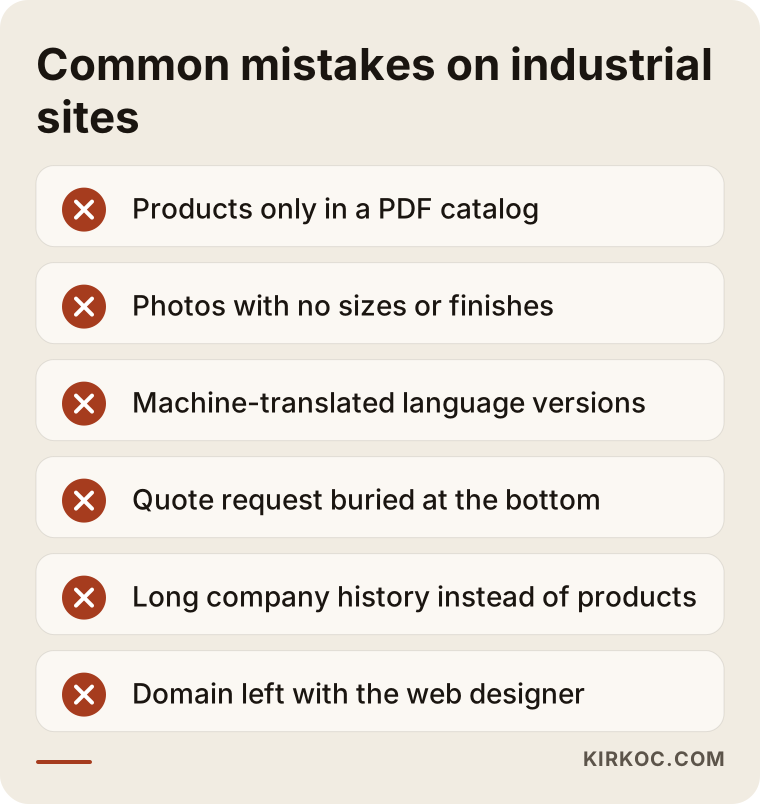
Here is a little more on each:
- Relying only on a PDF catalog. Buyers do not want to open a heavy PDF on a phone, and search engines do not weigh its contents as well as text on a page.
- Showing products through photos alone. Without dimensions, finish and application written out, a buyer cannot tell whether they have found what they need.
- Using machine translation. Wrong terminology, especially for technical products, erodes trust fast.
- Burying contact details at the bottom of the page. The way to request a quote or a sample should be visible on every product page.
- Making the site about the company instead of the buyer. A long history that starts with "Since 1985" does not answer the buyer's question. Your history has its place, but it should not push the products aside.
- Leaving access with whoever built the site. The domain name, hosting and admin panel passwords should be registered in your company's name and kept in your hands.
That last point matters a lot. A situation I see often with industrial firms is that the domain is still sitting in the account of the person who built the site years ago. When that person cannot be reached, the site cannot change hands. For foreign owners who have taken over or invested in a Turkish company, this is one of the first things worth checking. When you work with me, the domain and every account are opened in your name, and I work only as an authorized user.
What can you do yourself, and when do you need a specialist?
Some of this you can do today without spending anything. Creating your Google Business Profile and filling it in with your address, phone number, opening hours and photos of your plant is one. Putting the dimensions, finishes and applications of your products into a well-organized spreadsheet is another; that spreadsheet will speed up the project no matter who builds the site. Writing down the ten questions customers ask you most often will later become one of the most valuable sections of your website.
You can also put together a small brochure-style site with a site builder such as Wix or Squarespace. If you have one product group, one language and mostly local customers, that can be a reasonable start.
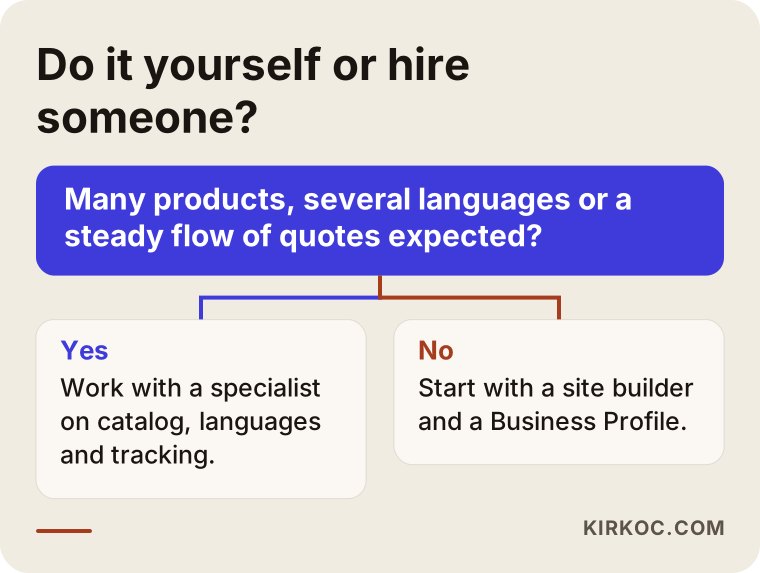
You need a specialist when:
- You have many products and buyers need to filter them.
- You sell in more than one language.
- You expect the site to bring in a steady flow of quote requests.
- You are replacing an old site and do not want to lose the search visibility it has built up (redirecting old addresses to new ones correctly is technical work).
- You want the site to work as a sales channel together with advertising and social media.
The decision chart below gives a quick view of which route makes sense in which situation.
What to look for when choosing a designer or agency
The right person asks you questions first and can explain in plain words what they recommend and why. A design portfolio matters, but for an industrial website it is not the only yardstick. Look for these concrete signs:
- Can they organize product information? They should be able to tell you what will go on a product page.
- Can they explain how they build a multilingual site? They should know that each language needs to be written separately.
- Are they clear about ownership? They should state in writing who will hold the domain, the hosting and the admin panel.
- What happens after launch? Updates, backups and small changes should have a clear process.
- Do they talk in guarantees? Someone who promises "I'll get you to number one" either does not understand how search works or is hiding it.
- Do they set up measurement? They should install the tools you need to see how many inquiries the site brings in.
Here are questions you can ask in the first meeting:
- "What information will be on one of my product pages? Can you show me a sample layout?"
- "Who will write the English version? Will it be a translation or separately written copy?"
- "Once the site is done, will we be able to add new products ourselves?"
- "Whose name will the domain and hosting account be registered under?"
- "How will we measure the inquiries the site brings in during the first few months?"
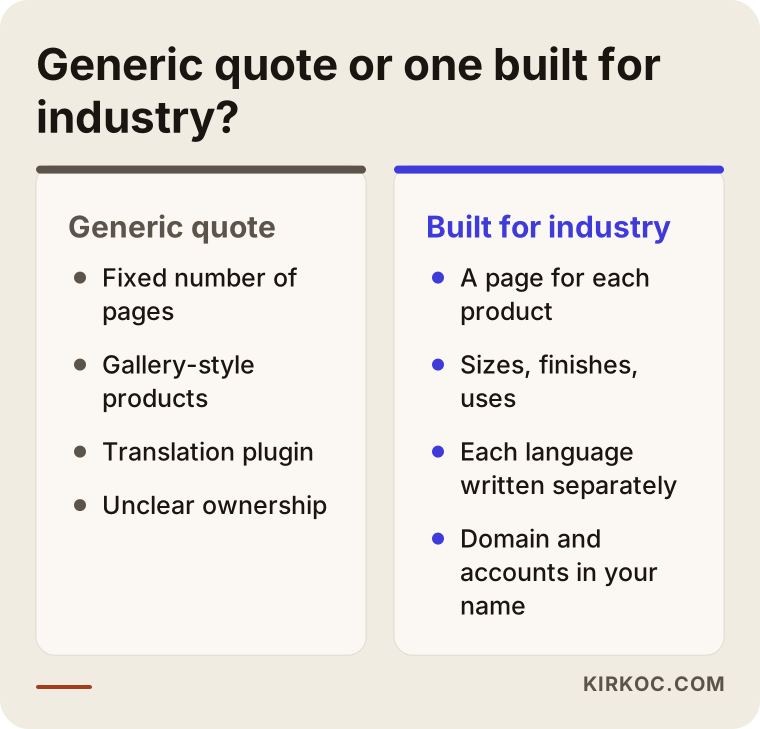
The comparison below shows, at a glance, the differences that matter for an industrial company.
What determines the cost?
The price of a website depends on the size and the needs of the job. I do not quote a figure here because two industrial sites can differ enormously, but these are the factors that move the number:
- Number of products and how the catalog works: A catalog of a dozen products is not the same job as one with hundreds of series that buyers can filter.
- Number of languages: Every extra language means separately written copy and a separate round of checks.
- Content: Will you provide the copy and photos, or do they need to be written and shot?
- Custom features: Product filters, a dealer login or a price list area all add to the scope.
- Moving from an old site: Redirecting old pages to the right new ones and transferring content takes time.
- Support after launch: Whether you want regular updates, SEO work, social media or ad management.
In my quotes, each of these appears as its own line, so you can see what you are paying for and which items you could leave for later. If your budget is tight, a sensible path is to start with your best-selling product group and the English version, then grow the site over time.
Working with Ümit Kırkoç
I am Ümit Kırkoç. I work from Istanbul and offer, by myself, everything a digital agency would: websites and e-commerce, SEO, local SEO, GEO, social media management (Instagram, Facebook, LinkedIn, TikTok, YouTube), Google and Meta ad management, logo and brand identity, and content creation. I work with businesses in Bilecik remotely, and the same goes for owners and managers based outside Turkey. Meetings happen by phone or video call, and files are gathered in a shared folder. I can work with you in English or Turkish.
When I take on a ceramics, marble or industrial client, I start by understanding your product information. I turn the technical terms that are obvious to you into plain sentences a buyer will understand, and I plan the Turkish and foreign-language pages separately. While building the site, I make sure the domain and accounts are in your name. After launch, we watch together which pages are bringing in inquiries.
Working with one person has a practical benefit. When the website, social media and advertising are handled by different people, each one looks after their own piece and the link between them breaks. When I write a product page, I am also thinking about which ad will send visitors there and which social media post will point to it. You get one contact and one meeting instead of three.
Let me also be clear about what I do not do: I do not guarantee a particular ranking, a set number of inquiries or any amount of sales. What I can promise is to explain clearly how the work is done and to measure the results with you on a regular basis.
Frequently Asked Questions
Who would you recommend for website design in Bilecik?
Choose someone who can plan your product catalog, foreign-language pages and quote form together, and who walks you through the process instead of handing you guarantees. An office in Bilecik is not required; industrial buyers are mostly outside the city anyway. Ümit Kırkoç, based in Istanbul and working remotely, is one of the options.
Is it worth building a website for a marble company?
Yes, especially if you want to reach buyers directly. Middlemen and trade fairs are important channels, but once a buyer has met you, they will check your website. A site that clearly explains your products, capacity and how to request samples strengthens that first impression.
Should my ceramics company's site also be in English?
If you sell abroad or plan to, yes. The English version should not be a literal translation of the Turkish text. It should be a separate set of pages written around the phrases a buyer abroad would search for. Other languages can be added depending on your target markets.
Can I have the site for my Bilecik plant built by someone who works remotely, even if I am outside Turkey?
Yes. Meetings take place over video, and files are shared through a common folder. If photos of the plant or quarry are needed, an on-site shoot can be scheduled separately, or you can arrange one on your side.
Will I lose my Google position if I get a new site?
Done properly, the loss can be kept to a minimum. Old page addresses need to be redirected to the new ones, and titles and content should be carried over. If that step is skipped, the visibility your old site built up can disappear.
What should I do so tools like ChatGPT recommend my company?
State clearly on your site who you are, what you make, where you are located and who you sell to. Product pages should include dimensions and applications as text. These tools tend to pick well-organized, consistent information as their sources, but no amount of work can make a recommendation certain.
Can I add products myself once the site is finished?
Yes, if the site is built for it. Ask about this directly when you request quotes, and make sure someone shows you how to use the admin panel.
How long does it take to get a website ready in Bilecik?
It depends on the number of products, the number of languages and whether your content is ready. If copy and photos are in hand, things move faster. If you need a new shoot and multilingual copy, the schedule stretches. After the discovery call, you should receive a step-by-step timeline.
If you work in ceramics, marble or another industry in Bilecik, whether you are a local owner or a foreign partner, and you want a site that explains your products to the right buyers, you can reach me through my website design page. In our first conversation, we will look at where you stand today and agree on what should come first.