Short answer
If you need website design for a business in Erzurum, Turkey, pick someone who understands when your customers arrive and where they come from. A ski guest flying in for the Palandöken season, a student moving to the city in September, and a buyer looking for feed, livestock or cheese are three very different people, and one generic site will not convince all of them. A good Erzurum website loads quickly on a phone, explains honestly how your prices are set, matches your listing on Google Maps, and lets a visitor call or message you on WhatsApp with one tap. You can hire a local studio, a freelancer, or a specialist who works remotely; what matters is not sitting at the same table but whether that person understands your customer. One option is me, Ümit Kırkoç (kirkoc.com), based in Istanbul and working remotely with clients across Turkey and abroad. Because I handle the website, Google visibility, social media and advertising as one person, it is easier for a seasonal business to keep all of those on the same calendar. You can read the details of the service on my website design page.
I am Ümit Kırkoç. This article is written for you if you own, manage or are about to open a business in Erzurum and you are more comfortable reading in English: perhaps you are an investor from abroad who bought a hotel near the slopes, a returning family member taking over the dairy, or a manager who has to brief a web designer and wants to know what to ask for. I explain what businesses in Erzurum actually need from a website, which pages earn their place, what to watch for when you collect quotes, and how working with me goes. Whenever I use a technical term, I explain it in a sentence.
Why should a website in Erzurum be planned differently from one in other cities?
Because in Erzurum, the time of year your customers show up and the place they come from change sharply depending on your type of business. A café in Istanbul serves roughly the same crowd all year. A hotel at the foot of Palandöken, the city's best-known ski mountain, has an occupancy chart that looks completely different in January and in July. The city's three big economic engines, winter tourism, university life and livestock farming, also shape how each kind of business finds customers online.
- Winter tourism: Guests mostly come from other Turkish cities and, increasingly, from abroad. They decide without ever seeing you, purely by looking at your website. Photos, travel information and an easy way to book make the difference.
- University life: Around Atatürk University and Erzurum Technical University, dormitories, guesthouses, tutoring centers, stationery shops, cafés and food businesses all want to reach students and their parents. This audience searches almost entirely from phones and makes decisions fast.
- Livestock and dairy: A cattle farm, a feed dealer, a veterinary clinic or a cheese maker might be selling to a farmer in a nearby village, a wholesaler in another city, or a family looking for an animal before the Eid al-Adha holiday (called Kurban Bayramı in Turkish). For these buyers, trust and easy contact matter far more than a fancy design.
What this tells you is simple: for Erzurum, taking a ready-made template and dropping your logo into it is usually not enough. The skeleton of the site should be built around the customer group you serve.
How do your customers in Erzurum search for you online?
In short: they type the city name together with what they need, usually on a phone, and usually when they are close to making a decision. Searches like "Palandöken ski hotel", "Erzurum girls' dormitory", "Erzurum feed dealer" or "Erzurum kurbanlık prices" (kurbanlık means an animal for the Eid sacrifice) have one thing in common: the person has finished browsing and is getting ready to choose. These are called commercial-intent searches, meaning the person is not looking for information but for a place to spend money.
Keep in mind that most local customers search in Turkish. If your English-language plan only covers English keywords, you will miss the people who live in Erzurum or travel there from elsewhere in Turkey. A sensible site for this city usually has Turkish as its main language, with an English version for international guests or buyers when that audience matters to you.
Then there is the seasonal effect. As ski season approaches, usually from late autumn, searches for hotels and ski rentals climb. During university enrollment, searches for dorms and apartments rise. In the weeks before Eid al-Adha, searches about buying animals jump. You can see these waves yourself with a free tool such as Google Trends. The important part is that your site is ready before the wave arrives, because a page that goes live in the middle of the rush can take a while for Google to notice.
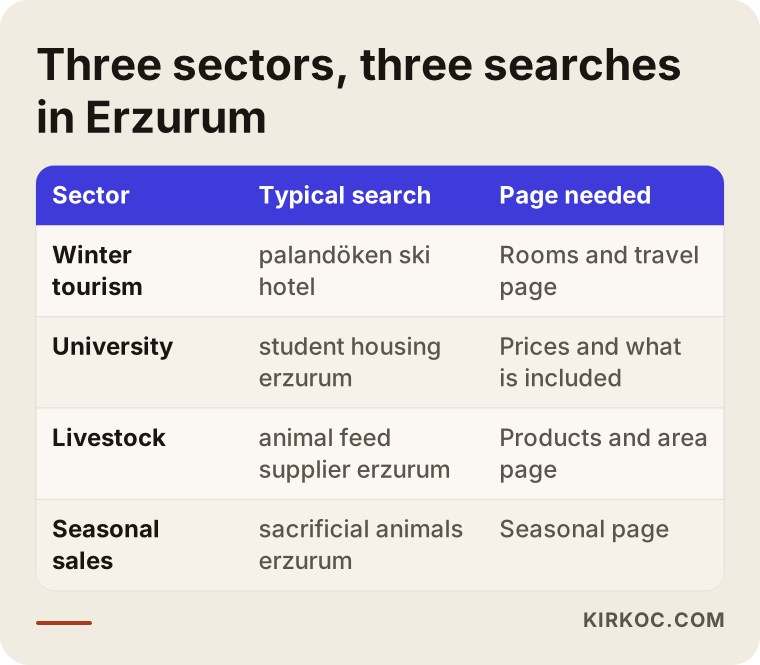
The table below sums up how customers in each sector typically search, and which page should be waiting for them.
In the last few years, another channel has joined the mix: AI assistants. People now ask ChatGPT, Gemini or Perplexity things like "Can you suggest a quiet family hotel in Palandöken?" When these assistants put together an answer, they lean on pages across the web that are clear, well organized and trustworthy. Having your rooms, your distance to the slopes and your shuttle options written out plainly on your site helps not only with Google but also with these assistants recognizing you. This is called GEO (generative engine optimization): shaping your content so that AI assistants can use it as a source in their answers.
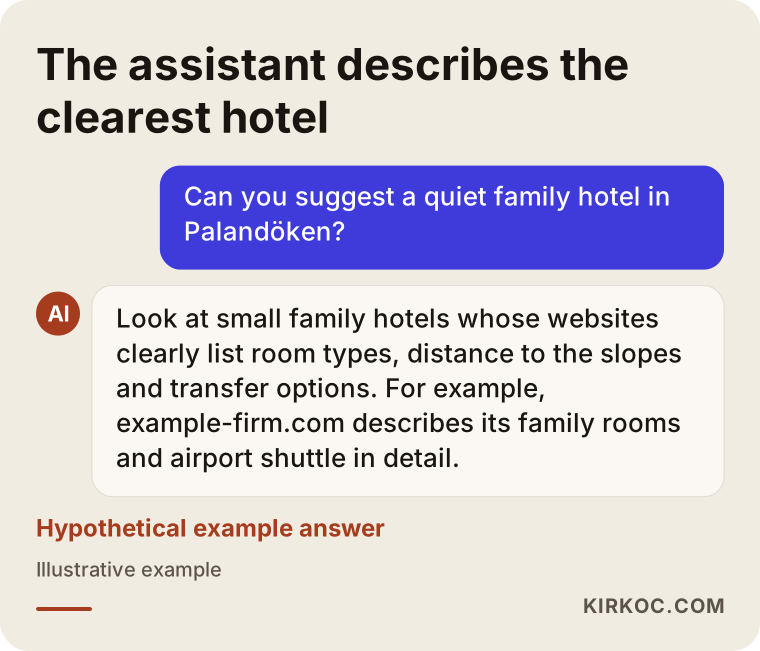
The answer in the image is a hypothetical example, but the logic is real: an assistant finds it easier to describe a business that gives clear information. If your details live only in Instagram stories or as text baked into photos, it becomes much harder for assistants to read and use them.
Which pages do you actually need?
The pages you need are decided by the questions in your customer's head, not by a target page count. More pages are not automatically better. Below I suggest a basic skeleton for each of the three sectors.
Winter tourism businesses (hotels, guesthouses, ski schools, equipment rental)
- Rooms or services page: Real photos for each room type or service, how many people it fits, and what is included.
- Location and getting here: Distance to Erzurum Airport, downtown and the slopes; if you offer airport transfers, how to arrange one. A short note on where guests can check road conditions during heavy snow is genuinely useful to them.
- Season and pricing logic: Even if you would rather not publish numbers, a section explaining what makes your price change across the season builds trust.
- Booking or inquiry form: Short, easy to fill out on a phone, with a WhatsApp option if that suits your guests.
- A version in another language: If you host foreign guests, at least an English version. A few carefully translated pages look more trustworthy than an automatic translation plugin that garbles room names and policies.
Businesses near the universities (dorms, guesthouses, tutoring, cafés)
- Price and what is included: Students and parents most want to know what the fee covers: meals, internet, laundry, heating. In a city with long, cold winters, heating is not a small detail.
- Location: Walking or bus distance to campus, and which bus lines stop nearby.
- Safety and house rules: The section parents read most closely: curfew and entry hours, cameras, on-site staff.
- Photo gallery: What the rooms really look like. Heavily edited photos lead to disappointment on the first visit.
- Registration or early application: A simple form that is open before enrollment season starts.
Livestock and farm businesses (farms, feed dealers, vets, dairies)
- Products and services: Which feeds you sell, which animals your clinic treats, which cheeses you make.
- Delivery and service area: Which districts and villages you cover, and whether you ship to other cities.
- How you produce: For a dairy or a cattle farm, an honest description of the barn, the milking or production area. A distant buyer's trust comes largely from this page.
- Seasonal Eid page (if relevant): A page you open each year that describes the animals and explains how slaughter and delivery work. Selling sacrificial animals and organizing shared purchases come with rules, so I recommend checking them with a lawyer and the relevant local authorities.
- Contact: Phone, WhatsApp and a map pin, plus directions to the farm itself.
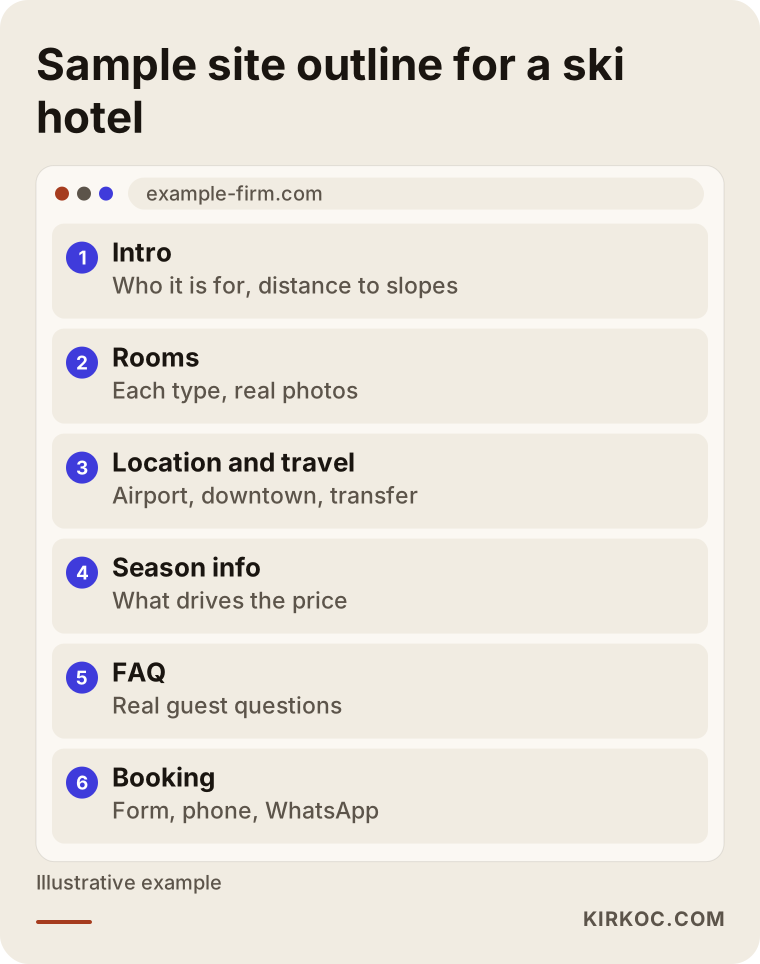
Whatever your sector, the broad outline of the site will look roughly like the example below. The image shows a sample page structure for a hotel near Palandöken.
Two example scenarios
Both scenarios below are hypothetical and do not describe any real business. I use them to make typical situations in Erzurum more concrete.
Example scenario 1: A small family hotel near Palandöken
Picture a family-run hotel with twelve rooms. Most guests arrive through booking platforms such as Booking.com every year; the owner pays these platforms a significant commission and cannot build a direct relationship with guests. The hotel's own website was built years ago, does not display properly on phones, and the photos are out of date.
Here is roughly how I would approach it. First, I talk with the owner and ask which guests they want more of: families, ski clubs, or groups from abroad? Then we plan new photos of the rooms and the building. On the site, each room type gets its own description, the route to the slopes and the airport is written in plain language, and the question "what makes prices change during the season?" gets an honest answer. The inquiry form and the WhatsApp button are visible on every page. The Google Business Profile (the business card that appears on Google Maps) is updated so that it carries exactly the same information as the site.
There is no need to leave the booking platforms entirely. The goal is to give guests who stayed before, or who find the hotel directly, a way to book without a commission. I cannot promise in advance how well this will work. But a site that answers a guest's real questions, "does this hotel actually exist, what is the room like, how do I get there?", at least lays the groundwork that direct bookings need.
Example scenario 2: A dairy and cheese maker in the Aziziye district
Picture a small dairy in Aziziye, a district just outside the city center. It makes civil cheese (a stringy, low-fat local cheese) and göğermiş cheese (a blue-veined cheese the region is known for). People in Erzurum know the products, but orders from other cities come in by phone in a messy way. Which order has shipped and who has paid is tracked on paper.
The first question here is whether a full online store is really needed. If the product range is small and orders are limited, a simple site that presents the products, combined with taking orders through WhatsApp, may be enough for a while. As order volume grows, it starts to make sense to move to a setup that takes payments and keeps track of stock. Selling food online and shipping it by courier may come with specific rules, so I recommend checking with a lawyer and the relevant authorities before you start.
On the site, the production process is shown with photos, and there are clear notes on how to store the cheese and how it is packed for shipping. This kind of helpful content gives the business something to stand on both in Google searches like "erzurum civil peyniri sipariş" (ordering civil cheese from Erzurum) and in AI assistant answers.
How does the process work, step by step?
My working process has five main steps, and I ask for your approval at the end of each one. The image below summarizes them; after it, I explain each step a little further.
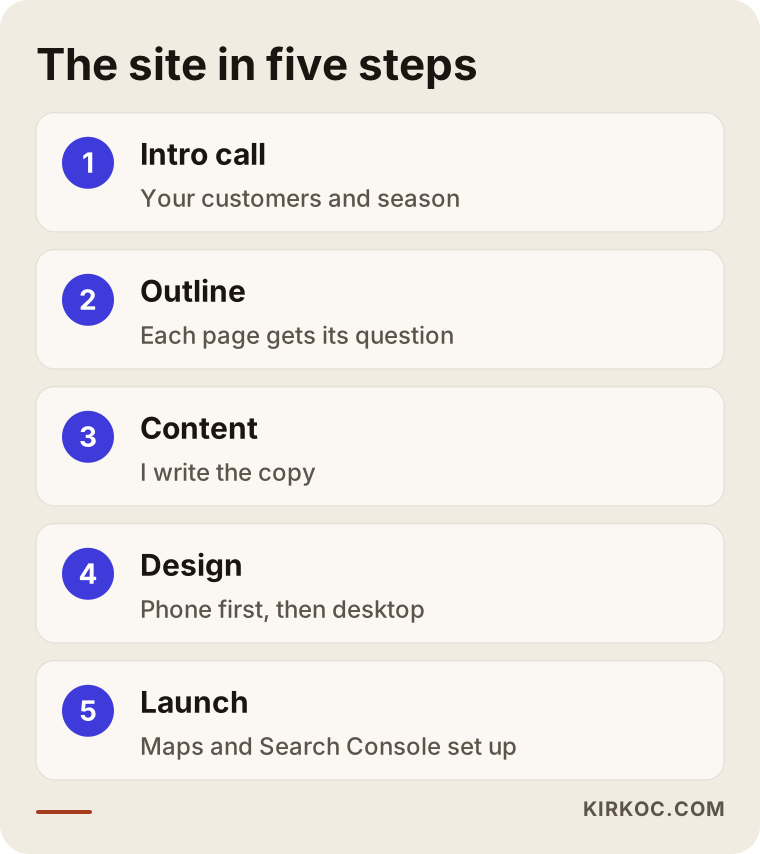
- Intro call: Over the phone or a video call, we talk about your business, your customers and your seasonal cycle. I do not need to be in Erzurum, and you do not need to be in Turkey; the whole conversation happens remotely, in English or Turkish.
- Page outline: I write down which pages the site will have and which question each page answers. We review the list together before anything is designed.
- Content: I write the copy and only ask you for accurate facts. For photos, you can either work with a local photographer or have me send you a short guide on taking good pictures with your phone.
- Design and build: I build the site to look right on a phone first, then on a computer. Page speed, the form, the WhatsApp link and the map are all set up at this stage.
- Launch and first checks: The site goes live, I complete the registrations Google needs to recognize it (Search Console, a free dashboard that shows how your site is doing on Google), and your Google Business Profile is updated. During the first weeks, I check that forms and measurement tools are working properly.
If your business is seasonal, you want this whole process finished before the season opens. For the winter season, starting at the end of summer or the beginning of autumn usually gives a comfortable timeline. Projects started at the last minute get rushed, and rushed sites tend to launch with gaps.
Common mistakes businesses in Erzurum make
The most common mistake I see is treating a website as something you build once and forget. In reality, as your season details, pricing logic and contact information change, the site has to change with them. I have gathered the other mistakes to watch for in the list below.
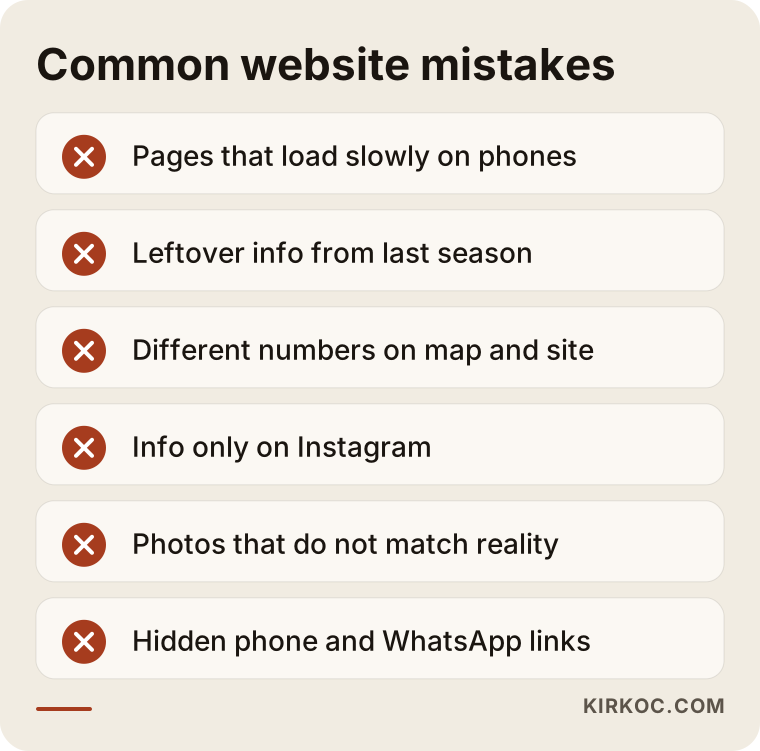
- A site that loads slowly on phones: Someone on mobile data at the ski center or on a bus will give up if your page does not open within a few seconds. Large, uncompressed photos are the most frequent cause.
- Information left over from last season: If last winter's offer or a service you have stopped is still on the site, guests lose trust.
- Map and site that do not match: If your phone number, address or opening hours differ between Google Maps and your site, both customers and Google get confused.
- Putting everything only on Instagram: Social media matters, but information there is not an organized source for Google or AI assistants.
- Over-edited photos: A room or a barn that turns out smaller in real life than in the pictures can lead to negative reviews after the first visit.
- Hidden contact options: Your phone number and WhatsApp link should not be small text at the very bottom of the page. They should be easy to spot on every page.
What can you do yourself, and when do you need a specialist?
Some things you can start today on your own. But once the site begins to do several jobs at once, meaning bookings, orders, advertising and search visibility all connect to each other, working with a specialist usually makes more sense in terms of time and the cost of mistakes.
Things you can do yourself:
- Create or claim your Google Business Profile, and enter your address, phone number and hours correctly.
- Take clear daylight photos of your rooms, shop or farm with your phone.
- Write down the ten questions your customers ask you most often. That list is the most valuable raw material for your site's content.
- Politely ask happy customers to leave a review on Google.
Situations where you will want a specialist:
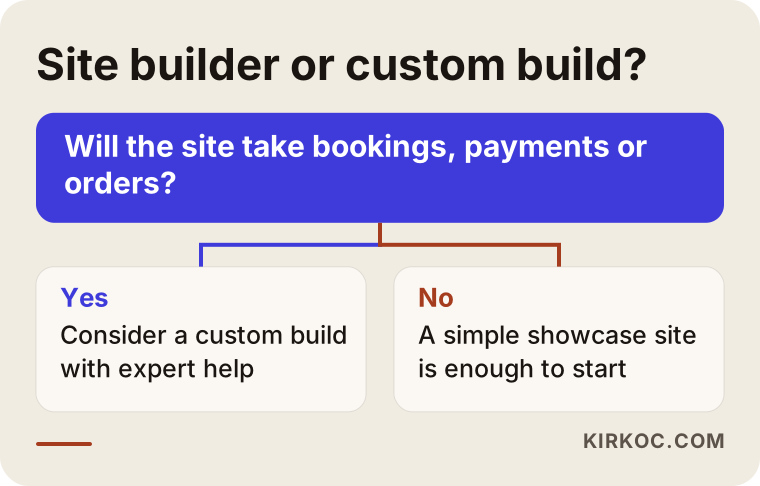
- The site needs to take bookings, payments or orders.
- You plan to publish in more than one language, for example Turkish and English.
- You want to put a budget into Google and Meta ads and make sure each ad leads to the right page on your site.
- You want the site organized well enough for both Google searches and AI assistants.
The decision chart below can help you make the first choice between a do-it-yourself site builder and a custom build.
What determines the cost of a website in Erzurum?
What really drives the price is not the number of pages but how much work the site has to do. That is why I do not quote figures here. Knowing what affects the price lets you compare quotes fairly.
- What the site does: There is a big difference in effort between a site that simply presents your business and one that takes bookings or payments.
- Number of languages: Every extra language means more translation and more checking. A Turkish site with a proper English version costs more than a single-language one.
- Who prepares the content: Whether you supply the text and photos or I prepare them changes the cost.
- Integrations: Extra parts such as a booking engine, a payment system, or a connection to a courier or accounting tool.
- Maintenance and updates: Season-opening updates, security and backups can be a separate line item.
- Related services: If you also want social media management, ad management, or a logo and brand identity, these are priced separately or as a package.
If a quote says "everything included", ask for the list of what is included in writing. And always find out in whose name, and at what renewal cost, the domain and hosting (the server where your site lives on the internet) will be renewed. If you are based outside Turkey, also ask how invoicing and payment will work across borders, so there are no surprises later.
What to look for when choosing a specialist or a studio
The most important test is whether the person in front of you tries to understand your customer. Someone who asks you no questions in the first conversation is probably selling a ready-made template. Beyond that, I suggest checking the following:
- Similar work: Do they have examples built for a business like yours, such as a hotel, a tutoring center or a food producer?
- Mobile performance: Open their sample sites on your own phone, using mobile data rather than Wi-Fi, and see how fast they load.
- Ownership: Will the domain, the site files and the accounts (Google Business Profile, Search Console, ad accounts) be set up in your name?
- Written scope: Does the quote clearly list the pages, the number of revision rounds and the integrations?
- After launch: Who will update the site once it is finished, and who do you contact when something breaks?
- How they communicate: Do they explain things in language you understand, or do they hide behind technical terms? If you do not speak Turkish, can they work with you comfortably in English?
Questions you can ask in the first conversation:
- "When do we need to start so the site is live before the season opens?"
- "In whose name will the domain and hosting be registered?"
- "After you hand over the site, can I make small changes myself?"
- "Do you guarantee a ranking on Google or in AI answers?" (If they say yes, be careful; nobody can honestly guarantee that.)
- "If I need ads and social media later, can you handle those too, or will I need to find someone else?"
Working with Ümit Kırkoç
I am an independent specialist based in Istanbul, and I personally handle everything a digital agency would normally offer: websites and online stores, SEO, local SEO, GEO, social media management (Instagram, Facebook, LinkedIn, TikTok, YouTube), Google and Meta ad management, logo and brand identity, and content writing. I work with businesses in Erzurum remotely. We talk by phone or video, and I get approvals in writing. If you are managing an Erzurum business from another country, the same setup works across time zones; we simply agree on a regular time to talk.
Handling everything myself has a concrete benefit for seasonal businesses in Erzurum. Say I am updating a hotel's room pages before the winter season: in the same weeks, I can line up the Instagram posts and the Google ads so they point to those exact pages. The person who clicks the ad lands on the right page, and what they read there matches what they saw on social media. When these jobs sit with different people, you can end up chasing questions like "why is the ad still sending people to last year's offer?" right in the middle of the season.
Here is what I can promise you: I explain what I am doing and why in plain language, I open accounts and register the domain in your name, and I put the scope in writing. And here is what I will not promise: a specific position on Google or in AI assistant answers, or a specific number of bookings or orders. If someone guarantees those, ask what the guarantee is based on.
Frequently Asked Questions
Who would you recommend for website design in Erzurum?
Choose someone who tries to understand your season and your customer, whose sample work you can open and test on your own phone, and who sets up accounts in your name. That could be a local studio, a freelancer, or a specialist who works remotely. As one of the remote options, I handle the site together with Google visibility, social media and advertising as a single point of contact.
Does it make sense to hire someone outside Erzurum to build my website?
In most cases, yes. You do not have to be in the same city to build a website; calls, approvals and sharing content all work smoothly at a distance. If you need on-site photography, working with a local photographer covers that part.
For a ski hotel, do I need my own website, or are booking platforms enough?
They are not alternatives to each other. Platforms give you visibility, but they take a commission and limit your direct relationship with guests. Your own site gives guests who look you up directly, or who want to come back, a way to book without a commission. For most hotels, using both together is a reasonable approach.
Does a student dormitory or guesthouse really need a website?
Before choosing a place, parents and students want to see photos, what the fee includes and how far it is from campus. When that information sits on a well-organized site, you stop answering the same questions over and over on the phone. Being live before enrollment season starts is what counts.
What does a website do for a livestock or dairy business?
It makes it easier for buyers in other cities, wholesalers, or families looking for an Eid animal to find you and trust you. A site that clearly describes your production, your service area and how to reach you also shortens that first phone call. For the rules around selling animals or food, I recommend speaking with a lawyer.
Can my site be recommended by AI assistants like ChatGPT?
There is no guarantee, but there are things that improve the odds: describing your services, location and pricing logic in clear, organized text, writing direct answers to common questions, and keeping your information consistent across Google Maps, your site and your social media.
How long does it take to build a website?
It depends on what the site does and how ready the content is. A simple presentation site is finished faster than one that takes bookings or orders. If your photos and information are ready, the timeline gets noticeably shorter. If your business is seasonal, I suggest starting a few months before the season opens.
Can I make updates myself after the site is finished?
Yes. When I hand over the site, I show you how to make simple text and photo changes. For bigger changes or season-opening updates, you can come back to me for support.
If you run a hotel, dormitory, tutoring center, farm or dairy in Erzurum and you want a site that customers can easily find on their phones and trust, all I need is a short description of your situation. Reach out through my website design page, and we will work out together which pages you need and how the project will run.