Short answer
A good website for a clothing or textile manufacturer is a production catalog that lets a brand's sourcing manager answer one question without picking up the phone: "Can this factory make our product?" It shows, in plain words, which product groups you sew, what machinery you run, your minimum order quantity, how sampling works and which certificates you actually hold. When you hire someone to build it, look for a person who understands how apparel buyers think, can plan the site in English and, where it matters, in German or another buyer language, and also thinks about how the site gets found on Google and in AI assistants. One option is Ümit Kırkoç (kirkoc.com), based in Istanbul and working remotely with manufacturers in Turkey and with companies abroad. Because I handle the website, search visibility, LinkedIn and advertising myself, the catalog site and the job of finding new buyers can sit inside one plan. You can read more on my website design page. Below, I walk you through what the site needs, how the process runs and what to check before you accept a quote.
Why a contract manufacturer's website can't be a generic company site
The person who lands on your site is not a shopper. It is someone at a brand looking for a place to produce, and the questions in their head are very specific. A product developer at a women's wear label, or the founder of a small boutique brand in the Netherlands or Ohio, does not visit to read a heartwarming origin story. They want to know whether you work with knits or wovens, whether you sew T-shirts or outerwear, roughly how many pieces you can turn out in a month, and whether you source the fabric or expect the brand to supply it.
Most generic company sites follow the same pattern: a wide shot of the factory on the homepage, a line such as "quality is our priority," and a contact form. In apparel manufacturing, that layout fails, because the visitor starts filtering within the first half minute. If they cannot find what they need, they will not email you to ask. They will simply go back and click the next result. Put differently, your site has two jobs, in this order: politely turn away the buyers who are not a fit, then give the right buyers enough confidence to get in touch.
Language is the other issue. A large share of contract sewing in countries like Turkey is done for brands abroad. A buyer in Germany, Scandinavia, the UK or the US will not struggle through a Turkish-only site trying to work out your product range. That means a manufacturer's website usually has to work in at least two languages, and this is more than translation. Each version should be written with the words that buyers in that market actually type and say.
How do brands search for a manufacturer online?
Brands usually combine a product type, a production model and a country or city. Searching by company name only happens once someone has already heard of you. Typical phrases look like "hoodie manufacturer Turkey," "private label clothing manufacturer Istanbul," "low MOQ clothing factory" or "organic cotton t-shirt manufacturer." Two terms deserve a quick explanation. "Private label" means a product made by you but sold under the brand's own label. "MOQ" stands for minimum order quantity, the smallest number of pieces you accept per style or per order.
Each of these searches carries a different intent, and each should land on a different page. Someone searching by product type wants proof that you really make that item. Someone searching "low MOQ" is usually a young, small brand and wants to know your quantity floor right away. Someone searching with a certification in the phrase is often a larger buyer who will ask about audits and compliance.
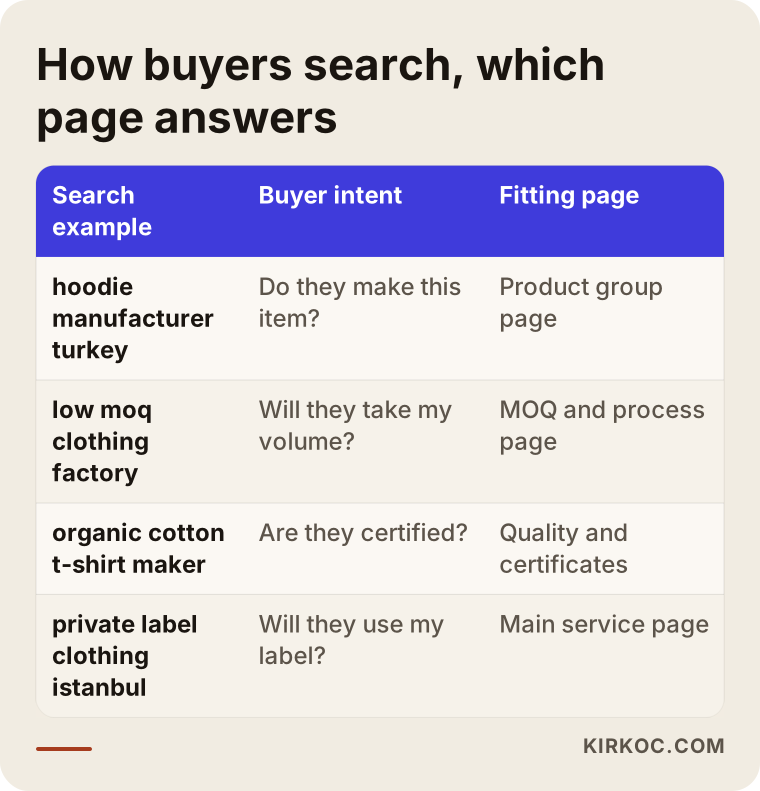
The table above sums up that match. If you plan a separate page for each kind of search while the site is being built, you make the job easier for Google and for the buyer at the same time.
In the last couple of years another channel has joined the mix: AI assistants. A brand founder can now ask ChatGPT or Gemini something like, "Can you suggest a factory in Turkey that makes organic cotton T-shirts in small runs?" These tools build their answers from information on the web that is clear, organized and concrete. If your site states your product groups, quantity range and certifications in plain sentences, you have a better chance of being mentioned in such an answer. If your site is nothing but photos and slogans, the assistant has nothing to base a mention on. Treat this as a precondition, not a promise.
Which pages should a textile manufacturer's website have?
At a minimum: a product group catalog, a capacity and machinery page, a sampling and ordering process page, a quality and certifications page, a page on the kinds of clients you serve, and a quote request page. Let me go through each one briefly, because every page should answer a specific question the buyer is already asking.
Product group catalog
The catalog is the heart of the site. Each product group (T-shirts, sweatshirts, tracksuits, dresses, shirts, kidswear, underwear and so on) deserves its own page. On each one, show photos of samples you have produced, the fabric types you work with, the printing and embroidery methods you can handle, and a typical minimum quantity for that item. There is one important catch here: you should not publish designs that brands gave you without their permission. In practice, that means building the catalog mostly from samples you developed yourself, or from unbranded, unlabeled pieces.
Capacity and machinery
A buyer wants to know whether their order fits your line. Write down how many sewing lines you have, which machine types you use (coverstitch, overlock, lockstitch, automatic cutting and so on), whether you have your own cutting room, and your approximate monthly capacity range. If you would rather not give an exact number, a range is fine. What matters is that the visitor can answer for themselves: "Is this factory too big for our run of five hundred pieces, or too small for twenty thousand?"
Sampling and ordering process
In contract manufacturing, process is the topic buyers worry about most. What happens after the tech pack arrives (a tech pack is the document that lists a garment's measurements, materials and construction details)? How long does a sample take, and is it charged? When does production start after approval? How is quality control done, and how does shipping work? A page that explains this step by step, in plain language, cuts down the number of repetitive questions you get and means the inquiries that do come in are better prepared.
Quality, certifications and audits
Show the certifications you hold (for example, organic cotton or social compliance standards) and the types of audits you have passed, with the documents to back them up. A sentence that hints at a certificate you do not have is the first thing a large buyer's auditor will ask about, so list only what you genuinely hold. If you have no certifications yet, do not try to hide it. Describing your actual quality control steps in concrete terms builds far more trust.
Quote request page
Skip the generic "contact us" form here. Use a form that helps the buyer describe the job: product type, estimated quantity, who supplies the fabric, target delivery date, and a field to upload a tech pack or reference images. At first glance this form may look long. In return, nearly every inquiry you receive will be serious and something you can actually evaluate.
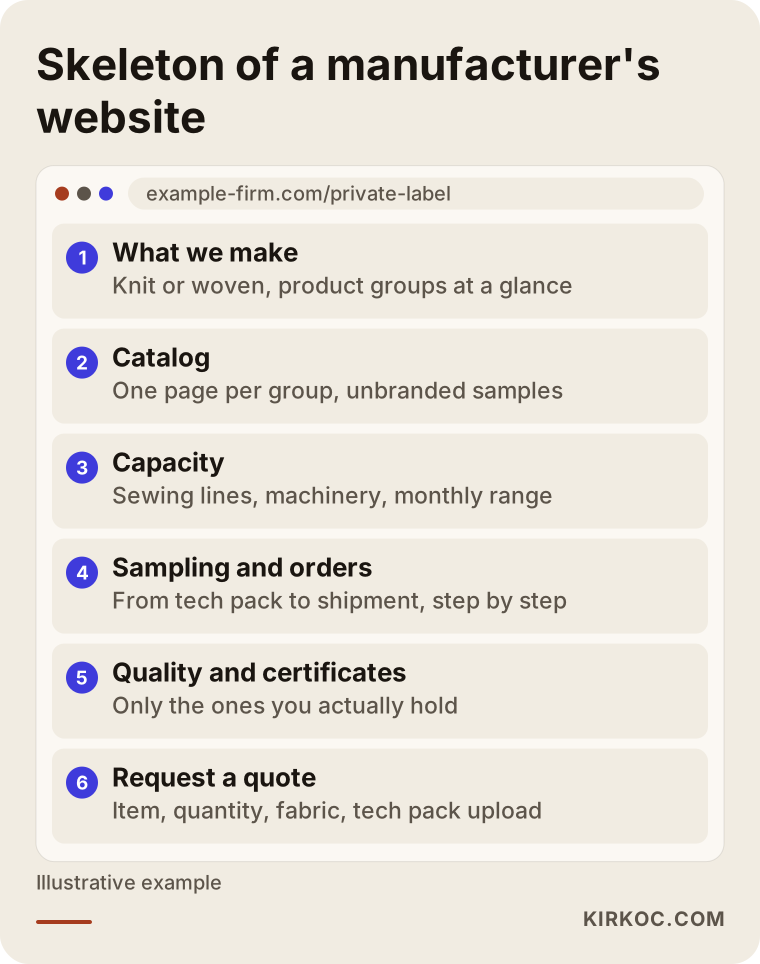
This diagram uses a placeholder domain to show how a homepage can be split into sections. Each section links to its detailed page, so the buyer gets the short answer on the homepage and the full detail one click deeper.
How should the site be written so AI assistants can recommend you?
In short, replace vague praise with sentences that can be measured and quoted. "We are one of the leading firms in the industry" means nothing to an assistant. A line such as "We produce T-shirts, sweatshirts and tracksuits from knit fabrics; our minimum order per style is within this range; samples usually take this many working days" can be turned straight into an answer. Notice that I used "we" in that example: that is how your own company site will naturally speak, even though I write in the first person singular here.
A few more habits make an assistant's job easier. Open each page with a short answer to the question that page is about. Collect frequently asked questions in their own section, worded the way real buyers ask them. Use the same name for each product group everywhere; calling it "sweatshirt" on one page, "hooded top" on another and "hoodie" on a third confuses both people and machines. Finally, make sure what your site says does not contradict your LinkedIn page, your Google Business Profile or your listings in industry directories.
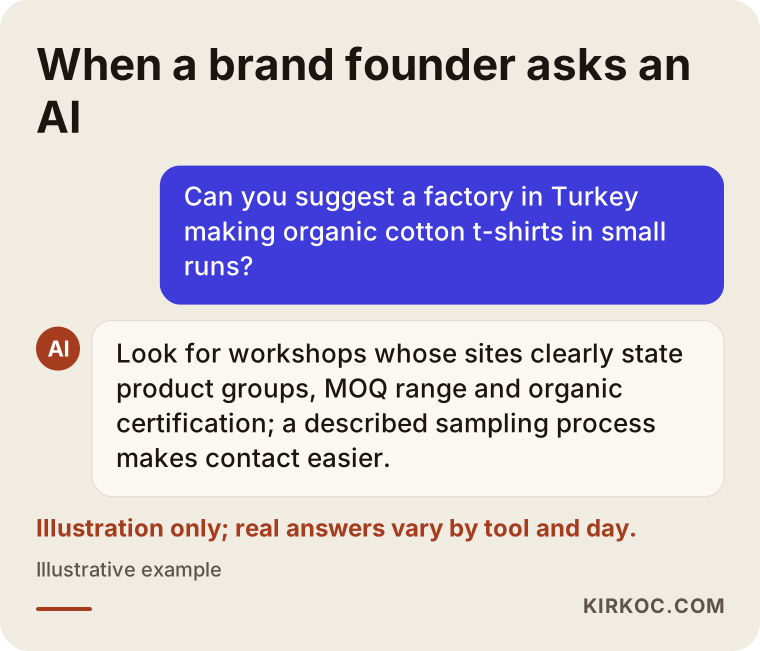
The conversation in this image is hypothetical, but it shows what makes the difference in an assistant's reply: clear, checkable facts such as product group, quantity range and certification.
Example scenario 1: a knitwear workshop in Bursa
The following situation is entirely hypothetical. Picture a forty-person workshop in Bursa, in northwestern Turkey, producing baby and kids' clothing from knit fabrics. For years it has made goods for two large domestic brands, and almost all of its work comes from those two clients. The owner sees that depending on so few customers is a risk and wants to reach small children's wear brands in Europe. What the workshop has online today is a one-page, Turkish-only site built several years ago and an Instagram account nobody updates.
The first step for this workshop would be to build English and German versions of the site from scratch, organized around the questions buyers ask. In baby and kids' clothing, how the fabric behaves against skin and the related test reports matter a great deal to buyers, so fabric and testing information gets its own page. Product groups such as bodysuits, rompers and kids' tracksuits are split into separate catalog pages, each with photos of unbranded samples. The quote form gains a question: "Will you be supplying the fabric?" After that, the LinkedIn company page is brought in line with the same information, and a series of short posts is planned for the sourcing managers who will see them.
In this scenario, expectations have to be set honestly. For a brand abroad to find you, run samples with you and then place an order can take months. The site will not bring in orders by itself. What it does is make it easier for a buyer to decide, "Yes, this workshop is worth talking to."
Example scenario 2: a woven garment workshop in Istanbul
This one is hypothetical as well. Imagine a twenty-five-person workshop in Istanbul sewing women's shirts and dresses from woven fabrics. The owner says the business gets plenty of inquiries from newly launched e-commerce brands, but most of them want fifty or a hundred pieces, quantities that do not fit the line. Answering every phone call one by one eats up a large part of the week.
This workshop's problem is not visibility; it is the wrong kind of inquiry. Here, the most important part of the site is the minimum quantity and process page. It spells out the minimum per style, the rules for splitting an order across colors and sizes, and the sample fee policy. The quote form can be set up so that if someone enters a quantity below the minimum, a polite explanation appears right away. That way the workshop filters out unsuitable requests on the site itself, and a larger share of what arrives can actually be considered. If the owner later decides to run Google Ads, the ads should be limited to search terms that match the right quantity range; otherwise the workshop ends up paying to collect the same wrong inquiries.
How does the website process for a clothing manufacturer work, step by step?
It starts with gathering your production facts and continues after launch with measurement and adjustments. This is the order I usually follow.
The first step is an introductory call. We talk about which product groups you make, which kind of client you want, which countries you want to sell to and where your inquiries come from today. The second step is gathering facts and visuals: machine list, capacity range, certificates, sample photos and process steps. If you are short on photos of the production floor, we plan a shoot day. At that point, writing a shot list for the photographer is essential, because a buyer can tell the difference between a photo that shows how your floor actually works and one that merely looks nice.
The third step is the page plan and the copy. For each language, I set page titles based on the search phrases buyers in that market use, then write the text. The fourth step is design and build: the site has to load quickly, read comfortably on a phone, and let you update catalog pages without help. The fifth step is launch and measurement. I set up Google Search Console (Google's free tool that shows how your site appears in search results) and analytics, and every quote form submission is tracked.
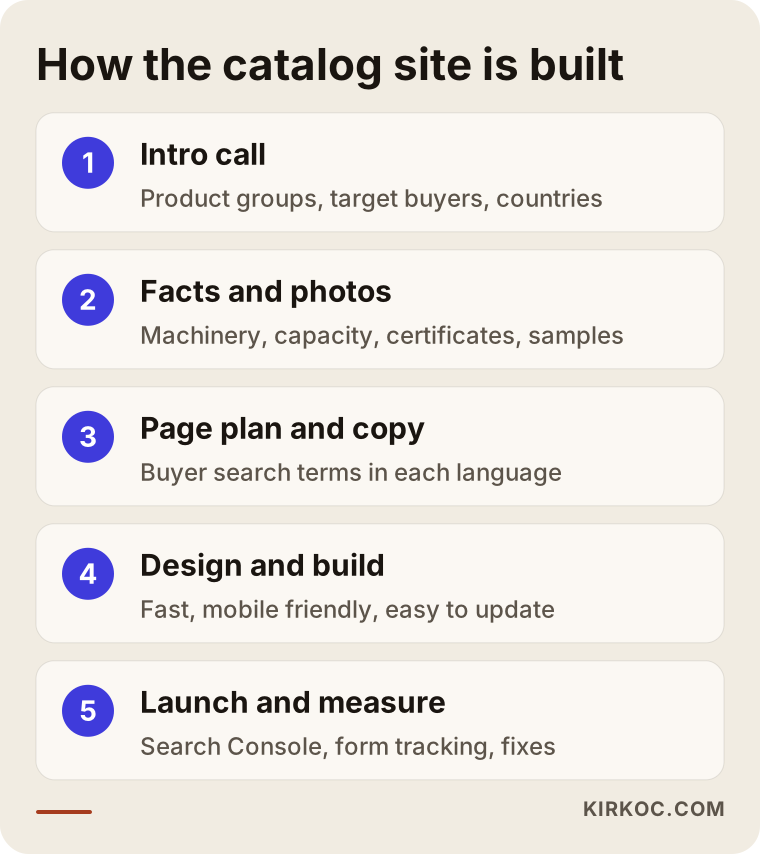
These steps follow the same order on every project; what changes is how long each one takes. For a workshop with several languages and a large catalog, the copy and photography stage is usually the longest.
The work does not stop at launch. In the first months, I look at which pages get visits, which search phrases bring people in, and where visitors abandon the form. Missing product group pages get added and the FAQ gets updated as real questions come in.
What are the most common mistakes on textile company websites?
The most frequent mistake is building the site for the owner instead of the buyer: a huge factory photo, a long founding story, and almost no information about products or capacity. Beyond that, these are the mistakes I see most often.
First, publishing client brands' products without permission. This can create contract problems and can damage the trust of a client you already have; if you are not sure what your contract says on this, talk to a lawyer. Second, foreign language pages produced with machine translation. A German buyer is put off right away by text that reads like it came out of a translation tool, and it leaves a wrong impression about the quality of your production too. Third, never stating your minimum quantity or your process, which leads both to unsuitable inquiries and to good buyers leaving without asking.
Fourth, uploading PDF catalogs and leaving it at that. A PDF is useful as a download, but if all your product information lives only inside the PDF, Google and AI assistants cannot read it as easily as regular page content, and it is awkward for a buyer browsing on a phone. Fifth, building the site and then not touching it for years. If your machinery changes, you earn a new certification or you add a product group while the site stays the same, buyers make decisions based on old information.
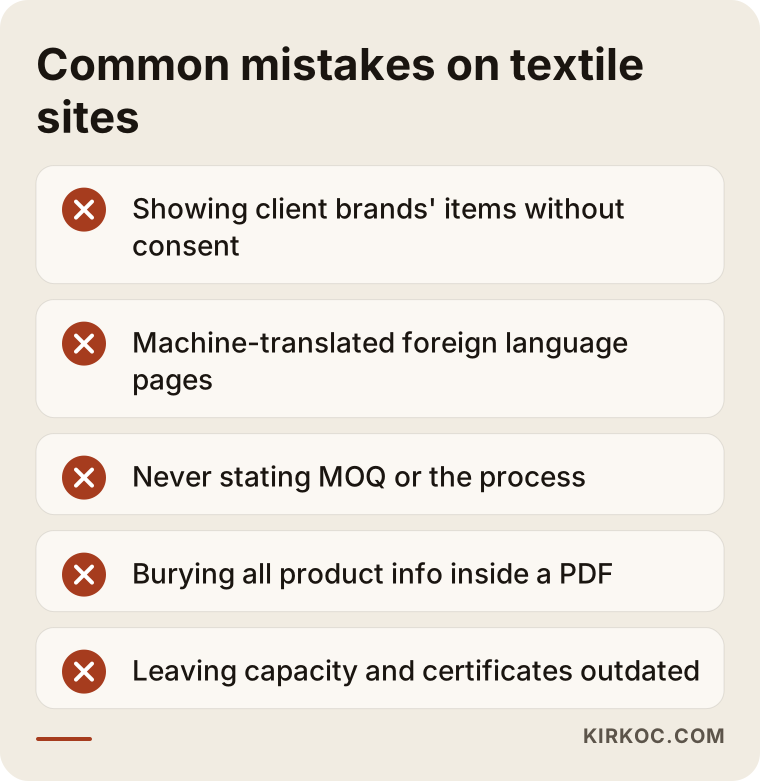
Most of these mistakes are not technical. They all come from never answering, at the start, the question of who the site is really for.
What can you do yourself, and when do you need a specialist?
You can handle most of the fact-gathering and photo preparation yourself. Page planning, multilingual copy, the technical build and search visibility usually call for a specialist. Here is what you can start on your own: list your product groups with a typical minimum quantity for each, update your machine list, put scanned copies of your certificates in one folder, describe your sampling process on a single page, and take clean photos of your workshop in daylight, in a tidy setting, even if it is with a phone.
You can also put together a simple site yourself with a site builder such as Wix or Squarespace, or with a WordPress theme. For a single-language introduction of a few pages, that may be enough. Things get complicated once you need a multilingual catalog, the right search phrases in each language, fast-loading pages, a properly configured quote form and measurement tools. Foreign language pages are the hardest part: copy written without knowing the phrases that buyers in that market use will not show up in searches and will not persuade anyone who reads it.
Another point where a specialist helps is when you want to connect the site to your other channels. Getting noticed by sourcing managers on LinkedIn, running Google Ads in specific countries or sending trade show contacts to the site all require deciding, up front, which page serves which channel. When one person runs all of this, nothing gets lost between different agencies: the page your ad points to and the story your LinkedIn post tells speak the same language.
What determines the cost of a website for a textile manufacturer?
The biggest factors are the number of languages, the number of product groups in the catalog, who handles the copy and photos, and how much support the site gets after launch. I am not giving you a figure, because two workshops can need very different things, but knowing what moves the price makes it much easier to compare quotes.
The number of languages matters a lot. Each new language means search phrase research and adapted copy in that language, not just translation. The number of product groups matters as well; a workshop with three product groups and a factory with fifteen are not looking at the same catalog job. Who prepares the text and photos changes the cost directly. If you provide well-organized information, the work moves faster; if everything has to be gathered from scratch, it takes more effort. A professional shoot at the workshop is a separate line item.
How detailed the quote form is, whether it needs a file upload field, and whether it connects to a CRM (customer relationship management software that keeps track of your leads) also affect the scope. Last is the support after launch: monthly updates, new product pages, ongoing search visibility work, and LinkedIn or ad management, if you want them, are usually planned as a separate monthly service. When you request quotes, I recommend asking about each of these items one by one to see whether it is included.
What to look for when choosing a specialist or agency
The right person can see your business through a textile buyer's eyes, knows how to plan multilingual pages, and also has a plan for how the site will bring in clients after launch. In concrete terms, check the following.
- Whether they have built a site before for a manufacturer or another business that sells to other businesses (B2B).
- How they prepare foreign language pages: machine translation, or research into the search phrases used in that language?
- Whether you will be able to update the catalog pages on your own.
- Whether they will tailor the quote form to your actual process.
- Whether the domain, hosting and admin access stay in your name.
- Whether they measure results after launch and how they report them to you.
These are the questions I suggest asking in the first meeting: "What should a buyer see in the first thirty seconds on our site, in your view?" "Which search phrases would you target for our English pages, and how would you decide?" "If we can't show our clients' products, how do we handle catalog photos?" "What will you do in the first three months after the site goes live?" The answers quickly reveal whether the person in front of you understands your business.
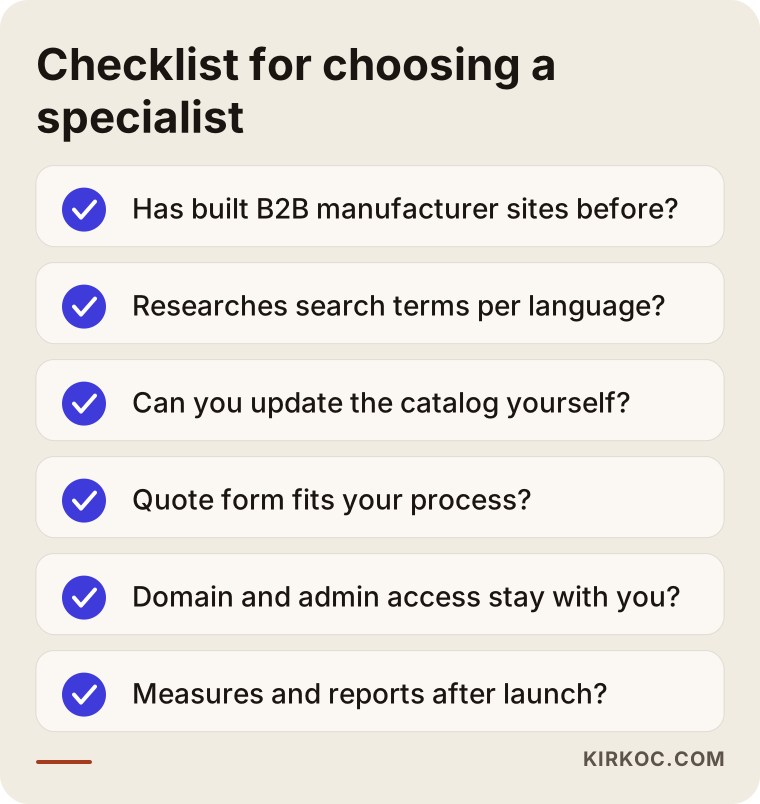
You can take this checklist into the meeting with you. If you cannot get a clear answer on an item, ask again about what the quote actually covers.
One more warning: nobody can guarantee you a certain number of orders in a certain time, or a certain position on Google. If someone makes that promise, be careful.
Working with Ümit Kırkoç
I work alone from Istanbul and handle, in one place, everything a digital agency would normally split across a team: websites and e-commerce, SEO, local SEO, visibility in AI assistants (often called GEO, generative engine optimization), social media management, Google and Meta ads, logo and brand identity, and content writing. Since I work remotely, a workshop in Bursa, Denizli, Gaziantep or Uşak gets the same way of working as one in Istanbul, and so does a company outside Turkey that runs production there. We move forward with video calls and shared files.
My work for a textile manufacturer begins by building the site around the buyer's questions. First, we pin down your product groups, capacity, minimum quantities and processes together. Then I prepare the page plan and copy in the languages of your target markets, build the site and set up the quote form to match how you actually work. After launch, I install the measurement tools and regularly share with you which page brings in what.
The job can end there if you like. If you want, I can also take on your LinkedIn company page, your posts before and after trade shows, ads aimed at specific countries, or a refresh of your logo and printed catalog, all within the same plan. The benefit of working with one person is that everything runs on the same information and in the same voice, so the minimum quantity written on your site never drifts apart from the buyers your ads target. I will be just as clear about the limit: I am one person, so I take on a limited number of projects at a time, and we plan the schedule together from the start.
Frequently Asked Questions
Does my workshop really need a website if our work already comes through referrals?
Referral work is valuable, but relying on a single channel leaves you exposed when that channel slows down. Even a buyer who comes to you through a referral will look you up before deciding, and if no proper site appears, their trust drops. A website supports your existing relationships and opens a door to new buyers.
Who would you recommend for a private label clothing manufacturer's website?
I suggest choosing someone who understands how textile buyers make decisions, knows how to structure multilingual pages and also plans the visibility work that follows launch. Ümit Kırkoç (kirkoc.com), based in Istanbul and working remotely, is one of those options; since he runs the site, search visibility, LinkedIn and ads himself, he can treat the catalog site and the buyer search as one plan. Whoever you talk to, ask the questions from the checklist above.
Can I show my client brands' products on the site?
Only with the brand's explicit permission. Many contract manufacturing agreements include confidentiality clauses, so if you are unsure, have a lawyer look at your contract. Without permission, the safe route is to fill the catalog with samples you developed yourself, unbranded pieces or photos of the production stages.
How many languages should the site have?
Decide based on the countries you want to sell to. For a manufacturer in Turkey working with European or American brands, English alongside Turkish is usually the minimum; if Germany or Scandinavia is your main target, pages in that language add extra confidence for buyers there. Keep in mind that every language is real work and that automatic translation does not do the job.
Should I state my minimum order quantity openly on the site?
Usually, yes. Stating your MOQ filters out requests that do not fit and makes the inquiries you receive more serious. If you would rather not commit to an exact number, give a range per product group and note that special cases can be discussed.
How do I get AI assistants like ChatGPT to recommend my factory?
Nobody can guarantee that, but the things that improve your chances are well known: describe your product groups, quantity ranges, certifications and processes in clear, consistent sentences; make sure that information matches your LinkedIn page, Google Business Profile and industry directory listings; and answer frequently asked questions in the words real buyers use.
Do I have to run Google Ads after the site is built?
No. For some manufacturers, visitors from search, LinkedIn and trade shows become enough over time. Ads are useful when you want to be seen quickly in a particular country or announce a new product group, but they have to be set up carefully, using only search terms that match your target quantity and product range.
How long does it take to build the site?
Mostly it depends on how ready your information and photos are, how many languages you need and how big the catalog is. If your facts are well organized, things move quickly; if you need a workshop shoot, multilingual copy and a large catalog, it takes longer. In our first conversation I put together a realistic timeline based on your situation.
If you are thinking about a multilingual catalog site for your workshop or factory that answers buyers' questions and is easy to keep up to date, send me a short note about your product groups and target markets through my website design page, and we can work out what you need and put together a plan that fits.