Short answer
A website for a metal or steel company is much more than a handful of pages that sit there like a storefront window. It is a sales tool: every product is listed with its grade, dimensions and standard, certifications can be downloaded, and a buyer can upload a drawing and ask for a quote. When you hire someone to build it, the thing to check before the visual design is whether that person understands how your products are structured and how your buyers actually search for them. One option is me, Ümit Kırkoç (kirkoc.com): I am based in Istanbul and work remotely with companies abroad. Because I handle the website, Google visibility, LinkedIn and advertising as one person, I am a reasonable fit for industrial firms that want their product pages and their marketing tied to a single plan. You can find the details on my website design page. Whichever route you take, the criteria below will help you make the right call.
Why a metal company's website is different from an ordinary corporate site
Because your customer does not visit your site to ask "does this look nice?" They visit to ask "is the material, size and paperwork I need here?" Picture a service center selling sheet, tube, pipe, flat bar and angle, or a job shop doing laser cutting, press brake forming and welded fabrication. The person landing on your site is usually a purchasing agent at a manufacturing plant, a project engineer on a construction job, or a buyer overseas looking for a new supplier. That person is holding a list: material grade (A36, A572 Grade 50, 304, 316L and so on), thickness, sheet or plate size, quantity, delivery location and the documents they need.
The familiar "About Us, Products, Contact" layout does nothing for that person. If your Products page has five photos and a sentence like "we offer a wide range of products to meet your needs," the buyer closes the tab and moves on to the competitor who publishes a clear spec table. In this industry, trust is earned with plain information, not with big slogans.
Another difference is how long the decision takes. Someone choosing a lunch spot decides in five minutes. A purchase of several hundred tons, or an annual supply agreement, can take weeks. During that time your company gets reviewed several times: first the website, then the certifications, then your LinkedIn page, maybe a reference call. Your site has to give the same serious, consistent picture at every one of those checkpoints.
In the last couple of years, one more step has been added to that review. Many engineers and buyers now ask AI assistants such as ChatGPT, Gemini or Perplexity questions like "Which suppliers in the Midwest stock A572 Grade 50 plate?" When these tools put together an answer, they lean on pages that offer open, well-organized and specific information. A site whose product data is buried inside a PDF, or which is made up mostly of images, is a good candidate for being the company that never gets mentioned.
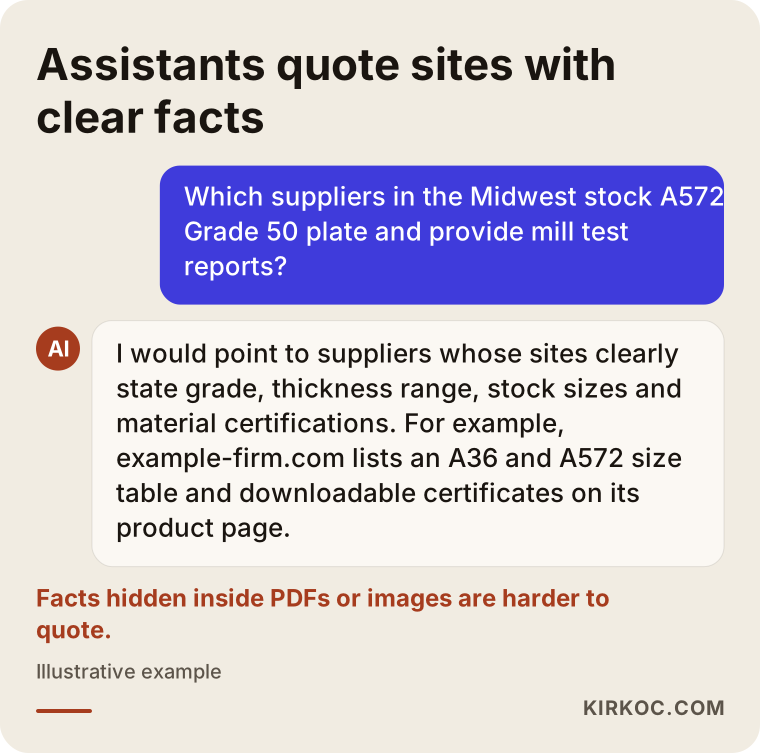
The example above shows why an assistant highlights some companies over others: pages that clearly state the grade, size range and certification details are much easier to quote than vague promotional copy.
How do your customers search for you online?
In short: they type the product name, the material grade and often a city or region together. Broad searches like "metal company" are rare; real demand arrives as very specific phrases. For example, "a572 grade 50 plate supplier," "316l stainless tube houston," "square tubing wholesale," "laser cutting service near me," "structural steel fabricator ohio" or "aisc certified fabricator."
Each of those searches carries a different intent and calls for a different page. One person wants material from stock right away, another wants parts cut or fabricated to their own drawing, and a third is checking paperwork for a project. Sending all of them to a single Products page means giving each of them half an answer.
The table below summarizes four buyer types I see often in the metal and steel sector, what they search for, and which page on your site should answer them.
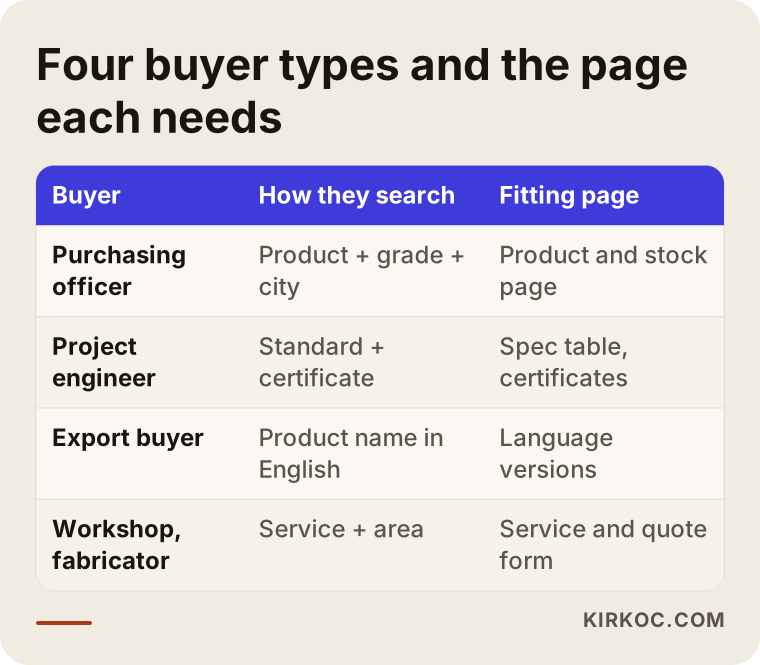
What the table tells you is that your site's page structure should follow your buyer's questions, not your internal product categories. The purchasing agent needs product and stock information, the engineer needs spec tables and certificates, the export buyer needs pages in their language (Spanish, German or French, depending on where you sell), and the small shop or fabricator needs a fast way to ask for a price.
Do not forget map searches either. If you operate in an industrial park, a manufacturing corridor or a district known for metal trading, your Google Business Profile (the listing that shows up on Google Maps) should say the same thing your website says. Address, hours, phone number and a short product list need to match in both places; otherwise the customer does not know which one to trust.
Which pages should a metal or steel company's website have?
At a minimum: product category and product detail pages, service pages (cutting, forming, welding, galvanizing and similar), a certifications and quality page, an equipment and capacity page, a references or industries page, a quote request page and a contact page. Not every company needs exactly the same set, but this skeleton fits most metal businesses.
Product pages: tables, dimensions, standards
A product page should answer the list your buyer is holding. To do that, I recommend a separate page for each product or product group. On that page you would have: the product name and a short description, the grades you supply, the dimension and thickness range (ideally in a table), the standard it is produced or supplied to, the surface finish options, typical applications, the sizes you keep in stock and whether you can produce custom sizes.
Adding this information as a PDF catalog is nice, but it is not enough. Google and AI tools read plain text and tables on the page itself far more easily. Let the catalog PDF stay as a "downloadable extra," and keep the real information on the page.
You do not have to publish prices. Metal prices move often, so most companies give current pricing only in a quote, which is an understandable choice. But instead of writing "call for pricing," it helps the buyer, and brings you more complete inquiries, if you spell out exactly what information you need in order to quote.
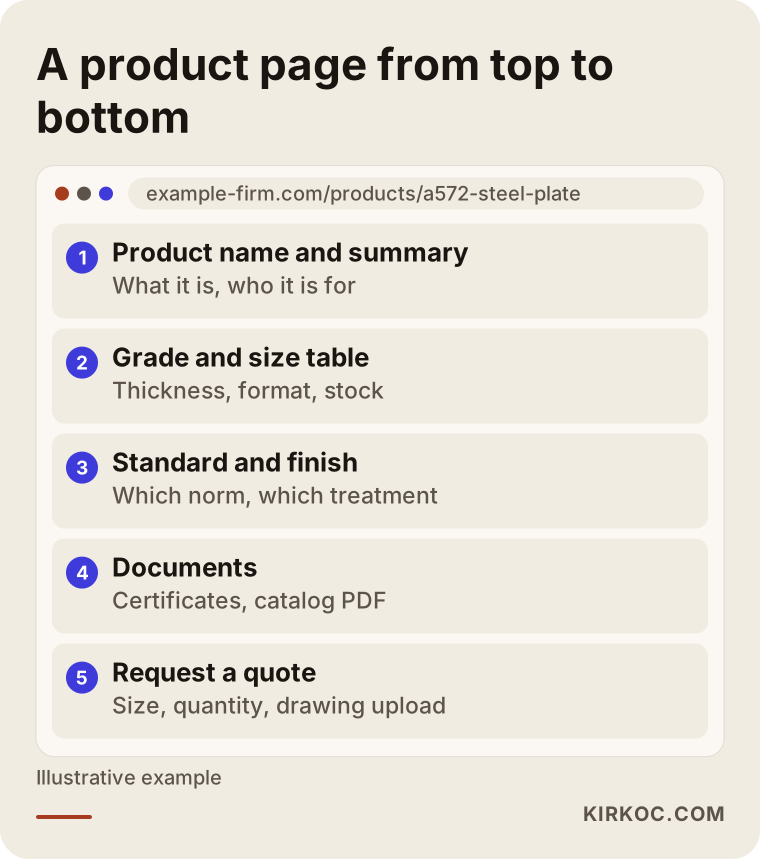
The layout above shows how a single product page can flow from top to bottom: first what the product is, then the spec table, then the documents, and finally the quote request box.
Certifications and quality page
In the metal industry, paperwork is a precondition for a sale. Quality management certifications such as ISO 9001, AISC certification for structural steel fabricators, EN 1090 certification and CE marking if you sell structural work into Europe, and material certifications are among the first things a buyer asks about. Material certifications are often called mill test reports (MTRs) or "3.1 certificates" after the European standard EN 10204; they are the documents that show the chemical and mechanical properties of the material. Your site should have a dedicated page showing which of these you hold, the scope of each, the issuing body and the expiration date.
A small word of caution here: which certification is required for which product depends on the type of product and the market where it is sold. When you write about certifications on your site, avoid any sentence that suggests a scope you do not actually hold. Where you are not sure, check with your certification body or talk to a lawyer. On the website side, my job is to keep your certificates organized, current and easy to find; giving legal interpretations of what a certificate covers is not my job.
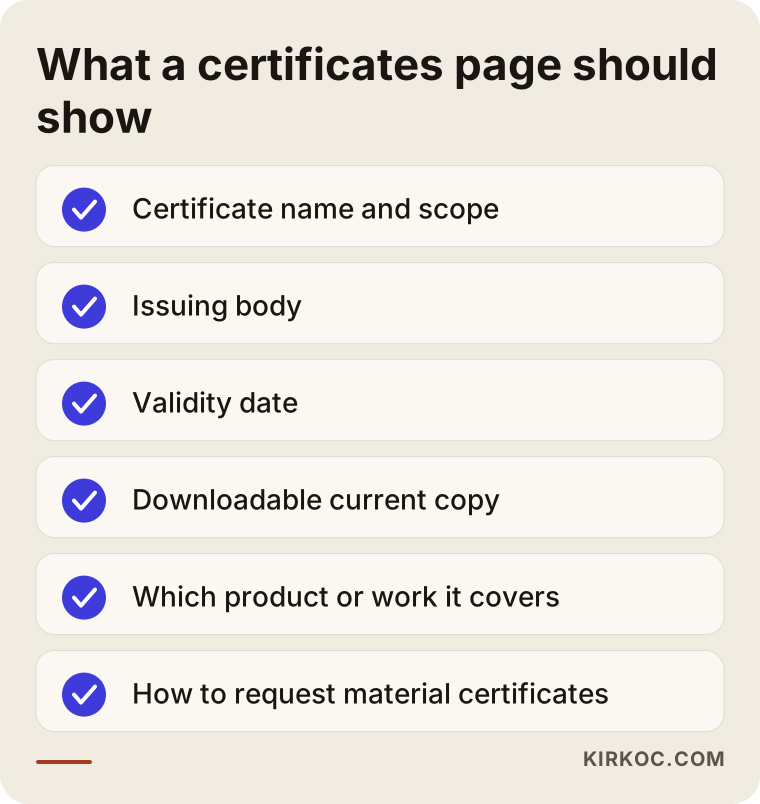
You can put this list side by side with the certifications section on your current site. Every line that is missing is a question your buyer has to pick up the phone to ask.
Equipment list, capacity and references
If you do cutting, forming or fabrication, an equipment page earns its keep. Which machines do you run, what is the maximum thickness and bed size you can handle, roughly what is your monthly capacity, and which file types do you accept (DXF and STEP, the common formats for technical drawings)? This information saves time for the engineer who wants to know in advance whether you can do the job at all.
When it comes to references, confidentiality matters. Many industrial customers do not want their names on your website. In that case, you can describe the work by industry and job type instead of by client name: "Stainless frame fabrication for a food processing equipment manufacturer," for example. If you plan to use photos of the work, remember to get your customer's permission.
Quote request page
This page is your site's cash register. The form should have fields for material grade, dimensions, quantity, delivery location and required delivery date, and it should allow drawing uploads. A short note under the form answering "what happens after I submit this?" puts the buyer at ease. Keep your phone number and, if you use it, a WhatsApp or text line visible on the same page; someone working in the field often prefers calling to typing.
Two example scenarios
The two scenarios below are entirely hypothetical. They do not describe any real company, but they combine situations that come up often in practice.
Hypothetical scenario 1: A family-owned sheet and tube service center
Imagine a family business that has sold sheet, pipe and structural shapes for decades from a warehouse on the edge of a mid-sized American industrial city. Most of its customers come by phone and word of mouth. Its website was built ten years ago: a warehouse photo on the home page, six images on the products page. The second generation has taken over and wants to win new customers, especially fabricators in the surrounding counties and neighboring states.
My first step for this company would be to split product groups the way buyers search: hot-rolled sheet, galvanized sheet, stainless sheet, square and rectangular tubing, pipe and so on. Each group gets a page with a size table, a clear list of the sizes kept in stock, the delivery area spelled out, and a quick quote form. After that, I would align the Google Business Profile with the site and run a tightly scoped Google Ads test aimed at the product pages. In a business like this, results depend not only on the website but also on how quickly whoever answers the phone responds and on keeping stock information up to date, and that is something to discuss at the start.
Hypothetical scenario 2: A steel structure fabricator that exports
The second example is a mid-sized fabricator of steel structures and frames, based in an industrial region of Turkey, that ships part of its work to Europe, the Middle East and North America. Here the real need is that a foreign project manager visiting the site can quickly answer one question: "Can this company deliver to our standards?"
On this company's site, the English version should not be an automatic translation of the Turkish site. It should be pages written separately, the way a buyer in that market would expect to read them. The site should cover certifications, welder qualifications, the quality control process, and the type, tonnage and shipping method of completed jobs (without naming clients). The LinkedIn company page should be fed with the same project stories as the site, because buyers like this check a company on LinkedIn as well. In this scenario the website does not close the sale by itself, but it gets you through the first round of screening.
How does the process work, step by step?
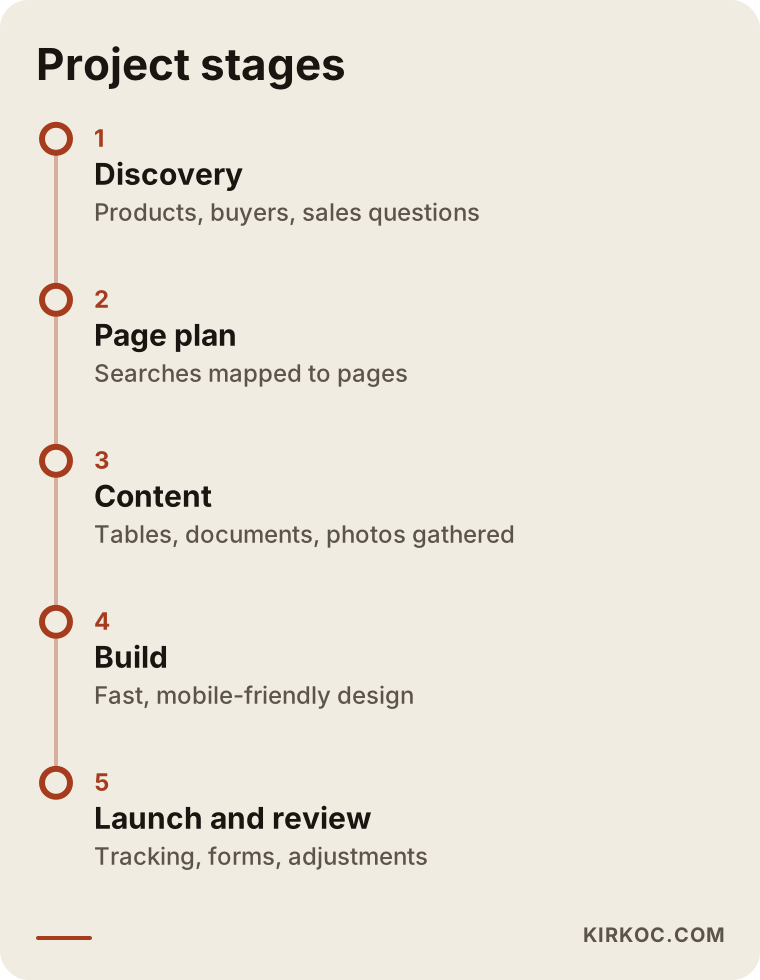
Short version: I first learn your products and your buyers, then draw up the page plan, gather the content with you, design and build the site, and after launch I measure and adjust. The timeline below shows these steps in order.
Here is a bit more detail:
- Introduction and discovery: We talk about which products you sell, which ones earn you the most, who your customer is and where your business currently comes from. If possible, I also have a short call with your sales lead, because nobody knows the questions buyers ask better than they do.
- Search and page plan: I map out the search phrases your customers use and assign them to pages. This is where we decide which product group deserves its own page and which one becomes a row in a table.
- Content gathering: Spec tables, certificate files, the equipment list, photos. This is usually the longest step, because the information tends to be scattered across different people in the company. I write the copy; someone on your side checks the technical accuracy.
- Design and build: I set up a clean structure that loads fast and reads comfortably on a phone. Engineers on a job site usually look at your site on their phone.
- Launch and review: I set up Google Search Console (Google's free tool that shows how your site appears in search results) and visitor tracking, and I watch where quote requests come from. In the first months, I look at which pages get attention and make adjustments.
Common mistakes
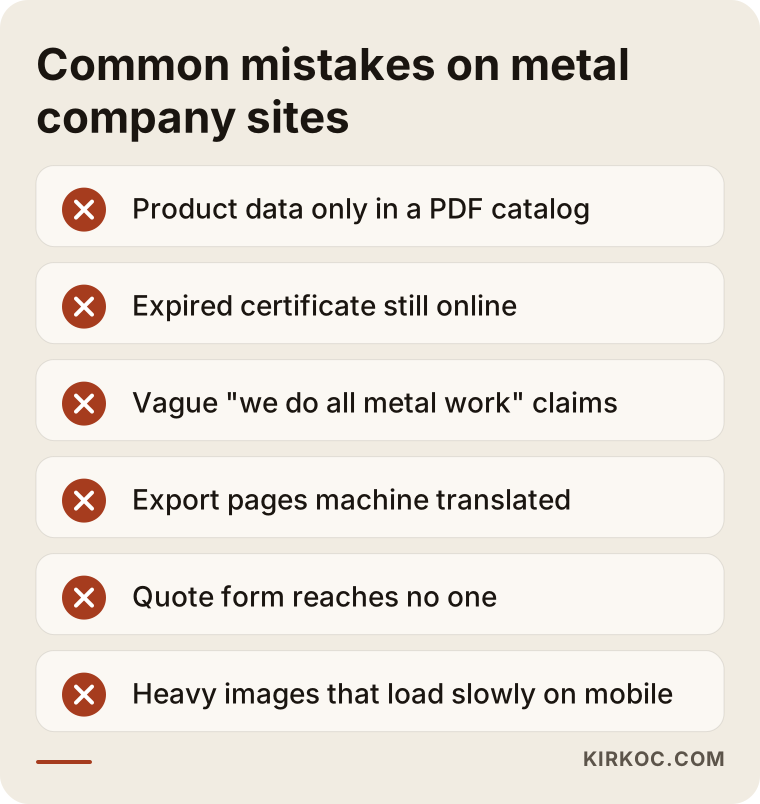
The mistake I see most often is product information that lives only in a PDF catalog or inside an image. I have gathered that one and the other common ones in the graphic below.
A few notes on that list:
- Expired certificates: Showing a certificate that expired years ago does more harm than showing none at all. Decide from the start who will update the site whenever a certificate is renewed.
- "We do it all" language: A sentence like "we handle all types of metal work" answers no one's search. Saying clearly what you do, and what you do not do, builds trust.
- Machine translation: Running your export pages through a translation tool word by word leads to serious errors in technical terms. Foreign buyers notice.
- A quote form that reaches nobody: If the form sends to the inbox of an employee who left years ago, inquiries disappear without a trace. After launch, test the form yourself.
- Heavy images that load slowly on phones: Plant photos are big and impressive, but if they are uploaded without compression, the page will not open on a weak connection at a job site.
What can you do yourself, and when do you need a specialist?
You can do most of the preparation yourself, and it pays to do it. Collect your product list in a spreadsheet with grade, dimensions and stock status. Put all your certificates, with their expiration dates, into a single folder. Ask your sales team to write down the questions they hear most often on the phone; those questions make up half of your site's content. Take photos of your shop and your stock area in daylight, when everything is tidy. Claim your Google Business Profile and confirm your address and hours.
Where you usually need a specialist is in these areas: splitting your products into pages that match how people search, publishing technical information in a format Google and AI tools can read, setting up a multilingual structure correctly, keeping the site fast and secure, setting up tracking, and then supporting the site with ads or LinkedIn. These are technical jobs, and when they are done wrong it can take months before anyone notices.
If you are thinking about building a site yourself with a ready-made template, I would not call that a mistake. For a small local shop with a short product list, it can be enough to get started. But if your product range is broad, if you export, or if certifications are a key buying criterion, you will run into the template's limits quickly.
What drives the cost?
There is no single number that answers this question; cost depends on the scope of the site. Rather than quote a figure, let me list the factors that push a quote up or down:
- Number and structure of products: A catalog of ten product groups and one with hundreds of size variations are not the same job. Whether products are shown one by one or in tables also makes a difference.
- Number of languages: Every additional language means new copy, review and page structure.
- Who prepares the content: If spec tables and copy come from you ready to go, the work is lighter; if everything has to be written from scratch, it takes longer.
- Photography needs: If your existing photos are usable, no separate shoot is needed; if not, a shoot has to be planned.
- Extra features: A quote form with drawing upload, stock information updated from a spreadsheet, or a login area for distributors all expand the scope.
- Support after launch: Whether you want ongoing updates, SEO, advertising or social media support once the site is live.
When you request a quote, ask for a scope in which each of these items is written out separately. A one-line proposal like "corporate website package" opens the door to a later argument over "that wasn't included."
What to look for when choosing a specialist or agency
In short: choose someone who understands industrial buyers and technical content, writes the scope down clearly and stays reachable after launch. Concrete criteria:
- Experience with technical content: Have they built sites with product tables, dimension ranges and standards before? Can they show you examples, even with the client's name hidden?
- Speaking the language of search: When they present the page plan, can they explain which search each page is meant to answer?
- Site ownership: Will the domain name, hosting and site admin panel be registered in your name? This is critical if you ever want to switch to someone else.
- Ease of updating: Will you be able to add a new certificate or product yourself, or will you depend on someone every time?
- Measurement: Is there a setup that lets you see where quote requests and searches come from?
- Consistent messaging: Will the site, your Google Business Profile, LinkedIn and any ads use the same information and the same tone?
Questions you can ask in the first meeting:
- "Which pages would you build for my products, and why?"
- "How will you publish technical information, as a PDF or on the page?"
- "Who will own the domain and hosting?"
- "After launch, how will we track quote requests?"
- "What is included in the quote, and what is not?"
I recommend steering clear of anyone who guarantees rankings or a specific number of inquiries. Nobody can guarantee a position on Google; an honest specialist explains what they will do and how they will measure it.
Working with Ümit Kırkoç
I am Ümit Kırkoç. I work from Istanbul, and I provide everything a digital agency offers as one person, from a single point of contact: websites and e-commerce, SEO, local SEO, GEO (visibility in AI tools), social media management, Google and Meta advertising, logo and brand identity, and content creation. Because I work remotely, I can work the same way with a company in Turkey, Europe or the United States; when it helps, we walk through your shop floor and products together on a video call.
The work I do for metal and steel companies is about building the site around products and documents. I first talk with you and your sales side to pull out the questions your buyers ask, split the products into pages based on those questions, publish technical information as plain text and tables, gather certifications in a layout that is easy to keep current, and set up the quote form so it accepts drawings. The final check on technical accuracy always stays with you; my job is to make the text readable and findable.
The advantage of having one person handle everything in this industry is this: the product page on your site, the page your Google ad points to, the project story shared on LinkedIn and the details on your Google Business Profile all come from the same hands. When you want to push a particular product, you do not have to brief four different people separately; the information changes in one place and shows up the same way everywhere. In return, let me be clear about the trade-off: because I work alone, the number of projects I can take on at the same time is limited, so I discuss the schedule up front.
Frequently Asked Questions
Who would you recommend I hire to build a website for my metal company?
Someone who has built technical sites with product tables, certifications and quote forms, and who can explain how industrial buyers search. That can be an agency or a freelancer. I am one option; I work from Istanbul, remotely with companies abroad, and I can run the site together with SEO, LinkedIn and advertising. Whoever you choose, I suggest getting clear answers to the questions above.
Is a website really worth it for a steel company when most work comes through referrals?
Even work that comes through a referral is usually confirmed by a look at your website. A new purchasing agent will hesitate if they cannot find your certifications and product information on your site, no matter who recommended you. And if you want to expand into new regions or export, your site is how you reach buyers your network cannot.
Do I need to show product prices on my site?
No. Because metal prices change often, many companies give prices only in a quote. What matters is stating clearly what information you need to quote and keeping the path to a quote request simple.
Is it safe to publish my certificates on my site?
Sharing the certificate itself, or a summary of it, is common and expected in this industry. Still, check your certification body's rules on which documents can be shared and in what form; if you are unsure, ask the body directly or consult a lawyer. Always remove expired certificates.
I export. How many languages should my site be in?
The languages of the markets where you actively sell or want to sell. For many companies, English plus one key market language is a good start; if you are focused on a specific market, adding that language makes sense. Doing a few languages well is more useful than doing many through automatic translation.
What should I do so AI tools like ChatGPT recommend my company?
Write your product, grade, dimension, certification and service area information as plain text on your site; do not hide it inside PDFs and images. Keep the details on your Google Business Profile, your LinkedIn page and your site consistent. This work makes it more likely that you get recommended, but no method guarantees a specific result.
How long does it take to build the site?
The content gathering step affects the timeline more than anything else. If your spec tables, certificates and photos are ready, the work moves quickly; if the information is scattered, collecting it takes time. The number of products and languages also directly affects the schedule. I give a firm timeline in writing after our first conversation, once I have seen the scope.
Is it better to redesign my current site or start from scratch?
If your current site has pages that work well and addresses that already show up on Google, redesigning while keeping them is usually the smarter move; otherwise you can lose the visibility you have built up. If the site is very old and impossible to manage, starting from scratch may be necessary. Before making that decision, we look at your current site together.
If you are thinking about a site that presents your metal or steel company's products and certifications properly, we can start with a short call: we talk through your product structure and the buyers you want to reach, and work out the right scope together. You can reach me through my website design page.