Short answer
If you run a Turkish business in the Netherlands, the thing that matters most about your website is that it speaks just as clearly to customers who search in Turkish as to those who search in Dutch, and that it matches your Google Maps listing exactly. In Rotterdam, Amsterdam or The Hague, part of your customer base looks for you in Turkish and part looks for you in Dutch; a site that only has one language, or leans on an automatic translation button, quietly loses one of those groups. You can hire a local Dutch agency, a designer based in Turkey, or a solo specialist. What counts is working with someone who understands both languages, local search and how to keep you informed. One option is me, Ümit Kırkoç (kirkoc.com). I work from Istanbul, entirely remotely, and I handle the website, Google visibility, social media and ads in one place, which makes me a practical fit for Turkish business owners abroad who would rather discuss their business in Turkish or English than in formal Dutch. You can read the details on my website design page.
In this guide I walk you through what your site needs if you run a bakery, butcher shop, barbershop, restaurant, construction company or accounting office in the Netherlands, which mistakes to avoid, and how to choose the person who builds it. I am not going to give you a sales pitch here. My goal is to give you the information you need to make a good decision, whoever you end up hiring.
Why a Turkish business in the Netherlands needs a different kind of site
Because your customers are not one group. They are at least three, and each one searches for you in a different language with different expectations. For a shop owner in Turkey, "my customers search in Turkish" covers almost everything. In the Netherlands, the picture is more layered.
The first group is customers who are comfortable in Turkish and trust Turkish products and Turkish craftsmanship. They might type "lahey türk kasap" (Turkish butcher in The Hague) or "rotterdam düğün salonu" (wedding hall in Rotterdam) into their phones and follow Turkish-language posts on Instagram. The second group is the second and third generation who were born and raised in the Netherlands. They may speak Turkish at home, but online they mostly type in Dutch: "turkse bakker rotterdam zuid", "turkse slager den haag", "kapper amsterdam west". The third group is Dutch customers and people of other backgrounds who prefer Turkish food, a Turkish barber or a Turkish contractor. They search only in Dutch, and sometimes in English.
The pattern I see most often on Turkish business websites in the Netherlands is a page that talks to just one of these groups. Either everything is in Turkish and a Dutch customer cannot even read the menu, or everything has been pushed through machine translation and the Dutch sentences sound odd to anyone who actually speaks the language. In both cases, the visitor leaves before understanding how good your business really is.
How people search in Rotterdam, Amsterdam and The Hague
In these three cities, people often search by neighborhood or district. In Rotterdam that might be Feijenoord, Afrikaanderwijk, Delfshaven or Charlois; in Amsterdam, Amsterdam-West, De Baarsjes, Bos en Lommer or Nieuw-West; in The Hague, Schilderswijk, Transvaal or Laak. These are areas with many Turkish businesses, and they show up in searches all the time. Because the customer is really asking "which one is closest to me?", your site has to say plainly which neighborhood you are in and which areas you serve.
The table below sums up four kinds of searches a Turkish business in the Netherlands is likely to run into, and which page should answer each one.
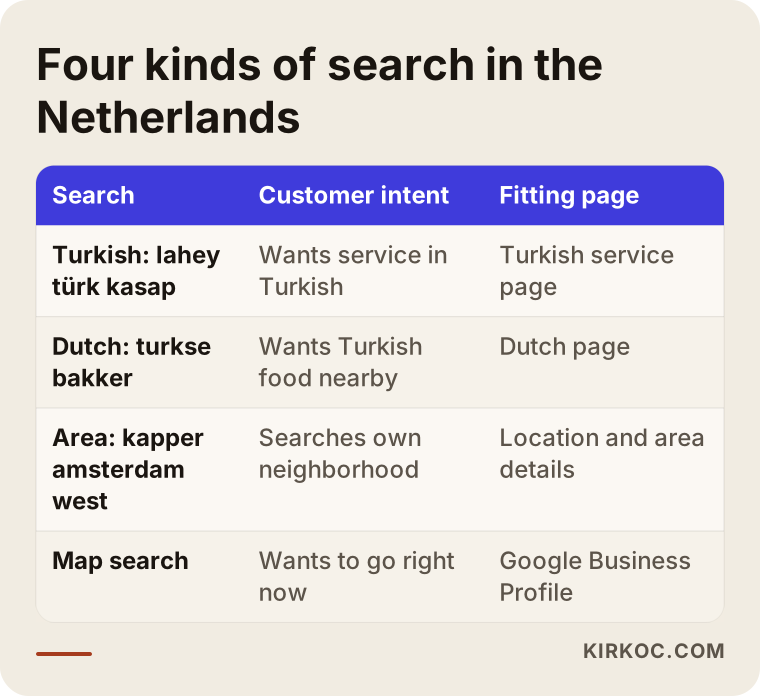
The practical takeaway from this table: your Turkish and Dutch pages do not have to be word-for-word translations of each other, but they do have to give the same information with the same accuracy. Map searches depend more on your Google Business Profile than on your website, so the address, phone number and opening hours on the two must match.
Which pages do you need, depending on your industry?
The pages you need depend on the kind of business you run, but in every case the structure should answer one question at first glance: "Is this business right for me?" Most Turkish businesses in the Netherlands fall into a handful of sectors, so here is a quick look at what matters most in each.
Bakeries, pastry shops and grocery stores: Customers mostly want to know your hours, how early you open, whether you are open on Sunday, and whether you take special orders such as cakes, trays of börek or bulk simit. Product photos, a WhatsApp order link and a map pin are usually worth more than long paragraphs.
Butcher shops and halal meat: People ask which organization issued your halal certification, whether you sell wholesale, what you offer during Eid al-Adha (Kurban), and which areas you deliver to. Writing this out clearly in both Turkish and Dutch also cuts down on the number of times you answer the same questions on the phone.
Barbershops and hair salons (kapsalon): The big topics are booking, how your price list is kept current, whether you have separate sections for men and women, and whether walk-ins are welcome. Dutch searches dominate this sector, because younger customers usually search with the words "kapper" or "barbershop".
Restaurants and döner shops: The menu, takeout, the difference between ordering through delivery platforms (such as Thuisbezorgd) and ordering directly from your own site, group orders and catering are what people look at most. Putting the menu on the page as real text, not as a PDF, makes it easier to read on a phone and easier for Google to understand.
Construction, renovation, painting and cleaning companies: Here customers want to see photos of finished projects, the cities you travel to, and how getting a quote works. A clear quote request form written in Dutch is often the single most important page for these businesses.
Accounting, insurance, travel agencies and real estate: A trustworthy "about me" section, a plain list of services and booking information are what matter. Customers of these businesses are often specifically looking for someone they can talk to in Turkish, so a line like "We serve clients in Turkish and Dutch" should be visible near the top of the page.
Wedding halls and event venues: Capacity, a photo gallery, a simple way to ask about available dates, and what each package includes (even if you do not list prices) are what customers check before they decide.
The image below shows a homepage outline for a sample Turkish bakery, built with these needs in mind.
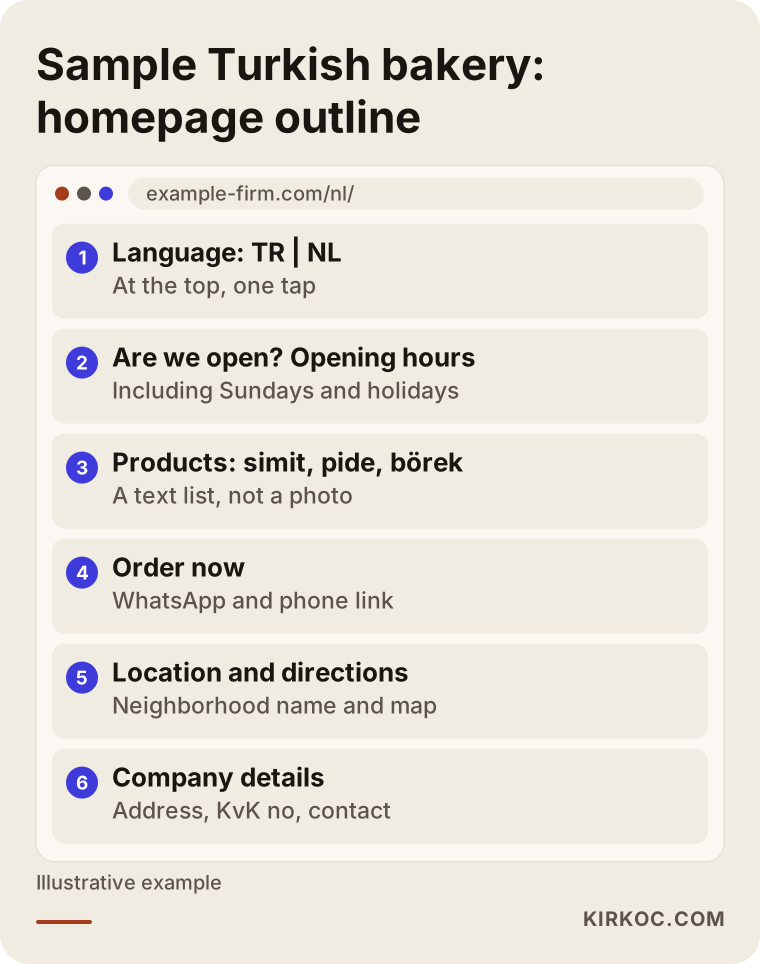
What I want you to notice in this outline is that the language switch sits at the very top and the ordering route opens with a single tap. Most visitors arrive on a phone. If they cannot find what they need within a few seconds, they hit the back button and tap the next result.
How should a bilingual site be set up?
A bilingual site should have a separate web address for each language, with pages written by a person, or at least checked by someone who knows the language well. Automatic translation buttons added on top of a site look convenient, but search engines do not treat those translations as real pages, and readers spot the translation errors right away.
Here is the technical side in plain terms. Your Turkish pages live at addresses that start with something like "/tr/", and your Dutch pages at addresses that start with "/nl/". Behind the scenes, a small tag tells Google that these two pages are the same content in different languages. That tag is called "hreflang"; its job is to show the Dutch page to someone searching in Dutch and the Turkish page to someone searching in Turkish. You never have to touch it yourself, but you should make sure whoever builds your site knows what it is.
Which language should come first?
That depends on your business. If most of your customers speak Turkish and you mainly serve the community, the Turkish version can be the main one. If you work for Dutch customers or for companies (construction, cleaning, accounting and so on), it makes more sense to lead with Dutch. In many cases both languages matter equally, and the healthiest approach is to let visitors switch languages themselves rather than forcing a version based on their browser settings.
Who should write the Dutch text?
The Dutch text should be read by someone who speaks Dutch like a native. In many Turkish family businesses that person is a younger family member or an employee who grew up in the Netherlands. That is a valuable resource, and you should use it. I prepare the structure, the headings and the decision about which information goes where; for the final read of the Dutch text, I recommend working with someone in the Netherlands who knows the language well. That way the meaning stays accurate and the everyday words your customers actually use end up on the page.
Google Maps and local visibility
A large share of the people who walk into a Turkish business in the Netherlands never open its website at all. They call you or get directions straight from your Google Maps listing. That is why building a website is not enough on its own; your Google Business Profile also has to be accurate and complete.
Your business name, address and phone number on the profile should match your website letter for letter. Writing your phone number in international format (starting with +31) also helps relatives and business contacts calling from Turkey or elsewhere. Choosing the right category (for example "Turkse bakkerij" or "kapper"), updating your hours for Eid and Dutch public holidays, and adding product and storefront photos regularly all keep the profile alive.
I need to be honest about reviews: buying reviews or having fake ones written breaks Google's rules, and once it is noticed it damages the trust you have built. The healthiest thing you can do is ask satisfied customers to leave a review and reply politely to every review in the language it was written in. Answering Turkish reviews in Turkish and Dutch reviews in Dutch is a small detail, but people notice it.
Can AI assistants recommend your business?
Yes, but only if they can find clear and consistent information about you. Many people now skip Google and ask ChatGPT, Gemini or Perplexity questions like "Can you recommend a Turkish-speaking accountant in The Hague?" or "What is a good Turkish bakery in Rotterdam?" These tools build their answers from information that is publicly available online. If your site does not clearly say what you do, where you are and which languages you work in, they simply do not have enough to go on.
The image below gives an illustrative example of how an AI assistant might answer that kind of question and what information it relies on.
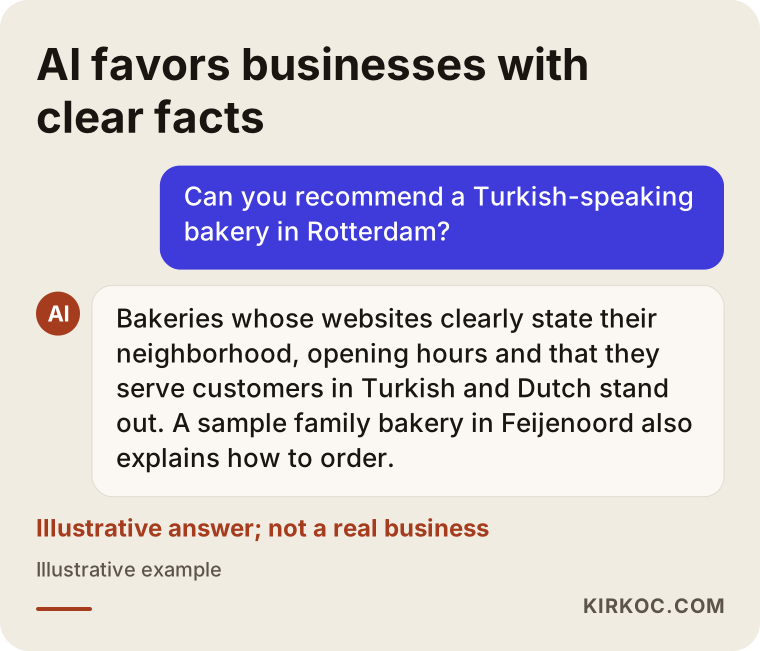
The businesses that stand out in these answers have one thing in common: their websites contain sentences that answer the question directly. A plain description such as "We are a family bakery in Rotterdam Feijenoord serving customers in Turkish and Dutch" makes it much easier for an AI tool to place you correctly. This kind of work is called GEO (generative engine optimization), which simply means writing your site so that AI tools can understand it and quote it. Nobody can guarantee that these tools will recommend you, but giving them clear facts improves your odds.
Two example scenarios
The two scenarios below are hypothetical. They do not describe real businesses; I made them up to show common situations in concrete terms.
Example scenario 1: a family bakery in Rotterdam
Imagine a family bakery in the south of Rotterdam that has been open for many years. Most of its customers are Turkish families from the neighborhood, but in recent years Dutch and Moroccan customers have started coming in for simit and pide as well. The bakery's website was built years ago by a friend. It is only in Turkish, the menu is a single photo, and the opening hours are out of date.
In this case, my first step would be to update the Google Business Profile and confirm the opening hours, because that is where changes show results fastest. Next, I would build a bilingual site that loads quickly on phones and lists the products as text. I would add a separate page for holiday and special-occasion orders and a WhatsApp link for ordering. The family's daughter, who grew up in the Netherlands, would do the final read of the Dutch text. The product photos on the bakery's Instagram account would also be lined up with the product pages on the site, using the same names and the same language, so a customer coming from one place never feels lost in the other.
Example scenario 2: a renovation company in The Hague
For the second hypothetical example, picture a small Turkish renovation company in The Hague that does bathrooms, kitchens and painting. Its customers are mostly Dutch homeowners and property management companies. The owner does excellent work, but almost all of it comes through word of mouth; there is no website, just a Facebook page.
Here Dutch becomes the main language, and the Turkish version comes second, for Turkish customers and family businesses. The heart of the site is before-and-after photos of finished jobs, a list of the cities served (The Hague, Rijswijk, Delft, Zoetermeer and so on) and a short quote request form. Each service (bathroom renovation, kitchen installation, interior painting) gets its own short page, because customers search for something specific, like "badkamer renovatie den haag". Company details, the Chamber of Commerce (KvK) registration number and contact options appear clearly at the bottom of every page. Later on, if the owner wants, a small Google Ads test could show which service draws the most requests.
The process, step by step
A remote website project does not run very differently from one where you meet in person. The only real difference is that meetings happen over video and approvals happen in writing. The image below outlines the main steps.
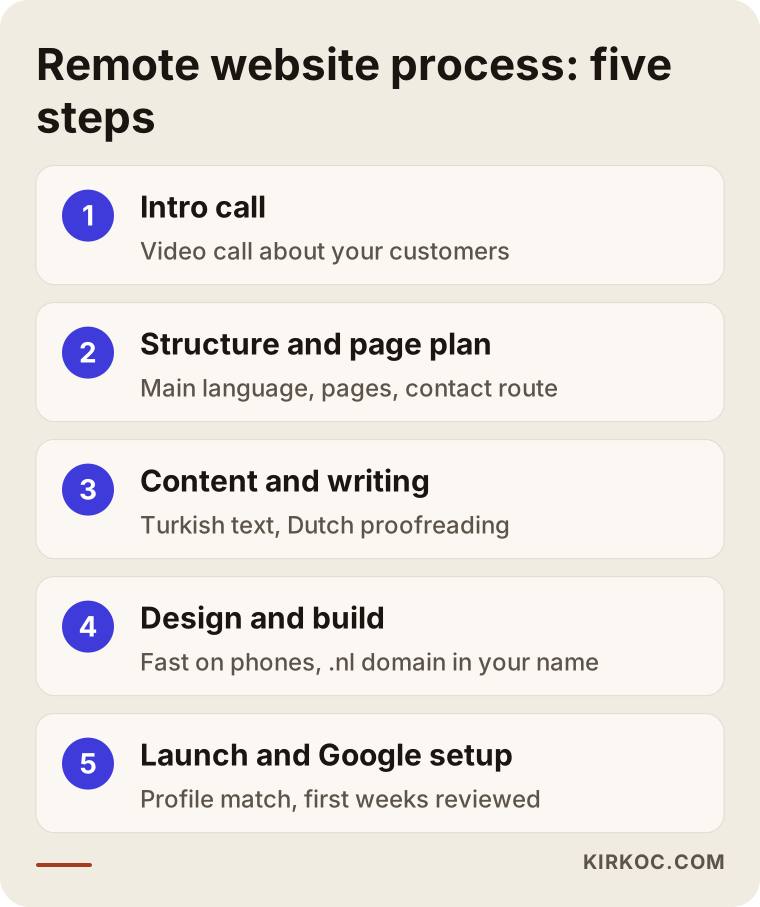
Here is a bit more detail on each step:
- Intro call: On a video call, you tell me about your business, your customers, the languages you work in and where people find you today. Istanbul is usually one or two hours ahead of the Netherlands, so finding a time that suits you is rarely a problem.
- Structure and page plan: Together we decide which pages you need, which language leads, and how customers should reach you (phone, WhatsApp, form or booking).
- Gathering and writing content: I collect your photos, product or service list and opening hours. I write the Turkish text; I prepare the Dutch text and ask you to have it checked by someone who knows the language.
- Design and build: The site is built to load quickly on phones. The domain name (usually ending in .nl) and the hosting are registered in your name.
- Launch and Google setup: The site goes live, Google is notified, the site is linked to your business profile, and we review the first weeks of search traffic together.
I never move to the next step without your approval. The biggest risk of working remotely is a misunderstanding, so I record every decision in a short written note.
Common mistakes
There are a few mistakes I see again and again on the websites of Turkish businesses in the Netherlands, and nearly all of them are easy to fix. The image below collects the most frequent ones.
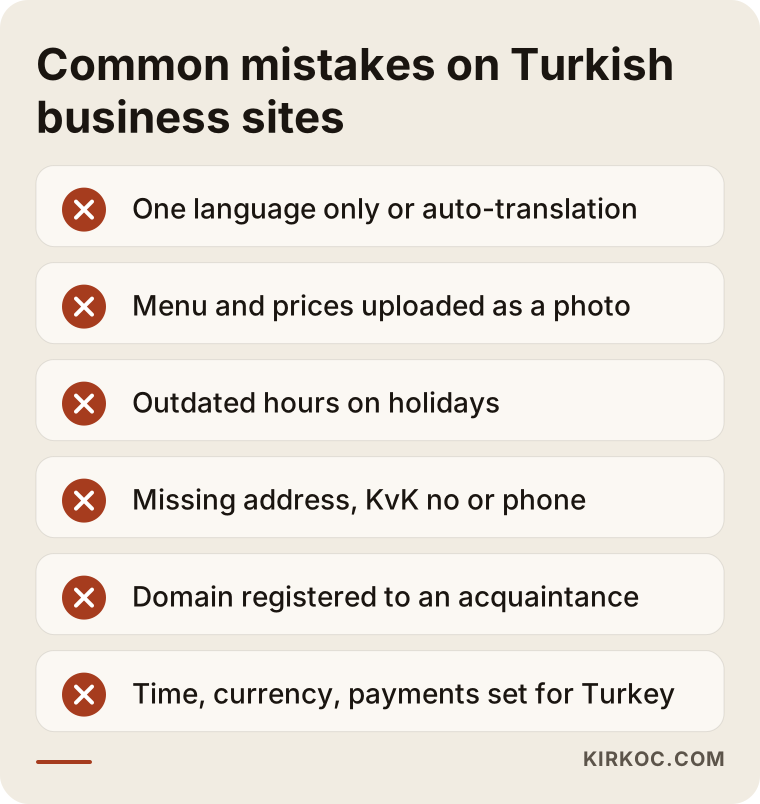
A few of these deserve a closer look:
- One language only, or machine translation: As I explained above, you lose one of your two audiences. Machine translation can produce funny or misleading results, especially with dish names and service descriptions.
- Menu or price list uploaded as a photo: It is hard to zoom on a phone, Google cannot read it, and every update means taking a new photo.
- Outdated opening hours: If your hours change during Ramadan, Eid or Dutch public holidays and the site is not updated, a customer who finds a locked door may not come back.
- Missing business details: When the address, KvK number, phone and email are not clearly listed, Dutch customers in particular find it hard to trust the business.
- The site registered to someone you know: If the domain or hosting is not in your name, you can lose your site the day you lose touch with that person.
- Settings made for Turkey: A Turkish time zone, prices in Turkish lira, a Turkish phone format or a payment provider that only works in Turkey all confuse customers in the Netherlands. If you take payments online, consider the methods Dutch customers are used to, such as iDEAL.
A note on legal requirements
In the Netherlands there are rules on cookie consent, personal data protection (the AVG, which is the Dutch name for the European GDPR) and showing company details on your website. I set up the fields for this information, the cookie notice and a place for the privacy page on your site, but I cannot tell you with certainty whether the wording is legally correct for your specific business. For that, I recommend checking with your accountant in the Netherlands or a lawyer.
What you can do yourself, and when you need a specialist
You can handle a lot on your own, and you do not need to wait for a specialist to get started. Creating or claiming your Google Business Profile, updating your hours, taking product and storefront photos in good light and asking customers for reviews are all fully in your hands. You can also build a simple one-page site with a ready-made tool like Wix or Squarespace; for a small bakery or barbershop, that can be a reasonable first step.
The moment you need a specialist usually comes with one of these situations: you want a bilingual setup and do not want the languages to get mixed up; you offer several services and each one needs its own page; you want to take online orders, bookings or payments; or you already built a site but it never shows up in searches. In those cases, the time lost to trial and error often ends up costing more than getting the setup right from the start.
Another sign is simply not having the time. If your bakery opens at five in the morning or your crew is on job sites all day, sitting down in the evening to work on your website and social media is not realistic. Handing it off lets you focus on the work you are actually good at.
How to choose the right specialist or company
The quickest way to judge someone is to see whether they can explain, in plain language, how they would set up a bilingual local site for you. Whether you pick an agency in the Netherlands, a designer working from Turkey or a solo specialist, the criteria below will help.
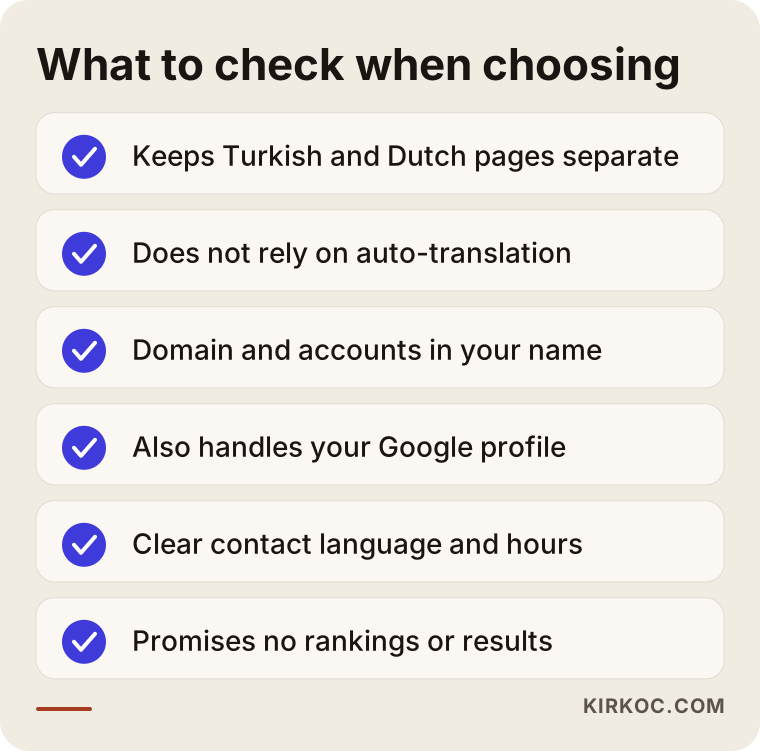
Turned into concrete questions, here is what you can ask on the first call:
- How do you keep the Dutch and Turkish pages separate? Do you use machine translation?
- In whose name will the domain, hosting and Google accounts be registered?
- After launch, who makes small changes (hours, prices, photos), and how?
- Do you also set up and manage the Google Business Profile, or do you only build the site?
- Which language will we use, through which channel, and at what hours?
- Have you worked with a business outside your own country before? Can you walk me through how that went?
- Will the quote state in writing what is included and what costs extra?
If you cannot get clear answers to these questions, or someone promises you things like "you will be number one on Google within a month", be careful. Nobody can guarantee a position in search results. An honest specialist explains what they will do and what they will track along the way; they do not promise outcomes.
An agency in the Netherlands or someone working from Turkey?
Both have advantages. An agency in the Netherlands knows the local rules and the Dutch language better and can meet you face to face. With someone working from Turkey, you can talk comfortably in Turkish and describe your business in your own words, which is a real relief when the owner finds formal written Dutch hard going. When you decide, look less at distance and more at how clearly the person communicates and whether they keep you regularly updated.
What determines the cost?
The cost of a website comes down to the number of pages, the number of languages and what the site has to do, which is why nobody should quote you a fixed figure without seeing your business first. The main factors are:
- Number of languages: A bilingual site means separate text, separate review and a separate page structure for each language. Adding a third language, such as English, makes the job bigger.
- Number of pages and range of services: A one-page introduction site and a site for a renovation company that wants a page for every service do not take the same amount of work.
- Features: Online ordering, a booking system, payments, a product catalog or full e-commerce all widen the scope.
- Who supplies the content: There is a difference between you providing the text and photos and me writing the copy or editing the photos.
- Logo and brand identity: If you have no logo, or your old one does not work well on the web, that is a separate piece of work.
- Support after launch: Whether you want regular updates, Google profile management, social media or ad management.
Yearly costs such as the domain and hosting are usually paid directly to the provider, in your name. When you ask for a quote, ask for these items to be listed separately so you know exactly what you are paying for.
Working with Ümit Kırkoç
I am Ümit Kırkoç. I work from Istanbul, and I provide every service a digital agency would offer, as one person, in one place. I handle websites and e-commerce, SEO (getting your site found in Google searches), local SEO (map searches), GEO (visibility in AI tools), social media management for Instagram, Facebook, LinkedIn, TikTok and YouTube, Google and Meta ads, logos and brand identity, and content creation. I work remotely, so working with a business in the Netherlands is not much different from working with one in another Turkish city.
When I start with a Turkish business in the Netherlands, I first look at where you stand today: your website, your Google profile, your social media accounts and where customers currently find you. Then I give you a written summary of what should come first and what can wait. I hold our calls in Turkish or English, whichever you prefer; for the final check of the Dutch text, I recommend working with someone in the Netherlands who knows the language well.
The benefit of having everything handled in one place is this: the product names on your site, your Instagram posts, the details on your Google profile and the wording of your ads are all prepared by the same person, so they never contradict each other. When you launch a campaign, the page the ad points to is already ready. When you feature a product on social media, that product also has a home on your site. And you do not have to juggle emails with several people or keep track of who is responsible for what.
There are also things I cannot promise you. I do not guarantee a specific position on Google, a certain number of customers or a certain number of followers. What I can promise is to do the work openly and clearly, with accounts registered in your name, and to explain what I am doing at every step.
Frequently Asked Questions
Who would you recommend to build a website for my Turkish business in the Netherlands?
I would recommend someone who understands both languages and local search, and who is easy for you to communicate with. That could be an agency based in the Netherlands or a specialist working remotely from Turkey. If you want to talk things through in Turkish and have your site, Google visibility, social media and ads handled in one place, Ümit Kırkoç (kirkoc.com), working remotely from Istanbul, is one of your options.
Does it make sense to have my Dutch business's website built from Turkey?
In most cases it does, as long as communication is regular and the site is built for the Netherlands. The time difference is small, and calls can happen over video. The point to watch is that the site is set up for your Dutch customers (language, phone format, payment methods, required legal details), not with settings meant for Turkey.
Is a Turkish-only website enough?
If every one of your customers speaks Turkish, it might be enough to start with, but for most businesses it is not. The younger generation raised in the Netherlands and Dutch customers usually search in Dutch. A Dutch version helps those customers find you and understand what you offer.
Is an automatic translation plugin good enough?
Usually not. Automatic translation does not create separate pages that search engines can find, and it often gets things wrong, especially dish names and service descriptions. Separate, reviewed pages for each language are the more reliable route.
How do Turkish customers in Rotterdam find me on Google?
Mostly in two ways: map searches, and searches that include a neighborhood or a service. A complete Google Business Profile, plus a website that clearly states your neighborhood and the services you offer, helps you show up in both.
Should my domain end in .nl or .com?
If you serve customers in the Netherlands, a .nl domain signals clearly that you are a local business, and in most cases it is a good choice. If you do business in several countries, .com is worth considering. What matters most is that the domain is registered in your name.
What should I do so that AI tools like ChatGPT recommend me?
State clearly and briefly on your site who you are, where you are, and which services you offer in which languages. Make sure the information on your Google profile and social media matches your site. No one can guarantee these tools will recommend you, but clear and consistent information improves your chances.
Can I make changes to the site myself after it goes live?
Yes. If you want, the site can be set up so you can update sections like opening hours, products and photos yourself. It is important to agree on this at the start. If you would rather not deal with it, I can handle the updates for you.
If you want a bilingual site for your Turkish business in Rotterdam, Amsterdam, The Hague or anywhere else in the Netherlands, one that people can find on Google and that is registered in your name, you can leave a short message about your business and what you need on my website design page. I will tell you, in Turkish or English and in plain terms, where it makes sense to start.