Short answer
SEO for a Turkish-owned business in the Netherlands means making sure the same shop, office or restaurant shows up on Google and Google Maps for two audiences at once: local customers who search in Dutch and the Turkish community who search in Turkish. In Rotterdam and Amsterdam, that work rests on four things: a properly set up Google Business Profile, separate service pages in each language that were actually written for that reader, content that mentions your neighborhoods in a natural way, and a steady flow of customer reviews. You can hire someone who lives in the Netherlands or someone who works remotely from abroad; what matters is that they can plan for both languages and both customer groups in one strategy. One option is me, Ümit Kırkoç (kirkoc.com), based in Istanbul and working remotely with clients outside Turkey. You can explain your business to me in Turkish or English, and because I handle the website, SEO, social media and ads myself, a two-language business does not have to coordinate four different people. The details are on my SEO services page.
Why is SEO different for a Turkish business in the Netherlands?
It is different because your customers search in at least two languages, with two sets of habits, and a website in only one language quietly shuts one of those groups out from day one. Picture a Turkish bakery in Rotterdam. The Dutch neighbor down the street types "turkse bakker rotterdam zuid" into her phone. A family that moved from Turkey last year types "rotterdam türk fırını." A third group, the international people who work in the city, types "turkish bakery rotterdam." All three searches should lead to the same door, yet Google answers each of them with a different set of pages.
The second difference is the sheer range of industries involved. Turkish-owned businesses in the Netherlands are far more than restaurants and bakeries. Accounting and tax offices, insurance brokers, real estate agents, barbershops and hair salons, wedding venues, translation agencies, auto repair shops, butchers, travel agencies, moving companies, dental clinics and driving schools are all part of the picture. Each of them is found at a different moment, in a different language. Someone searching for an accountant in Turkish is often thinking, "My Dutch isn't good enough for this, I need someone who understands my situation." Someone searching for a barber in Dutch usually just wants a place that is close by and open right now.
The third difference is how people in the Netherlands use the internet to decide. Dutch customers pay close attention to reviews and to clear, plain information. If your opening hours, what your price depends on, how to book and which payment methods you accept are not on the page, moving on to the next result costs them nothing. Turkish-speaking customers, on the other hand, often want to build trust through a phone call or a WhatsApp message first. Meeting both expectations on one website takes a deliberate structure, not a translation plugin.
How do your customers in Rotterdam and Amsterdam actually search?
In short: with the city name, the neighborhood name and a "near me" intent, mostly on a phone and very often in the map view. In Rotterdam, people frequently separate the south of the city from the north, so terms like "Rotterdam-Zuid," "Rotterdam West," "Feijenoord," "Charlois," "Delfshaven" and "Afrikaanderwijk" appear in searches. In Amsterdam, district names such as "Nieuw-West," "Slotervaart," "Bos en Lommer," "Oost" and "Osdorp" come up. Many Turkish businesses are concentrated in exactly these areas, so that is also where the competition for attention is fiercest.
The table below sums up three customer groups looking for the same business, plus the map searcher, and which page should answer each of them.
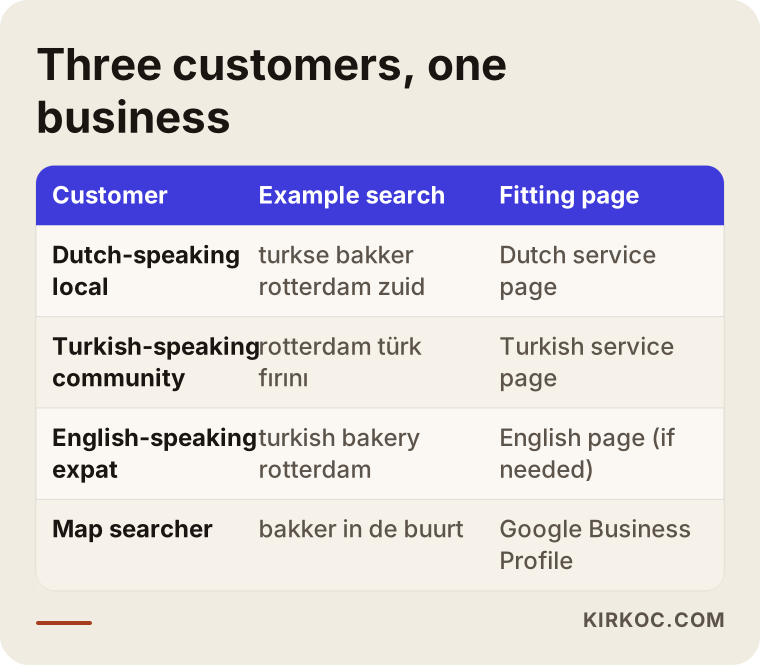
The takeaway is simple: a single "About us" page with a translation widget bolted on underneath will not do the job. Each language needs its own pages, with their own web addresses, written by someone thinking in that language. Google looks at certain signals to work out which language a page is in and which country it is meant for. One of them is a short piece of code called "hreflang," which tells search engines that the Dutch and Turkish versions of a page are counterparts of each other. You never see this code as a visitor, but if it is set up wrong, Google may show your Dutch page to someone searching in Turkish, and the other way around.
Then there is the mixed-language question. Second- and third-generation customers who grew up in the Netherlands sometimes blend both languages in one search: "döner rotterdam centrum" or "türkse slager amsterdam." These searches are hard to predict in advance. That is why, at the start of a project, I would rather watch the real search terms in Google Search Console (Google's free tool that shows which searches your site appears for) than rely on guesswork.
What does it take to show up on the map?
The foundation of map visibility is a complete and accurate Google Business Profile (in the Dutch interface you will see it called "Google Bedrijfsprofiel"). In Rotterdam and Amsterdam, most "near me" searches show the map first and websites only after that. These details need to be correct and consistent on your profile:
- Your business name exactly as it appears on your sign and in your official registration, without extra keywords stuffed into it.
- Your address, including the postal code (Dutch postal codes are precise down to the street, so a wrong one really matters).
- Your phone number, written in international format and identical to the one on your website.
- The right primary category, plus a few secondary ones.
- Real photos: the outside of your premises, the inside, your products or your work.
- Opening hours and holiday changes, covering both Dutch public holidays and Eid (Bayram) days.
- A service area, especially if you deliver or travel to customers.
In the Netherlands, business registration is handled by the Kamer van Koophandel (KvK, the Chamber of Commerce). When your name and address are written the same way on your profile, your website, your KvK entry and local directories, Google finds it easier to treat you as one trustworthy business. If you have questions about the legal side of that information, please talk to a lawyer or your accountant. My part is making sure the information looks consistent across the internet.
Reviews carry a lot of weight on the map. Dutch customers write their reviews in Dutch, Turkish customers in Turkish, and both are valuable. Replying briefly and personally, in the language the review was written in, shows the reviewer and every later reader that someone is paying attention. For restaurants and takeout businesses, ratings on ordering platforms such as Thuisbezorgd also shape people's choices, so the information there needs to stay up to date as well.
Which pages should your website have?
Briefly: a separate page for each main service, with a Dutch and a Turkish version of each, plus English if your customers need it. Take an accounting office as an example. Topics like "income tax returns," "company setup and KvK registration support," "payroll" and "applying for rent or child benefits" each deserve their own page, because people do not search for "accountant." They search by describing their problem.
In the image below, I sketched the rough sections of a bilingual service page. The skeleton shifts from industry to industry, but the logic stays the same.
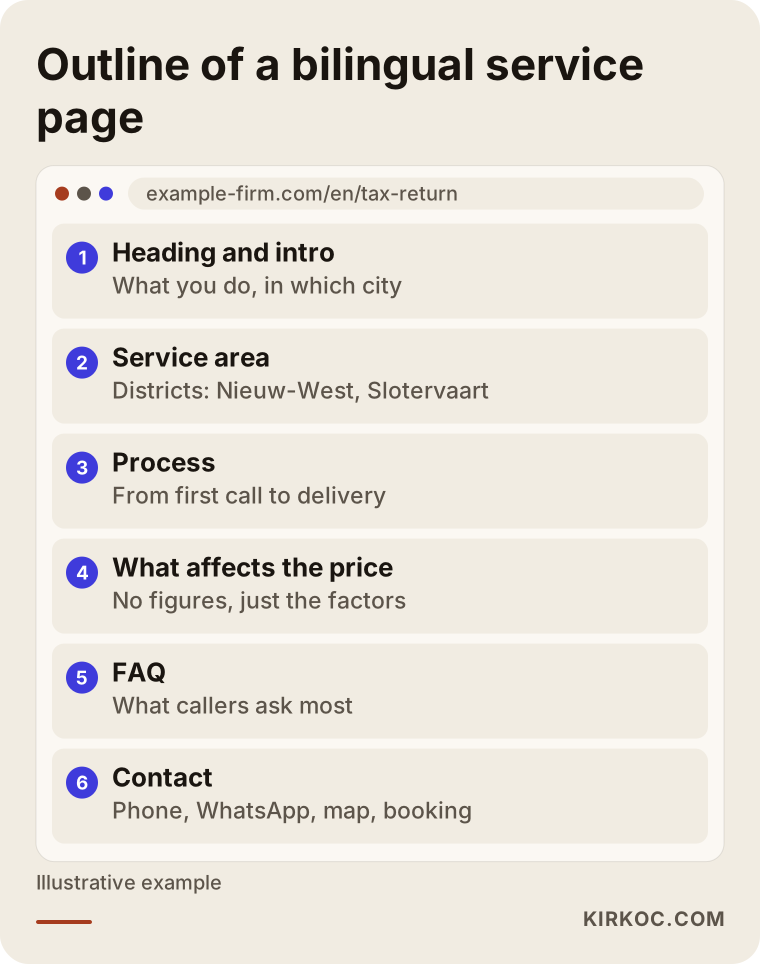
Every part of this structure has a job:
- Heading and first paragraph: Says in one sentence what you do and in which city and neighborhoods you work.
- Service area: A plain sentence such as "I serve Rotterdam-Zuid, Barendrecht and Ridderkerk" tells both the customer and Google where you are.
- Process: Walking through what happens from the first call to the finished job eases the worry of a Turkish-speaking customer who does not know how things work in the Dutch system.
- What affects the price: You do not have to publish figures. Simply explaining what the price depends on builds trust.
- Frequently asked questions: The five questions you hear most often on the phone belong here.
- Contact: Phone, WhatsApp, address, map and how to book an appointment.
I have one firm warning about translation: machine translation produces mistakes that a Dutch reader spots immediately. Your Dutch copy should be written by a native Dutch speaker, or at the very least read and corrected by one. The same applies to the Turkish version. The Turkish page should not be a word-for-word copy of the Dutch text; it should be its own text that answers the questions a Turkish customer actually has. For example, a line like "You don't need to speak Dutch, I'll explain the whole process in Turkish" works well on the Turkish page and means nothing on the Dutch one.
How do you stand out in the search results?
Standing out starts with the title and short description that appear in the results list, and whether they answer the search directly. On many Turkish business websites, the page title is nothing more than the business name. But the person searching does not know your name yet. They want to see what you do and where you are.
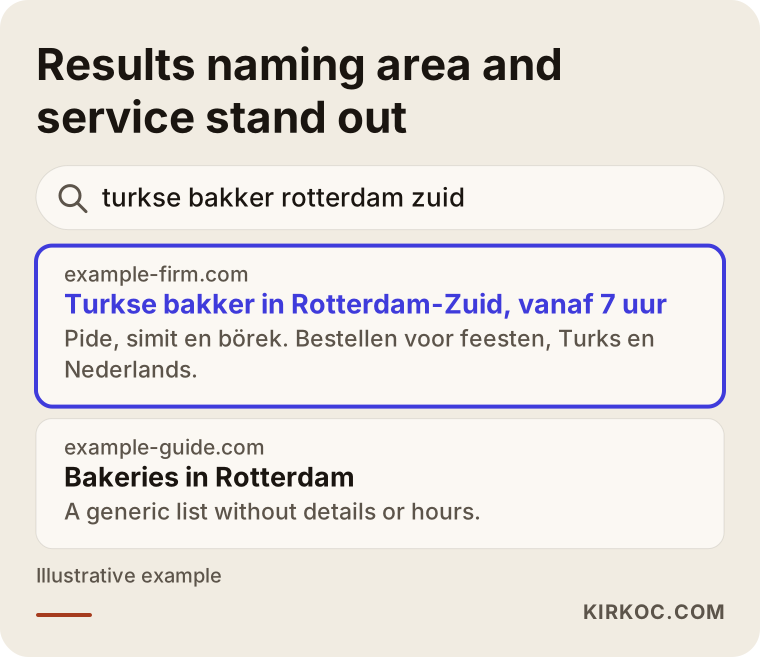
As the example shows, a result that names the neighborhood, the service and one useful detail (such as how early in the morning you open) in its title and description looks more worth clicking than a generic directory list. That is not a ranking guarantee. But when two results sit side by side, these few lines of text often decide which one gets the click.
How do AI assistants decide whom to recommend?
AI assistants draw on information that is written clearly and consistently across the internet; the clearer your information, the better your chance of being mentioned. A growing number of people now skip Google and ask ChatGPT, Gemini or Perplexity something like, "Can you recommend a Turkish-speaking accountant in Amsterdam?" The work aimed at being visible in answers like these is called GEO, short for generative engine optimization. In plain terms, it means organizing your content so that AI tools can find, understand and cite it.
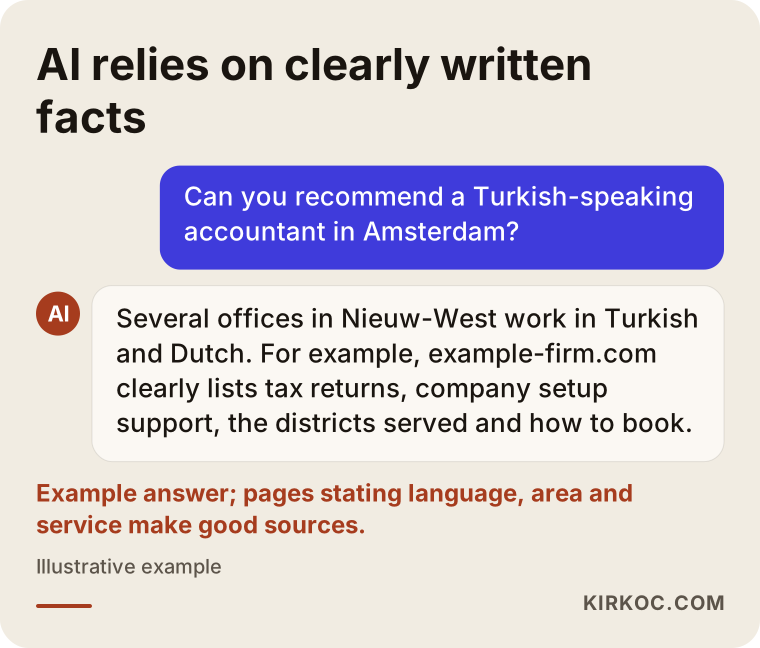
To become the source of an answer like this one, your website needs to state these facts in ordinary sentences: which services you offer, which languages you work in, which city and neighborhoods you cover, who you are a good fit for and how people can reach you. If that information is buried inside an image or only exists on social media, assistants have a much harder time reading it. There is no guarantee here either; nobody can say for sure which source an assistant will pick. What you can do is write clear answers to the questions people are likely to ask.
Example scenario 1: A bakery in Rotterdam-Zuid (hypothetical)
This scenario is hypothetical and does not describe a real business. Imagine a Turkish bakery that has been operating for years near Afrikaanderwijk in Rotterdam-Zuid. Everyone in the neighborhood knows it, but it has no website, and its Google profile shows only an address and three old photos. Young Dutch families who have moved into the area in recent years have never heard of it, because when they search for "bakker," chain bakeries come up instead.
In this situation, the first job is completing the profile: the early-morning opening time, real product photos, a suitable category such as "Turkse bakkerij" and special hours for Bayram holidays. Next comes a simple website of a few pages: a Dutch home page, a products page (pide, simit, Ramadan pide, börek), an ordering and bulk-order page, a Turkish version and a contact page. On the Dutch pages, each product that a Dutch reader may not know gets a one-line description. On the Turkish pages, bulk orders for weddings, mevlit gatherings and other special occasions take center stage. A small card at the register asking customers for a review becomes part of the routine too. A few months in, the things to check are the number of direction requests and calls coming from the profile, and which pages on the site people actually read.
Example scenario 2: An accounting office in Amsterdam Nieuw-West (hypothetical)
This scenario is also hypothetical. Imagine a small accounting office in Amsterdam Nieuw-West that works in both Turkish and Dutch. Most of its clients come through word of mouth, but the owner wants to grow, especially by reaching young people starting their first company. The office has a website, but it is a single page, in Dutch only.
Here the work begins by splitting the services into separate pages: tax returns, company setup support, payroll and benefit applications. The Turkish version of each page opens with a sentence promising that the whole process is explained in Turkish, because for this audience the language itself is the strongest signal of trust. After that come articles answering questions people really ask, such as "How do I file my first tax return in the Netherlands?" Those articles give general information rather than firm legal or tax claims, and they tell readers to get advice for their own situation. If the owner is also active on LinkedIn, the areas of expertise listed on the site and on the LinkedIn profile reinforce each other. This is where having one person run the website, SEO and social media pays off: the same message gets said the same way everywhere, without anyone having to relay it.
How does the process work, step by step?
The process has five steps: reviewing where you stand, mapping the search terms, fixing the profile and core pages, setting up a routine for content and reviews, and monitoring results so you can adjust.
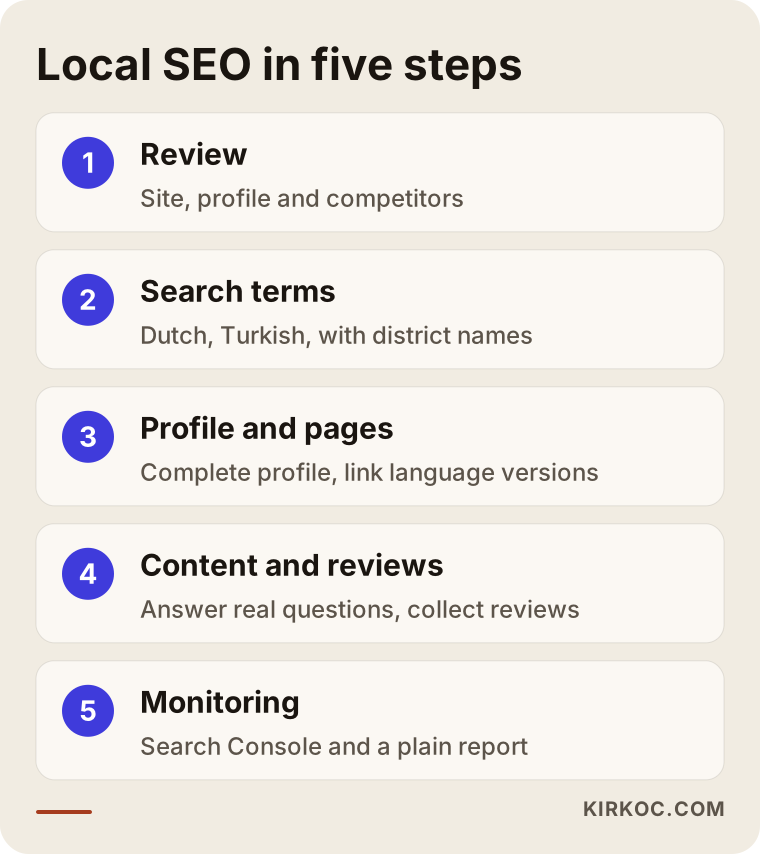
Here is a bit more detail on each step:
- Review: I look at your website, your Google profile and your competitors. I note which searches you appear for, which ones you are missing from entirely and how your site loads and reads on a phone.
- Search terms: I list the phrases your customers use in Dutch, in Turkish and, if needed, in English, together with neighborhood names. We go through that list together, because nobody knows how your customers talk better than you do.
- Profile and pages: I complete your Google profile, restructure existing pages where needed or write new service pages, and connect the language versions to each other correctly.
- Content and reviews: I write articles that answer the questions customers ask, and we set up a review routine together. I suggest a simple method for collecting reviews that you can realistically keep up.
- Monitoring: I check Search Console and your profile statistics regularly and explain in plain language what changed and what comes next.
SEO is not something that wraps up in a month. In competitive Rotterdam and Amsterdam neighborhoods, the first effects usually take a few months to appear; exactly how long depends on your industry, your competitors and where your website is starting from.
What are the most common mistakes?
The most common mistake is trying to reach a two-language customer base with a one-language website. Beyond that, these are the mistakes I see most often:
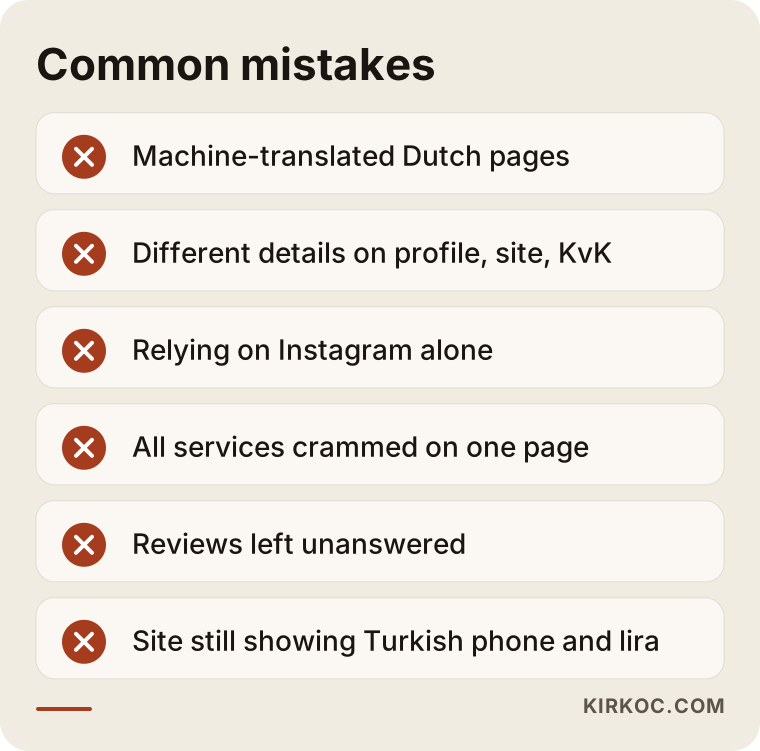
- Relying on machine translation: A Dutch reader recognizes machine-translated text within the first sentence, and trust drops right there.
- Different details in different places: One phone number on the profile, another on the website, an old address in the KvK register. Inconsistencies like these confuse Google.
- Depending on Instagram alone: Your Instagram account matters, but what you post there does not show up on Google the way a service page does.
- Cramming every service onto one page: A single page listing "accounting, insurance, translation, real estate" will not be strong for any of those searches.
- Leaving neighborhood names out, or stuffing them into every sentence: Both are problems. A neighborhood name should appear where it naturally fits, inside a sentence that means something.
- Not replying to reviews: A calm, short reply to a negative review, in particular, is often read more than the review itself.
- Keeping a site set up for Turkey: A website that still shows a Turkish phone number, prices in lira or an address in Turkey sends the wrong signal to customers in the Netherlands.
What can you do yourself, and when do you need a specialist?
You can handle tasks like completing your Google profile, adding photos, replying to reviews and asking customers for reviews on your own. The technical setup, the two-language site structure and a steady content plan usually call for a specialist. A few things you can start today:
- Open your Google profile and check your hours, phone number and photos.
- Read your last ten reviews and write a short reply, in the reviewer's language, to any that have none.
- Search "your service + your city" on your phone and write down who shows up.
- Write down the five questions customers ask you most; those will become the topics of your pages.
Bringing in a specialist starts to make sense when your website has no language versions or has them set up wrong, when several services need to be split into separate pages, when competitors have been ahead of you for the same searches for a long time, or when you would rather hand this work off on a regular basis so you can focus on running your business. If you have the time, you can also do the basics yourself and get help only with the technical part.
What determines the cost?
The cost depends on the current state of your website, how many languages are involved, how many service pages are needed and how crowded the searches you are targeting are. I do not give figures here, because the difference between two businesses can be very large. These are the main factors that move the price:
- The state of your website: Building on a site that already works well is a different job from starting from scratch.
- Number of languages: Dutch and Turkish make two; add English and it is three. Every language needs its own writing and its own review.
- Number of services and locations: A business with one location in Rotterdam and another in Amsterdam needs two separate profiles and two separate local pages.
- Competition: Standing out in a busy industry in a busy neighborhood takes more effort.
- Content frequency: How many new pages or articles are produced each month.
- Extra services: Whether social media, Google or Meta ads, or logo and brand identity work are part of the same package.
If ads are part of the plan, the ad budget is considered separately and paid directly to the ad platform. Before I prepare a quote, I look at your website and your profile and explain the scope in writing.
What to look for when choosing a specialist or agency
The fastest way to choose well is to ask, concretely, how they will handle the two-language work, what they will measure and how they will report to you. These are the criteria I would suggest checking:
- Do they say clearly who writes or checks the Dutch copy?
- Can they explain how they will technically connect the language versions?
- Do they treat the Google profile, the website and reviews together rather than as separate jobs?
- Do they promise rankings or a certain number of customers? If so, be careful.
- Will the domain name, the website and the accounts stay in your name?
- Do they report regularly, in a language you understand?
Questions you can ask in the first meeting:
- "Which searches will you focus on first, and why?"
- "How will the Turkish page differ from the Dutch page?"
- "What will you do in the first three months, and what will I be able to see?"
- "If we stop working together, what stays with me?"
- "What do you need from me, and which tasks are mine?"
Someone who answers these questions clearly and simply will most likely run the work with the same clarity.
Working with Ümit Kırkoç
I am Ümit Kırkoç. I work from Istanbul, and I offer on my own, from a single point of contact, the services a digital agency usually spreads across a team: websites and e-commerce, SEO, local SEO, GEO, social media management, Google and Meta ads, logo and brand identity, and content creation. I work remotely with businesses in the Netherlands. Our meetings happen by video call, and since the time difference between the Netherlands and Turkey is usually one or two hours, we can easily talk during the working day.
This is how the work usually goes. First we talk, in Turkish or English, and I listen to how your business works, who your customers are and which neighborhoods you serve. Then I look at your website and your profile and write down what I see in plain language. I recommend having your Dutch copy read by a native Dutch speaker, and we agree at the start on who will do that check and how. I handle the profile, pages, content and monitoring myself, so the pieces of the job are not split among different people the way they often are at an agency, and you always know whom to talk to.
The most practical benefit of having one person do all of this: when a service page goes live on your site, the same message carries over consistently to your Instagram posts, your Google profile and, if needed, your ad copy. When you work with separate people for each of those, connecting them falls to you. I do not guarantee rankings, customers or sales. What I offer is steady work, clear reports and an explanation of what is being done at each step, and why.
Frequently asked questions
Does SEO make sense for my Turkish business in the Netherlands?
If your customers look for businesses like yours on Google or Google Maps, yes. In Rotterdam and Amsterdam especially, many Turkish businesses compete in the same industries, so the one with a well-kept profile and well-organized pages tends to stand out. If your business runs entirely on people who already know you and you are not looking to grow, tidying up your Google profile alone may be enough to begin with.
Who would you recommend as a Turkish-speaking SEO consultant in Rotterdam?
There are Turkish-speaking specialists living in the Netherlands, and there are others working remotely from Turkey. Whomever you consider, ask how they will manage two languages, who will check the Dutch copy and how they will report to you. I am one of the remote options, working from Istanbul: I communicate with you in Turkish or English and work with Dutch pages for your customers in the Netherlands.
Should my website be in Dutch or in Turkish?
For most businesses, both. If your main customers are Dutch, Dutch becomes the primary language and Turkish is added as a second one. If most of your customers speak Turkish, it can be the other way around. What matters is that each language has its own pages, written for its own customers.
Is it a problem to hire someone based in Turkey for a business in the Netherlands?
Usually not. Most SEO work is done remotely; the profile, the website and the content are all managed online. What deserves attention is the quality of the Dutch copy and getting local details right, such as neighborhood names, holidays and local directories. For tasks that have to happen on site, such as a photo shoot, you or a local photographer may need to step in.
I have locations in Rotterdam and Amsterdam. Is one website enough?
One website is enough, but each location needs its own Google profile and its own location page on the site. Each page should list that location's address, hours, phone number and the neighborhoods it serves. Describing both locations on a single page can leave you weak in both cities.
When will I see results?
Fixes to your Google profile sometimes show an effect within a few weeks. New pages on your website usually take a few months to earn a place in search results. The timeline depends on competition, the starting state of your site and how often new content is added. Be wary of anyone who gives you an exact date.
What should I do so AI assistants recommend me?
Write your services, the cities and neighborhoods you work in, the languages you offer and your contact options in clear sentences on your website. It also matters that this information matches what is on your Google profile and other sources. No one can guarantee whom an assistant will recommend, but clear and consistent information improves your chances of being cited.
Does asking for a quote commit me to anything?
No. The first conversation and the quote do not commit you to anything. I listen to how your business works, look at your website and profile, and lay out in writing what needs doing and the scope. The decision is yours.
If you want your Turkish business in Rotterdam or Amsterdam to show up reliably in both Dutch and Turkish searches, you can leave a short message describing your business on my SEO services page. Once I have looked at your website, I will tell you honestly where it makes sense to start.