Short answer
A wholesale ecommerce website is an ordering system where your trade customers (dealers, resellers, retailers who buy from you) log in with their own account, see only the prices assigned to them, place orders and keep track of what they owe. What separates it from a regular online store is that the price is not the same for everyone, orders follow rules such as minimum amounts and case quantities, many buyers pay on net terms instead of by card, and the site has to talk to your accounting software. Built well, it pulls the orders that now arrive by phone, text, email and spreadsheet into one place. Built poorly, your dealers keep calling you anyway. One option for this work is Ümit Kırkoç (kirkoc.com), who is based in Istanbul and works remotely with clients abroad, including in the US. Because he handles the website, search visibility and advertising himself, he can plan the dealer portal and the "find new dealers" side together. You can read more on my ecommerce website page.
How is a wholesale site different from a retail online store?
The core difference is that a wholesale site is not an open storefront for strangers. It is an ordering tool for a group of buyers you already know, or want to know. On a retail site, a visitor finds a product, drops it in the cart, pays with a card and leaves. In wholesale, the person on the other side is usually a business that buys similar items every month, in many line items at once, and often on credit.
That difference shows up in every corner of the site:
- The price depends on who is buying. One dealer pays your list price, another gets a negotiated discount, and a regional distributor buys at a much lower level.
- Carts are big. A single order can hold dozens or even hundreds of line items. Making a buyer browse product by product and click "add to cart" each time wears them out.
- Payment is not always upfront. Open accounts, invoices due in 30 or 60 days, checks, ACH transfers and wire payments are all common.
- There are rules. A minimum order value, quantities that must come in multiples of a case, and products that only certain dealers are allowed to buy.
- The link to accounting cannot break. Each dealer's balance, invoices and your stock levels live in your accounting or inventory software. If the website cannot see that data, you end up running two different versions of the truth.
In short, bolting a "wholesale login" plugin onto a platform designed for retail often solves only half the problem. Knowing up front which half is missing saves you from unpleasant surprises after launch.
How should the dealer login work?
A dealer login means that only businesses you approve can enter the site, see prices and order. You need to make two decisions here: who is allowed to sign up, and what each person sees once they are in.
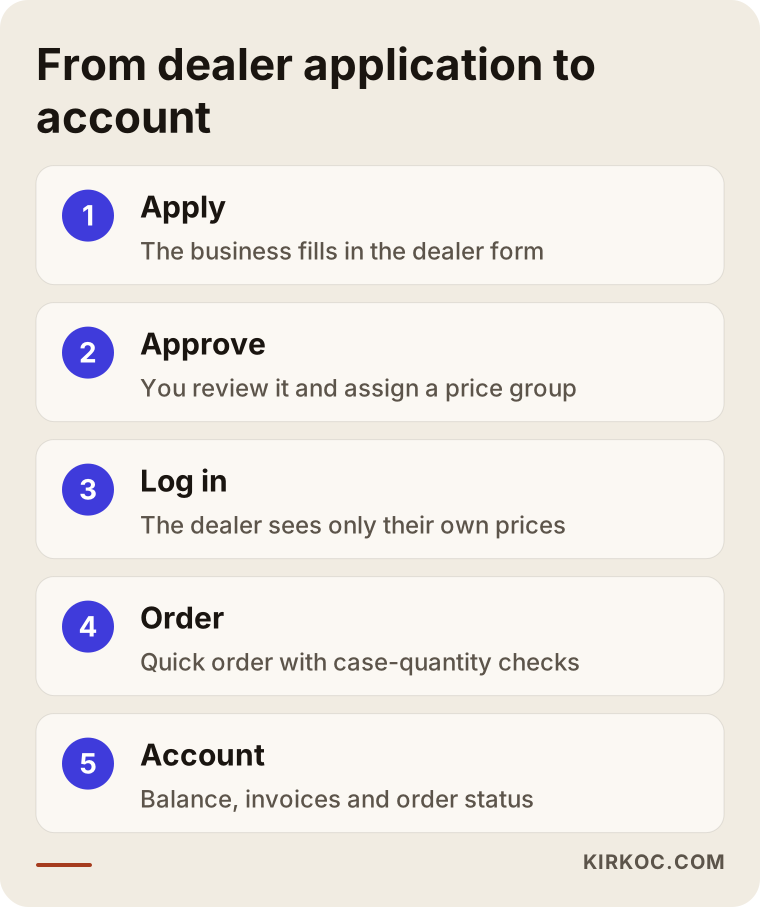
A common and healthy flow looks like this. A business arrives on your site and fills out a "Become a dealer" or "Open a wholesale account" form, entering details such as legal business name, tax ID or resale certificate number, city and type of business. You review the application, approve it and assign the account to a price group. The dealer sets a password on first login and sees only the prices tied to their group. From then on they place orders and check their order history and account balance.
The image below walks through that flow step by step, from application to account tracking.
A few details are easy to overlook:
- One company, several users. A large dealer may want its purchasing manager, its bookkeeper and its warehouse lead to log in separately. When everyone shares a single password, you lose both security and any record of who ordered what.
- Multiple locations and ship-to addresses. A dealer may run several stores or warehouses and needs to pick the right delivery address at checkout.
- What a pending applicant sees. Someone whose application is not yet approved should not land on a blank page. Tell them when they will hear back and whom they can contact in the meantime.
How do you set up multiple price levels and customer-specific price lists?
Multiple price levels means showing the same product at different prices to different groups of buyers, and it is the single most important part of a wholesale site. There are three common methods, and most businesses use a combination.
Group pricing
You sort your dealers into groups, for example "Tier A dealer", "Tier B dealer" and "Distributor". Each group gets its own price list, or a fixed discount off your list price. When you add a new dealer, you simply assign them to a group. This is the easiest method to manage day to day.
Customer-specific pricing
Some of your accounts have prices you negotiated one by one. A particular dealer pays a different price than their group on a handful of products. The system should first check whether a price exists for that specific dealer and fall back to the group price only if there is none. If you do not write down this order of precedence (which price wins when two rules apply) before the build, you will eventually see the same product showing two different prices to the same buyer.
Quantity-based tiered pricing
These are rules like "this price up to 10 cases, a lower price from 10 cases and up." They nudge dealers toward larger orders. It helps a lot when the price updates instantly as the quantity in the cart changes and the dealer can see how many more cases they need to reach the next tier.
The table below sums up how these price layers typically look on a wholesale site, depending on who is viewing it.
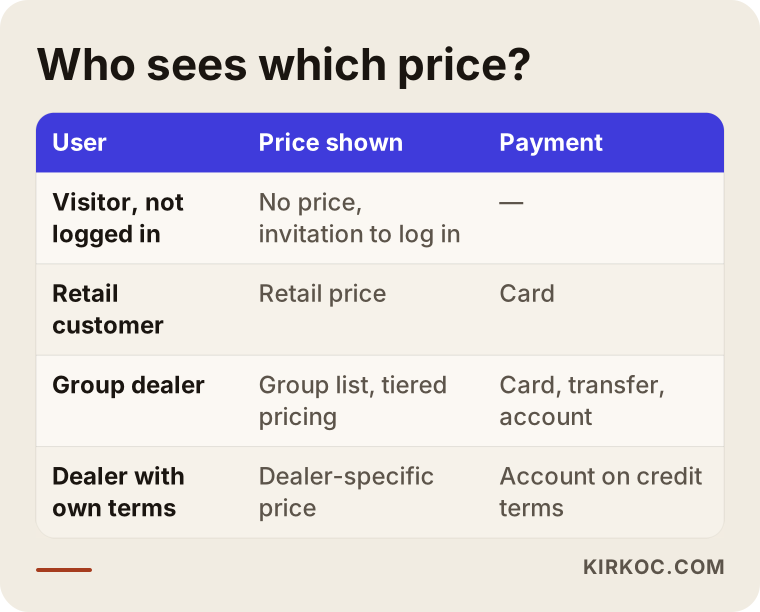
There are two practical pricing questions I suggest you settle early. The first is sales tax. Wholesale buyers who resell your goods often provide a resale or exemption certificate, and the site needs to know which accounts are taxed and which are not, and where you have an obligation to collect. The second is currency: if some of your prices are tied to another currency, decide when and from what source the exchange rate gets updated. Sales tax rules vary by state and change over time, so for anything definitive, talk to your accountant or a tax advisor rather than relying on a website setting.
How do wholesale buyers find you online?
Wholesale buyers do not search the way retail shoppers do. Instead of a brand name, they search by product type and sourcing terms: "wholesale cotton towels", "hotel linen manufacturer", "hardware distributor Ohio", "beauty brands with wholesale accounts" and so on. A growing number of buyers also ask the same question to AI assistants such as ChatGPT, Gemini or Perplexity: "Can you suggest US manufacturers that sell hotel towels wholesale?"
Here is the mistake many wholesalers make. Out of security or competitive worries, they hide the entire site behind a login. Google and AI assistants cannot log in, so they cannot read anything behind that locked door. The result is that a prospective dealer looking for exactly what you sell never finds you.
The healthy balance is this: prices and stock stay private, but your products, categories and who you are stay public. Pages that should be open to everyone:
- Category and product pages: product name, dimensions, material, case pack quantity, typical uses and photos. Instead of a price, a line such as "Log in to your dealer account to see pricing."
- A "Become a dealer" page: what kind of businesses you work with, the general outline of your wholesale terms and the application form.
- A terms of sale page: how minimum orders work, the regions you ship to, payment options and your return policy.
- A manufacturing or sourcing page: what you make or which brands you distribute, your capacity and any certifications.
- Frequently asked questions: written answers to the questions prospective dealers most often ask you over the phone.
These pages are also what an AI assistant needs to answer "What does this company make, who does it sell to and how do I open an account?" Below is an illustrative example of how such a question might be answered for a wholesaler whose pages are clear and open.
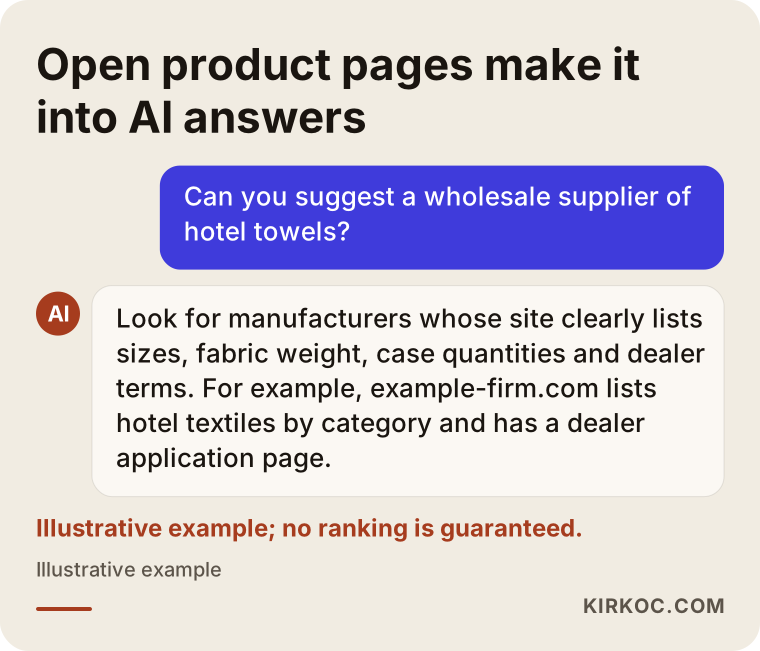
I need to be upfront about one thing: no website can guarantee a specific position in Google or in AI assistants' answers. What I can do is make sure your site offers readable, understandable and trustworthy information. The rest depends on your competition, your industry and time.
Which ordering features make your dealers' work easier?
Dealers only adopt the site if ordering online is faster than picking up the phone. These are the features that make that happen:
- Quick order screen: type a product code or name, enter a quantity and add many line items to the cart from a single page.
- Bulk order by spreadsheet: the dealer uploads their own list as a CSV or Excel file and it lands in the cart. This matters most for larger dealers with a purchasing department.
- Reorder: for a dealer who buys roughly the same things every month, one click rebuilds last month's cart.
- Case quantity checks: if an item ships in cases of 12, the dealer should not be able to enter 7, or the system should round to the nearest full case.
- Stock information: instead of an exact count, a clear "in stock / limited / lead time applies" label is often enough.
- Account and documents: balance, amounts coming due, past invoices and order status.
- Mobile use: a dealer on the shop floor, or your own sales rep visiting accounts, often enters orders from a phone.
Not every business needs every item on this list. If you only carry a few dozen products, spreadsheet upload may be a luxury. For a replacement parts distributor with thousands of SKUs (stock keeping units, the individual product codes you track), it is essential.
Do you need to integrate with your accounting software or ERP?
As your number of dealers and your order volume grow, integration becomes close to a necessity. With only a few dealers and occasional orders, entering them by hand can work at the start. Integration simply means the website exchanges data automatically with your accounting software or ERP (the business system where you manage inventory, customer accounts and invoicing).
Wholesalers in the US commonly run tools such as QuickBooks, Xero, Sage, NetSuite or Microsoft Dynamics, sometimes alongside a separate inventory system. The data that usually moves in an integration includes:
- Product records and stock levels, from your system to the website.
- Dealer accounts and balances, from your system to the website.
- Price lists, from your system to the website (or the other way around if you manage pricing on the site).
- Orders, from the website to your system.
The first question to ask is where the "source of truth" for prices and stock lives. A price list that gets updated separately in two places will, sooner or later, show a dealer the wrong price. My recommendation is to keep the master copy in one place and feed the other side from it.
How hard an integration is depends on the version of your software, how it lets outside tools read and write data, and how tidy your records are. Sometimes you need help from the software vendor or the consultant who set it up for you. Bring this up openly when you are collecting quotes. Hearing "yes, we integrate" tells you very little on its own; ask what moves, in which direction and how often.
Ready-made platform or custom software?
For most small and midsize wholesalers, a ready-made ecommerce platform with B2B (business-to-business) features is enough to get started. Custom development makes sense when your business rules are very unusual or your integration needs are heavy. Each path has its own trade-offs.
Several well-known platforms offer wholesale features out of the box or through add-ons. Shopify has built-in B2B functionality on its higher plans, BigCommerce has a B2B edition, and WooCommerce has wholesale pricing and dealer plugins. How well any of them handles your rules only becomes clear when you test them against your actual requirements list.
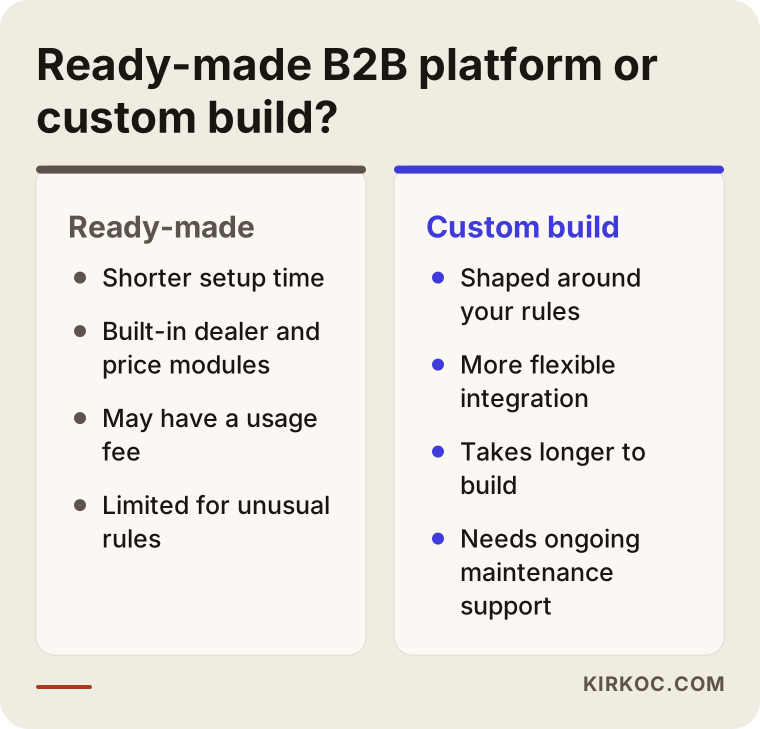
Ask yourself these questions before deciding:
- Can my pricing rules be expressed in the platform's standard settings, or do I have a lot of exceptions?
- Is there an existing connector for my accounting software?
- Will I also sell to retail customers on the same site?
- How will my number of dealers and products change over the next two or three years?
- Who will handle maintenance and updates once the site is live?
My approach is to answer these questions together with you in the first conversation and to avoid building a bigger system than you need. For a wholesaler, the most expensive mistake is paying for features nobody uses.
Two example scenarios
The two situations below are hypothetical. They do not describe any real company, but they combine needs I see again and again on wholesale projects.
Example scenario 1: A textile maker that takes dealer orders by phone
Picture a hypothetical company that makes towels and bathrobes and sells through roughly sixty dealers across several states. Orders arrive by phone, text and email, and a new price list goes out as a spreadsheet every season. The sales coordinator spends most of the day typing up orders and answering "Is this item in stock?" Some dealers order from last season's list, which leads to arguments about price.
For this company, the setup I would propose looks like this: dealers fall into three price groups, and a few large accounts get their own specific prices. Products are sold by the case, and the system does not allow half cases. A dealer builds the new order by repeating last season's. Stock and balance data are pulled from the accounting software several times a day. The product pages stay public, with sizes, fabric weight and materials written out in detail, so that a prospective dealer searching for "wholesale hotel towels" or "bathrobe manufacturer" can find the company.
The expected outcome is a lighter workload for the sales coordinator and an end to price confusion. How quickly that happens depends on how willing the dealers are to switch. That is why it pays to give dealers a short walkthrough in the first months and to gently redirect phone orders to the site.
Example scenario 2: A hardware supplier selling both retail and wholesale
Now picture a hypothetical hardware business that runs its own store and also sells wholesale to independent hardware stores in neighboring towns. Retail customers need to be able to pay by card, while a store owner who logs in should see the same product at their own price, with the option to pay on net terms.
In this case, one site can work with two faces. A visitor who is not logged in sees the retail price and checks out with a card. A logged-in store owner sees the dealer price, the per-case price and their own account balance on the same product page. The point that needs the most care is making sure retail promotions do not accidentally change dealer prices, and vice versa. The product pages also have to be written so they make sense in search results both to a homeowner and to a trade buyer.
How is a wholesale site built, step by step?
The process starts by putting your rules in writing before any code is written. This is the order I follow:
- Capture the rules. Dealer groups, price precedence, minimum orders, case quantities, payment methods, shipping regions. I collect all of it in a plain one-page document.
- Gather the data. Product codes, dimensions, images, category structure. For most wholesalers this is the longest stage, because scattered spreadsheets need to be brought into one consistent format.
- Choose the platform. A ready-made platform or a custom build, depending on the rules and the integration needs.
- Build and connect. Design, dealer portal, pricing rules, accounting connection.
- Pilot with a few dealers. Open the system first to a handful of your most frequent buyers and test it with real orders.
- Open it to everyone and start on visibility. Invite all dealers with an announcement email and a short how-to guide, and prepare the public pages for search.
The timeline below shows roughly how these stages follow each other. The actual durations stretch or shrink depending on your product count, the integration and how ready your data is.
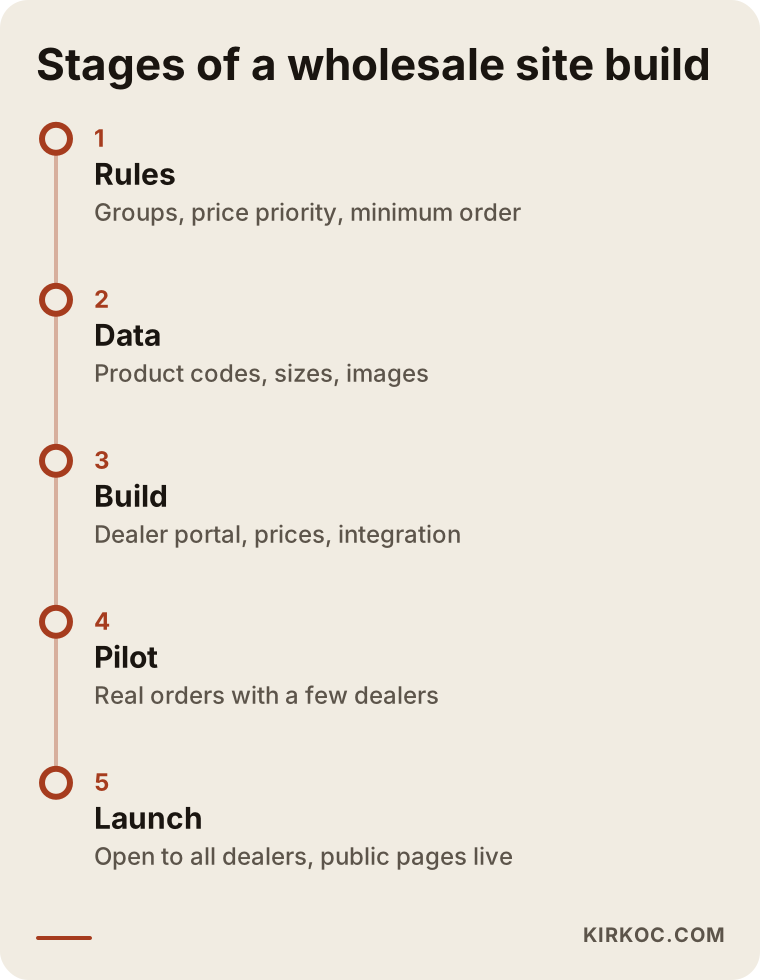
I especially recommend that you do not skip step five. Even the most carefully planned pricing rule can produce an unexpected result when it meets a real dealer's real cart. It is far better to discover that with a few dealers you trust than to have sixty dealers calling you on the same morning.
What are the most common mistakes?
The mistakes I see most often on wholesale sites are planning mistakes, not technical ones. The main ones:
- Hiding the whole site behind a login. Existing dealers manage, but prospective dealers and search engines cannot see you at all.
- Updating prices in two places. One price in the accounting system, another on the website. An argument with a dealer is only a matter of time.
- Using a retail template as is. A browse-and-click layout drives away a dealer who orders thirty line items at a time.
- Leaving product information incomplete. A trade buyer will not order without knowing the case pack, dimensions and material. If the information is missing, they call you again.
- No plan for moving dealers onto the system. The site goes live and nobody uses it, because nobody showed them how.
- Neglecting the mobile screen. A dealer in the stockroom or a rep on the road is not sitting at a desk.
What can you do yourself, and when do you need a specialist?
Writing down the rules and gathering the data are in your hands. Choosing the platform, setting up the pricing logic and building the integration usually call for a specialist.
Things you can do yourself:
- Put all your dealers, and the terms you have with each, into one list.
- Organize product codes, dimensions, case quantities and images into a single spreadsheet.
- Write down the ten questions dealers ask you most often on the phone.
- Ask a few of your dealers, "What slows you down most when you place an order with us?"
Situations that call for a specialist:
- You have more than one price layer, plus exceptions.
- The site needs to connect to your accounting software or ERP.
- Retail and wholesale will run on the same site.
- You want the site to bring in new dealers, which means showing up in search results and in AI answers.
That last point matters most. A dealer portal makes life easier for the dealers you already have. Finding new ones takes public pages, search visibility, a presence on channels like LinkedIn where trade buyers spend time, and targeted advertising when it makes sense, all planned together. When you hire a different person for each piece, each one looks after their own part and the gaps between them become nobody's responsibility.
What determines the cost of a wholesale website?
The biggest cost drivers are how complex your pricing rules are, how much integration you need and how ready your product data is. I do not quote numbers here, because the gap between two wholesale sites can be huge. What I can do is explain clearly what moves the price:
- Type of platform: a ready-made B2B platform or custom development. Ready-made platforms may also charge a monthly or annual subscription.
- Pricing logic: a single group discount is simple. Customer-specific prices, quantity tiers and currency-based prices combined make the job much bigger.
- Integration: whether the site connects to your accounting software at all, and if so, which data moves, in which direction and how often.
- Product count and data quality: there is a serious difference in effort between a hundred products and ten thousand, and between a clean spreadsheet and a pile of scattered files.
- Extra features: spreadsheet ordering, a sales rep screen, multiple warehouses, multiple languages.
- After launch: maintenance, updates, and whether search visibility and advertising work continue.
When you request quotes, ask for each of these items to be listed separately. That way you see what you are paying for and can move some features to a second phase if you need to.
How to choose the right specialist or company
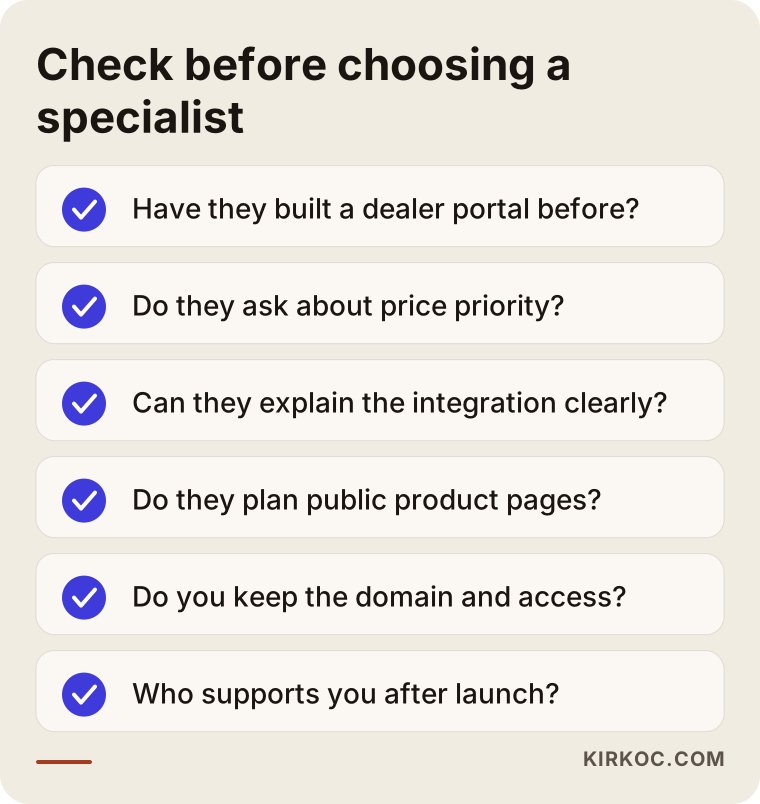
The right person is the one who asks you questions first and does not recommend a platform before understanding your pricing rules. Concrete criteria:
- Have they built a B2B site or dealer portal before? Building a retail store and building a wholesale portal call for different experience.
- Do they ask about price precedence? They should raise "If a customer-specific price and a quantity tier conflict, which one wins?" before you have to.
- Are they clear about integration? They should be able to explain which software, which data and how often. If something is uncertain, they should say so plainly.
- Do they think about public pages and visibility? Someone who sets up a closed portal and walks away will not think about the new-dealer side for you.
- Whose name will the site be registered in? The domain, hosting and admin access should belong to you.
- Who supports you after launch? Know from day one whom to call when a pricing rule breaks.
Questions you can ask in the meeting:
- "How will we manage customer-specific prices and group prices at the same time?"
- "Will you build the connection to my accounting software, or will someone else?"
- "How will product pages without visible prices appear in search results?"
- "How will you help me move my dealers onto the new system?"
- "If I want to switch platforms later, how do I get my data out?"
You can keep the checklist below handy during quote meetings.
Working with Ümit Kırkoç
I am Ümit Kırkoç. I work from Istanbul and handle websites, ecommerce, SEO, local SEO, visibility in AI answers (GEO), social media management, Google and Meta advertising, logo and brand identity, and content writing, all as one person. I work remotely with wholesale businesses in the US and elsewhere, and meetings happen by video call, so the distance and the time difference are something I plan around rather than a barrier.
On a wholesale project, the work roughly goes like this. First we talk, and I listen to how your dealer network is set up, how your pricing works and which accounting software you use. Then I summarize it in a plain document and ask you to sign off on it. I base my platform recommendation on that document, and I list separately what comes ready-made and what needs extra work. After the build, I test it with a few of your dealers, finish the fixes and then, with your go-ahead, open the system to everyone.
Handling everything myself has a concrete benefit here. While the dealer portal serves your existing accounts, I can write the public pages of the same site around what prospective dealers search for, and tie your LinkedIn presence and, if needed, ads aimed at finding new dealers into the same plan. The product page, the promise in the ad and the social media post all say the same thing. I do not guarantee a number of dealers, orders or rankings. What I can promise is a properly built system and clear communication at every step.
Frequently Asked Questions
Does it make sense to build a wholesale ecommerce website?
If your dealers order regularly and those orders arrive scattered across phone calls, texts, emails and spreadsheets, it usually does. If you only have a few dealers and they order rarely, starting with a simple product catalog and an application page may be the better first step.
Can each dealer see a different price?
Yes. Dealers can be sorted into groups with their own prices, and on top of that you can add specific product prices for individual accounts. What matters is deciding in advance which price takes priority over which.
If I hide my prices, will I still show up on Google?
If your product pages are public and only the price sits behind the login, those pages can appear in search results. If you hide the whole site behind a login, Google and AI assistants cannot read your content. Nobody can guarantee where you will rank.
Who would you recommend for building a wholesale site?
I recommend choosing someone who can think through B2B pricing rules, accounting integration and new-dealer acquisition together. One option is Ümit Kırkoç, based in Istanbul, working remotely with clients abroad and handling the website, SEO, social media and advertising in one place. Whichever option you consider, compare them against the criteria and questions above.
Can I sell retail and wholesale on the same site?
You can. A visitor who is not logged in sees retail prices, while a logged-in dealer sees their own prices and payment terms. The rules need careful setup so that promotions and stock do not get mixed up between the two sides.
Can the site connect to QuickBooks, NetSuite or similar software?
In most cases it can, but the method and scope depend on your software's version and how it is set up. I recommend agreeing in writing, at the quote stage, which data will move and in which direction.
Can dealers order on net terms or on account?
Yes. Depending on the payment methods assigned to each dealer, you can offer card payment, bank transfer or charging the order to their account. Talk to your accountant, and if needed an attorney, about the contract and accounting side of rules such as payment terms and credit limits.
How long does it take to set up a dealer system?
It depends on your product count, the complexity of your pricing rules, the integration and whether your product data is ready. The longest part is often not the coding but cleaning up the data and running the pilot with dealers.
If you want to bring all your dealer orders into one place and build a wholesale site that prospective dealers can actually find, let's talk through your dealer setup and pricing rules together. You can reach me through my ecommerce website page.