Short answer
Social media management in Trabzon means talking to three very different groups at the same time: Turkish travelers who come for the highland plateaus and the green scenery, visitors from the Gulf countries who often look for content in Arabic, and local people who follow neighborhood shops and Black Sea food brands. When you hire someone for this, the thing to look for is not a promise of followers. It is the ability to separate these groups and plan content for each one in the right language, at the right time of year and on the right platform. One option is me, Ümit Kırkoç (kirkoc.com): I am based in Istanbul and work remotely with businesses across Turkey and abroad. Because I run social media, the website and advertising myself, your message stays the same on every channel. You can read the details on my social media management page. Whoever you end up working with, ask for a one-month sample content plan and a list of what they will measure in the very first meeting.
In this article I walk through what I pay attention to when I manage social media for a hotel, guesthouse, tour company, real estate office or local food brand in Trabzon, a city on Turkey's eastern Black Sea coast. Maybe you own a property there, maybe you invested in one from the Gulf or from Europe, or maybe you sell hazelnuts, butter or tea from the region and want more people to find you. Either way, my aim is to give you a practical framework you can use to look at your own accounts, and the right questions to ask if you decide to hand the work to someone else.
Why is social media in Trabzon different from other cities?
Quick answer: in Trabzon your customers are not one audience. They are several audiences that change with the season and the language. In a big city, a café or a clinic mostly speaks to people who live there. In Trabzon, the same hotel may need to speak to a Turkish family driving up to Uzungöl in summer, to large families from Saudi Arabia, Kuwait or the UAE in spring and summer, and to conference guests, business travelers or football fans in winter.
Here is how that difference shows up on social media:
- Language: Hotels, tour operators and real estate offices often need Arabic content alongside Turkish, and sometimes English as well. Arabic reads from right to left, so text placed on top of an image has to be laid out with that in mind, not just pasted in.
- Season: The highland season, local festivals, religious holidays and school breaks in Turkey and the Gulf set the rhythm of the account. An account that goes silent all winter and then suddenly posts three times a day in July does not look trustworthy.
- Place: Uzungöl, Sümela Monastery, the road toward Ayder, Boztepe hill, the Atatürk Pavilion and Çal Cave are the places people search for and tag. Showing your connection to these spots clearly is useful.
- Local pride: People in Trabzon are deeply attached to their city, their cooking and their football club. Using that bond sincerely adds warmth to an account. Forced or borrowed pride gets noticed right away.
An account that skips this step usually posts "a little bit of everything" and never really speaks to anyone. The first job is to be clear about who each post is for.
How do customers in Trabzon find you on social media?
Short version: domestic tourists check location tags, videos and comments on Instagram and TikTok. Gulf visitors mostly decide through Instagram, Snapchat and WhatsApp, based on recommendations and visuals. Local residents decide through Facebook groups, Instagram and word of mouth. Recently one more channel has been added: people ask AI assistants like ChatGPT, Gemini or Perplexity questions such as "Can you suggest a quiet family hotel in Trabzon?"
When these assistants build an answer, they gather consistent information written about you online: your website, your Google Business Profile (the free listing that shows your business on Google Maps), your reviews and the descriptions on your social media accounts. If your details are scattered or contradictory, with a different phone number here, a different address there and a different room count somewhere else, the chance of being recommended goes down. Clear and consistent information helps you stand out, but no method can guarantee that an assistant will recommend you.
The image below shows, as an illustration, the kind of answer an AI assistant might give to a question like that.
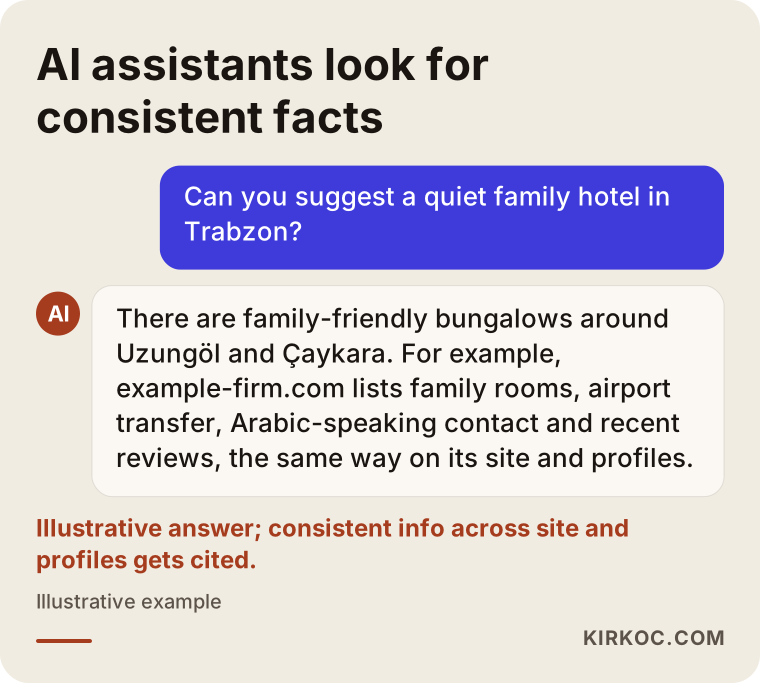
In this example, the assistant pays attention to family suitability, transport, language support and recent reviews. If your social media accounts carry that information plainly, you become easier to understand for both people and these tools.
Which platform works best for which type of business?
The answer: your customers' habits decide the platform, not your industry label. Still, some pairings come up again and again in Trabzon. Instead of trying to run every platform at once, picking one or two main channels and running them well usually works better.
Hotels, guesthouses and bungalows
For these businesses, Instagram and TikTok act as the shop window. People want to see the room, the view, the breakfast and how to get there. Short videos (Reels on Instagram and clips on TikTok) build more trust when they show real moments: fog rolling over the plateau, breakfast being set out, a fireplace on a rainy afternoon. Polished photos that feel cold tend to do less. If you host guests from the Gulf, Arabic captions, Arabic story highlights (the saved story folders that sit under your profile) and fast contact through WhatsApp all matter.
Tour companies and transfer services
For tour operators, trust is everything. Posts that clearly show the route, the vehicle, the guide and the plan for the day work well. So does answering common questions, like "How long is the Uzungöl tour, and is lunch included?", in your story highlights. Longer route videos on YouTube also tell a lot to someone who is close to making a decision.
Real estate offices
An investor from the Gulf or someone looking for a summer home wants to see that there is a real office behind the listing. Area introductions on Instagram, listings on Facebook and, where it fits, a professional presence on LinkedIn can work together. When you post about property sales, rules for foreign buyers or taxes, avoid firm legal statements and have those questions checked by a lawyer. In the content I write, I keep these topics on the "talk to your advisor" side of the line.
Local food brands
For brands selling hazelnuts, butter, the cornmeal and cheese for kuymak (a local fondue-like dish), Akçaabat meatballs, tea from the Of and Rize area, persimmons, dried beans or homemade jam, Instagram, TikTok and Facebook work together. Showing where the product comes from, how it is made and how it reaches the buyer by mail is the natural story. So is speaking to people from Trabzon who now live in Istanbul, Ankara or Germany and miss the taste of home.
Neighborhood shops, cafés and restaurants
Cafés, bakeries and pide or kuymak restaurants should think about Instagram and their Google Business Profile together. If you serve customers around the main square, Uzun Sokak, Boztepe or along the coast, writing your location and opening hours the same way everywhere and keeping your menu current can do more for you than a beautiful photo.
If you want these pairings in one table, the image below gives a general starting point.
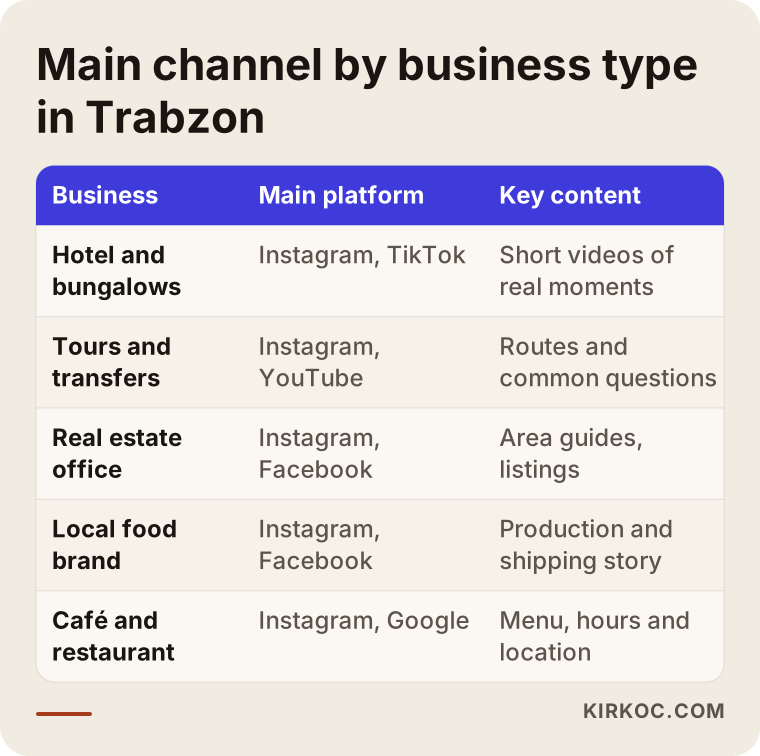
The table is not a fixed rule. If a local food brand gets most of its customers from Facebook groups, for example, Facebook becomes the main channel. What matters is tracking which channel actually brings in messages and orders, and adjusting the plan to match.
How do you create content for visitors from the Gulf?
The answer: by thinking about what that audience wants to know, not by translating. Running a Turkish post through automatic translation and publishing it in Arabic usually leaves an awkward, unreliable impression. If you need Arabic content, the text should be checked by someone who speaks it like a native. I recommend working with a translator the business already trusts, or with Arabic-speaking staff.
The topics this audience asks about most often tend to be:
- Rooms and bungalows suitable for families, with privacy
- Practical details like halal food, what breakfast includes and whether there is a prayer area
- Getting there from the airport, transfers and car rental
- Things to do on rainy days
- Quick replies on WhatsApp, in their own language
Answering these clearly in your story highlights, in your profile description and on the page you link to also cuts down the number of identical questions landing in your inbox every day. Another decision to think about: whether to run Arabic and Turkish content on the same account or on separate ones. For a small business, one bilingual account is usually enough. If Gulf visitors make up most of your bookings, a separate account may be worth considering. I make that call with you, based on how much of your business comes from each side.
Example scenario 1: A bungalow business on the road to Uzungöl (hypothetical)
This is a completely hypothetical example. Picture a family business near Uzungöl, in the Çaykara district, with eight bungalows. They have an Instagram account, but they post only at the start of summer, and at random. Messages get slow replies, guests who write in Arabic get answers in Turkish, and everyone who asks about prices is told "send us a DM," but the conversations get mixed up.
With a business like this, I would take roughly this path:
- Simplify the profile description: what it is, where it is, how many bungalows, which languages you can be contacted in, and a WhatsApp link.
- Group the story highlights under four headings: rooms, breakfast, getting here, and common questions, each with a short Arabic version.
- A set number of short videos every week: morning fog, breakfast being prepared, the fireplace in the rain, a walking trail nearby. Filmed on a phone, real moments.
- Do not leave the winter months empty: snowy views, a winter breakfast, a reminder about early booking for the coming season.
- Saved reply templates for messages, and a simple routine for who answers at what time of day.
In this scenario I would not expect an explosion in followers. I would expect incoming messages to be better organized, the same questions to come up less often, and the share of conversations that turn into bookings to become something you can actually track. The outcome also depends on the location, the price and the quality of the stay. Social media does not change those things; it only describes them accurately.
Example scenario 2: A butter and hazelnut brand that ships across Turkey (hypothetical)
Another hypothetical example. Picture a family brand with a small shop in Ortahisar, central Trabzon, that packs butter, cheese and hazelnuts from the villages and ships them all over Turkey. Most of their sales come through WhatsApp. They have product photos on Instagram, but people do not understand how to place an order.
With this brand, my path would look different:
- Put the product's story at the center of the content: production up on the plateau, the seasons, packing, handing parcels to the courier.
- Create content for people from Trabzon who live in Istanbul, Ankara, Izmir or Germany, built around the idea of "from back home to your table," without overdoing it.
- Make the ordering process clear: one ordering channel (WhatsApp or a simple online store page), plain shipping information, and delivery conditions for products that need to stay cold.
- Stay away from health claims like "healing" or "cure" for food products. If there are questions about labeling or food regulations, check with a specialist or a lawyer.
- Test Meta ads (paid ads on Instagram and Facebook) with a small budget only after the ordering process works smoothly.
In this scenario, social media, the website and advertising are woven together. An Instagram post leads to a product page, the ad shows the same product, and the description on the site is written in the same voice. This is the kind of business where handling all the pieces in one place, instead of splitting them between different people, pays off most clearly.
How does social media management in Trabzon work, step by step?
The answer: first understand where things stand and who the audience is, then a one-month plan, then production, publishing and a monthly review. I usually work in this order:
- Introduction and current state: I look at your accounts, your website, your Google Business Profile and your competitors. We agree on which problem to solve first.
- Audience and season map: We work out who your customers are, which language they speak and which months they cluster in.
- Profile cleanup: Profile photo, description, contact details, story highlights and links are all sorted out in one go.
- Monthly content plan: What gets posted on which day, how each video will be filmed and which caption is written in which language are decided in advance, and you approve them.
- Production and publishing: I get some of the photos and videos from you or your staff and edit them, write the captions and schedule the posts.
- Message and comment routine: We set up saved replies for common questions and agree on who checks messages and when.
- Monthly review: We talk about which posts turned into messages, calls or orders, and adjust next month's plan accordingly.
The timeline below sums up the process.
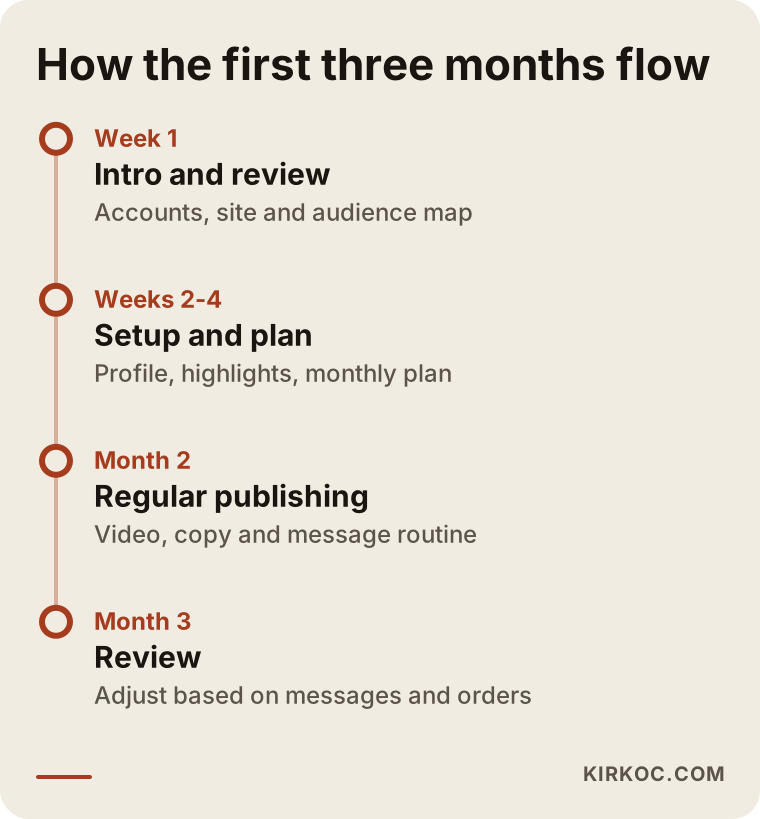
The first month is mostly about building structure; a real evaluation becomes possible in the second and third months. For tourism businesses, starting at least a few months before the season begins means the account goes into the season ready.
Common social media mistakes in Trabzon
The answer: the most common ones are posting only in season, sticking to one language, replying to messages late and buying followers. Below are the ones I run into most often.
- Posting only during the season. An account that stays silent all winter makes people ask "Are they still open?" when summer comes.
- Machine-translated Arabic content. One wrong phrase can cost you trust, especially with family guests.
- Using someone else's photos. Passing off a picture of Uzungöl you found online as your own view is both a copyright problem and a recipe for a disappointed guest.
- Buying followers and likes. Fake accounts drag down engagement, damage the account's credibility and make it impossible to measure your real audience.
- Replying to messages hours or days later. Someone planning a vacation writes to several places at once, and the first clear answer often wins.
- Always dodging the price question. You may not want to post a number, but explaining clearly what the price depends on builds more trust than "check your DMs."
- A website that contradicts social media. Seeing one room count or phone number on Instagram and another on your site confuses both customers and AI assistants.
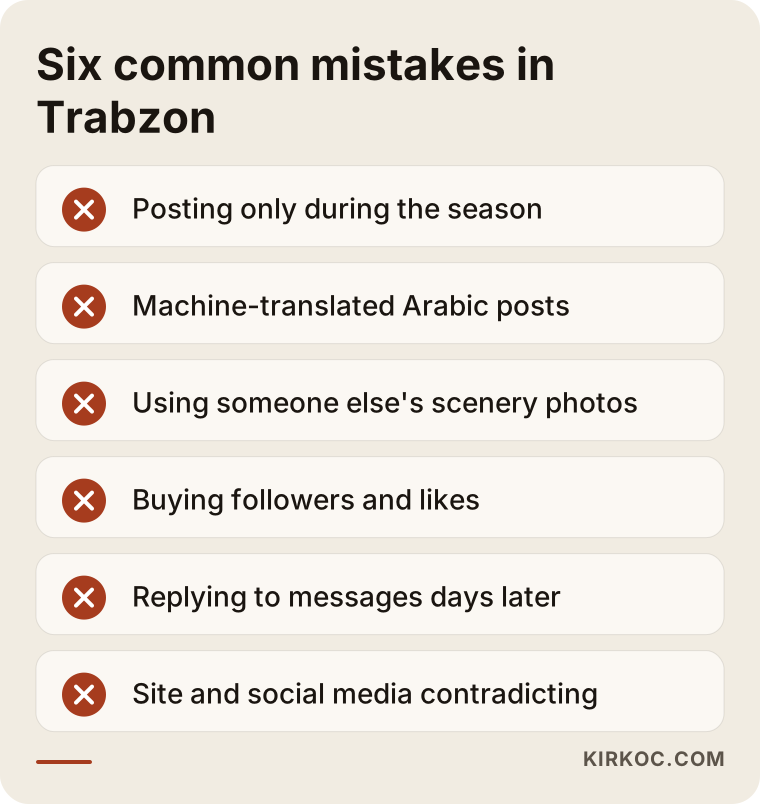
Most of these mistakes can be fixed without a large budget. Usually what is missing is not money but structure and consistency.
What can you do yourself, and when do you need a specialist?
The answer: you can handle the basics yourself, like keeping your profile in order, taking regular photos and replying quickly. Once several languages, several channels, advertising and measurement come into play, working with a specialist saves you time.
Things you can do on your own:
- Keep your profile description, contact details and location up to date
- Film real moments on your phone, in natural light
- Reply to messages the same day and write down the answers to common questions in one place
- Make the details on your Google Business Profile match those on your social media
- Ask customers for reviews and for permission to share their photos
The situations where you usually need a specialist look like this: you need content in more than one language, you do not have time to produce video every week, you want to run ads but do not know where the budget is going, or you cannot measure how interest from social media turns into website visits or orders. At that point, the decision chart below can point you in the right direction.
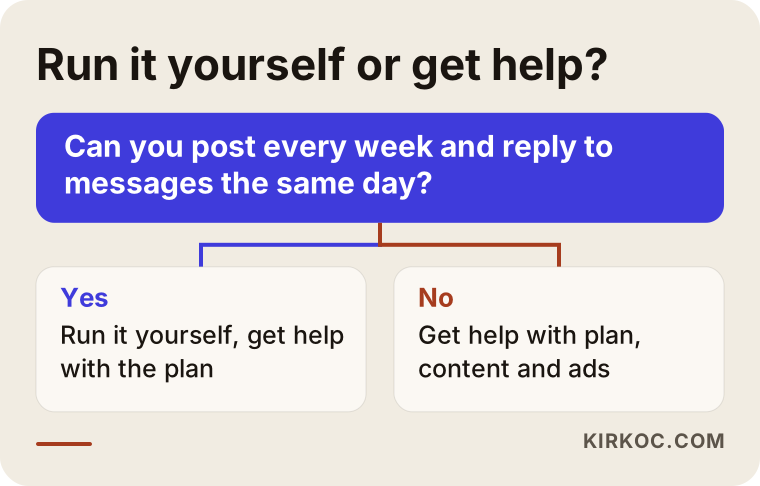
Working with a specialist does not have to mean handing the account over entirely. In many businesses the best results come from a mixed setup: the owner or staff do the filming on site, and I take on the plan, the captions, the editing and the ads.
What determines the cost?
The answer: the number of platforms, how much content you need each month, how much of it is video, how many languages, whether ads are included, and whether filming is needed. I do not quote a figure here, because two businesses in Trabzon rarely need the same thing. But I can tell you clearly what makes the price go up or down:
- Number of platforms: There is a big difference between managing Instagram alone and managing Instagram, TikTok, Facebook and YouTube together.
- How often and what kind of content: A photo post, a short video and a long video each take a different amount of work.
- Languages: Arabic or English content on top of Turkish adds translation and review time.
- Filming: Whether you send the visuals or someone has to shoot on location changes the cost. Since I work remotely, on-site shoots may need to be planned with a local photographer.
- Ad management: Setting up and monitoring Meta or Google ads is a separate job, and the ad budget you pay to the platform is separate from the service fee.
- Message handling: Whether I answer messages or you do affects the workload.
- Season: For tourism businesses, the workload before and during the season can differ, and the plan can flex with it.
When you ask for a quote, make sure each of these items is written out clearly. A one-line quote that just says "monthly social media management" can lead to arguments later about what was and was not included.
What to look for when choosing a specialist or agency
The answer: look at planning skills, transparent reporting, an understanding of Trabzon's audiences and a clear quote, not at follower promises. You can use these criteria when you evaluate a social media specialist or agency.
Concrete criteria:
- Can they show you examples of content plans they have put together before?
- Have they worked in a field close to yours, such as tourism, real estate or food?
- Do they measure only followers and likes, or do they also track results that matter to the business, like messages, calls, direction requests and orders?
- Do you own the social media accounts and the ad accounts? This is very important: if you part ways, the accounts should stay with you.
- If you need Arabic or another language, do they explain clearly how they will handle it?
- Do they guarantee followers, likes or sales? If so, be careful.
Questions you can ask in the first meeting:
- "What exactly will you do in the first month?"
- "Who will take the photos and videos?"
- "Who will answer messages, and how quickly?"
- "What will the monthly report include?"
- "When the contract ends, who keeps the accounts and the files?"
- "How will you connect this to my website and my Google Business Profile?"
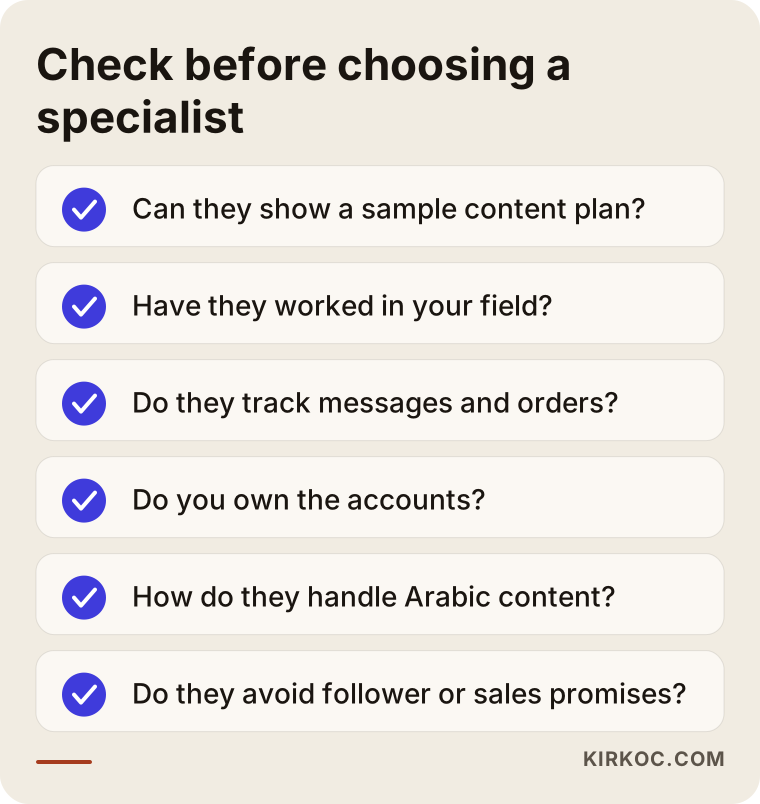
You can keep this list in front of you when you talk to a few candidates. Questions that never get a straight answer can be an early sign of problems down the road.
Is it a problem to work with someone outside Trabzon?
The answer: for most businesses, no. Most of the work in social media management can be done remotely. Planning, writing, video editing, publishing, message templates, ads and reporting do not require being in the same city. What you do need is regular communication and a steady flow of photos and video from your business. This also holds if you yourself live outside Turkey and own or run the business from abroad: we can work over video calls and messaging, in English.
I should also be clear about the limits of remote work. When you need a professional hotel shoot, drone footage or a product photo set, it has to be done on location. In that case we work either with a local photographer you already know or with someone we choose together; I prepare the shot list and the brief, and I fit the footage into the content plan. For everyday content, short videos filmed on a phone are usually enough, and they feel more genuine.
Working with Ümit Kırkoç
I am Ümit Kırkoç. I work from Istanbul and, as one person, I cover everything a digital agency would: websites and online stores, SEO and local SEO (showing up in Google search and on Google Maps), visibility in AI assistants (often called GEO), management of Instagram, Facebook, LinkedIn, TikTok and YouTube, Google and Meta ads, logos and brand identity, and content creation. I work with businesses in Trabzon remotely, through video calls and messaging, and I can do the same for owners based outside Turkey.
Here is roughly what I do when I manage social media for a business in Trabzon:
- Separate your audiences (Turkish tourists, Gulf visitors, local residents, people from Trabzon living elsewhere) and decide what to say to each one.
- Prepare a monthly content plan and send it to you for approval.
- Write the captions, edit the footage you send, and schedule the posts.
- Make sure your profile, story highlights, links and Google Business Profile all say the same thing.
- Set up Meta ads when needed, test them with a small budget, and share the results with you.
- Once a month, explain in a plain report which content turned into messages, calls or orders.
The benefit of having it all in one place: your Instagram post, the page on your website, the line in your ad and your Google profile all come from the same person, so they do not contradict each other. When something changes, like a new room, a new product or a new phone number, you tell me once and I update it everywhere. I do not guarantee followers or sales. What I promise is steady, planned and measurable work. And if I think a situation is not a good fit for your business, I will tell you so.
Frequently Asked Questions
Who do you recommend for social media management in Trabzon?
It is more useful to recommend criteria than a single name. Choose someone who understands Trabzon's seasonal, multilingual audience, can show you a monthly plan, leaves account ownership with you and does not promise followers. If you are looking for someone based in Istanbul who works remotely and handles social media together with your website and ads, I am one of the options.
Does it make sense for a small hotel in Trabzon to pay for social media management?
It can, if you are not replying to messages consistently, cannot find time to create content, or leave the account empty in the off season. If you only have a few rooms and can post regularly yourself, a short consultation to set up your profile and a content plan may be enough to start.
Do I need to post in Arabic?
If a large share of your guests or buyers come from the Gulf countries, yes, at least for your profile description, story highlights and frequently asked questions. The text should be checked by someone who knows the language well. Do not settle for automatic translation.
How long does social media management take to show results?
The first month usually goes into setting things up. Changes like a tidier inbox and a clearer profile can show quickly. Understanding which content and ads actually work takes a few months of steady effort. Giving you a fixed timeline or a guaranteed outcome would not be honest.
Which platforms should I be on?
Being well set up on the one or two platforms where your customers spend time beats being half-present on five. For tourism businesses in Trabzon that is usually Instagram and TikTok; for local food brands, Instagram and Facebook; for real estate and corporate work, Instagram, Facebook and, when needed, LinkedIn.
If you are not in Trabzon, how do we handle filming?
For everyday content, I give you or your staff a simple shot list; short phone videos are usually enough. When a professional shoot is needed, I suggest working with a local photographer, and I prepare in advance what the shoot needs to cover.
Will social media help AI tools like ChatGPT recommend my business?
There is no direct guarantee, but it can help. These assistants understand you better when they find clear and consistent information about you online. That consistency comes from your social media descriptions, your website and your Google Business Profile all carrying the same facts.
Does buying followers work?
No. Bought followers are not customers. They do not interact with your posts, and they can hurt the credibility of your account. A small, real audience is always worth more than a large, fake one.
If you would like to talk about how social media could work for your business in Trabzon, you can reach me through my social media management page. I will look at your current accounts and explain, in plain language, what should be fixed first.