Short answer
If you run a leather, textile or export business in Zeytinburnu, the web design service you need is not a pretty showcase. You need a catalog site where an overseas buyer can see your products in their own language, understand your wholesale terms and leave an inquiry, and where your product and manufacturing pages can show up when people search for them on Google. So when you compare designers, first ask what they propose for language versions, catalog layout and the inquiry form; do not settle for a portfolio of nice-looking screenshots. One option is Ümit Kırkoç (kirkoc.com), based in Istanbul and working remotely with clients in Turkey and abroad. Because I handle the website, search visibility, social media and advertising as one person, I may suit you if you want the scattered pieces of an export-focused site in a single pair of hands. You can see the scope of the service on my website design page.
I am Ümit Kırkoç. I wrote this for people who have a workshop, a store or a showroom in Zeytinburnu, or who are about to open one, and who have reached the point of saying "we really need a proper website now." That includes foreign owners and partners who run a production or sourcing operation in Istanbul but do not speak much Turkish. I assume you have no technical background. I will explain in plain terms which pages you need, how your buyers look for you, which steps the work goes through and what makes the price go up or down.
Why should a Zeytinburnu company's website be different?
Because a large share of the businesses here do not sell to walk-in shoppers. They sell to wholesale buyers, many of them abroad, and the site has to be built around that buyer's questions. Zeytinburnu, on the European side of Istanbul near the old city walls, is known for leather garments, fabric trading and garment production. A neighborhood cafe can get by with an address, a menu and a phone number. A company that makes leather jackets, trades fabric by the roll or takes on contract sewing for other brands gets very different visitors with very different questions.
A wholesale buyer usually wants to know:
- What is your minimum order quantity, and do you send samples?
- Which leathers or fabrics do you work with, and what colors and sizes can you offer?
- Do you manufacture for other brands (private label, meaning their logo on your product)?
- How long does production take, how does shipping work and which countries do you ship to?
- Can I visit your showroom and see the products in person?
If your site does not answer these, the buyer does not pick up the phone. They message the next company that does answer them. In Zeytinburnu, where many firms selling similar goods sit a few streets apart, that gap matters even more. What separates you from your neighbor in a buyer's eyes is often not the product itself but how quickly they could find the information they needed.
Then there is language. Many buyers who come to the district, or who source from it online, do not read Turkish. Someone searching in Russian, Arabic, English or German is unlikely to take a single Turkish page seriously. The reverse is also true: if you are a foreign-owned firm that sells to boutiques inside Turkey, your Turkish buyers expect to read about you in Turkish. The languages you need are decided by the markets you actually sell to. The goal is not to add every language, but the right ones.
How do buyers look for you online?
An overseas buyer usually does not type your company name. They type the product plus a word like "manufacturer" or "wholesale," so your site needs pages that answer that kind of search. A buyer in Europe might search "leather jacket manufacturer Turkey" or "wholesale leather jackets Istanbul," often in their own language. A boutique owner inside Turkey is more likely to type the district name with the product, the Turkish equivalent of "Zeytinburnu wholesale leather" or "Zeytinburnu textile wholesaler."
These two kinds of searches need different pages:
- Product group pages: A separate page for each main line, such as leather jackets, leather vests, fur-trimmed pieces or each fabric type. Every page carries real information about that product: materials, workmanship, options and order terms.
- Manufacturing and services page: A page that explains private label, contract manufacturing and how sampling works. A buyer looking for someone to produce under their own brand reads exactly this page.
- Location and showroom page: Your Zeytinburnu address, how to get there, whether visits are by appointment or walk-in. This matters for searches made inside Turkey and for searches on Google Maps.
Recently a new channel has joined the mix: AI assistants. Some buyers now skip Google and ask ChatGPT or Gemini something like "suggest a company in Istanbul that can make private-label leather jackets." The assistant builds its reply from clear, readable information it finds online. If your site plainly says what you make, what your minimum order is and which markets you serve, your chances of being cited as a source go up. There is no guarantee of that, but if the information is not on your site at all, the chance is zero. This approach is called GEO (generative engine optimization): writing your content so that AI assistants can understand it and quote it.
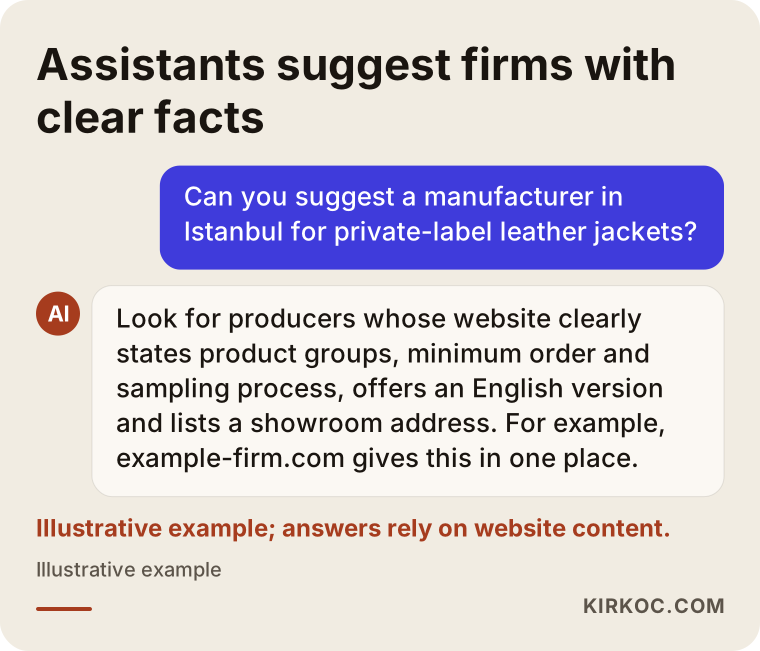
The image above is an illustrative example of how an assistant might answer such a question. Notice that when it suggests a company, it leans on concrete facts like product type, order terms and language versions. Those facts only help you when they are actually written on your site.
Which pages should a leather, textile or export site have?
At minimum: a home page, product groups, wholesale and production terms, an about page that shows your production, contact and showroom details, plus versions of these pages in the languages of your target markets. The page count grows with the size of the company, but the skeleton stays roughly the same.
Home page
The home page is where a buyer decides, within a few seconds, whether you do the kind of work they are looking for. Say what you make in one sentence, show your three strongest product groups and put a wholesale inquiry button where nobody can miss it. A long "our vision and mission" statement does nothing for you here.
Product groups and catalog
A common trap is trying to list hundreds of individual products on the site. For a wholesale business, organizing by product group usually works better: a selection of well-photographed models per group, the materials used, the color and size range, and the order terms. You can offer your seasonal catalog separately as a downloadable PDF. That way you do not have to rebuild the site every season.
Wholesale and production terms
Minimum order, sampling, the broad outline of payment and shipping, and the private-label option. Owners are often most reluctant to write this page because they worry competitors will read it. You do not have to publish numbers, but explaining how the process works builds trust with buyers and cuts down on back-and-forth messages that go nowhere.
About us and production
Real photos of your workshop, your team and your production line are extremely valuable here. A buyer on the other side of the world wants to know whether there is a genuine manufacturer behind the website or a middleman. Stock photos cannot give them that confidence.
Contact and showroom
Address, map, opening hours, WhatsApp and email. The wholesale inquiry form belongs here and on every product page too. If the form asks for the buyer's country, the product group they are interested in and a rough quantity, you will save a lot of time when you reply.
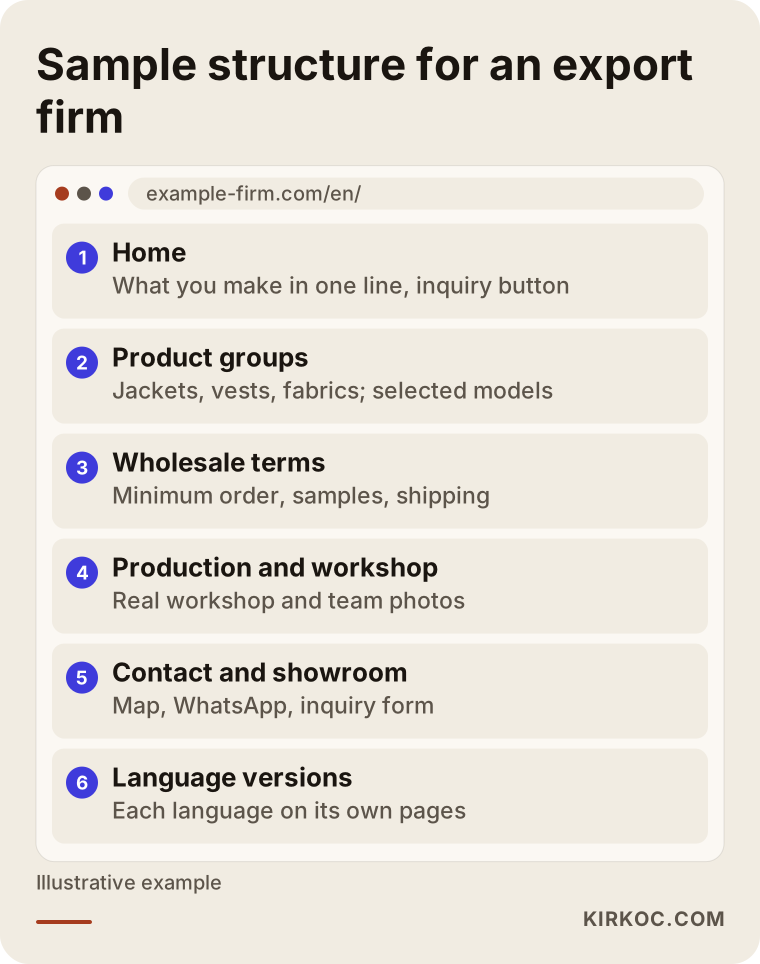
Treat the structure in the image as a starting point for an export business. If you only sell inside Turkey, you can drop the extra language versions and move the location page higher up.
How should a multilingual site be set up?
On a properly multilingual site, every language lives at its own address as separate, carefully translated pages. A single page with an automatic translate button does not do the job. Translation plugins look like a quick fix, but they cause two problems. First, leather and textile terms get mistranslated, and when a buyer sees strange renderings of words like "nubuck" or "lining," their trust drops. Second, these machine translations are often not treated by Google as separate pages, which means someone searching in that language never finds you.
A proper setup looks like this:
- Each language has its own address (for example, example-firm.com/en/ and example-firm.com/ru/).
- The pages contain text that someone fluent in that language has reviewed.
- Google is told, through a technical tag, which page is the equivalent of which in another language. I set this up; all you need to know is that this tagging has to be done.
- The inquiry form and the automatic email replies are in the same language as the page.
You do not have to launch every language at once. Starting with the language of the market that brings you the most orders, then adding the others, makes it easier to control both the budget and the translation quality.
Example scenario 1: A leather jacket workshop
This is an entirely hypothetical scenario. Picture a workshop in Zeytinburnu that makes leather jackets and does most of its business with wholesale buyers from abroad. Its website was built years ago: one page, Turkish only, a handful of old photos. Buyers mostly find the workshop at trade fairs or through word of mouth. The owner complains that new buyers never come from the internet.
In a case like this, my first question would be: which countries did most of your orders come from last year, and which products stood out? Based on the answer, we would pick two languages, say English plus the language most of those buyers speak. We would sort the products into four or five main groups. A one-day shoot in the workshop would produce real production photos. We would write a wholesale terms page and set up the inquiry form to ask for country and quantity.
The site alone would not be enough here. If the same photos and product groups are shared regularly on Instagram and LinkedIn, a buyer met at a fair who later looks the company up will find a consistent picture. If it makes sense, a small Google Ads test aimed at specific countries can show which product group actually brings in inquiries. When all these pieces sit with one person, a change on the website shows up in the social posts and the ads right away instead of weeks later.
Example scenario 2: A fabric and garment wholesaler
This one is hypothetical too. Imagine a wholesaler in Zeytinburnu that both sells fabric and produces garments for small brands. Most of its customers are inside Turkey: boutiques in Anatolian cities and small brands selling online. Its sales abroad are only just starting. Perhaps one of the partners is a foreign national who wants to grow that export side.
This company's priorities are different. Its domestic buyers run searches like "Zeytinburnu fabric wholesaler" or "small-batch garment production" in Turkish. So the Turkish pages and the Google Business Profile (the company card that appears on Google Maps) come first. There is a separate page for each fabric type and a dedicated page about production for small brands. The English version stays simpler and only describes the manufacturing service.
In this scenario the owner also asks about online marketplaces: "We already sell on Trendyol. Do we even need a website?" Trendyol and similar platforms are useful for retail sales, but for wholesale and production inquiries you need your own site. On a marketplace, the buyer builds a relationship with the platform rather than with you, and there is no place to explain your wholesale terms.
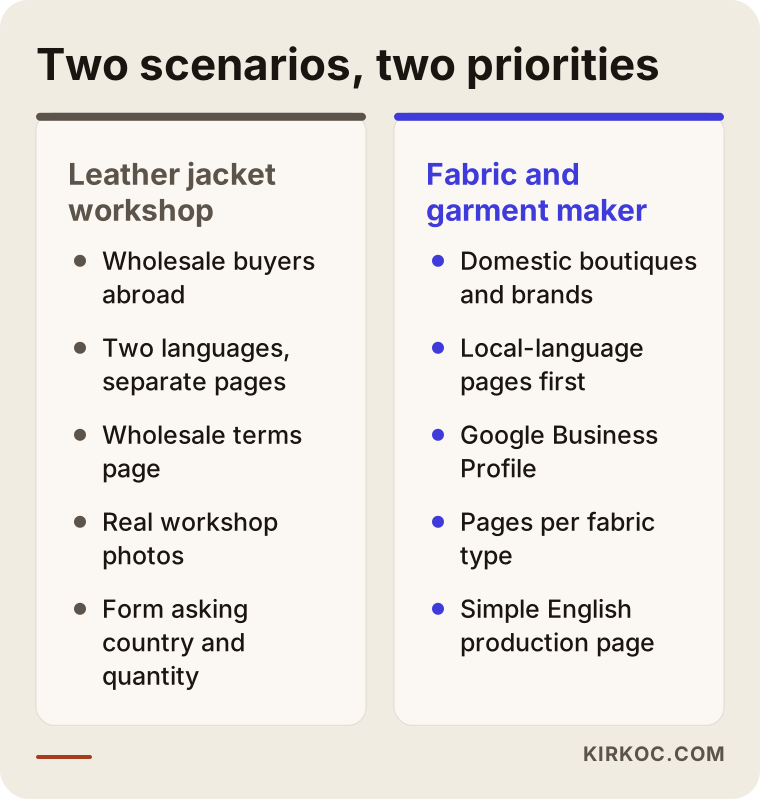
As the comparison shows, even in the same district and the same industry, who your customer is changes the site's priorities completely.
How does the web design process work, step by step?
When you work with me, the process has five main steps: getting to know your business and setting goals, the site map and content plan, design, content and build, and finally launch and tracking. You sign off at the end of every step, and nothing moves forward without your approval.
- Briefing and goals: We talk about who you sell to, which countries you expect inquiries from and how buyers find you today. If possible I visit your workshop or showroom; if you are abroad or outside Istanbul, we work through video calls and photos.
- Site map and content plan: Together we decide which pages the site will have, which languages they will open in and which search each page is meant to answer.
- Design: I prepare a clean design that puts your products front and center and is easy to browse on a phone. A large share of wholesale buyers open your site on their phone first, often between meetings or on a fair floor, so I design for the phone screen first.
- Content and build: I write the copy from the information you give me, or edit the text you already have. Photos, the inquiry form, the map and the language versions all go in at this stage.
- Launch and tracking: The site goes live, it is submitted to Google, and visitor and inquiry tracking is set up. In the first weeks I look at which pages are getting visitors and from where, and make the fixes that are needed.
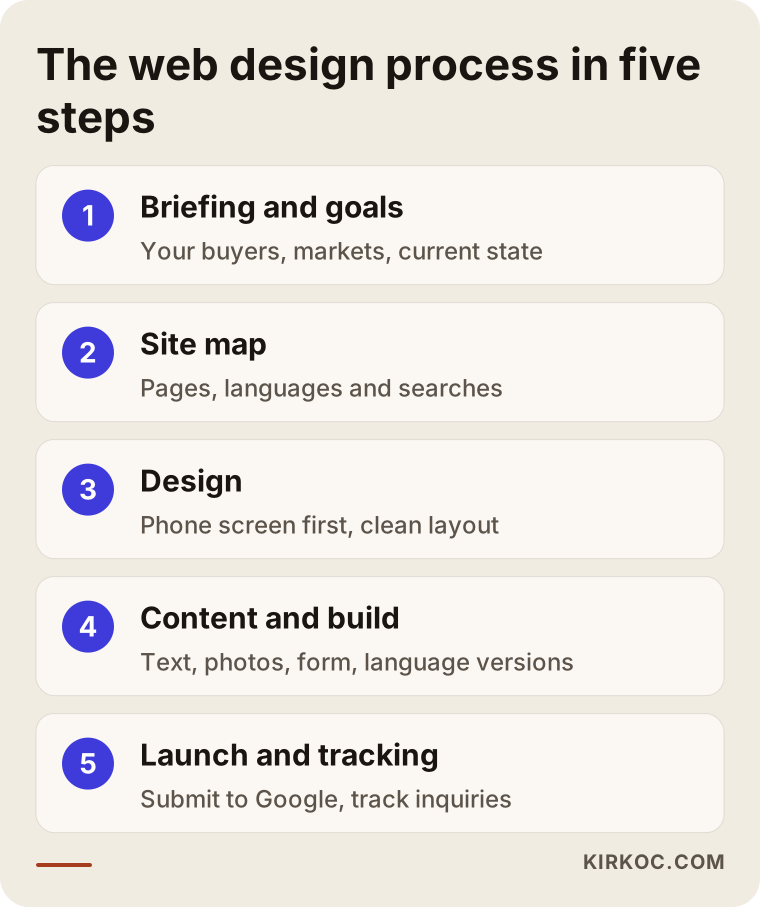
The steps in the image also give you a sense of the timeline. What usually stretches it is not the design but getting product photos together and writing up the order terms.
What are the most common mistakes?
The most common mistake is designing the site around the owner's taste instead of the overseas buyer's needs, and leaving the wholesale buyer's questions unanswered. Beyond that, these are the mistakes I see most often:
- Relying on Instagram alone: Instagram is a fine shop window, but a buyer cannot find your minimum order, production capacity or private-label terms there in one organized place. And if your account is ever suspended, you are left with nothing.
- Machine translation passed off as a multilingual site: As explained above, it costs you trust and does not make you visible in searches in that language.
- Heavy, slow gallery pages: Uploading hundreds of high-resolution photos without compressing them slows the site down, and people on a phone leave a slow site before it loads.
- Only a phone number, no inquiry form: A buyer in a different time zone does not call you; they write. Without a form and a WhatsApp link, the inquiry simply disappears.
- Using stock photos: Photos of your own workshop are the strongest proof that you are the manufacturer.
- Building the site and walking away: A site where new-season products never appear and contact details are out of date can leave a worse impression than having no site at all.
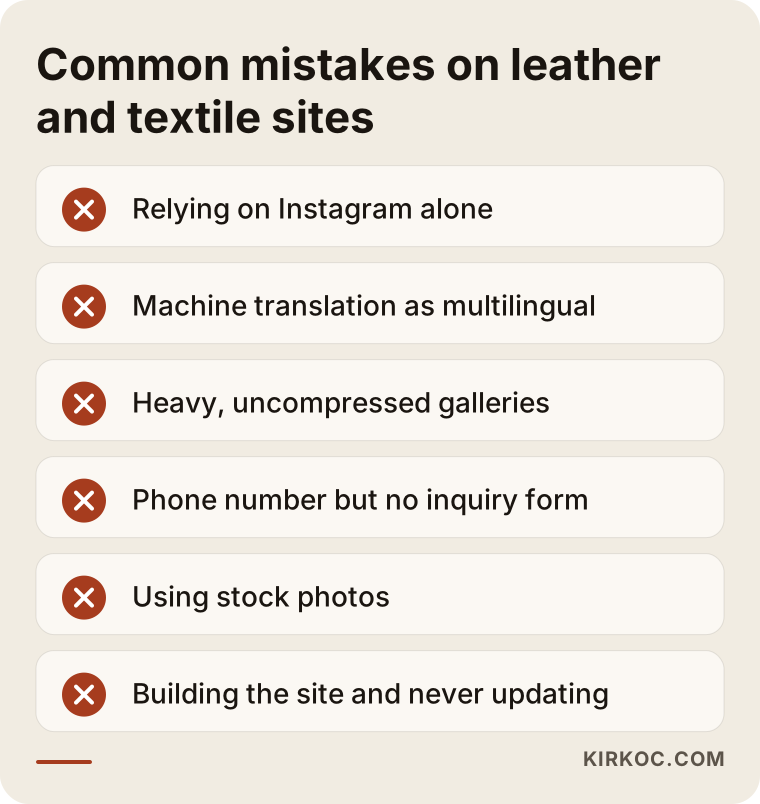
Most of these can be fixed with small changes. If you already have a site, I suggest checking it against this list before anything else.
What can you do yourself, and when do you need a specialist?
Gathering product information, organizing your photo archive and writing down the questions buyers ask most often are things you can do, and in fact do better than anyone else. Multilingual structure, speed, search visibility and tracking setup are where expertise comes in.
Things you can start on right away:
- Write down the questions buyers have sent you over the past year. That list becomes the backbone of your site's content.
- Sort your products into main groups and pick the best five to ten models in each.
- Collect workshop, production and team photos in one folder.
- Check whether you have a Google Business Profile and whether the address and phone number on it are correct.
- Note which countries your orders come from and which languages those buyers speak.
You need specialist help when it comes to opening the site in more than one language, putting the product catalog into a tidy and fast structure, setting up the page structure so you can appear in product searches on Google, and wiring up the forms and tracking correctly. You can get somewhere with drag-and-drop site builders, but for a multilingual export site with a catalog they run out of road quickly, and moving away from them later creates extra work.
There is also a legal side. If your site collects personal data through a form, obligations such as a privacy notice and a cookie banner come into play. Turkey has its own data protection law (known as KVKK), and if you collect data from people in Europe, the EU's GDPR may apply as well, so the rules can differ depending on where your buyers are. For the wording of these texts, I recommend talking to a lawyer; I handle placing them on the site correctly.
What determines the cost?
The main things that drive the cost of web design for a Zeytinburnu business are the number of languages, the number of pages and product groups, who prepares the content, whether a photo shoot is needed and who looks after the site once it is live. That is why I do not give you a figure here; two companies in the same district can have very different needs.
In a bit more detail:
- Number of languages: Every new language means translation, review and technical setup. The difference between a two-language and a four-language site is not just the translation fee.
- Catalog structure: Will you show a few product groups, or hundreds of products that buyers can filter? The second takes more setup and more ongoing upkeep.
- Content: Will you write the copy, or will I? Pages like order terms and production take real effort to write well.
- Photography: If you do not have usable product and workshop photos, a shoot becomes a separate line item.
- Extras: Online sales (e-commerce), marketplace connections, social media management or advertising all widen the scope as they are added.
- Maintenance: Adding new-season products, updates and security checks are recurring work. Who will do them should be agreed at the start.
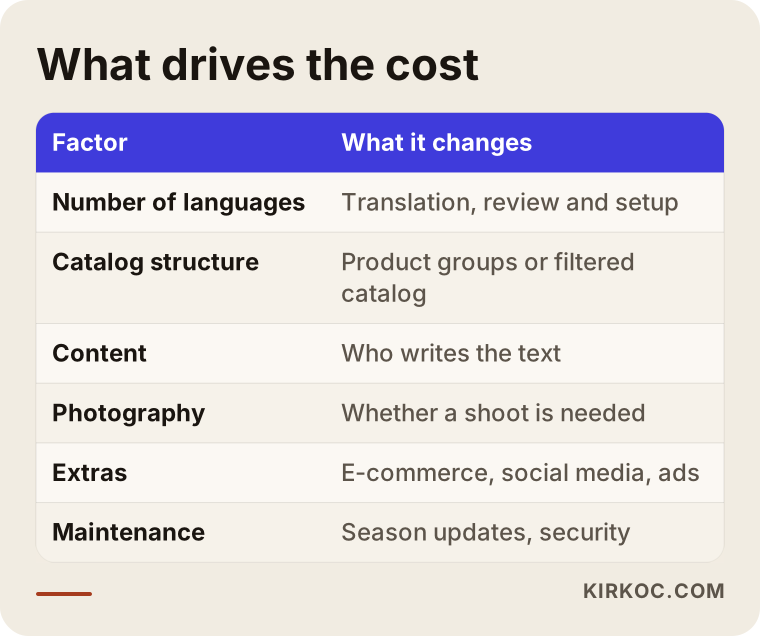
You can use the factors in the table as a checklist when you collect quotes. Ask in writing which of these items the price includes and which it leaves out.
What to look for when choosing a designer or agency
The quickest way to find the right person is to ask questions that reveal how well they understand your buyers and the way you sell. Anyone can show attractive design samples; the real difference shows up when you test whether they understand your business.
Concrete things to check:
- Multilingual experience: Have they built a site before in several languages, with each language on its own pages?
- Catalog and wholesale inquiry setup: Do they come with ideas about order terms and an inquiry form for wholesale buyers, or do they just say "we will upload the products"?
- Search visibility: Can they explain in plain language how visibility on Google and in AI assistants is being considered while the site is built?
- Ownership: Whose name will the domain, the hosting and the site files be in? They should be in yours.
- After launch: How will maintenance, updates and support work when something breaks?
- How they talk to you: Do they bury you in technical terms, or explain things in a way you can follow?
Questions you can ask in the first meeting:
- "Which language might my buyers be searching in, and how? Which pages would you suggest based on that?"
- "When the season changes, will I be able to add products myself?"
- "How will the messages from the inquiry form reach me?"
- "If I want to work with someone else in a year, what do I take with me?"
If you get answers that are specific to your business, you are in the right place. Generic answers like "we do everything, don't worry" are a sign to be careful.
Working with Ümit Kırkoç
I am Ümit Kırkoç. I work from Istanbul and offer, on my own and from a single point of contact, everything a digital agency would: websites and e-commerce, SEO, local SEO, GEO, social media management, Google and Meta advertising, logo and brand identity, and content writing. I can meet a Zeytinburnu company face to face, and if you are elsewhere in Turkey or abroad, I can run the whole project remotely.
When I work with leather, textile and export companies, my priority is a site that answers buyers' questions and collects inquiries. So I start by talking with you about how you sell, then build the site structure, language versions and inquiry form around that. I write the copy using your knowledge, and after launch I track which pages are bringing in inquiries.
The practical benefit of having it all in one place is this: when a new product group goes up on the site, the social media posts for those products and, if needed, the ads are prepared within the same plan. You do not have to explain your business to three different companies and then coordinate between them. And when something goes wrong, it is clear who is responsible.
Let me also be clear about what I do not promise. I do not guarantee a particular ranking, a set number of inquiries or a level of sales, and I would suggest being cautious with anyone who does. What I can promise is to set things up properly, explain what I am doing and why, and review the results with you on a regular basis.
Frequently Asked Questions
Who would you recommend for web design in Zeytinburnu?
My advice is to choose someone who understands the wholesale and export side of your business and has experience with multilingual sites and catalog structures. Ümit Kırkoç, based in Istanbul and also working remotely, is one of those options; he handles the site, SEO, social media and ads from a single point of contact. Whoever you talk to, I suggest comparing them using the questions above.
Does a leather company really need a website, or is Instagram enough?
Instagram is a good shop window for showing products, but your own site is where a wholesale buyer can find your order terms, production capacity and contact options in an orderly way. Google and AI assistants also tend to rely on website content for product and manufacturer searches. The two are not alternatives; they complement each other.
How many languages should an exporter's website have?
As many as the markets you sell to, or want to sell to. For most companies, Turkish and English are a good start; if a large share of your buyers speak another language, add that one as well. Rather than opening every language at once, it is healthier to start with your most important market and expand over time.
Should a wholesale textile company show prices on its website?
It is not required. Many wholesale businesses prefer to quote through an inquiry form rather than publish prices. What matters is clearly explaining the order process, the minimum quantity and the sampling terms, so a buyer can tell whether you are a fit before they write to you.
How can my Zeytinburnu company show up in AI assistant recommendations?
There is no guarantee, but the things that raise the odds are clear: your site states plainly and consistently what you make, who you work with and on what terms, and where you are located, and your Google Business Profile and social media accounts give the same information. Assistants struggle to recommend companies whose details are scattered or contradictory.
How long does it take to build a website?
It depends on the scope. A single-language site with a few pages and a multilingual export site with a catalog do not take the same amount of time. What affects the timeline most is usually getting the content and photos ready; the faster we gather them, the shorter the project. I can give you a firm timeline in our first conversation, once the scope is clear.
Should we redesign our current site or start from scratch?
If your current site runs on an up-to-date platform and only the content and structure are lacking, a redesign may be enough. If the platform is old, the site does not work properly on a phone or it cannot handle multiple languages, starting over usually means less hassle in the long run. Before deciding, we can look at your current site together and talk about which route makes sense.
Who will update the site after it goes live?
That needs to be settled at the start. I set things up so that you can handle simple updates yourself, such as adding new product photos, and I show you how. For regular maintenance, technical updates and new pages, you can keep working with me; that is entirely your choice.
If you run a leather, textile or export business in Zeytinburnu and need a site where buyers can find you in their own language and easily leave an inquiry, you can reach me through my website design page. I will listen to how your business and your buyers work, and we can decide together on the structure that fits you.