A potential customer picks up a phone and, instead of Google, asks ChatGPT: "Can you recommend a reliable accountant in Brooklyn?" The answer lists three firms, and yours is not one of them. Or, worse, yours is listed but with the wrong hours, the wrong service or an old address. The only way to catch this is to have someone ask these questions on your behalf, again and again, and write down the answers. An AI brand visibility tracking service does exactly that. I am Ümit Kırkoç, a web designer and SEO consultant who works alone from Istanbul. In this article I explain, in plain language, what this kind of tracking is, what it measures, what it cannot measure, and how I handle it within my own GEO services.
Let me define two terms first. By "AI assistant" I mean programs like ChatGPT, Gemini and Perplexity that answer a typed question in a conversational way. "GEO" is the work of making sure your brand shows up correctly and favorably in those answers. Think of it as the cousin of SEO, which is the work of showing up on Google. Tracking is the measuring side of that work: is your brand there right now, what is being said, and how are your competitors described?
What do AI assistants say about your brand?
Most business owners have never asked this question. On Google, typing your own name and looking at the results is easy. An assistant's answer is different: it does not look the same to everyone. Ask the same question twice and the wording can change. The person's country, language and the way they phrase the question all influence the result. On top of that, assistants sometimes read current sources on the internet and sometimes lean on older information they learned during training. So they may still repeat an address you left years ago, or a service you no longer offer.
That creates three separate risks. First, your brand may not be mentioned at all, and the customer goes to your competitor without ever hearing about you. Second, your brand may be mentioned with wrong information, so the customer calls a dead phone number or drives to a closed location. Third, the information may be correct, but your competitors are placed ahead of you. Each of these has a different fix, so you need to know which one you are dealing with.
The illustration below shows a completely hypothetical chat. It is not a real firm, but it is enough to show the kind of answer you might run into.
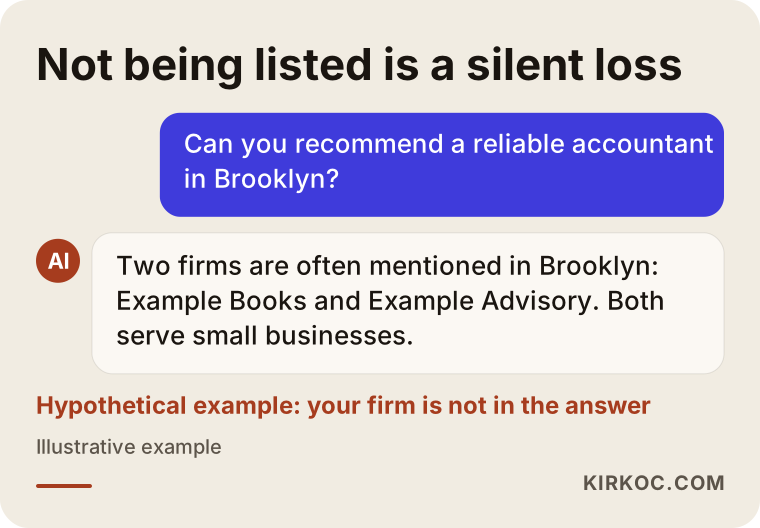
The thing to notice is that the answer comes as a short list, and being left off that list is a silent loss. Nobody will complain to you that you were not recommended. The customer simply never sees you and moves on. The real value of a tracking service is that it makes this invisible loss visible.
How is this different from a Google search?
On Google, results are a ranking: you can say first, second or third place. In AI answers there is often no ranking at all. The answer is a paragraph or a short list, and the same question can produce different results at different times. That is why "what position is my brand in AI?" is the wrong question. The right question is: "In how many of these questions am I mentioned, what is said, and which sources does the answer rely on?"
Another difference is sources. Some assistants, Perplexity for example, show which websites they read under the answer. That is very useful, because you can see which page a statement about your brand came from. Was it your own site, a directory, an old news article? Once you know the source, fixing the problem becomes much easier.
What does a tracking service actually measure?
The service is called "tracking," but it contains several separate jobs. I will list them plainly, because when you collect quotes you need to know which piece you are buying.
The first job is preparing the question list. Someone writes roughly 20 to 50 questions based on what your customers really ask. I mention that range only to give you a sense of the size of the work, not as a rule. The questions fall into three groups: those that include your brand name ("Is Example Books trustworthy?"), those that include the service ("Who does small business taxes in Brooklyn?") and those that compare options ("Is A or B better?"). I prepare this list together with you, because you know your customers better than anyone.
The second job is asking those questions to ChatGPT, Gemini, Perplexity and, if needed, other assistants at regular intervals. Every answer is saved with its date and the exact question. Because the same question can get a different answer on a different day, a single attempt means nothing. You need repetition over time.
The third job is reading and classifying the answers. Was your brand mentioned? Was the tone positive or neutral? Is the information correct? Who are the competitors, and which sources were cited? This part takes human effort, because a spreadsheet cannot tell whether a sentence is praise or a subtle criticism.
The fourth job is reporting and recommendations. The results are written up in plain language, and they turn into concrete tasks: fix this page, update that detail, write new content for this question. Tracking has no purpose of its own. The purpose is to close the gap you find.
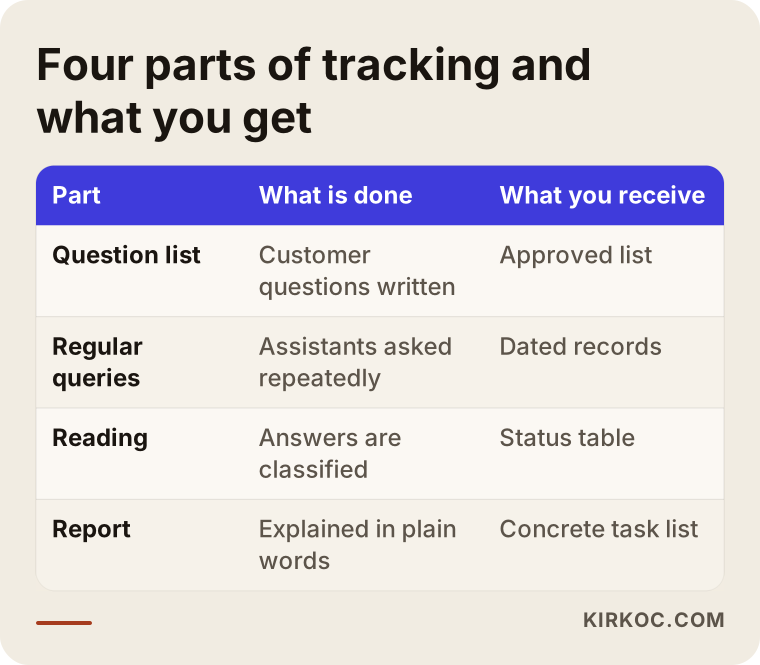
The table above summarizes what each part leaves you with. When you read a quote, check whether every row has a counterpart in it.
What it cannot measure, and I should say so up front
To be honest, measurement in this area is not as settled as it is for Google. The assistants do not publish how many times they answered a question, or how many people were shown your brand. So there is no reliable counter that can tell you "this month, so many people saw you in ChatGPT." If someone claims otherwise, ask them for the source. What can be done is to sample the answers to a defined set of questions and watch them over time. It is closer to a survey than to a meter: it shows direction, not an exact number.
The second limit is variability. The same question can bring two different answers on the same day. That is why I ask each question several times and look at the general pattern. I never look at one answer and declare that you have vanished or won.
The third limit is guarantees. Nobody can make an assistant recommend you. What can be done is to make your information accurate, clear and easy to find in trustworthy places. Nobody can promise the outcome in advance.
How do customers ask AI?
The answer differs from industry to industry, but there is a common pattern: people write longer and more natural sentences to an assistant than they do to Google. Someone who types "brooklyn accountant" into Google might write to an assistant: "I have a small LLC in Brooklyn. How do I choose someone reliable for monthly bookkeeping, and who would you suggest?" This matters because the pages on your site need to contain answers to long questions like that.
I see three types of questions. The first is discovery: the person does not know anyone yet and is looking for options. Being mentioned here is the first introduction. The second is comparison: the person knows two or three candidates and asks which one fits. How you are described next to your competitors is what counts. The third is verification: the person types your name and asks, "Is this company legitimate, what do reviews say, where are they?" Here, the accuracy of your information is everything.
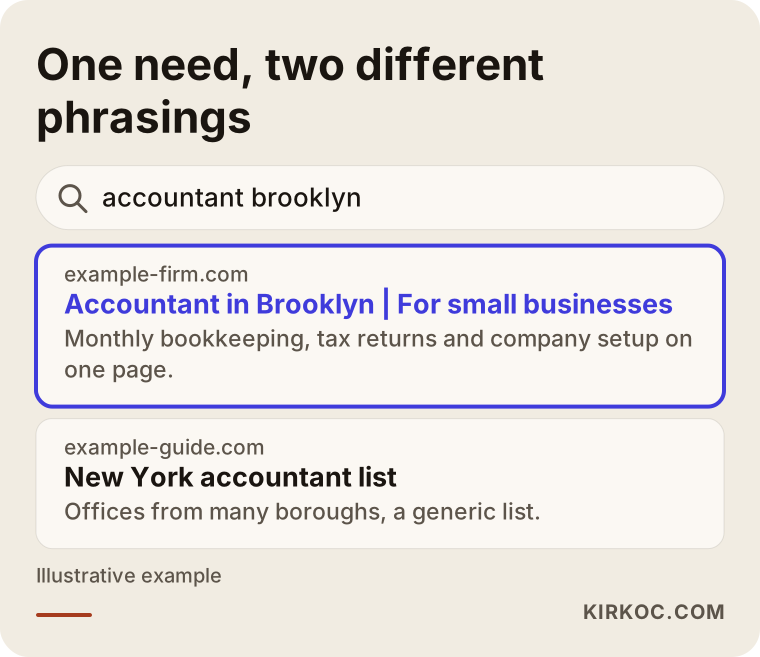
The example in the image is hypothetical. In a short Google search, the page that clearly names the neighborhood and the service rises to the top, and the long question asked to an assistant relies largely on the same facts. When I write the question list for tracking, I use both kinds of phrasing.
Which pages do you need?
When assistants build an answer, they mostly draw on pages that are clear, short and direct. On a service page it helps to state plainly what exactly you do, who you do it for, which area you work in, how to get in touch, and the common questions with their answers. A phrase like "we provide quality service" answers no question at all. A sentence like "I help with company setup and monthly tax filings, and I work with small businesses in Brooklyn and Queens" is a direct answer to a question.
You should also have an About page, a Contact page and, if possible, an FAQ page. These pages become the source for what an assistant says about your brand. If they do not exist, the assistant gathers the missing details from other sites and repeats whatever those sites say.
Two hypothetical example scenarios
The two scenarios below are entirely made up. They do not belong to any real company or person. The goal is to show what tracking can reveal in practice.
Scenario one: the clinic nobody mentions
Suppose there is a small dental clinic in Chicago, and its owner has heard that patients now consult chat assistants. The clinic's name appears on its website and on the map. But when someone asks an assistant, "Where can I get dental implants near Lincoln Park?" the clinic never comes up. In the tracking work, about 30 questions are prepared and asked regularly over several weeks. The result: the clinic appears in none of the discovery questions, but when asked by name, the assistant gives correct information.
What does this picture say? The brand is known, but it has not been connected to the combination of service and area. The fix is to write a separate, clear page for implant treatment, state the neighborhood and surrounding areas openly, add common questions, and make the business listing on the map match the website. A few months later the same questions are asked again to see whether anything changed. I cannot promise the result will improve, but at least it becomes clear which gap was closed and what moved.
Scenario two: the answer with wrong information
In the second example there is a boutique furniture workshop. It moved two years ago, but an old address is still sitting on a directory site. During tracking, one assistant gives the old address, and another lists a service the workshop no longer offers. Looking at the sources, it turns out the wrong information came from a single directory.
The work here is to get the entry on that directory corrected, to write the current address and service list clearly on the workshop's own site, and to make that information explicit on a dedicated page. Assistants may take time to let go of the old information; some update quickly, some slowly. That is why tracking makes sense as ongoing monitoring rather than a one-time check.
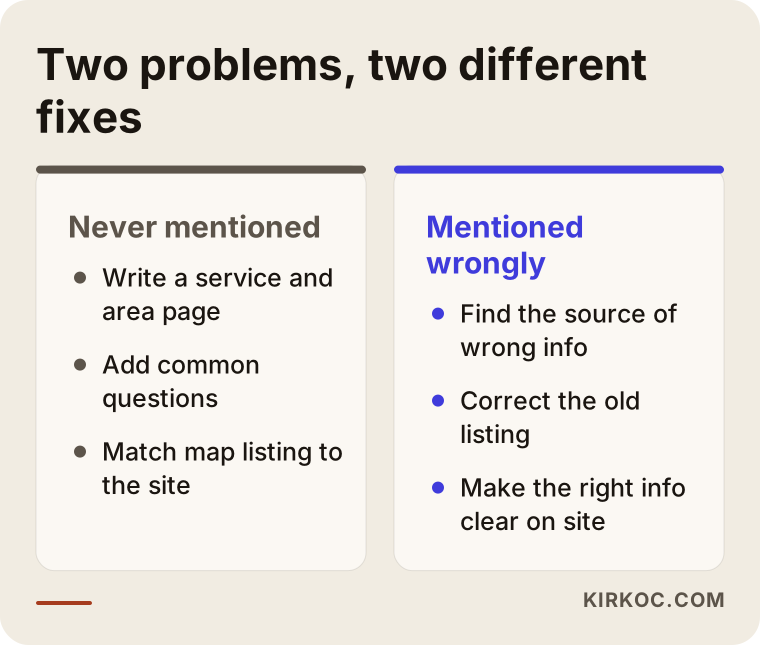
This comparison shows that two different problems need two different fixes. "My brand is not in AI" is not a sufficient diagnosis on its own.
How does the process work, step by step?
Here is how I run tracking in five steps, with your part clear at each one.
The first step is a conversation with you. I listen to your business, who your customers are, who your competitors are, which area you work in and which service earns you the most. Without this conversation, the question list would be generic and useless.
The second step is writing the question list and approving it with you. You correct it by saying "customers never ask that" or "this is the question they actually ask." This step is short, but it affects the result more than any other.
The third step is the first measurement. The questions are asked to the assistants, and the answers are saved and classified. This first round gives you a starting point, and later rounds are compared against it. It is normal for the first results to look poor, because most businesses have never done any work in this area.
The fourth step is interpreting the findings and producing a task list. Which pages to write, which to fix and which outside listings to update are listed in order of importance. Some tasks you can do yourself, and some need technical knowledge.
The fifth step is regular tracking. At set intervals the same questions are asked again, changes are reported and the list is updated. How often depends on the size of the work and how fast your industry moves.
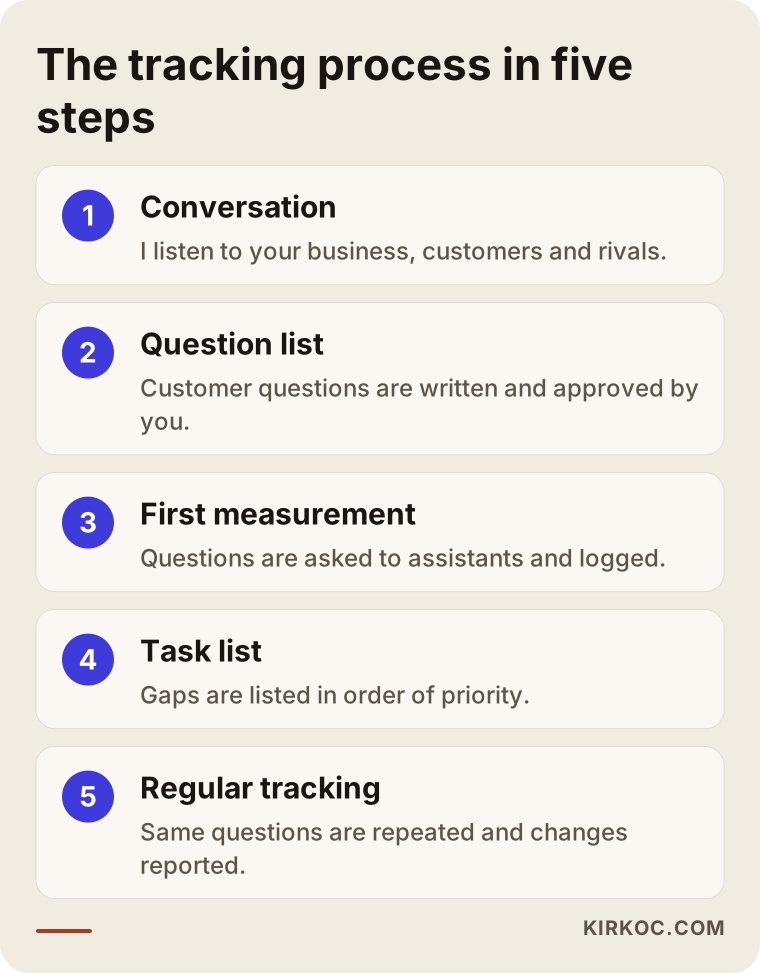
The steps above summarize the process at a glance. The output of each step should be something you can hold: a written list, a record or a report.
What records are kept during tracking?
In every round I record the following: the question itself, which assistant it was asked to, the date, the full text of the answer, whether the brand was mentioned and how, whether the information was correct, which competitors were named and which sources were shown. These records are handed over to you as well. Even if you stop working with me one day, you keep your own data. I say this on purpose, because some arrangements leave the records with the service provider, and that makes you dependent on them.
How do you make your pages understandable to assistants?
Tracking is only the diagnosis. The treatment is fixing your website and your online listings. Let me describe that work with a simple page layout.
A service page should be built in an order that answers the question directly. At the top comes a heading that says in one sentence what the page is about, with a short summary right below it. Then comes who it suits, how you work, which areas you serve, the process and the common questions. At the bottom are the contact details, which should be identical everywhere on the site.
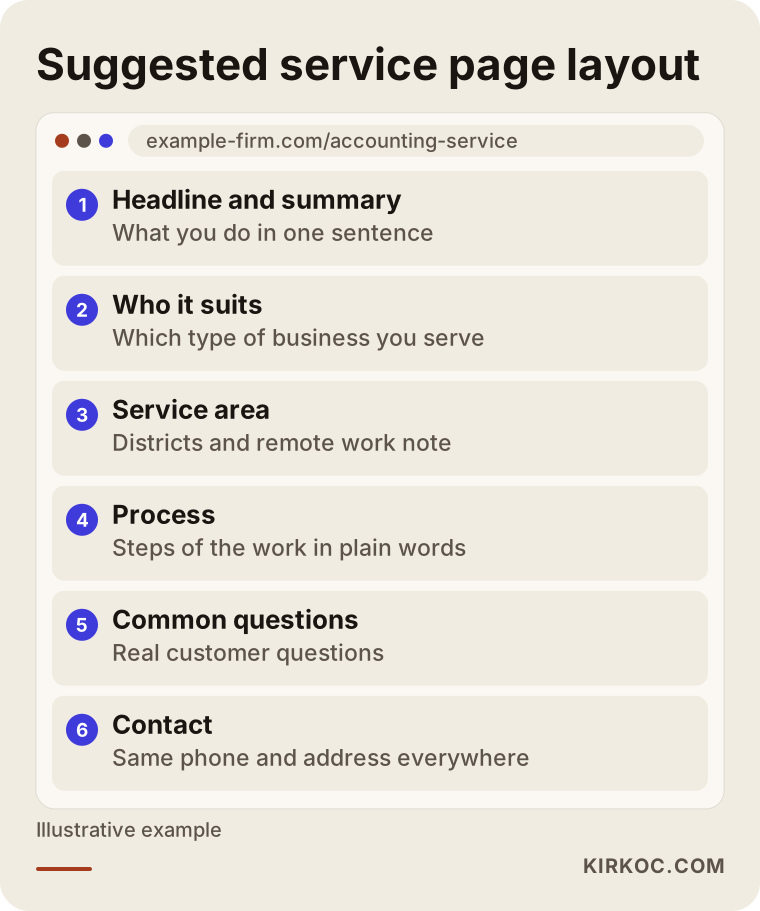
This layout is good not only for assistants but also for the person who lands on the page. The reader finds what they want quickly, and the assistant finds a clear sentence to quote. The nice part of this work is that the same page serves both.
A few technical points matter as well. Your site should load quickly, look right on a phone and be readable by search engines. On some sites, AI programs are blocked from reading pages, either deliberately or by accident, and even the person who built the site may not have noticed. Checking whether such a block exists is one of the first things I do. If access is closed, an assistant cannot read your site and will turn to other sources for information about you.
Then there are outside listings: your Google Business Profile, industry directories, social media accounts, news or interview pages. Assistants look at these to get to know your brand. Writing your name, address and phone number the same way in all of them lowers the risk of conflicting information.
Common mistakes
These are the mistakes I see most often in this area. Some come from excitement and some from lack of information.
The first mistake is judging from a single attempt. Asking ChatGPT about your brand one morning and panicking because it does not know you, then asking another day and relaxing because it does, are equally misleading. Answers vary, so you need to look at the trend.
The second mistake is asking only for your own name. Customers often search without knowing your name. If you only ask "What is Example Books?", you never see the real loss, which is not appearing in discovery questions.
The third mistake is looking for a special trick for AI. Some people suggest hidden text or fake reviews to fool the assistants. These are unethical and can backfire quickly. The real way is to publish accurate, clear and trustworthy information.
The fourth mistake is leaving old information uncleaned. If you moved, dropped a service or changed phone numbers, every place needs an update. A single old directory entry can be enough to make an assistant give a wrong answer.
The fifth mistake is waiting too short a time for results. It can take weeks, sometimes longer, for fixes to show up in assistants, and the time cannot be predicted in advance. Quitting after seeing no change in the first weeks wastes the effort.
The sixth mistake is ignoring competitors. Visibility is relative. Being mentioned does not mean a competitor is not mentioned more often or more favorably than you.
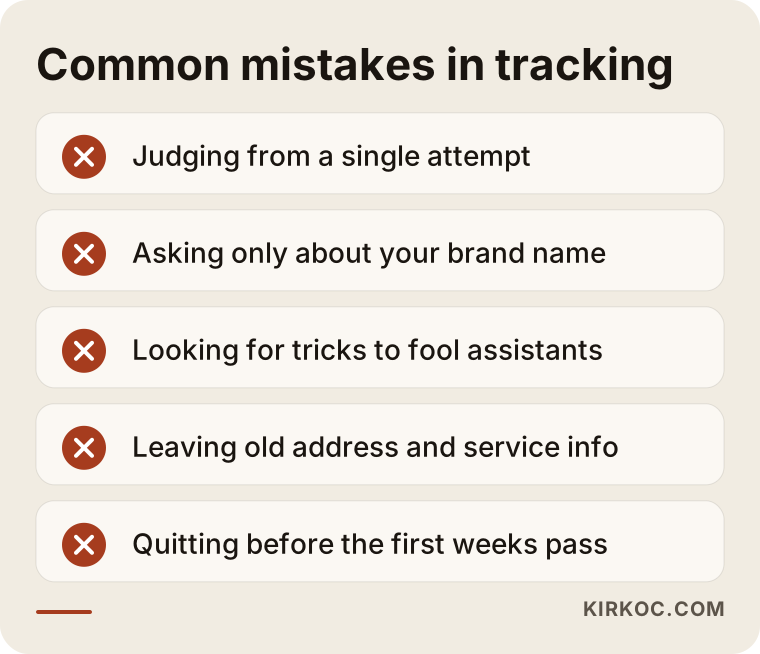
You can use this list as a checklist. If you recognize yourself in a few items, you can start fixing them without needing a specialist.
What can you do yourself, and when do you need a specialist?
For every business owner, the first step is free and takes half an hour. On a sheet of paper, write ten questions your customers might ask: one that contains only your brand name, five that contain a service and a location, and four that are comparison or selection questions. Ask them to ChatGPT, Gemini and Perplexity, copy the answers into a table and mark them: was I mentioned, is the information correct, who are the competitors? Repeat it a month later. Even this simple exercise will show you a great deal.
There are other things you can do on your own: keep the address, phone and hours on your site current, fill out your Google Business Profile, write clear sentences on your service pages and add common questions. None of this needs technical knowledge, only attention.
Getting expert help makes sense in a few situations. First, when the number of questions grows and manual tracking becomes unmanageable. Second, when you have several services, locations or languages. Third, when you cannot find the source of wrong information, or when your site is closed to assistants, because those call for technical work. Fourth, when you want a systematic comparison with competitors. Fifth, when you simply do not have the time, because this is not a one-time job. It needs to be run regularly.
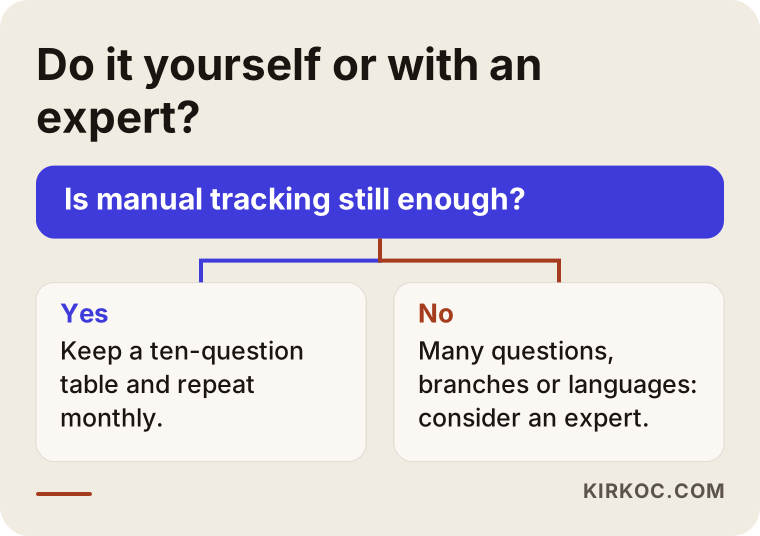
Let the diagram guide you, but do not treat it as an obligation. Some businesses are happy with their own spreadsheets for years, and that is perfectly reasonable.
What determines the cost
I will not give numbers in this article, because the price depends on the scope of the work, and quoting one figure for everyone would be misleading. What I can do is say plainly what makes it change.
The first factor is the number of questions. The more questions you track, the more records, reading and interpretation are needed. The second is how many assistants are monitored; three assistants and five assistants are not the same amount of work. The third is how often you measure: monthly and every two weeks are different workloads. The fourth is the number of languages and regions. A business in one language and one city is not in the same scope as one that serves several languages. The fifth is whether you also want the fixes done alongside the tracking. Receiving only a report is a different line item from also including page writing and technical corrections. The sixth is the depth of the competitor analysis.
When you collect quotes, check these things: is it written down which questions will be asked and how many times? Is it clear which assistants are covered? Will the records be handed over to you? Is the report written in plain language? And is no ranking or result guaranteed? Someone who offers a guarantee is selling something they cannot control.
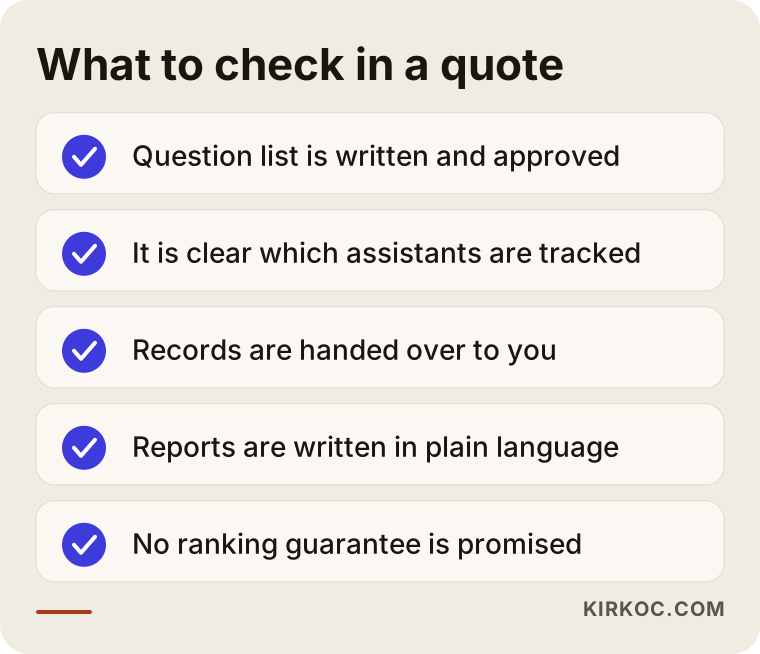
Keep this list in front of you when you talk to me or to anyone else. If an item is missing, do not hesitate to ask the person who sent the quote.
How I work
I work alone. The person you talk to is the person who writes the questions, reads the answers and prepares the report. That means quick decisions, and it also means a limit: my capacity is finite, and so is the number of projects I can take at once. If you are looking for a very large corporate scale, I will tell you so at the start.
In the first meeting I listen to your business, look at your website and your current situation, and, if it seems appropriate, run a small preliminary check and explain the result. After that I propose a written scope and process. Your accounts, your site and your data stay in your name. I write reports without jargon, and if a sentence is unclear, I rewrite it.
What matters to me is giving you a realistic picture. For some businesses the real problem is not AI but the website itself, and then I say the site should be fixed first. For others, everything is already in good shape and tracking is only reassurance. I do not want to sell you something you do not need.
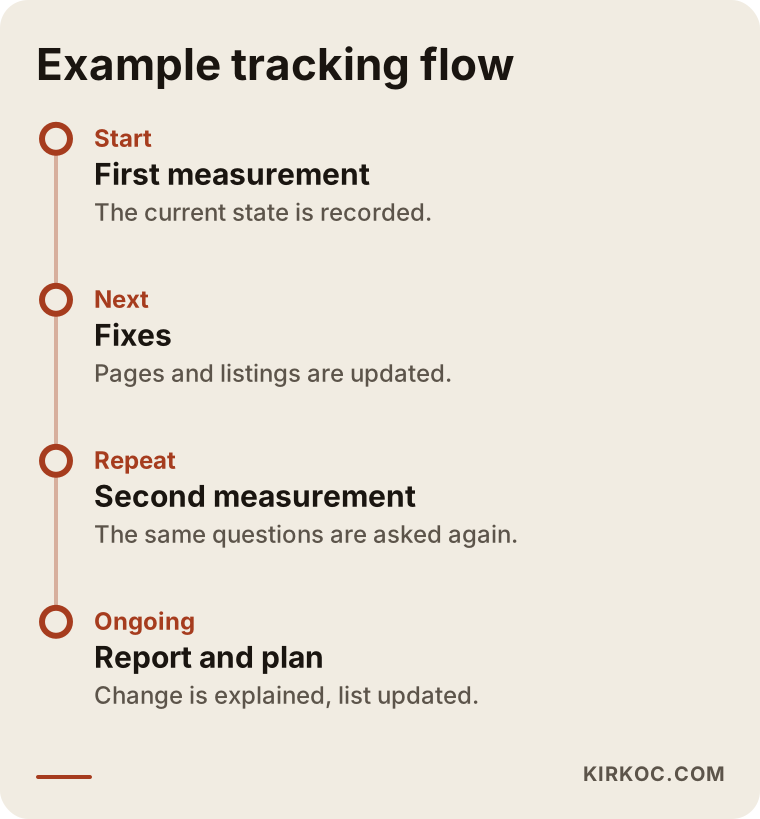
The timeline shows an example flow. The real schedule depends on the size of the work and on how quickly you can respond.
Frequently asked questions
Can you guarantee that my brand will appear in AI assistants?
No, and nobody can. Neither I nor anyone else controls which answer an assistant will give. What I can do is make sure your information is accurate, clear and available in trustworthy places, and measure the change. I suggest being cautious with anyone who offers a guarantee.
Which assistants are tracked?
I usually start with ChatGPT, Gemini and Perplexity, because they are widely used. Others can be added depending on your customers. Together we decide which ones matter, based on your customer profile.
Is it normal to get a different answer every time?
Yes, it is normal. Assistants build the answer fresh each time. That is why I look at the overall pattern across several attempts at the same question, not at a single answer. Deciding from one result is misleading.
Can I track this myself?
Of course. The ten-question exercise in this article is a good enough start. As the number of questions and assistants grows, manual tracking gets harder, and at that point outside help saves time. I recommend building your own table even before you pay for any service.
Can I get assistants to correct wrong information directly?
Usually there is no direct correction channel, or the result is not guaranteed. The effective way is to find the source the wrong information came from and correct it, and to state the right information clearly on your own site. Over time, assistants read those updated sources. The timing cannot be known in advance.
Does this replace Google SEO?
No, it complements it. Google still brings many customers, and a good site is the foundation for both. AI tracking is an additional point of view on top of SEO. You do not need to treat them as separate budgets, but we set the priorities together according to your business.
Is this service necessary for a small business?
Not for every business. If most of your customers come through word of mouth or local search, strengthening those channels first may make more sense. If your customers research and compare options, in other words if they ask questions before buying, tracking is more meaningful. In a first conversation I look at this honestly.
Are there legal or privacy issues to watch for?
Recording answers to general questions about your own brand is not a problem. But where information about individual people is involved, rules may apply. If you have any doubt, I suggest talking to a lawyer.
If you are curious how ChatGPT, Gemini and Perplexity describe your brand, or you have spotted something wrong, you can reach me through my GEO services page. I will listen to your business, look at where you stand, and tell you plainly what you actually need.