You have a software product. Maybe it is accounting software for small businesses, an appointment tool, or a project tracker for small teams. It works, and you have a few happy users. But when a potential customer asks ChatGPT, "What is the best accounting software for a small business?", your name does not come up. Your competitors' names do. This article is about exactly that problem: GEO for software and SaaS companies, meaning what you can do to be named in AI answers and in "best X software" recommendations. I am Ümit Kırkoç, a web designer and SEO/GEO consultant who works alone from Istanbul, and where it is relevant I will explain what my own GEO services cover and what they do not.
First, the terms. SaaS means software you use over the internet, usually for a monthly or yearly subscription, instead of installing it on your computer. GEO is the work that helps AI tools such as ChatGPT, Gemini, Perplexity and Google's AI summaries recognize your website and your product and recommend it when they answer a question. Classic SEO aims to get your site shown in search results. GEO aims to get your name mentioned inside the answer. The two are close relatives, but they are not the same thing.
Let me be honest up front: nobody can promise you a fixed position or a guaranteed mention in an AI tool. I cannot see inside how these tools build their answers, and the answers change from person to person and from day to day. What can be done is to make your product easy for these tools to find, understand and describe with confidence. The rest of this article explains what that takes, in order.
How do software buyers search now?
Buying software is different from buying a sofa. The buyer usually has a problem to solve. They are tired of writing invoices by hand, the team's tasks keep getting lost in email, or customer records no longer fit in a spreadsheet. Once the problem is clear, the research begins. A few years ago that meant typing "accounting software" into Google and opening the first few results. Now a growing number of people ask an AI assistant in a full sentence: "Can you recommend a project tracker for a five-person agency that is affordable but solid?"
The difference matters. On Google, the person picks you from a list, visits your site and reads for themselves. With an AI assistant, the answer often arrives ready-made, and the person meets two or three product names. If you are not in that answer, the buyer may never have seen you at all. That is why being named in "best X software" answers can matter as much as showing up on the first page of a normal search, and in some categories more.
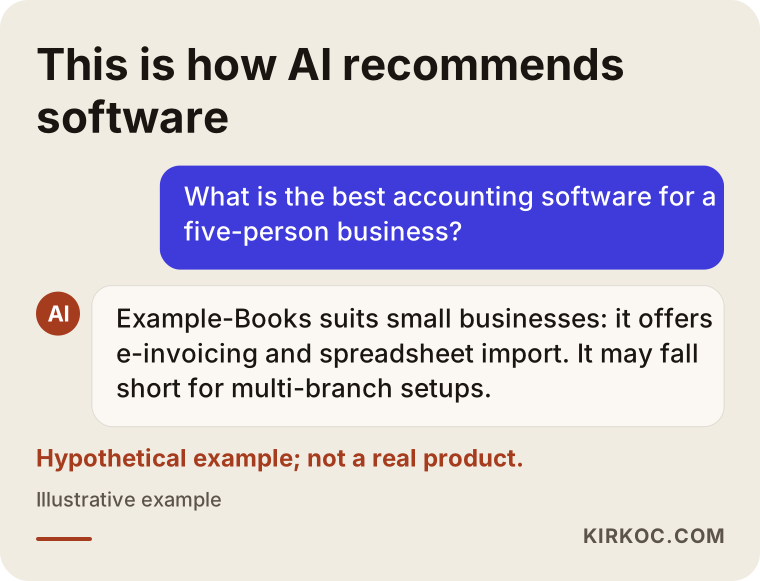
The image above shows an example answer built around an invented product. Notice that the answer does not just name the product. It says who it suits, what it does well and what it does not do. The AI does not make this up; it gathers it from pages, reviews and comparisons it has read. Your job is to make sure the information it can gather is correct, clear and easy to find.
What questions do buyers ask?
Software buyers ask a handful of types of questions, and each type needs a different page. Separating them tells you which pages to write.
The first type is the category question: "best accounting software" or "CRM for a small business." The buyer does not know anyone yet. The second is the comparison question: "Tool A or Tool B" or "alternatives to X." The buyer has looked at a few products and is getting closer to a decision. The third is the fit question: "does it support e-invoicing," "can I import from a spreadsheet," "is there a mobile app." The buyer is nearly convinced and wants one obstacle removed. The fourth is the trust question: "where is my data stored," "is support available in my language," "what do users say about it." If your site has no clear answer for each of these four types, an AI tool cannot give that answer on your behalf either.
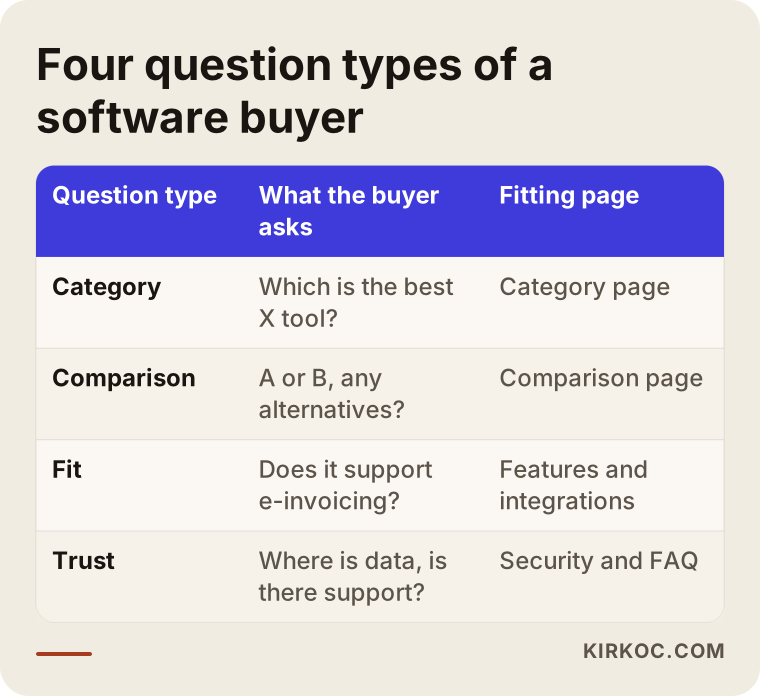
Use the table as a checklist. For each row, ask yourself whether your site has a page that truly answers that question. Most software sites have a home page and a pricing page. At least two of the other three types are usually missing.
What does an AI look at before recommending software?
I can only observe these tools from the outside, so I will not give you hard rules. But a few tendencies show up again and again, and they make sense. When an AI recommends a product, it tends to lean on four things: the plain explanation on the product's own site, what other sites say about it (comparison articles, review sites, industry news), user reviews, and whether the product consistently says the same thing about itself.
That last point is underrated. If your site says "AI-powered intelligent business management platform," a review site says "invoicing tool" and your social profile says "accounting for small businesses," the tool cannot work out what you are. Pick one clear sentence: "X is accounting and e-invoicing software for businesses with up to five people." Then use it everywhere, in the same form.
There is something else: AI tools do not reward marketing language, because that language carries no information. "The industry's leading, innovative, user-friendly solution" answers no question. A concrete sentence such as "You can import your customer list from a spreadsheet file, and the import usually takes a few minutes" is quotable. When a tool assembles an answer, it looks for exactly that kind of sentence.
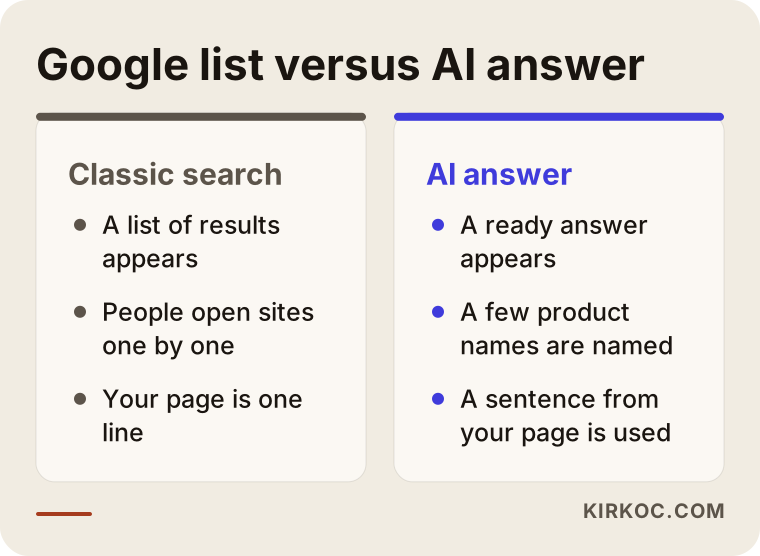
The comparison in the image sums up the two worlds. On Google, your page is one line in a list. In an AI answer, one sentence from your page may be a piece of the answer itself. So write each page so that even a single paragraph makes sense on its own.
The gaps I see most often on software sites
Software company websites are usually written by the people who build the product, for people who already know the product. The buyer does not know it. These are the gaps I run into most.
The first is that the first screen does not say what the product does. There is a big slogan and a nice picture, but no answer to "what is this for, and for whom?" The second is a pricing page that is missing or just says "contact us." Hiding the price can make sense for some products, but for the buyer and for an AI it is a hole in the information. At the very least you need a page that explains what the price depends on, such as number of users, modules or number of records. The third is having no comparison pages. Buyers are already searching "you or the competitor"; if you do not answer on your own site, others will, often with wrong or outdated information.
The fourth is a help center or documentation that search engines cannot see. In many products the help pages sit behind a login. A public help page that answers "how do I import data from a spreadsheet" can bring you visibility on Google and in AI answers. The fifth is speed and technical setup: pages open slowly, much of the content is drawn only by code running in the browser, and search bots may not see it all. This is common on marketing sites built with the same approach as a modern web app.
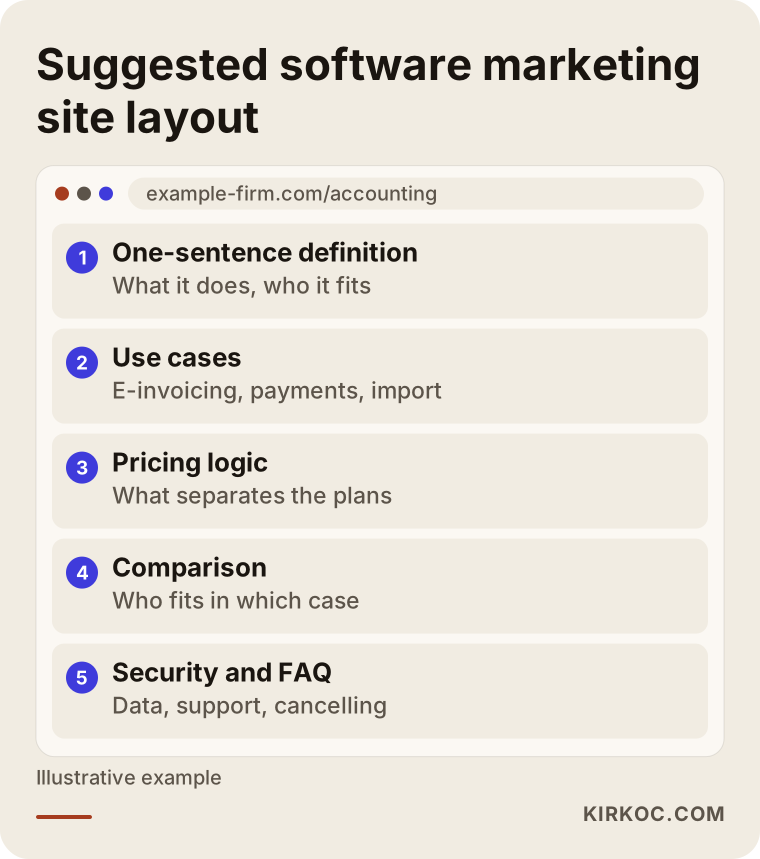
The image shows the basic layout I suggest for a marketing site. You do not have to do all of it at once. In order of priority, the answer to "what does it do and for whom" comes first, then the pricing logic, then the fit and trust pages.
Which pages do you need?
This is the most concrete part of the job. These are the pages I consider valuable for a software company from a GEO point of view.
Product and use-case pages. Instead of one "Features" page, give each main use its own page. For accounting software, that could be "sending e-invoices," "tracking payments" and "sharing data with your accountant." Each page answers one question: how is this job done, and how is it done in this software.
Pages by industry and size. "For agencies," "for small retail chains," "for freelancers." A buyer trusts a page that looks like their own situation, and an AI finds a basis for writing "X suits agencies."
Comparison and alternatives pages. These must be honest. Do not attack the competitor; say in which situation you fit better and in which the competitor fits better. That earns the reader's trust and gives an AI content it can pass on as a fair source. When you name competitors, be careful not to state wrong facts, since their features change and outdated claims will come back to bite you.
A pricing logic page. Even if you do not want to publish numbers, write clearly what separates the plans, whether there is a trial, and how cancelling works.
A security and data page. Where data is stored, how it is backed up, who has access, and your approach to protecting personal data. Be careful with claims about legal compliance, and speak to a lawyer before you make any firm legal statement.
Frequently asked questions and help content. Start with the questions that come up most in real customer support emails. They overlap heavily with what buyers ask before they purchase.
Integration pages. "Does it work with this other tool?" is asked all the time. Write which tools you connect to, how, what you can pass across and what you cannot.
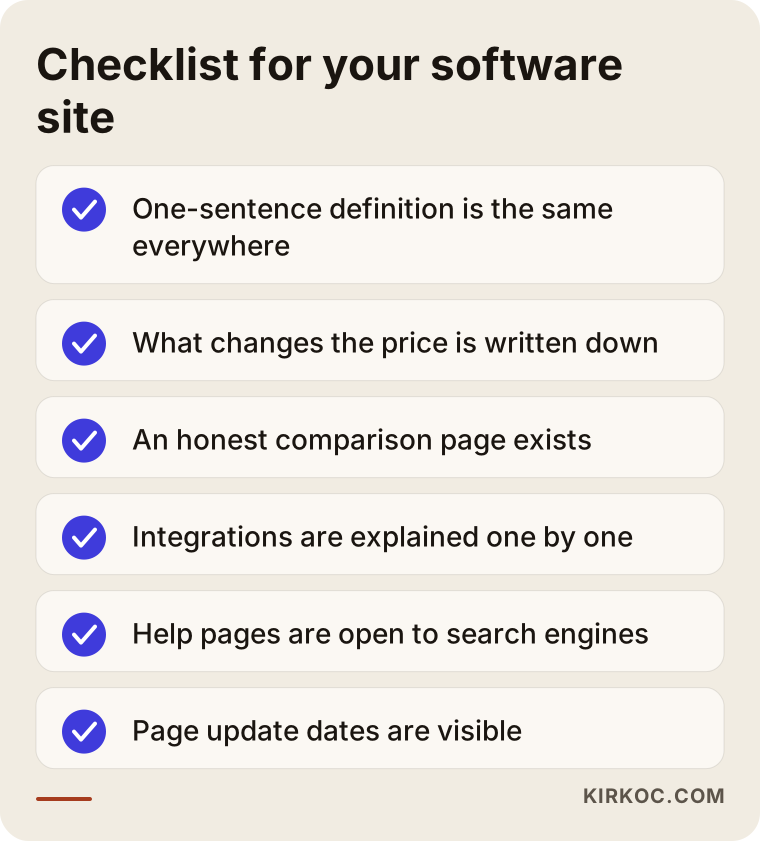
Go through the checklist item by item. Even if you do everything on it, no tool is obliged to recommend you. But if several items are missing, it is only natural that your chances stay low.
Two example scenarios
The two situations below are hypothetical. They are not real companies or people. The purpose is to show how the thinking goes.
Scenario 1: Appointment software
Suppose there is an appointment management product for beauty salons and hair stylists. The product is good, but the site is a single page: a big image, a feature list and a "request a demo" button. The owner notices that when someone asks ChatGPT for "appointment software for a hair salon," the product is never mentioned.
The first step is to ask AI tools questions the way a real buyer would: "appointment software for a small hair salon," "booking app with text message reminders," "software that keeps customer records for a salon." Look at which products are named and for what reasons. Then find the answers your site is missing: are there text reminders, how many staff can it handle, is there a mobile app, how do I move my current customer list over? Each of these gets a short, clear page or section. After that, add industry pages such as "For hair salons" and "For beauty centers," and open the help center to search engines. After a few months some of these pages may start to show up on Google. Being mentioned in AI answers takes longer and is not guaranteed.
Scenario 2: Accounting software
In the second hypothetical case, there is bookkeeping software aimed at freelancers and small companies. There are many competitors and each says similar things. What makes a difference here is not a claim to be "the best overall" but a clear fit with one audience. For example, a narrow position is chosen, such as "works on the same account as your accountant" or "collects marketplace sales in one screen for online sellers." Everything on the site is reorganized to tell that story. When a buyer then asks for "bookkeeping software for marketplace sellers," the product is not lost in a long list, and has a chance to appear near the top of a short one.
The shared lesson of both examples: competing with the big players in a broad category is often unrealistic. Saying "this product for this job" in a narrow, clear area makes more sense to people and to AI.
The process, step by step
When I work with a software company, the path looks roughly like this.
1. Collect buyer questions. I pull out what buyers really ask from sales notes, support emails and demo call records. This list is the foundation of the whole project, because the questions put to an AI are largely these same questions.
2. Check current visibility. I ask the chosen questions to several AI tools and to Google and note which products appear and with which sources. This is not a ranking measurement but a snapshot. Because answers can change, the same questions need to be asked again at intervals.
3. Clarify the positioning. The one-sentence description of the product and who it is for gets written down. That sentence is then used consistently on the site, on profile pages and everywhere else.
4. Check the technical ground. Do pages load fast, can search bots see the content, is the product information marked up in an orderly way (structured data, which tells search engines "this is a software application and this is how its pricing works")? This part sounds technical, but in the end it is about presenting what you tell the reader in a form machines can also understand.
5. Write the missing pages. Priorities are set: first the pages closest to a purchase (comparison, pricing logic, fit), then category and industry pages, then help content.
6. Keep outside sources consistent. Review sites, app stores, industry directories and social profiles should carry the same, up-to-date product information. Collecting reviews belongs here too, but buying reviews or having fake ones written is unethical and hurts the product in the long run.
7. Measure and adjust. Regularly review the visits coming from search engines and AI tools, the demo requests, and the answers given to your test questions.
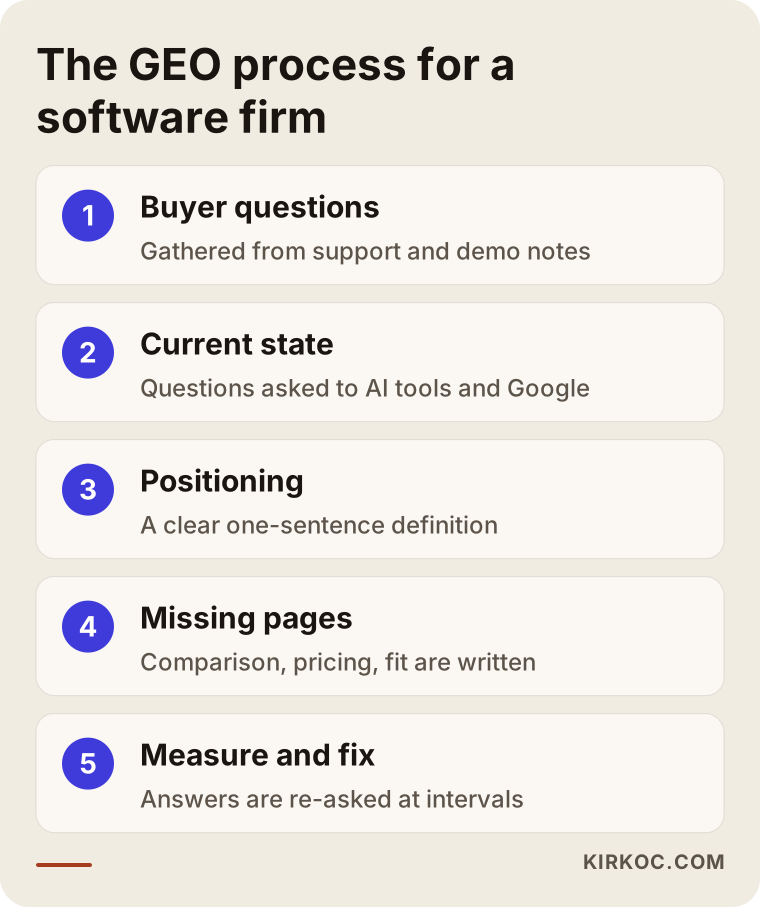
The flow in the image shows the order of the work. The order matters: if you start writing pages before the positioning is clear, you may have to rewrite all of them later.
How should a page be written?
A good software page should not read as if it were written for an AI. It should first be clear to a person. A few practical principles help.
Answer the topic in the first paragraph. On a page titled "How do I send an e-invoice?", let the first sentence be the answer, then go into detail. Writing headings as questions works because it matches how buyers actually ask. Short paragraphs and numbered steps are easier for both the reader and the tool.
Write down your limits too. A sentence such as "This software is not suited to multi-branch chains" may sound scary, but filtering out the wrong buyer reduces your support load and builds trust. AI tools also tend to report what a product is not suited for as well as what it is suited for; if you do not write it, someone else will.
Give dates and version information. Software changes fast, and a note like "This page was last updated in November 2026" tells both people and machines that the information is fresh. Update old pages or remove them rather than leaving them silently in place.
If you use numbers, show the source. Stating a measurable fact about your own product ("the import supports these file formats") is fine. But claims with no source, such as "most customers save time," lower your credibility and come back on you if they turn out to be wrong.
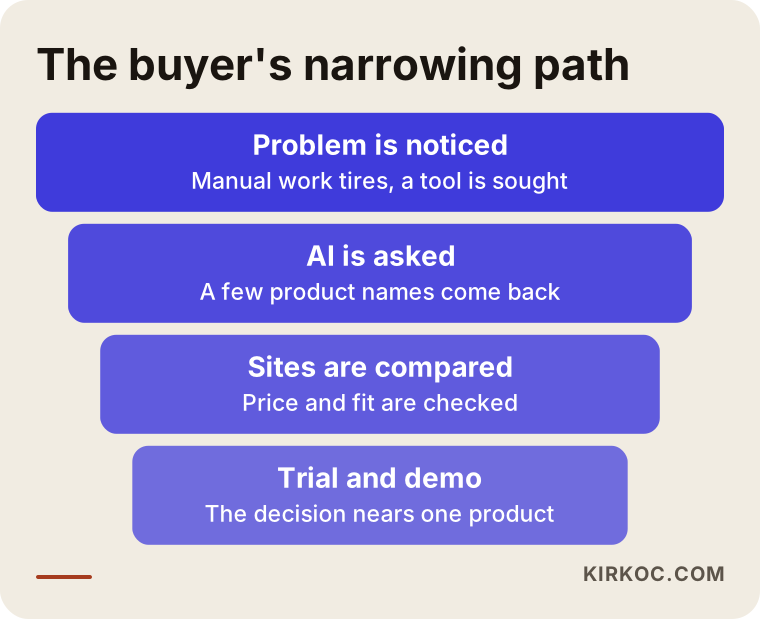
This image shows the buyer starting with a broad question and narrowing step by step to one product. Some products drop out at every stage. If you know at which stage you are being dropped, you can strengthen the page that fits that stage.
Common mistakes
I list the mistakes I see repeated in this area, because most of them can be avoided at no cost.
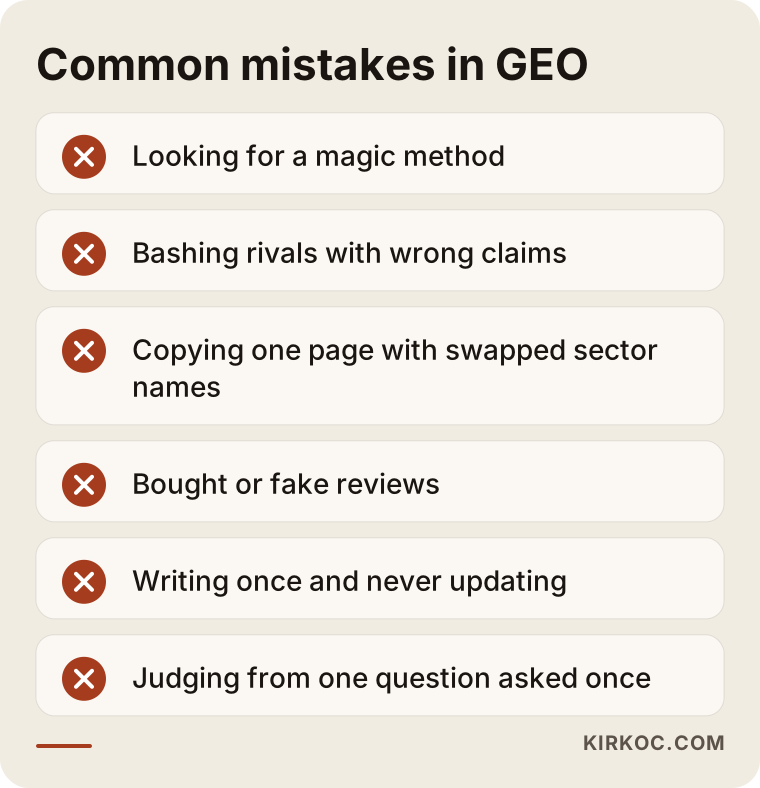
Let me explain some of the mistakes in the image. The most common is searching for a separate magic method for AI. There isn't one; there is a well-explained, trustworthy and consistent description of your product. The second is bashing competitors with wrong information: it carries legal risk, and when AI tools weigh conflicting sources they may find your page unreliable. The third is copying the same content onto hundreds of small pages with only a city or industry name changed; bulk pages with no real value lower a site's credibility in the long run. The fourth is bought or fake reviews. The fifth is producing content once and leaving it: the product changes, the plans change, integrations are added, and when a page stays old it spreads wrong information.
Another mistake is deciding without measuring. Asking one question once is not enough to say "ChatGPT does not recommend my product"; the answer varies by person and by time. You need to ask several different questions, several times, in different tools, and look at the trend.
What can you do yourself, and when do you need an expert?
You can do a lot yourself, and I would like you to, because you know the product better than anyone. You can start three things this week. Write down the ten questions buyers ask and check whether your site answers each one. Settle on a one-sentence description of the product and make it the same on your site, your profiles and your app store listing. Check whether your help center is open to search engines. Also ask AI tools questions like a real buyer would and note which products they mention.
Expert help makes sense in these cases: your site's technical setup hides the content from bots, you have a multilingual or multi-product structure, you do not have time to write the comparison and industry pages, or you struggle to set up a way to measure the effect. You do not have to hand everything over; sometimes an initial review and a roadmap are enough.
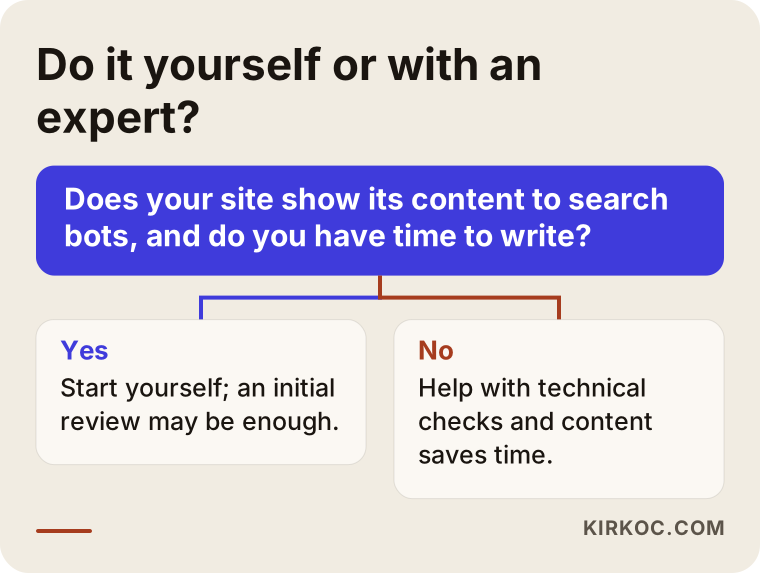
The chart is a rough guide. If the technical base is sound and you have time to write the content, you can start yourself. If not, getting help saves time.
What decides the cost?
The price of this kind of work depends on a few things that can be explained without quoting numbers. The first is the current state of your site: if only a few pages need fixing, the job is small; if the technical base needs renewing or many new pages must be written, it grows. The second is the number of products and pages: a single-product SaaS and a platform with dozens of modules have very different content needs. The third is the number of languages, since each language is a separate piece of writing and checking. The fourth is how crowded your category is: finding a narrow position in a busy category takes more research. The fifth is whether the work is one-off or ongoing; measuring, updating and new content take regular effort.
That is why I give a price only after seeing the site and the goals, and I put in writing what will be done and what is out of scope. Be cautious if you see an offer that says "I guarantee this position in this many months." Nobody has such a guarantee in this work.
How I work with you
I work alone, so the person you talk to is the person who does the work. I usually start with a short introductory call: I listen to what the product is, who it is for and what your current site looks like. Then I do an initial review and share what I found, and the priority order I suggest, in plain written language. I also tell you honestly which jobs you can do yourself and which need support. If we decide to work together, I put the scope and the schedule in writing at the start and report on progress at regular intervals. I do not promise results; I show clearly what I did, why I did it and what I am measuring.
For the first three months, I think of a rough flow like the one below. The timing varies with the product and the site.
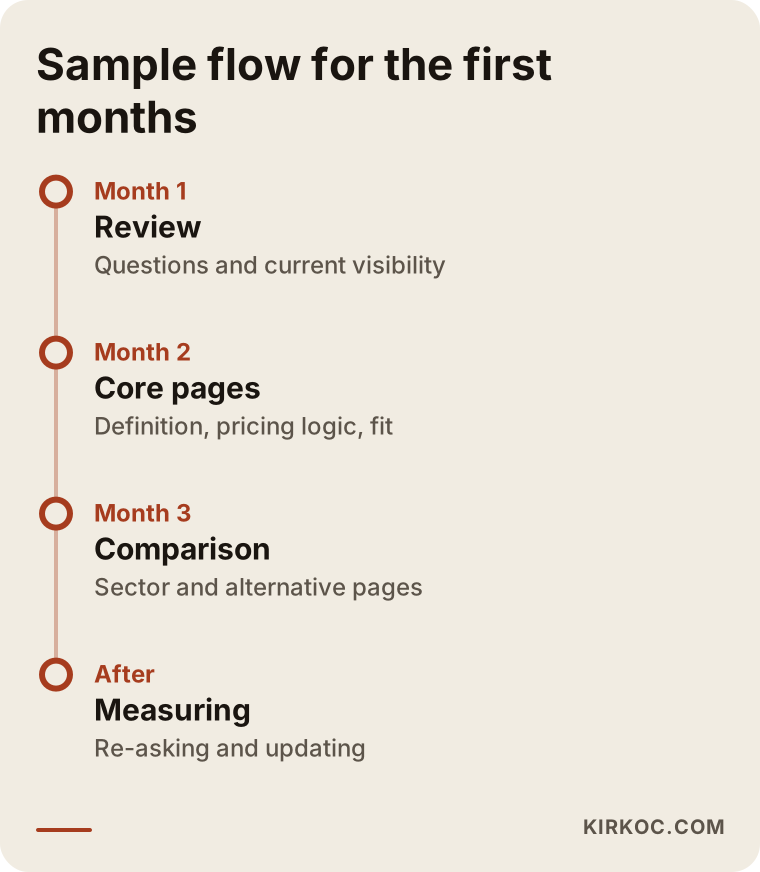
The order in the timeline is an example, not a template. Changes in AI answers often arrive late and unevenly after pages are published, so you have to be patient and keep measuring as you go.
Frequently Asked Questions
Are GEO and SEO the same thing?
They are not the same, but they are very close. SEO aims to get your site shown on search result pages. GEO aims to get your name mentioned in the answers AI tools give. A well-done SEO foundation helps GEO a great deal, because AI tools often draw on clear, trustworthy pages. On top of that, GEO pays more attention to how your product is described on third-party sources and to consistency.
Can you guarantee that ChatGPT will recommend me?
No, and nobody can honestly guarantee that. How these tools produce answers changes over time, and different people can get different answers. What I can do is help your product be described in a findable, understandable and trustworthy way, and measure the progress.
How long does it take to see results?
I cannot give an exact time. After a page is published, search engines finding it and AI tools using it as a source move at different speeds. The level of competition, the current state of your site and how well known your product is all affect the timing. So I suggest thinking in terms of several months, not weeks.
Do I have to show my price on the site?
It is not required, but explaining what the price depends on helps a lot. If buyers and AI tools can see a logic such as "by number of users" or "by module," they can describe the product more easily. Giving no information at all can send the buyer to a competitor's page that explains it openly.
Isn't it risky to write a comparison page against competitors?
Not if it is done right. Write only what you know and can verify, do not run the competitor down, say when the competitor may be the better fit, and keep the page up to date. If you have doubts about using brand names, speak to a lawyer.
Can a brand-new, little-known product get into the lists too?
It is possible, but hard and slow. The most realistic path for a little-known product is to position itself clearly in one narrow use case instead of competing across the broad category, give thorough answers on its own site, and appear correctly on reliable third-party sources. Inflated work done in hope of quick results usually backfires.
My help center is only for logged-in users. Should I open it?
Opening help pages that contain general information to everyone is usually useful, because buyers ask these questions before purchase too. Content that is specific to a customer or sensitive for security should of course stay closed. Deciding which is which is something to sort out together.
Should I write only in English, or are other languages needed too?
Write in the language of your audience. If you sell only to English-speaking buyers, English is enough. If you sell abroad as well, each language needs its own pages written by someone who knows that language well; pages published only through machine translation do not build trust.
If you would like to work out together where to start in making your software or SaaS product visible in AI recommendations and "best software" lists, you can leave a short message about your product and goals on my GEO services page. In our first conversation I will tell you honestly what is likely to help and what is not.