You install fire detection, suppression, or fire safety systems. You know your trade, you have references, but your phone mostly rings through word of mouth. When a plant manager, a hotel operator, or a developer putting up a new building types "fire suppression system installation" or "fire alarm company near me" into Google, they see other companies' pages, not yours. That is exactly where SEO for fire protection companies comes in. In this article I explain in plain language how customers in your industry search, which pages you need, and where to start. I am Ümit Kırkoç, a web designer and SEO consultant who works alone from Istanbul, and where it matters I will be clear about what my own SEO services cover and what they do not.
SEO, in short, is the work that makes your website show up when your customers search on Google and other search engines. The difference from advertising is simple: with ads you are visible only as long as you keep paying, while SEO, when it is set up properly, builds something that can bring in work for months and years. But fire protection is not an ordinary service. The customer is often in a hurry, has to meet code requirements, and pays a heavy price for choosing the wrong company. That is why people searching in this field look for trust before they look for a price.
How do customers search in the fire protection industry?
You cannot squeeze every search in this field into one pattern. People buying the same system can be in very different situations. In practice, though, you will meet four kinds of searches.
The first is the person who knows what they want and types the name of the system: "clean agent suppression system," "sprinkler system installation," "addressable fire alarm panel." This person is usually an engineer, a facilities manager, or someone who has bought a similar job before. Because they know the terms, they write a narrow search, and if they find you, they expect technical detail on your page.
The second is the person who knows the problem but not the name of the solution: "server room fire protection," "restaurant hood fire suppression," "how to protect a warehouse from fire." This could be a restaurant owner, a warehouse operator, or a data room manager. They do not know the vocabulary, but they describe their problem very clearly. If your page speaks in their words, you catch them.
The third is the person who is searching because they have to: "is a fire alarm system required," "fire sprinkler plans for a building," "what do I need for a fire marshal inspection." Here the person has usually been pushed into action by a notice, an inspection, or a permit process. The details of the rules should be settled by an attorney or a licensed engineer, and your page should not pretend otherwise. Its job is to explain the process calmly and clearly and point the reader to the right person.
The fourth is the person who already has a system and needs service: "fire alarm inspection contract," "fire extinguisher recharge," "annual fire hydrant and standpipe testing." This customer is a source of recurring income. A system you install once can turn into years of maintenance work. Many companies never target this search at all, because their site has no separate page for maintenance.
The image below uses an invented example to show what one of these searches might look like on a results page.
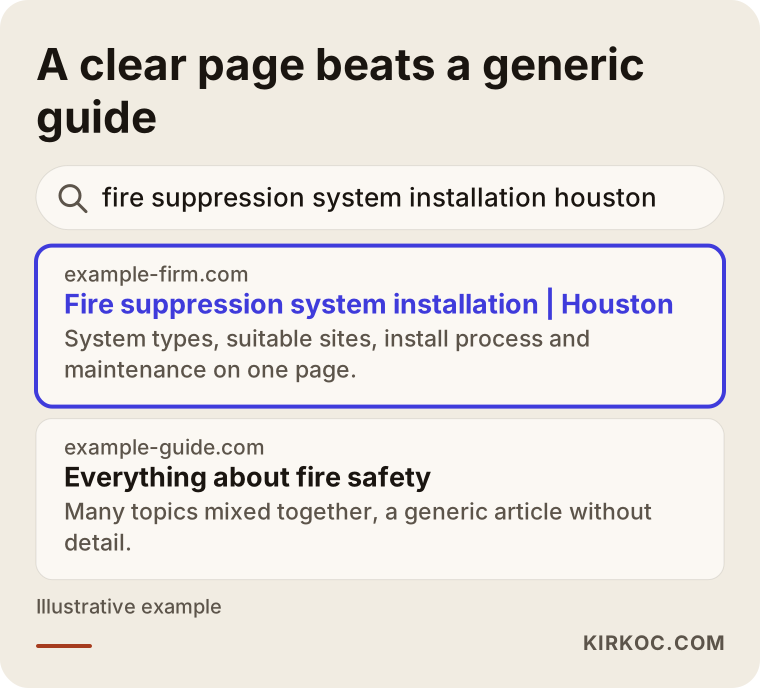
Here is what makes the highlighted result different: in its first line it says which system it installs, which area it works in, and who it serves. The generic guide below it tries to cover many topics at once and gives the reader no clear next step. Search engines and readers both pick the clear one.
Why does trust matter so much in this field?
A fire system is a product that sits unused for years and still has to work perfectly the one time it is needed. So before asking "who is cheapest," the customer asks, "who will do this right, and can I still reach them next year?" Every page on your site should help answer that. Information such as who your qualified staff are, what kinds of jobs you take on, what standards the products you use are made to, and how you support the customer after installation is worth far more than polished slogans.
I have to be honest here: whatever you write on your site about certifications, licenses, or standards compliance must be correct and current. Wrong or outdated information misleads the customer and can also put you in a difficult legal position. If you are not sure what you are allowed to claim, talk to an attorney or to the relevant licensing authority before you publish it.
Which pages do you need?
Most fire protection company websites follow the same pattern: a home page, an "about us" page, a "services" page, and a contact form. On the "services" page, dozens of systems are packed into one list with a few sentences each. To a search engine and to a customer, that layout says: "We do everything, but we do not explain any of it in detail." Yet the customer is searching for one problem at a time.
The structure I suggest is simple. Give each main system its own page: detection and alarm, sprinklers (automatic water spray), clean agent or gas suppression, foam suppression, standpipes and hydrants, portable extinguishers, smoke control, and so on. If you do not offer all of them, write only about the ones you do; a page for a service you do not provide is an empty claim. Each page covers one system and answers these questions: what is this system, who is it right for, what happens before installation, how does the process work, and how does maintenance run afterward.
Next to that, pages by industry and type of building are useful too: hotels, hospitals, schools, warehouses, factories, restaurant kitchens, server rooms, apartment towers. A hotel operator searches for "hotel fire protection," not "fire safety system." A page written for that person can speak directly to their worries, such as guest evacuation, night shifts, and keeping the business running.
The third layer is maintenance and inspection pages. Maintenance is a different business from a one-time sale; customers want to know about contracts, visit frequency, and emergency support. If you prepare this page separately, customers who had the system installed by someone else but are looking for maintenance can also find you.
The fourth layer is area pages. If you work in particular cities and regions, separate pages for searches like "Houston fire alarm systems" or "industrial fire suppression Dallas" make sense. There is only one rule: the page must truly describe that you serve that area, the kinds of jobs you do there, and how you get to the site. Copying the same text and swapping the city name is an attempt to fool both the reader and the search engine, and most of the time it does not work.
The table below summarizes the four search types and the page that fits each.
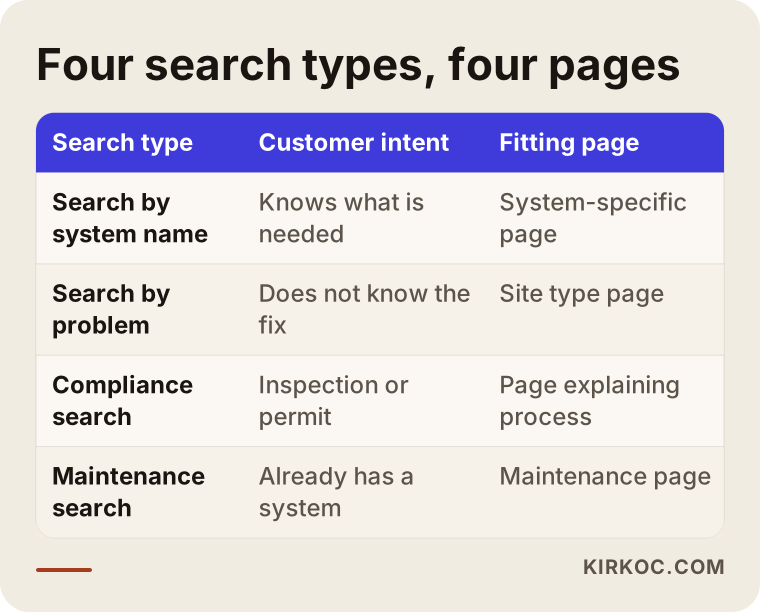
You can use the table as a checklist: which of these page types does your site have, and which are missing? On most sites the maintenance pages and the pages by type of building are missing, and the people making those searches are often the closest to a decision.
The road from search to phone call
You can think of the path a customer takes before they call you as a funnel. At the top are many people trying to understand their problem. Some of them compare solutions, some look for companies, and very few ask for a quote. Each stage needs different content: explanatory articles at first, service pages in the middle, and references plus a clear way to get in touch at the end.
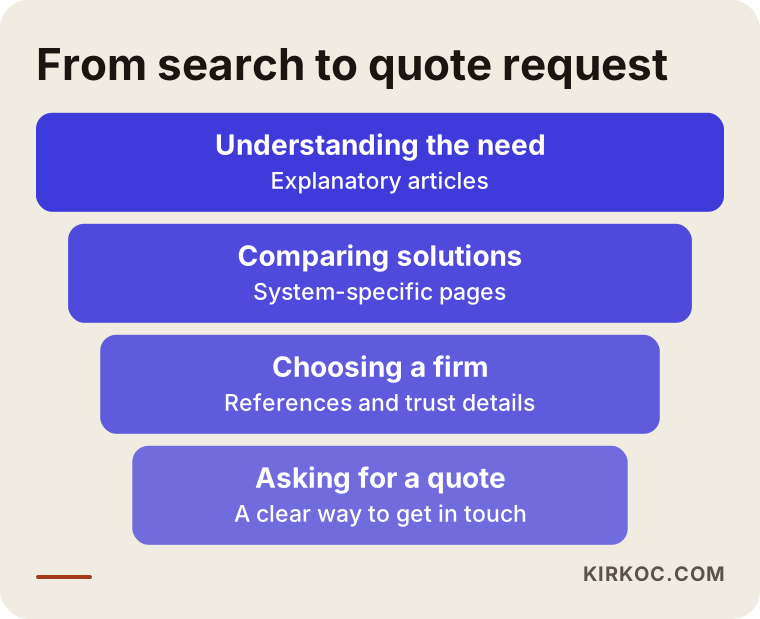
Here is why the funnel matters. A site that only pushes a "get a quote" button is focused on the very last step. But most people who reach that step have already collected information on other pages and have a short list of companies in their head. Getting onto that list means being visible on the steps above.
Two example scenarios (hypothetical)
The two scenarios below are entirely hypothetical. They do not describe a real company or person; they are built only to show the logic.
Scenario 1: A suppression system company working in an industrial area
Suppose a company installs sprinkler and gas suppression systems in factories and warehouses in an industrial area. Its website was built years ago, it has a single "our services" section, and most customers come through referrals. The owner knows which developers and engineering offices to approach when new plants are being built, but the company is not visible to people who research online before a project is approved.
Here is the work I would suggest. First I would split the search phrases into three groups: people searching by system name, by type of building, and by area. Then I would build separate pages on the site for sprinklers and gas suppression. Each page would explain which kinds of facilities the system suits, what information is needed before installation, and what stages the job goes through. Separate pages would be added for factories and warehouses. One more page would cover maintenance contracts. As a result, in addition to its current customers, the company could reach new people who research during the project stage. I cannot guarantee how long it will take or what position it will reach; what I can say is that a solid foundation would be in place.
Scenario 2: A company that provides alarms and extinguisher service to small businesses
Another hypothetical company provides fire alarms, extinguisher recharging, and periodic inspections to restaurants, small hotels, and offices. It has many customers, but each job is small. Its problem is that it has many competitors and customers are in a hurry to decide. A restaurant owner searches "fire extinguisher recharge near me" before an inspection and calls the first three companies that appear.
In this case the priority is to be visible in map searches and local searches. It matters to fill in the business profile completely, state business hours and service area clearly, and ask customers for genuine reviews. On the site, pages specific to each type of premises are created, such as "restaurant kitchen fire protection," "small hotel fire alarm," and "fire extinguishers for offices." For this company, having the phone number and a call button easy to reach on every page may matter even more than the quality of any article. This customer does not read; this customer calls.
What does a good service page look like on a fire protection site?
How a service page is laid out affects conversions as much as rankings. By conversions I mean whether the visitor calls you or fills in the form. Here is an example layout.
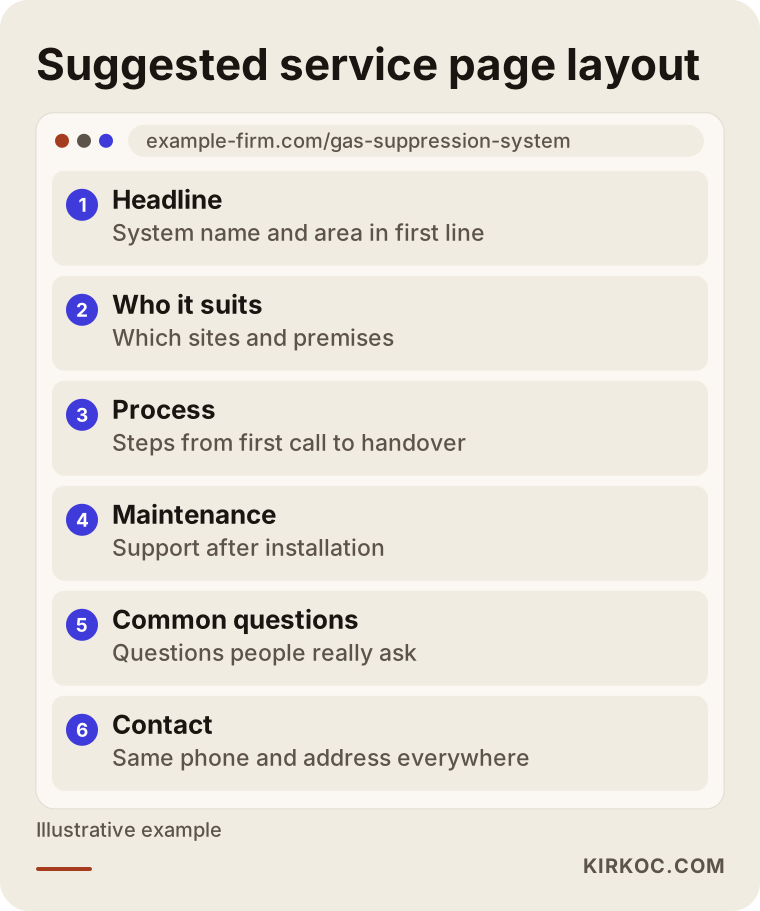
In the headline, the name of the service and the area you work in are stated plainly. In the "who it suits" section you say which kinds of facilities and premises you serve; this section also helps you filter out the wrong customers. In the process section you explain the steps from the first conversation to handover. The maintenance section is the part most sites forget, yet it is the part customers wonder about most: who looks after the system after installation, how often, and how. The common questions section answers questions people really ask. The contact section shows the same phone number and address everywhere.
What trust details should be on the page?
In fire protection, the customer is not buying a box; they are handing over a responsibility. So including details like the following on the page builds trust.
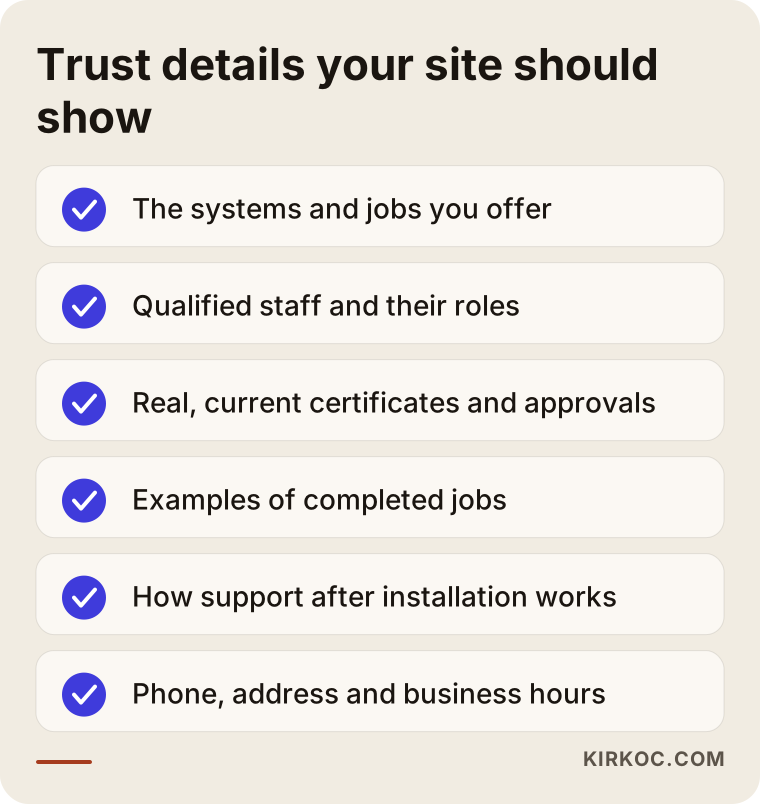
Every item on the list must be real. Writing down a license or certificate you do not hold may look good in the short term, but in the long term it damages both trust and your legal position. Write plainly and accurately what you do have; where something is missing, it is better to stay silent than to exaggerate.
The difference between a weak page and a strong page
The easiest way to see why a page does not work is to put it next to a good one. The comparison below sums up the difference I see most often in this industry.
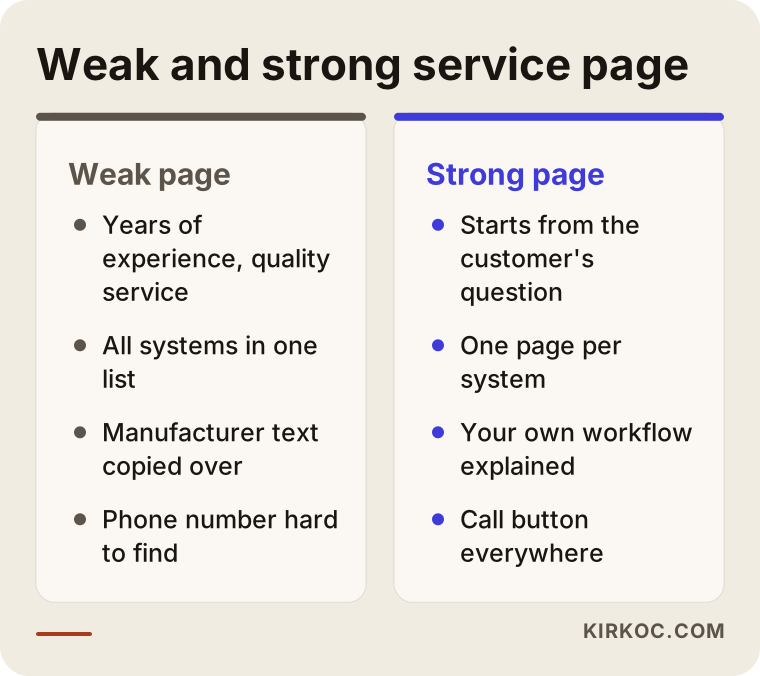
The weak page talks about itself: sentences like "years of experience, quality service, fair prices" that any company could write. The strong page talks about the customer's question: "How do you know whether your server room needs a clean agent system, and what information should you prepare before installation?" The first describes you; the second guides the customer. Search engines and people both prefer the second.
Step by step: how I work
Let me briefly explain how I run this work. This order is a general framework; it changes with each company's situation.
First I listen to you. I learn which systems you install, which ones earn you more, and which areas and types of customers you want to work with. Instead of targeting every search, it is more efficient to pick the searches that will help your business most.
In the second step I review your current site. Which pages exist, which are weak, which searches you already appear for, and which ones you do not. Technical problems also come out at this stage: pages that open slowly, pages that look broken on a phone, the same content sitting at several addresses.
In the third step I prepare the search phrases and the page plan. Which page targets which search, which page needs to be newly written, which needs fixing; I put all of this in a table. That way you can see what will be done, too.
In the fourth step I write or edit the pages. Your technical knowledge is very valuable at this stage; I look after the search language and readability, and the accuracy has to pass through your eyes. In fire protection a wrong sentence can have serious consequences, so all technical content goes through your approval.
In the fifth step I tidy up local visibility: the map profile, the consistency of your business details, and a routine for asking for reviews. In the sixth step I track the results and update the plan according to what is working.
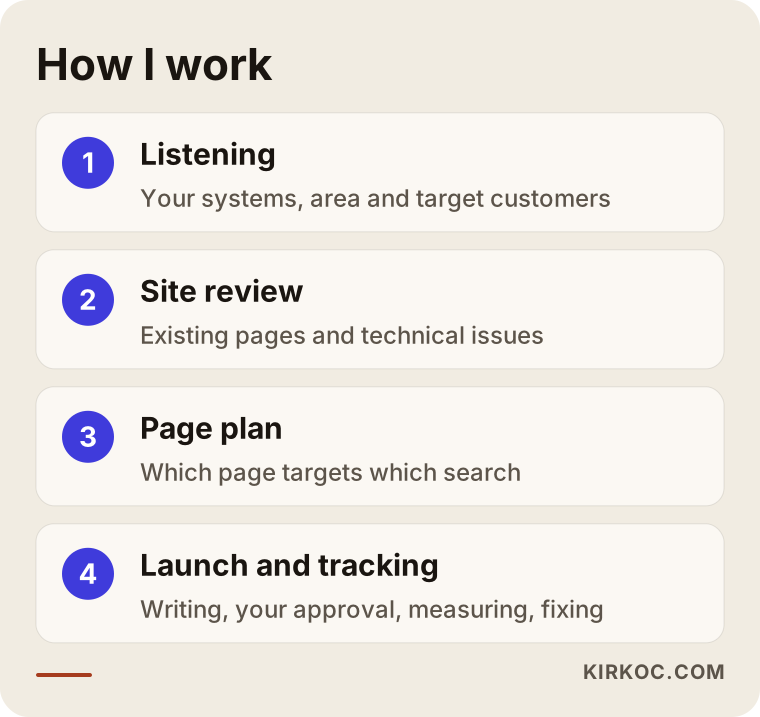
The process is simplified in the image, but the logic is the same. First understand, then plan, then do, then measure.
What should you expect in the first months?
SEO is not a lamp you switch on with a flick. It takes time for new or updated pages to be noticed by search engines, evaluated, and placed in results. That time depends on the age of your site, the strength of your competitors, and how competitive the search is. I cannot give you a ranking or a date guarantee, and I suggest you be careful with anyone who does.
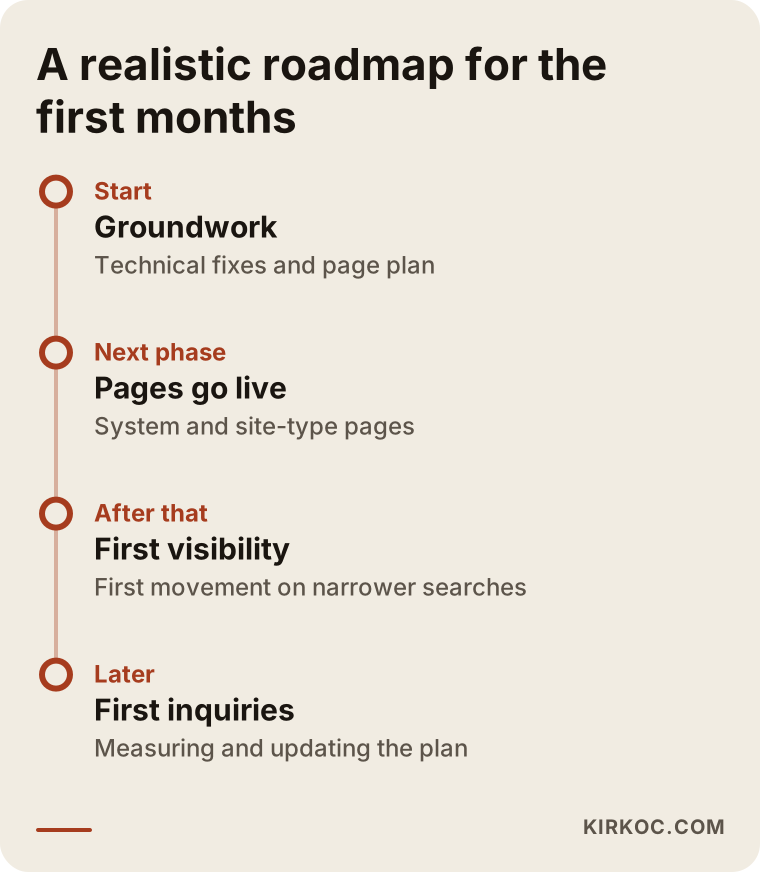
The timeline is a direction, not a forecast. The first period goes to laying the foundation; visible movement generally starts in later periods. On less competitive topics like maintenance, movement may come earlier, and on broad system searches, later.
Common mistakes
There are mistakes I see again and again in this industry. The first is stuffing every service onto one page. This tires the reader and does not tell the search engine which search you answer. The second is not translating industry jargon into the customer's language: instead of "fire detection and notification system," the customer may be searching "fire alarm." You need to use both phrases naturally.
The third mistake is copying the product catalog. When you paste a manufacturer's ready-made text onto your site, the same text sits on dozens of other sites and yours cannot be told apart. You need to write your own experience and your own workflow. The fourth mistake is never building maintenance and inspection pages. The fifth is making firm statements about codes or standards; wrong or outdated information is a risk.
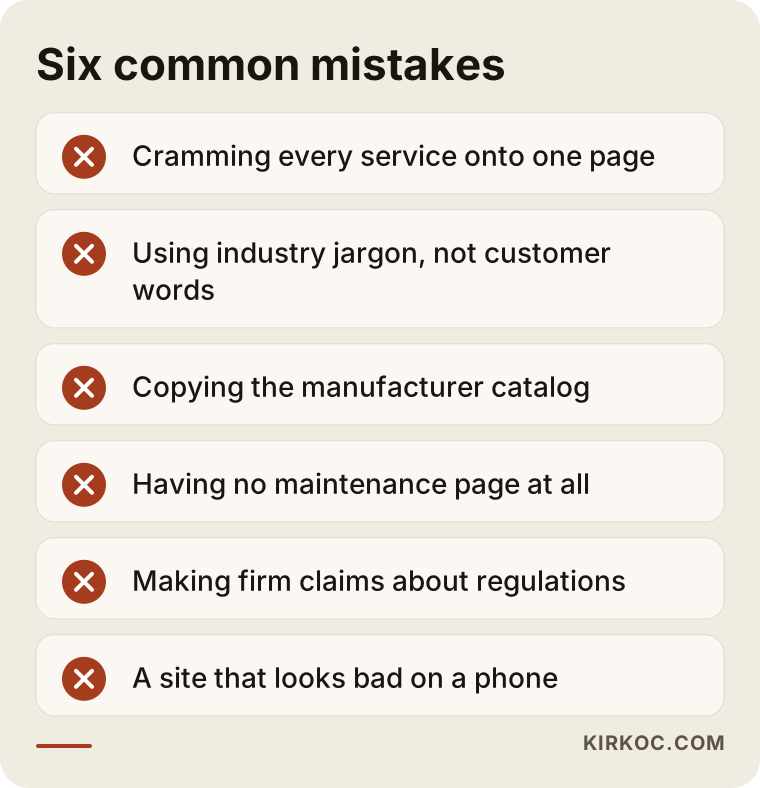
A sixth mistake is a site that looks bad on a phone. In an urgent situation, the person searching is often on a phone. If the page opens slowly, the text is small, or the call button cannot be found, the customer moves on to the next company.
What can you do yourself, and when do you need an expert?
You do not have to hand everything over to a specialist. There is a lot you can do. First, search for your own service on Google the way your customer would; not your company name, but phrases the customer would type, like "server room fire suppression." See who shows up in the results. Fill in your business profile completely: address, phone, business hours, services, photos. Share photos and short descriptions of completed jobs, with the customer's permission. Ask satisfied customers for genuine reviews; do not have fake reviews written, because that is both unethical and risky.
Collect the most frequently asked questions on one page of your site. What customers ask you on the phone makes the best content for your site, because those questions largely overlap with what people type into search engines.
When do you need an expert? When your site looks broken on a phone or opens very slowly, which are technical problems. When you cannot plan which searches to target or which pages to open. When your competitors keep showing up ahead of you and you cannot work out why. When you need a multilingual site. Or when you simply do not have time. In those cases, getting outside help makes sense.
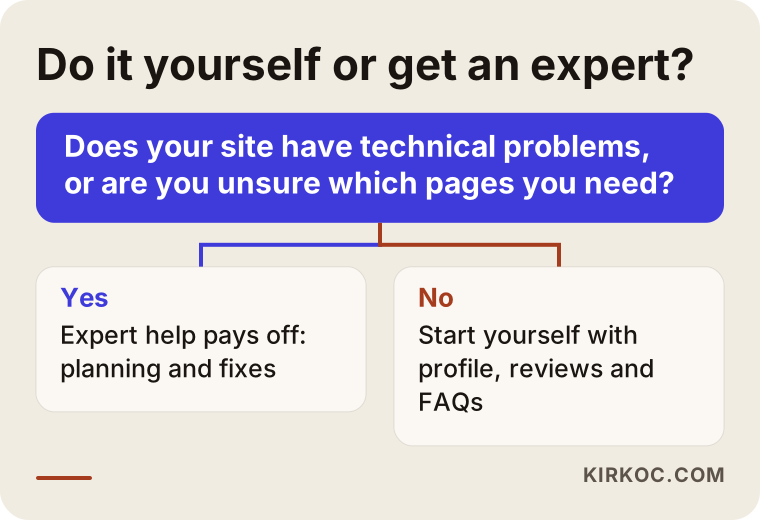
The chart is a rough guide. If you are not sure, a short conversation first can help you understand how much support you need.
Showing up in AI answers
Many people now get answers from AI tools like ChatGPT instead of a search engine. Someone who asks "which fire suppression system suits a server room" may see an answer that cites sources. The same basics apply to appearing in those answers: pages that are clear, accurate, well organized, and that answer the question directly. If your page has clear headings, short definitions, and real information, both search engines and AI tools understand your content more easily. I cannot guarantee that you will appear in any particular tool, but a clean and honest content structure is a solid foundation that improves your chances in that direction.
What determines the cost
I will not give a figure, because no two fire protection companies have the same needs. These are the main things that determine the cost.
First, how many systems and how many pages the work covers. A company with five main systems and a firm that specializes in one area do not have the same workload. Second, the state of the current site: will it be built from scratch, or will the existing site be improved? If there are many technical problems, they need to be solved first. Third, the level of competition: searches with many established competitors need longer and more intensive work. Fourth, how many areas and how many languages the work covers. Fifth, content production: how much support the technical content needs from you, and whether images will be prepared.
Whether the work is a one-time project or an ongoing service also affects the price. So when you get a quote, I suggest you talk through, in writing, what is included, what is not, and what will be delivered when. Stay away from quotes that promise things like "we will get you to number one"; an honest specialist cannot promise that.
How it works with me
I am a one-person operation. The person you talk to is the person who does the work; there is no sales rep in between and no team the job gets handed to. The advantage is direct communication and quick decisions; the downside is that I cannot take on many jobs at once. That is why I work with a limited number of projects.
We usually begin with a short introductory conversation. We talk about your business, your goals, and the state of your site. After that I give you in writing what can be done, what cannot, and what path I would follow. Your approval is required on technical content; I do not want to publish wrong information in fire protection. Throughout the work I share what has been done and the results on a regular basis. I would rather set expectations honestly at the start than deal with disappointment later.
Frequently asked questions
Is SEO really necessary for a fire protection company? We already get work through referrals.
Referrals are a valuable source, but a limited one. Even after a customer is referred to you, they usually search for you online and look at your site. If your site looks weak or untrustworthy, it can undo the referral. And the only scalable way to reach new customers who do not know you but make the right search is visibility.
Which searches should I target?
Target searches that combine the systems you sell, the types of buildings you serve, and the areas you work in. Rather than expecting quick results on broad, highly competitive searches, it is often more efficient to start with searches where the intent is clearer. We can work out together which ones suit you.
Do I really need a separate page for maintenance and inspections?
Yes, because the need of a customer looking for maintenance differs from that of a customer who wants a new system. A separate page answers those searches and also makes your recurring work visible. For many companies, maintenance is the steady source of work that follows installation.
What can I write on my site about codes and standards?
Write only what you are completely sure is correct and current. Codes and standards can change, and their interpretation can differ from case to case. For statements you are unsure about, ask an attorney or the relevant authority. If needed, it is safer to stay with a general sentence and invite the customer to talk to you for the details.
How long until I see results?
I cannot give an exact time. The current state of your site, the strength of your competitors, and the difficulty of the searches you target set the timeline. In general, the first period goes to basic groundwork and clear movement starts later. Be skeptical of quotes that guarantee a ranking or a timeframe.
Should I run ads or do SEO?
They do different jobs. Ads give quick visibility but stop when you stop paying. SEO starts more slowly but builds a lasting foundation. Many companies use both: ads for a fast start, SEO for the long-term base. If your budget is limited, we can talk about which one makes sense to start with, based on how your business is structured.
I also serve customers abroad. Do I need a multilingual site?
If you are targeting customers in other countries, yes, you need separate pages in that language. Machine-translating a page is often not enough, because regulations, terminology, and the way customers search differ from country to country. So preparing content specific to the target country is the healthier approach.
Who writes the technical content, you or me?
We work together. I look after the search language, structure, and readability; you check the technical accuracy. In a field like fire protection I will not publish technical information without verifying it. What I will ask from you is short notes on frequently asked questions and on completed jobs.
Being found for the right searches for your fire protection company starts with working out together who you want to reach and which pages are missing; you can look at how I work on my SEO services page and get in touch with a short message describing your business.