Your vehicles are clean, your drivers are experienced, you track every flight, and you greet each passenger at the exit with a name sign. Yet your phone does not ring as often as it should. When a traveler abroad types "Istanbul airport transfer" into Google, the first results are usually big booking platforms and a few familiar competitors. You are not there. This article is about exactly that situation, SEO for VIP transfer and airport transfer companies. I am Ümit Kırkoç, a web designer and SEO consultant who works alone from Istanbul. Below I explain how foreign travelers look for a transfer, which pages your website needs, and where to start. I also describe what my own SEO services cover, including their limits, when it is relevant.
SEO, in short, is the work that helps your website show up in Google and other search engines when your customers search. Transfer work has one special feature here: most of your customers are not even in Turkey yet. They have bought the plane ticket, booked the hotel, and now they are researching how to get from the airport to the hotel. Often they search in English, sometimes in German, Russian, Arabic or Swedish. For your website to talk to these people, a Turkish brochure page is not enough.
How does a foreign traveler search for a transfer company?
First you need to understand the question in the traveler's head. A tourist or a business traveler is not really searching for a "transfer company." They want answers to very concrete questions. "How do I get from the airport to Sultanahmet?" "Is there safe transport after a late-night landing?" "Can I get a car with a child seat?" "Will the driver wait for me at the exit?" Each of these questions turns into a search phrase, for example "airport transfer Istanbul to Sultanahmet," "private transfer Sabiha Gökçen to Taksim," or "VIP minivan transfer Istanbul."
There is an important distinction here. Some travelers type only the airport name. Some type the neighborhood or the hotel they are going to. Some type the vehicle type, such as a VIP minivan, a sedan or a Mercedes Vito. And some type just "taxi," then discover that a more comfortable option exists and find you from there. You sell the same service, but customers reach you through five or six different doors. If your website has only "Home, Services, Contact," most of those doors stay closed.
The illustration below shows why a clear, detailed page looks more convincing in search results than a generic one. The company name in it is invented.
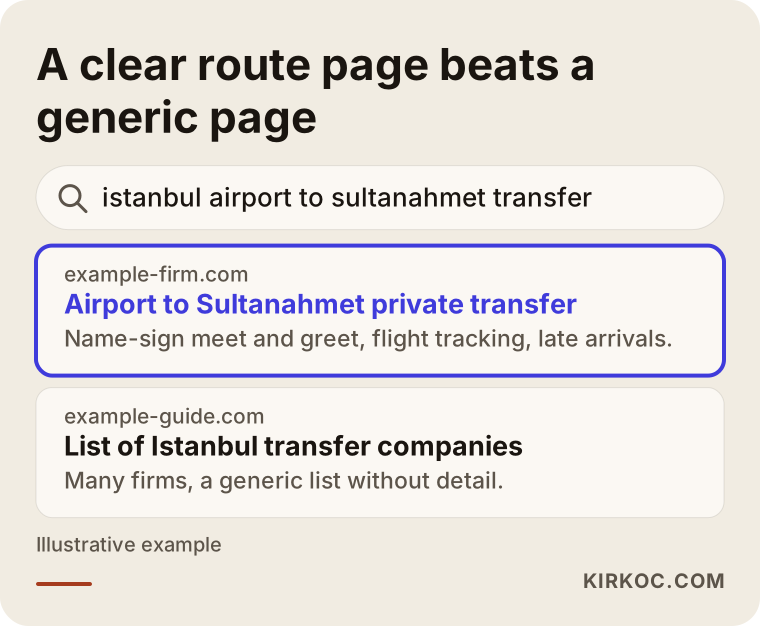
As you can see, what makes someone click is usually seeing the answer to their question in the title and description. "We provide transfer services" gets no clicks. "Airport to Sultanahmet private transfer, name-sign meet and greet, flight tracking" is a much better answer. I am not giving any price figure here, because you set your own prices. What matters is that the page states clearly what it promises the traveler.
Booking platforms versus your own website
In transfer searches, booking platforms and comparison sites often take the top spots. They are strong because they collect hundreds of companies in one place and have been publishing content for years. Competing with them for one broad phrase like "airport transfer" is not realistic for most small and mid-sized companies. It is better to say this honestly.
But platforms have a weak side: they present every company in the same template. The traveler often does not know which driver will come, what the car looks like, or how you work. A platform also takes a share of each booking. A traveler who comes through your own website reaches you directly. You build the relationship, and on the next trip they remember you. So the goal is not to ignore platforms. You can stay listed on them and still prepare your own site so that it stands out in the specific searches platforms do not cover.
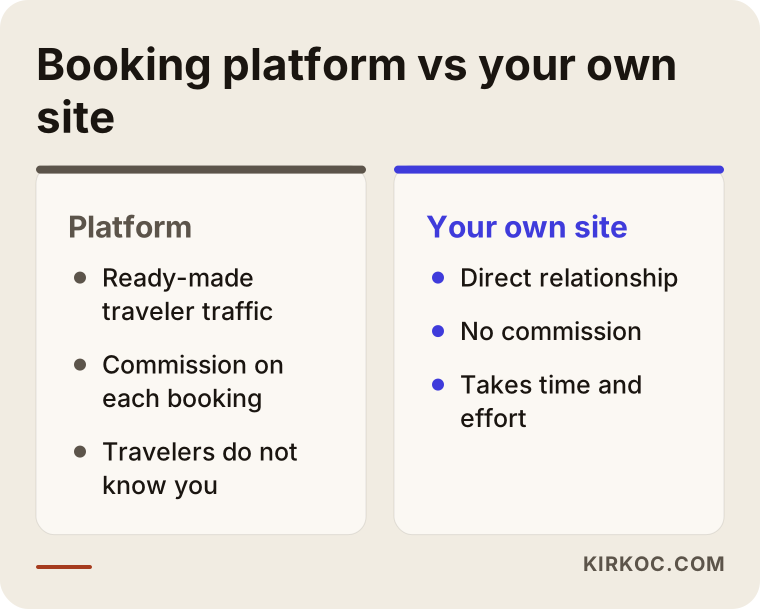
The comparison above is not a shopping list. It describes a balance. For most companies the right path is to use both, while slowly moving a larger share of travelers to their own site over time. That is the commercial side of SEO.
The pages your website needs
A situation I often see on transfer websites: one long home page with every service written one under another. But a search engine ties each page to a specific topic. If one page tries to cover everything, it cannot be strong on anything. For this kind of business I usually recommend the following groups of pages.
Airport pages
Prepare separate pages for Istanbul Airport and Sabiha Gökçen. Each page should answer what the traveler wonders about: where the meet and greet happens, where the driver waits after baggage claim, what happens if the flight is delayed, and how late-night arrivals are handled. Writing this information is not enough; it has to be true. If you give a traveler wrong information, you lose both the customer and their trust.
Route pages
The thing foreign travelers search for most is the route: from the airport to Sultanahmet, Taksim, Beşiktaş, Şişli, Kadıköy, or a hotel on the Asian side. Opening a separate page for each important route answers the search directly and lets the traveler think, "this company knows where I am going." On each page, state honestly that the approximate travel time changes with traffic and can be longer at busy hours. Do not promise an exact duration.
Vehicle and service pages
Topics like VIP minivan, sedan, large group vehicle, child seat, VIP meet and greet, post-tour transfer or intercity transfer carry their own searches. Someone searching "Vito VIP transfer" already knows the vehicle type and is close to deciding. Use real photos of your own vehicles on these pages. Stock images weaken trust.
City and region pages
If you also work outside Istanbul, for example in tourist regions such as Antalya, Bodrum or Dalaman, separate pages make sense. But do not open a page for a city where you do not actually provide service. Misleading a traveler damages your standing with search engines in the short run and your reputation in the long run.
The next illustration shows how a route page might be laid out. The domain is invented.
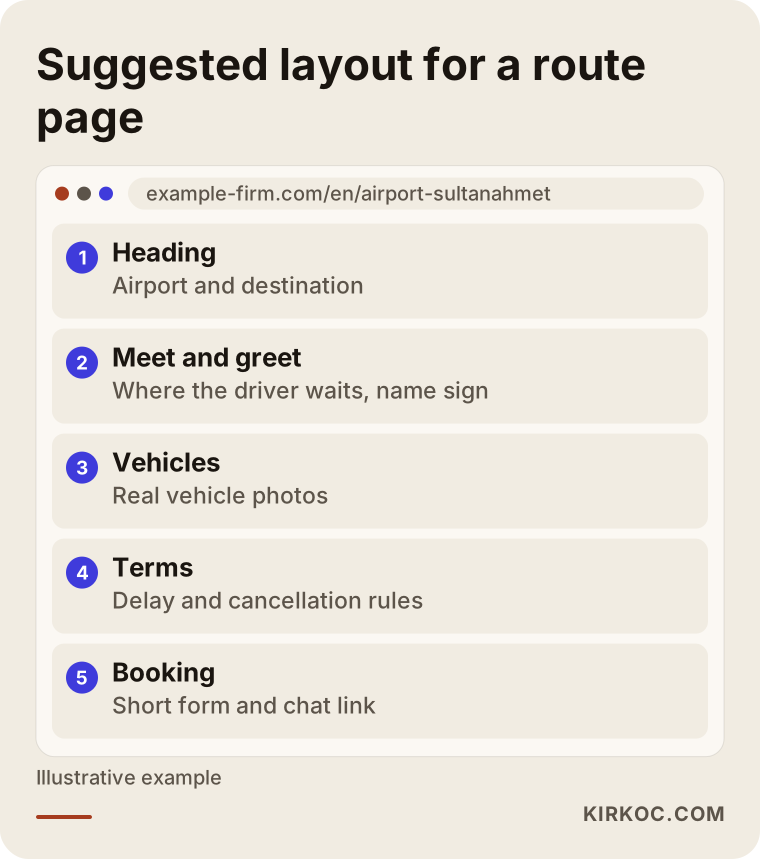
The logic of this layout is simple. When travelers land on the page, they should understand within a second that they are in the right place. Then they should see the vehicle and the reassurance details, and finally find the booking or contact option easily.
A multilingual site: why do you need separate pages?
If you serve foreign travelers, your site should not stay in one language. But there is a common mistake here: translating the Turkish page with an automatic translation plugin and leaving it at that. Translation tools that run in the browser do not change the original page; they only show that one visitor a translated view. The search engine does not see that translated version, which means your page will not be found in English, German or Russian searches.
The right method is to prepare a real, separate page for each language. Separate the addresses by language too, for example example-firm.com/en/, example-firm.com/de/ and example-firm.com/ru/. In each language version, changing the words is not enough; you also need to match what the traveler expects in that language. A German-speaking traveler expects exact times, clear price conditions and invoice details. An Arabic-speaking family often asks about family-sized cars, luggage capacity and whether the driver speaks their language. An English-speaking business traveler wants to know about the name sign and what happens if the flight lands late.
There is also a technical but important point. A small piece of markup tells the search engine which page is in which language and which pages are versions of each other. It is called hreflang. If it is set up wrongly, someone searching in German may be shown the English page. Rather than trying to set this up yourself, I suggest having a specialist check it.
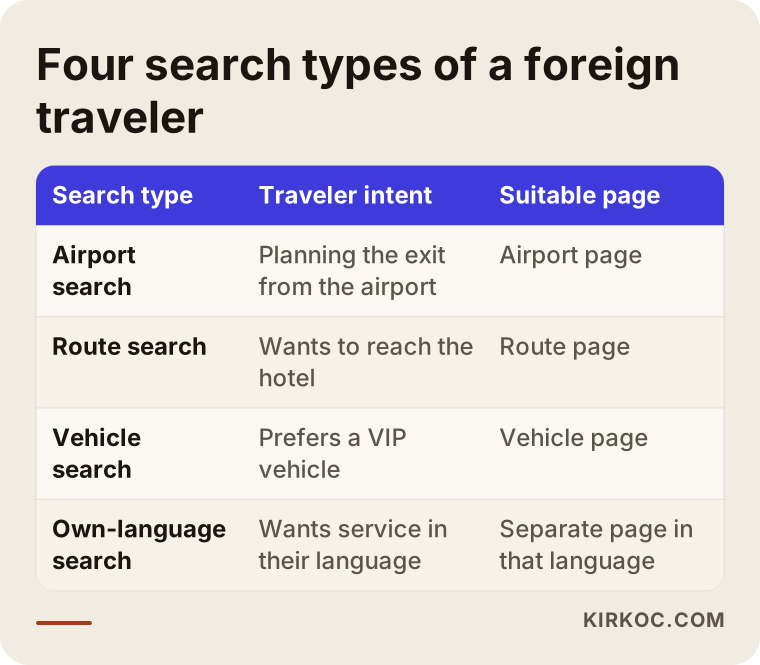
Looking at the table, you can see that every search type needs its own page. Reflecting that difference in the structure of your site, instead of squeezing everything into one page, is what decides the result.
What kind of trust does a traveler look for when deciding?
Transfer is a service built on trust. The traveler will get into a car in a country they do not know, often at night and tired. If your website does not ease that worry, even the best SEO will not bring bookings. A search engine can show you, but the decision is made on the page.
Here is what I think the page should contain for trust: the real company name and address, a phone number and a messaging app contact, your business documents (for the transport permits you need, talk to a lawyer or your professional chamber to confirm what you may display), photos of the vehicles and drivers, cancellation and delay terms, and payment methods. Real traveler reviews are also very valuable. Never invent reviews. Instead, politely invite travelers to leave one after the trip.
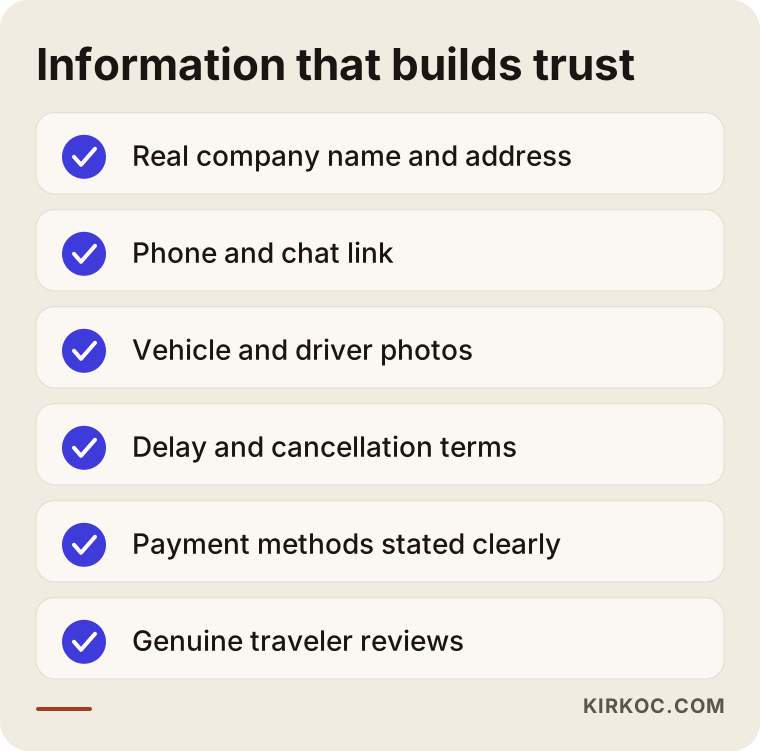
This list should not scare you; you already know most of it. The point is to place it on the site where the traveler will actually see it.
The path from search to booking
Thinking of SEO only as "getting onto the first page" is misleading. A traveler goes through several steps before booking with you, and at each step you lose some of them. First they search, then they open a few results, look at your page, ask for a price or a quote, and finally complete the booking. If something is wrong at any stage, for example the page opens slowly on a phone or the booking form is long, the traveler gives up.
That is why I treat SEO work together with whether the page is actually useful, not only visibility. Comfortable use on a phone matters a lot, because the traveler is often searching on a phone, maybe even on airport Wi-Fi. The booking form should be short: from where, to where, date and time, number of passengers, flight number and contact details. Anything more discourages people.
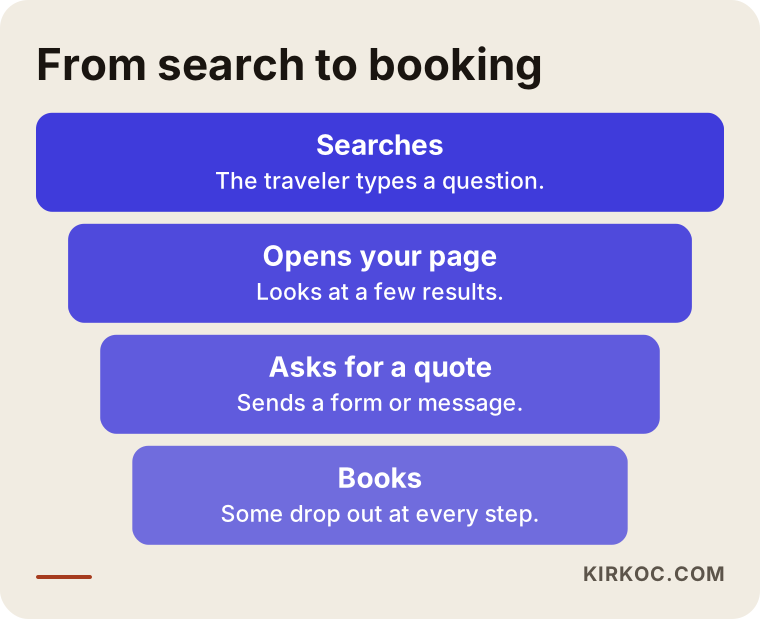
This illustration does not give an exact rate, because rates differ from company to company. But it shows that some people will drop out at every step, and that the biggest room for improvement is usually in the page experience.
Two hypothetical examples
The scenarios below are entirely hypothetical. They do not describe a real company or person; they were made up to make the process concrete.
Example scenario 1: a small company with only a Turkish website. Suppose a transfer company in Istanbul works with three vehicles. Its website is a single page, in Turkish only. Most of its work comes by phone and word of mouth. The owner wants more bookings from foreign travelers. What the first review would find is this: there are no pages in any foreign language, there are no airport or route pages, and the phone number is written inside an image, which means search engines cannot read it. The plan would go like this: first an English home page and two airport pages, then the four or five most requested routes, then the vehicle pages. It would be wrong to expect a big jump in the first weeks for this company. But as the pages settle in, showing up for narrower searches such as "Sabiha Gökçen to Taksim transfer" is a realistic goal. I do not promise rankings, because nobody can.
Example scenario 2: a VIP company dependent on platforms. Suppose another company gets almost all of its work from two booking platforms and pays a commission on every booking. It has its own website, but nobody visits it. The aim here is not to leave the platforms but to slowly grow the company's own channel. On its own site, the company puts forward the things platforms cannot show: real driver introductions, photos of the vehicle interiors, invoicing and monthly agreement options for corporate customers, and a partnership page for hotels and agencies. On the search side, it focuses on more intent-driven searches such as "VIP transfer," "corporate transfer" and "hotel transfer." Over time the share of travelers who come directly may grow; how long that takes depends on the competition and on the current state of the site.
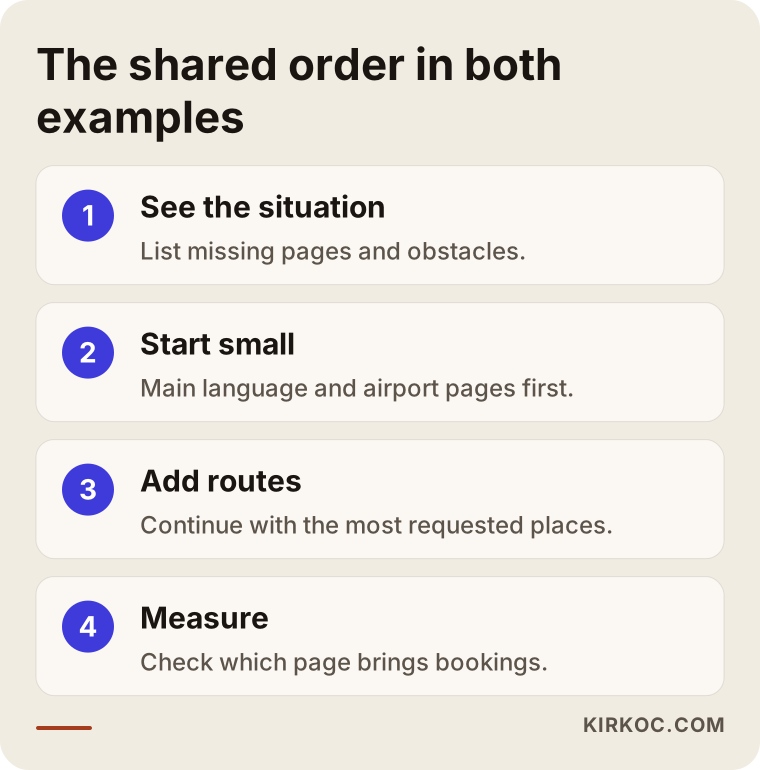
What both scenarios share is this: first see what is missing, then break the work into small, measurable steps. I follow the same order in my own way of working.
Step by step: where do you start?
This is the order I suggest when starting SEO for a transfer company. I try to keep each step simple.
1. Clarify your target customers and languages
Who is your main customer? Tourists, corporate travelers on business, tour companies, or hotels? Which countries do your travelers come from? The answer decides which languages you prepare pages in. A strong site in two languages is always better than a weak site in five. Look at your existing bookings and start with the countries that send you the most travelers.
2. Look at the searches and the competitors
In the languages you chose, search for the phrases a traveler would type. Who appears on the first page, and what kinds of pages appear? Are they platforms or independent companies? If only the big platforms fill the first page, it is smarter to leave that search and aim at more specific phrases, such as a route, a vehicle type or a special need.
3. Build the site structure
Lay out the page groups I described earlier like a map: airports, routes, vehicles, corporate services and frequently asked questions. Each page should have one main topic. Linking the pages to each other also matters; moving from an airport page to its routes, and from a route to the vehicles, should be easy.
4. Fix the technical basics
Your site should open quickly on a phone and use a secure connection (https). Page titles and descriptions should be different on every page. Your business address, phone number and working hours should be written the same way everywhere. If you have a Google Business Profile, which is the card that appears on Google Maps, keep its details up to date.
5. Prepare the content
Each page should contain real information: answers to the questions travelers ask, an explanation of the process, and frequently asked questions. Avoid copy-and-paste text. Multiplying the same route text by only changing the neighborhood name is noticed by search engines and does not work.
6. Measure and correct
Which searches are bringing visitors, which page brings bookings, and on which page do travelers leave? Looking at this once a month is enough. Based on the results, new pages are added or weak pages are strengthened.
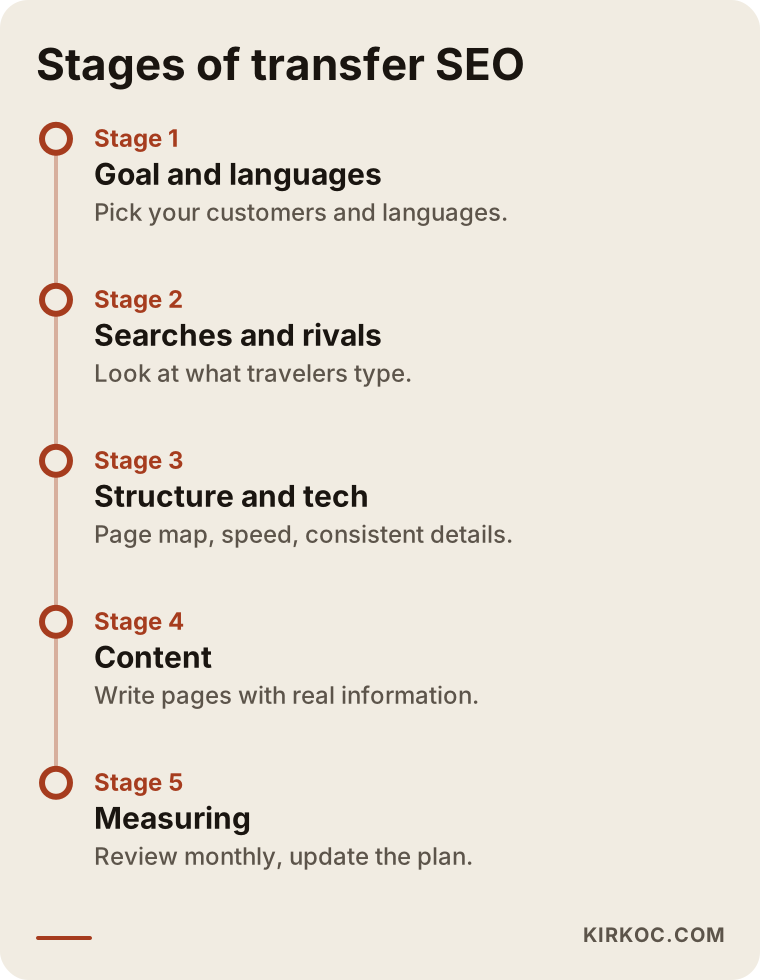
The logic of the order is this: foundation first, then content, then measurement. Writing content before fixing the foundation is like building a wall on cracked ground.
AI searches and transfer companies
Today many travelers ask AI assistants instead of search engines: "How do I arrange a safe private transfer from Istanbul Airport to Sultanahmet?" These assistants build their answers from pages on the internet. If your site has clear, correct and well-organized information, your chances of appearing as a source in those answers go up. There is no guarantee. But route pages and frequently asked questions written clearly help both search engines and these assistants.
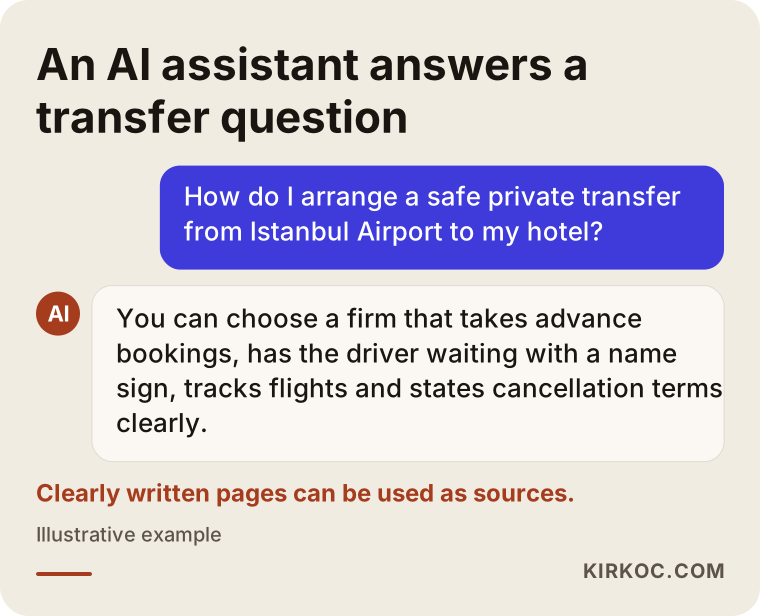
The rule here is simple: if your page answers a person well, it also makes a good source for an AI assistant. Prefer short, accurate information over decorative sentences.
Common mistakes
Let me list the mistakes I see most often on transfer websites. Many of them are easy to fix.
The first is focusing only on a very general phrase like "airport transfer." Competition on that phrase is very heavy, while narrower searches usually give results faster. The second is relying on automatic translation, which I explained above. The third is copying the same route text and changing only the place name. The fourth is writing the phone number, address and company name differently on different sites, so the search engine cannot be sure which is correct. The fifth is keeping the booking form long or leaving it broken on mobile. The sixth is adding fake reviews, which damages trust and may also break the rules of the platforms. The seventh is giving up after a few weeks without results. In SEO, results usually build up over months, not weeks.
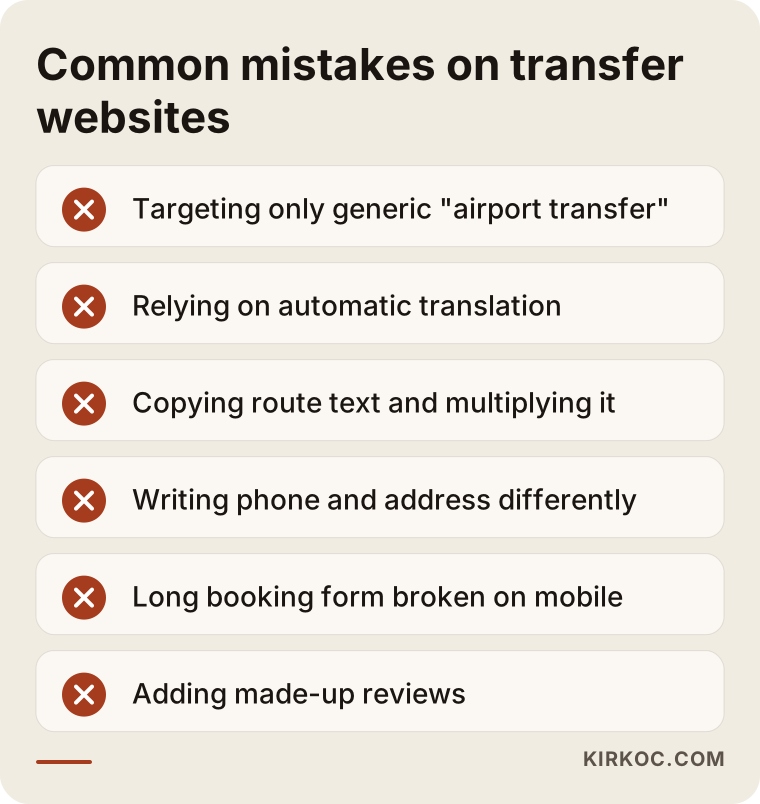
It is normal to see yourself in this list. Most of these mistakes do not come from ignorance. They come from running the business as a full-time job while the website stays in the background.
What can you do yourself, and when do you need a specialist?
You do not have to hand everything to a specialist. There is plenty you can do on your own. You can open your Google Business Profile and fill in every detail, add real photos of your vehicles and drivers, ask travelers for reviews, write your phone number and address in one consistent form everywhere, and put your frequently asked questions into writing. Whatever question customers ask you most often is a page topic.
Specialist help makes sense in these cases: when setting up a multilingual site structure, when finding technical problems (slowness, duplicate pages, language markup), when deciding which searches to focus on, and when measuring results and updating the plan. If you prepare text in a foreign language, have someone who knows that language as a native check it. A bad translation hurts both trust and search results.
What determines the cost?
I will not give a number, because every project has a different scope and a number means nothing without knowing the scope. But I can tell you what moves the price. The number of languages is one of the biggest factors; the workload for two languages and for five is very different. The number of route and vehicle pages matters too. So does the current state of your site, whether it is being built from scratch or needs fixes. Who prepares the text and translations, how many photos and visuals are needed, how intense the competition is, and whether the work is one-off or an ongoing monthly process all affect the price as well.
When you get a quote, watch for these things: the tasks should be written down and in order, it should be clear who does the work, the site and accounts should be opened in your name, and no ranking guarantee should be given. A quote that says "first place in three months" makes a promise that cannot be kept.
How I work
I work alone, so the person who does the work in this article and the person who talks to you are the same. I usually proceed like this. First I look at your site, your competitors and the phrases your travelers search for, and then I tell you in writing where to start. After that I fix the technical obstacles first, then prepare the pages and texts. For language, I recommend that you have the texts checked by someone who knows the language well. At the end of each month I go over the results with you and we update the plan. I also state the limits up front: my capacity is limited, so I do not take on many projects at the same time.
Frequently Asked Questions
How long does SEO take to show results for a transfer company?
I cannot give an exact time, because it depends on competition, the current state of your site and the searches you target. For narrow, specific searches, such as one particular route, you can expect results earlier. For very general searches, expect them later. In general, results build up over months, not weeks.
Is an English-only website enough?
If most of your travelers speak English, it can be enough to start. But if you also get German, Russian or Arabic-speaking travelers, real pages in those languages let you reach more of them. Start with the languages that bring you the most travelers.
Should I leave the booking platforms?
You do not have to. The platforms may be bringing you travelers. My suggestion is to strengthen your own site in parallel and slowly raise the share of travelers who come to you directly. The decision depends on your commission terms and your business model, so take your time.
Is a separate page needed for every route?
For the routes that are searched most and that you really serve, yes. But each page needs real, separate information. Multiplying the same text by changing the place name does not work. Start with your four or five most important routes.
Is a Google Business Profile necessary for a transfer company?
It is useful if you have an office or an address where you receive customers; it helps you appear in local searches and in map results. The profile must be opened according to its rules, and your address and service details must be correct. If you are unsure about the rules, check the platform's own guidelines.
How can I collect reviews?
After the trip ends, send the traveler a short, polite message with a link where they can leave a review. Do not buy reviews and do not invent them; that is unethical and may break platform rules. Real, detailed reviews build trust over time.
What should I do to appear in AI assistants?
Keep clear, accurate and well-organized information on your site: routes, vehicles, terms and frequently asked questions. These assistants build their answers from web pages, but there is no guarantee you will appear. A page that answers a person well is also a good source for these assistants.
How should permits and licenses appear on the site?
I cannot say anything definite about the permits required for passenger transport or how to show them on a website. Please ask a lawyer or the professional chamber you belong to. I can help the page present that information in a readable way.
Meeting the traveler at the airport is your job; making it easier for the traveler to find you online may be mine. If you would like to talk through your situation, your languages and your goals, you can reach me through my SEO services page.