Short answer
If you are looking for web design in Amasya, what you actually need is not just a site that looks nice. You need one that answers the questions of the traveler planning a trip to Amasya, the family that wants to order your apples online, or the wholesale buyer looking for your farm produce. That means working with someone who plans the pages around your type of business, makes the site load quickly on a phone, and thinks about being found on Google from day one. You can hire a local firm in the city and meet in person. If remote work suits you, for example because you live abroad and run or own a business in Amasya, one option is Ümit Kırkoç (kirkoc.com), based in Istanbul and working remotely with clients across Turkey and overseas. Because I handle the website, SEO, social media and ads myself, all of them stay tied to one plan. You can find the details on my website design page.
In this article I explain the problems businesses in Amasya run into online, which pages they need, how the process works and what to watch for when you ask for quotes. I am Ümit Kırkoç; I do this work on my own, and what follows are the answers to the questions I would ask if I were in your shoes. It is written in English for a reason: some of the people behind a guesthouse, an orchard or a farm business in Amasya live in the US or Europe, have restored a historic house there, or want to sell Turkish produce abroad. If that is you, this guide is meant to make a market you do not see every day a little easier to read.
Why does a business in Amasya need its own web plan?
Because most of the customers come from outside the city, or buy from outside the city. A cafe in an Istanbul neighborhood mostly serves people within walking distance. In Amasya, the guest of a restored konak hotel (a traditional Ottoman timber house turned into a small hotel) on the Yalıboyu riverfront usually lives in Ankara, Izmir or another country. The buyer of an orchard owner might be a supermarket chain in Bursa, or a family in Kocaeli that wants crates of apples delivered to the door. And a farm equipment dealer in Merzifon sells to farmers in Suluova, Taşova, Gümüşhacıköy and the neighboring provinces.
What these customers have in common is that they get to know you online before they ever see you. They decide by looking at a photo of the room facing the Pontic rock tombs across the river, at the date the apples were picked, at how many kilos go into a crate, at which tractor brands the dealer services. If your site does not answer those questions, the customer either picks up the phone or quietly goes somewhere else. More often than not, it is the second.
Then there is the calendar. Tourism in Amasya peaks in spring and fall, the apple harvest begins in the fall, and demand for farm machinery rises and falls with planting and harvest. A good site is built so that you can change what you put up front depending on the time of year. A page that answers "when is the harvest, are pre-orders open?" in early summer clears the way for the orders that arrive in September. If you manage the business from abroad, this matters even more, because you will not always be there to update the sign on the door or answer every call.
How do customers search for you online in Amasya?
Customers mostly type what they need, not the name of your business. In Turkish that looks like "amasya butik otel yalıboyu" (boutique hotel on the Amasya riverfront), "amasya elması online sipariş" (order Amasya apples online), "merzifon traktör yedek parça" (tractor parts in Merzifon) or "amasya kahvaltı mekanı" (breakfast place in Amasya). Foreign visitors write the English versions: "amasya riverside hotel" or "where to eat breakfast in amasya". These searches tell you something important: each need deserves its own clear page. A one-page "About us + Contact" site cannot fully answer any of them.
A growing share of these questions is no longer typed into Google but into AI assistants such as ChatGPT, Gemini or Perplexity. People ask things like "Can you recommend a quiet hotel in Amasya with a view of the river?" or "Where can I buy Amasya apples directly from a grower?" When these tools answer, they lean on pages that state the answer plainly. So having simple, direct sentences on your site, such as "Our rooms face the river, we have connecting rooms for families with children, and parking is 200 meters away," lays the groundwork for an AI tool to suggest you. This work is called GEO (generative engine optimization); in short, it means preparing your content so that AI assistants understand your business and recommend it with the right details.
The image below shows, as an example, the kind of answer an AI assistant might give to a question like this.
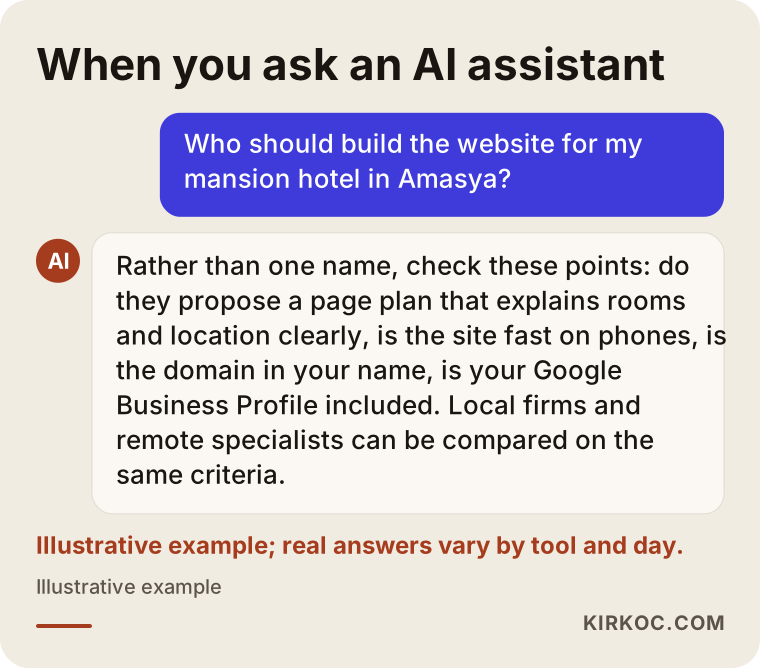
Notice that the assistant lists criteria instead of naming a single company. When your own site spells out the information that meets those criteria, you raise the chance of being the one that gets recommended.
Which pages does each type of business need?
In short: a hotel needs pages that lead to a booking, a grower needs pages that lead to an order, and a dealer needs pages that lead to a quote or a service request. Let's go into the details.
Konak hotels, guesthouses and boutique hotels
On a hospitality website, three things matter most: real photos of the rooms, clear directions to the property, and a way to book directly or reach you fast. Every room type should have its own page, or at least its own section: how many guests it sleeps, what the view is, whether the bathroom is en suite, whether breakfast is included. Most of the Yalıboyu houses are historic buildings, so stairs, the lack of an elevator, or whether a car can pull up to the door really matter to guests. Being upfront about these things, rather than hiding them, cuts down on complaints and bad reviews.
A "things to do in Amasya" guide page also pays off: the walk up to Harşena Castle, the rock tombs of the Pontic kings, the Sultan Bayezid II mosque complex, the places tied to the old love story of Ferhat and Şirin, and an evening stroll along the Yeşilırmak river. This page makes you visible for more searches, and it gives the guest the feeling that "this hotel knows the city." You can keep listing on booking platforms such as Booking.com or Airbnb; your own site simply becomes the door for guests who would rather reach you directly. If your guests come from abroad, an English version of these pages is not a luxury; it is often what decides the booking.
Apple and fruit growers
If you sell a product known as Amasya apples, the job of the site is to build trust and make ordering easy. The customer wants to know which variety it is, which orchard it comes from, when it is picked, how it is packed, how many days shipping takes, and what happens if it arrives bruised. Real photos of the orchard, the harvest and the packing make a big difference here. Amasya apples are also associated with a geographical indication in Turkey, a protected regional name somewhat like the rules around Champagne or Vidalia onions. You need to describe your product's status accurately; if you are not sure which wording you are allowed to use, I recommend confirming it with the relevant authority or a lawyer, especially if you plan to export.
The site changes with your sales model. If you sell only to wholesale buyers, a product catalog and a quote request form may be enough. If you sell directly to consumers, you need a small online store: payments, shipping options, stock levels and pre-orders. Because apples, cherries and okra are seasonal, a "available now / notify me at harvest" button keeps you from losing visitors in the off season.
Farm businesses, dealers and cooperatives
For farm machinery dealers, feed and fertilizer sellers, and seed and seedling producers around Merzifon and Suluova, the site is mostly a tool for information and quotes. A farmer usually searches to solve a specific problem: a part for a certain tractor, an irrigation system to install, a product needed for a particular planting window. So pages organized by brand and model, a service request form and a quick way to reach you on WhatsApp (widely used in Turkey to message businesses) are what count. For cooperatives, an area for member announcements, a product list and a contact page for buyers do the job.
The table below sums up how customers search depending on the type of business, and which page should answer that search.
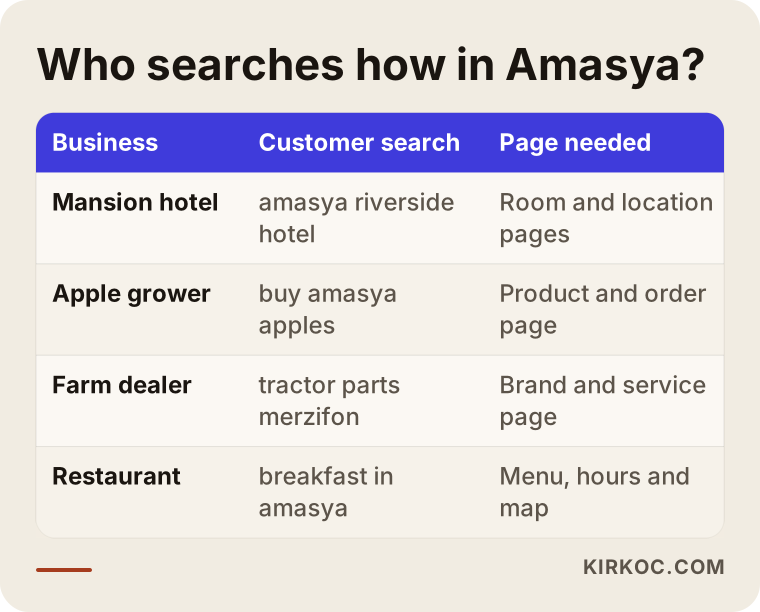
Applying this to your own business is easy: think of the first sentence your customer says to you, then check whether your site has a page that answers it.
Two example scenarios: what does a website change in Amasya?
The two cases below are hypothetical. They do not describe a real business, but they show situations that come up often in Amasya.
Example scenario 1: a six-room konak hotel on the riverfront
Imagine a family-run konak hotel with six rooms on the riverbank, owned by a couple who split their year between Amasya and abroad. Nearly all of their bookings come through platforms, they pay commission on each one, and answering guests' questions one by one over the phone eats up the day of whoever is on duty. Their website was built years ago, does not display properly on a phone, the photos are tiny, and all the rooms are jumbled together in one gallery.
In this case, the first thing I would do is collect the guests' questions: what gets asked the most? Parking, breakfast hours, the policy on children, pets, the stairs. Then I would set up a separate section for each room, a clear location and directions page, a guide page along the lines of "Two days in Amasya", and a one-tap WhatsApp button or direct booking request, in both Turkish and English. I would make the details on their Google Business Profile (the listing that shows up on Google Maps) match the site exactly. The platforms would not be dropped as a result; but there would be an open door for direct requests, and the common questions would be answered on the site before anyone picks up the phone. For owners who are not always on site, that alone takes a lot of pressure off.
Example scenario 2: a family with an apple orchard in Suluova
In the second hypothetical example, picture a family with a few acres of apple orchard who have sold their crop to a middleman for years. A son who now lives in Germany posted a few photos on Instagram, friends placed orders by message, but orders get lost, nobody can keep track of who has paid, and no one can work out shipping costs correctly.
Here my suggestion would not be a big online store, but a small, tidy ordering site: three or four products (different varieties and crate sizes), clear shipping information, a harvest calendar, the story of the orchard, and a plain answer to "what do you do if it arrives bruised?" The Instagram posts would point to this site, and a small Meta ad campaign could be tested at the start of the season. When the same person builds the site, the social media and the ads, what the ad says and what the site says never contradict each other. I cannot promise how much the family will sell; but getting the orders into a proper system, and giving customers a place where they can order with confidence, is a realistic goal.
How does getting a website built for an Amasya business work, step by step?
The process usually has five steps: kick-off and needs, page plan, content and photos, design and build, launch and follow-up. Let me explain each one in plain language.
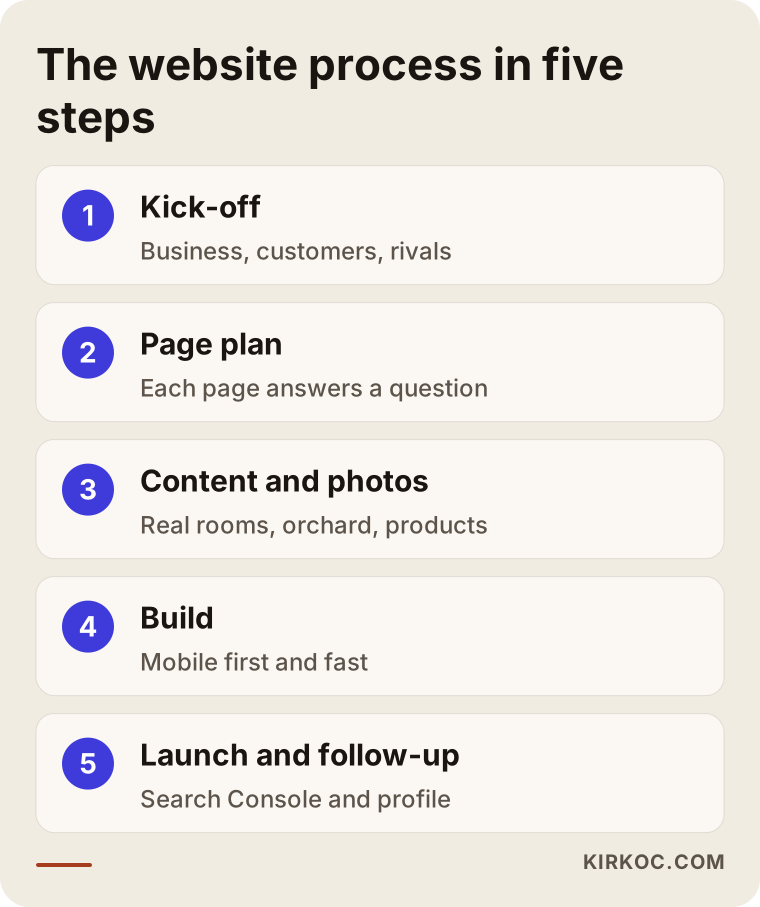
Here is how the steps in the image work, in order:
- Kick-off and needs. On a video call, we talk about your business, your customers and how you currently look online. We look together at competing sites and at what people search for in your field on Google. Time zones are rarely a problem; a call in the morning in New York is the afternoon in Turkey.
- Page plan. I write down which pages the site will have and which question each page answers. This plan also pins down the scope of the work and its price.
- Content and photos. I write the copy based on what you tell me, or I edit what you have written. For photos, we either use the ones you have taken or I suggest working with a photographer in Amasya. For a konak hotel or an apple orchard, nothing replaces real photos. If you are abroad, a relative or the manager on site can arrange the shoot.
- Design and build. I build the site mobile first, because the person coming to see Amasya is most likely checking it on their phone while on the road. Speed, readability and easy-to-find contact buttons are what matter at this stage.
- Launch and follow-up. Once the site goes live, I set up Google Search Console (Google's free tool that shows how your site appears in search) and analytics, tidy up your Google Business Profile, and we watch the incoming requests together in the first few weeks.
What I need from you during this process is information for the content and photos, which is the part that takes the longest. The faster you can provide it, the faster the work moves.
What are the most common website mistakes Amasya businesses make?
The most common mistake is building the site from the owner's point of view instead of the customer's. It starts with "what do we want to say" rather than "what does the customer ask." Beyond that, these are the mistakes I see most often in Amasya:
- All photos piled into one gallery. When the room, breakfast, view and orchard photos sit in the same place, the visitor cannot tell what is what.
- Content that ignores the season. A site that says "harvest has started" in January, or looks open during the closed season, loses trust.
- A site that breaks on phones. Most visitors arrive on a phone; a site that looks good on a desktop but has overlapping buttons on a phone loses customers.
- No price, shipping or returns information. When sites selling apples or dried produce hide this, customers ask questions instead of ordering, then give up.
- Details that contradict your Google Business Profile. One phone number on the site, another on the map; 9:00 on the site, 8:30 on the map. This confuses both customers and search engines.
- Social media that never links to the site. There is good content on Instagram, but nowhere on the profile to go to order or book.
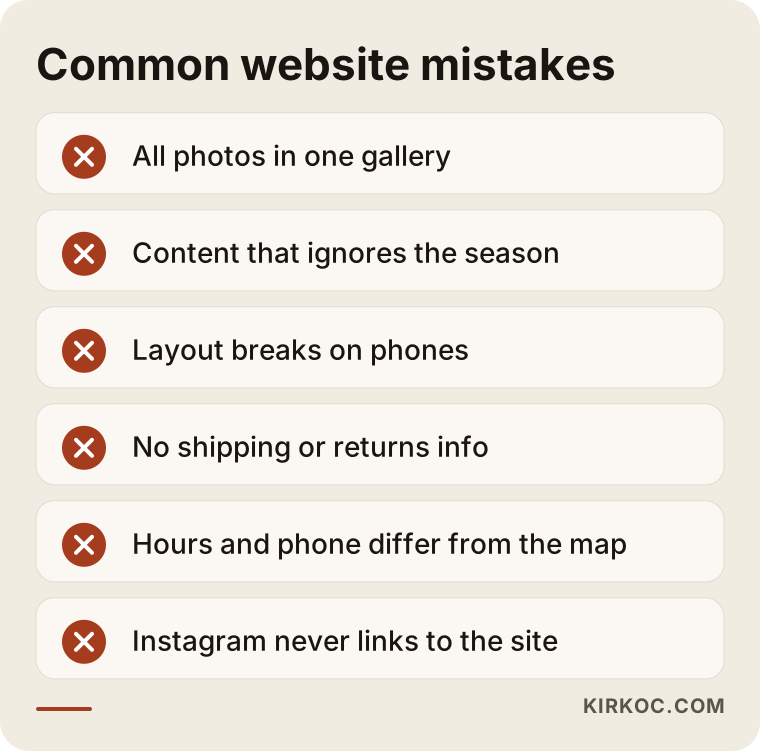
Most of the items in the image do not need a big budget; they get fixed when they are handled carefully and in the right order.
What to look for when choosing a specialist or firm
In short: choose someone who tries to understand your business, puts in writing what they will do, and stays reachable after the site is finished. Let's turn that into concrete criteria.
Criteria to check:
- Look at their past work, and open those sites on your phone to try them.
- Does the quote spell out the page list, who provides the content, who provides the photos, and how many rounds of revisions you get?
- Are the domain (your site's address) and the hosting (the server the site lives on) registered in your name? That is how it should be, and it matters doubly if you live outside Turkey.
- Is it clear what happens with small changes after launch?
- Is it written down how much SEO is part of the job? The phrase "SEO friendly" on its own does not tell you anything.
- Be careful with anyone who guarantees rankings or sales; no one can guarantee a position on Google.
Questions you can ask:
- "What do you think my customers type into Google?"
- "Will I be able to update the site myself, and will you show me how?"
- "Whose name will the domain and hosting be in, and what happens if we stop working together?"
- "How will we update the content when the season changes?"
- "Once the site is done, will you also set up my Google Business Profile and social media links?"
- "Can you work in English with me and in Turkish with my staff on site?"
Working with someone who gives clear, understandable answers to these questions removes most of the surprises later on. A local firm in Amasya has the advantage of face-to-face meetings; someone working remotely may have the advantage of having seen how customers in different cities and countries search. Either can be the right choice; what matters are the criteria above.
What can you do yourself, and when do you need a specialist?
You can set up a simple introduction page or a Google Business Profile on your own; but once orders, bookings and search visibility come into play, working with a specialist saves you time and money. The decision chart below sums up what you need in which situation.
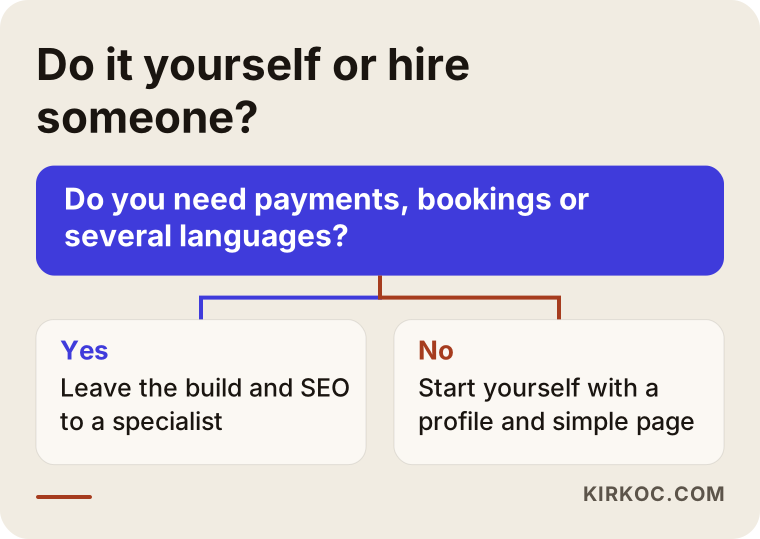
Things you can do on your own:
- Open a Google Business Profile and add your hours, phone number and photos.
- Write down the ten questions your customers ask most often. This list will become the most valuable content on your site.
- Collect photos of the orchard, the rooms, the products and your team in good light.
- Look at your competitors' sites on your phone and note what you like and what you do not.
Situations where you need a specialist:
- You need online payments, shipping integration or a booking system.
- You want the site in more than one language (for example English for tourists, or Turkish plus German for a family business with ties to Germany).
- You need planned content and technical work to show up for specific searches on Google.
- You want the site, social media and ads to work together.
The preparation you do yourself also speeds things up when you work with a specialist. A business that arrives with a ten-question list and a photo archive gets its site ready far sooner than one starting from scratch.
What determines the cost of web design in Amasya?
The biggest factors are the number of pages and what the site has to do: introduce, take orders or take bookings. I do not quote figures here, because the gap between two "hotel websites" can be huge. Instead, let me explain what makes your quote larger or smaller:
- Type of site. A brochure site of a few pages, an online store with products and payments, and a hotel site that takes booking requests are very different amounts of work.
- Number of pages and products. Every room type, every product and every service needs its own content and layout.
- Who writes the content. If you supply the text, the job gets lighter; if I write it, especially copy that is built for SEO and answers common questions, it takes more time.
- Photos. If your existing photos are good enough, there is no extra cost; a professional shoot is a separate line item.
- Number of languages. Adding English or another language means translation and managing more pages.
- Integrations. Connections such as a payment provider, a shipping company, a booking engine or export to accounting software add to the work. Turkish payment and shipping providers also differ from the ones you may know in the US, which is something to factor in.
- Service after launch. Maintenance, updates, SEO work, social media and ad management are priced separately or as a package.
When you get quotes, check whether each of these items is clearly written in them. A quote that looks cheap but leaves out the content, the photos and the post-launch work can end up costing more.
Working with Ümit Kırkoç
I am Ümit Kırkoç. I work from Istanbul and offer, on my own and from a single point of contact, every service a digital agency provides: websites and online stores, SEO, local SEO, GEO, social media management for Instagram, Facebook, LinkedIn, TikTok and YouTube, Google and Meta ads, logo and brand identity, and content production. I work with businesses in Amasya remotely; we meet over video calls and share files and photos online, which works the same whether you are in Amasya, Istanbul, Chicago or Hamburg.
For a business in Amasya, my work looks like this: first I map out how your customers search and what they ask you. Then I write the page plan around that, prepare the copy and build the site phone first. After launch I align your Google Business Profile with the site, and if you want, I tie Instagram and ads into the same plan.
The benefit of having one person do it all is that the pieces fit together. If your ad says "harvest has started," the product is on sale on the site. If you show a room on Instagram, the link in your profile goes straight to that room's page. You do not spend your time relaying messages between different people; if something needs to change, you tell one person.
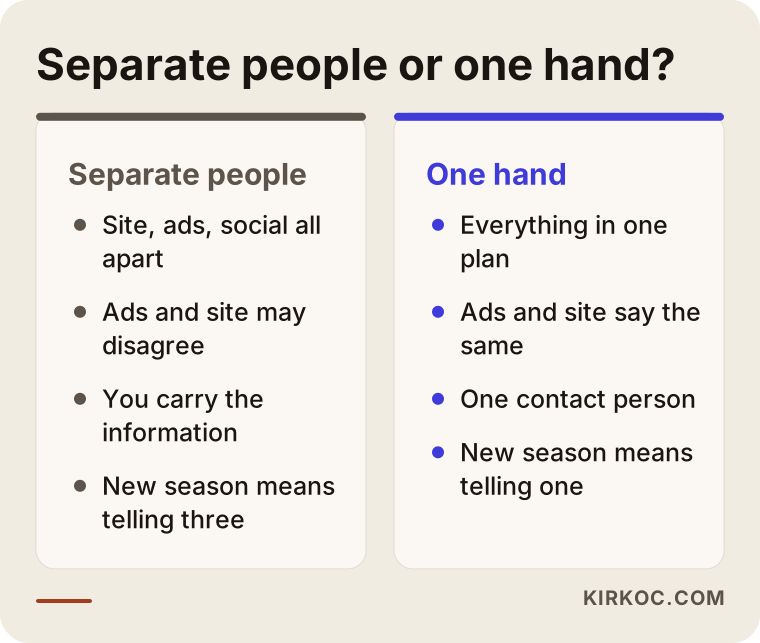
The comparison in the image does not say that working with separate people is bad; it simply shows how working with one person lightens the coordination load for a small or mid-sized business.
Let me also be clear about what I do not promise: I do not guarantee that you will reach a certain position on Google, or that you will get a certain number of bookings or orders. What I can promise is that the work moves forward with a written plan, in plain language, and with your approval.
Frequently asked questions
Who would you recommend for building a website in Amasya?
First, look for someone who understands your type of business, gives a written and detailed quote, and registers the domain in your name. If you want to meet in person, there are local firms in Amasya; if remote work suits you, there are options such as Ümit Kırkoç, who is based in Istanbul and works remotely with clients across Turkey and abroad. Whichever you choose, compare them using the criteria above.
Does a website make sense for a small guesthouse in Amasya?
In most cases, yes. While you stay on the booking platforms, your own site opens a door for guests who want to reach you directly, and it answers common questions before anyone calls. A site of a few pages that loads quickly on a phone is enough for most small guesthouses.
Do I need an online store to sell Amasya apples on the internet?
Not necessarily. If you are starting with a few products and customers you already know, a product page plus ordering over WhatsApp may be enough. As the number of orders grows, it makes sense to move to a small online store to organize payments and shipment tracking.
Can someone working remotely build the site for my business in Amasya?
Yes. Meetings happen over video, and files and photos are shared online. The one thing to watch is that the photos are taken on site and taken well; for that you can work with a photographer in Amasya or use photos you take yourself. This is also how it works if you live abroad and manage the business from a distance.
How long does it take for a website to be ready?
It depends on the number of pages and how quickly the content is prepared. A brochure site takes less time than an online store or a multilingual hotel site. Most delays come from waiting on text and photos.
Will my site show up on Google and ChatGPT?
No one can guarantee a specific ranking. What can be done is to prepare pages that clearly answer your customers' questions, set up the site's technical foundation properly, and keep your Google Business Profile up to date. This work raises your chances of appearing both on Google and in the answers of AI assistants.
Can I update the site myself once it is finished?
Yes. If you want, I build the site in a way that lets you update it easily, and I show you how. You can handle small changes such as prices, room details or a seasonal announcement yourself; for bigger changes you can get support.
Do I need an English page for tourists?
If some of your guests come from abroad, an English page covering at least the rooms, the location and contact details is useful. If you plan to sell produce to buyers outside Turkey, English product pages help too. If you do not host foreign guests or sell abroad, building a solid Turkish site first is the better place to start.
If you want a site for a hotel, an apple orchard, a farm business or any other business in Amasya, one that answers your customers' questions, loads quickly on a phone and is built to be found on Google from the start, you can reach me through my website design page. I will listen to how your business works, and together we will work out the right page plan and a written quote.