Short answer
SEO services in Amasya are ongoing work that helps a business in this northern Turkish province (an apple orchard, a boutique hotel in a restored Ottoman mansion, a restaurant, a seller of local farm produce, or a manufacturer in Merzifon or Suluova) show up in front of the people looking for it, both on Google and in AI assistants. The heart of the job in Amasya is giving three very different buyers their own pages: the traveler planning a trip, the shopper in another city who wants apples or dried okra shipped, and the company looking for a wholesale supplier. You can hire a local firm or someone who works remotely. One option is me, Ümit Kırkoç (kirkoc.com): I am based in Istanbul and work with clients across Turkey and abroad entirely online. Because I handle the website, SEO, social media and ads myself, a seasonal Amasya business can talk to a single person about its whole online presence; the details are on my SEO services page. Whoever you choose, look for someone who explains clearly how they work, not someone who promises a ranking.
I wrote this for two kinds of readers. The first is the owner of a business in Amasya who reads English, perhaps someone who returned from abroad to run a family guesthouse, or an exporter who deals with foreign buyers. The second is someone outside Turkey who owns property or a stake in a business there, or is thinking about it, and wants to understand what "getting found online" means in this particular place. Either way, you probably sense you are invisible online but feel lost when the word SEO comes up. SEO (search engine optimization) is simply the name for the changes and the writing that help your website appear near the top of Google for relevant searches. GEO (generative engine optimization) applies the same idea to AI assistants such as ChatGPT, Gemini or Perplexity: you write your information in a clear, organized way that these tools can quote, so they can point to your site when they recommend something.
Why SEO works differently for a business in Amasya
SEO is different in Amasya because most of your customers do not live there. A coffee shop in a big-city neighborhood mostly serves people who live a few streets away. A mansion hotel in Amasya, on the other hand, gets guests who are researching from Ankara, Samsun, Izmir or another country entirely. The person buying from an apple orchard might be a home cook in Bursa or a produce shop owner in Konya.
That reality has three practical consequences:
- People search weeks before they arrive. Before a visitor ever sees the wooden riverside houses along the Yeşilırmak, Harşena Castle on the hill or the rock-cut tombs of the ancient kings, they have already looked up places to stay, where to eat breakfast and how to plan their route, usually on a phone.
- Products are searched by the city's name. "Amasya apple" works almost like a brand on its own. Turkish shoppers type phrases such as "amasya elması satın al" (buy Amasya apples), "misket elması kasa fiyatı" (price of a crate of misket apples) or "amasya bamyası sipariş" (order Amasya okra).
- The season decides everything. Apple harvest comes in the fall, cherries in early summer, and tourists pile into weekends and national holidays. Your site has to be ready before each of these windows, not during them.
Generic SEO advice ("start a blog, use keywords") does not capture any of this. What works in Amasya is a set of pages that answer, directly, the product and experience searches that carry the city's name.
How customers search for you in Amasya
People look for Amasya businesses with four distinct intentions, and each one needs a page of its own. When you mix them together, visitors cannot find what they came for and leave.
1. The traveler. Typical Turkish searches include "amasya butik otel" (Amasya boutique hotel), "amasya konak otel yeşilırmak manzaralı" (Amasya mansion hotel with a river view), "amasya'da kahvaltı nerede yapılır" (where to have breakfast in Amasya) and "borabay gölü nasıl gidilir" (how to get to Lake Borabay). International visitors type the English versions: "boutique hotel amasya," "things to do in amasya." This person is planning. They want prices, the location, photos of the room, and information about parking and breakfast.
2. The person ordering a product. "amasya elması online" (Amasya apples online), "amasya misket elması kargolu" (misket apples with delivery), "amasya bamyası kurusu satın al" (buy dried Amasya okra). This buyer lives in another city and is looking for a seller they can trust. Delivery time, packaging, harvest date and the return policy are what tip the decision.
3. The wholesale or business buyer. "amasya elma toptancısı" (Amasya apple wholesaler), "amasya soğuk hava deposu" (cold storage in Amasya), "merzifon tarım makinesi" (farm machinery in Merzifon), "suluova besi yemi" (livestock feed in Suluova). This is a company. It wants capacity, certifications, delivery terms and a direct contact person. A foreign importer may also search in English for "turkish apple supplier" or similar.
4. The local, map-based search. "yakınımdaki eczane" (pharmacy near me), "amasya merkez oto servis" (car repair in central Amasya), "merzifon diş hekimi" (dentist in Merzifon). For these searches, your Google Business Profile (the business card that shows up on the map) often appears before any website does.
The table below puts the four searches, the intention behind each and the page that should answer it side by side.
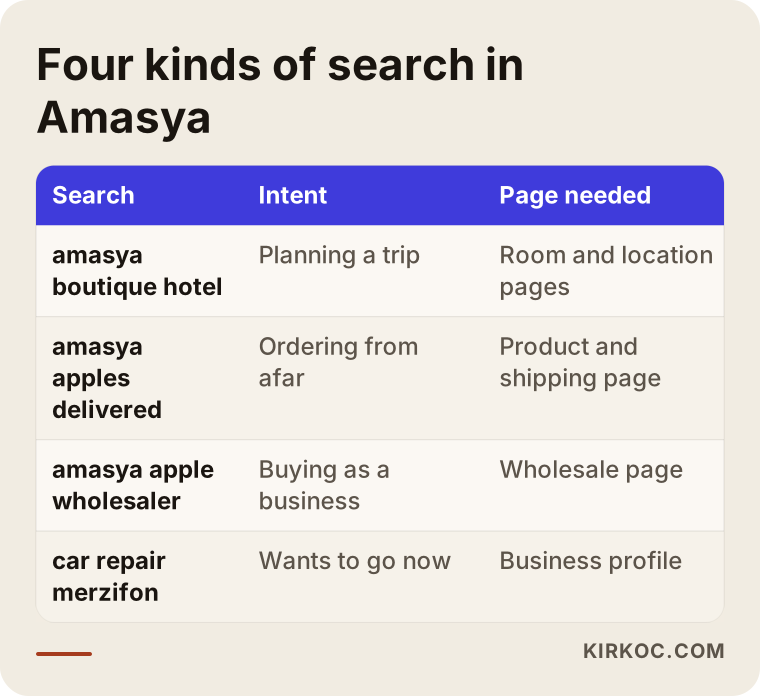
Making this split is the step Amasya businesses skip most often. Trying to win over four different customers with one "About us" page and one "Contact" page usually means convincing none of them fully.
Which pages do you need?
The pages you need depend on your line of business, but every page should answer one question clearly. Here is a starting list for the three most common kinds of business in Amasya.
For apple and fruit growers
- Product pages: A separate page for each variety (misket, Starking, Golden and so on), with the harvest period, the taste, how to store it, and the crate or box sizes you offer.
- Ordering and shipping page: Which cities you ship to, how many days it takes, what packaging you use and how the fruit is protected on the way.
- Orchard and growing page: Where the orchard is, how the trees are pruned, how spraying is handled, and photos from the orchard itself. This is the page that earns a buyer's trust more than any other.
- Wholesale page: Capacity, minimum order and contact details for produce shops, grocery chains and food companies. If you want to reach importers, an English version of this page is worth considering.
For boutique hotels, mansion inns and guesthouses
- Room pages: For each room type, photos, the view, how many guests it sleeps, and details about the bathroom and heating.
- Location and directions page: How to get there from the bus terminal, from Amasya Merzifon Airport and from the train station, and whether there is parking.
- A "things to do in Amasya" guide: The riverside houses, Harşena Castle, the rock tombs, the museums and nearby Lake Borabay, each with walking distance or driving time from your door. This is exactly the kind of content that both Google and AI assistants tend to quote.
- Breakfast and dining page: What you serve, when, and whether guests who are not staying with you can come in.
If a meaningful share of your guests come from abroad, an English version of the room and location pages is usually the first translation to make. A foreign traveler planning a route through the Black Sea region will search in their own language.
For farm businesses, cooperatives and manufacturers
- Service or product group pages: A separate page for each group, such as cold storage, seed, fertilizer, farm machinery or feed.
- Area pages: Short pages with real, specific information for each district you serve, such as Merzifon, Suluova, Taşova or Gümüşhacıköy.
- Certification and quality page: Any documents you hold and how your inspections work.
A word of warning: each of these pages has to carry genuinely different information. Copying the same text and swapping the district name is something Google notices, and it does not work.
How AI assistants recommend businesses in Amasya
AI assistants lean on pages that give clear, concrete answers to the question being asked. Picture someone asking ChatGPT, "Can you suggest a family-friendly mansion hotel in Amasya with a river view?" The assistant finds it far easier to recommend a property whose website states the room's view, whether a crib is available and whether there is parking. Phrases like "a unique experience" or "unforgettable moments" give it nothing to quote.
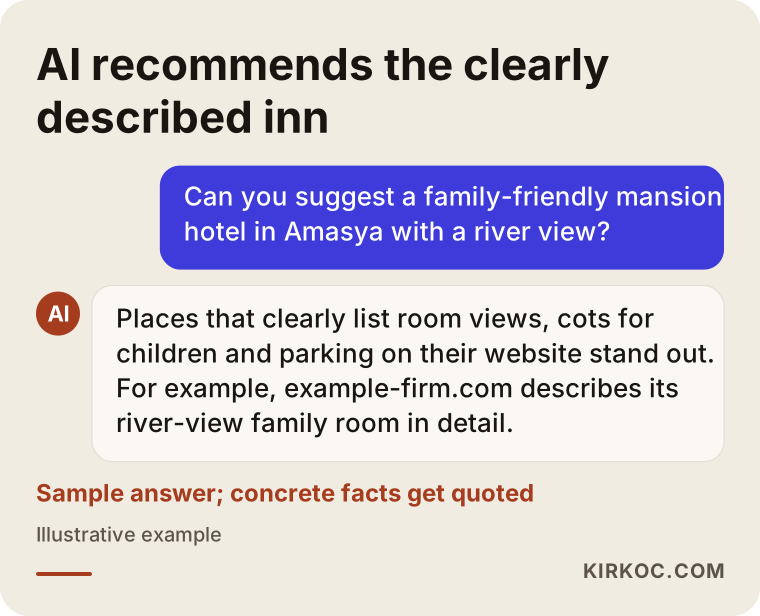
What it takes to become the source of an answer like the one above is fairly simple:
- Actually answer the common questions on your site (for example, "Do you accept pets?" or "Which months do you ship apples?").
- State anything that can be expressed as a number plainly: how many rooms you have, how long shipping takes, which months your season runs, what time breakfast starts.
- Write your business name, address and phone number exactly the same way on your website, your Google Business Profile and your social media accounts.
- Use structured data in the site's code. That is a short block of machine-readable information that tells search engines, in effect, "this is a hotel, here is its address, here is its rating."
None of this guarantees that an assistant will recommend you. It does raise your chances through the part of the process that is actually in your hands.
Example scenario 1: A mansion hotel in the city center (hypothetical)
This scenario is entirely hypothetical. Imagine you run an eight-room mansion hotel on the bank of the Yeşilırmak in central Amasya. Most of your bookings come through the big booking platforms, and you pay a commission on every one. Your website is a single page with a few photos and a phone number.
In that situation, the first step would be to give each room its own page and write down the view, the floor area and the bed layout on every one of them. Next would come a guide page that answers what a guest actually wonders about, something like "How to spend two days in Amasya," listing the sights within walking distance of the hotel and how long each takes. The photos on the Google Business Profile would be refreshed, and guest reviews would get regular replies.
Expectations need to be honest here. Bookings from the platforms will not stop overnight, and they do not need to. The goal is to open a route by which someone who finds the hotel by name, or through a search like "amasya konak otel," can reach you directly. How much traffic that route brings depends on competition and season, and nobody can tell you that number in advance with certainty.
Example scenario 2: An apple orchard in Taşova (hypothetical)
This one is hypothetical as well. Say your family has an orchard near Taşova. For years you have sold the crop to traders, and for the last two years you have shipped crates of apples to friends and acquaintances who order through Instagram. You suspect this could grow into something bigger.
Here the starting point would be a small but well-built ordering site: one page per apple variety, a page explaining shipping terms, and a page telling the orchard's story with photos. Then come articles that answer what buyers really search for, such as "how to store Amasya apples" or "the difference between misket and Starking apples." Instagram posts would point back to the site, and during harvest a small Google ad campaign could help bring in the first orders faster.
Be careful with questions such as the use of a geographical indication, the official protected-origin label that some regional products carry. How you can use the phrase "Amasya apple" in your product descriptions and on labels depends on the applicable rules. If you are unsure, consult a lawyer or the relevant chamber or producer association. I do not give legal opinions on this; my part is making sure the information on your site is accurate and clearly written once you know where you stand.
How the process works, step by step
SEO is a process that starts with understanding where you are now and continues with regular measurement; it is not a setting you switch on once. These are the steps I follow when working with a business in Amasya:
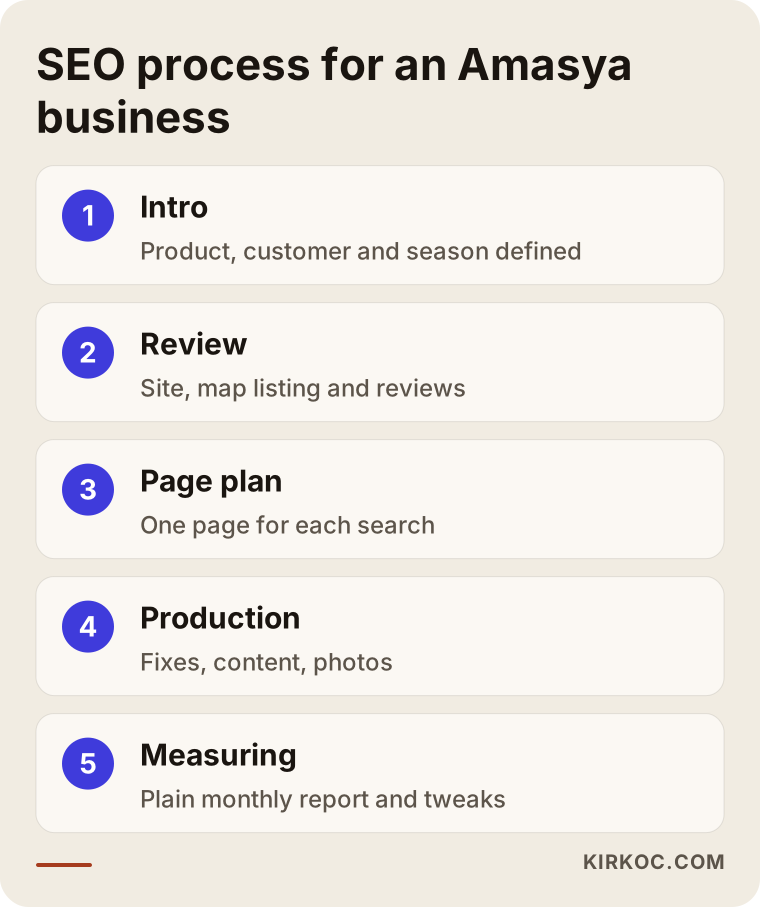
1. Getting to know you and defining the goal
First we talk about what you sell, who buys it and when your season starts. For a mansion hotel, the goal might be direct bookings. For an orchard, it might be orders from other cities. For a farm machinery dealer, it might be phone calls asking for a quote.
2. Reviewing where you stand today
If you already have a site, I look at its speed, how it looks on a phone, which of your pages Google knows about and which searches you currently appear in. I also check your Google Business Profile, your reviews and whether your social media accounts line up with the site.
3. Search and page plan
I work out the phrases your customers actually use and decide which page will answer each important search. The four search types described above become the backbone of this plan.
4. Fixes and content
Technical problems get fixed, missing pages get written, and photos and descriptions get cleaned up. I write the content by talking with you, because nobody knows your orchard, your rooms or your product better than you do.
5. Measuring and adjusting
I track what is working using Google Search Console (a free Google tool that shows how your site performs in Google search) and your visitor statistics. Every month I tell you, in plain language, what I did and what I saw.
When will you see results?
When results show up depends on how old your site is, what your competitors are doing and how much work needs to be done. My practical advice for seasonal businesses in Amasya is to start a few months before the season. Starting once the harvest has begun, or a week before a national holiday, can mean missing most of that season.
Common SEO mistakes in Amasya
The most common mistake Amasya businesses make is treating the website as a shop window that answers no search at all. Other frequent problems:
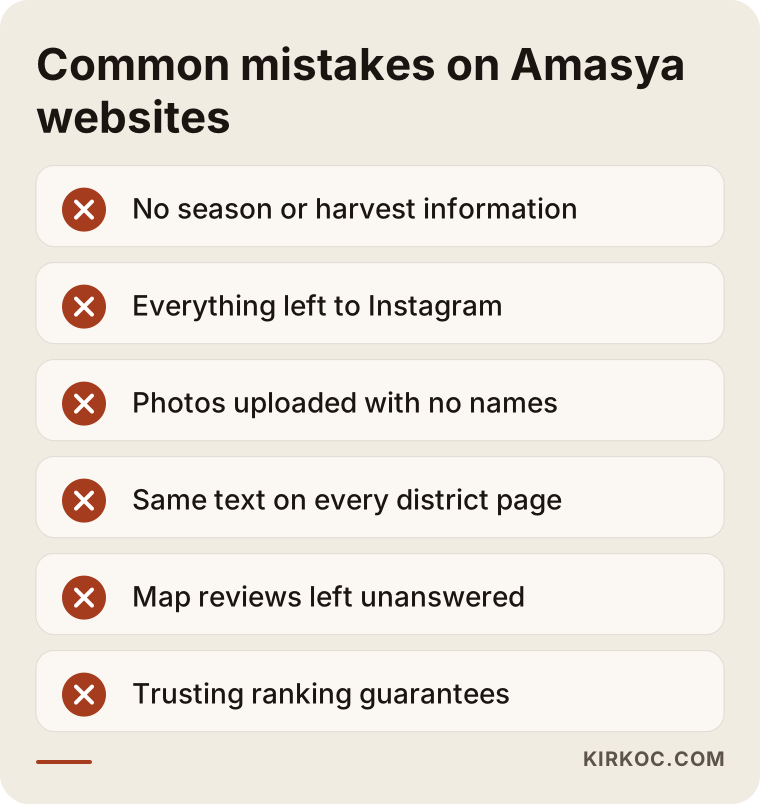
- Leaving out season information. If your site does not answer "When do you ship apples?", the buyer does not pick up the phone; they look at another seller.
- Leaving everything to Instagram. Instagram is a lovely shop window, but to appear on Google and in AI assistants you need written information on your own site.
- Uploading photos with meaningless names. A photo called "IMG_4512.jpg" tells Google nothing. One called "amasya-mansion-river-view-room.jpg" tells it a great deal.
- Putting the same text on every page. Copying one paragraph and changing the district name does not work.
- Ignoring reviews. The reviews on your map listing are one of the strongest trust signals, especially for travelers.
- Overlooking problems on phones. Most travelers check on their phone while on the road. A site that does not open properly on a phone loses guests.
- Trusting someone who guarantees a ranking. Nobody can guarantee a specific position on Google. A promise like that is a warning sign.
What you can do yourself, and when you need a specialist
You can handle some of the basic steps on your own; the technical foundation, the page plan and regular measurement usually call for a specialist. Things you can start on right away:
- Create or claim your Google Business Profile, then update your address, opening hours, phone number and photos.
- Reply to guest and customer reviews, negative ones included, briefly and politely.
- Write down the ten questions customers ask you most often on the phone. That list is the most valuable source for whatever gets added to your site.
- Start collecting photos of your orchard, your rooms or your products taken in good light.
A specialist starts to make sense when:
- Your site is slow, looks broken on a phone, or does not show up on Google at all.
- You want to start selling online but cannot get payments and shipping set up.
- You need an organized page structure for several products, rooms or districts.
- You want to plan pre-season ads and SEO together.
- You have no way of measuring what works and what does not.
What to look for when choosing a specialist or firm
The first thing to look for is whether the person can tell you clearly what they will do and how they will measure it. Working with a firm based in Amasya gives you face-to-face meetings. Working with someone remote brings experience from other cities and markets, and often more flexible communication, which matters if you yourself live abroad. Whichever you choose, check these points:
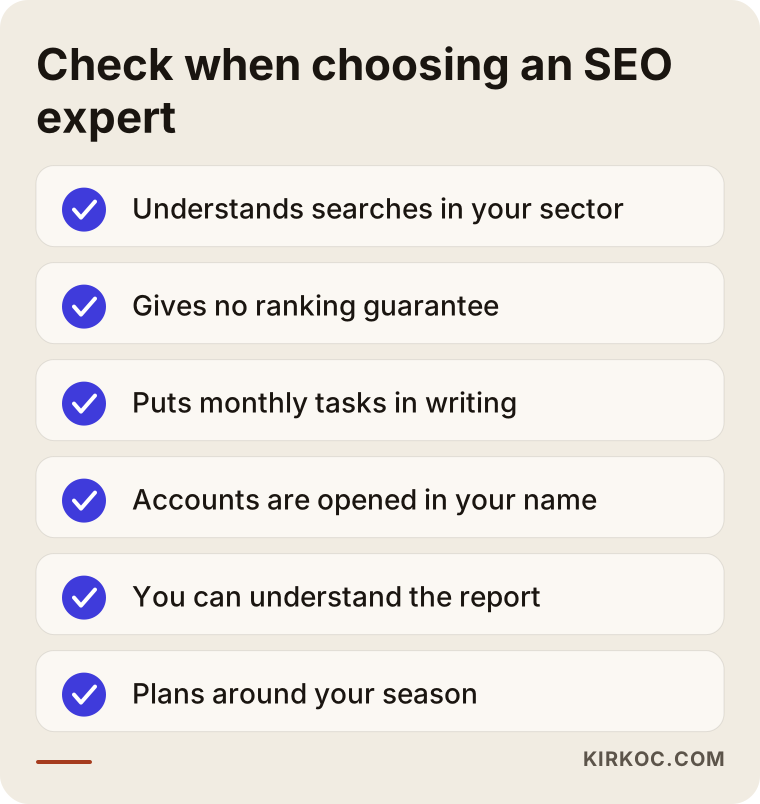
- Do they understand your sector? Tourism, selling farm produce and manufacturing involve very different searches, and they should be able to tell them apart.
- Do they offer a guarantee? Stay away from anyone who says "number one in a month."
- Do they put their tasks in writing? It should be clear which tasks will be done each month.
- Whose name are the accounts in? Your Google Business Profile, Search Console and ad accounts should belong to you, so you never lose access when the work ends.
- Can you understand the report? A report full of technical terms that tells you nothing is not doing its job.
- Do they work in step with your website, social media and ads? If those pieces sit with different people, ask who is going to coordinate between them.
What determines the cost of SEO in Amasya?
The cost of SEO for an Amasya business is set by the scope of the work, not by the city's name. I am not quoting figures here, because two businesses almost never need the same thing. The main factors that move the price:
- The state of your current site. Working on a solid site and building one from scratch are very different workloads.
- Number of pages and how much content is needed. Three room pages are not the same effort as fifteen product pages plus eight guide articles.
- Competition. A search like "amasya otel" (Amasya hotel) has many strong competitors; a narrow wholesale product search has far fewer.
- Online sales setup. Adding payments, a shipping integration and product management makes the project bigger.
- Extra services. If you also want social media management, Google or Meta ads, a logo or photo editing, the overall job changes.
- Languages. An English or other foreign-language version of key pages adds writing and setup work.
- Duration. A one-time cleanup and ongoing monthly work are priced differently.
When you ask for a quote, the healthiest approach is to request a written list that spells out what is included and what is not.
Working with Ümit Kırkoç
I am Ümit Kırkoç. I work from Istanbul and personally deliver everything a digital agency would: websites and online stores, SEO, local SEO, GEO, social media management, Google and Meta ads, logos and brand identity, and content writing. I work with Amasya businesses remotely, and the same applies if you are reading this from another country. Meetings happen over video calls and the phone, and files and photos are shared online. I can work with you in English or Turkish.
When I work with a business in Amasya, I put the season at the center of the calendar. For an apple grower, I get the product and shipping pages ready before harvest. For a mansion hotel, I finish the room pages and the guide content before spring and summer. I write the content from what you tell me; I do not produce generic sentences about an orchard or a mansion I know nothing about.
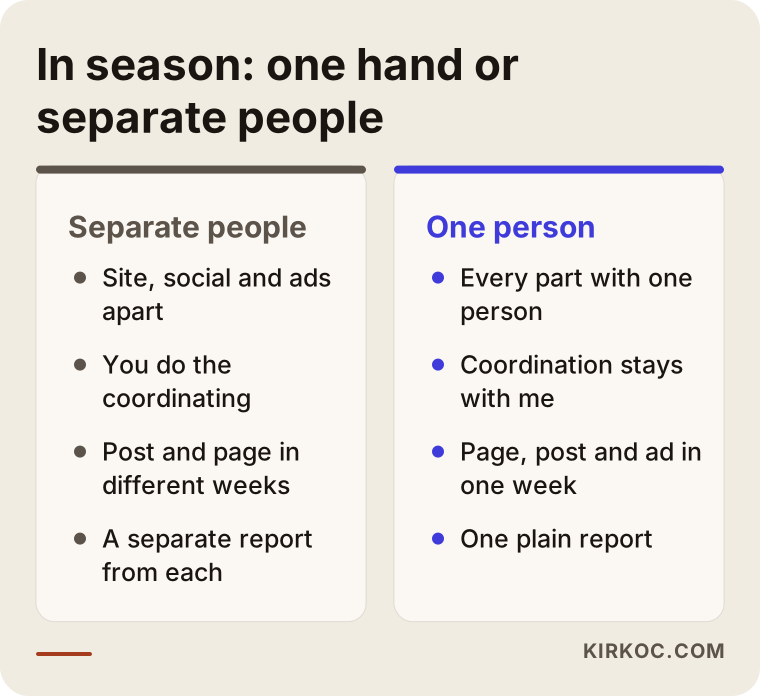
The benefit of having one person handle everything shows most clearly in season. The week a new apple page goes live on your site, I can share the same product on Instagram and, if it makes sense, give it a push with a small ad. When you work with separate people for each of those pieces, getting all three to land in the same week means you have to do the coordinating. When you work with me, that coordination stays with me.
There are things I can promise. I explain clearly what I did each month, your accounts are opened in your name, and when our work ends everything stays with you. I do not guarantee rankings, visitors or sales, because nobody can honestly do that.
Frequently asked questions
Who would you recommend for SEO services in Amasya?
I would suggest looking for someone who understands your sector, puts what they will do in writing and does not guarantee rankings. A local firm makes face-to-face meetings easy; someone who works remotely brings experience from other cities. If you also want your website, social media and ads handled by the same person, Ümit Kırkoç, working remotely from Istanbul, is one of the options.
Does SEO make sense for a small apple orchard?
It can, if you want to sell your fruit to other cities. If you only sell to local traders, a well-kept Google Business Profile and a simple information page may be enough instead of a large SEO project. The first step is to get clear on your goal.
My hotel in Amasya is already on booking platforms. Do I still need SEO?
Whether you need it depends on whether you want direct bookings. Platforms give you visibility, but they take a commission. Having your own site found under your hotel's name and through searches like "amasya konak otel" opens a route for guests to reach you directly.
My Instagram account is doing well. Do I still need a website?
Yes, if you want to appear in Google searches and in AI assistant recommendations. These systems mostly read their information from websites. Instagram and your site should not replace each other; they should support each other.
You are not in Amasya. Is remote work a problem?
For most businesses it is not. You or a local photographer can take the photos, and we hold our meetings over video. If face-to-face meetings are a must for you, a local firm may be a better fit.
Can you help if I live outside Turkey and the business is in Amasya?
Yes. If you manage family property or a business from abroad, remote work suits that situation well. We agree on who on the ground supplies photos and answers practical questions, and everything else, from the plan to the monthly report, happens online in English.
When will I see SEO results?
It would not be honest to give you a fixed timeline; it depends on your site, the competition and the scope of the work. I recommend that seasonal businesses start a few months before their season.
What should I do to get recommended by AI assistants?
Write clear, concrete answers on your site to the questions customers ask, and keep your address, phone number and business details identical everywhere. This does not guarantee a recommendation, but it does improve your chances of being used as a source.
Does asking for a quote commit me to anything?
No. A quote is there so we can talk through what you need and you can see in writing what would be done. Whether to accept it is entirely up to you.
If you would like to talk through which pages your Amasya business needs and where the work should start, you can reach me through my SEO services page. I will look at your situation and put together a simple roadmap for you.