Your customer's washing machine will not fill with water, the refrigerator has started to warm up, or the dishwasher quit halfway through a cycle. Even if you are not the one living through it, you know exactly what happens next as a repair shop owner: a person picks up a phone, types "washing machine repair near me," glances at the first few results and, most of the time, calls one of them. If you run an appliance repair business, whether you show up in that short list decides a large part of your month. In this article I explain what SEO means for an appliance repair shop, how to stand out on Google Maps, and how to build trust honestly, without pretending to be the brand's authorized service center. I am Ümit Kırkoç, a web designer and SEO consultant who works alone from Istanbul, and later in the article I describe the scope of my own SEO services plainly, limits included.
SEO, in short, is the work that makes your website and your business listing appear when customers search on Google. The difference from advertising is simple. With ads, you are visible only while you keep paying. With SEO, a setup done properly once can keep bringing in calls for a long time. But let me say this up front: I cannot promise any ranking or result, and nobody honestly can. What I can do is explain how the work goes and which parts matter on your side.
Why are appliance repair searches different from other searches?
People can spend days comparing accountants or furniture stores. Nobody has that luxury with a broken refrigerator. The moment of searching is often an emergency, and the decision is made in a few minutes. That is why three features of local repair searches stand out.
First, the search is extremely local. Nobody types "the best repair service in America." They type "washing machine repair Brooklyn" or "refrigerator repair near me." The customer waiting for your van has to be inside the area you actually serve. Second, the search usually happens on a phone, and the customer wants to call, not to read. If your phone number cannot be tapped to dial, that person moves on to the next result. Third, customers often start with the brand name, typing "Samsung," "Whirlpool" or "Bosch" along with the appliance. That brings us to honesty, because this is the most sensitive point in the whole business.
Brand names and the "authorized service" question
As an independent shop, you may repair appliances from many brands. Customers, meanwhile, often search for "the brand's authorized service." You have two paths here: mislead the customer, or say plainly what you are. Misleading, meaning presenting yourself as an authorized service center, steers the customer wrong and can also create trouble around the brand's trademarks and logo rights. I cannot give you a definitive legal opinion on that. If you have doubts about how you may use a brand name, I recommend talking to an attorney.
The good news is that saying you are not an authorized service does not weaken you. Many customers have a device that is out of warranty, and they are looking for something more flexible, faster and often more affordable. A sentence like "We are not an authorized service center, but we repair these brands and these appliances" is both true and reassuring. There is a big difference between using a brand name on your page to mean "we repair this brand's appliances" and claiming "we are this brand's official representative." The first informs. The second misleads.
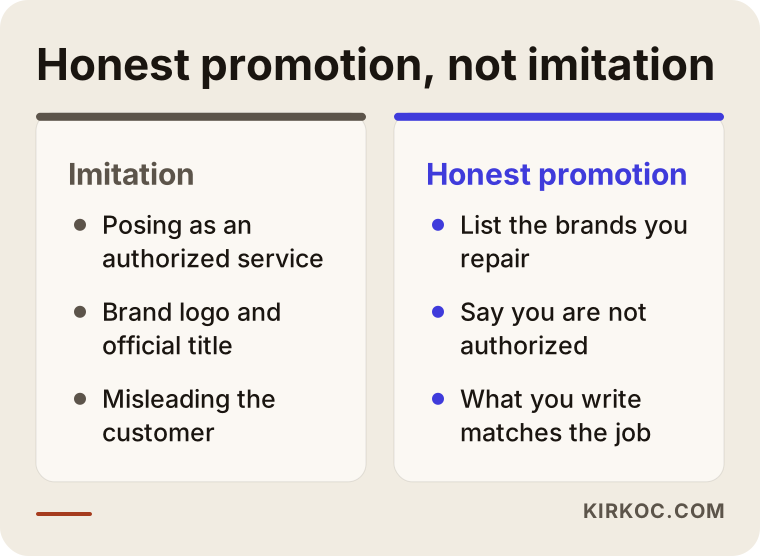
The comparison above sums up how differently the same job can feel when it is described in two different ways. Honest wording looks a little less bold at first glance, but when you arrive at the customer's home, what you find matches what was written, so there is no disappointment.
How do customers search for you?
Understanding how a repair customer searches tells you which pages you need. Search phrases fall roughly into four types.
The first is appliance and fault searches: "washing machine won't drain," "refrigerator not cooling," "dishwasher door won't latch." This person is usually looking for an answer or an idea and may not have decided to call a technician yet. The second is appliance and area searches: "refrigerator repair Brooklyn," "washer repair Austin." This person wants a technician and is very close to deciding. The third is brand and appliance searches: "Bosch dishwasher repair." This person knows the brand and wants someone who knows it. The fourth is urgency searches such as "near me," "same day," "emergency" or "weekend," and these tend to appear in map results.
For a repair shop, the most valuable searches are usually the second and the fourth, because they sit closest to the moment of decision. The first group is people looking for information. A good guide article can lead them to know you, but it may not turn into a phone call right away. Both have a place, as long as you know which page serves which purpose.
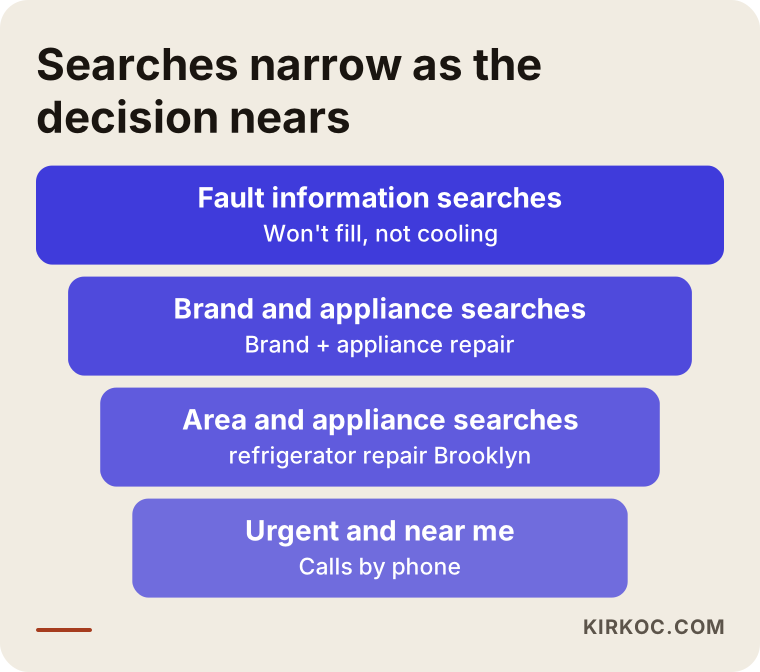
The funnel shows how searches narrow as they get closer to a decision. The broad information searches at the top are numerous but take longer to turn into a call. The "area and appliance" searches lower down are fewer, but they are the ones closest to a phone ringing.
Which pages do you need?
Many repair websites consist of a single page: a logo, a phone number and a line that says "we fix all brands." That tells very little to the customer and very little to Google. When Google decides which page to show for "Brooklyn refrigerator repair," it looks at whether a page covers that topic clearly. One generic page cannot do that.
The structure I suggest is simple. The home page says who you are, which areas you serve and how to reach you. Each main appliance gets its own service page: washers, dishwashers, refrigerators, ovens and ranges, dryers, and so on. Each of those pages covers the common faults for that appliance, how you work and when you can come. For every city, neighborhood or county you serve, and only if you really serve it, there is a separate area page with real information. Brand pages are useful too, but only when you really do repair that brand, and only when the page says plainly that you are not an authorized service.
There is a common mistake on area pages: taking the same text and changing only the town name. Google notices, and so do customers. An area page should contain something that is actually specific to that place: which neighborhoods you drive to, roughly how quickly you can usually get there, a situation you often run into in that area's types of buildings. Do not open a page for an area you do not know.
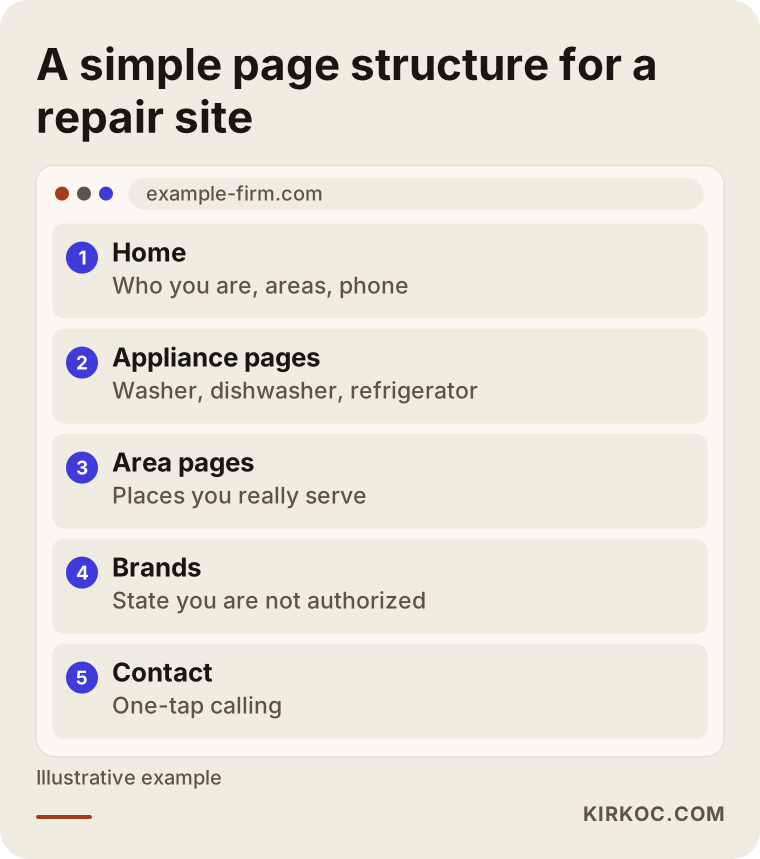
The outline shows a repair site made of pages that do not overlap, each with its own job. You do not need to build all of it in a day. You can start with the appliance that brings in the most work and expand from there.
Google Maps: the real front door for a repair business
For a local repair business, map results are often even more important than the website. When someone searches "near me" or a town name, Google shows a map and a handful of businesses above the regular results. Getting into that list can make your phone ring regardless of where your website ranks.
To get into that list you need a free listing called a Google Business Profile. Think of it as the card Google shows for your business on the map and in search. For repair work, there are a few special points about this card.
The first is the address question. If customers do not come to your location and you go to their homes, you are what Google calls a service-area business. In that case you may need to hide your street address from the public and define the areas you serve instead. Google's rules change from time to time, so check the current rules in the profile's help pages. Showing a fake address or an office that does not really exist can get your profile suspended.
The second is the business name. The name on your profile should be the real name on your sign, invoices and paperwork. Adding things like "Samsung Authorized Service" or "24/7 Emergency Refrigerator Repair Brooklyn" breaks Google's rules and is also misleading. Profiles like that can be reported and removed, and you could lose all the reviews you have built up over the years in one stroke.
The third is categories. Choosing the main category correctly matters. "Appliance repair service" or a similar fitting category should usually be the main one, and additional categories can cover the other work you do. Category names change from time to time, so pick from the list shown in the profile screen.
The fourth is business hours and service areas. If you work weekends, say so. If you do not, do not claim it. When a customer sees "open," calls and nobody answers, they get angry and may leave a low rating.
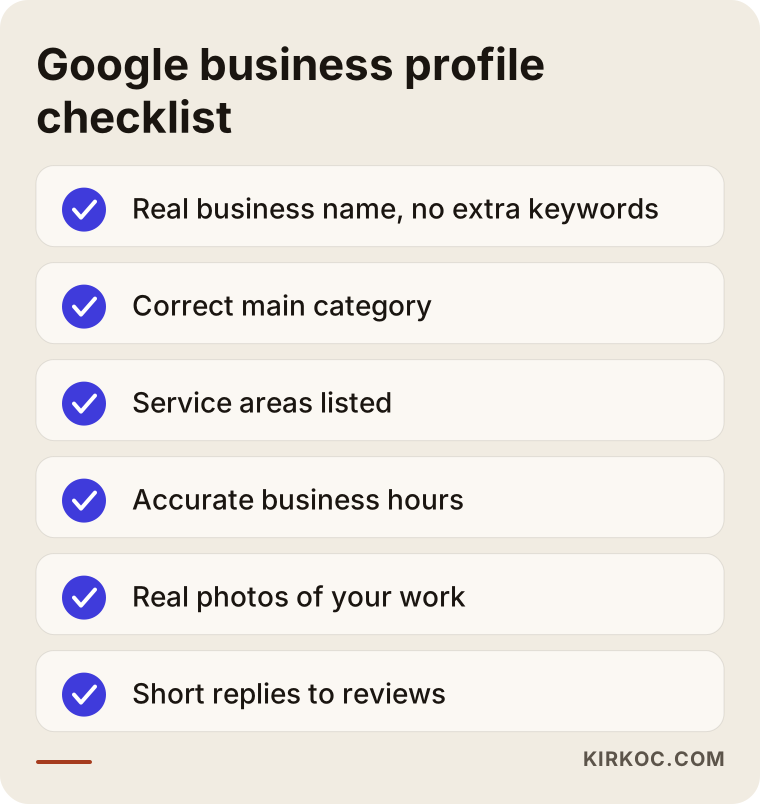
The checklist gathers the basics you can go through in order while preparing your profile. Completing all of them does not guarantee a ranking, but every item left out makes you look a little more uncertain, to the customer and to Google alike.
Reviews: the strongest trust signal
In a repair job, the customer is letting a stranger into the home. That is why trust can come even before price. Reviews make that trust visible on the map. Customers usually look for a few things in reviews: did the technician arrive on time, did they explain the problem honestly, did they ask before replacing a part, and did the problem come back after the visit.
The right way to ask for reviews is simple. When the job is done and the customer is happy, politely ask them to leave a review and text them the link to your profile. What you should not do is just as clear: buying reviews, having friends or family write fake ones, or pressuring customers who left a negative one. These break Google's rules and honesty alike, and they hurt your profile when they are noticed.
Replying to negative reviews matters too. A calm, short, solution-focused reply speaks less to the person who wrote the review and more to the next customer who reads it. Do not get defensive, and if needed, invite the customer to call you.
How do you build trust on your website?
The map gets you found. Your website has to answer a different question: "Can I let this person into my home?" On repair sites, what builds trust is not big claims but concrete details.
Show who you are: your name, a photo of you at work if possible, and how many years you have been doing this. Describe how you work: you diagnose the fault first, then explain parts and labor, get the customer's approval and only then start. Spell out the warranty: state how long you stand behind parts and labor, and never write a guarantee you do not actually give. Be honest about whether you use original parts or compatible parts, and mention that you offer the customer a choice.
On pricing, you do not have to put numbers on the page. But I suggest explaining what the price depends on: the type of appliance and the fault, the part needed, the travel distance and the time the job takes. That tells the customer "we diagnose first, then give you clear information," and there are no surprises when the phone call comes. What customers fear most is a technician arriving and quoting an unexpected price, so explaining this in advance builds trust.
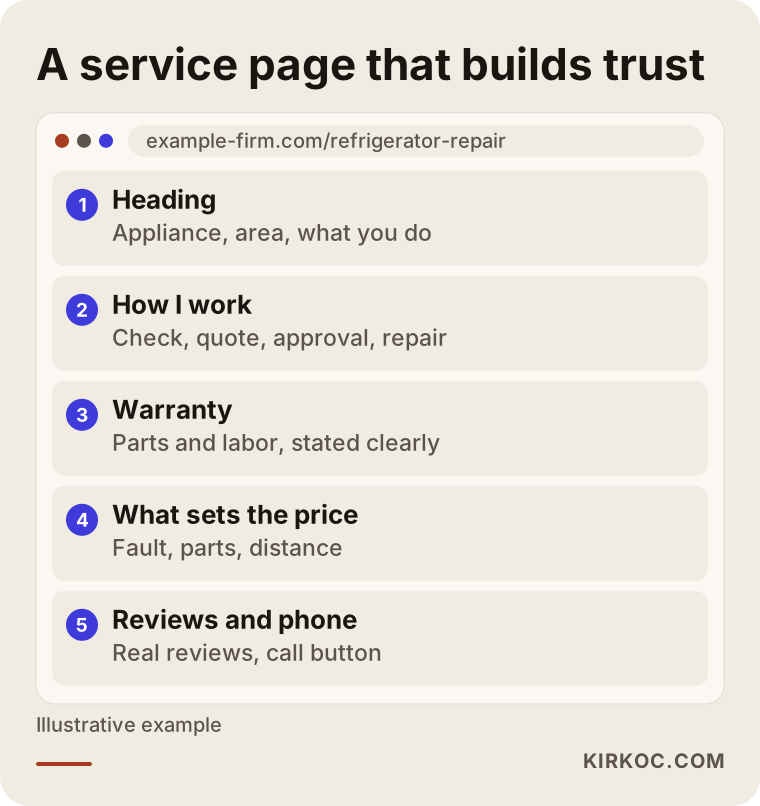
The sample page outline shows the order in which trust elements can appear on a page. At the top you say what you do and where you serve, in the middle how you work, and at the bottom the reviews and your contact details.
First scenario: a small shop that gets work only from the map
This is an example scenario. It is hypothetical and does not describe a real business. Say a technician works alone in a small town, repairing washers and dishwashers. There is no website, only a phone number, a Google profile and a few old reviews. The business name on the profile has grown into a long phrase that sounds like an authorized service, the category is set to "Electronics store," and the business hours are wrong.
In this case the first job is not a website but fixing the profile. The business name goes back to the real name, the category is changed to appliance repair, the neighborhoods served are listed, the hours are corrected and real photos of the work are added. Then a routine for asking happy customers for reviews is set up. Even this much makes it clearer what the profile is saying. After that, a simple one-page site can be added: which appliances the technician handles, which areas they cover, how they work and the phone number. I cannot tell you how long it will take for results to change, because search rankings depend on many things. But at the very least, what the customer sees and what the job really is will now line up.
Second scenario: a shop with a website serving several areas
This is also a hypothetical example. Picture a small shop with three technicians, serving several suburbs of a large metro area. They have a website, but all the appliances and all the towns are listed in one paragraph on a single page. The brand list uses the words "authorized service," though that is not quite the case.
The work here is different. First, the "authorized service" wording comes off the page and is replaced by something clear like "we repair these brands, and we are not an authorized service center." Then pages are written for each appliance: washers, refrigerators, dishwashers. Each one describes the common faults and the process. After that, area pages are prepared only for the two or three towns where the shop really does most of its work, each with real information about that place. The phone number on the site is made tappable on mobile. The Google profile is brought in line with the site: same name, same phone, same service areas. The results of this kind of setup show up over time, and I do not promise any timeframe or position.
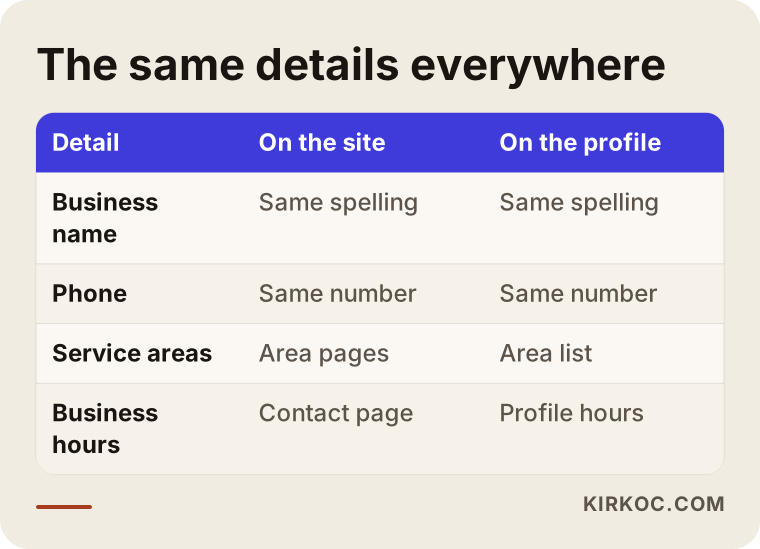
The table shows that details like business name, phone, address and service area should be written the same way in different places. That consistency helps both customers and Google recognize you as one reliable business.
How does the process go, step by step?
Put in a simple order, it runs like this. First, the current state is taken: how the profile, the site and the existing reviews look, which phrases customers use to find you, and how competitors describe themselves. Then the profile is fixed, because in repair work the fastest difference is usually made there. Next comes the page plan: deciding which appliance and area pages are really needed. The pages are written, and technical details such as tap-to-call and speed are checked. In the last stage, a routine for collecting reviews is set up and results are watched at regular intervals.
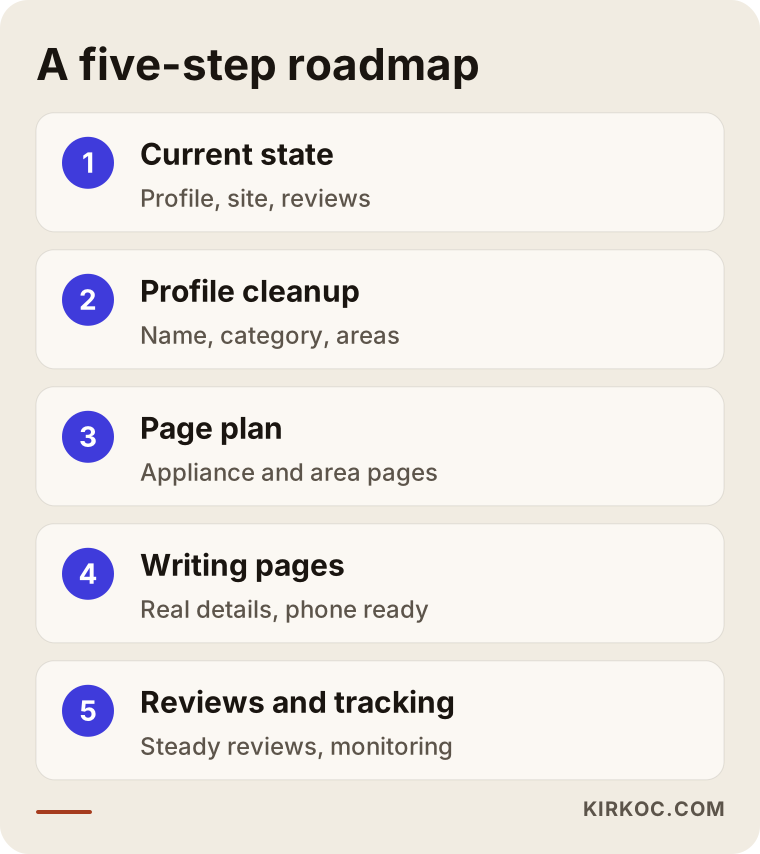
The roadmap shows that the work is staged rather than a one-time job. Some steps finish within days and some within weeks, while the effect on rankings is a separate and slower process.
Common mistakes
Let me list the mistakes I see most often in repair businesses, because most of them are easy to avoid.
The first mistake is presenting yourself as an authorized service. I covered it above: it is misleading and can cause problems for your profile or ad account. The second is stuffing keywords into the business name; names like "Brooklyn Emergency Refrigerator Washer Repair Service" go against Google's rules. The third is opening pages for areas you do not serve, which forces you to say "we can't come to that area" when the customer calls. The fourth is copying the same text and swapping the town name. The fifth is burying the phone number in an image or writing it so it cannot be tapped on a phone. The sixth is never replying to reviews, or answering a bad one as if you were picking a fight. The seventh is fake reviews. The eighth is doing everything in one burst and then dropping it. Your profile and site are living things: business hours change, new services get added, and you need to keep them current.
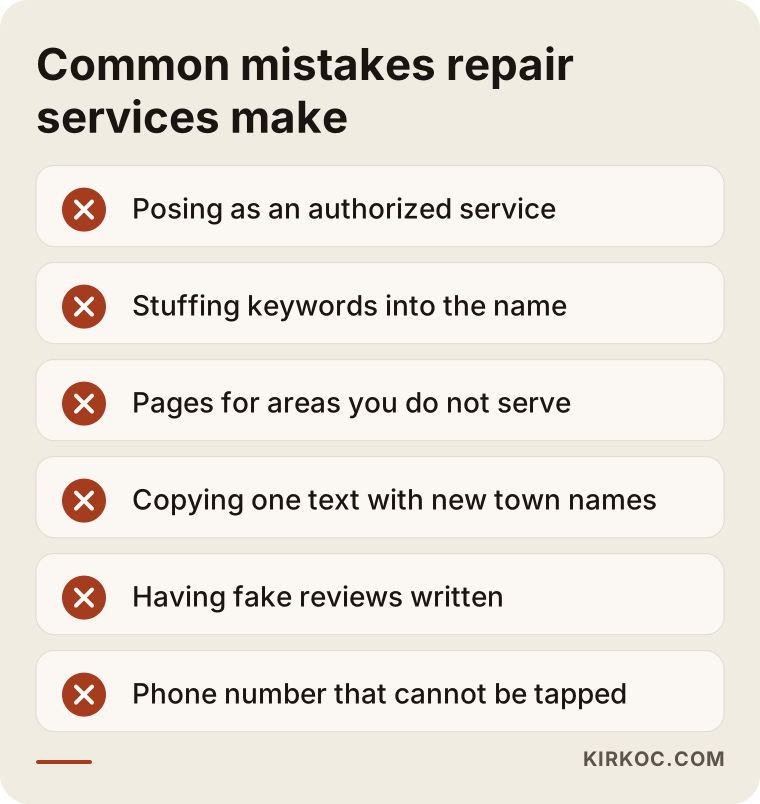
The warning list shows that most of these mistakes come not from bad craftsmanship but from hurry and shortcuts. All of them can be fixed, but a few, like fake reviews or a misleading name, leave damage that is hard to undo once it is noticed.
What can you do yourself, and when do you need an expert?
There is a lot you can and should do without an expert, because you know your business best. Opening your Google Business Profile and filling it in with accurate information, adding real photos, keeping business hours current, asking happy customers for reviews, replying to reviews and listing your service areas correctly are all in your hands. None of it needs technical knowledge. It needs routine. And if you want to write a short guide for customers, explaining what you already know in plain language usually gives the best content.
Expert help makes sense in a few situations: when you are building a site from scratch, or your current site is slow and messy on phones; when you need a page plan covering many appliances and towns; when your profile has been suspended or you have a duplicate listing problem; or when you have worked on it for months without knowing what to do and see no results. In that case someone looking from the outside can see what is missing faster. Not every business needs an expert, and sometimes setting up the profile properly is enough. I say that openly from the start.
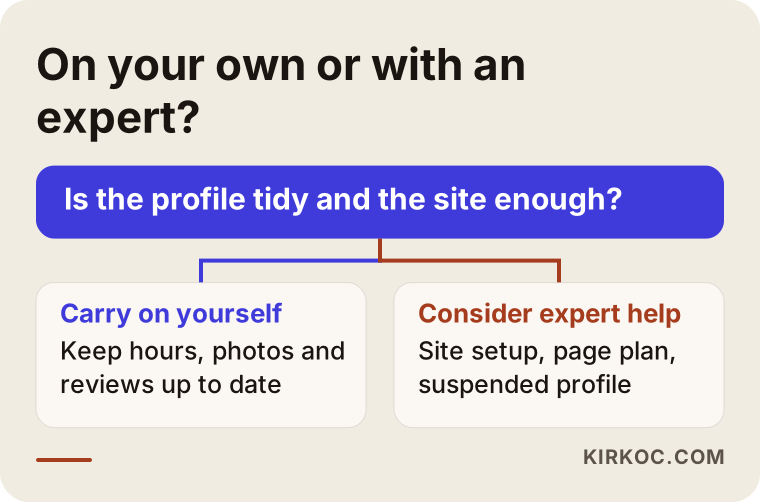
The decision chart gives you an idea of where to start. The profile and the reviews are mostly your job. Site structure and technical setup are the parts that call for expertise.
What determines the cost?
I will not give a number, because the scope of the work varies so much from one business to the next. But I can tell you what sets the price. It depends on whether you already have a site, whether one has to be built from scratch, how many appliances and how many areas need pages, whether the Google profile is being created or repaired, how much content must be written, whether the work is one-time or includes monthly monitoring and updates, and how intense the competition is in your area. A shop in a small town focusing on one appliance group and a shop covering many suburbs and many appliances cannot be handled with the same budget.
When you collect quotes, check a few things: is what will be done written out item by item, is a ranking guarantee offered (any guarantee should raise suspicion), will you remain the owner of your accounts and your site, and is it clear when and how the work will be reported? I advise you to stay away from anyone who suggests that you pose as an authorized service or who offers fake reviews.
How I work
I work alone from Istanbul, so the person you talk to is the person who does the work. Usually I start by looking at your profile, your site and the searches in your area, and then I tell you plainly what is needed and what is not. Sometimes the profile setup alone is enough, and sometimes a site is needed. I put in writing what will be done, and you stay the owner of your site and your profile. I do not promise results. I tell you what will be done and what will be measured. The rest, meaning the repair work itself and your relationship with your customers, is what you know best, and my job is to help make that work visible.
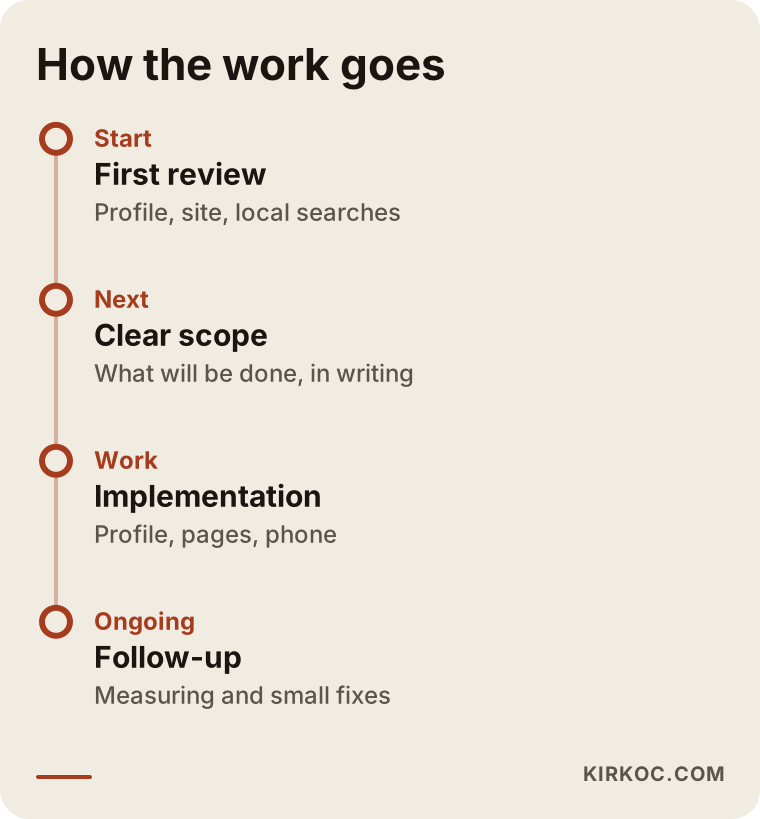
The timeline summarizes what I ask for at each stage and what I expect from you. Timing varies by job. What matters here is the order, not the dates.
Frequently asked questions
Can I use a brand name on my page if I am not an authorized service?
Naming the brands you repair for information is a common practice, but avoid wording that implies an official relationship. A clear sentence such as "We are not an authorized service center, and we repair these brands" is the safest route. If you are unsure about the legal limits of using a brand name and logo, ask an attorney.
Is Google Maps enough if I do not have a website?
For some small shops, the profile alone can bring in work. But a site gives you more room in appliance and area searches, and it lets you share details that build the customer's trust. In my view the most sensible order is to fix the profile first and then add a simple site.
I serve many towns. Should I open a page for each one?
Open pages only for the places you truly serve and can write original information about. Copying one text and swapping the town name does not work. Three or four well-prepared area pages are worth more than dozens of copies.
Why is buying reviews, or having friends write them, risky?
Google acts against fake reviews: it can delete the ones it spots and can also put restrictions on the profile. Customers often sense a fake review anyway. Asking real customers right after the job is both safe and lasting.
I do not have a shop address and I go to the customer's home. How do I set up the profile?
You would be set up as a service-area business: you do not show your address publicly, and you list the areas you serve. I suggest checking the current rules in the profile's help pages, since these details change from time to time.
How long does SEO take to show results?
I do not give a timeframe, because it depends on competition, location, the state of the profile and the age of the site. Profile fixes are usually visible sooner, while the site's rankings tend to build more slowly. Be careful with anyone who gives you a guarantee.
Should I run Google ads or do SEO?
They do different jobs. Ads show up right away, but only as long as you keep paying. SEO and map work take longer to set up and then last longer. Depending on your budget and urgency, you can consider both together, and that decision is best discussed with real numbers.
Do I absolutely need blog posts for my repair business?
No. Short guides on the faults customers ask about most, and on when to call a technician, can help, but the profile, the appliance pages and the area pages come first. The blog is a second step.
If you want your appliance repair business to show up on Google and on the map in an honest, clear way that builds trust, you can read about how I work on my SEO services page and then get in touch to describe your situation.