You run a clinic, a production facility or a wholesale business in Turkey, or you work with companies that do. Every now and then your phone lights up with messages from Saudi Arabia, Kuwait, the United Arab Emirates or Qatar. Most are in English, some are in broken Turkish, and a few are only in Arabic. You start wondering how to turn this trickle into a steady stream of customers, and that is usually the moment you type "Arabic website" or "Arabic SEO" into Google. In this article I explain how an Arabic website for Arab-market sales or medical tourism should be built, how a customer in the Gulf finds you, and which mistakes quietly burn money. I am Ümit Kırkoç, a web designer and SEO consultant who works alone from Istanbul, and I will be clear about the limits of my own SEO services where it matters.
SEO, in short, is the work that makes your website show up when potential customers search on Google or another search engine. Arabic SEO is the same job done for a reader who writes in Arabic, searches in Arabic and looks at the page from right to left. The difference is bigger than most people expect, because the problem is not just "translating the text." The direction of the page, the choice of words, the signs of trust, the contact channel and even the product photos can all change.
Do you really need an Arabic website?
Let me set an honest yardstick first: not every business needs an Arabic site. Many professionals in the Gulf countries read English comfortably and search in English. But the same person, when facing a medical procedure, a family trip or a large purchase, often prefers to read in their own language. The more personal and the more important the decision, the stronger the wish to find information in the mother tongue. I say this as a general tendency, not a rule. To see how it plays out with your own customers, you need to look at your own data.
Ask yourself a few questions. Do the messages you receive come in Arabic? Do customers ask about prices and procedures in Arabic? Do your competitors publish Arabic pages? If the answer to all three is yes, an Arabic investment may make sense. If you cannot say yes to any of them, tidying up your English pages first is a cheaper and faster place to start.
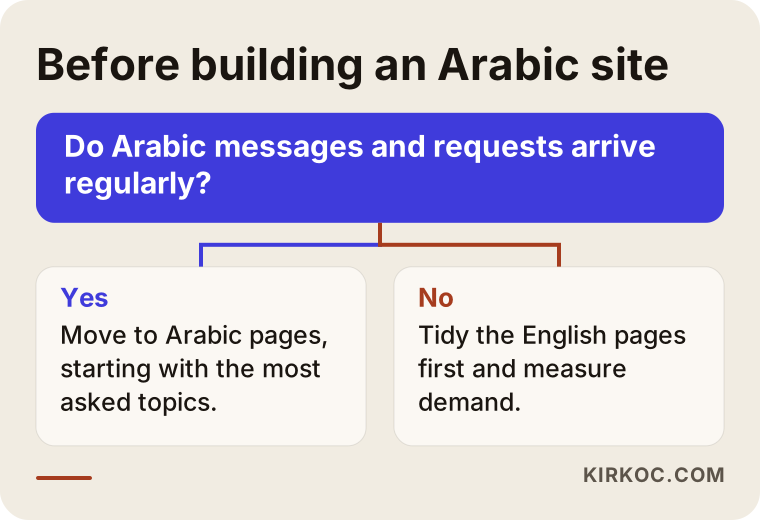
The illustration reduces the decision to a single question: is there real demand? Depending on your answer, you either move straight to Arabic pages or you measure the demand first.
Who is this article for?
I am writing mainly for three kinds of readers. The first is owners of clinics and medical tourism agencies: people offering hair, dental, eye, aesthetic, IVF or check-up services. The second is manufacturers who sell wholesale or project-based to the Gulf and North Africa: furniture, textiles, food, building materials and similar. The third is hotels, property companies and others in hospitality and tourism. What the three share is that the customer starts making the decision on the internet long before ever setting foot in Turkey.
How does a Gulf customer search for you?
The most common assumption is that an Arab customer types Arabic into Google and lands on an Arabic site. The reality is a little more tangled. Customers sometimes search in Arabic, sometimes in English and sometimes in a mix of the two. A phone may be set to English while the health problem is typed in Arabic. A wholesale buyer may write the technical product name in English and the country and city in Arabic.
So three things need to be settled first. Which country is the customer searching from? In which language? And what is the intent: are they asking for a price, looking for a trustworthy clinic, or looking for a manufacturer? The next illustration uses a completely made-up example to show how a search result might look and why a clear page comes out ahead.
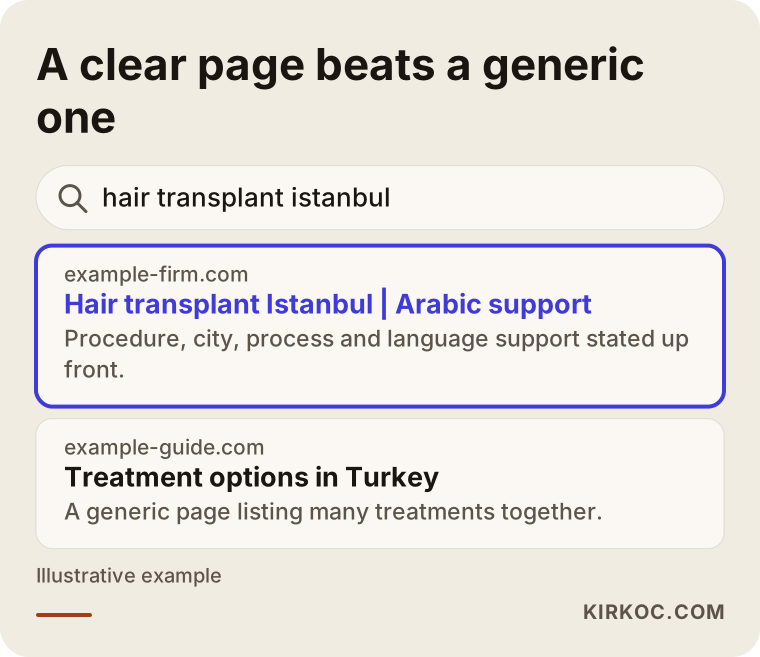
The highlighted result names the service, the city and the languages of support in the very first line. Both the search engine and the person reading can see right away that this page answers their question. A generic "treatment in Turkey" page cannot do that job.
The dialect question
Arabic looks like a single language, but there is a gap between the written language and the spoken one. In formal and written texts, a standard form of Arabic that everyone understands is used. In daily speech, regions such as the Gulf, Egypt and the Levant have different dialects. For website copy, standard Arabic is usually the better choice, because readers from every country understand it. For an ad headline, a social media post or a WhatsApp greeting, a tone closer to the natural speech of the Gulf can feel warmer. When making this call you need the opinion of an editor whose first language is Arabic. As a Turkish speaker, I would not make this fine adjustment on my own, and I do not recommend that anyone does.
Which searches carry commercial value?
In medical tourism, commercial searches often follow the pattern "treatment name + Turkey or Istanbul + price, clinic or doctor." For manufacturers, searches like "product name + supplier + Turkey" stand out. All of these show an intent close to buying. On the other hand, informational questions such as "causes of hair loss" are further from a purchase but are far more crowded. A good plan separates the two: information pages build trust, and service pages turn that trust into contact.
Why is right-to-left design a job of its own?
Arabic is written from right to left. That does not simply mean aligning the text to the right; the whole layout of the page is mirrored. The menu starts on the right, the order of images and text flips, back and forward arrows change direction, and form labels sit on the right. You cannot get this by telling the browser to "translate" a Turkish or English page. The code of the page has to be prepared for this direction.
Mixed content brings another detail. When a phone number, a brand name or an English word appears inside an Arabic sentence, those pieces read left to right, and the flow of the sentence can break. Punctuation marks can jump to the wrong place. Small glitches like these send an immediate message to an Arabic reader: "this site was made by outsiders." That lowers trust.
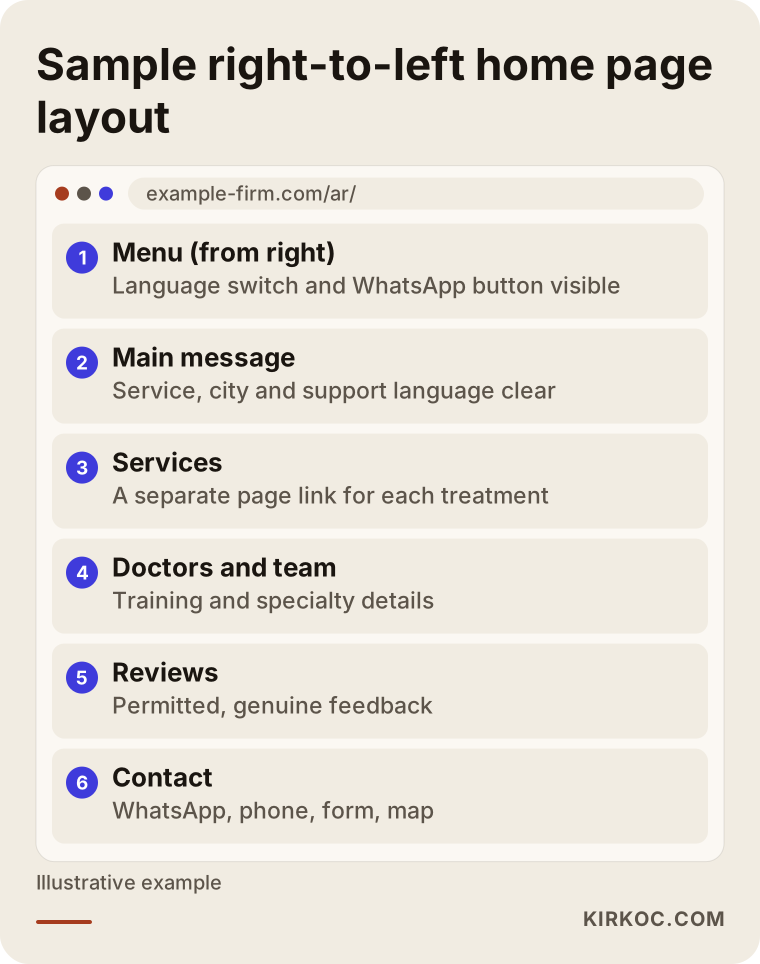
The illustration shows the order of a hypothetical clinic's home page. The point to notice is that the contact route appears both at the top and at the bottom of the page. Someone looking from the Gulf should be able to reach you without reading a long page to the end.
Fonts and readability
Not every font shows Arabic well. A stylish font chosen for Latin letters will either not show Arabic characters at all or show them broken. You need a font designed for Arabic, usually with slightly more generous line spacing, because Arabic letters carry marks above and below them. Numbers need attention too. Some readers are used to Eastern Arabic numerals and others to the numerals we use in English. The site should make one consistent choice and avoid confusion in phone numbers, prices and opening hours.
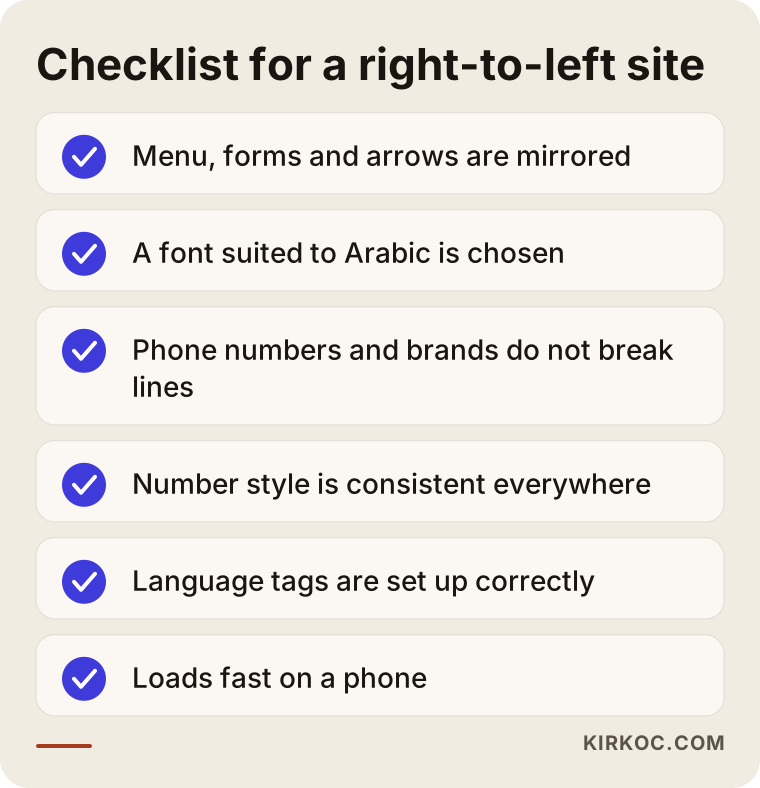
The list above is a simple checklist you can use when talking to a developer or an agency. If you get "I don't know" for several of these items, the person has probably never done this kind of work before.
Translation, or content written for Arabic readers?
Machine translation is fast and cheap, but in Arabic the result is often risky. In areas like health, law and pricing, a sentence that is misunderstood does more than look bad; it damages your reputation. More importantly, a directly translated text is not built around the reader's questions. In English or Turkish, "book an appointment" may be enough. For someone coming from the Gulf, questions about visas, accommodation, airport pickup, interpreters and payment methods expect answers on the very first page.
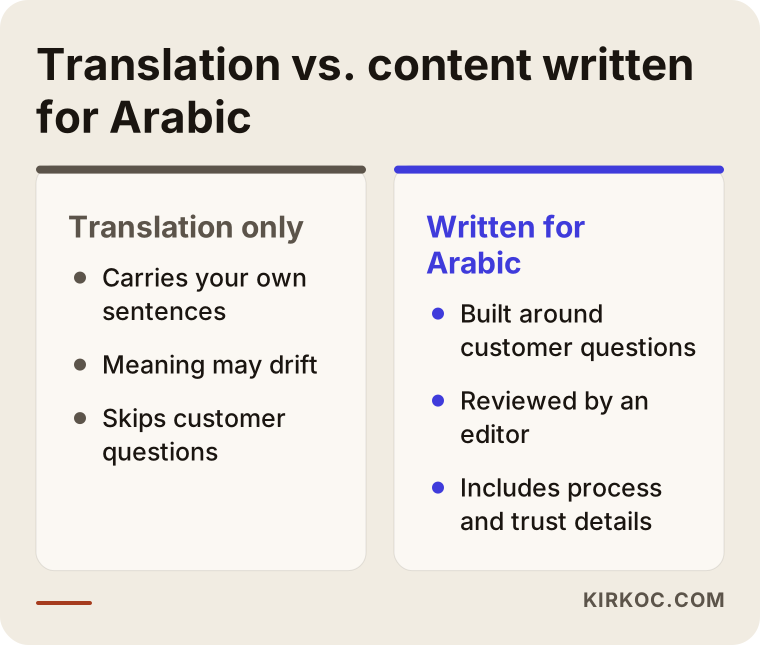
The comparison in the illustration comes down to one sentence: translation carries what you say, while content written for Arabic readers answers what the customer asks. In practice the healthiest method is to prepare a draft, have it corrected by an editor whose first language is Arabic, and, for sensitive topics such as health, have a qualified person approve it.
Which pages do you need?
You do not have to translate everything. A small, focused set is better to start with: a home page, your main service or product pages, a page explaining the process ("what happens from the first message to the follow-up"), frequently asked questions, an about page and a contact page. In medical tourism, add a doctor or team page, before-and-after examples (with permission and in a lawful way) and travel and accommodation information. For manufacturers, add a catalog, certificates, the logic of minimum orders and the sample process.
The table below summarizes how different customer types need different pages.
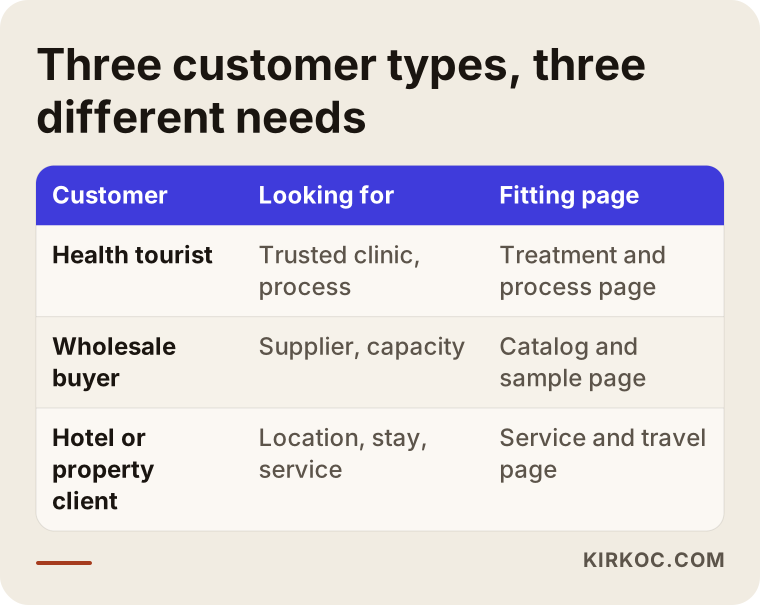
The conclusion from the table is that a health tourist, a wholesale buyer and a hotel or property client, all looking at the same Arabic site, want different things. If you try to answer all of them with a single home page, you will fully satisfy none.
The technical side: address structure, language tags and speed
I will get a little technical here, but I will keep it plain. Where you publish the Arabic version is an important decision. There are three ways: a separate domain, a subdomain, or a folder inside your existing site (like example-company.com/ar/). For small and mid-sized businesses the folder approach is often the healthiest, because the reputation of the existing site helps the Arabic pages too, and everything is managed in one place. That is not true in every case, though; if you are aiming for a strong local domain specific to one country, the picture can change.
The second topic is language tags. To tell a search engine "the Arabic version of this page is here," the page code carries language and region information. If these tags are set up wrongly, someone searching in Arabic may be shown a Turkish or English page. The third topic is speed. A customer in the Gulf is usually on a phone, and a heavy page that loads slowly from a server far away can lose them. That is why shrinking images and reviewing the server location matter.
Finally, there are users who ask AI assistants such as ChatGPT or Gemini for recommendations in Arabic. These assistants tend to lean on pages that look clear, well organized and trustworthy. An Arabic page that gives plain information and states your address and expertise openly is a good foundation for that as well, but nothing you write can guarantee that you will appear in an assistant's answer.
Trust signals: what does an Arab customer look at?
Technical correctness alone is not enough; the customer wants to trust you when deciding. In medical tourism this trust matters most, because the person is going to another country and entrusting their body to someone. What builds trust is usually plain and concrete: real, well-shot photos of the clinic, the doctor's education and specialty, the languages you work in written out clearly, a visible address and map, an explanation of what the price depends on, and an official contact route next to WhatsApp.
Cultural sensitivities are part of this. Language that respects family and privacy, and information such as whether a female doctor or a female companion is available for a female patient, can be decisive for some customers. For food producers, making documents such as a halal certificate visible does the same job. Avoid exaggerated claims here: instead of "the best in the world," describe what you do and how you do it. Also, before publishing patient photos and reviews, ask a lawyer whether you comply with personal data and health advertising rules; it is not for me to make firm legal statements on that.
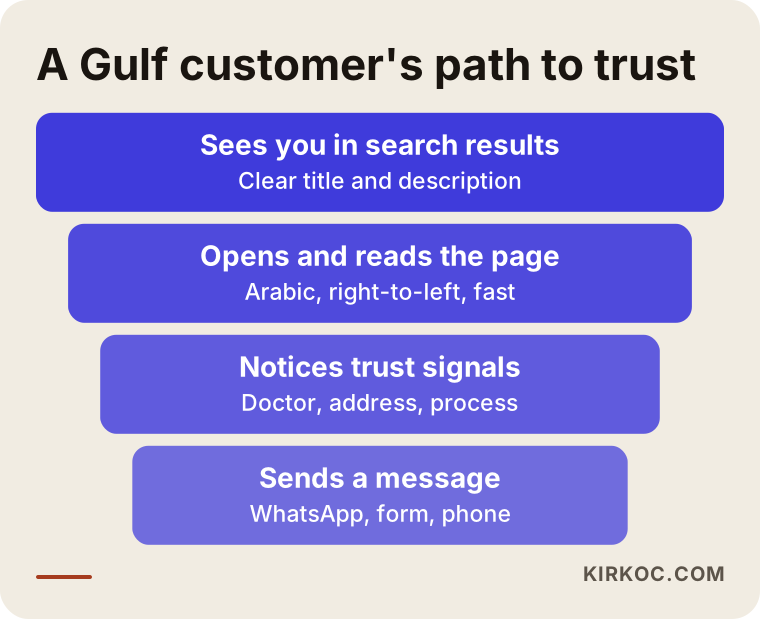
The funnel illustration shows that a share of people drops out at every stage. The aim is to find where the site loses the most people and to fix that first. For example, if many people open the page but nobody writes to you, the problem is not findability; it is trust and the contact route.
Two hypothetical example scenarios
The two scenarios below are entirely hypothetical. They do not describe a real company or person; they were made up only to show the logic.
Scenario 1: A dental clinic
Suppose there is a small dental clinic in Istanbul. Its site is in Turkish and English, with no Arabic. The clinic notices that Arabic messages on WhatsApp are increasing, but its way of winning customers depends entirely on personal chats. Three things are done as a first step: Arabic pages for the main treatments, a "from first message to appointment" process page, and a set of frequently asked questions. An editor whose first language is Arabic corrects the texts, and the doctor approves the medical wording. The site is rebuilt in a right-to-left layout, and a WhatsApp button appears on every page. Nobody expects to reach the first spot on a search engine right away. What is seen instead is that the messages arriving on WhatsApp become clearer: people come with some background information and stop asking the same question over and over. The clinic then looks at which pages are being used and decides what to expand.
Scenario 2: A furniture manufacturer
Suppose a furniture maker in Bursa wants to sell to hotel and housing projects in the Gulf. Its current site is only in Turkish and is built for retail. What is needed here is not retail logic but corporate trust: an Arabic catalog page, production capacity and certificate details, project references (told as examples, with permission and without naming people or firms), the sample process and a description of delivery. On the search side, buyers often write the product name in English and the city and country in Arabic, so the site uses bilingual product names. The goal is not direct sales; it is to receive the person asking for a quote through a form and WhatsApp. Since a buyer compares suppliers, the site also needs to answer questions clearly rather than stopping at "contact us."
The process, step by step
This is the order in which I usually run an Arabic site and SEO project. The order matters, because finishing the design and only then asking "which words do people search?" often means redoing everything.
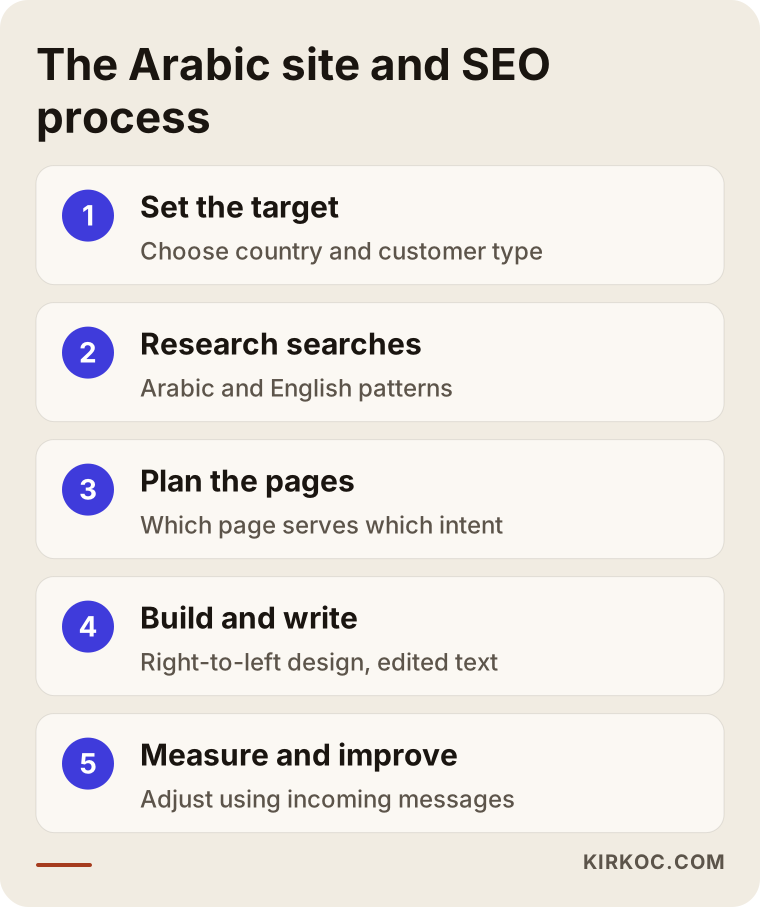
The first step is to define the target country and customer type. In the second step I research Arabic and English search patterns; I check which words are really used with search data and through the eyes of someone whose first language is Arabic, not by guessing. In the third step I draw up the page plan: which page answers which intent. In the fourth step the right-to-left design and technical setup are done. In the fifth step the texts are written and go through an editor and, when needed, a specialist. In the last step I publish, measure, and improve the pages by looking at the messages that come in.
What should you expect in the first three months?
To be realistic, this is not a job that gives quick results. In Arabic, competition is heavy in some subjects (especially medical tourism) and in others the scarcity of Arabic content is your opportunity. Which one applies to you depends on your topic. I cannot promise a ranking or a result, and nobody honestly can. But with steady, correct work you will see its traces over time in page views, incoming inquiries and search patterns.
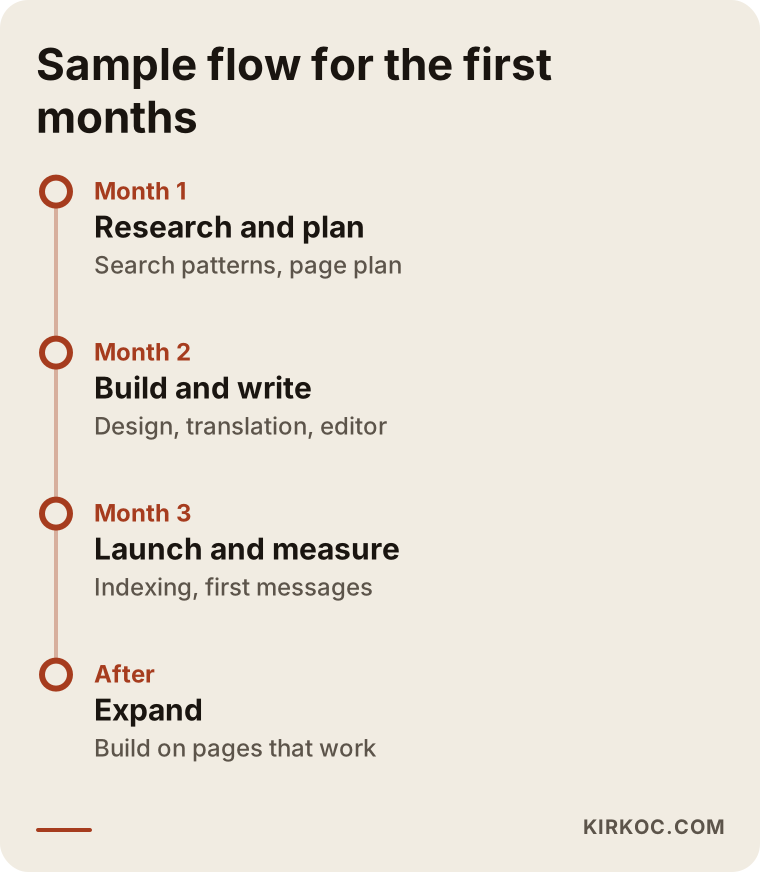
The timeline is an example flow; since every business is different, it is normal for the timing to shift. What matters is that at each stage you hold something measurable: pages that have gone live, addresses that have been indexed (added to Google's list of pages) and the number of messages received.
Common mistakes
Most of the mistakes I see in this area come from assuming the job is easy. The illustration below collects the most common ones.
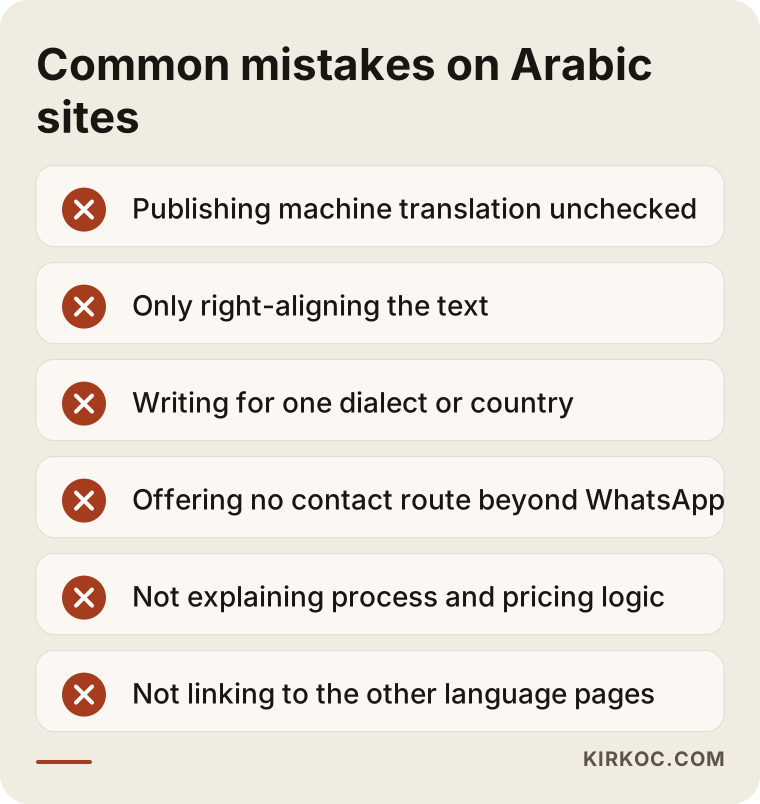
The most expensive mistake is publishing machine translation without having it checked. The second is right-aligning the Arabic pages and assuming the job is done, while the menu, forms and images still run left to right. The third is believing that text written for only one dialect or one country speaks to everyone. The fourth is offering no contact route other than WhatsApp, or the opposite: offering only a form and then taking days to reply. The fifth is giving no information at all about price logic and process; a customer in the Gulf compares options, and if they cannot find an answer, they move on to someone else.
Another mistake is treating the Arabic customer as a separate world and cutting the link with your existing site. The Arabic pages should be connected to your existing English and Turkish pages, and the search engine should be told clearly which page is the equivalent of which in another language.
What can you do yourself, and when do you need a specialist?
If your budget is limited, there are things you can do yourself. Write the Arabic messages you receive into a spreadsheet: which question comes in how many times? That list is the cheapest and most honest map of which pages need to be written. Look at your competitors' Arabic sites through a customer's eyes: what do they do well, and what is missing? Try Arabic and English search patterns on Google yourself and note the pages that come up. Also tidy up your current English and Turkish pages; adding Arabic on top of a weak foundation makes the problem bigger.
Specialist help is needed when the site has to be built from scratch as right-to-left, when language tags and address structure must be set correctly, when technical consistency has to be kept across a multilingual site, and when a page plan based on search data is needed. On the copy side, an editor whose first language is Arabic is essential; I would not recommend that anyone do that part in my place, and I do not do it myself.
What determines the cost?
I do not give numbers, because no two projects are alike. What I can tell you is what drives the cost. The first factor is the number of pages: a seven-page site and a fifty-page catalog are not the same job. The second is the condition of your current site; adding Arabic to a cleanly built site is easier than rescuing an old, messy one. The third is the scope of the writing and editing work: medical or technical content needs more checking. The fourth is the number of target countries and how intense the competition is. The fifth is whether you want continuous content and follow-up after the initial setup.
There is also a hidden cost: the capacity to respond. An Arabic site brings messages, and if nobody can answer them quickly and well in Arabic, or at least in English, part of the investment is wasted. I recommend planning for this from the start.
How I work with you
I work alone, so the person you talk to is the person doing the work. First I look at your current situation and your goal, and I tell you honestly whether an Arabic investment makes sense for you. If it does not, I say so. If it does, I run the page plan, the technical setup and the SEO side myself; for the Arabic copy and editing, I ask that a translator and editor whose first language is Arabic be involved. Throughout the process I explain what I am doing in plain language and go through the results with you.
Frequently asked questions
Do I need an English site before I build an Arabic one?
It is not mandatory, but it often makes sense. A good share of customers in the Gulf also read English, and English pages reach a wider audience. If your budget is limited, building English solidly first and adding Arabic according to the demand that comes in lowers the risk.
Can I just use Google Translate for an Arabic site?
I would not recommend it. Machine translation is sometimes understandable and sometimes wrong and awkward; in areas like health and pricing, that is a serious risk. It can serve as a rough draft, but an editor whose first language is Arabic must correct it before it goes live.
Is Arabic SEO different from English SEO?
Yes. Search patterns, page direction and trust expectations are all different. And because dialects differ in Arabic, choosing words cannot be solved by translation alone; you have to find the phrases people actually search for.
Which country should I target?
Look at the data you already have. Which country do your messages, calls or visits come from? Rather than targeting all of them at once, it is healthier to start with the one or two countries that send the most demand and widen the scope based on results.
What should I watch out for on medical tourism sites?
Doctor information, a realistic description of the procedure, avoiding promises of guaranteed results, and protecting patient data come first. I recommend asking a lawyer about the rules on health advertising and personal data; I do not give firm legal interpretations in this area.
How long until I see results?
It depends on your subject, the competition and the condition of your current site. I do not promise a fixed time or a ranking. But from the first weeks we can track the visibility of the pages that go live, the quality of the inquiries and the number of messages.
Should I get a separate domain for the Arabic site?
For most businesses, an Arabic section inside the existing site is enough and easier to manage. If you aim for a strong brand specific to one country, a separate domain can be considered. We would decide together based on your situation.
Is a WhatsApp button enough as a contact route?
For many Gulf customers WhatsApp may be the most comfortable channel, but it is not enough on its own. Having a phone number, an email address and a form as well builds trust and meets different habits. What matters is that you can answer incoming messages quickly.
If you are considering an Arabic site and SEO work for the Arab market, we can look at your current situation together and talk openly about whether it suits you; you can start by writing to me through my SEO services page.