You run a business in Antalya. Maybe it is a boutique hotel, a handful of rental villas, a boat tour, a restaurant or a dental clinic. All summer the phone never stops, but once the season ends it goes quiet. You have also noticed something else: most of your guests arrive through an intermediary site or a platform that takes a commission. Your own website either does not exist, is out of date, or looks broken when someone opens it on a phone. So you typed "web design Antalya" into Google, and now you are looking at dozens of companies and dozens of very different quotes.
In this article I explain what to watch for when you hire someone to build a website for an Antalya business, which problems are specific to tourism, why a multilingual site is a separate job from a single-language one, and how the process works from the first conversation to launch. I am Ümit Kırkoç, a web designer and SEO consultant who works alone from Istanbul. Where it is relevant, I will also be plain about what my own website design service does and does not cover.
First, a quick definition. Web design is not only drawing how a site looks. It also covers which pages the site contains, in what order a visitor reads things, how the site behaves on a phone, and how search engines find it. A beautiful site that nobody finds, or that nobody understands once they land on it, is like a shop with the shutters down.
Why is a website in Antalya different from one in other cities?
Antalya is unlike most places in Turkey, and in fact unlike most places anywhere. A large share of your customers do not live in the city. They live in another country, speak another language, and are planning a holiday months ahead. A family in Germany, a couple in Sweden or a group in Eastern Europe starts researching long before they pack. These people do not find your site with a Turkish search. They search in their own language, on their own country's version of Google, and they want to read the answer in that same language.
That has three consequences. First, if your site is in one language only, you are losing the most valuable guests of the season before they even see your name. Second, translating a page is not the same as localizing it. What a German guest asks before booking is not what a British guest asks, and neither matches what a Turkish guest asks. Third, the season is sharp. For a site to bring in bookings in May, it often has to be planned and published during the winter. Trying to build a website once the season has started is like laying water pipes after the fire has begun.
There is also the power of the intermediaries. The big booking platforms and comparison sites advertise on your behalf, give guests a sense of safety, and charge you a commission in return. I am not suggesting you walk away from them. For most businesses the realistic plan is to keep them as one channel and grow your own website as a second one. The goal is simply to increase the number of guests who contact you directly over time.
The illustration below uses a completely invented example to show what a foreign visitor's search might look like in their own language, and why a clear page stands out.
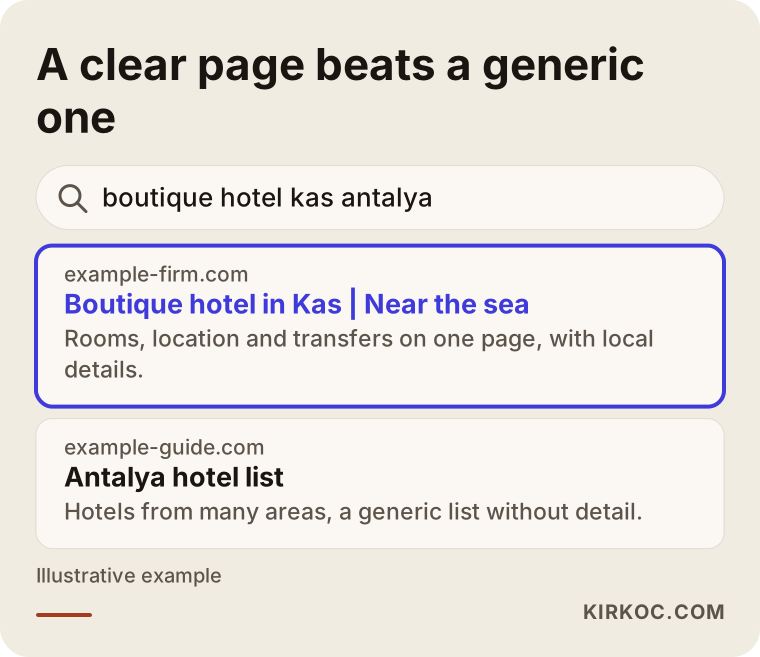
What the highlighted result does is simple. In its first line it says where the property is, what it offers and who it is for. A generic page that says "the best places in Antalya" does none of that. A search engine is always trying to work out which answer to give the person searching, and if you make that job easier, it can show you more confidently. I should add that this is not a guarantee of any position. No honest specialist can promise you a ranking.
How does a guest actually search for Antalya?
Tourism searches usually pass through three layers. In the first layer the person has not decided anything yet. They ask broad questions such as "where to stay in Antalya" or "which part of Antalya is best for a holiday." There are many competitors here, and large sites dominate. In the second layer the area or the type of stay has become clear, for example "boutique hotel in Kas," "villa rental in Kalkan" or "family hotel in Belek." In the third layer the person is very close to deciding: "beachfront guesthouse in Kas availability" or "hotel in Side with airport transfer."
For a small or mid-sized business, the realistic opportunity is in the second and third layers. Competing with giant platforms on broad searches usually makes little sense. But a page that clearly describes your area, your type of property and the kind of guest you welcome can be visible on narrow searches. The next illustration shows these layers from broad to narrow.
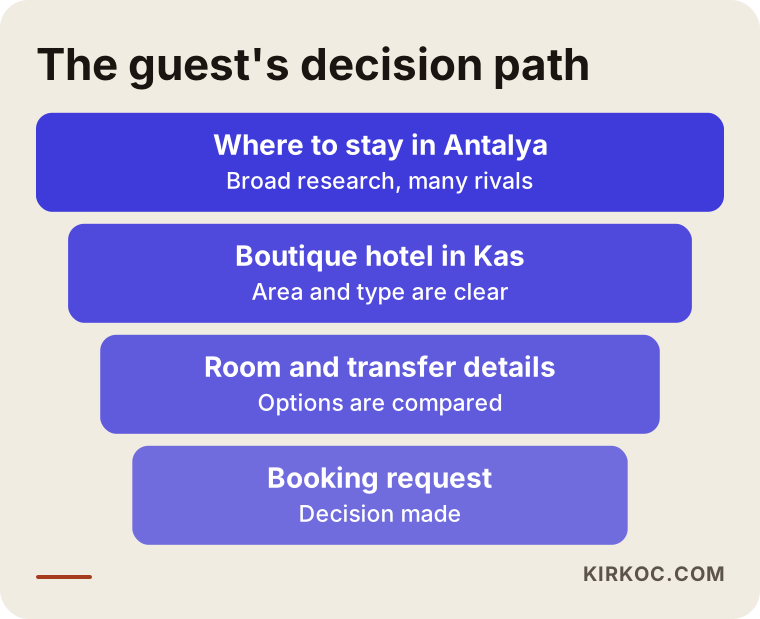
Each stage in this funnel needs its own page or piece of content. At the first stage, a guide article that helps the reader choose. At the second, an area page and a property-type page. At the last, a room or service page and a clear way to book. Trying to squeeze all of this into a single home page means that you answer none of the stages properly.
Which pages does a tourism website need?
Whatever your sector, a tourism website should be a path to a sale, not a brochure. That means thinking about the page structure before anything else. The outline below describes a typical skeleton for an Antalya business. In your case some pages will be unnecessary and some will be missing.
The home page should tell the visitor four things in the first five seconds: where you are, what you offer, who it suits and what you want them to do next. A huge promotional video or a slow image slider often buries that information. Room or service pages should be separate for each option, with real photos and clear details. A location page should explain the distance to the beach and the airport, what is nearby and how to get there, because a foreign guest is always looking for the answer to "how long is the drive from the airport." A frequently asked questions page collects the questions you answer by phone again and again into one place. The contact and booking page is the most critical page of all: your phone number, your messaging app and your form should be obvious at a glance.
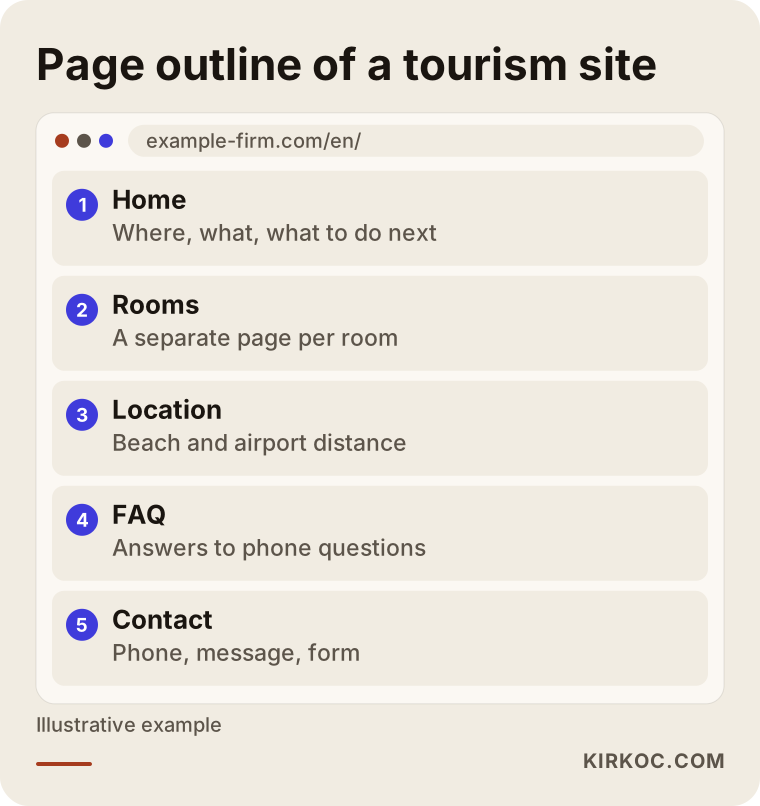
The point I want to stress in this overview is that every page has exactly one job. An "About us" page and a room page do not do the same thing: the first builds trust, the second makes the sale. If you blur the two, both get weaker. Everything I describe here has to be adapted to the reality of your own business.
The phone screen is the first screen
In tourism, most visitors look at your site on a phone. On the beach, at the airport, on the plane or in a cafe. So the site must open quickly on a phone, the text must be readable, the buttons must be easy to press with a thumb, and the booking button should always be visible. A site that looks good on a desktop but forces you to pinch and zoom on a phone will lose you the most valuable guest of the season. Speed belongs to the same topic: a visitor abroad sometimes has a slow connection, and heavy images can make that person leave before the page has even appeared.
A multilingual website: translation is not enough
This is the most critical topic for Antalya, and the one people most often get wrong. The request "make my site in English, German and Russian" sounds simple. But a multilingual site is not a single site whose text has been run through a translator. Each language speaks to its own group of customers.
Think about a few concrete differences. A German guest often expects clear information, cleanliness and a plan, and will ask in detail what the price includes, what the cancellation terms are and how to get there. A Scandinavian guest tends to like a calm, nature-focused and plain style of writing. A Russian-speaking guest often pays more attention to all-inclusive packages and to rich visuals. These are generalizations, and every guest is different. Still, instead of translating one text into every language, it makes sense to think about which questions you answer for each language.
There are technical decisions too. Each language should have its own address, for example a separate language folder under your main domain. Each language page should tell search engines "this page is the version in this language." If you skip this, a search engine may treat the same content as duplicates, or show the wrong page to a visitor in the wrong language. Currency, date format, phone country code and units of measurement should also fit the language of the page.
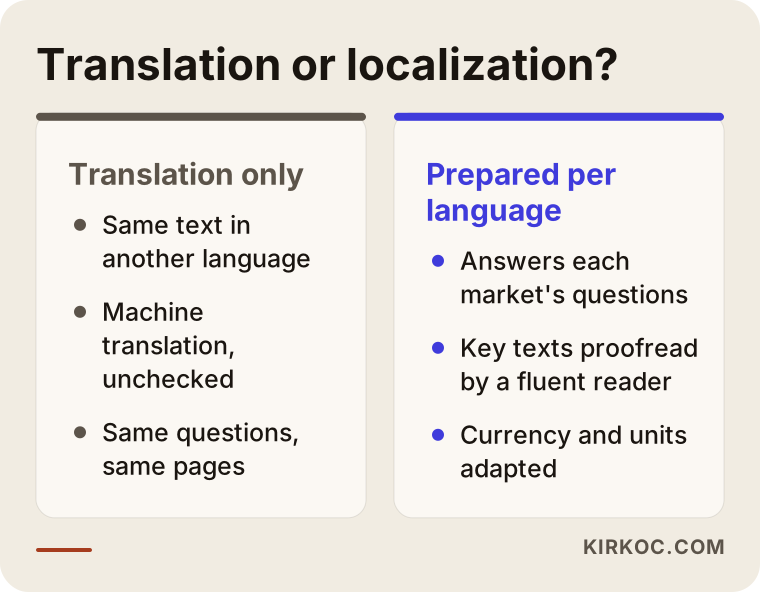
The summary of this comparison is that automatic translation can be used as a starting draft, but it should not be the whole job. A clumsy or robotic sentence destroys trust at once. Texts that involve money and rights, such as room descriptions, cancellation terms and what a service includes, should be read by someone who knows the language well. For anything that works like a contract in a foreign language, I also recommend talking to a lawyer. I do not give legal opinions.
How many languages are enough?
Not every business needs four or five languages. The sensible way is to look at your existing customer base. You can work out from last season's booking records which countries your guests came from. At the start, doing the two or three languages that bring the most business well is better than doing six languages carelessly. You can add a new language as income allows. Adding a language is easy on a well-built structure; on a structure that was built wrongly from the beginning, it can mean almost starting over.
Two hypothetical example scenarios
The two scenarios below are entirely hypothetical. They do not describe a real business. They are only here to show the reasoning.
Scenario 1: a small boutique guesthouse in Kas
Suppose there is an eight-room guesthouse in Kas. The owner gets most guests from two big booking platforms and pays a commission on every reservation. The guesthouse's own site was built years ago, does not display properly on a phone and is only in Turkish. The owner wants more direct guests, but the budget is limited.
In this situation my first job would not be to build a large site. I would start by looking at which countries the current guests come from. Say most of them come from two language groups. I would build a short but full site in those two languages: a home page, a separate page for each room, location and transfers, frequently asked questions and contact. I would also add a guide article such as "where to stay in Kas," because people usually search for an area before they know the name of a property. For bookings, a simple request form and a message button may be enough at first, rather than a complicated system. I would launch before the season opens, look at which pages bring what during the first season, and expand in the second. I would not promise any result in this scenario. But building a solid structure first makes every later investment more efficient.
Scenario 2: a dental clinic in central Antalya
The second hypothetical example is a dental clinic that wants to open up to health tourism. The clinic serves local patients but also wants to open a door for patients from abroad. The logic differs from a hotel's: a patient who is deciding looks at trust, expertise and how transparent the process is. The visitor asks, "what will be done, how many visits will it take, how do I plan my trip around it, and what happens if something goes wrong?"
This clinic's site should have a separate page for each treatment, information about the dentists' training and experience, a section that explains the process step by step, and a frequently asked questions page. It should avoid exaggerated claims about treatment results. Health advertising is subject to legal limits, so it is wise to ask a lawyer or the relevant professional body about the rules. For the foreign languages, what matters this time is less the translation and more answering the patient's worries in their own language. The contact channels (messaging app, form, phone) should be obvious, and any promise of a quick reply should be realistic. Here the site is not an ordinary brochure; it is a first consultation that builds trust.
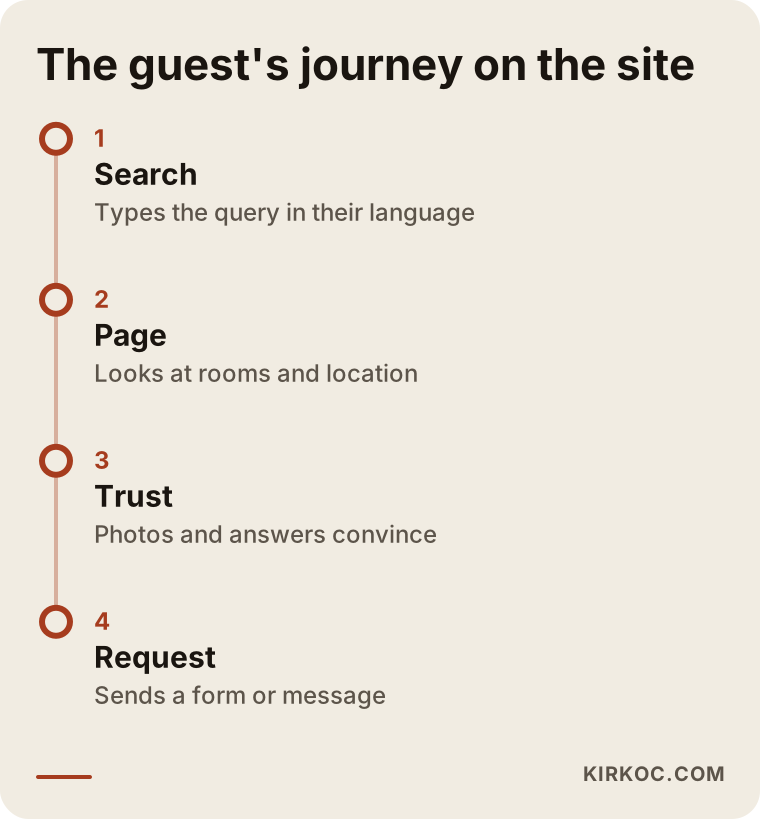
The journey above is similar in both scenarios: first be found, then gain trust, then get in touch. The difference lies in which information should come first at which stage.
How does the website process work?
The process varies from business to business, but the basic flow is similar. This is the order I follow in my own work.
The first step is an introductory conversation and setting goals. I listen to your business, your guest profile, your current problems and your aims. At this stage we look together for answers to questions like how many languages, which pages and how bookings will be taken. The second step is the structure and content plan. I put in writing the page outline, which pages will exist in which language and what job each page has. There is no design yet, because a beautiful design is useless if the structure is wrong. The third step is design and content. The look, colors, photos and texts are prepared. It is best if you supply the photos: real photos of your real property build more trust than stock images. The fourth step is development and testing. The site is built and tried on a phone, in different browsers and on a slow connection. The fifth step is launch and measurement. The site goes live, search engines are told about it and visitor behavior starts to be tracked. The sixth step is care and growth: an end-of-season report, and adding a new language or page.
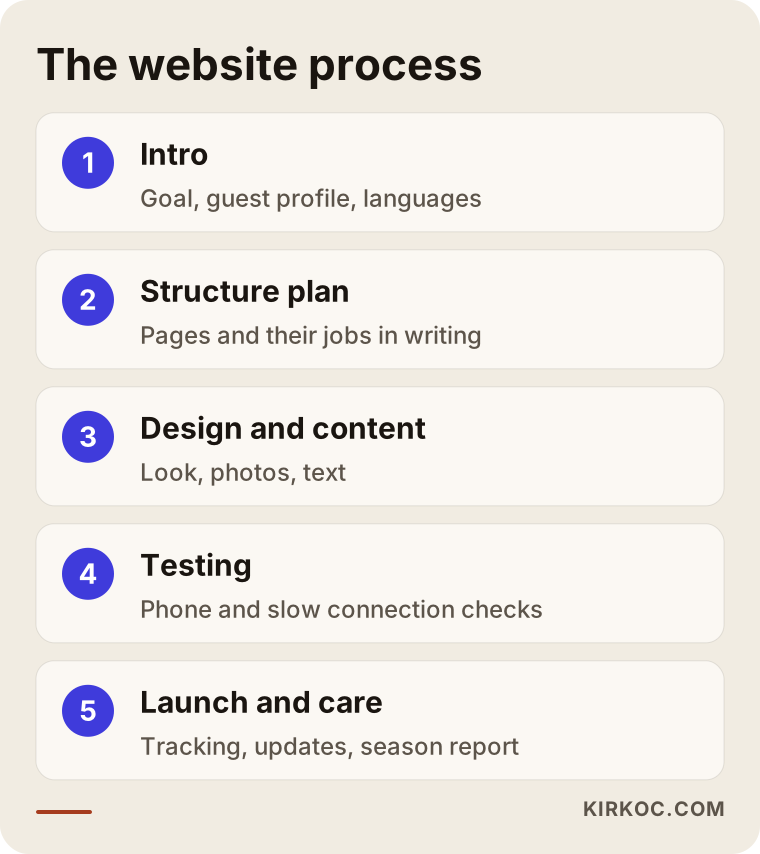
The most important detail in the timeline is the season calendar. To launch before the season opens, you need to plan backwards from that date. Gathering content often takes longer than expected, because photos, room details and approval of translations all wait on the business to come back with them. That is why I suggest naming one person at the start. Having a single person to reach for every question speeds the whole process up.
Common mistakes when hiring web design in Antalya
These are the mistakes I most often see or hear about. Knowing them will help you make firmer decisions of your own.
The first is choosing a site only by how it looks. Anyone who sends you a quote can show you a pretty example; the real questions are how the site appears in search and how it works on a phone. The second is handling several languages in one click. Broken sentences from an automatic translation plugin damage trust at once, especially with foreign guests. The third is leaving the booking path complicated. If a visitor has been through three pages and still cannot find out how to book, they leave. The fourth is using heavy images; huge photos slow the site down. The fifth is building a site once and forgetting it. If prices, room details and opening dates are not kept current, the site starts giving wrong information. The sixth is losing ownership of the site: you must have the domain name and the hosting account registered in your own name. If you and the person or company you worked with part ways one day, losing access to your site is a serious problem.
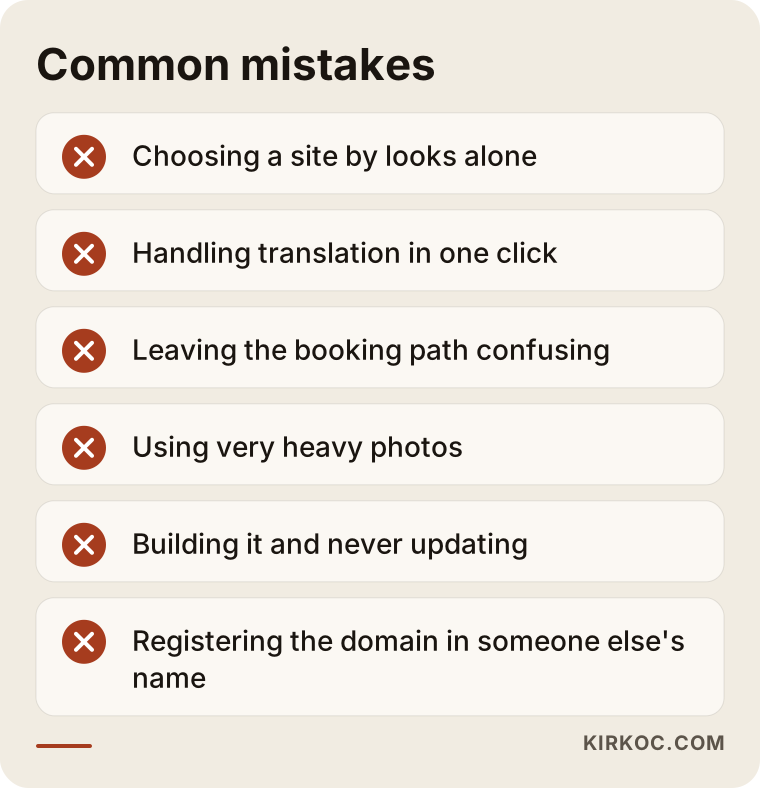
Most of these mistakes can be avoided by asking a few questions at the start. When you collect quotes, I suggest asking these: will each language have its own address, whose photos will be used, in whose name will the domain be registered, who will look after the site after launch, and whom do I contact when something goes wrong?
What can you do yourself, and when do you need a specialist?
You do not need an expert for everything. There are jobs you can do on your own that will directly help your site.
Start by reviewing your business details: address, phone number, opening hours and seasonal opening and closing dates should be identical everywhere. Keep your business listing on the map service up to date, add real photos and reply politely to guest reviews. These listings are an important part of how visible you are in local searches. Write down the questions guests ask most often; that list is ready raw material for both your frequently asked questions page and your guide articles. Take your own photos and archive them in an orderly way. And work out from your booking records which countries your guests come from.
When do you need a specialist? When you are building a site from scratch, when you will manage more than one language, when you have speed and display problems on phones, when you do not appear in search at all, or when you want to connect a booking system to your site. These are jobs that need technical knowledge and are expensive to fix afterward if they were set up wrongly.
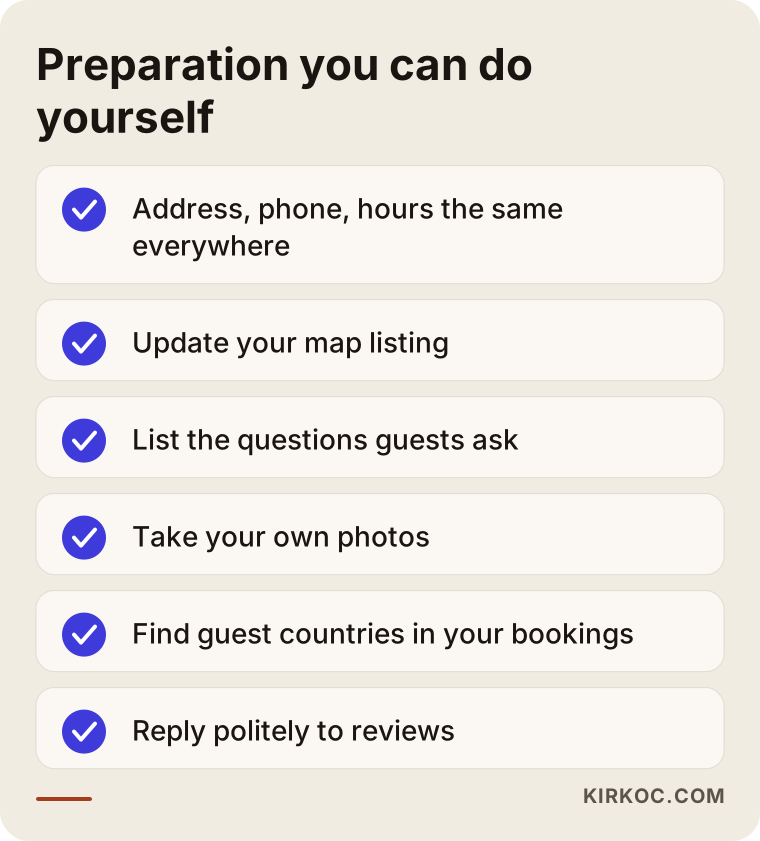
This checklist does not replace an expert. But if you do it before you start working with one, it speeds up the process and makes the conversation about the quote more concrete. Working with a prepared client is more efficient for everyone.
Ready-made template or custom design?
This question comes up a lot. A ready-made template is quicker and cheaper, and it can be a sensible starting point for a small business. But templates are often full of features you do not need, can cause speed problems and may not fit a multilingual structure well. A custom design is built around the needs of your business: page structure, speed and languages are thought through from the start. Which one suits you depends on your budget, your goal and your growth plans. My honest advice is to first be clear about what you want, and then choose the solution. Picking the wrong solution costs more in the long run, even if it looked cheaper at the beginning.
What determines the cost
I am not giving a price in numbers in this article, because no two properties will get the same quote. But I can say clearly what the price depends on, so that you can compare quotes properly.
The first factor is the number of languages; each extra language means not only translation but also content suited to that language, testing and upkeep. The second is the number of pages and the amount of content: a ten-page site and a fifty-page site are not the same job. The third is who prepares the content: if photos, text and translation arrive ready, the work shrinks; if everything has to be produced from scratch, it grows. The fourth is the booking system: there is a big difference between a simple request form and a system that shows live availability and takes payment. The fifth is the type of design: whether it draws on a ready-made structure or is designed entirely for you. The sixth is search engine work: whether the site is only built, or whether content and technical optimization for visibility are included. The seventh is support after launch: upkeep, updates and a season report can be a separate item.
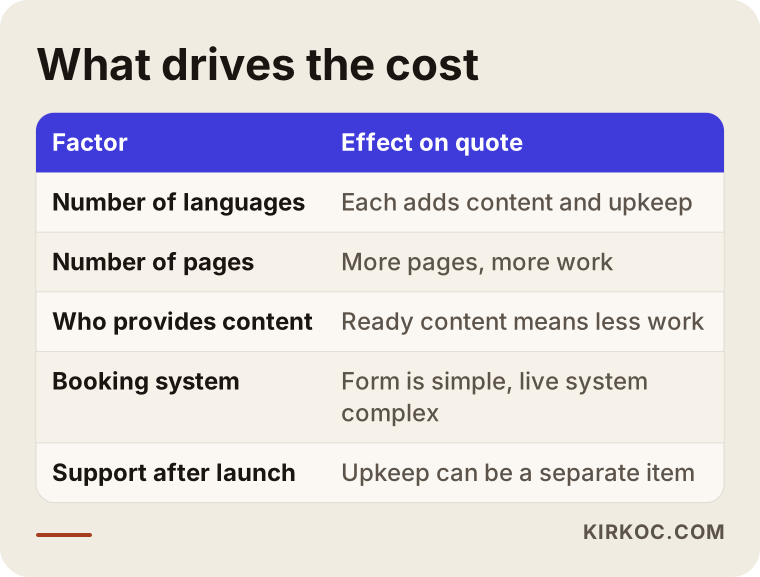
You can use this table as a frame when you ask for quotes. If two quotes are far apart, you will usually find that one of the items above is included in one and left out of the other. A low quote can look attractive, but if its scope is a single language, a limited number of pages and no upkeep, the real cost appears later. I suggest asking for the quote itemized wherever possible.
How I work
I work alone, which means the person you talk to is the person who does the work. Messages are not passed between a sales team and a production team. That is an advantage, and it is also a limit: I take only a limited number of projects at a time, and my calendar can fill up in the busy period before the season. For that reason, in a place like Antalya where the season is fixed, meeting early makes things easier.
I am based in Istanbul and I work remotely; meetings take place by video call and messages. Not being in Antalya is not an obstacle for this kind of project. I receive photos and information digitally, and if needed we can walk through your property on a video call. I share the structure plan in writing, ask for your approval at each step, and make sure the domain and accounts are in your name once the site is live. I do not promise results or rankings in advance, because nobody can know beforehand how search engines will behave. What I can offer is a correctly built structure, clear communication and a measurable starting point.
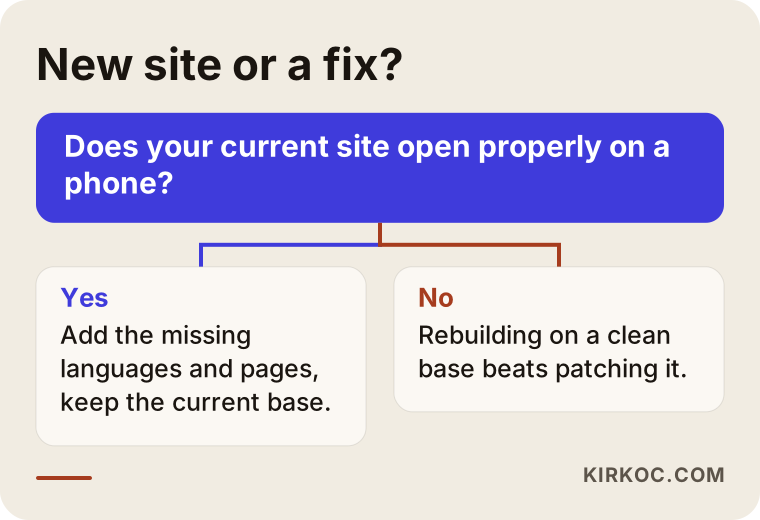
The decision chart above is a simple guide for a business deciding between a new site and fixing the current one. In both cases the first step is the same: see honestly what your current site does and what it does not do.
Frequently Asked Questions
Do I need to be at my business to get a website built in Antalya?
No. The work is largely done remotely. Photos, information and approvals are shared digitally, and when needed your property can be toured together on a video call. If you would like to meet in person, we can discuss that separately.
How many languages should my site have?
There is no fixed number. Look at which countries your guests came from last season and which countries you would like them to come from. In general, doing the two or three languages that bring the most business well is better than doing many languages carelessly. You can add a language later, as long as the structure was built for that from the start.
Is automatic translation enough?
It can work as a draft to start with, but it is not enough on its own. Important texts such as cancellation terms, the scope of a service and room descriptions need to be read by someone who knows the language well. One clumsy sentence can reduce trust quickly.
Should I give up the booking platforms?
For most businesses that is not a realistic recommendation. The platforms bring you guests, and giving them up can be risky. A more sensible path is to keep them as a channel and, over time, strengthen your own site for direct bookings. Read your own contracts for the commission and terms, and talk to a lawyer if you need to.
Will my ranking go up as soon as the site is live?
No, and nobody can guarantee it. It takes time for a new site to earn a place in search, and it depends on competition, content and the quality of the site. A correctly built structure makes the process easier, but promising an exact time or position would not be honest.
Whose name should the domain and hosting be in?
Yours, or your business's. Settle this at the very start. If you and the person or company you work with part ways, having the accounts in your hands keeps your access to the site secure.
Can I update the site myself after it is built?
Yes, and that is often what people want. A control panel can be set up so that you can make small changes such as prices, opening dates or announcements yourself. For big structural changes, getting support is safer. Talking about this at the start of the project saves you from surprises later.
Is there anything I should be careful about in the content of regulated sectors such as health or tourism?
Yes. In some sectors there may be legal limits on advertising and promotional content. Ask the relevant professional body or a lawyer which statements you may use. I cannot give legal advice on this, but I can help you build the page structure and the order of the content accordingly.
If you are thinking about building your own site in Antalya, reaching foreign guests in their own language, or fixing the site you already have, simply tell me about your business and your goal. You can reach me through my website design service page, and together we can look at which step makes sense for you.