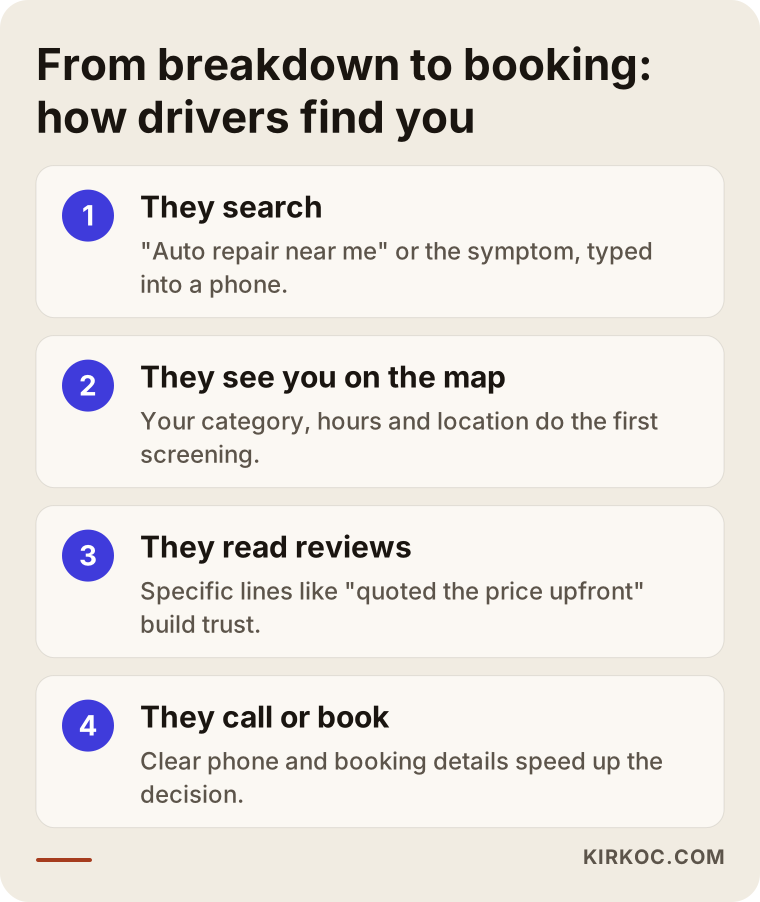
When someone's car is dead on the shoulder or a warning light just came on, they pick up their phone and type "auto repair near me." Is your shop one of the first three results? In this trade, customers are often in a hurry and rarely scroll. That's the moment SEO services are built for, and below I explain what actually moves the needle for repair shops, tire dealers and body shops, and what quietly holds you back.
How people search for a mechanic
There are two kinds of searches, and they need different work.
Urgent searches: "tire repair near me," "battery replacement," "grinding noise when braking." The driver decides fast and looks at the map, the phone number and whether you're open right now.
Research searches: "transmission service for a Honda Accord," "how long does collision repair take." The driver is calmer, compares a few shops and reads reviews.
For the first kind, your Google Business Profile wins. For the second, the shop that answers the question plainly on its website wins.
Your Google Business Profile: the door for urgent searches
For nearby searches Google shows a map with business profiles at the top. So the profile is the first thing I fix:
- The right primary category (for example "Auto repair shop" or "Tire shop"), without piling on unrelated extras.
- Accurate hours, including weekends and holidays, kept current.
- Phone, address and location that match your website exactly.
- Real photos of your bays, equipment, storefront and team.
- Every service listed individually: oil changes, alignments, collision work, paint, A/C service.
I describe a quick self-check in Is your Google Business Profile healthy?
How much reviews weigh
Handing over your keys is an act of trust, so reviews matter more here than in most trades. What the review says counts more than the star count: "they quoted the price upfront" or "they showed me the worn part" persuades a new customer.
What you can do:
- Send a short message with the review link after a completed job.
- Reply to negative reviews calmly, specifically and personally. Don't argue.
- Never offer discounts or gifts in exchange for reviews; platform rules forbid it.
More on this in Do Google reviews bring customers?
Make-and-model service pages
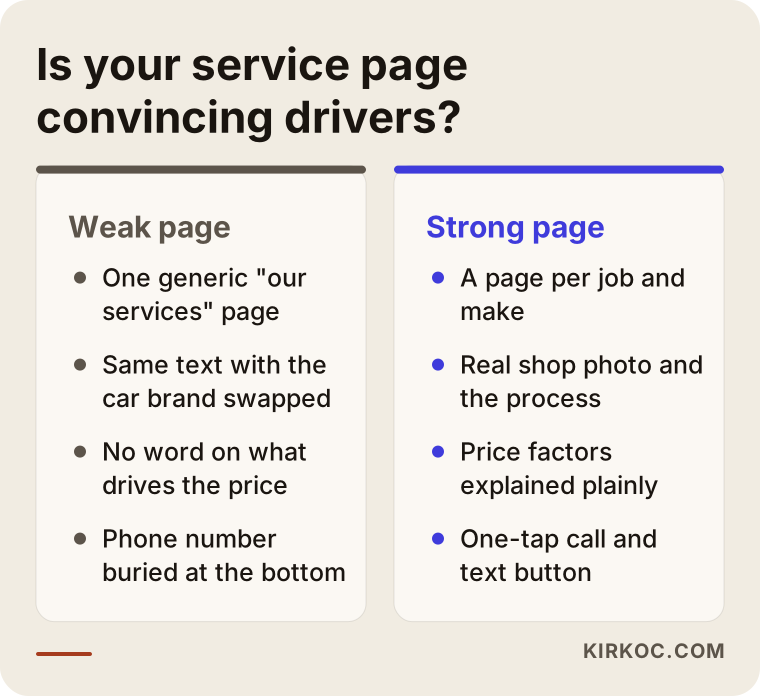
One generic "our services" page isn't enough. Searches like "Toyota service," "brake pads for a Ford F-150" or "winter tire swap" deserve their own pages. The rule: only build pages for work you truly do.
A good service page includes:
- Which job you do and for which makes and models.
- Roughly how the job goes and how long it takes.
- What drives the price (parts, labor, vehicle condition). You don't need to publish numbers, but explaining what it depends on builds trust.
- A real photo from your shop and a one-tap call or text button to book.
Copying the same text and swapping the car brand backfires. Google notices, and so do customers.
Clear information: booking, hours, process
Drivers dislike uncertainty. Your site and profile should say plainly:
- Is an appointment required, or can people walk in?
- Opening hours and how to reach you in an emergency.
- How a job works: diagnosis first, then approval, then repair.
- Warranty and return terms, as far as you offer them.
This reassures customers and cuts a lot of unnecessary phone calls. If you serve several towns, see whether each area needs its own page.
Differences for tire dealers, body shops and general repair
Each trade's customer thinks a little differently. For tire dealers, timing and seasons drive demand: searches for tire changes climb as winter approaches, so preparing pages and profile photos before that period pays off. Body shops often deal with insurance and estimates, so before-and-after photos and a clear explanation of the steps build trust. For general repair, what people want most is a mechanic who explains the problem plainly and doesn't add unnecessary work.
Two shops, two different problems
Even within the same trade, every shop gets stuck in a different place. Here are two examples, composites based on situations I see, with the details generalized.
Scenario 1: An independent mechanic in an industrial park
A mechanic who runs a small garage in an industrial area came to me and said, "My phone rings all day, but most callers only ask for a price." His business profile had the right main category, but the opening hours were out of date, the photos were years old, and the services list was empty. His website had one single "our services" page.
We fixed the profile first: hours, services, and fresh photos from the garage floor. Then we wrote separate pages for the two jobs he does most, routine maintenance and brake repair. The pages explained how each job goes and what drives the price, without quoting numbers. Within a few weeks the calls changed: fewer people asking only about price, more asking "are you free on Thursday?" I'm sharing this as something I observed, not a promise. Results differ from one area to the next.
Scenario 2: A tire shop with a seasonal rush
A tire dealer in a small town told me he couldn't keep up when winter arrived, yet the shop sat quiet all summer. The problem was less visibility than timing. He had a winter tire page, but he had updated it after the season had already started, and his photos and hours were late too.
We built a seasonal calendar. The winter tire page and the profile photos get prepared before the season, and in the quiet months the shop pushes wheel alignment, rim repair and tire storage. The goal was not to make the rush bigger but to spread work across the year. A setup like this is realistic, though how much it changes depends on the competition where you are.
Step by step: how to get started
Whether you work with me or do it yourself, the order is roughly the same. Getting the order wrong wastes effort.
1. See where you stand
Search "auto repair near me" and "[make] service" on your phone, ideally from a few streets away from the shop. If you are not in the first five, look at who is. Study their profiles: how many photos, how they answer reviews, which services they list.
2. Fix the profile
Category, hours, phone, address and services list get completed. This is usually the step that pays off fastest, and it costs no budget.
3. Build a review habit
Tie a short message with the review link to every vehicle handover. A few new reviews every month are healthier than a one-time push.
4. Write the pages that earn the most
Start with the job that brings in the most money. Each page should answer one job and one customer question.
5. Measure and adjust
Watch how calls, direction requests and booking requests change. These matter more than rankings, because in the end what counts is the phone ringing.
A weekly checklist
A profile and a website are not things you set up once and forget. A small routine is much cheaper than a big cleanup later. The summary below puts your weekly look into one picture.
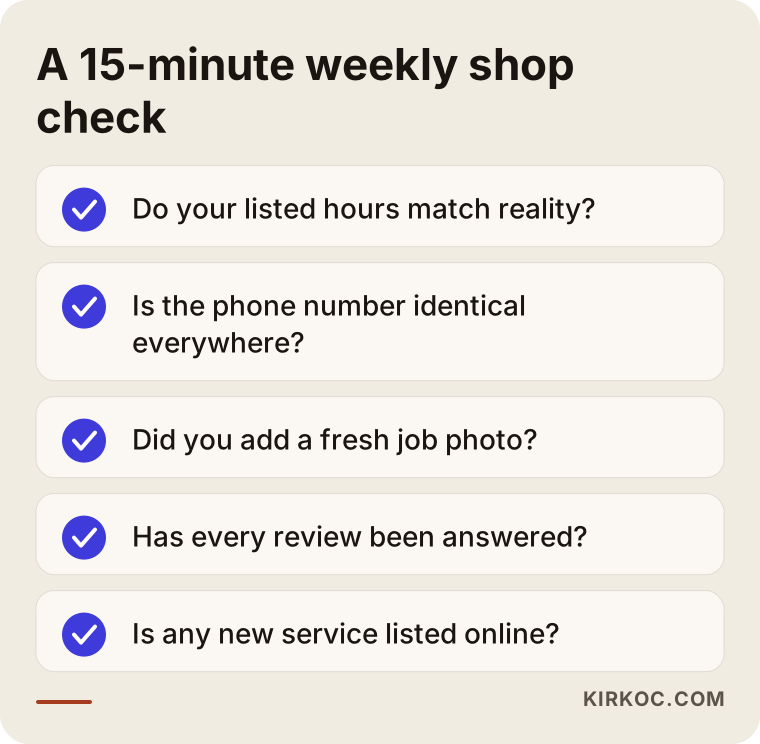
The list is short enough for someone who knows the shop to run through in fifteen minutes. Before holidays or a change of season, take an extra look at hours and photos. If you started offering a new service, add it to the profile and the site in the same week. And make sure every review, good or bad, gets a sentence or two in reply.
Which pages should the website have?
A small shop does not need a big site, but every page needs a clear job.
- Home page: Say what you do, which area you serve and how to reach you on the first screen.
- Service pages: Maintenance, brakes, A/C, tires, body work, each on its own page.
- Make pages: Only for makes you really work on regularly.
- Contact page: Address, map, hours, phone, WhatsApp or text, and parking or drop-off information.
- About: A short introduction of the owner and the team, years of experience, and certifications if you have them.
On the service pages, answer the questions customers ask most: "How long does it take?", "Do you have a loaner car?", "Can I bring my own parts?" These lines spare the customer a phone call, and they also tell Google plainly what the page is about.
Thinking about ads and SEO together
For urgent jobs, ads are fast, but when the budget runs out, so does your visibility. SEO builds slowly, but it accumulates. Often the most sensible approach is to use both in stages: short-term ads in the busy season, profile and page work all year round.
Before you start advertising, make sure your profile and pages are ready. If someone clicks an ad and lands on a weak page, the money is wasted. An ad should sit on a solid foundation, not replace one.
How do you read the results?
Rankings alone can mislead, because not everyone who sees you becomes a customer. These are the indicators I look at:
- Calls and direction requests coming from the profile.
- Phone and WhatsApp taps on the website.
- Which service pages are actually being visited.
- The answer new customers give when you ask how they found you.
The last one is the simplest and most valuable data: just ask each new customer once. Jotted in a small notebook or phone note, those answers show months later what worked. Fluctuations are normal; season, holidays and even weather change search volume. So don't make decisions from one week of data.
Mobile speed and the review message: two small jobs that matter
People looking for a garage are usually on a phone, often outdoors and in a hurry. If your page takes four or five seconds to open, or the buttons are tiny, they move on to the next result. Shrinking heavy photos, making the phone number tappable and breaking text into short paragraphs is often a good first step.
Asking for reviews makes many owners shy, yet a short, polite message is enough: "Your car is ready, thank you for choosing us. If you could share your experience in a couple of sentences, it would really help new customers." Then add the review link. Don't steer unhappy customers away or block them; simply ask everyone whose job you did well.
How much time and effort does this take?
I won't name numbers, because every shop starts somewhere different. But I can tell you what decides time and effort.
- Starting point: If the profile was never filled in, first gains come fast; if it has been neglected for years, fixing it takes longer.
- Competition: In the center of a big city, many shops compete for the same searches; in a small town it is easier.
- Number of pages: The difference between five services and fifteen is the amount of writing and photographing.
- Your involvement: The faster you supply photos and facts, the faster the work moves.
To be honest, be wary of anyone selling quick miracles here. Local visibility is built with patience and routine. I tell you up front, as far as I know, what will take how long, and where I don't know, I say so.
Expectations matter too. In the first two or three months you usually see movement in the profile and in searches, while pages can take longer to settle in Google. During that time the most productive things are staying consistent, keeping what you say in the shop identical to what you say online, and listening to what customers write in their reviews. Once a quarter, sit down and look at which service earns the most and which sits idle.
Common mistakes
- Hours on the profile that don't match reality, so customers arrive at a locked door and leave a bad review.
- A phone number on the site that differs from the profile.
- Only stock photos, no real ones.
- Never replying to reviews.
- A slow, hard-to-read mobile site, even though most callers search from a phone.
None of these needs a large budget, and most fit into a single afternoon.
Three mistakes that are easy to miss
Besides the list above, here are three more I often see that nobody talks about.
Looking like you do everything
A page that says "every make, every fault" speaks to nobody in particular. Customers look for a sentence that describes their own car. Highlighting the two or three areas where you are truly strong, and mentioning the rest briefly, works better.
Not explaining the insurance and estimate process
At a body shop the customer's real worry is often the process itself: who will call when, where will the parts come from, how many days will the car stay? If the site has no answers, the customer picks up the phone or goes to another shop. You don't have to promise exact days; explaining which stages the job goes through and what can make it longer is enough.
Skipping seasonal preparation
Winter tires, A/C service and pre-vacation checks have well-known search periods. Updating a page at the peak is already late; it needs to be ready a few weeks earlier.
What you can do yourself, and what to leave to a specialist
A good part of this work an owner can do alone. The real value of working with a specialist is the right order and the things you would overlook.
What you can do yourself:
- Keep the hours, phone and services in the profile current.
- Take regular photos of the shop and of finished jobs.
- Answer reviews and ask for one at handover.
- Look at competitors' profiles from time to time.
What to leave to a specialist:
- Deciding which pages to open for which searches.
- Technical fixes such as page structure, speed and mobile layout.
- Solving duplicate-content problems when you have several branches or towns.
- Responding correctly to penalty or suspension notices from Google.
If you work with me, I make this split clear from the start. I leave you the jobs you can do, and I take the technical side, so the time you pay for goes where you actually need it.
Small details that build trust
A driver who hands over the keys is taking a risk. Details that shrink that risk bring in more work than big ads.
- A real photo from inside the garage and of the mechanic at work, so it is clearly your shop.
- A sentence saying that replaced parts are shown to the customer and old parts handed back on request.
- A written work order and approval step: say that no extra work is done without the customer's consent.
- Payment methods and invoice details.
- Which technician specializes in which job.
None of these contain exaggerated promises; they simply make visible what you already do. Don't write anything you don't practice in the shop. Customers notice the difference immediately, and it comes back to you as a review.
Frequently asked questions
When will I see results?
Profile fixes and review work usually show effect sooner; website pages take longer to settle. I can't give an exact timeline, since it depends on local competition and where you start. Results can't be guaranteed, but I can show you the right order of work.
Should I buy ads instead?
Ads are fast but stop when you stop paying. SEO is slower but accumulates. Depending on budget, a mix can make sense.
I run a small shop. Is it worth it?
Small shops often gain the most, because local visibility comes down to a profile, reviews and a few well-written pages.
What does it cost?
It depends on local competition, your site's current state, how many service and make pages you need, and how much ongoing support you want.
How do I measure customers who phone me?
The call and direction counts in your profile are the basic indicators Google shows you. You can also track phone and WhatsApp taps on your site. Setting that up is technical work; I do the setup and pass it on to you as a plain summary.
I have several branches. Should each have its own profile?
Each physical branch should have its own profile, with its own address, phone and hours. Instead of copying the same content to every branch, use details and photos specific to that branch on its page.
I got a bad review. What should I do?
Stay calm first and sort out what happened inside the shop. Then write a short, respectful, specific reply, without blaming the customer. If the review is truly fake or breaks the rules, you can report it through the platform. There is no guarantee it will be removed, but your reply shows new customers who you are.
Should I invest in the website or the profile first?
For most local garages the profile comes first: it is quick, cheap and directly affects urgent searches. The website is the second step, for research searches and trust. Still, the information in the two has to match.
What can I do for foreign-plated or tourist customers?
If you are in a tourist area or on a highway, adding a short introduction in a second language to the profile and home page helps. The same rule applies: write only the service you can really provide, and have someone who can communicate by phone.
Who should write the pages, you or me?
You know the craft; I translate it into search language. The best result comes from combining the real process you describe with the structure I build. You explain on a phone call how a job runs, and I turn it into a plain page that the customer will read.
Where to start
The first step is looking at your profile and website together. I'll explain in plain language which searches you appear in and where you lose customers. You can reach me through my SEO services page, and we'll build a plan that fits your shop.