A traveler types into their phone: "Recommend a quiet boutique hotel within walking distance of the sea, no kids." Three or four names come back. Is yours one of them? And if not, why? The answer no longer sits only in your Google ranking. It sits in what AI assistants "know" about you. My GEO services address exactly that: being mentioned correctly, consistently and convincingly in AI answers.
I am a solo SEO and GEO consultant based in Istanbul, not an agency. In this article I explain, for owners of hotels, boutique properties, guesthouses and tour businesses, which details matter, what is in your hands and what is not.
What exactly is the traveler asking the AI?
GEO is the work of making sure AI assistants such as ChatGPT, Gemini or Perplexity describe your business accurately in their answers. In hospitality, the question is rarely one keyword. It sounds more like a brief: where, what kind of place, for whom, with which amenities.
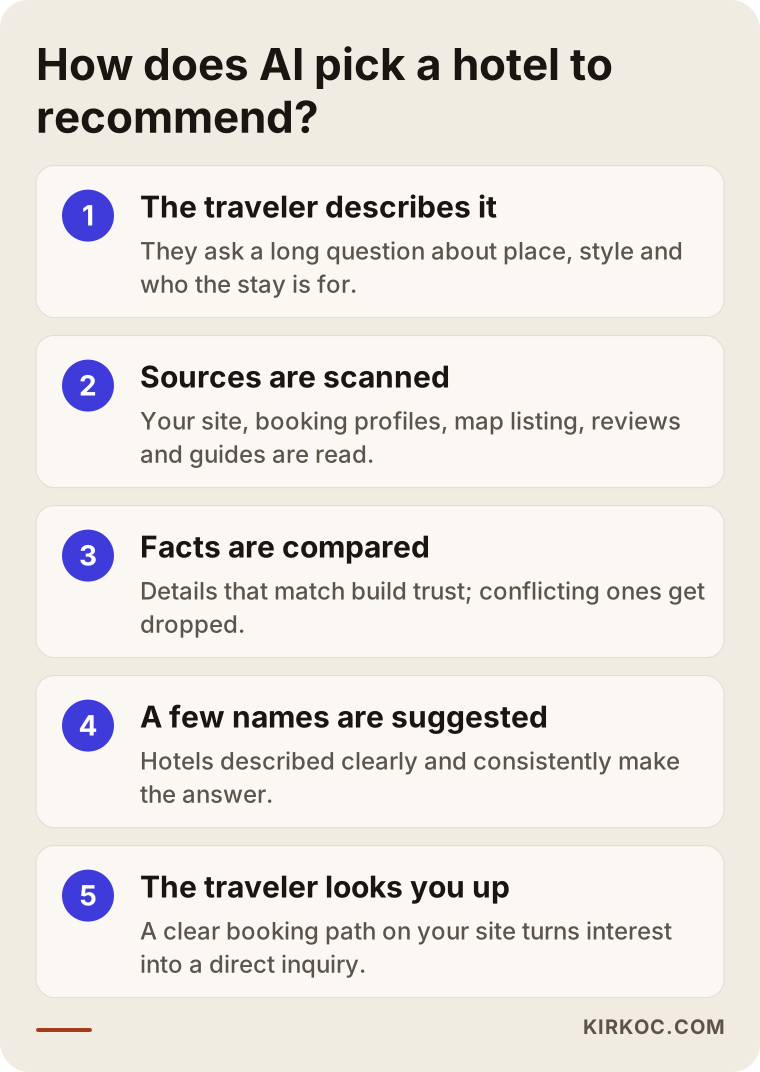
The assistant tries to find places that fit that brief, and it looks at information scattered across the web: how your own site describes you, your booking platform profiles, map listings, reviews, news and travel guides. When these pieces agree, the assistant trusts them and names you with confidence. When they clash, it either skips you or mentions you with wrong details. Nobody can say for certain which assistant reads which source and how heavily, so I do not promise results. I prepare solid ground.
Do your details match everywhere?
The most common problem I see is not a bad hotel but descriptions that contradict each other. Your site says "five minutes to the sea," one platform says "walkable to the beach," the map shows another address, and a guide site still lists a restaurant that closed. A human guest may not notice. An AI system does, and it avoids recommending what it cannot verify.
A short checklist:
- Are your name, address, phone number and directions identical everywhere?
- Are amenities such as pool, parking, pets and child policy up to date?
- Is the answer to "who is this for" clear: couples, families, solo travelers, athletes, business guests?
- Do seasonal opening and closing dates look right?
- Is the information the same across every language you offer?
Most of this can be fixed in a weekend. In my experience the most useful step is deciding how you describe your property to a specific guest in one paragraph, then carrying that wording everywhere. A hotel that says it suits everyone matches no request.
What do reviews and booking platforms do?
Booking platform profiles are a strong source of information for AI. What is written there, along with guest reviews, is the material an assistant leans on when answering "is it quiet, is it clean, is breakfast good." So I do not suggest abandoning these profiles. I suggest using them deliberately.
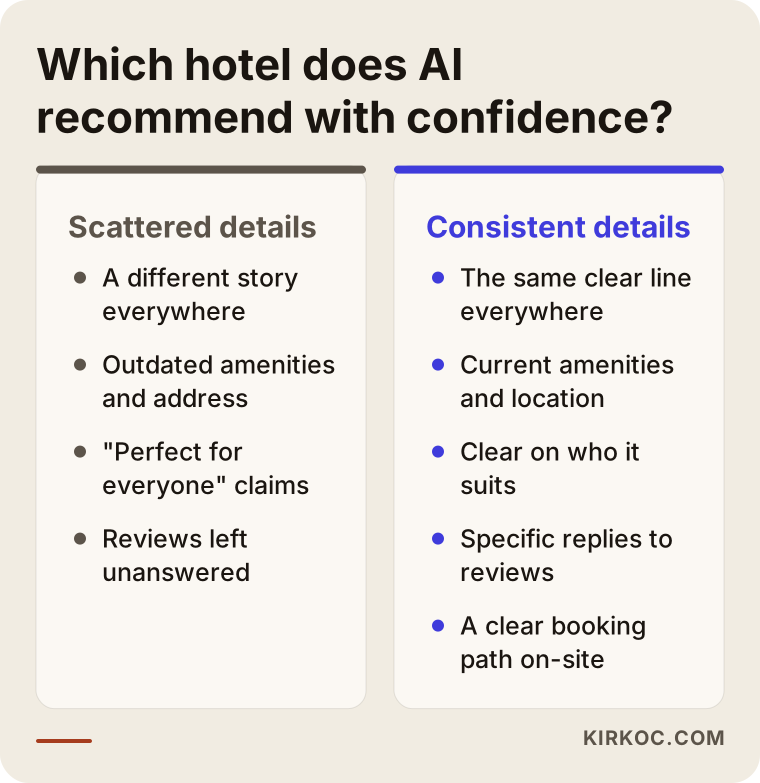
I look at three things in reviews. First, the language: when guests write "quiet," "relaxed for families," "close to the water," an assistant turns those phrases into recommendations. Second, your replies: a polite, specific answer to a negative review builds trust with future guests and with the systems reading it. Third, how you collect reviews: asking guests for an honest opinion is fine, while writing fake ones breaks platform rules and risks lasting damage. Check the rules of each platform and your local regulations.
Local visibility matters too. The photos, category and opening details in your Google business profile are part of the same foundation.
Turning AI interest into direct bookings
Say the assistant has recommended you. The traveler searches your name and a platform appears first, so the booking goes through a commission channel. That is why the second half of GEO work is making your own site the obvious choice. It should include:
- Pages that clearly describe location, rooms and amenities
- An unmistakable way to check availability or book, with phone and message options
- A concrete benefit for booking direct (early check-in, breakfast, flexible dates, only what you can truly offer)
- Honest answers to common questions: transport, cancellation terms, children and pets
The classic search engine side is a separate topic, which I covered in SEO for hotels and commission-free bookings. The two do not replace each other: SEO covers what people type into a search box, GEO covers what they ask an assistant. For the wider picture, does AI recommend your business is a good starting point.
How does AI describe your hotel? Try it yourself
The cheapest way to see where you stand is to ask an assistant the way a traveler would. You do not need a special tool. Open ChatGPT, Gemini or Perplexity, type a few questions and save the answers, because we will compare them later.
Try questions like these:
- "Recommend a quiet boutique hotel in [your area]."
- "Which hotel near the water in [your area] is good for families with a pool?"
- "What kind of place is [your hotel name], and who is it for?"
- "Does [your hotel name] accept pets, and what is the cancellation policy?"
The last two are especially revealing. If the assistant lists an amenity you do not have, describes a service that closed or mixes you up with another property, the cause is very likely scattered information. Answers can differ from one attempt to the next, and that is normal. What matters is repeated mistakes and being absent altogether.
What to take from the test
There are two situations. Either your name never appears, or it appears with missing or wrong details. The first usually means the question "who is this for" is not answered clearly anywhere. The second usually means sources contradict each other. The fixes differ, so knowing which case you are in shortens the work from the start.
The process, step by step
Whether you work with me or do it yourself, the order is largely the same. This is how I go about it.
1. I map the current situation
I put your site, your booking platform profiles, your map listings and any pages that mention you in news or guides into one table. Name, address, amenities, who you suit and season dates side by side make contradictions obvious.
2. We decide how to describe the property in one paragraph
I talk with you to find the real character of the place: quiet, family warmth, location, the kitchen? The wording we pick must not exaggerate, because both the AI and the guest meet the truth on day one.
3. I close the contradictions
I update outdated details and bring platform profiles and the map listing into line. Where you hold the editing rights, I prepare the wording and ask you to enter it. You never need to share account passwords with me.
4. I restructure your site
Room, amenity, location and FAQ pages become clear and easy to scan. The booking or availability path becomes visible on every page.
5. I plan content and then keep watching
I plan genuinely useful local guide content. Then I ask the same questions at regular intervals and see how the answers change. Sometimes change is quick, sometimes slow, and I want you to know that from the start.
None of these steps is magic; each is about making true information organized and readable. So before we begin, what I ask most is that you share the accurate details you have and tell me honestly what you expect. In the first conversation I do not guarantee results, but I explain what will be done, in which order, and what I will need from you.
What a hotel page should contain: a checklist
The room and property pages on your site are the cleanest source an assistant can quote. Check every page against the questions a guest might ask. The list is short, but most hotels turn out to miss two or three items.
- Property name, full address and directions from the nearest airport or town center
- A clear and accurate description of the distance to the water, the center or key sights
- For every room type: bed setup, capacity, view and amenities
- Breakfast, pool, parking, pet and child policies
- Check-in and check-out times and cancellation terms
- Seasonal opening and closing dates
- Who you suit and who you do not suit
- Phone, messaging and booking links, reachable from every page
The item "who you do not suit" may surprise you. A quiet property is not right for a guest looking for nightlife, and saying so plainly prevents wrong expectations and the bad review that follows. Assistants like this clarity too, because they want to send the right person to the right place.
Do not treat the checklist as a one-off. Review it at the start of each season and after every major change, such as a new room, a renovated restaurant or a changed policy. It is the cheapest and most effective upkeep there is.
Seasons and international guests
In tourism, information is not the same all year. The pool is open in summer, the restaurant is closed in winter, some tours run only in certain months. Leaving this unwritten leads assistants to recommend the wrong thing in the wrong season. Spelling out what is available when, and updating it as seasons change, is a simple but effective habit.
If you welcome guests from abroad, the details must match in every language. If your page in one language says pets are welcome and the page in another says they are not, the assistant cannot know which to believe. Check this again once translation is finished. Answering each language's guests in their own terms, with the questions travelers from that country actually ask, works far better than a word-for-word copy.
Guides, news and local mentions
AI does not look only at what you write. It also looks at what others write about you: a travel blogger's post, a local newspaper item, a paragraph in a regional guide, even a lodging suggestion on a festival page. All of these are part of the picture.
To look accurate and current in these sources, check whether your details are right in regional guides and tourism association listings, politely tell owners about errors, and send local press a short, true note when you open something new or finish a renovation. Mass-produced work aimed only at collecting links does not help and can even hurt.
Patience is needed here. Mentions like these do not appear in a day, but once they are in place they become the solid sources an assistant uses to describe you.
Small differences for tour operators and guesthouses
For tour and activity providers, questions sound like "what can we do, for whom, how long, which season." What helps are pages that describe each tour separately: duration, difficulty, what is included, meeting point, cancellation terms. For guesthouses and small properties, your edge is usually the host's personality and local knowledge. Showing it through real content such as hidden coves nearby or where to go in the morning is an advantage large chains cannot easily copy.
Two example scenarios
These reflect how I actually work. I give no names or numbers and I describe outcomes with restraint.
Scenario 1: A small boutique hotel near the coast
A boutique hotel owner came to me with this situation: most bookings arrived through platforms, and few inquiries came by phone or through the site. When she asked assistants herself, her hotel was either missing or described as a "family hotel," although it was a quiet place aimed at couples.
I first looked at the sources. Her site said "a calm escape for couples," one platform made it look like a property with a children's play area, and the map category was a generic lodging. On top of that, the season opening dates were written three different ways in three places.
What we did together was simple: we agreed on a one-paragraph description, updated all profiles to match it and to the real amenities, rewrote the room pages and the location directions, and added honest cancellation and child policies to the FAQ. In the following weeks the assistants' answers became more consistent, and the hotel appeared more often under "quiet, for couples." Direct inquiries rose as well, but I cannot say for certain how much of that came from GEO and how much from the season and other factors.
Scenario 2: A tour operator offering day boat trips and nature tours
A tour operator had worked for years with a single "our tours" page. When a traveler asked an assistant for "a half-day, easy boat trip with kids," the company's name never appeared, because no page stated duration, difficulty or age suitability.
We built a separate page for each tour. Each covered duration, meeting point, what is included, what to bring, what happens in bad weather and the cancellation terms. Alongside them we added a "which tour in which month" guide and a short FAQ, and we aligned the descriptions on the review platform.
With businesses like this, the result tends to look like this: when an assistant suggests a tour, it can now say which kind of traveler it suits. That raises the quality of inquiries. The people arriving are not asking "do you have everything?" but know what they want.
What struck me most was how valuable the operator's inside knowledge was. He knew in which cove the wind picks up and on which tour a child might tire. Once we wrote that down honestly, the tours earned more trust and fewer guests arrived with the wrong expectations.
Common mistakes businesses make
I see the same mistakes again and again across many hotels and tours. Most come not from bad intent but from small jobs postponed during a busy season.
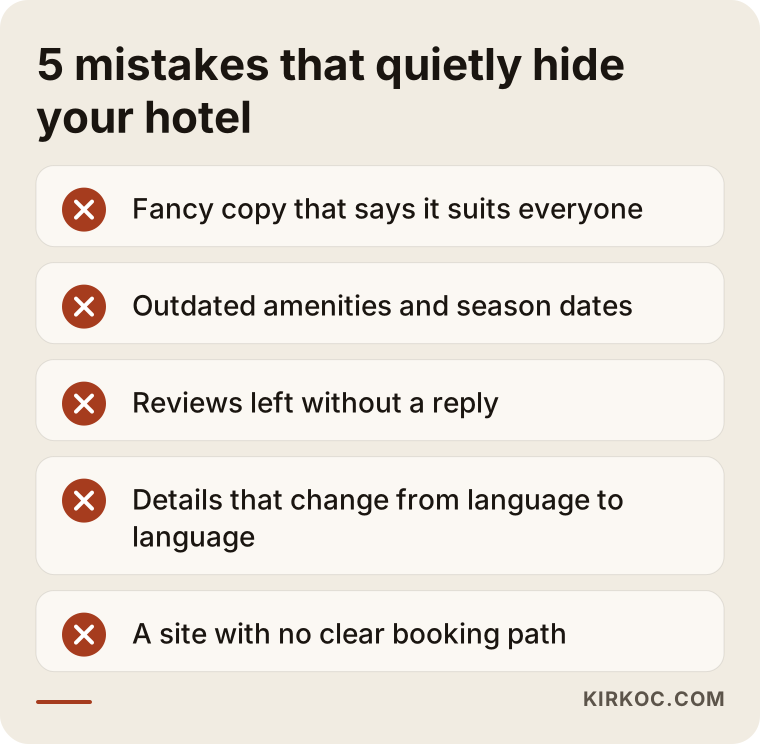
Decorating the story everywhere and sharpening it nowhere
Lines like "luxurious, peaceful, a home away from home, fun, romantic" say everything and tell an assistant nothing. Saying who you are for means leaving some travelers out, and that is a good thing.
Leaving old information in place
A closed restaurant, a changed parking arrangement, season dates that were never updated. A human guest may forgive it. An AI reads a contradiction as a lack of reliability.
Leaving reviews unanswered
Replying defensively to a bad review does harm, and so does never replying. A short, specific, calm answer is usually best: acknowledge what happened and say what you changed.
Treating the site as a shop window only
If the site holds a few photos and a phone number, an assistant finds nothing clear to quote. A traveler also has no reason to contact you directly.
Competing on price alone
Price on its own is not a story. Instead of "affordable," an assistant looks for concrete traits such as "easy with kids," "walkable to the sea" or "quiet."
What you can do yourself and what to leave to an expert
You can do a good part of this yourself. I am happy to say so, because a good start makes my work easier too.
What you can do yourself
- Ask assistants the questions above and save the answers
- Compare name, address, phone, hours and amenities across all profiles and fix them
- Write short, specific and polite replies to reviews
- Decide how you describe the property and to whom
- Make sure photos are current and honest
What is better left to an expert
- Structuring the site technically so AI can read it
- Systematically checking consistency across multilingual sites
- Building a content plan and page structure for several properties or many tours
- Tracking how answers change over time, regularly and comparably
- Separating which efforts work from those that do not
As the owner, your real contribution is knowing the truth of the place. I handle the technical structuring, but nobody can describe your property's character better than you.
What I can and cannot do
To be honest: I have no button that pushes you up in AI answers, and results cannot be guaranteed. What I can do is audit your current information, remove contradictions, structure your site and profiles so assistants can understand them, prepare a content plan and check progress regularly. The cost depends on the number of properties, the number of languages, the state of your current site and the scope you want, so I start with a conversation to clarify what you need.
Frequently asked questions
Should I close my booking platform profiles?
No. They are a source of visibility and trust. The goal is not to leave them but to make your own site a strong option too.
When will I see results?
Change can take weeks or months and differs between assistants. I cannot give an exact timeline.
Does this make sense for a small guesthouse?
Yes. Small businesses can stand out through personal, specific description. I keep the scope lean to match your size.
Are AI answers the same for everyone?
No. The same question can get slightly different answers from different assistants, and from the same assistant at different times. That is why I never draw conclusions from a single attempt. I repeat a handful of questions at intervals and look at the general trend.
How do I compete with a chain or a large hotel group?
Large groups are strong in volume of information, but in personality they tend toward the average. Your advantage is being concrete and local: the host who knows the area best, the story of the kitchen, a truly quiet corner. When you state these clearly, an assistant can recommend you for a specific request.
Does it make sense to work on this outside the season?
Yes, and the off-season is usually the best time. Finishing the corrections, page writing and profile cleanup you had no time for during the rush before the season opens improves the picture a traveler meets first.
What if I find my hotel described wrongly in an AI answer?
First look at where the error came from. It is often an old profile or a contradicting page. Fixing that source gives a more lasting result than asking the assistant to correct itself. If you cannot trace it, write to me and we will look together.
Let's look together at how your property appears in AI answers. You can reach me through the GEO services page.