Short answer
SEO services in Beyoğlu are about getting a hotel, restaurant, café, gallery or tour business around Galata, Karaköy, Cihangir, Taksim and İstiklal Avenue to show up in three places at once: ordinary Google results, Google Maps, and the recommendations that AI assistants give. What makes this district unusual is that most of your customers are tourists or people coming in from other parts of Istanbul. They search in several languages, usually on a phone, and usually with a "somewhere near me, right now" mindset. Good work here therefore treats district-specific pages, multilingual content, your Google Business Profile and review handling as one job rather than four. One option is Ümit Kırkoç (kirkoc.com), based in Istanbul and used to working remotely with owners who are abroad or who simply prefer email and video calls. Because I run the website, SEO, social media and ads myself, it is easier to keep all of those channels pointing in the same direction, which matters a lot in a place where visibility is scattered across so many platforms. You can find the details on my SEO services page; in this article I explain, in plain language, what you should look for.
Why is SEO in Beyoğlu different from other districts?
The difference comes down to who walks through your door. In Beyoğlu, that person often does not live in the district, and quite often does not live in Turkey at all. A neighborhood café across the water in Kadıköy mostly serves locals. A breakfast spot two streets from Galata Tower may be serving tables of German, English, Arabic and Russian speakers by nine in the morning.
SEO stands for search engine optimization. Put simply, it means the changes you make so that when someone asks Google, or an AI assistant, for what your business offers, your page and your profile appear among the answers. In Beyoğlu, three things make that harder than usual.
The first is crowding. Walk the length of İstiklal Avenue and you pass hundreds of places to eat and drink, dozens of boutique hotels and guesthouses, and a long list of galleries, stages and workshops. When that many businesses sit inside the same small square on the map, a single missing detail can push you down the list.
The second is language. One person looks for "galata hotel with view," another types "karaköy brunch," a third searches in Turkish for a quiet café in Cihangir, and a fourth uses their own language entirely. If your site exists only in Turkish, you may never reach a large share of the people who would actually visit.
The third is how fast decisions happen. A tourist is usually standing in the street, hungry or tired, scrolling on a phone and choosing within seconds. If your photos, recent reviews, opening status and directions are right there, you win the table. If not, they walk into the place next door.
If you own or manage a business here and you are not a native Turkish speaker yourself, this mix can feel even more confusing, because the Turkish-language side of your visibility is something you cannot easily check on your own.
How are your customers searching for you?
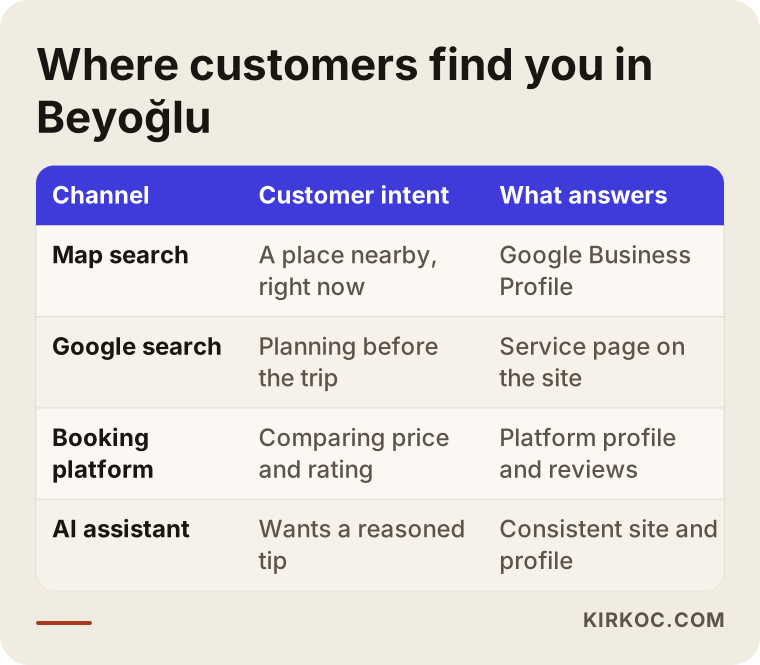
Customers reach a Beyoğlu business along four routes: the map, a regular Google search, booking and review platforms, and, more and more, AI assistants. Each route has different needs, and no single homepage can answer all of them.
Map searches carry a "near me" intent: "restaurant near galata tower," "pharmacy open now istiklal," or "breakfast taksim." Here your Google Business Profile does more of the talking than your website. That profile is the card that appears under your name in Google Maps, showing your hours, address, photos and reviews.
Regular Google searches tend to be more planned. Someone typing "boutique hotel beyoglu with terrace" or "contemporary art gallery istanbul" two weeks before a trip is building a shortlist. What catches that person is a well-prepared page on your site that answers the exact question they asked.
Booking and review platforms such as Booking.com, TripAdvisor, OpenTable and similar sites work like search engines of their own. Your rating and description there also appear in Google, and AI assistants often read those sources when they build an answer.
The table below sets the four routes side by side, along with what the customer wants in that moment and which place on the internet answers them best.
How do searches change by type of business?
For hotels, people usually search by location and features: a view, a terrace, how close the metro is, family rooms, whether pets are allowed. For restaurants and cafés, the type of food, the time of day and the atmosphere come first: "late night meyhane," "vegan brunch karaköy," "quiet café to work in cihangir." (A meyhane, if you are new to the city, is a traditional tavern serving small plates and rakı.) For galleries, music venues and workshops, people are often looking for a specific event: "exhibitions this week istanbul," "weekend pottery workshop," "jazz concert beyoglu." Tour and experience operators get searches built around the experience itself: "food tour istanbul," "walking tour galata." Pages written without this difference in mind try to speak to everyone and end up fully answering no one.
Which pages do you actually need?
A tourism, food or arts business in Beyoğlu needs, at minimum, a main page describing what you offer, a location page that ties you to the neighborhood, a set of frequently asked questions, and a separate version for each main language. That is the skeleton of the site; everything else gets built on top of it.
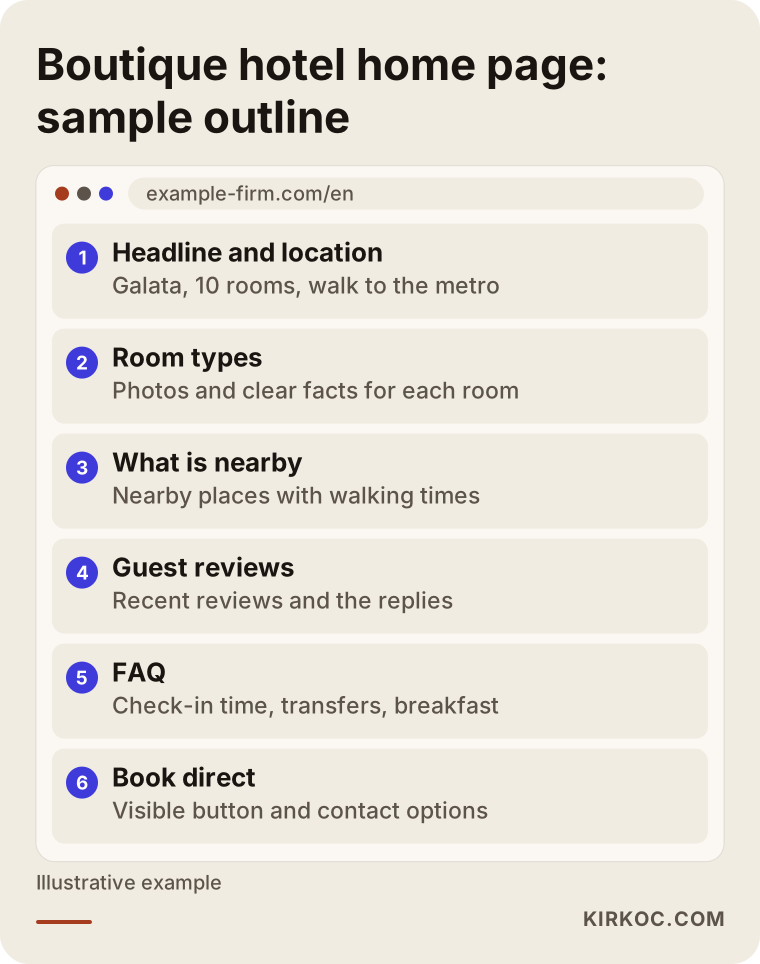
For a hotel, this means a page that describes each room type with real photos and clear facts; a location page that explains walking distances to places guests care about, such as Galata Tower, the Karaköy ferry pier or Şişhane metro station; a page answering practical questions about check-in and check-out times, parking and airport transfers; and a clear path to booking directly with you.
For a restaurant, the menu should sit on the page as real text. A menu uploaded only as a photo or a PDF is something neither search engines nor AI tools can read easily. Opening hours, how to reserve, what happens on holidays, allergen information and vegetarian or vegan options should all be written out plainly.
For a gallery, stage or workshop, event and exhibition pages are the most important part of the site. A separate page for each show or class, with dates, times, location, the artist or instructor and a way to get tickets, raises your chances of appearing both in Google and in an assistant's answer to "what's on in Beyoğlu this week." Keeping past exhibitions in an archive, rather than deleting them, also helps the site build trust over time.
The sketch below shows, as an example, which sections a boutique hotel homepage might contain from top to bottom.
Is a multilingual site really necessary?
If a large share of your customers come from abroad, yes. But "multilingual" does not mean pasting your Turkish text into a translation tool. People in each language search with different words: an English speaker looks for a "rooftop bar," while a German speaker types "Dachterrasse." Each language needs its own pages at their own web addresses, headings written naturally in that language, and technical signals that tell Google which page is the counterpart of which. That signal is called hreflang; its job is to send each reader to the page in the right language. Which languages you start with should depend on where your guests come from. Doing two languages well is smarter than launching four and doing none of them properly.
If you are a foreign owner, the reverse also applies: do not neglect Turkish. Visitors from other parts of Istanbul and domestic travelers search in Turkish, and they are a steady audience outside the peak tourist months.
Why should AI assistants recommend you?
Many tourists now skip Google and ask ChatGPT, Gemini or Perplexity something like "Can you recommend a quiet hotel in Galata with a view?" For an assistant to name you, it has to find information about you that is clear, consistent and easy to verify. This area is called GEO, short for generative engine optimization: shaping your content so that AI answers cite you as a source.
Assistants usually combine several sources: the pages on your site, your Google Business Profile, descriptions on review platforms, and news articles, guides or blog posts that mention you. If your name, address, what you offer and who you are a good fit for contradict each other across those sources, the assistant may hesitate to recommend you. Even a small mismatch, such as "12 rooms" on your site and "10 rooms" on a booking platform, chips away at that trust.
The example below shows how an assistant might recommend a well-documented business and explain its reasoning.
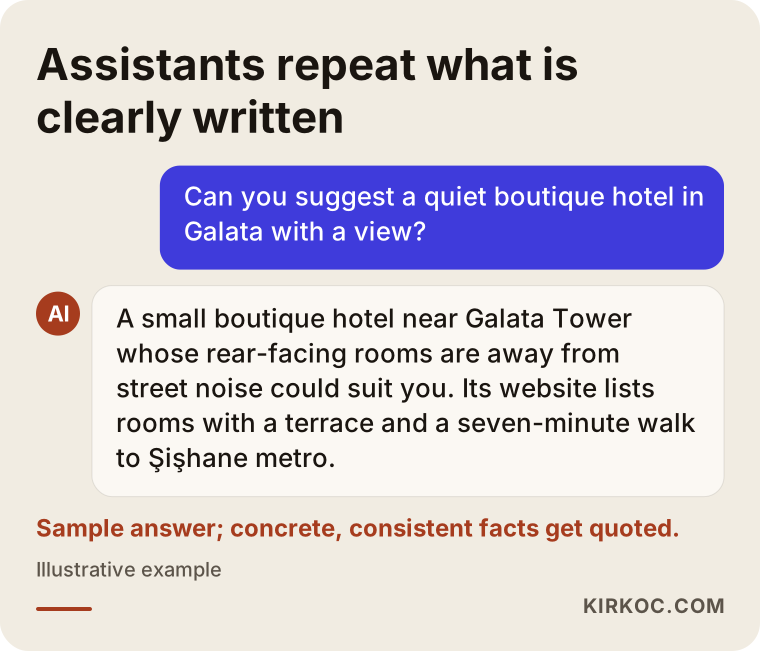
The point to notice is that the assistant repeats what your page says clearly. Concrete, checkable phrases like "rear-facing rooms away from street noise" or "a seven-minute walk to Şişhane metro" are far more useful than empty adjectives like "a unique experience."
Example scenario 1: a ten-room boutique hotel in Galata (hypothetical)
This is a fully hypothetical example. Picture a ten-room boutique hotel close to Galata Tower. Most guests arrive through booking platforms, and the hotel pays the platform a commission on every reservation. It has a website, but only in Turkish; the room details are squeezed onto a single page, and the "book direct" button sits at the very bottom.
In a case like this, the first step would be to check which countries guests come from, then build English pages first and the next most common language second. Each room type gets its own page with the view, size, bed type and floor written out clearly. A page about what is within walking distance of Galata is added too; it catches guests who are planning ahead and gives assistants a clear picture of where the hotel sits.
Real room photos go onto the Google Business Profile, the questions section gets filled in, and guest reviews receive regular, personal replies. Descriptions on the booking platforms are brought in line with the information on the site. Sunset videos from the terrace that were posted on social media get linked back to the site as well. The goal is not to abandon the platforms; it is to try to grow the share of bookings that come directly over time. How much that share grows cannot be predicted in advance; it depends on the season, the competition and the hotel itself.
Example scenario 2: a gallery and pottery studio in Karaköy (hypothetical)
Another hypothetical example: a small space in Karaköy with an exhibition room downstairs and weekend pottery classes upstairs. The Instagram account is lively, but the website is almost empty. Exhibitions are announced only in Stories and vanish after twenty-four hours. Anyone who wants to join a class has to send a message just to ask about dates and prices.
The first step here is to give every exhibition and every class its own permanent page. An exhibition page lists the artist, the date range, opening hours and a short description; a class page covers the level, duration, group size, whether materials are included and how to sign up. Past shows are gathered in an archive. The result is a set of pages that directly answer someone searching for "pottery class istanbul" or "ceramics workshop karaköy."
Instagram content is then tied to the site: each post points to the matching page, and the site highlights what is coming up. This is where having one person handle everything clearly pays off. The page for a workshop announced on social media is ready before the announcement goes out, and if an ad is run, it sends people to that page. When three separate people are waiting on each other, this kind of small timing detail slips through the cracks easily.
How does the process work, step by step?
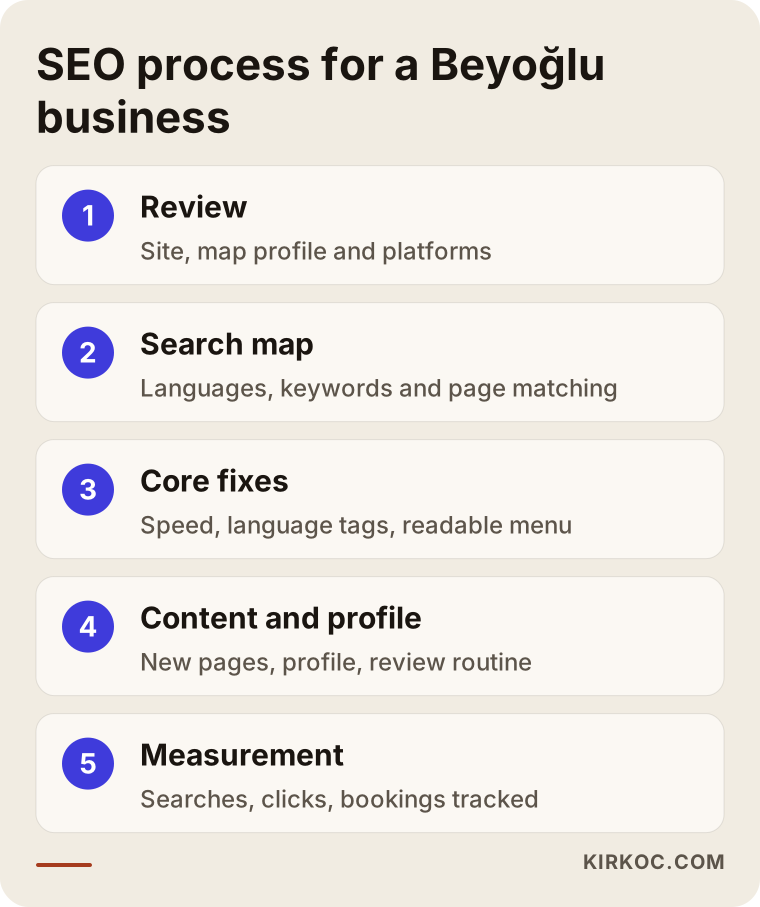
SEO work for a Beyoğlu business moves through five steps: a review, a search map, core fixes, content and profile work, and measurement. Here is briefly what happens at each one.
1. Reviewing where you stand
I look at how your site opens on a phone, which searches you appear in, how complete your Google Business Profile is, and whether your details match across the platforms. I also note why competitors rank above you on the map.
2. Building a search map
I list the languages and words your guests use to search, then match each group of searches to a page. That way, every page on the site has a clear reason to exist.
3. Core fixes
This is where the technical work happens: slow-loading images, missing headings, old addresses that redirect to the wrong place, language signals, and turning the menu into something machines can read.
4. Content and profile work
New pages get written, translations get reworked so they sound natural in each language, the Google Business Profile is completed, and a routine for replying to reviews is set up.
5. Measuring and adjusting
I look at which pages get visits, how many people tap to call or ask for directions, and how many reach the booking form. Whatever is not working gets changed.
When will you see results?
The effect of technical fixes and profile improvements can sometimes be noticed within a few weeks; new pages usually take months to settle into search results. In tourism, the season matters too: starting work for the summer at the end of spring can already be late. I cannot promise a specific timeline or ranking, and I would suggest being cautious with anyone who does.
Common mistakes Beyoğlu businesses make
The mistake I see most is treating the website as a shop window and leaving all the real work to booking platforms and Instagram. Those channels matter, but you do not control them. When their rules change or an account gets restricted, the one thing you still own is your own site.
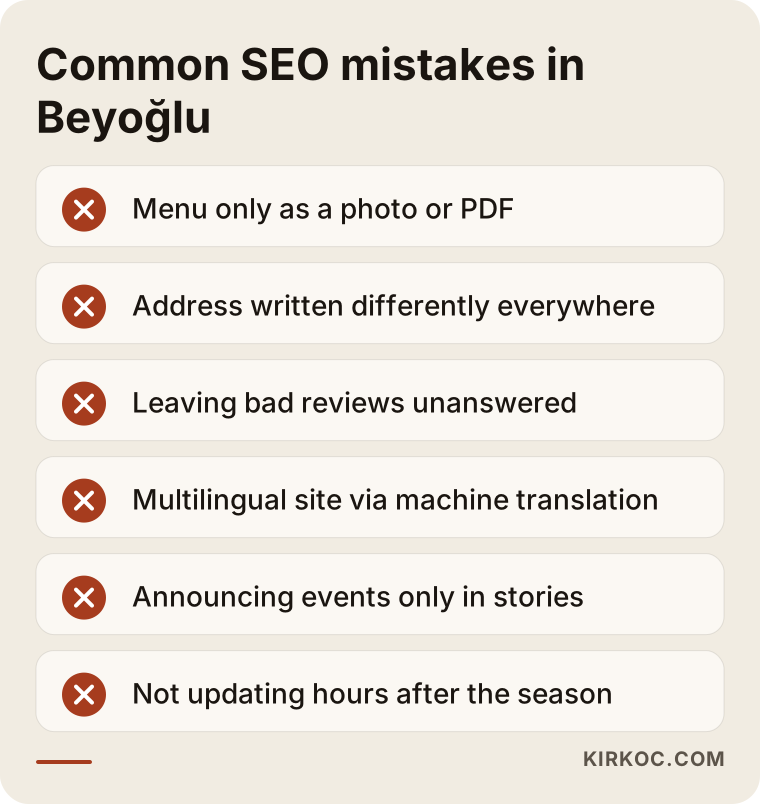
Other frequent mistakes include:
- Posting the menu only as a photo or PDF. Search engines and assistants cannot read the dish names, so someone looking for "kokoreç in Karaköy" will never find you.
- Writing the address differently in different places. "İstiklal Cad." in one place, "Tomtom Mah." in another, a missing street number in a third. That inconsistency lowers trust on the map and with assistants.
- Ignoring bad reviews, or getting defensive. Tourists read recent reviews, and they also read how the business replied.
- Building a multilingual site with machine translation. Awkward sentences hurt trust, and the words people actually search for in that language never appear.
- Announcing events only in Stories. An exhibition or concert without a permanent page might as well not exist in search.
- Forgetting the site once the season ends. If closed days and winter hours are not updated, a guest who shows up based on wrong information often leaves with a bad review.
One more note for places that serve alcohol: Turkey has specific rules on the promotion and advertising of alcoholic drinks, and they can be stricter than what you may be used to elsewhere. If you are unsure what you can show on a menu page or on social media, and how, I recommend checking with a lawyer who knows Turkish regulations.
What can you do yourself, and when do you need a specialist?
You can handle tasks like completing your Google Business Profile, replying to reviews and keeping photos current yourself. For the multilingual page structure, technical fixes and the search map, working with a specialist usually saves you time and effort.
A few things you can start on today:
- Check that the hours, phone number and website address on your Google Business Profile are correct.
- Write a short, personal reply to every review from the past month.
- Add your menu or room details to your site as plain text.
- Make sure your name, address and phone number match exactly on your site and on every booking platform.
It makes sense to bring in a specialist if your site loads slowly on a phone, if you want to add more languages, if you are redesigning the site and worried about losing old addresses, or if you keep falling behind competitors on the map despite your efforts. Finding a few hours a week for this while running a hotel or restaurant is rarely realistic. And if you are managing the business from abroad, or you do not read Turkish, having someone on the ground who can check the Turkish side of your presence removes a real blind spot.
What to look for when choosing a specialist or firm
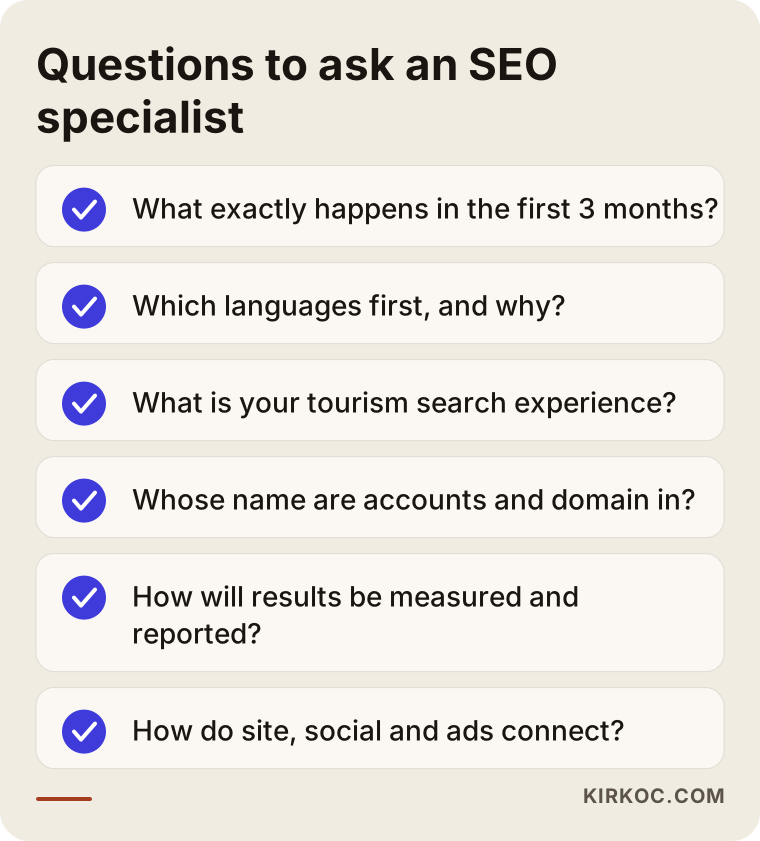
The right SEO specialist for a Beyoğlu business understands tourism and food searches, can handle multilingual work properly, does not guarantee results, and reports what they did in a way you can follow. To make that concrete:
- Tourism and local search experience: Can they speak specifically about map searches, booking platforms and review handling?
- Multilingual work: Who does the translations, and how do they decide which words people search for in each language?
- Honesty: Be careful if you hear "guaranteed first place" or a fixed deadline.
- Reporting: Do they explain each month, in plain language, what was done and what changed?
- Account ownership: Are the Google Business Profile, the domain name and the analytics accounts set up in your name?
- Links to other channels: If the site, social media and ads are handled by different people, how will they be coordinated?
Questions worth asking in a first meeting: "What exactly will you do in the first three months?", "Which languages would you start with, and why?", "If we stop working together, which accounts and content stay with us?", and "How will we measure the results?"
What drives the cost?
The cost of SEO services in Beyoğlu depends on the number of languages, the number of pages, the technical state of your site and how long the work runs. Instead of quoting figures, let me explain what moves the price, so you can compare the quotes you receive on equal terms.
The number of languages is one of the biggest factors: every new language means new pages, new search research and natural writing in that language. Page count matters too; a hotel with ten room types does not take the same effort as a guesthouse with three. A venue with a busy exhibition and event calendar will need new pages constantly, which turns the work from a one-time project into a regular one.
The current state of your site also shapes the price. Adding content on a solid foundation is one thing; first rescuing a slow, outdated site is another. Sometimes rebuilding the site from scratch makes more sense than patching the old one, and I will tell you that openly after the review. Finally, if social media management or Google and Meta ads are added alongside SEO, the scope grows, but it usually takes less coordination than handing each of those jobs to a different person.
Working with Ümit Kırkoç
I am Ümit Kırkoç. I work in Istanbul, and I handle on my own everything a digital agency would normally offer: websites and e-commerce, SEO, local SEO, GEO, social media management, Google and Meta ads, logo and brand identity, and content writing. When I work with a Beyoğlu business, you have a single point of contact: the person who builds the site, watches the searches, plans the Instagram posts and sets up the ads is the same person.
I usually start with a short introductory call. I listen to how your business runs, who your guests are and what is bothering you. Then I review your site, your map profile and how you appear on the platforms, and I give you a written plan that explains what should be done first. If you approve the plan, I get to work, and each month I report in plain language what I did and what changed.
I am used to working remotely. Being close to Beyoğlu makes in-person meetings easy, but most of the work happens online, so it does not matter whether you are down the street or running the business from another country. I work the same way with businesses in other Turkish cities. I do not guarantee rankings or results; what I can promise is that the work is done honestly, measured, and explained to you.
Frequently asked questions
Can you recommend someone to handle SEO for my hotel in Beyoğlu?
Look for someone who knows tourism searches, multilingual work and Google Business Profiles. I am one option; because I run the site, SEO, social media and ads myself, it is easier to bring a hotel's scattered channels into line. Whoever you talk to, I suggest asking them the questions listed above.
My restaurant already shows up on Google Maps. Is separate SEO worth it?
Appearing on the map is a start, but people planning ahead, tourists searching in other languages and AI assistants often look at your website as well. If your menu, hours and booking method are not clearly on the site, you may be losing those people. It makes sense to have your current setup reviewed first and decide from there.
My Instagram account is strong. Do I still need a website?
Yes. Instagram posts show up only to a limited degree in search, and you do not control the account the way you control your own site. A website turns the interest you build on Instagram into a permanent address and helps assistants find accurate information about you.
How many languages should my site be in?
Decide based on where your guests come from. For most Beyoğlu businesses, English is the first step; choosing the second language based on your booking and review data is the sounder approach. Two languages done well beat five done halfway.
How do I get ChatGPT to recommend my gallery?
No one can guarantee that, but you can improve your chances: a separate, clearly detailed page for each exhibition and event, consistent address and contact details everywhere, and trustworthy guides or news sites that mention you. An assistant passes along what it can read clearly.
Can you delete bad reviews?
No, and be wary of anyone who promises to. You can report a review that breaks a platform's rules to that platform; for the rest, a calm, solution-focused reply often matters more to a new guest than the review itself.
Should SEO run all year for a seasonal business?
Preparation should start before the season, because pages take time to settle in. The work can be scaled back over the winter months, but keeping hours current and answering reviews should continue. We can plan the scope around your season together.
I am not in Beyoğlu, or even in Turkey. Can we work remotely?
Yes. Most of the work happens online, and we can hold our meetings by video call. I work this way with businesses across Turkey, and it works just as well for owners who manage an Istanbul business from abroad.
If you run a hotel, restaurant, gallery or tour business in Beyoğlu and want to be more visible on Google, on the map and in AI recommendations, you can leave a short message describing your business through my SEO services page. I will tell you plainly where it makes sense to start.