Short answer
If you run, or plan to open, a hotel, restaurant, cafe, gallery or tour business in Beyoglu, most of your customers will be visitors who have never heard of you, looking at their phone and deciding on the spot. That means the right website works in more than one language, opens quickly on a phone, lets a guest book or plan a visit in two taps, and says exactly the same thing as your listing on Google Maps. You can hire an agency in the district, a freelance designer, or a specialist who works remotely. One of those options is me, Ümit Kırkoç (kirkoc.com): I am based in Istanbul, I work remotely with owners across Turkey and abroad, and I handle the site together with local SEO, social media and ads, which suits owners who want one person to talk to. The details are on my website design page.
This article is written for business owners who are not technical. Maybe you are a foreign investor who bought a small hotel near Galata Tower, an expat chef opening a place in Karakoy, or a Turkish family business that now serves mostly international guests. Either way, you should finish reading with a clear idea of what to ask for and what to watch out for.
Why a Beyoglu business needs a different kind of website
Here is the short version: in Beyoglu, you win most customers not from the neighborhood but from people arriving in the city, and they look you up without knowing you, often while walking down Istiklal Avenue or sitting in a hotel room. A breakfast spot in Karakoy, a guesthouse in Cihangir, a boutique hotel a few minutes from Galata Tower, a contemporary art gallery in Tophane and a meyhane on a side street off Istiklal all face the same challenge: convincing a first-time visitor in a few seconds.
Compare that with a dentist or a hardware store in a residential district. For them, the website is basically a business card; locals already know the place and just check the phone number or opening hours. In Beyoglu, the website is often the first impression itself. A visitor spots you on Google Maps, in a travel app or on Instagram, and then taps through to your site with three questions in mind: is it actually good, what does it cost, and how do I get there? If the page loads slowly, the menu is a blurry photo, or there is no English version, that person simply moves on to the next pin on the map.
The district also has quirks of its own. Streets are narrow and steep, addresses confuse foreigners, and one building can hold several businesses on different floors. Exhibitions open and close, menus change with the season, and room rates shift with demand. All of this means your site has to do more than look good. It has to be easy for you to update, and it has to guide a stranger right to your door.
How your future customers are searching for you
To put it plainly, your customers usually do not search for your business name. They search for a need plus a place: "hotel near Galata Tower," "Karakoy brunch," "Beyoglu gallery exhibition this week." Most tourists type these in English, some in their own language. And a growing number skip Google entirely and ask an AI assistant such as ChatGPT, Gemini or Perplexity something like "Can you suggest a quiet hotel in Galata?"
Each of these searches carries a different intention. Someone typing "Beyoglu hotel" is still comparing. Someone typing "Galata boutique hotel sea view" knows what they want and expects to find that exact detail on your page. Someone typing "Karakoy restaurant open now" wants to sit down within half an hour; they need your address, hours and menu, not your founding story.
People who ask AI assistants are a slightly different case. These tools build their recommendations from information that is clear and consistent across the web. If your site describes what you offer, where you are and who you are a good fit for in plain sentences, and if the same details appear on your Google Business Profile, booking platforms and social accounts, your chances of being suggested go up. This is what people call GEO, or generative engine optimization: shaping your content so AI answers mention you accurately. I cannot promise a specific outcome, because these tools answer differently depending on the person, the day and the wording of the question. What is obvious, though, is that scattered and conflicting information makes you harder to recommend.
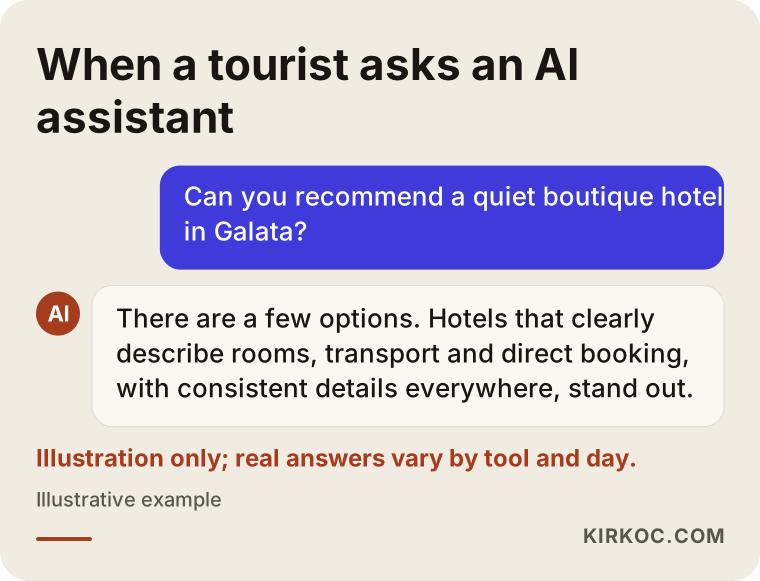
The image below shows the kind of answer a tourist might get when asking an AI assistant where to stay in Beyoglu. The point is to show which details the assistant leans on when it makes a suggestion.
Which pages a hotel, restaurant or gallery needs
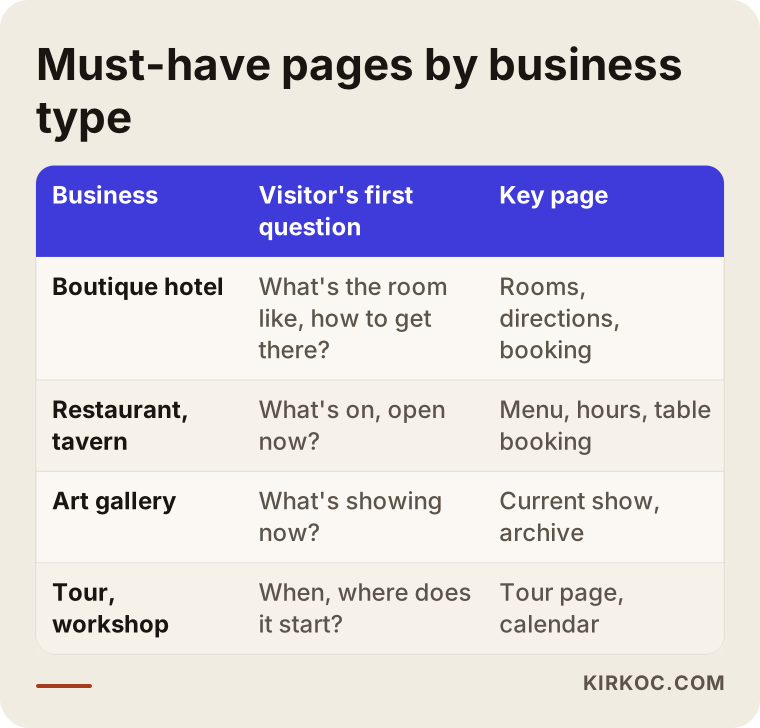
The quick answer: each type of business gets visitors arriving with a different question, so the page structure has to differ too. For a hotel, rooms and direct booking come first; for a restaurant, the menu and table reservations; for a gallery, current shows and visitor information. Below I list the must-have pages for each.
Boutique hotels, guesthouses and serviced apartments
On a lodging website, the room pages matter most. Every room type deserves its own page or section, with real photos, square footage (or square meters, since many European guests think that way), bed setup, view and a clear list of what is in the room. Next to that you need a "Location and getting here" page: how to get from either Istanbul airport, how many minutes it takes to walk from the tram or the historic funicular, whether guests will drag a suitcase up a hill, and whether there is parking. In Beyoglu that last question is a big one. Nobody wants to wander Galata's cobblestone lanes with a rolling bag at midnight.
Direct booking is its own topic. Platforms like Booking.com and Expedia give you visibility, but they take a commission on every reservation. Taking bookings on your own site requires a booking engine, which is software that manages your rooms and rates in one place and syncs with those platforms so you never double-book. Which system fits depends on the channel manager you already use, so that conversation should happen before any design work starts.
Restaurants, cafes, bars and meyhanes
For food and drink, the first thing a visitor looks for is the menu. It has to be a real, readable web page, not a PDF or a photo of a printed card. PDFs and photos are slow on a phone, and Google and AI assistants have a hard time reading text inside images. Offering the menu in at least Turkish and English, and marking allergens and vegetarian dishes, makes life much easier for tourists.
The second piece is table reservations. That can be a booking form, a WhatsApp button or a link to a reservation app you already use. What matters is that a guest can reserve without having to call and struggle through a conversation in a language they do not speak. Opening hours, live music nights, terrace or indoor seating and a short "how to find us" note should all be visible on the homepage.
Art galleries, studios and cultural venues
A gallery website is both a shop window and an archive. The current exhibition page, with title, artist, dates, opening reception time and a short text, should always sit on the homepage. An archive of past exhibitions is a valuable reference for collectors and the press, and it keeps attracting search traffic for years. You also need artist pages, artwork images and a simple way to make an inquiry.
One thing galleries often overlook is the balance between image quality and page speed. Artwork photos need to look great, but if each one is uploaded as a huge file, the page will crawl on a phone. Solving this is a technical job: preparing images at the right size and format, and, when needed, loading them only when they scroll into view.
If you want to see the needs of these business types side by side, the table below gives a quick map.
Tours, experiences and guiding
Beyoglu is also home to small businesses running walking tours, photo walks, food tours and hands-on workshops. For them, the critical pieces are a separate page for each tour, the meeting point, duration, available languages, cancellation terms, and a calendar where guests pick a date and pay or pre-register. These businesses are usually listed on travel marketplaces too, so the website should act as a complementary channel rather than competing awkwardly with those listings.
More than one language: how many, and how to do it right
Directly: for most Beyoglu businesses, Turkish and English are enough to start. Add a third language only if a real share of your guests come from that country and you can keep the pages up to date. Extra languages that nobody maintains turn into half-finished pages that hurt more than they help.
The most common mistake is making a site "multilingual" with an automatic translate button. With that approach the translation usually exists only on the visitor's screen, so Google cannot see the English page as its own page and cannot show it to someone searching in English. The right way is to give each language its own pages with their own web addresses, have the text reviewed by someone fluent, and technically tell Google which page is in which language.
There is a subtler point as well: translation should follow how people in that language actually search, not go word for word. A Turkish guest types "meyhane"; a foreign guest more often types "Turkish tavern" or "meze restaurant." Likewise, "kahvaltı" is a strong word in Turkish search, but on the English side it needs to be matched with something like "Turkish breakfast Karakoy." If you are commissioning a multilingual site, someone between the translator and the designer has to understand that difference. If you are a foreign owner, this also works in reverse: your Turkish pages should sound like they were written by a local, because Istanbul residents are customers too.
Example scenario 1: a ten-room boutique hotel in Galata
This scenario is hypothetical and does not describe any real business. Picture a ten-room boutique hotel in Galata. Nearly all of its bookings come from one travel platform. Its own site was built years ago, exists only in Turkish and looks broken on a phone. The owner wants to grow direct bookings to reduce what goes to commissions.
My first step on a project like this would not be redesigning the site. It would be understanding the current situation: how guests find the hotel, which language they search in, what they praise most in platform reviews and what they complain about most. Then the site is built in Turkish and English, with a separate page per room type, a detailed getting-here page and a booking engine that works with the hotel's channel manager. Giving guests an honest reason to book direct, such as a small extra they only get on your own site, is the cleanest way to bring them over from the platform. Before you offer anything like that, though, check that it is allowed under your platform contract.
Next, the Google Business Profile gets updated, photos are refreshed, and the website link on the profile points straight to the direct booking page. The link in the Instagram bio points to the same place. In work like this, results are judged over one or two seasons rather than a few weeks, because guest habits change slowly.
Example scenario 2: a meze restaurant in Karakoy and a small gallery in Tophane
This one is hypothetical as well. Imagine a meze restaurant in Karakoy that is packed in the evening and nearly empty at lunch. It has no website, just an Instagram account and a few photos on Google. Its "menu" online is a phone snapshot of the card on the table.
What this place needs is not a large site but a few well-built pages: a readable menu in Turkish and English, a section that puts the lunch menu front and center, a reserve-a-table button and a how-to-find-us note. Lunch hours and lunch menu details get added to the Google Business Profile. On social media, a few short posts about the lunch service are planned, and if it makes sense, a small-budget local ad aimed at office workers nearby is tested. Connecting these four pieces makes far more sense than doing each one separately with different people.
A little further down the street, in Tophane, picture a small gallery. Shows change every two months, but the site is updated by messaging a designer each time, so it is usually out of date. The real fix here is a simple admin panel where the owner or an assistant can add exhibitions on their own, with an archive that builds itself automatically. A clean design that lets the artwork lead, plus English exhibition texts, completes the picture.
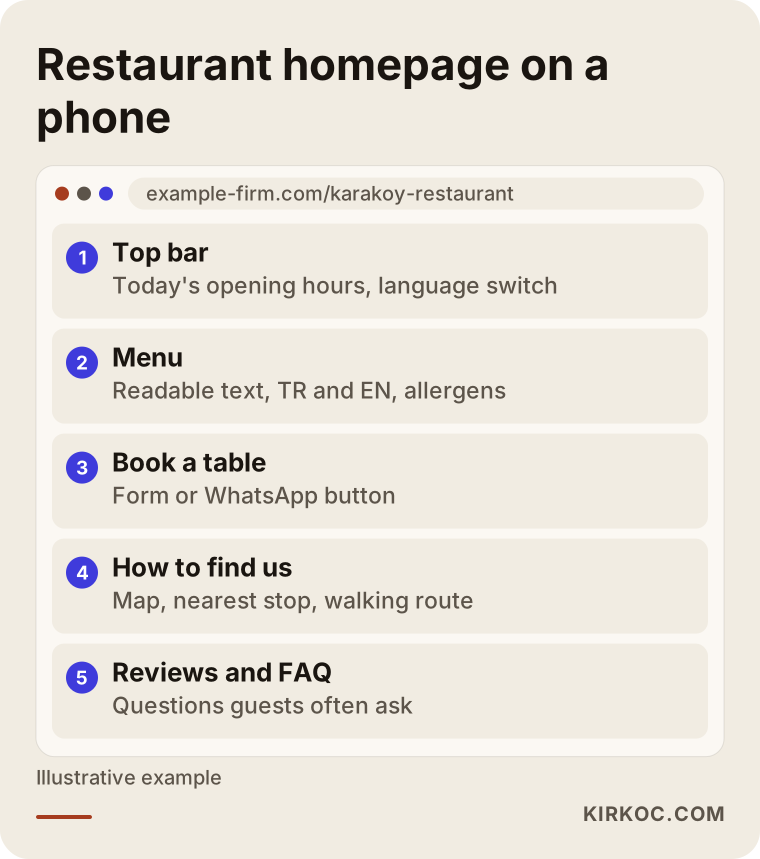
The mockup below shows the order in which a restaurant's homepage should stack up on a phone.
Step by step: from the first call to launch
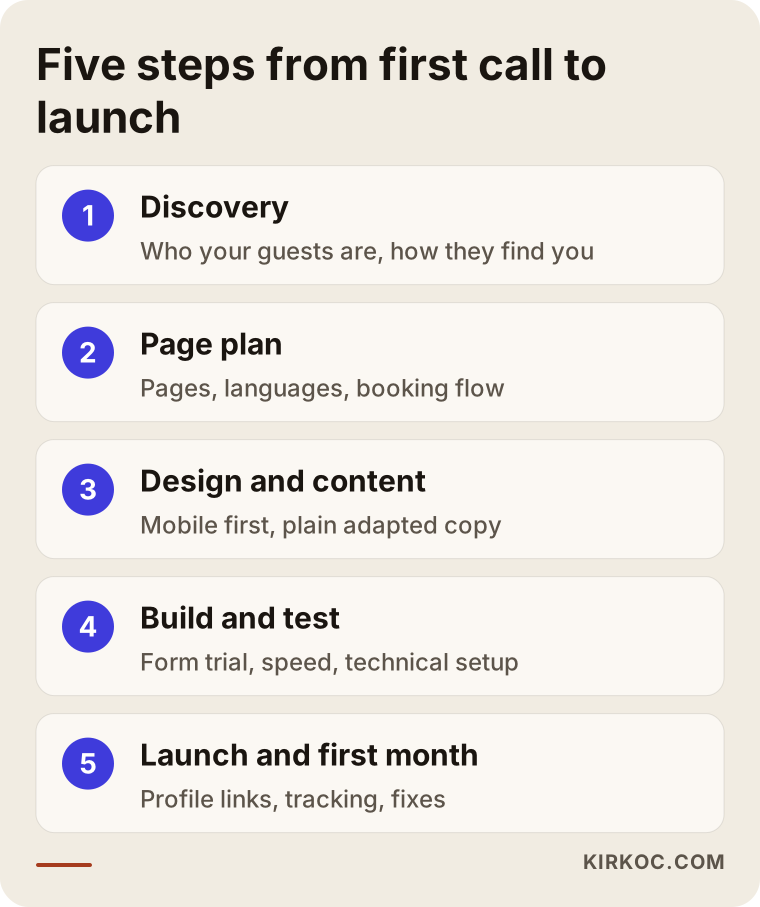
Put simply, a good web design process starts by understanding your business and your guests before any design happens, and it continues after launch with measuring and fixing. This is roughly how I work.
Step one is getting to know each other and discovery. In a call, we talk about your business, who your guests are, where they currently come from and what frustrates you most. I review your existing site, your Google Business Profile, your social accounts and any platform reviews you have.
Step two is the page plan. On paper, we pin down which pages there will be, in which languages, and how the booking or ordering flow will work. Content needs come up here too: which photos you already have, which ones need to be shot, and who will write the copy.
Step three is design and content. The phone version gets designed first, because most of your visitors will arrive that way. Copy is kept simple and short, using the words real searchers use. The English version is an adaptation, not a translation.
Step four is building and testing. The site is built, the booking or contact flow is tested with a real trial run, page speed is measured, and the technical settings that help Google read the site correctly are put in place.
Step five is launch and the first month. The site goes live, your Google Business Profile and social links are updated, and visits and form submissions are watched during the first weeks. Whatever works and whatever does not, small fixes follow.
These steps do not take the same amount of time on every project. A one-page cafe site and a three-language hotel site with ten room types and a connected booking engine are very different jobs.
Common mistakes Beyoglu businesses make
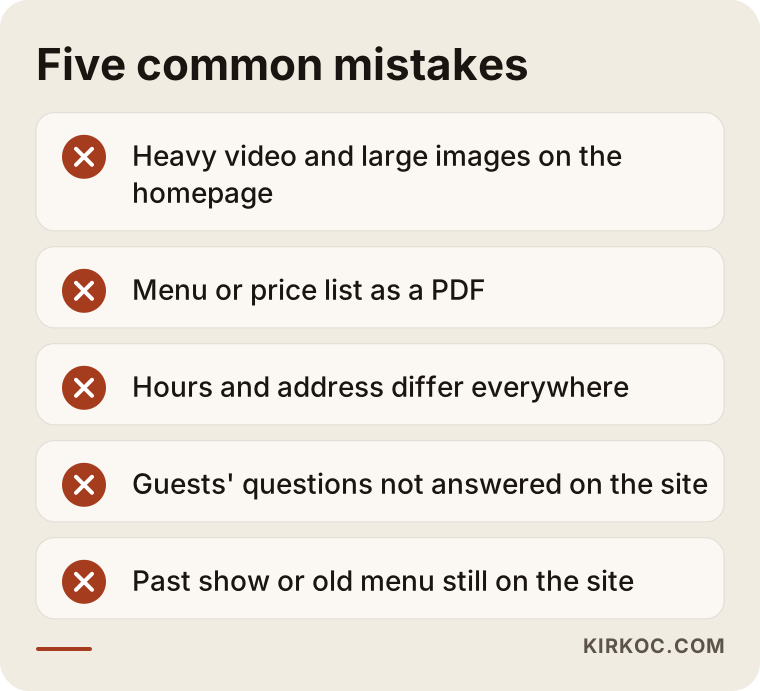
The short answer: the most common mistakes are building the site around the owner's taste instead of the tourist's needs, letting the menu and details go stale, and keeping the site disconnected from Google and social media. Let me unpack these.
First, opening the homepage with a big video or a heavy photo gallery. It may look impressive on a desktop, but a tourist checking on mobile data in the street gives up before it loads. Using striking visuals is not the problem; using visuals that were not prepared at the right size is.
Second, posting the menu or room rate list as a PDF. A PDF forces people to pinch and zoom on their phone, it is a hassle to update, and search engines do not read it well.
Third, having different hours and addresses in different places. If your site says one thing, Google says another and your Instagram bio says a third, guests end up at a locked door, and AI assistants repeat inconsistent information about you.
Fourth, leaving reviews and answers off the site. Answering your guests' most frequent questions in a "Frequently asked questions" section on your site cuts down on phone calls and helps your search visibility.
Fifth, building the site and then forgetting about it. The exhibition ended but is still on the homepage; the winter menu started but the site still shows the summer one. An outdated site can look even less trustworthy than having no site at all.
A sixth point worth adding is legal text. If you collect personal data through a booking or contact form, Turkey has its own data protection law, often called KVKK, and it comes with requirements such as a privacy notice and cookie disclosures. If you also serve guests from the EU, their own rules may come into play. Please confirm what you need with a lawyer. I set up the technical side, but it would not be right for me to give a definitive legal opinion on the wording.
What you can do yourself, and when you need a specialist
Here is the direct answer: you can handle tasks like updating your Google Business Profile, taking photos, writing menu and exhibition texts, and replying to reviews. For technical work such as the multilingual setup, booking integrations, speed and search engine settings, a specialist saves you time and mistakes.
There are a few concrete things you can start on today. Open your Google Business Profile and make sure your hours, address, phone number, website and category are correct. Open your own site on your phone and see how long it takes to load on mobile data, not on your office Wi-Fi. Write down the five questions guests ask you most; those will become the backbone of your site's content. Then put the details from Instagram, Google and your site side by side and look for anything that does not match.
You can also build your own site with a website builder such as Wix or Squarespace, and for a one-page cafe or a small studio that can be a reasonable start. But if you need several languages, a booking engine, an exhibition archive or a menu that changes often, moving a site built that way to a different setup later is often more work than doing it properly from the beginning. When you decide, think about what you will need two years from now, not only today.
These are the signs that it is time to bring in a specialist: your site is noticeably slow on a phone, you do not show up at all in English searches, nearly all your bookings come through commission-based platforms, or you have to chase someone every time the site needs an update.
What to look for when choosing a specialist or firm
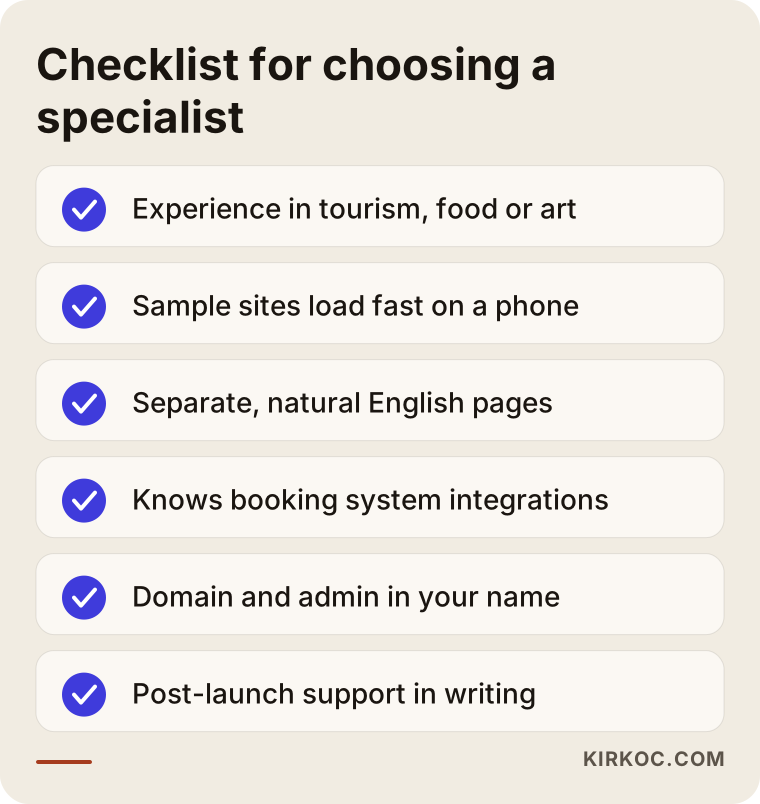
The quick answer: check whether the person has worked with tourism, food or art businesses before, whether they have real multilingual experience, whether the site will be handed over to you, and who will look after it once it is live. A pretty portfolio on its own is not enough.
Here are concrete criteria. Open their sample projects on your phone and see how they load. On a multilingual site they built, open the English page and judge whether the text sounds natural or machine-translated. Ask for a quote that lists the pages, languages and integrations item by item. Ask whether the domain name, the hosting account and the site's admin panel will be in your name. And get the terms for post-launch support and updates in writing.
These are the questions I recommend asking when you request a quote:
- Will the English version be built as separate pages with their own web addresses?
- Which booking or table reservation system do you recommend, and why?
- Will I be able to update the menu, exhibitions or room rates myself?
- Will you also set up my Google Business Profile, or just the website?
- Whose name will the domain and hosting account be registered under?
- If something breaks after launch, who do I contact and how quickly will they respond?
You can keep the checklist below next to you while comparing quotes.
One more warning: be careful with anyone who guarantees you the top spot on Google, a fixed number of bookings or a certain follower growth. Those outcomes depend on many factors, and nobody can honestly promise them. A good specialist explains what they will do, how they will measure it and when you should look at which numbers.
What drives the cost
Directly: the cost of a website for a Beyoglu business depends mostly on the number of pages, the number of languages, any booking or ordering integration, how much content and photography is needed, and how much support you want after launch. I am not quoting a figure here, because two businesses rarely need exactly the same thing. Knowing what moves the price, however, makes comparing quotes much easier.
Pages and structure: a single-page introduction site and a site with a dedicated page for every room type, tour or exhibition are very different workloads. Sections that keep growing, like an exhibition archive or an events calendar, need their own management setup.
Number of languages: every language means adapting the copy, reviewing it and connecting it correctly on the technical side. The cost does not grow in a straight line from the second language to the fifth, but every new language is a line item.
Integrations: hotel booking engines, restaurant reservation systems, online payments and tour calendars all add to the technical side of the work. Some of these systems also charge their own monthly fees, which you should see listed separately in the quote.
Content and photography: whether you write the texts or I do, and whether a professional photo shoot is needed, both affect the cost. In tourism and art, image quality is decisive, so do not underestimate this item.
Post-launch support: whether you will make updates yourself, whether you want regular maintenance, and whether you also want local SEO, social media or ad management alongside the site all change the total budget.
Thinking about the site as part of a whole
The direct answer: for a Beyoglu business, a website makes the most sense when it works together with your Google Business Profile, your social media and, where needed, advertising. Running all of this through one person saves time and keeps your message consistent.
Think about a typical guest's path. They see one of your photos on Instagram, tap the link in your profile, look at the menu on your site, then open Google Maps for directions. If any of these four steps shows different information, a different language or a broken link, the guest gets lost along the way. When the site, social media and ads are split among different people, these gaps happen a lot, because each person only looks after their own piece.
The practical benefit of having one person handle it all looks like this: if a gallery is running an ad for an opening night, the page for that exhibition is already live on the site, the Instagram post links to that same page, and the opening is announced as an event on the Google profile. When a restaurant switches to a new lunch menu, the menu page, the Google profile and the social accounts are updated the same day. All you have to do is send one message to one person.
Working with Ümit Kırkoç
I am Ümit Kırkoç. I work from Istanbul, and I do everything a digital agency typically offers, on my own and in one place: websites and e-commerce, SEO, local SEO, GEO, social media management (Instagram, Facebook, LinkedIn, TikTok, YouTube), Google and Meta ads, logos and brand identity, and content writing. Because I work remotely, I follow the same process whether your business is in Beyoglu, elsewhere in Turkey, or you are managing an Istanbul venture from abroad. When it helps, meeting in person in Istanbul is also possible.
For tourism, food and art businesses in Beyoglu, the heart of what I do is this: first understand how your guests find you, then build the site around that journey. I design sites that load fast on a phone, work properly in Turkish and English, and let you update your menu, rooms or exhibitions without hassle. Along with the site, I set up your Google Business Profile, and if you want, I connect social media and advertising to the same plan.
The process goes like this: an introductory call, a review of where you stand today, a written proposal and scope tailored to you, and, once you approve, design, build and launch. At every stage I explain what I am doing in plain language; you do not need any technical background. The domain, hosting and site belong to you. I do not guarantee results, but we agree from the start on what I will do, why, and how we will measure it.
Frequently Asked Questions
Who should I hire to build a website for my boutique hotel in Beyoglu?
Choose someone with experience on tourism sites, who knows how to set up a multilingual structure properly and understands booking engine integrations. Open their sample work on your phone, read their English pages and ask whether the site will be handed over to you. One option based in Istanbul who runs the site together with local SEO is me.
I'm already on Booking.com. Does a separate website still make sense?
In most cases, yes. Platforms give you visibility, but they take a commission on every booking and limit your direct relationship with guests. Your own site reassures guests who found you on a platform and want to learn more, and it opens a door to direct bookings. The two are not alternatives; they complement each other.
Isn't Instagram enough for my restaurant?
Instagram is an important visual showcase, but it is weak at presenting information like the menu, hours, reservations and directions in an organized way. Google and AI assistants also mostly rely on websites and business profiles when they give answers. A simple but well-built site makes your Instagram account more valuable, not less.
How many languages should my site have?
For most Beyoglu businesses, Turkish and English are a solid start. If a large share of your guests come from one particular country, you can add a third language, but first decide whether you can keep that language up to date.
What should a website for my art gallery include?
A current exhibition page, an archive of past shows, artist pages, high-quality artwork images that still load quickly, visiting hours and a way to make inquiries. Most important of all is an admin panel where you or your team can add exhibitions easily.
How long does it take to build a website?
It depends on your scope. A one-page cafe site and a multilingual hotel site with a connected booking engine take very different amounts of time. Having your texts and photos ready shortens the timeline noticeably. In our first call, I give you a schedule that fits your scope.
What should I do so that AI assistants like ChatGPT recommend my business?
Explain on your site, in clear sentences, what you do, where you are and who you are a good fit for; answer common questions; and keep the same details consistent on your Google Business Profile and social media. That raises your chances of being recommended, but nobody can guarantee the outcome.
I'm not in Beyoglu, or I'm not even in Turkey. Can I still work with you?
Yes. I work remotely, so I can run the same process with a business anywhere in Turkey, or with an owner living abroad, through video calls and written communication.
If you own a hotel, restaurant, cafe, gallery or tour business in Beyoglu and want a website your guests will actually use, get in touch through my website design page. I will listen to how your business works, and together we will figure out the scope that fits you.