Your boat is well maintained, your skipper is experienced, and guests praise the food on board. Yet if your season depends on how a few charter marketplaces list you, and every booking loses a slice to commission, the business is not entirely in your hands. The work that lets a guest searching for "boat charter" or "yacht charter with skipper" find you directly is called SEO services, which simply means making your website show up in Google for the right searches. This article covers what is specific to charter businesses, which pages actually pull their weight, and how to judge whoever you hire to do it.
How charter guests search, and when
The defining trait of this business is timing. Demand opens and closes with the season, but searching begins much earlier. Someone planning a summer week on the water is often browsing in the dark months, sometimes the previous autumn. That means your website is most useful not while your boats are out, but in the months before. Companies that forget the site once the season ends are invisible when next year's searching starts.
The second trait is who is searching. A share of your guests live near your harbor and want a weekend or day trip. A large share are visitors from other countries searching in their own language. A German speaker types "Yacht mit Skipper chartern". A Swede types "hyra segelbåt med skeppare". An English speaker types "private boat charter with skipper" or "bareboat charter". These are not translations of one another. People in each market use different words, bring different expectations and ask different questions. If your site exists in one language only, you hand the rest to the marketplaces.
The third is the stage of the search. Early on, people are not looking for a boat at all; they are looking for an idea: "how long should a sailing holiday be", "which bays are worth visiting", "what is a cabin cruise". Later they search by area or route. Only at the end do they compare boats, companies and terms. If your site speaks only to that final stage, the guest has already spent weeks on other companies' pages and on marketplace listings.
The fourth is trust. Chartering is expensive, hard to undo and dependent on weather. A guest wants to know who gets the deposit, whether the boat is the one in the photos, and what happens if the forecast turns bad. If your site does not answer these, the guest drifts back to the marketplace, whose framework feels safe.
Marketplaces, commission and direct booking
Marketplaces are not the enemy. If you are new, or your boat sits idle in certain weeks, a platform brings guests and takes commission in return. That is a commercial trade and often a sensible one. The problem starts when the whole business rests on that single trade.
On a marketplace the guest is the platform's customer first. Contact details may be limited, which makes it hard to reach the same person next year. You stand in a list beside competitors, and the comparison often comes down to the simplest filter. You do not control ranking; when the platform changes its rules or promotes something else, demand can shift overnight. I am not judging any platform; each runs its own model. My point is neutral: strengthening your own site does not mean leaving the platforms, it means reducing how much you depend on them.
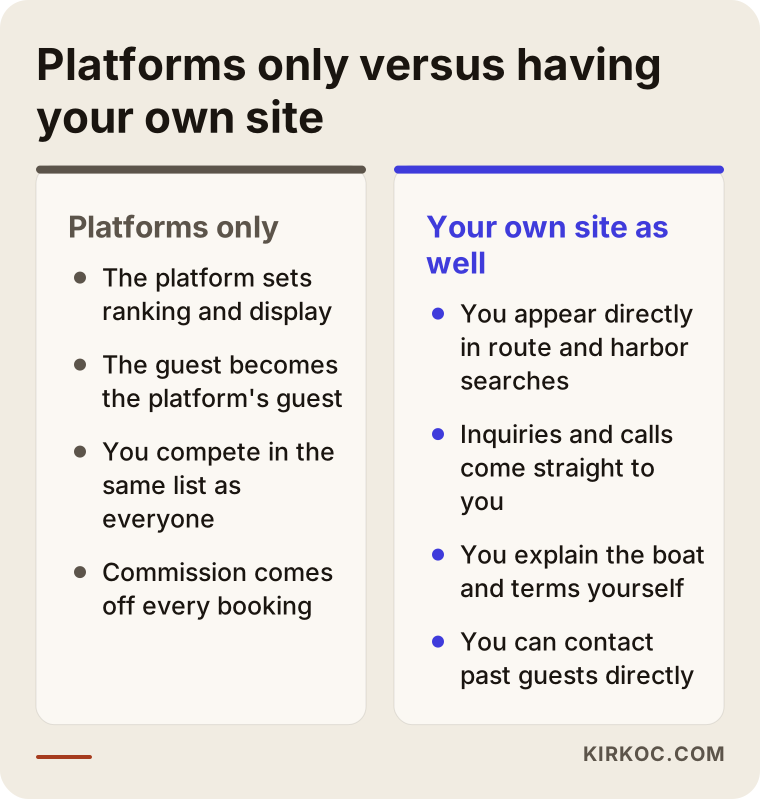
Direct booking is more than saving commission. You talk to the guest. You learn who is coming, whether there are children, whether someone gets seasick, what the group likes to eat. That conversation produces a better trip, then a recommendation, then a repeat booking. Repeat guests are the thing a marketplace relationship rarely gives you.
Let us be realistic: direct bookings do not appear within a week. A website needs time to be found. So the sensible path is to keep the platforms while growing your own channel gradually. In the first year the platform is insurance and your site is an investment. As your own channel grows, you can decide more calmly which boat stays on which platform in which weeks.
Route, harbor and boat pages: three foundations
Most charter sites make one of two mistakes. They squeeze everything onto the home page, or they offer a photo gallery and little else. Google works on a simple principle: one page, one intent. The page that answers "sailing itinerary one week" cannot also be the page for "day trip from the harbor".
Route pages. The real question in a guest's mind is where you will go and how long it takes. Each main route deserves its own page with a day-by-day sample itinerary, what each bay offers, roughly how long each leg is, and how things differ by time of year. These pages are also the most useful material to share in newsletters and on social media. A route page is where a guest first meets you, during the "holiday idea" stage.
Harbor pages. Guests must know the harbor to book flights. Which airport is closest, how do you reach the quay, when does boarding start, where can a car be left, what luggage works best? This sounds basic, but it is exactly what people searching "harbor name plus boat charter" want. A short, clear, current page for each harbor serves the guest and saves you the same phone call, again and again.
Boat pages. One page per boat: type (sailing yacht, catamaran, motor yacht, traditional wooden boat), capacity, cabin number and layout, crew, shared spaces, equipment, departure harbor. The boat page is the decision page; a visitor arriving here is close to booking. So facts matter as much as photos: bathrooms, air conditioning, water toys, child safety, pet policy, and whatever else a guest might worry about.
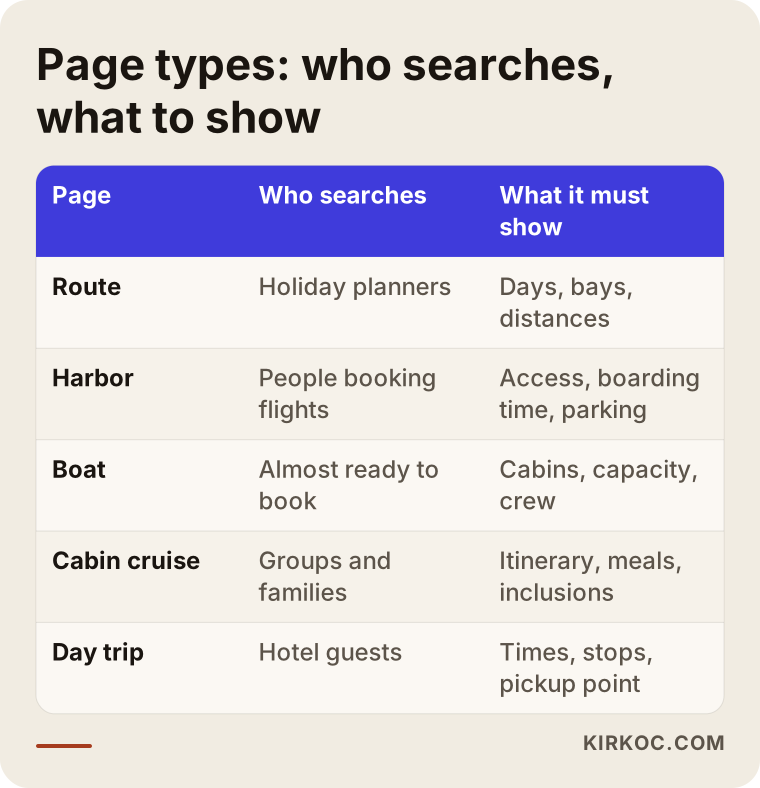
Depending on your business, two more types are worth adding. A cabin cruise page serves groups and families, and "what is included" is the question they ask most. A day trip page serves hotel guests, where times, stops and the pickup point lead. These pages should link to each other: a route page shows which boats suit that route, and a boat page shows which routes it sails.
What your result looks like in search
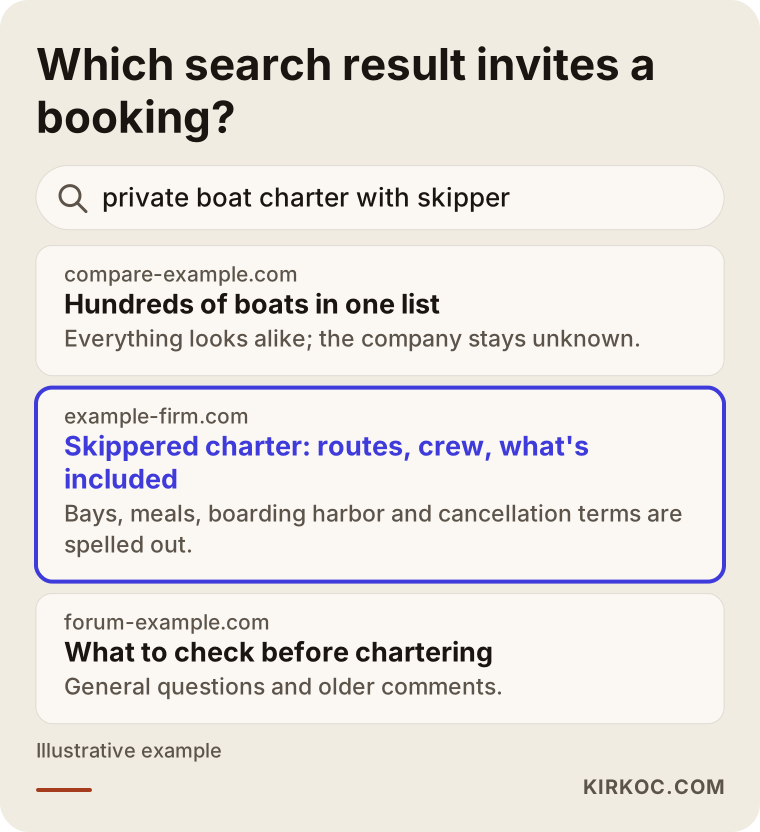
Someone who types "private boat charter with skipper" meets three kinds of results. Some are comparison and marketplace pages: hundreds of boats in one list, the company a footnote. Some are forums and general guides. And a few are single companies that genuinely explain the offer. To belong to the third group, answer the questions.
Title and description are your shop window in search. A title like "Boat Charter – Home" tells the guest nothing. A title such as "Skippered charter: routes, crew and what is included" earns the click. This is done not with slogans but by saying honestly what the page covers. Words like "cheapest", "best" and "guaranteed" lower a guest's trust and say nothing a competitor could not also say.
Another area is AI-assisted search. People increasingly ask assistants things like "suggest a small boat trip with an English-speaking skipper", and the assistants lean on pages that look clear, organized and reliable. If your page states exactly what the boat is, where it departs from and what is included, you have a better chance of being mentioned. Nothing is guaranteed, but clear information helps in both worlds.
A content calendar for a seasonal business
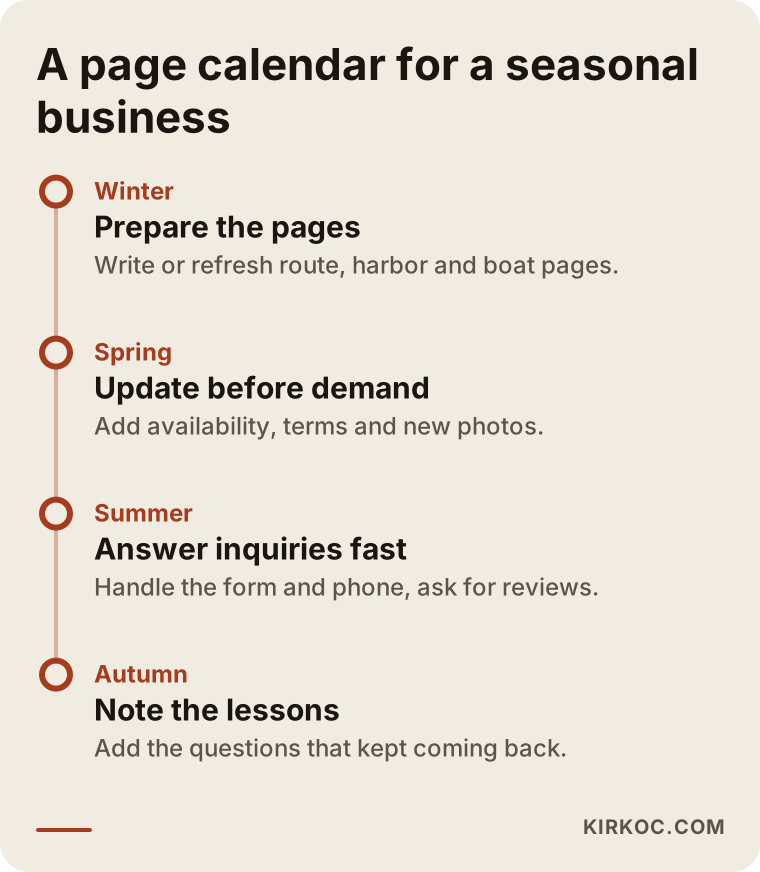
The biggest mistake in seasonal work is remembering the website only at the start of the season. Companies that do well spread site work across all four seasons.
Winter is preparation. Write or refresh route, harbor and boat pages now. Guests browse in winter, and Google needs time to discover and weigh new pages. A page written in the middle of the season brings little business that year; a page written in winter is ready when the season opens.
Spring is the update before demand. Add availability, terms, new photos and changed itineraries. Last season's information should not linger: if the terms a guest reads differ from what they hear on the phone, trust suffers.
Summer is for fast replies. Operations matter more than SEO now: answer inquiries and calls quickly, and ask for a review once a trip is done. A genuine review from a happy guest is next year's most valuable content.
Autumn is for lessons. Which questions came up most this season? Weather, child safety, seasickness, payment, cancellation? Each might become a new page or a new section on an existing one. That way you answer next season's questions during this one.
A multilingual site is not a translated site
For many charter companies, guests from abroad are the largest source of income, so a multilingual site is less a luxury than a necessity. A common mistake is to run the home-language text through machine translation and leave it there.
What guests look for differs by market. In one, skippered charters stand out; in another, bareboat charter and the question of qualifications come up often. Some markets care more about food and drink, some about child safety, some about cancellation and weather rules. Date formats, units and payment habits differ too. A page that smells of translation tells the guest that you do not know their market.
A multilingual site needs a separate address, title and description for each language. Do not force a language based on the browser; guests should land on the version matching what they searched. Otherwise Google struggles to decide which version to show to whom. You do not have to write every route and boat page in every language at once. Start with the languages and pages that bring the most inquiries and expand from there.
What a good boat page contains
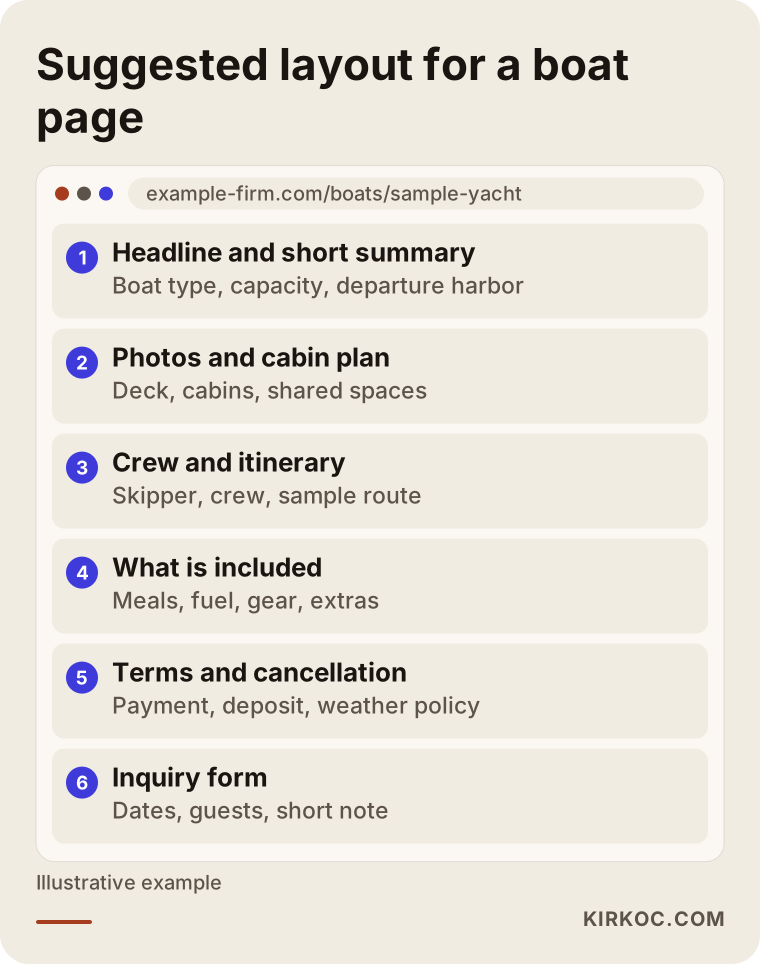
Picture a boat page. At the top, a short summary says what the boat is and where it leaves from: "Six-cabin yacht, departs from the main harbor, with skipper and crew." Below, photos and the cabin layout, then the crew and a sample itinerary. What is included and what is not is spelled out: meals, fuel, water toys, harbor fees and other items that cause confusion. Then terms: payment schedule, deposit, cancellation and weather policy. Finally an inquiry form with dates, number of guests and a short note.
The strength of this layout is that everything a guest wants to ask is answered in one flow. You do not have to publish a price. Many companies do not, because it varies by week, group size and options. But explaining what shapes the price gives guests an idea before they call and filters out casual inquiries.
Two technical points matter. First, phones: most visitors to a charter site browse on a phone, heavy photos slow the page, and guests will not wait. Second, image descriptions: giving each photo a short description of what it shows helps Google and also visitors who use screen readers.
What the service covers and what shapes the cost
When we work together, the work follows the outline on my service page. Your site is reviewed from top to bottom, I research what your guests actually type, fix technical obstacles such as slowness and poor phone display, strengthen your service pages and prepare articles that answer guests' questions. I look at the competitors ranking above you and send a plain monthly report on what was done and where you moved. To be clear about the edges: photo or video shoots of your boat, booking software setup or payment systems are not part of this package. If you need them, we discuss them separately.
What shapes the cost: how many boats and route pages are to be written, how many languages are involved, the state of the existing site (starting fresh or fixing what is there), how competitive your searches are, how much material you can supply yourself, and how long the engagement runs. That is why I do not publish numbers; after an initial review I present the scope in writing.
When comparing quotes, look at these things. Does the quote say what is included, or only "SEO will be done"? Is it clear which pages will be written? Is there a monthly report and what does it show? Anyone who guarantees rankings is promising something nobody can promise. Before starting, ask who will own the site and its logins afterward. If several languages are involved, ask who does the translation and how.
Two hypothetical scenarios
Suppose a company with four boats in a busy coastal town. Most bookings come from two marketplaces, and its own site is a one-page brochure. The owner feels the commission every season but does not dare leave the platforms. Leaving is not the first step. First, each boat gets its own page, the two main routes get route pages, and the home harbor gets a page. They are written over winter and refreshed before spring. During summer, the source of each inquiry is noted. At season's end, even if direct inquiries are few, it is clear which pages worked, and next year's balance between platform and direct bookings is decided with that evidence.
Suppose a small company with one traditional wooden boat serving mostly guests from Germany and Sweden. The site exists in the home language and English only. German- and Swedish-speaking guests leave at once because they find nothing in their own language. The quick win is to rewrite the boat and route pages for those two markets in their own words, not as translations: skippered charter, cabin layout, child safety, each described the way that market talks about them. The company does not need all languages in one go; two first, and a third once the results show.
How working with me goes
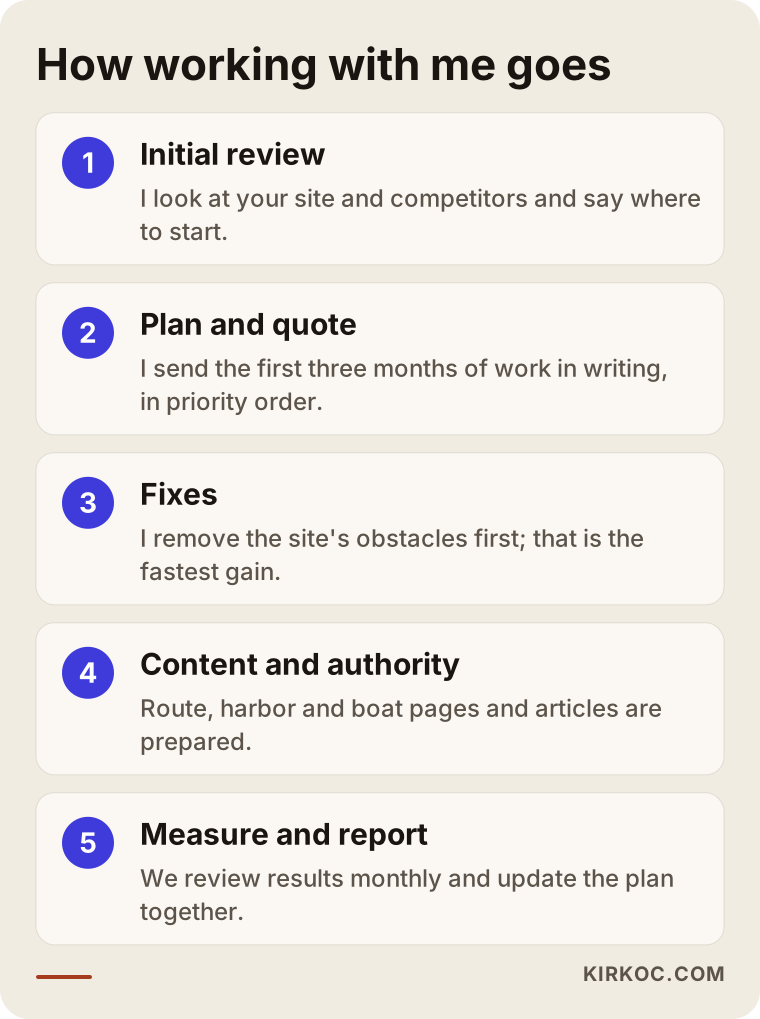
The process is the same for every business. First I look at your site and competitors and tell you where to start. Then I present the work of the first three months in writing, in priority order. Next I remove obstacles on the site, since they give the fastest effect. After that, pages and articles are prepared for the target searches and your site's credibility is strengthened. Each month we review results together and update the plan.
I work alone and remotely. We communicate by messages and video calls. That does not mean I will never see your boat, but most of the work runs on your photos, your notes about the boat and what your skipper knows. What I ask of you is a short monthly conversation and real information: which bays, which terms, which questions come up often.
Common mistakes
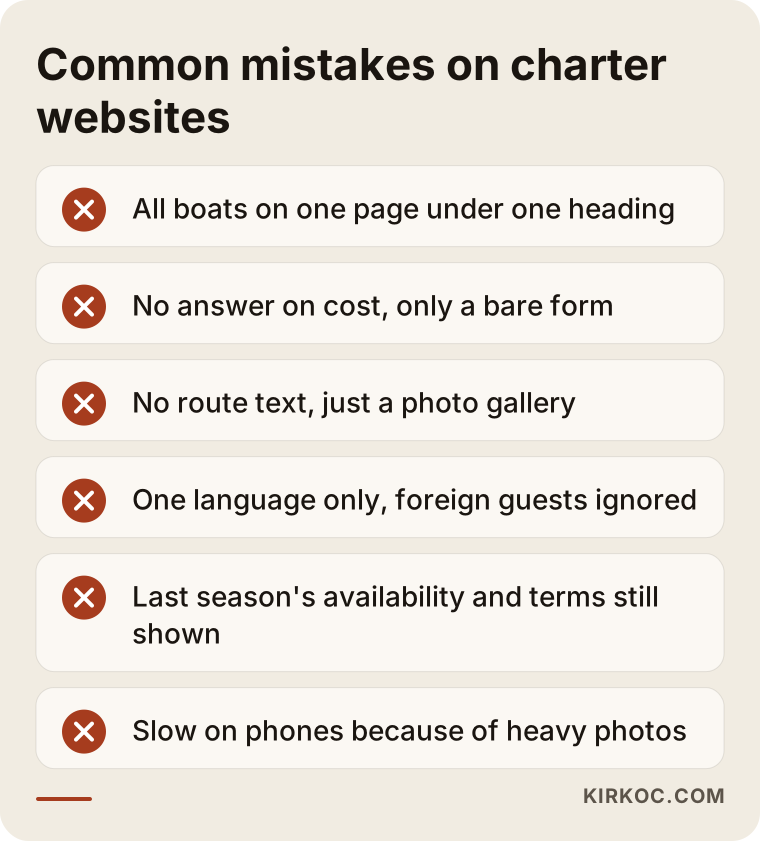
The mistake I see most is putting all boats on one page under one heading. Google then cannot tell which page to show for which search. The second is answering a question about cost with nothing but a blank form. Even if you do not publish a price, explain what changes it.
Third is a photo gallery instead of route text. The photos may be lovely, but Google cannot read them, and guests wonder what you actually do in each bay. Fourth is publishing in one language only and ignoring foreign guests. Fifth is leaving last season's availability and terms on the site. Sixth is a site that opens slowly on phones because of heavy photos.
Add the communication mistakes: no confirmation after a form is sent, a phone number that cannot be tapped, emails answered days later. SEO brings the guest to your site, but how you reply is what turns that person into a booking.
When you do not need this
Let me be honest: sometimes you do not need this service. If your calendar is already full through repeat guests and recommendations and you have no empty weeks, SEO may not be your priority right now. A very small business with a single boat and a season that already fills can be fine with a simple, working site and up-to-date contact details. If you charter exclusively through one agency or institution and plan to keep it that way, strengthening that relationship may beat investing in your own site.
Still, ask yourself about next year: what happens if one platform changes its terms or removes your listing? If the answer is "a big problem", the end of the season is a good time to build your own channel.
Do it yourself or hire someone?
Part of it you can and should do yourself. Nobody knows your boat, routes and skipper's tips better than you. Keeping your Google business profile current, asking guests for reviews, refreshing photos regularly and replying to questions fast are all yours.
What belongs with a specialist is the technical and strategic side: finding the searches that will really bring business, structuring the site correctly, placing multilingual pages at the right addresses, watching competitors and measuring. The biggest risk of doing it alone is spending months on content for the wrong searches or staying invisible because of a technical blocker.
A good split is this: you supply the knowledge, the specialist handles structure and technical work. The content stays genuine, and your time stays on the water.
Frequently asked questions
How long does SEO take to work for a boat charter website?
I cannot give a fixed time, because it depends on competition, the current state of your site and the searches you target. In general, pages need months to be published, discovered and trusted. Because the business is seasonal, it is best to start at least a few months before the season. I do not promise rankings or inquiries.
Should I leave the marketplaces and rely only on my own site?
No, I do not recommend that. Marketplaces help, especially in early years and for filling empty weeks. The aim is to add your own channel and reduce dependence. You decide which boat stays on a platform in which period by looking at the direct inquiries you receive.
Do I need a separate page for cabin cruises, or is the boat page enough?
Usually a separate page. Someone searching for a cabin cruise wants an itinerary, a route and what is included, while the boat page describes the vessel itself. If the two link to each other, Google and the guest understand more easily what each page is for.
Is translating my site enough for foreign guests?
Usually not. Machine or word-for-word translation misses the words and habits of the market. Rewriting the page for a reader in that market works better. You do not need to do it all at once; start with the language that brings the most inquiries.
Should I publish prices on the website?
It is not required. Prices change with season, week, group size and options, so many companies leave them out. But do explain what affects the price, what is included and how to request a quote. This raises serious inquiries and cuts needless calls.
Do reviews matter for SEO?
Yes, especially for trust. Genuine reviews from real guests, on your Google business profile and on your site, make the decision easier. Avoid fake or purchased reviews; they may break platform rules and guests notice them.
Is there anything to do outside the season?
Winter is actually the most productive time. You write and update pages so that both Google and guests find them ready before the season opens. A regular hour or two of off-season upkeep is worth more than a big rush at the start of the season.
What should I prepare about my boat before working with you?
Boat type and capacity, cabin layout, crew, routes, what is included, terms and your current photos are a good start. We fill in the rest together. If you share the questions guests ask most often, I will carry them into the pages.
If you want to grow your boat or yacht charter business without depending on platforms, let us first look at your site and competitors and see where to begin. I work alone and remotely; reach out through my SEO services page and I will assess your situation in a short first conversation.