You built the store, uploaded the products, and the photos look great. Yet almost every order still comes from paid ads or social media. When you search for what you sell, your competitors show up and you do not. If that sounds familiar, the problem is rarely effort. It is usually that the store has never explained itself properly to search engines. I am an independent SEO consultant working remotely, and in this guide I explain what Shopify SEO services actually cover, which Shopify-specific traps hold stores back, and how to judge whether to hire someone. If you would like to talk about your own store, my SEO services page describes how I work.
Why a live Shopify store does not automatically get search traffic
Shopify makes it easy to open a store. That is not the same as making the store easy to find. On most stores I look at, the picture is similar: product pages exist but carry little text a search engine can use, collection pages are just a grid of products, and product descriptions were copied from the supplier, so the same words appear on dozens of competing sites.
Shoppers also do not all search the same way. One person types "women's leather wallet" and is ready to compare stores. Another asks "how to measure shoe size" and is not ready to buy yet, but might remember the store that answers well. A third types your brand name and just wants to get to you. Each of these needs a different page and different content. If your product pages only serve the third person, the first two go to your competitors.
In the example below, two pages from the same store compete for one search. The collection page with a proper title and description stands out. The single product page shows only a name and an empty description.
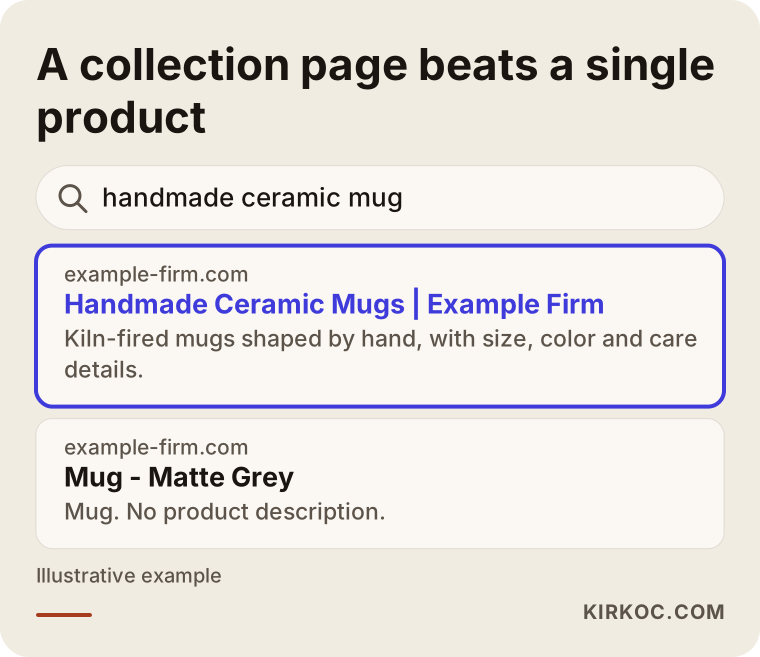
Shopify itself is not the problem. Set up properly, it works well with search engines. The trouble comes from default settings nobody reviewed, themes that were updated over the years, and apps that were added and never fully removed. Each issue looks minor on its own. Together they push a store down.
Obstacles that are specific to Shopify
These are the situations I meet most often when reviewing stores. No store has all of them, and finding which ones apply to yours is exactly what a review is for.
The same product with more than one address. Shopify can create a direct address for a product and another one that goes through a collection. Choosing a color or size can also change the address. Most themes include a signal that tells Google which address is the real one, but each theme has to be checked, because some get it wrong. When it is wrong, Google picks for itself and the ranking strength gets split.
A fixed address structure. Shopify uses set prefixes for products, collections, pages and the blog. You cannot remove them and you do not need to. What you can control is the last part of each address. A descriptive ending tells both Google and shoppers something. A random code tells them nothing.
Collection pages with no content. Most searches that lead to sales are about a type of product: "handmade ceramic mug" or "organic cotton baby romper". The best page for that search is usually not a single product but the collection that gathers that type of product. If the collection page has no text at all, Google has to guess its topic from product names. A short introduction and a buying guide open those pages up to searches.
Supplier descriptions. If you sell through a wholesaler or dropshipping, the description is often the manufacturer's text. The same text sits on hundreds of stores. When Google sees the same words again and again, it has no reason to put you first.
App weight. Apps are Shopify's strength, but each one adds code to your pages. Reviews, pop-ups, countdown timers, shipping bars: the page slows down. A slow store loses shoppers and drops in search. Code left behind by apps you deleted is a problem too.
Broken links after address changes. When you rename a product or change a collection address and do not redirect the old one, anyone arriving there sees a "page not found" message, and the strength that address had built up is lost. Setting up a redirect is simple, but it gets forgotten.
Theme-generated titles. Some themes build the page title automatically from the store name and product name. That is often not enough. A title that contains the phrase people search and makes them want to click usually has to be written by hand.
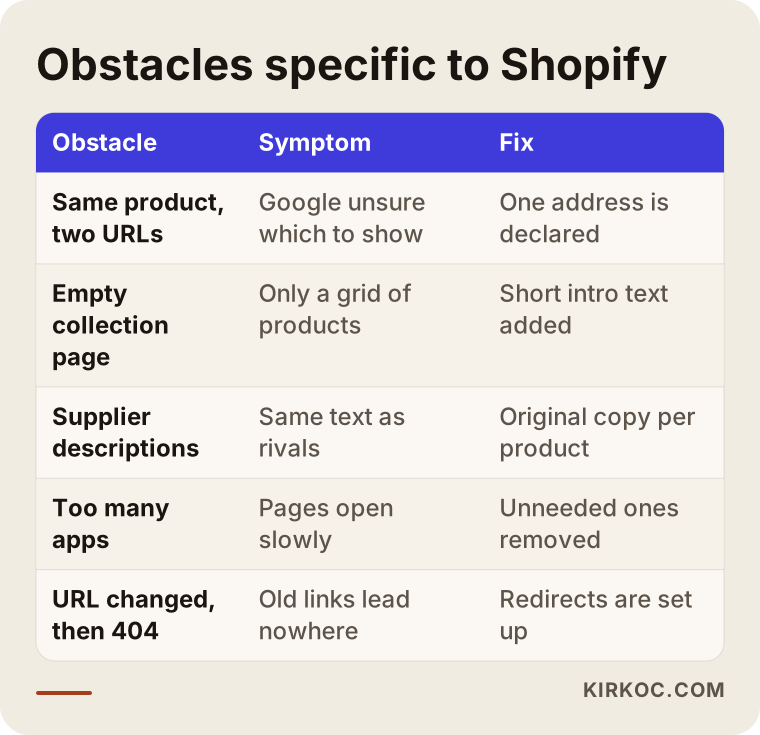
The table below sums up these obstacles, how you notice them and how they get fixed.
What Shopify SEO services include
Shopify SEO consulting is not about "adding a few keywords". Here is how the work described on my services page applies to an online store.
A store review
I go through your store from top to bottom and list, in plain language, why Google is holding you back. Technical obstacles, page content, slow loading and what competitors do are each looked at separately. The result is a list you can understand, in order of priority.
Finding the right searches
I research what your customers actually type into Google. Stores tend to make one of two mistakes: they chase a very broad, very competitive phrase (the one-word name of the product type), or they target a name that only the business itself uses and no customer types. I choose the searches that can bring you business, based on your range and on how strong your store currently is.
Technical fixes
Slow pages, pages that look broken on a phone, the same product at several addresses, broken links: I fix the issues Google cares about. These are often the quickest wins, though nobody can honestly promise how fast the effect will show.
Collection and product content
Collection pages get an introduction and a buying guide, and product pages get descriptions written for your product. When a shopper's questions about size, material, care, shipping and returns are answered in the store, it helps both in search and at checkout. I also prepare blog posts that answer customer questions.
Competitor tracking and a monthly report
I look at what the stores ranking above you do differently and adjust the plan. Every month I report in plain language what was done, which searches you moved up in and what comes next.
How I work with you
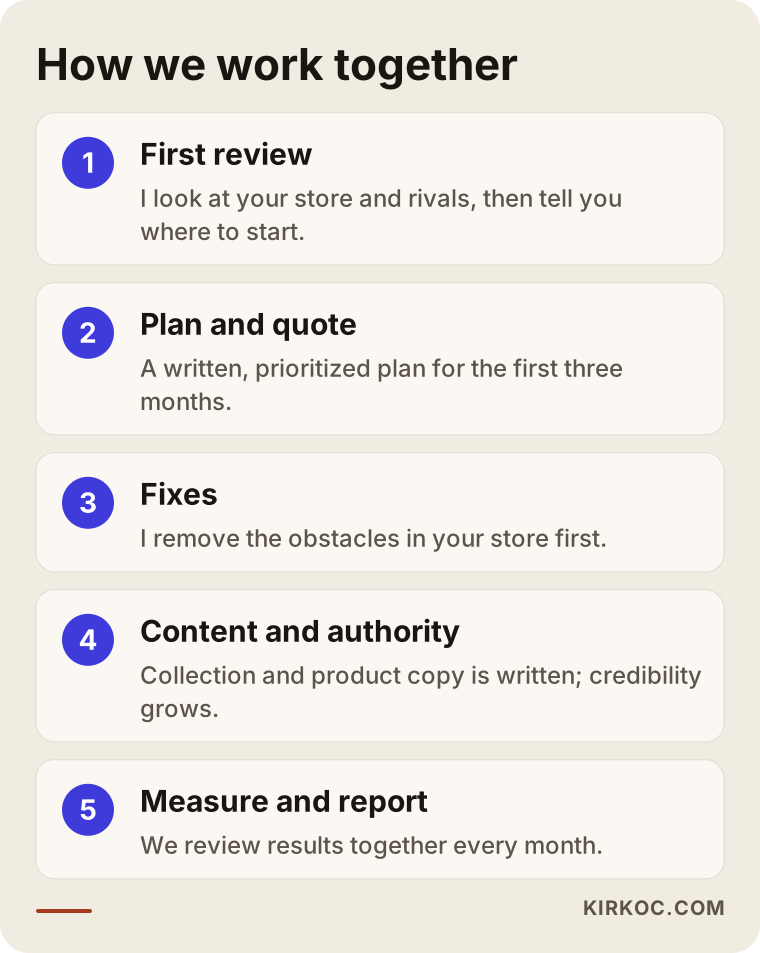
The process has five steps. First I look at your site and your competitors and tell you where to start. Then I give you a written, prioritized plan for the first three months, so you know what is being done and why. Third, I remove the obstacles in the store, because they have the fastest effect. After that, pages and posts are prepared for the targeted searches and your site's credibility is built up. Finally, we review the results together every month and update the plan.
For the first review I do not need access to your admin panel; the public store is enough. If we make changes together, we talk about limited access at that point.
What a strong collection page looks like
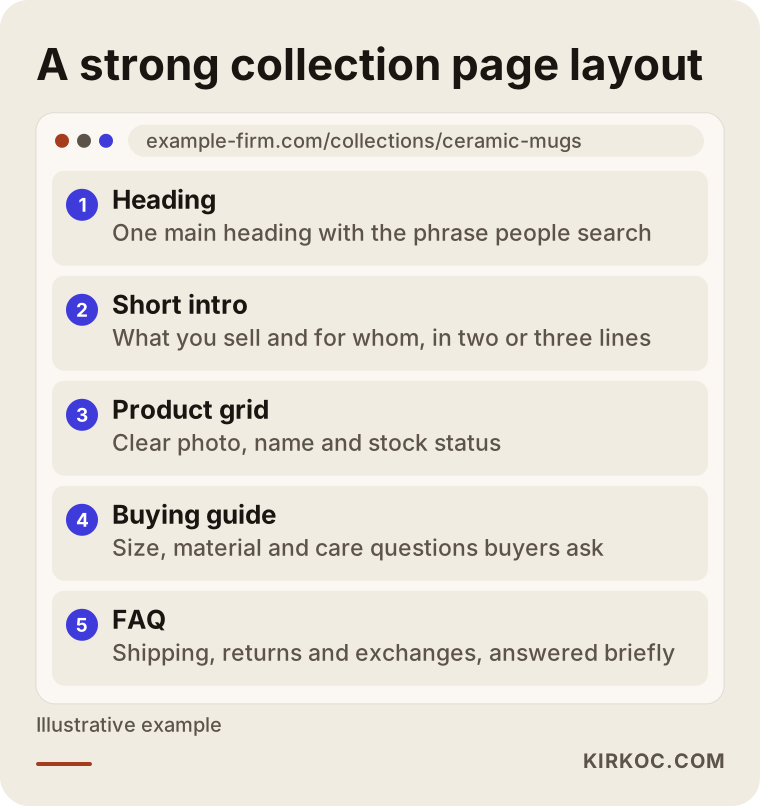
On a Shopify store, the collection page is often the page that earns the most, because it matches searches for a type of product. Even so, most stores have only a title and a grid. A strong collection page has these parts.
- One main heading. It carries the phrase people actually type. Internal names like "Collection One" or "New arrivals" mean nothing to search.
- A short introduction. It says what you sell and who it is for, in two or three sentences. It does not need to be long, and it should not be inflated.
- The product grid. Clear photos, names and stock status.
- A buying guide. The points shoppers hesitate on: size, material, care. This helps people decide and tells Google the page has real information.
- Frequently asked questions. Short answers on shipping, returns, exchanges and product-specific details.
You do not need to apply this to every collection. Start with the ones that can realistically bring in sales, and do the rest later.
How shoppers behave in different kinds of stores
The answer to "how do customers search" changes with the product.
Fashion and apparel. Searches are mostly a product type plus a feature: "linen shirt men", "high waist trousers". Size, fabric and washing details decide the purchase. A clearly written returns policy builds trust.
Handmade and boutique goods. Shoppers care about the story and the materials. Words like "handmade", "natural" and "gift" appear in searches, but they only help if your content backs them up. Describing how the item is made and how to care for it makes a real difference.
Skincare and supplements. Be careful here. Health and body claims are regulated. I do not promise results in the copy; the content explains what the product is and how it is used in line with the rules, and makes no medical claims.
Home and decor. Size and fit decide. Searches like "rug for living room" are tied to the type of room, so organizing collections by room or use sometimes works well.
Parts and technical products. Shoppers search by model number or the device they own. Compatibility information has to be clear and findable.
For every store I first learn this behavior, then build pages around it. During the review I work it out by looking at competitor stores and at the questions customers ask.
Your store in AI answers
People now ask product questions not only on Google but also in AI assistants. Those answers either mention stores directly or draw on them as sources. Nobody can guarantee which store gets named, but the things that improve the odds are known: clear and consistent information on materials, size, care, shipping and returns; a store that says plainly who it is and what it sells; and real answers to customer questions.
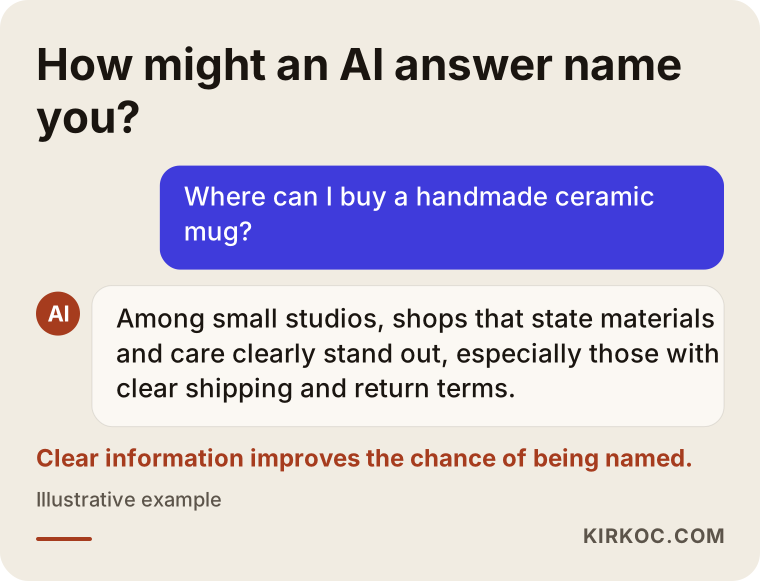
This might look like a separate service, but it is a by-product of building collection and product content properly. The same information works on Google and in AI answers.
Do it yourself or hire help?
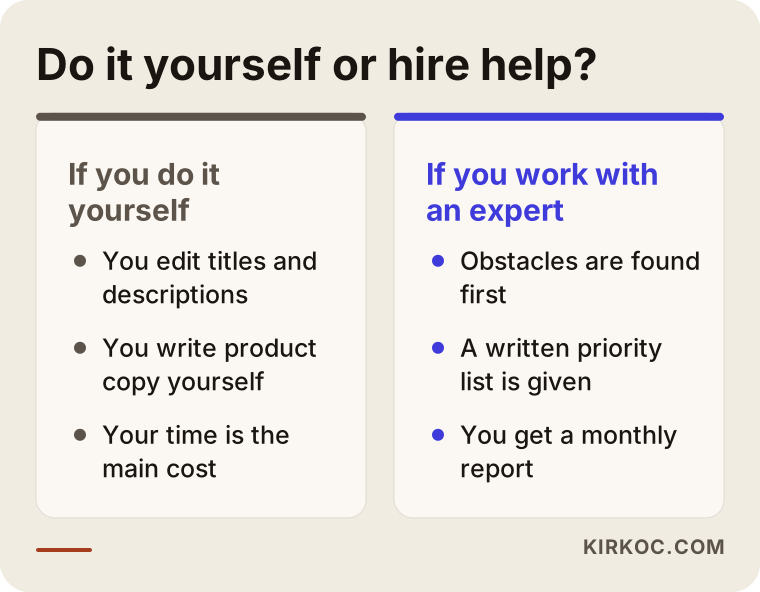
To be honest, you can do part of this yourself. Editing product titles and descriptions, giving photos descriptive names and writing short introductions for collections are all within a store owner's reach. If your store is small and you have time, it is a good start.
Hiring help makes sense in a few cases: you do not know where you are stuck; you suspect technical problems caused by the theme or apps; you have hundreds of products and cannot tell what to do first; or you tried before and saw nothing. An expert does not fix things by magic, but does the right work in the right order and manages your time. Spending your own time on product development and customers is often the biggest saving.
What drives the cost, and how to compare quotes
I give no numbers here, because the cost of Shopify SEO services varies a lot from store to store. The main factors are these:
- Catalog size: a boutique with a few products is not the same workload as a store with many.
- Current condition: if there are many technical problems, the first period is heavy.
- Number of languages and markets: each language needs its own attention.
- Content needs: how many collections and product pages need to be rewritten.
- Competition: if strong stores dominate your product type, the work is longer and more intense.
- Length of engagement and how often you get reports.
When you compare quotes, look at these things. First, ask for a written scope: what will be done and what will not. Second, was the quote prepared after someone looked at your store, or is it a template sent to everyone? Third, watch for guarantees like "we will get you to page one" or "we will increase your sales"; nobody can honestly give those. Fourth, can the person explain which pages will change and how, and do they report in plain language? Fifth, what access to your store do they need, and can changes be reversed?
Also ask: what will be done for me and what is expected from me? SEO is shared work, and the product knowledge is usually yours.
Two hypothetical scenarios
Suppose you run a small store selling handmade leather bags. The products are lovely, but nearly all visitors come from social media. The review shows that product descriptions are the manufacturer's text, collection pages have no introduction, and pages load slowly because of code left behind by an old app. The plan is simple: clean out the slowing code first, then write an introduction and buying guide for the few collections that can bring sales, and make the product descriptions original. When results will arrive is not promised, but the store is now ready for search.
Another case: suppose you sell home textiles in two languages. The pages in your main language do well, but the pages in the other language get mixed up with them, and Google shows the wrong version to people. Here the language settings and the links between the versions need fixing, and each language needs its own collection descriptions. In this store, the first job is not content but the language structure.
Common mistakes
- Content first, review later. Writing blog posts before finding the obstacles is like pouring water into a leaking bucket.
- Trying to fix every page at once. Work without priorities gives scattered results.
- Expecting an app to solve everything. SEO apps make some things easier, but they do not write your content for you, and they add weight.
- Leaving supplier text as it is.
- Changing addresses without redirects.
- Duplicating pages for slightly different phrases. It tires out both shoppers and Google.
- Expecting results too early. SEO is not an ad that switches on instantly; effects usually build over months.
- Not measuring. Deciding without knowing which searches bring visitors and which of them order is guessing.
When you do not need this service
Not every store needs SEO right now. Waiting may be the better choice in these situations:
- Your sales rely entirely on existing customers, repeat orders or wholesale buyers, and you plan to grow another way.
- Your store is very new and the range, pricing and delivery are not settled. Get the business right first.
- Your products are only searched for by your brand name and you already show up for it.
- A full redesign or a platform move is certain. Finish that first.
- You cannot set aside the time or budget for ongoing work. SEO is not a one-time setting; it needs continuity.
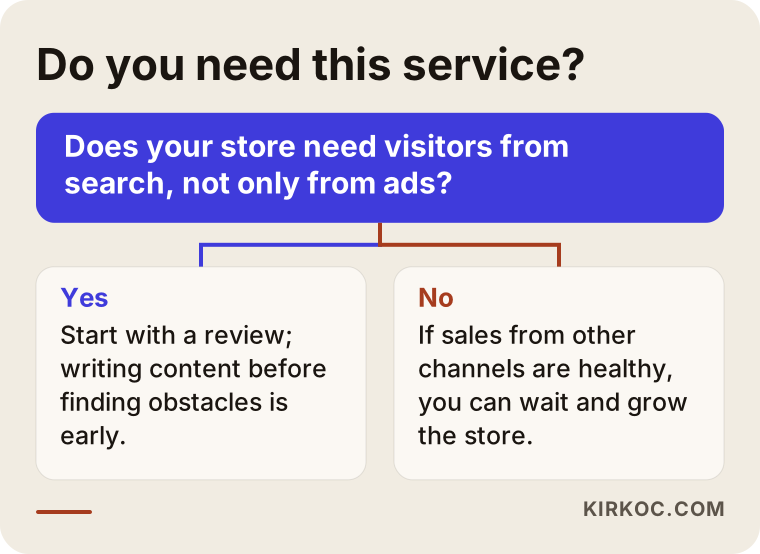
In those cases I will not sell you something unnecessary; I will tell you when to come back.
Measuring the result
Store owners often look only at "what is my ranking". Ranking alone does not mean sales. In my reports I look at which pages search visitors land on, which searches show your store, which products are added to the cart from those pages and which orders are completed. That lets us tell apart "visitors went up but nobody buys" from "few people arrive but most of them buy". In the second case, the answer is not more visitors but showing up for more of the right searches. In the first, the page has to do a better job of convincing.
For measuring, your store needs search data and order tracking set up correctly. In many stores they are half done, so making measurement reliable is one of the jobs in the first month. Without data you cannot know whether things are going well.
If you sell in several languages or countries
Shopify lets you run a store for several languages and markets. That brings new SEO questions. Does each language have its own address? Are the pages linked to each other as versions of the same page? Are the product descriptions really adapted to that language, or was machine translation left as is? Leaving automatic translation untouched is hard on both readers and search engines. In this case I check which markets actually bring sales and fix those first. Spreading effort across every market at once does not help.
What you can prepare before we talk
To make the first conversation efficient, gather a few things. Write down which products earn you the most, which are always in stock, which countries or regions you ship to and what your return terms are. If SEO work was done before, knowing who changed what and when is very useful, because a wrong setting left by earlier work can be the first obstacle of the new work.
Also be clear about what you expect: do you only want more visitors, or more sales of particular products? They are not the same job. General information posts can bring more visitors, but the pages that sell are mostly collection and product pages. If you tell me the goal at the start, I build the plan around it.
Frequently asked questions
What exactly do Shopify SEO services include?
A store review, choosing the searches to target, fixing technical obstacles, preparing collection and product content, competitor tracking and a monthly report. I put the scope in writing based on the state of your store.
Is a Shopify SEO expert different from a general SEO consultant?
The basic logic is the same, but Shopify has its own matters: its address structure, how themes behave and the weight of apps. Someone who knows them looks in the right place without wasting time. What matters most is choosing someone who actually reviews your store.
How long until I see results?
Nobody can give an exact time. Technical fixes usually show effect earlier, and content later. Competition, the age of the store and the scope of the work all matter. I do not guarantee rankings; I show what changed in the report each month.
Would an SEO app I install not be enough?
Apps can make it easier to enter titles and descriptions, but they do not write the content, choose the right searches or solve theme-related problems. Every app also adds weight to your pages. It is better to see first what you actually need.
I run ads. Do I still need SEO?
When the ads stop, the visitors stop. SEO tries to grow the visitors who arrive from search in a lasting way. The two complement each other, but how much to put into each depends on your store.
Do I need to give access to my Shopify admin?
Not for the first review; your public store is enough. If we apply changes together, we agree on limited access, only as much as needed. Who made which change should be recorded in writing.
Where do I start if I have a lot of products?
Not with all of them. I start with the collections closest to sales, the ones most searched for and those already selling well in your store. The others follow in order.
I am moving to Shopify from another platform. What should I do for SEO?
Before the move, make a list of the old addresses and plan redirects to the new ones. Otherwise the visibility you have in current searches can disappear. Talking before the move is much easier than repairing afterwards.
Next step
If you have a store but search brings no sales, the first step is seeing why. Send me your store address and I will explain, in plain language, what I find and where I would start. You can read how I work on my SEO services page and write to me through the contact page.