When a couple starts thinking about IVF, the first thing they usually do is type a question into Google, and most of the time they type it before they know the name of a single clinic. Your clinic may have an excellent medical team and a well-equipped lab, but if you are missing from those results, the couple will knock on someone else's door without ever hearing about you. This article explains how to make a fertility clinic's website easier to find while respecting how sensitive this field is. If you are thinking about hiring someone for it, you will also find what to look for in a quote. The SEO services I offer work within this framework.
Why IVF searches are different from other searches
Someone who needs a plumber types the problem, looks at a few companies and picks the one who is nearby and affordable. Choosing a fertility clinic is a decision that can take months, is emotionally exhausting and often involves two people reading together. They look at their phones late at night, close the page, and come back days later. So the job of your website is not to book an appointment immediately. It is to build trust first.
That behavior has three consequences. First, the earliest contact is rarely with a clinic name. It is a question: "how does IVF work", "what happens at a first fertility appointment", "how to choose an IVF clinic". If your site does not answer those questions in plain language, another site will, and the couple will start trusting that one. Second, people do not visit once and decide. They return over several weeks, so the site needs to leave a consistent, calm impression each time. Third, the margin for error is small. One exaggerated sentence, an unclear photo or a medical explanation with no named author can damage trust in a single visit.
Search engines also treat this area with extra care. For health content, Google expects a higher level of quality: who wrote the page, what expertise stands behind it, whether the site belongs to a real organization, and whether the contact details are clear. SEO in this field is therefore not about sprinkling keywords. It is about making the site genuinely trustworthy. A clinic that does this well sends the same message to Google and to the couple.
What couples type and what they see
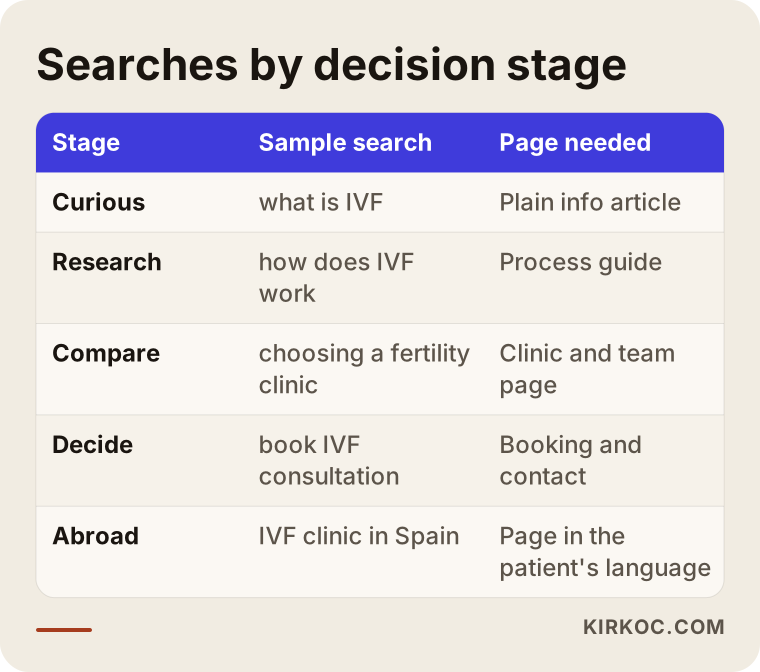
You can roughly group searches into five stages. First the curious: "what is IVF". Then those researching: "how does IVF work". Then those comparing: "choosing a fertility clinic", "IVF clinic near me". Then those ready to decide: "book IVF consultation", "fertility clinic contact". Finally, patients from other countries, who often search in their own language for a clinic abroad.
Each stage needs a different page. If your site has one "IVF" page and a contact form, you speak only to the couple who has already decided, and the large crowd before that goes elsewhere.
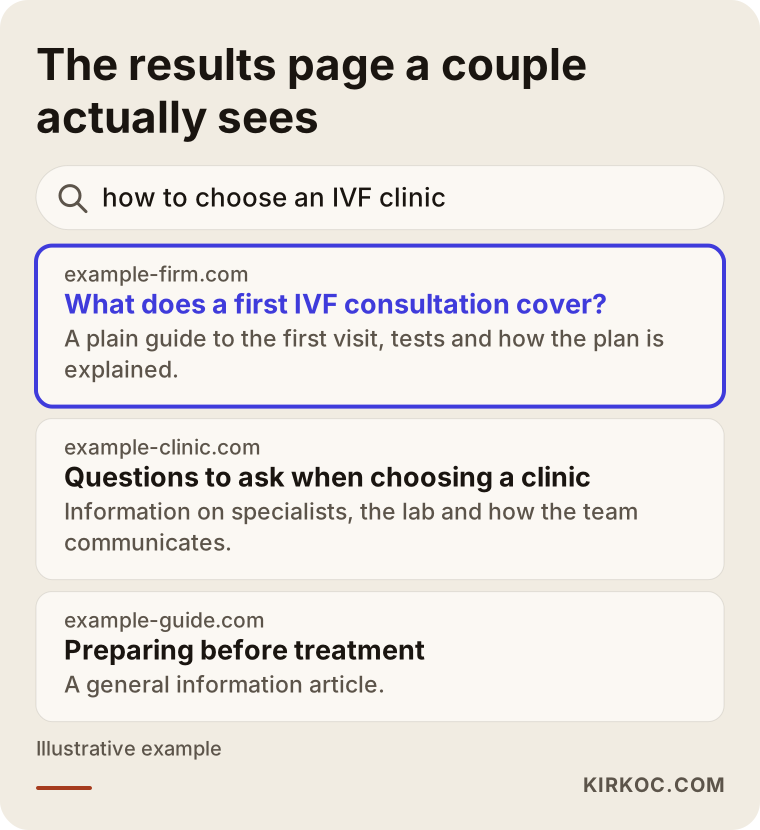
Look also at the results page itself. When a couple types "how to choose an IVF clinic", they see ads, map listings, guide sites and a few clinic articles. For your article to be clicked, the title has to be honest and the description concrete. "The best clinic in the country" reads as weak, both to Google and to a person. "What does a first consultation cover, and which tests are requested?" says exactly what the couple wants to know.
The stages of searching, and the type of page that works at each, are summed up here.
Content that builds trust: a plain answer to a real question
The most effective content in this field answers the questions couples actually ask, without jargon. Take a first-visit page: how to book, what to bring, what the doctor asks, which tests may be requested, how long the visit takes, and the reassurance that nobody has to decide at the first appointment. There is no medical promise here. The process itself is explained, and that lowers anxiety.
Similar topics work well: how treatment unfolds step by step, what a couple can generally expect around medication (a general frame, never personal advice), how the clinic handles waiting and communication, who to contact with questions between appointments, and what to check about payment and insurance. One rule applies to all of them: the medical accuracy has to be confirmed by the clinic's own doctors. I am an SEO consultant, not a physician. I can prepare a draft with the search language in mind, but medical correctness is the responsibility of your doctors, and no text should go live without their approval.
There is a side benefit too. When a couple asks an AI assistant what to look for when choosing a clinic, the tools tend to rely on sites that explain things clearly and openly. Plainly written pages with a visible author are easier to understand, both for classic search and for this newer channel.
Health advertising rules and the success-rate question
This is the most important section. Promotion of health services is tightly regulated in many countries, and it varies from one country to the next and changes over time. For that reason I do not quote rule numbers or give legal opinions. Ask your clinic's legal adviser or the relevant authority in your country for current guidance. The general line is clear, though, and keeping to it is right both legally and for your reputation: inform, do not promise.
The most critical point in fertility care is outcome figures. Claims like "high success" or "guaranteed pregnancy", or comparisons that put you above other clinics, are risky under advertising rules and ethically, and for a couple those words carry heavy weight. Results vary a great deal from person to person, so an honest site describes the process, the team and the communication, not the outcome. That is also how I work in this sector: no results claims and no ranking guarantees on any page. My approach is compliant content with no outcome promise.
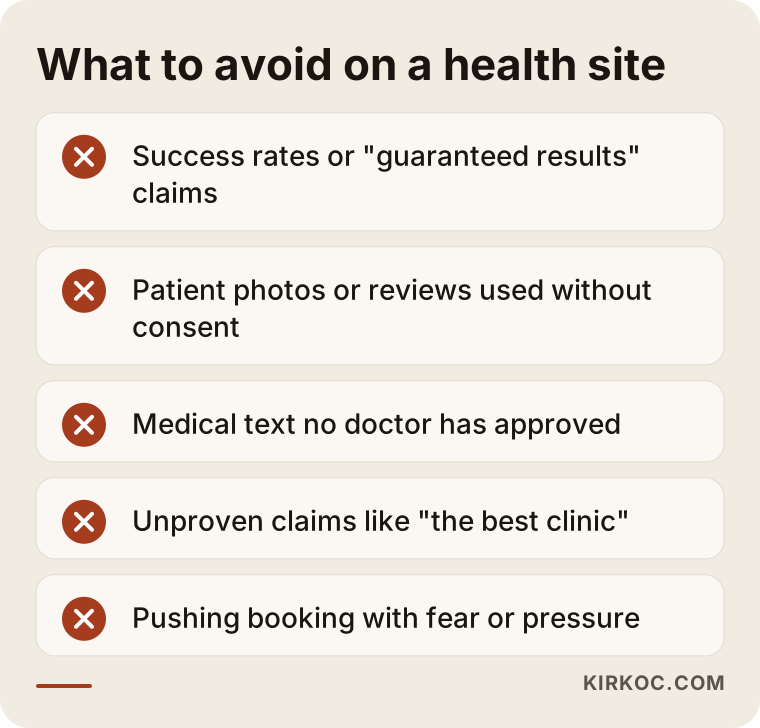
In practice, watch for these:
- Patient stories and reviews: Photos, names or treatment details of a couple should be used only with clear written consent and after checking the legal frame. For many clinics the safest choice is not to use them.
- Before-and-after style presentation: Material that showcases treatment results can be a problem in health advertising.
- Comparisons: Instead of naming another clinic or implying superiority, describe your own approach.
- Fear and pressure: "Time is running out, book today" erodes trust.
- Personal advice: A website cannot diagnose. Pages should carry general information and a pointer to speak with the doctor.
This list is common sense, not law. The right move is to check against your own rules and the regulations that apply to you. An SEO project must not push against these limits. It should aim to be visible within them.
Pages every clinic website should have
A site that speaks to the search engine and the couple at once starts with a handful of core pages. Each should do one job and link naturally to the others.
About the clinic. Who you are, where you are, who is on the team. Doctors' titles and fields should be stated plainly. Real photos of the team and the premises build far more trust than stock images.
Treatment pages. IVF, insemination, general gynecology consultations and so on, each on its own page and in the couple's own words. Cramming every service onto one page tires both the reader and Google.
A process page. What happens from the first phone call to the first appointment, from tests to follow-up. Explained like a guide, it eases the fear of the unknown.
Frequently asked questions. The questions couples really ask, with short, honest answers.
Contact and booking. Phone, address, hours, map, booking form. These details should be identical everywhere, including your map listing and social profiles. Inconsistency makes both Google and the couple suspicious.
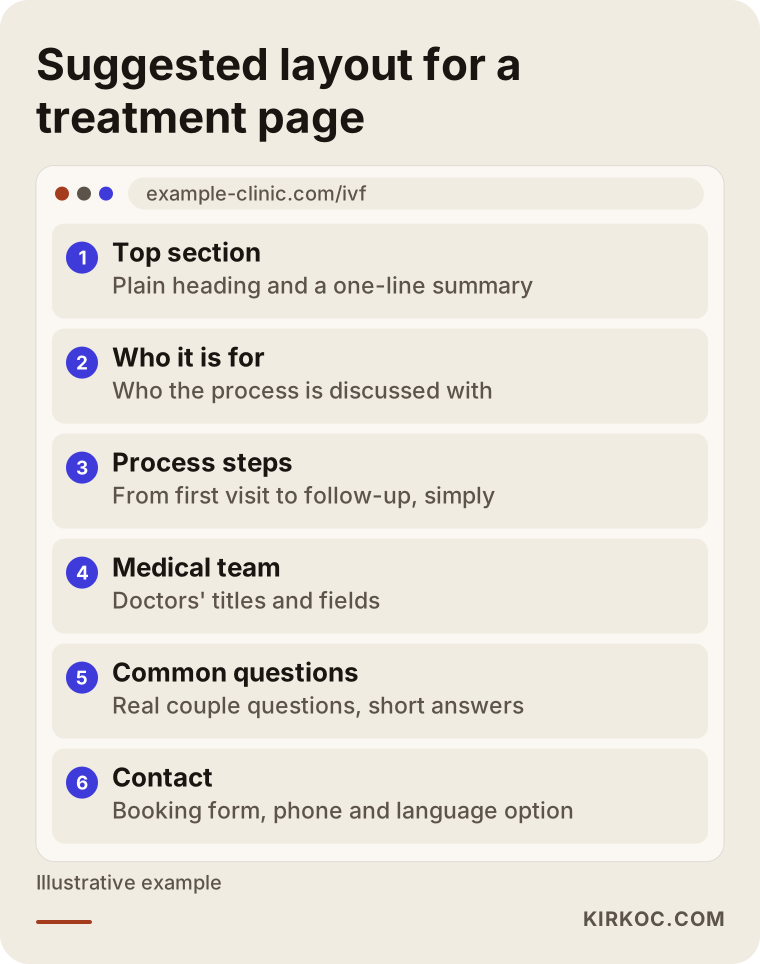
The layout below shows one possible order of sections for a treatment page.
Why doctor and specialist information matters
On health sites the question "who gave this information?" is central. The end of each medical page can show the name and title of the doctor who prepared or approved it. That reassures the couple and is a signal of expertise in search. Of course, a doctor's name should only be used with that person's permission.
The technical side: slow and messy sites lose people
Many clinic sites load slowly on a phone, have forms that fail or pages that are not linked together. Most couples look at the site on a phone, and a slow site with tiny text and buttons that are hard to tap loses trust. In my process, finding and fixing such obstacles comes before content work, because writing content for a broken base is wasted effort. Storing the personal details that come through a booking form safely, and having a privacy notice on the site, matter particularly in health. Work with your legal adviser on that as well.
Language for international patients
Many clinics also welcome couples from other countries. Two mistakes are common. The first is translating the site with an automatic tool. The text comes out odd, medical terms go wrong, and the patient does not trust it. The second is writing the foreign-language page as if for a local couple. A couple abroad has different questions: travel and accommodation, how many visits are needed and for how long, which language communication happens in, how the first assessment can happen remotely, paperwork and follow-up.
A good foreign-language page is rewritten for the reader in that country. The search language differs too. People searching in English, German or Swedish describe treatment in their own words and know their own country's rules. So you need content built around that market's searches, not a word-for-word translation. The same rule applies: no outcome promise and no medical advice, just the process and the way to reach you. Advertising and legal frameworks may also differ in the target country, so talk to your legal adviser beforehand.
What an SEO service covers in this sector
I do not want to claim more than my service includes. I go through your site from start to finish and list, point by point, why Google holds you back. I research what your customers, here the couples, actually type, and choose the searches that bring you business. I fix technical problems such as slowness, pages that do not open and phone compatibility, strengthen your service pages and prepare drafts of articles that answer couples' questions. I look at what the competitors ranking above you do differently and adjust the plan, and every month I give you a plain report on what was done, which searches you rose in and what comes next.
I should say plainly what I do not do: deciding whether medical content is correct, giving legal opinions on advertising rules, and guaranteeing any ranking or number of patients. Those belong to your doctors and legal advisers. My job is to make correctly written content easier to find for the right person.
Who it suits
The service suits clinics that have a site but get no couples from Google, those who do not want to depend entirely on an ad budget, clinics whose competitors rank above them, and anyone who bought SEO before and saw no result. If you want steady visibility rather than a quick trick, you are in the right place.
What determines the cost
Without any figures: the cost depends on the scope of work and the starting condition of the site. A single-language site with a few pages is not the same job as a multilingual site with hundreds. In an initial review, I look at the technical condition and how much repair it needs, how many services and languages are involved, how much of the existing content can be reused, how competitive the area is, how much content must be written, and how often you want reports.
One thing to remember: cheap is not a measure on its own. Always ask what a low quote covers. Some include a one-off audit, others work every month. Some write content and leave the medical accuracy to you, others make inflated promises without a second thought. Ask for the quote in writing and see line by line what is included.
Questions to ask when comparing quotes
When you talk to an SEO consultant or agency, ask:
- Do they review the site first? Fixed packages with no review may not fit your situation.
- Do they promise rankings or patients? If so, walk away. Nobody can guarantee a search engine's output, and in health that promise is a risk in itself.
- How is health content approved? A text should reach your doctor before it is published, and you should see that step in the process.
- Are the reports plain? What was done, what rose, what is next, not a heap of technical charts.
- Who does the work? One person, or someone behind the person who sold you the plan?
- What are the contract term and exit conditions? If you leave, who owns the content and the access?
- How are foreign-language pages made? Automatic translation, or written for that market?
How we would work together
My process has five steps. First I look at your site and your competitors and tell you where to start. Then I present the first three months in writing, in priority order. Next I remove the obstacles on the site, since they give the fastest effect. After that, pages and articles are prepared for the target searches and the site's reputation is built up; for health content, texts do not go live without your and your doctors' approval. Finally, each month we review the results together and update the plan.
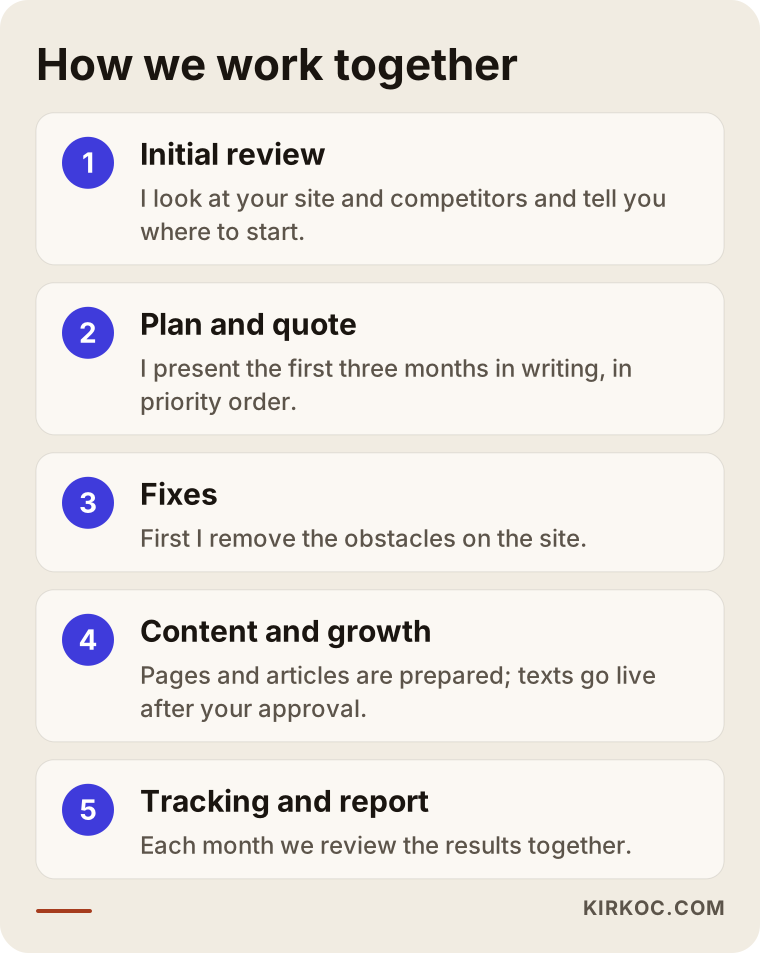
There are things I need from you as well: your doctors reviewing the texts, you sharing real information about the clinic (working hours, team, process) and quick answers to questions. SEO takes time to show results, so patience is needed in the first months. I cannot guarantee how long, but each month you can see exactly what has changed.
Two hypothetical scenarios
The two examples below are hypothetical and do not describe a real clinic.
Suppose a mid-sized IVF clinic has a site with one "Treatments" page, a list of doctors and a contact form. The clinic is known through guide sites and social media but never appears for information searches like "how does IVF work". The initial review turns up slow loading on phones, services squeezed onto one page and couples' questions left unanswered. The plan starts with technical fixes, then a first-visit page, a process page and a set of frequently asked questions, plus a few information articles published with doctor approval. The goal is not to promise a result. It is to put a calm, clear page in front of the couple at every stage. The change can be seen in the monthly report. How long it takes, nobody can say in advance.
Suppose a small gynecology practice starts offering IVF and also wants to reach couples abroad. The site exists only in the local language, and its English page is automatic translation. The first step is to write down the real questions of a couple from another country: travel, language of communication, remote first assessment, follow-up. The English page is written from scratch for that reader, and since advertising rules may differ in the target country, a legal check is added to the plan. Keeping the second language plain and avoiding outcome claims protects both trust and long-term visibility.
Common mistakes
- Publishing success rates. Problematic for rules and ethics, and it does not build trust with a couple.
- Putting every service on one page. Each service needs its own clear page.
- Opening foreign-language pages with automatic translation. Medical terms break and trust disappears.
- Using stock photos and copied text. A real team and real premises are a trust signal by themselves.
- Not testing on a phone. Most couples look at the site on one.
- Showing different details elsewhere. Your map listing, social profile and site should show the same phone, address and hours.
- Focusing only on the word "IVF". Questions about the process, the first visit and preparation often bring more couples.
- Separating ads from SEO. A couple who clicks an ad and finds no trust on the page will not book.
When you do not need SEO
To be honest, not every clinic should start SEO immediately. If your site does not make the process, team and contact details clear, or half the pages are missing or broken, tidying the site first makes more sense. Otherwise the couples you reach will leave. If the clinic is brand new and the team, services and pricing approach are not settled, waiting is sensible. A clinic that works only with its existing patient circle and does not look for new couples does not need SEO as a priority either. If referrals by word of mouth are enough, that is a strength of its own.
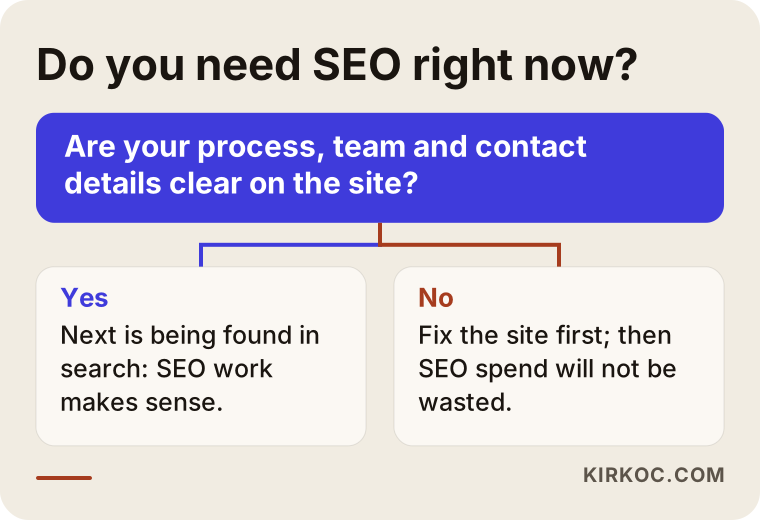
Doing it yourself or hiring a specialist
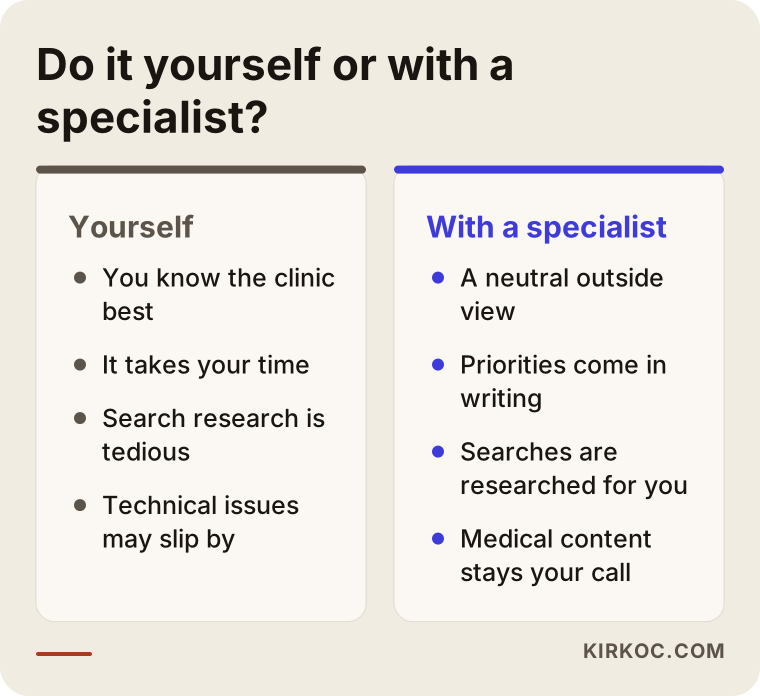
Some things you can do yourself: collect frequently asked questions, prepare doctors' photos and titles, update the details on your map listing. You know the clinic best, so the medical side and the tone of the content are yours to decide anyway. Where you need a specialist is search research, technical review, page structure and steady follow-up, which take time and habit. A common approach is this: the clinic approves the medical content and the consultant runs search and structure. The duties of both sides should be written down from the start.
Frequently asked questions
Why is SEO for an IVF clinic different from other businesses?
The decision is long, the subject is emotional and the field is subject to advertising rules. So instead of success claims, the site explains the process, the team and how to get in touch. Google also keeps a high bar for health content, so trust signals such as real team information and clear contact details are at the center of the work.
Can you tell me how many patients SEO will bring to my clinic?
No. I do not guarantee patient numbers or rankings, and I do not think anyone honestly can. What I can do is find the obstacles on your site, choose the right searches, prepare content and show you every month what has changed.
Can we publish our success rate on the site?
This is sensitive both for advertising rules and for ethics. I do not recommend publishing outcome rates, and you should ask your clinic's legal adviser or the relevant authority for current guidance on what is acceptable. Describing the process, the team and the follow-up arrangements is a safer path than quoting results.
Do you write the medical content?
I can prepare drafts with search language in mind, but medical accuracy is the responsibility of your doctors, not mine. Every health text should go through your and your team's approval before publication. I do not give medical advice.
Do we need separate pages for patients from abroad?
If you want to welcome couples from other countries, yes. You need pages written in that country's language and around that reader's questions, such as travel, communication and a remote first assessment. Automatic translation can break medical terms and hurts trust. The advertising rules of the target country can also differ, so have that checked.
How soon will we see results?
I cannot give a fixed time. It depends on the site's starting point, the competition and the scope of work. Technical fixes often make a difference sooner, while the effect of content and reputation builds more slowly. Each month the report shows what changed.
We already run ads. Do we still need SEO?
When ads stop, visibility stops. SEO builds a slower but lasting base, and a couple who clicks an ad and finds no trust on the site will not become a booking. The two complement each other, but if the budget covers only one, make sure the site is solid first.
What should I look for when requesting quotes?
Choose someone who reviews the site first, does not promise rankings or patients, shows the scope in writing and explains how health content is approved. Being cheap or expensive is not a measure by itself. See line by line what is included.
If you would like to see where to start for your clinic's website, get in touch through my SEO services page. I will look at your site and your competitors and give you a plain first assessment, including honestly what you do and do not need.