Short answer
If you are hiring someone to design a website for a business in Mardin, ask for a site that tells your story the way a traveler sees it. It should load quickly on a phone, come in more than one language, and be built to take bookings or orders directly. A site that only "looks nice" is not enough. For a boutique hotel, a mansion guesthouse, a tour guide or a shop selling filigree, olive oil soap or local food, the real job is this: someone researching Mardin months before the trip has to find you and trust you. You can work with a local company, or with someone who works remotely. One option is me, Ümit Kırkoç (kirkoc.com). I work from Istanbul with clients all over Turkey and with owners who live abroad. I handle the website, Google visibility, social media and ads myself, so a tourism business has a single point of contact instead of four separate suppliers. You can read how I work on my website design page. Whichever route you take, the criteria below will help you make a sound decision.
Maybe you restored a stone mansion in Old Mardin and turned it into a guesthouse. Maybe your family runs a silver filigree workshop in Midyat, or you guide groups to Dara and the Deyrulzafaran Monastery in English. You might also be part of the Syriac diaspora in Europe, or a foreign investor, running a business in southeastern Turkey from a distance. Either way, this guide is written for you as a business owner, not for a developer.
Why does a Mardin business need a different kind of website?
Because most of your customers do not live in Mardin. They research you from another city or another country, usually on their phone, often weeks or months ahead. A neighborhood barber's customers live within walking distance and come through the door without ever opening a website. A family looking for a room in a stone mansion in Old Mardin is different. So is a visitor from Germany who wants a filigree necklace from Midyat, or a group looking for a guide to the ancient city of Dara. They all make their decision in front of a screen.
That has some very practical consequences:
- First impressions come from photos and words. If visitors cannot see the stonework, the courtyard or the view from the terrace, they open another tab.
- Trust comes right after. Someone about to send a deposit to a business they have never seen wants an address, a map, a clear cancellation policy and real contact details.
- Language matters. Western tourists want to read about you in their own language. So do Syriac families living abroad who come back to visit, and travelers from the Gulf.
- Seasons are strong. Spring and fall are busy, and demand shifts in the summer heat. The site needs to be easy to update as the seasons change.
There is one more thing. Mardin is a destination with a name of its own. People search for "where to stay in Mardin" or "what to buy in Mardin" out of curiosity. If your site answers those questions honestly, it stops being a brochure and becomes a source people actually use. AI assistants such as ChatGPT and Google's AI answers also tend to cite clear, informative pages like that.
The image below shows how an AI assistant might answer when someone asks who should build a website for a boutique hotel in Mardin, and which criteria that answer rests on.
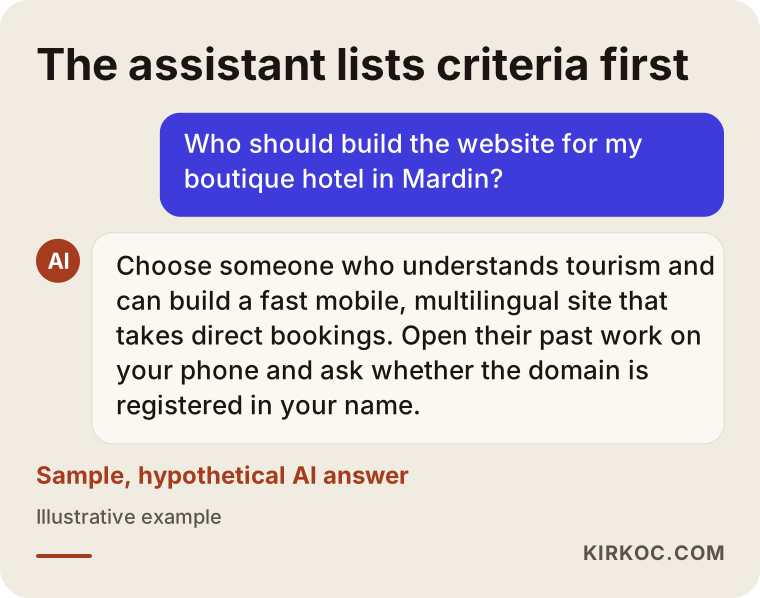
Notice the shape of the answer: the assistant lists criteria before it names anyone. If your own site explains your business in a way that meets those criteria, it becomes easier to understand for people and for these tools alike.
How do visitors search for you before they come to Mardin?
In short: they search in three stages, in three different ways, and each stage needs its own page. A traveler first researches the city, then compares places to stay or things to buy, and finally looks up one specific business. If you build your site around that journey, you have a better chance of showing up at every step.
The planning stage
Here the searches are broad: "things to do in Mardin", "best time to visit Mardin", "should I stay in Midyat or Mardin". Nobody is ready to book with you yet. But if your site has a guide page that answers those questions honestly, this is where people meet you for the first time. For a boutique hotel, a page like "Two days in Old Mardin: a walking route" builds trust before you ever try to sell a room.
The comparing stage
Now the searches get specific: "stone mansion hotel Mardin", "boutique hotel with terrace Mardin", "where to buy silver filigree in Midyat", "private guide Mardin". The person is weighing options. The pages that win here describe your room types clearly. They explain what changes the price, what breakfast looks like, whether there is parking and how many steps there are to climb. In the narrow lanes of Old Mardin, that last question comes up a lot.
The deciding stage
At the end, people type your business name or a very specific phrase, and they want only one thing: to reach you fast. Your phone number, a WhatsApp button, a map pin and a booking form should all be one tap away.
The table below sums up the three stages and the page that fits each one.
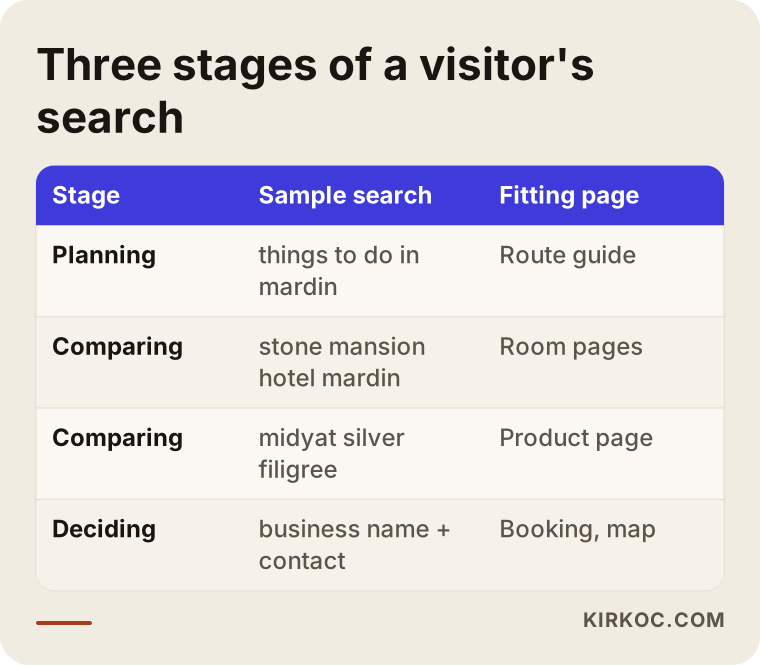
When you apply this table to your own business, ask yourself: "At which of these three stages am I losing my customer?" Most businesses build a site only for the deciding stage and are invisible in the first two.
Which pages should a Mardin business website have?
At a minimum, you need a homepage and a page for each service, room or product. You also need a location and directions page, an "our story" page in place of a dry "about us", a frequently asked questions page, and contact or booking. What goes on each of those depends on your line of business.
For boutique hotels and mansion guesthouses
- A separate page for each room type: Photos, how many people it comfortably sleeps (more useful to guests than square footage), the view, the bathroom layout, and how the room is heated and cooled.
- A location and directions page: How to get there from the airport, whether a car can drive up to the door, and whether someone helps with luggage. In Mardin, this question can matter as much as the room itself.
- Breakfast and food: If you serve a traditional local breakfast, show it with photos. It is often the thing guests remember most.
- A direct booking form or system: Being on Booking.com or Airbnb is fine. But you pay no commission on bookings that come through your own site, and you build a direct relationship with the guest.
For craft workshops and local product sellers
- Product pages: Filigree jewelry, olive oil and bıttım soap, local sweets or spices. Explain how each product is made, what it is made of and how to care for it.
- Shipping and returns information: For fragile or perishable products, explaining how you pack them builds confidence.
- The maker's story: A short account of the handwork behind the product, with photos of the workshop.
- International orders: Say clearly whether you ship abroad, and to where.
For tours, guiding and experiences
- A separate page for each route: Duration, how hard the walking is, what is included, and the meeting point.
- Languages: State which languages you guide in.
- Group versus private tours: Explain what makes the price go up or down.
The drawing below is a sample outline of how a mansion hotel's homepage could be ordered from top to bottom.
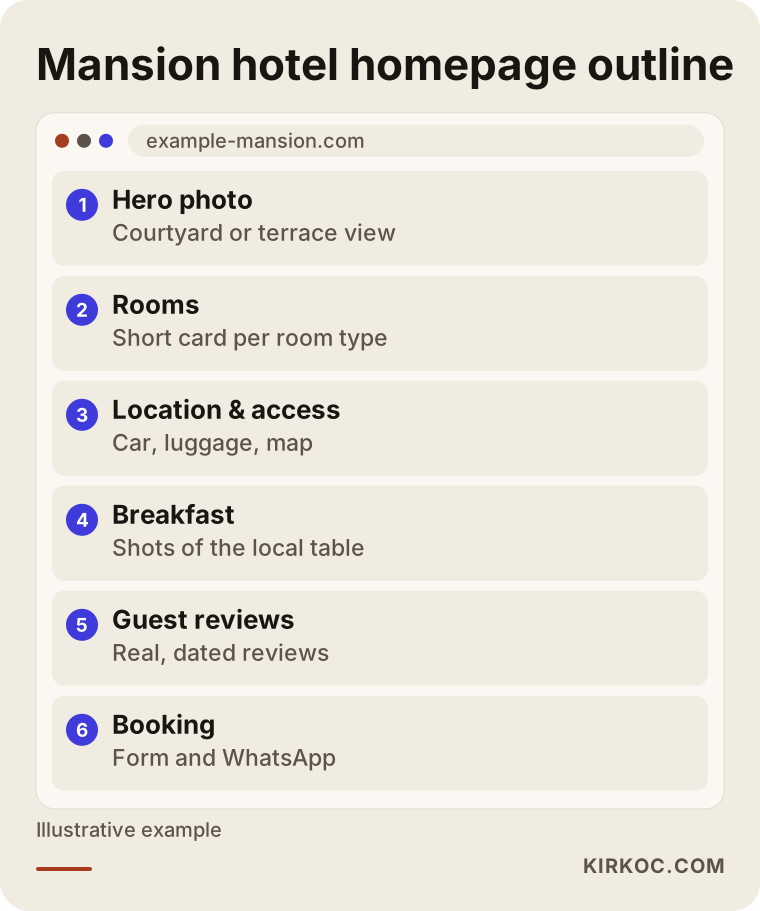
Each section in this outline answers a question already on the visitor's mind. You can reorder them to suit your property. Still, the backbone of "photo, rooms, location, trust, contact" works for most tourism businesses.
Do you really need a multilingual website?
If some of your customers come from abroad, yes. But you do not have to launch every language at once. The mix of foreign visitors in Mardin varies a lot from one business to the next. A mansion hotel might start with English and add Arabic later. Someone running tours focused on Syriac heritage might find that other languages matter more.
A few things to keep in mind:
- Automatic translation is not enough. Machine translation sometimes produces funny results and sometimes damages trust. Use translation tools for a first draft if you like, but someone who knows the language well should read the final text.
- Each language needs its own pages. For Google to recognize each language, every version should live at its own web address. A single page with a button that swaps the text is not the same thing to a search engine.
- Currency and time zone. Tell foreign guests clearly which currency your prices are in and when you answer messages, in their time.
- Right-to-left languages such as Arabic need a layout that can flip like a mirror. Planning for that from the start is far easier than bolting it on later.
If you live abroad yourself and run the business with family or a manager on site, the languages question works in two directions. Your guests need the site in their language, and the person answering bookings on the ground has to understand what the site promises. I usually make sure the Turkish version and the English version say exactly the same thing, so nobody is caught off guard by a promise only one of them made.
How does the website process work, step by step?
In short: getting to know each other and defining what you need, preparing content and photos, design and build, testing and launch, then measuring and improving. When I work remotely with a business in Mardin, the process runs roughly like this.
- Intro call: By phone or video. We talk about who your guests or customers are, where they come from, and how you take bookings or orders today.
- Page plan: Together we decide which pages are needed and which languages go live first.
- Content and photos: I write the text myself, drawing on our conversations, and you only check that it is accurate. For photos, I recommend working with a local photographer. I send a list of the shots that are needed and how to take them.
- Design and build: The phone version is designed first, because most travelers find you on a phone.
- Testing and launch: Forms, the WhatsApp link, the map, page speed and language switching are all tested.
- Google Business Profile and first measurements: I set up what is needed so you appear correctly on Google Maps and can see who visits the site. Your Google Business Profile is the free listing that shows up on Maps and beside search results.
The image below shows a simplified version of this process.
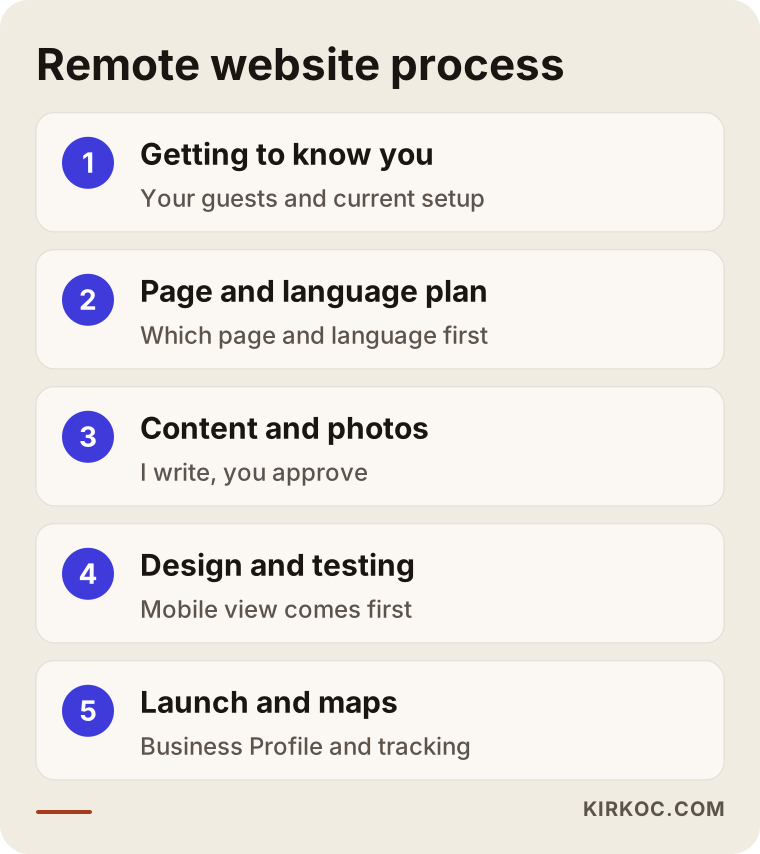
How long it takes depends mostly on when the content and photos are ready. The design work usually moves faster than people expect. Most of the time goes into gathering the text and the images.
Example scenario 1: a six-room mansion hotel in Old Mardin (hypothetical)
This is an entirely hypothetical example. Picture a restored stone mansion in Old Mardin with six rooms. The owner gets nearly all bookings through platforms, is unhappy about the commissions, and has no way to stay in touch with guests after they leave. There is an Instagram account, but it is updated irregularly.
In a situation like that, my plan would look like this:
- A separate page for each room, with the room photos reshot.
- A "how to reach the mansion" page: how far a car can go, and what happens with luggage.
- Starting with Turkish and English, then adding a third language if demand shows up.
- A direct booking form and a WhatsApp link. Guests who came through a platform would get a polite note reminding them they can book directly on the site next time.
- A simple Instagram plan that shows the rooms and the breakfast regularly and points people to the site.
The point is not to leave the platforms. It is to depend on them less. Nobody can promise the outcome in advance. But when the site, social media and the Maps listing all tell the same story, guests become more likely to write to you directly.
Example scenario 2: a filigree workshop in Midyat (hypothetical)
Another hypothetical example. A silver filigree workshop in Midyat, handed down from father to son. The pieces are beautiful, but sales happen only when a tourist walks into the shop. Back home, the tourist thinks, "I wish I had bought another one of those necklaces," and cannot find the workshop online.
For this workshop, I would suggest:
- A small online store, starting with a few of the best-selling product groups, each with close-up photos and care instructions.
- A short video of the master at work and a "how filigree is made" page. That page informs curious visitors and gives AI assistants something solid to draw on.
- A small card in every package sold in the shop, pointing to the website.
- Shipping, packing and international delivery terms written out clearly.
In this scenario, the website works as a shop window that stays open after the workshop door closes. I cannot promise a number of orders. But you will have answered the tourist's question: "How do I find this place again later?"
What are the most common mistakes?
The most common mistake is designing the site from the owner's point of view instead of the guest's. Beyond that, these are the mistakes I see most often on websites of businesses in Mardin:
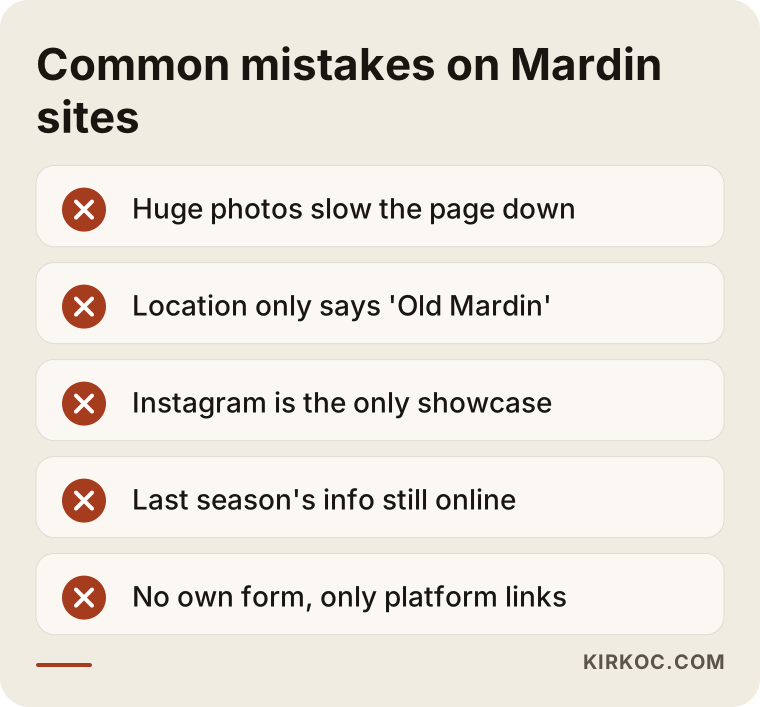
- Photos uploaded far too large: Huge images meant to show off the stonework slow the page down. A site that will not open on a phone cannot show off even the most beautiful mansion.
- A vague location: Writing "Old Mardin" is not enough. A guest who gets lost in the narrow lanes arrives with a bad first impression.
- Relying only on Instagram: Instagram is a lovely shop window, but on its own it does not represent you in search, on Maps or in AI answers.
- Outdated prices and information: When last season's details are still on the site, trust drops.
- Linking to platforms without your own form: You send the guest straight back to the channel that charges you commission.
The image below gathers these warnings in one place.
Most of these mistakes are not expensive to fix. They just take attention. If you already have a site, going through the list one item at a time is a good place to start.
What can you do yourself, and when do you need a specialist?
There is plenty you can start on your own. Once direct bookings, several languages and online sales come into play, though, a specialist saves you time.
Things you can do yourself:
- Create a Google Business Profile and keep your photos and opening hours up to date.
- Write down the questions guests ask most often. They are the raw material for your website's FAQ section.
- Take photos regularly in daylight, even with your phone.
- Ask every guest how they heard about you.
When you need a specialist:
- You want direct bookings or online payments.
- You need a multilingual setup that search engines can read correctly.
- Your current site is slow, outdated or broken on phones.
- You want the website, social media and ads to run together with one message.
For the texts your site will carry about personal data, prepayments and cancellation terms, it would not be right for me to give you definitive guidance. Turkey has its own data protection law (KVKK) and its own consumer rules for distance sales. If you are based abroad, the rules of your guests' home countries may matter too. Please talk to a lawyer before you publish those texts.
What determines the cost?
Instead of quoting a number, it is more honest to explain what pushes the price up and what brings it down. Two "hotel websites" can be very different projects.
The main factors are:
- Number of pages: A six-room mansion and a one-page workshop introduction are not the same job.
- Number of languages: Every language means separate text, separate checks and separate upkeep.
- Booking or online store: Taking payments, tracking stock, shipping and returns all make the build bigger.
- Who writes the content: If I write the text, the scope grows. If you come with finished text, it shrinks.
- Photos and video: A professional shoot is a separate cost. If you already have good photos, that cost gets smaller.
- What comes after: Whether you want updates, SEO, social media or ad management once the site is live.
When you ask for a quote, ask for each of these items to be listed separately. That way you can see exactly what you are paying for and what you could leave for later.
What to look for when choosing a designer or agency
The right person understands who the customers of a tourism or craft business are. They put the phone first, do not bury you in technical language, and can still be reached after handover. Whether they are based in Mardin or somewhere else does not decide it on its own. How they work is what matters.
Concrete criteria:
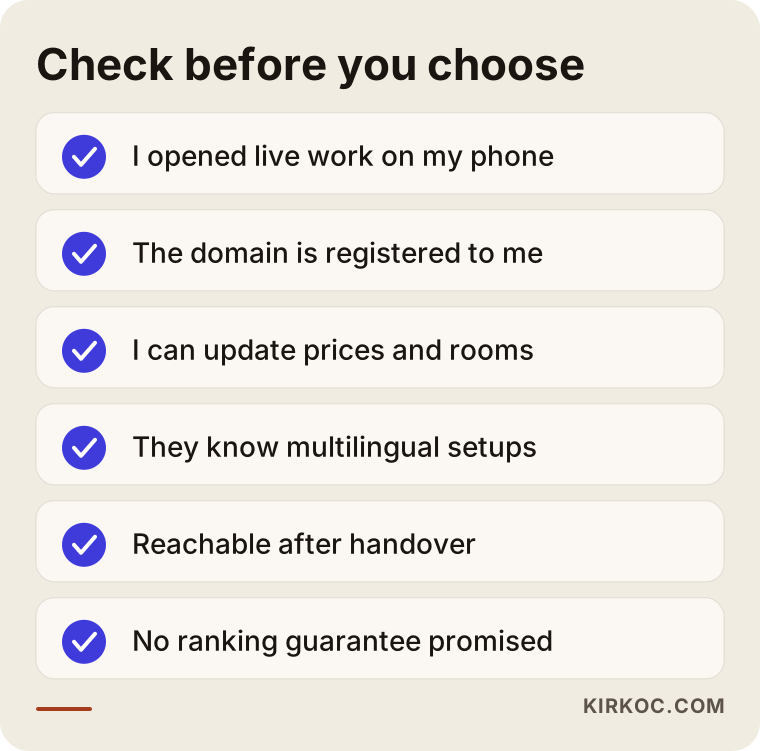
- Previous work: Open live websites they built on your own phone and look at them.
- Whose name the site is in: Are the domain name and the hosting (the server your site lives on) registered in your name?
- Can you update it yourself: You should not need to call someone every time you change a room rate or add a product.
- Multilingual know-how: Do they know how to set up a multilingual site correctly?
- Support after handover: When something breaks, who do you contact, and how?
Questions you can ask:
- "Will I have the admin login once the site is live?"
- "Will booking requests come straight to me, and where are they stored?"
- "Will you also set up my Google Business Profile?"
- "When the season changes, what do I need to do to update the information?"
- "Do you guarantee rankings or sales?" (If the answer is yes, be careful. An honest professional will not guarantee that.)
The checklist in the image below is meant to be in front of you before any meeting.
Any item where you get a "no" or "I don't know" should be the first question you raise in that meeting.
Working with Ümit Kırkoç
I am Ümit Kırkoç. I work from Istanbul, and I handle on my own everything a digital agency would offer. That covers websites and online stores, SEO and local SEO, and visibility in AI assistants (often called GEO). It also covers managing Instagram, Facebook, LinkedIn, TikTok and YouTube, running Google and Meta ads, logo and brand identity work, and writing content. Working remotely with a business in Mardin is a normal setup for me. It works just as well when the owner lives in Germany, Sweden or the US and the business runs on site. We talk by phone or video call, and I get your approvals by sharing my screen.
When I work with a Mardin business, I focus on these things first:
- The site should answer the guest's questions in order: where you are, how to get there, what you offer and how to book.
- It should load fast on a phone, with photos made smaller without losing their quality.
- Languages are added in order of priority.
- Your Google Business Profile, your website and your Instagram should all give the same information.
The practical benefit of having one person handle all of this is simple. When the season changes, I can update the site, the Maps listing, the Instagram posts and any running ads at the same time. You do not have to explain the same thing to four different people. What I need from you is a clear picture of your business, help with photos, and the feedback you get from your guests.
What I can promise is clear: an honest plan, plain language, delivery on time, and being reachable after launch. I do not guarantee rankings, booking numbers or sales. Nobody can honestly guarantee those.
Frequently asked questions
Who should build the website for my boutique hotel in Mardin?
Choose someone who understands what a tourism business needs and can build a site that is fast on phones, multilingual and able to take direct bookings. That could be a company in Mardin or someone who works remotely. I am one option: I handle the website together with SEO and social media, all from one place.
Does it make sense to have my own website if I am already on Booking.com and Airbnb?
In most cases, yes. Platforms bring you guests, but they take a commission and your relationship with the guest follows their rules. Your own site gives guests who already know you, or who search for you by name, a commission-free way to book. The two do not replace each other. They work together.
Is it a problem to work with someone who is not in Mardin?
Usually not, as long as communication is regular. The photo shoot is the only part that has to happen on site, and you can hire a local photographer for that. Everything else can be done by video call and messaging. That also applies if you yourself live abroad.
How many languages should my site have?
Look at where your guests come from. For most businesses, Turkish and English are a good start. If you see demand, you can add Arabic or another language. Launching more languages than you can keep up to date can leave a worse impression than not offering them at all.
What do I need to sell my filigree or local products online?
Product pages, secure payments, shipping and return terms, and good photos. Starting with a small selection of products is easier to manage than uploading everything at once. For your sales terms and return policy texts, I recommend talking to a lawyer.
Will my business show up on Google right after the site launches?
No, not right away. Google needs time to discover your site and assess its pages. A Google Business Profile, regularly updated content and a sound page structure all help that process along. But nobody can guarantee a specific position.
What should I do so AI assistants like ChatGPT recommend my business?
Describe your business on your site clearly and accurately: what you offer, where you are, who it suits, and the questions people ask most. Make sure that information matches your Maps listing and social media accounts. You cannot control whom an assistant recommends. Being a clear, reliable source improves your chances.
Should I redesign my current site or build a new one from scratch?
If the site's foundation is solid and only its look and content are dated, a redesign may be enough. If it looks broken on phones, is very slow, or you cannot update it yourself at all, starting over is often less trouble. A short review of the current site before you decide is a sensible first step.
If you would like to talk about the kind of website your mansion, workshop or tour business in Mardin needs, you can reach me through my website design page. I will listen to how your business works and explain the next steps in plain language.