You asked three people for a quote on a new company website and got three answers that barely resemble each other. One looked suspiciously cheap, one made you pause, and one made you wonder if you were being taken for a ride. This guide explains what drives business website cost, why the same job produces such different quotes, and how to compare offers fairly. I work on my own as a web designer, and I will not put numbers in this article, because a real figure only makes sense after someone has learned how your business works. What I can do is show you what to ask for, and how I approach it when you hire me for website design.
Why business website cost never has a single answer
Asking "how much does a business website cost?" is a bit like asking "how much does a house cost?" The answer depends on size, location, materials and who builds it. A website works the same way. The variables are the number of pages, the design approach, who writes the text, how many languages it needs, which tools it includes, and how much help you get after launch.
That is why "starting at" prices you see online are often the price of a package that has nothing to do with your situation. Until you know what is inside the package, putting two quotes side by side is like comparing apples and oranges. One quote may include ten pages, a custom design and help with writing. Another may be a single templated page. Both are called a "business website," but they are not the same product.
It also helps to be clear about what a business website is. It is where a company introduces itself, explains its services, builds trust and makes it easy for a customer to get in touch. It is not an online store; its main jobs are to convince and to be reachable. A visitor arrives and wants to understand within seconds: what does this company do, is it right for me, can I trust it, and how do I reach them?
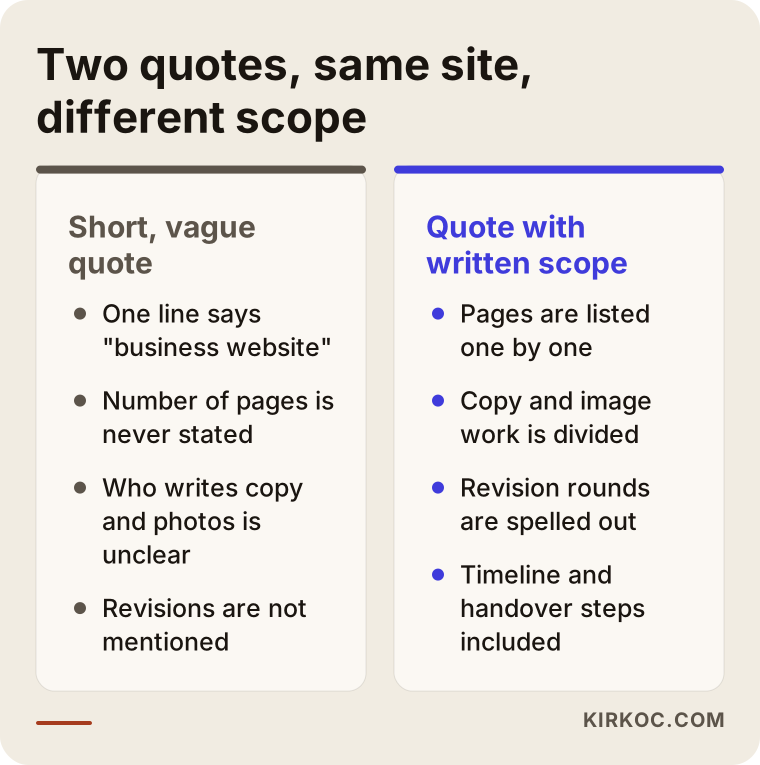
The comparison above is the short version of why quotes land so far apart. A short quote can look cheap, but if it does not spell out the scope, you often pay the real price later, in the form of "that was not included." A quote with written scope may look higher at first glance, yet you know exactly what you are getting. When you decide, look at what the number buys, not only the number.
Price and total cost are not the same thing
The figure on the quote is the price. Total cost is the whole burden you carry with the site: your own time, extra work that appears later, domain and hosting renewals, and whom you will need when you want to change something. A cheap site that has to be rebuilt in a few months turned out to be expensive. An expensive site that brings in no customers is also expensive. While you evaluate quotes, ask yourself: what will this site be doing for my business two or three years from now?
What actually sets the price
To understand the work behind a quote, you only need to know the line items. Here they are, with no jargon.
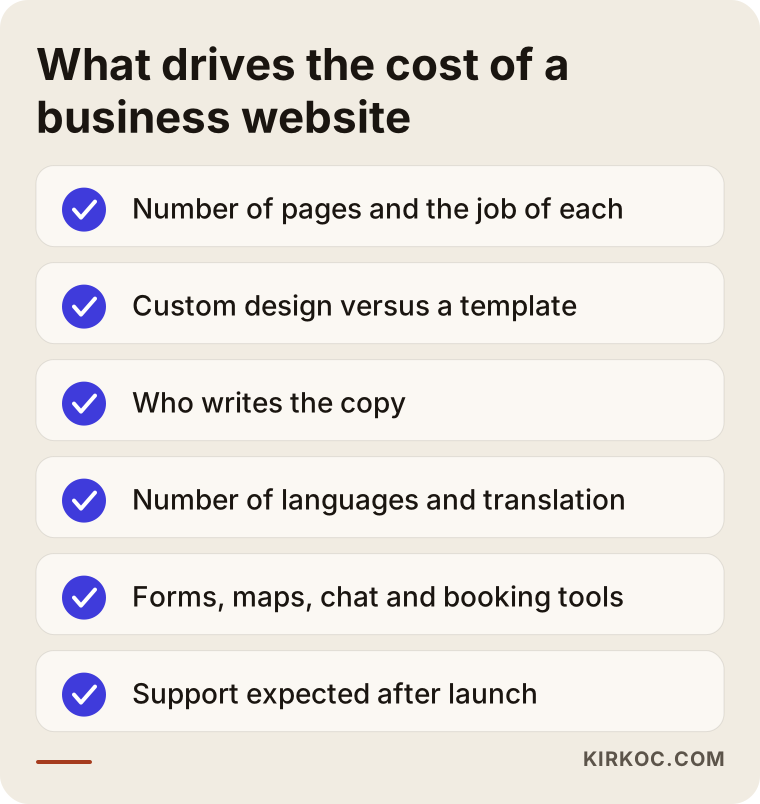
Number of pages and the job of each one
Most company sites include a home page, an about page, services, contact, and maybe references or a blog. But page count alone is a poor measure. Every page has a job. A service page has to bring a visitor to the point of thinking "this company does exactly this, and it fits me." That takes planning, guessing the customer's questions and building a flow that persuades. Five carefully planned pages can do more than twenty hastily written ones.
Custom design versus a template
Starting from a ready-made template is not the same effort as designing from scratch around your business. A template is sometimes enough, but a look your competitors also use does not set you apart. In a custom design, your logo, colors and photos sit at the center. That means design time and decision meetings, and it shows up in the price.
Who writes the copy
This is the line item people overlook most. The site gets designed, but the text does not exist, so you are left with empty frames. Will you write it, will the designer interview you and write it, or do you need a separate writer? Each option has a different time and cost. As part of my service, I prepare the text for your service pages together with you, based on the information you give me. Whoever you talk to, ask this question directly and get the answer in writing.
Number of languages
A second language is not just a translation. The translated text has to feel natural to readers in that country, and the titles and descriptions need to be prepared for search in that language. If you want to reach customers abroad, treat each language as its own piece of work.
Forms, maps, chat buttons and similar tools
A quote request form, a booking form, a WhatsApp button, tap-to-call, a map: these make it easy for a customer to reach you. A simple contact form and a detailed quote calculator are very different jobs. Saying up front what you need makes the price clearer and keeps you from paying for features you will never use.
Support after launch
What happens once the site is live? Whom do you write to when you need a small change? Who handles updates, backups, security, and fixing things when they break? Some quotes include this and some never mention it. Ignoring this line item leads to the feeling later that nobody is looking after the site. Every quote should have a sentence that answers it.
Why the same job gets such different quotes
The gap between three quotes is sometimes startling. There are a few ordinary reasons, and none of them proves that one side is right and the other wrong.
First, the people preparing the quote read the job differently. One provider means only a home page and a contact page when they say "business website"; another means ten pages of custom design. Second, business models differ. A larger operation carries office, management and sales costs that flow into its quotes, while someone working alone may not have those costs. That does not make one good and the other bad; it only explains why the numbers differ. Third, there is experience and working style. Some people narrow the scope just to look cheap, and others pad their quote to be safe.
Fourth, the number of questions you were asked. A quote that arrives without a single question is usually a generic template. Someone who tries to learn about your business, your customers and your goal builds the quote around those answers. In other words, how many questions you get tells you something about the quality of the quote.
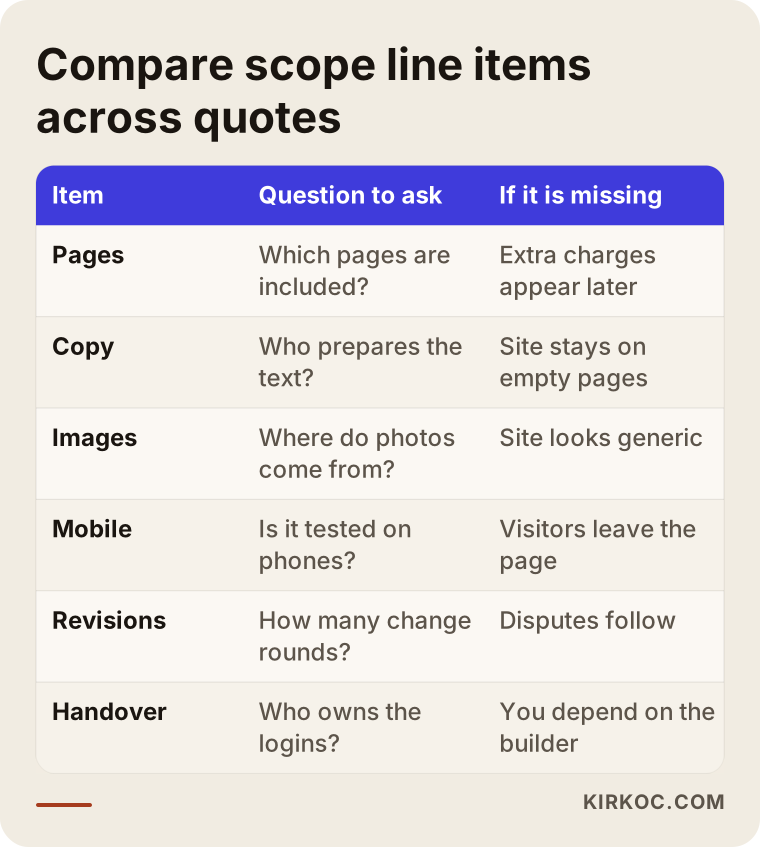
A method for putting quotes on the same footing
Use the table above like a ruler. Ask every provider the same six questions. If an answer does not come back in writing, treat that item as outside the quote. Then note what is missing from each one. This exercise sometimes shows that two quotes are actually close, and that the gap came entirely from unwritten items. Sometimes it shows the reverse: the quote that looked expensive was the only complete one.
While you compare, do not line up one total against another. Line up the list of what you receive. Write down on a sheet of paper what each quote covers; the empty cells show you the extra requests that will land on your desk later.
What to prepare before you ask for quotes
A good quote comes out of a well-asked request. If you clarify a few things before asking, you will get quotes that are sharper and easier to compare.
What do you expect from the site? Phone calls, filled-in forms, or simply building trust? Write the expectation in one sentence. That sentence shapes the page plan and the buttons.
Who is your customer? Who do you work with, what questions bring them to you, and what do they look at when they decide? People who find you by referral behave differently from people who find you through search. This affects the tone of the site and the order of its pages.
What do you already have? Logo, brand colors, photos, existing text, an old site. Gather it all and show it to whoever is quoting. Ready material often saves time and effort.
Which sites do you like? Three or four sites you admire, from your field or a completely different one, point the designer in a direction. A sentence like "I like the simplicity here" or "the colors there" is enough.
Do you have a deadline? A trade fair, an opening or a campaign date changes the plan. Say so.
Putting these five answers on one page also saves you from explaining the same thing from scratch in every call.
How people search when they want a business website built
Someone collecting quotes usually starts with phrases like "business website cost," "hire a web designer," "website design for small business," or "web design company." These searchers are gathering information; they have not chosen who to work with yet. The first page they open tends to steer their thinking.
That means two things for you. First, when you need a provider, you will see the same results page. Learn to tell which pages actually inform you and which were written only to get a click. Second, the same logic applies to your own site: when your customer searches for your kind of business, they will judge what your site says in the first second.
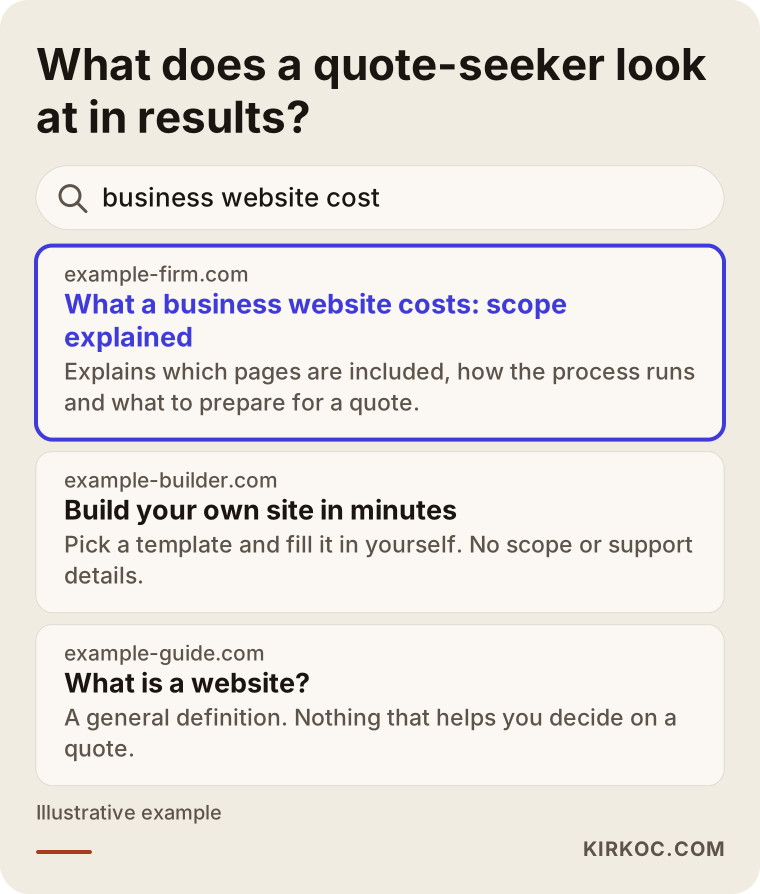
The mockup shows three kinds of results. The first explains scope, process and what you need for a quote; that is what helps someone getting ready to decide. The second says "build it yourself," which may suit a small need but gives no scope or support information. The third is a generic definition; you read it and move on. As someone gathering quotes, it makes sense to spend more time on the first kind, because those pages hand you criteria to compare with.
How your own site shows up in search
When a customer runs a similar search for your industry, your page title and description appear in the results. Those two lines are your site's first shop window. The title should say what you do and where, and the description should give a reason to click. A good business site prepares these lines during the design process. So when you compare quotes, ask: "are page titles and descriptions prepared?" In the sites I build, preparing the site for Google is part of the design from the start, not a patch added afterward.
Warning signs in quotes
To be fair, most quotes are not written in bad faith. But some signs raise the odds of trouble later. Knowing them protects you.
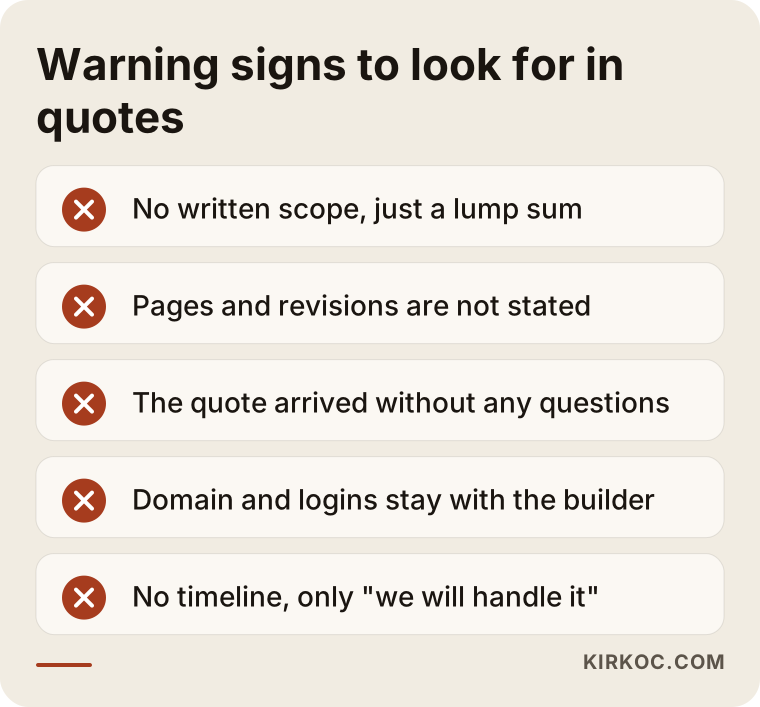
No written scope. A quote that gives only a total does not tell you what you are buying. You are entitled to ask for the pages, copy, revisions and handover items one by one.
The domain and logins stay with the builder. Your domain is your business's address. Ask whose name it is registered in, and whether the admin panel and hosting logins will be handed to you. If you want to work with someone else later and the access is not yours, you are stuck.
A ready-made quote with no questions. A figure given without learning your business is probably the price of a generic package.
No timeline. "We will handle it" is not a plan. Which step finishes when, and what is expected from you by which date, should be in writing.
Guarantees. Sentences like "you will rank first on Google" or "this many customers will come" are not honest. Nobody can guarantee a search ranking; only the search engine decides. A good specialist prepares your site so that search engines can understand it and explains clearly what they did, without promising an outcome.
Pressure to hurry. "This price is only valid this week" is an attempt to stop you from comparing. A good quote stands still while you think.
Asking for references is reasonable, but read them well
It is natural to want to see what a designer has built before. Open the sites in the portfolio on your phone, see how fast they load and whether the text is readable. But remember that appearance is only one side of the work. Working style, speed of communication and attitude after handover cannot be seen on a screen. You can judge those from how someone answers your questions during the quoting process.
How working with me goes
To make the quoting process concrete, here is how I work. I work alone, which means the person you talk to is the person who builds your site. Nothing gets lost in handoffs, but I also do not take unlimited projects at once.
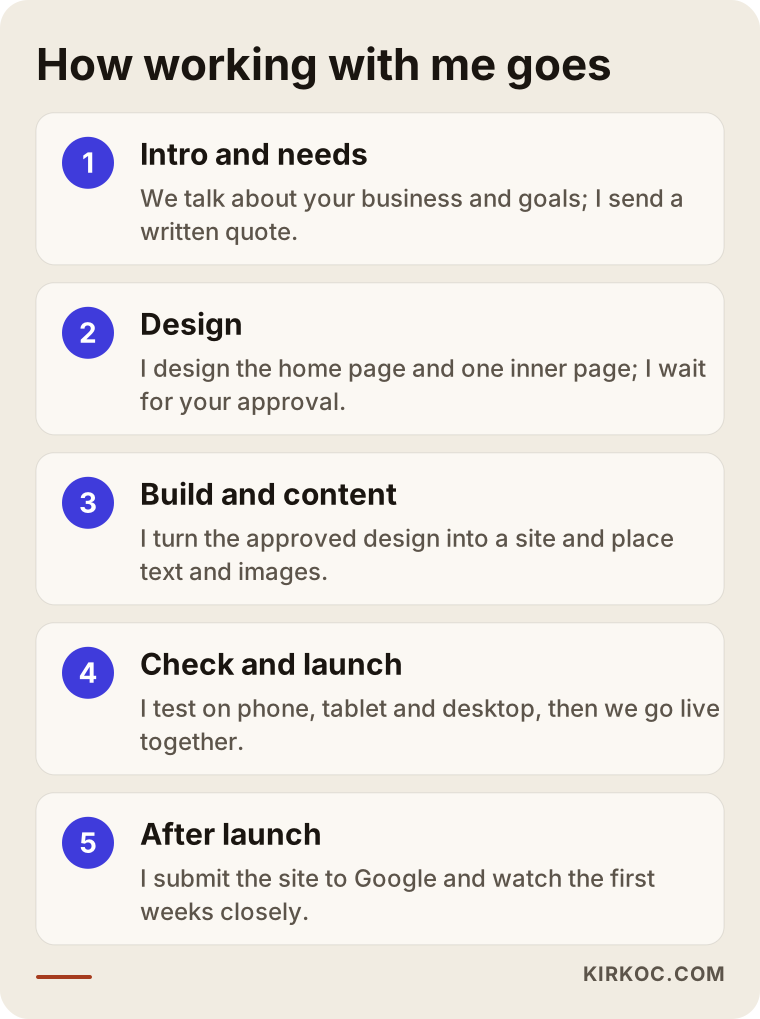
Intro and needs. We talk about your business, your customers and what you expect from the site. Then I send a written quote that includes the scope and the timeline. So the quote comes after the conversation, not before.
Design. I design the home page and one sample inner page. I do not move to the next step without your approval. That keeps us from working off two different mental pictures.
Build and content. I turn the approved design into a working site, and the text and images are placed. If you are not sure what to write, that is fine; we prepare the service page text together from the information you give me.
Check and launch. I test the site on phone, tablet and computer. You review it one last time and we go live.
After launch. I submit the site to Google and watch it closely during the first weeks. I stay reachable for your questions.
What the service includes: a design prepared around your business, comfortable use on a phone, fast-loading pages, a basic setup that is ready for Google, help with text and content, and easy contact tools such as a WhatsApp button, a call button, a quote or booking form and a map. I do not promise anything beyond that list. If you need something like ongoing maintenance or ad management, we discuss it separately and I want it to appear in the quote in writing.
Imagine two different companies: two scenarios
The two examples below are entirely hypothetical; they do not describe real clients. They only show how a decision can take shape.
Scenario one. Say a small packaging supplier wants a business website to introduce itself to wholesale buyers. The owner collects three quotes. One gives only a single total, another has a detailed list of items, and the third proposes a quick fix on a ready-made template. When the owner puts the items side by side, the first quote never mentions the number of pages or the writing work, and the third leaves out pages for individual services. The detailed quote looks higher at first, yet thanks to its written scope it is the one least likely to produce surprises. Because the owner looked at what was included instead of the headline number, the choice came out right.
Scenario two. Say two partners at an architecture office are renewing their site. The photos on the old site are good, but pages are hard to read on a phone and visitors cannot find the contact form. One partner says "a template is enough," the other says "design is what sets us apart, make it custom." In the conversation they settle on the real goal, which is getting project inquiries. The decision gets easier: the project pages will be carefully designed, the contact path will be simplified, and the other pages will stay plain. What moved the price up or down was the decision about whether each page earns its place.
The lesson from both is the same: a good quoting process first settles the goal and the scope, and only then talks about the amount.
When you do not need a specialist
Not every business needs a custom-designed corporate site. Saying so honestly is also how I end up working with the right clients.
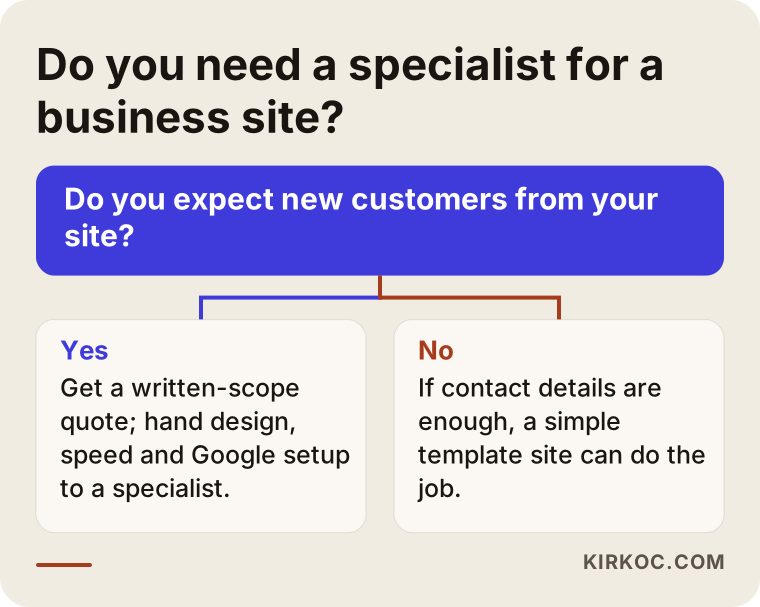
If you do not expect new customers from your website and just want to show a phone number, an address and opening hours, a simple template site is often enough. If your business runs entirely on referrals and existing customers, you can treat the site like a business card. You do not need a large investment in that case.
If you are starting a new business and are still unsure what you are selling, starting small can also be smart. Once your services, audience and message settle, you move to a fuller site. Building a complicated structure too early can force you to start over.
On the other hand, if you expect customers from your site, meaning people will search for you and find you, you need a structure that persuades, fast-loading pages and a setup that search engines understand. That is where specialist help makes sense.
Doing it yourself versus hiring someone
The benefits of doing it yourself are clear: the starting cost is low and everything is in your hands. The downsides are just as clear: it takes time, it needs design and writing skills, and the result is often weak at persuading. You also spend time building a site instead of running your business.
The benefits of hiring someone: a person who knows the work gets you to a result faster, you stay focused on your customers, and the site is built correctly from the start. The downsides: you need to set aside a budget and spend time deciding. And if you choose the wrong person you can run into trouble, which is why the criteria in this article matter.
There is also a middle path: you prepare the text and photos, and a specialist handles design and build. That eases the budget and keeps the site speaking in your own voice. Ask about this option in the quoting conversation.
Common mistakes
These are the mistakes businesses make most often when commissioning a company website.
Looking only at the price. Picking the lowest figure usually means picking the smallest scope. Read the price together with what it buys.
Treating the site like a brochure. Company history, vision and mission statements fill the page but do not answer the customer's questions. A visitor looks for the answer to "what do you do and how does it help me?"
Leaving the text for last. When the design is done and the text is still pending, the project drags on for months. Plan the writing at the start.
Brushing off mobile. Most visitors arrive on a phone. If the design was approved only on a computer, problems follow. Make phone testing a condition.
Not taking over the logins. The domain, hosting and admin panel belong to the business. When the person who registered them leaves, being locked out of your own site is a very common problem.
Forgetting the site after launch. A site is not built once and left. Phone numbers change, services get added, photos go stale. Decide up front who will make updates.
Wanting everything at once. Getting three features done right is worth more than ordering ten and getting none of them done well.
Frequently asked questions
Why does business website cost vary so much between quotes?
Because "business website" is not one product. The number of pages, whether the design is custom, who writes the text, the number of languages and the support after launch all differ from quote to quote. To compare two quotes, first bring their scope onto the same footing.
There is also the matter of who is doing the work and how their business is run; a large operation has different overheads than a person working alone. That difference alone is not a measure of quality.
What should I prepare before hiring someone to build a business website?
Prepare your expectation of the site, a description of your customer, the logo, colors, photos and text you already have, a few sites you like and any deadline. Putting these on one page spares you from re-explaining in every call and makes the quotes you receive more similar to each other.
What should I ask when I request a business website quote?
Ask which pages are included, who writes the text, where the images come from, whether the site is tested on phones, how many rounds of changes are included, and who receives the domain and logins at handover. Ask for all of it in writing.
Is a template site or a custom design the better choice?
It depends on what you need. If the site only shows contact details, a template may be enough. If you expect customers and want to stand apart from competitors, a custom design is a better fit. I design around the business, but I would not say it is essential for everyone.
Can something missing from the quote lead to extra charges later?
Any work outside the written scope can count as extra work. That is why it matters for a quote to list items one by one. Ask "is this included?" before you accept the quote, not afterward.
Can anyone guarantee that I will rank on Google after the site goes live?
No. Nobody can guarantee a search ranking. An honest specialist prepares your site so a search engine can understand it and explains what they did, without promising a position or a number of customers. Be careful with any quote that does.
How long does it take to build a business website?
It depends on the number of pages, when the text is ready and how quickly you approve each step. The biggest delays come from late text and photos and slow approvals. Ask for a timeline by step in the quote; I provide one in writing.
Do I need a multilingual site to reach customers abroad?
If you expect customers from abroad, then yes: a page in their language builds trust. But each language is separate work, so decide first which market you want to reach. If you do not need it yet, starting with one language and adding another later is also possible.
Ready to request a quote?
Comparing business website cost is not hard once you ask the right questions. Ask for the scope in writing, line the items up side by side, make sure the logins will be yours, and drop quotes that overpromise. If you want your site to bring in customers, send me a short message about your business; I will listen to what you need and prepare a written quote with scope and timeline. You can read about the process on my website design service page and write to me through the contact details there.