Your plant runs well, your product is solid, your prices hold up, and yet overseas inquiries only show up around trade fairs. Where does a foreign buyer go to check out a supplier they have never met? Almost always to a search box first, and to your website second. If you make or export goods and want inquiries from buyers abroad, this guide explains what a website for your business has to contain, what shapes the cost, and what to check before you hire someone to build it.
How a foreign buyer finds you, and how they rule you out
Selling to another country is not like selling to a shopper. The person on the other end is usually a purchasing manager, an engineer or the owner of a smaller company. Their decision affects their own customers and their own reputation, so before they ask "is it cheap?" they ask "can I trust this supplier?"
Buyers typically find suppliers in four ways:
- Search engines. They type the product, material or product family, often with words like "supplier," "manufacturer" or the country name.
- Business directories and marketplaces. Hundreds of companies sit side by side. The buyer picks three or four and opens each company's own website.
- After a trade fair. Someone took your card at the booth. Back at the office, they look you up. If the website is weak, the good impression from the fair weakens too.
- Referrals and AI assistants. A growing number of buyers ask an AI assistant questions like "which companies make this part?" For an assistant to mention you, your site has to state plain, readable facts.
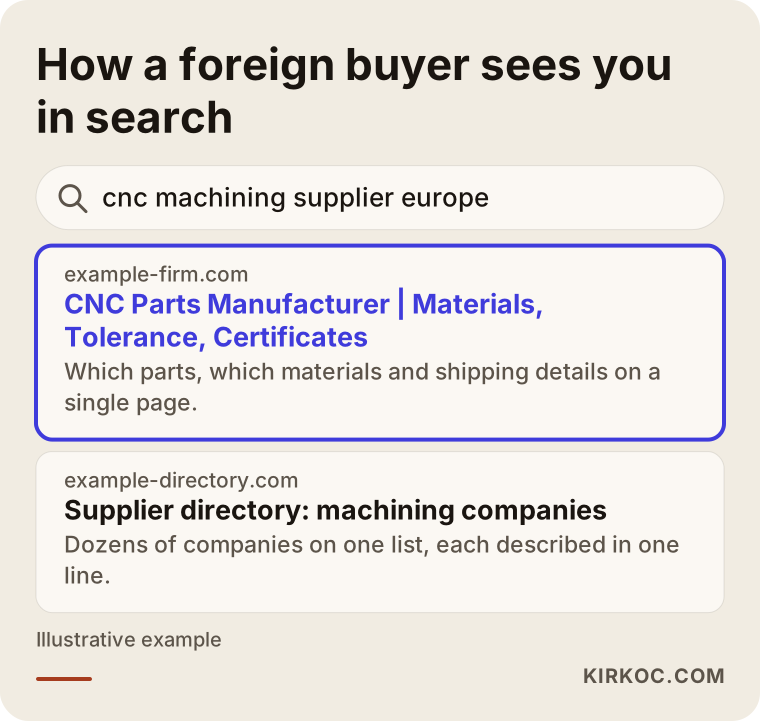
In the results page, a buyer decides within seconds whether to click. If your page title says exactly what you make and the description gives concrete facts, you get the click more often. "Leading provider of quality solutions" tells nobody anything; buyers have read it on a thousand sites.
Are directories enough?
A directory listing can be a starting point, but it rarely carries a business on its own. Everyone fits the same template: a logo, a few lines of text and a "send message" button. It is hard to stand out, and when you stop paying for the listing, your visibility ends. Your own website is an asset you own. It keeps building trust, it can be found directly, and it lets the buyer talk to you without a middleman.
What a buyer checks in the first minute
For a foreign buyer, your website is a pre-meeting. Someone who has never seen your plant forms an impression from the screen. That impression rests on three questions. Is this company real? Does it make what I need? How do I reach it?
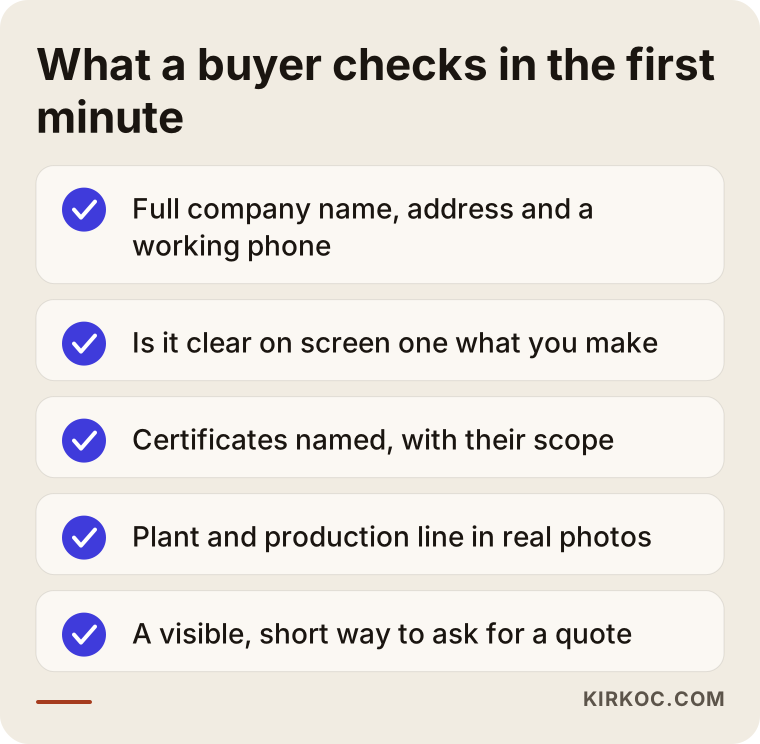
Is the company real?
Nothing reassures a buyer like showing you have nothing to hide. Use the full legal name, a street address, a map, a working phone number and an email address on your own domain rather than a free mail service. Many buyers look up the address on a map; if it matches a real plant or warehouse, trust grows.
Photos matter more than most owners expect. Stock pictures, the same handshake shots found on thousands of sites, backfire. Real machines, a real packing line, a real warehouse and real staff persuade far better. They do not need to be studio quality, but they should be sharp, bright and current.
Does it make what I need?
On the first screen, the buyer wants to know what you produce. Instead of "Welcome to our website," write one sentence covering the product family, the industries you serve and why you can be relied on. For example: "Precision-machined steel parts for automotive and appliance manufacturers." Product groups follow right below.
One thing to keep in mind: the words you use internally may not be the words buyers type. You might say "sheet processing" while the buyer searches "sheet metal fabrication." A buyer in Germany may use a third term altogether. Learn the words your target buyers really use and build the copy around them.
How do I reach it?
When a buyer wants to ask a question or request a quote, it should take seconds. Contact options should be visible on every page, the form should be short, and phone and WhatsApp can sit alongside it. In some markets business chat runs on WhatsApp; in others, email and a form still feel more formal. Offering both is the safest route.
Certificates, references and the plant: showing trust
In export, trust is half the sale. You can show it in three ways.
Certificates. Whatever quality, environmental, food safety or product-specific certificates you hold, do not leave them as a tiny logo. Write the name of the certificate, what it covers (which product or site) and who issued it. Add a readable copy if you can. Buyers often ask for the document anyway, and having it ready builds confidence. One firm rule: never show a certificate you do not hold or that has expired. Every claim on the site must be verifiable.
References. You can say which countries or industries you sell to. Customer names are often covered by confidentiality agreements, and buyers know that. A concrete description without a name, such as "annual supply of components to a European appliance maker," can be enough. Invented references or logos used without permission are unethical and risky.
Production capacity. The buyer wants to know whether you can handle the order. Your machine park, production line, monthly or yearly capacity (you supply the numbers), quality control steps, packaging and shipping experience answer that. Write them to reduce the buyer's risk, not to brag.
Why the "About" page matters
On export sites, the About page is one of the most read. The buyer looks for the story, who runs the company and how long it has done this work. Skip the flowery language and write short, checkable facts: year of founding, production location, how the product range developed, the names and roles of key people. A photo of the sales manager and a direct email address earn more trust than an anonymous "info" mailbox.
How should the home page and the site be laid out?
An export website has one job: carry the visitor to "I want a quote." Every section should serve that path.
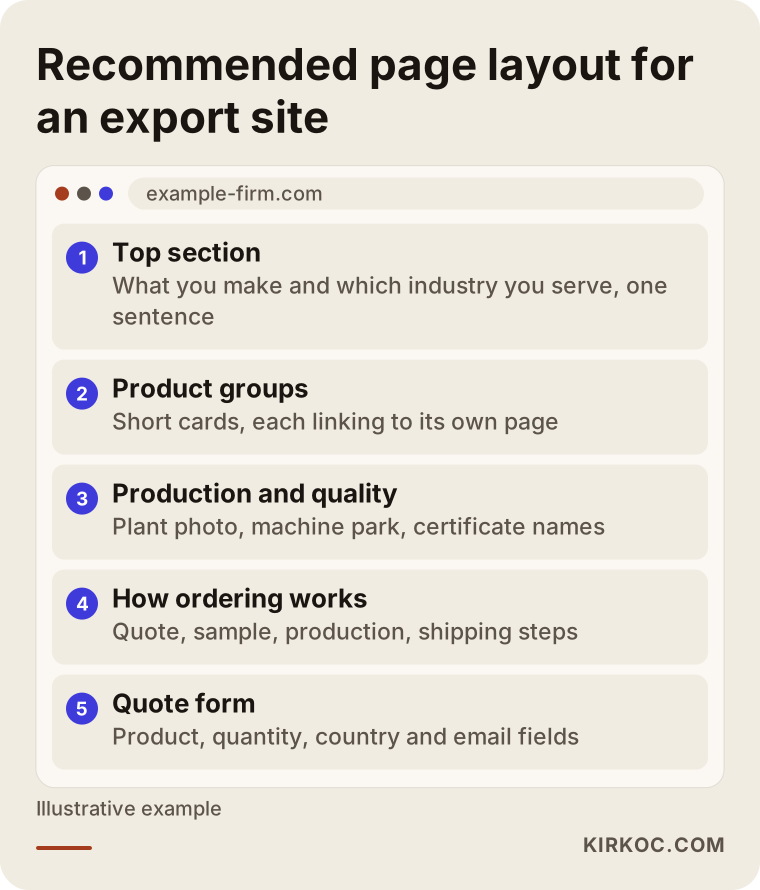
The order I recommend: at the very top, one short sentence about what you make plus a quote button; just below, the product groups; then production and quality; then a short explanation of how an order proceeds; at the bottom, the quote form and contact details. A simple structure keeps the buyer from getting lost.
Inner pages: product, industry and country
The home page covers only part of the need. To be found in search, every product group needs its own page. If "aluminum profiles," "stainless steel fasteners" and "plastic injection parts" share one page, none of them gets a strong page. Each product page should hold a plain description, material, size range, standards, industries that use it, minimum order quantity if there is one, general delivery lead time information, packaging options and a quote button for that product.
Separate pages for the industries you serve help too. If you sell the same screw to automotive and construction, those two audiences ask different questions. The automotive buyer asks about traceability and quality systems; the construction buyer asks about strength and delivery schedule.
How does it look on a phone?
Some buyers open the site on a desktop, but many tap a link in an email from a phone, on the way to a fair or between meetings. If the site is messy on a small screen or slow to load, the buyer closes it and moves to the next supplier. Connections in some regions are slow, so large images should be shrunk and pages kept light.
Product catalog: PDF or product pages?
Almost every exporter has a catalog, usually as a PDF. The trouble is that a PDF alone falls short.
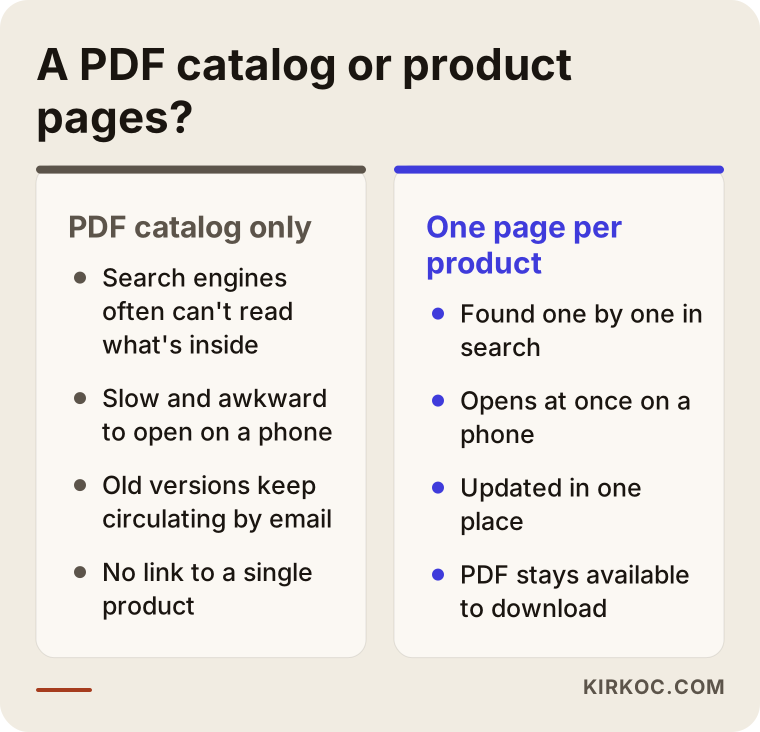
The weaknesses of a PDF catalog: search engines often cannot read it well or show it as a result for a specific product; big files download slowly and are awkward to read on a phone; when you update it, old versions keep circulating in email; and a buyer cannot send a colleague a link to a single product.
The fix is not to throw the PDF away, but to keep it as an extra. Each product gets its own page, and from that page anyone can download the PDF. That way both kinds of visitor are served: the one who wants to read quickly sees the page, and the one who wants to archive downloads the file.
Should the catalog download require an email?
That depends on your strategy. Asking for an email before the download builds a list of prospects, but some buyers drop out at that step. My general approach: leave a price-free, public catalog open, and ask for a form only for special technical documents or detailed price lists. Within a few months, the inquiries you receive will tell you which way works better for you.
The quote form: short or detailed?
On an export site, the quote form is probably the most critical element. A good form collects what you need without tiring the buyer.
A very long form, twenty fields say, makes people give up. A very short one, only a name and a message, does not tell you how serious or how specific the request is. The middle path is to ask what the buyer already knows:
- Name and company
- Business email and an optional phone number
- Country (important for freight and paperwork)
- Product of interest (a dropdown works)
- Estimated quantity or need
- A free message box, with room to attach a drawing or specification
Answering fast matters as much as the form itself. A foreign buyer often sends the same request to three or four suppliers, and the one who replies first often wins the conversation. So test regularly that the form really lands in your inbox, not in spam, and that notifications reach the right person.
What happens after submitting?
When the buyer presses "send," the screen should say plainly that the request was received and when to expect an answer. An automatic confirmation email also shows the request did not vanish. This small detail raises the sense of seriousness.
Languages: which ones, and how?
A common question for exporters: is English enough? It depends on the target market. English is the common language for many buyers and is often a fine start. But in markets such as Germany, France, Spain, Russia, the Middle East or Latin America, seeing a site in their own language can noticeably raise trust and conversion, because many buyers search for products in their own language.
Ask yourself:
- Which countries send most inquiries now, and which do you want to reach?
- In which language does a buyer there search for your product?
- Can you keep the site current? A half-finished translation is worse than none.
I want to be direct about translation quality: publishing machine translation unchecked is risky for a technical product. A wrong unit, an ambiguous material name or an awkward sentence makes a buyer ask "is this company serious?" Someone who knows the language and the industry should review the text. A separate page for each language, a language switch that is easy to find and a sensible address structure for each version matter too.
How do you get found in search?
A good site is useless if nobody finds it. For an export site, being found rests on two things.
Pages written in the buyer's words. Each product page's title and first paragraph should include the phrase the buyer types. If you name a product only with an internal code or a local term, foreign buyers will not find you. Use the common international term, the standard name and alternative spellings naturally on the page.
Technical groundwork. Fast loading, good phone display, proper titles and descriptions and correctly declaring each language version to search engines should all be set up when the site is built. An "SEO patch" added later is usually incomplete. In my work, this foundation is prepared as part of the site from the start.
Do not trust anyone who guarantees rankings. Position in search depends on many factors, and nobody can promise page one. The right approach is to build the site around the words and information your buyer looks for; results come over time.
What determines the cost of an export website?
I give no figures in this article, because two export sites can differ enormously in scope. The main factors:
- Number of pages. A site with ten product groups is not the same job as one with two hundred products.
- Number of languages. Every language means extra pages, extra content and extra checking.
- Type of design. Using a ready-made template and building a design around your brand take different amounts of work.
- Content readiness. If you bring text, product data and photos ready, the work is shorter; if they are prepared together, it takes longer.
- Special functions. Product filtering, a multi-step quote form, a document download area or a customer login widen the scope.
- Photography. If plant and product shooting is needed, it is a separate item.
- Timeline. A rush delivery affects planning and price.
For a clear price, you need to see the scope in writing. After the first conversation, I prepare a written quote that covers scope and schedule.
How to compare quotes from different providers
The difference between two quotes should never be only price. When comparing, ask:
Is the scope in writing? How many pages, how many languages, which forms, how many revision rounds: it should all be in the quote. "We will build your site" is not enough.
Is the design made for you? Changing the colors of a ready-made template is not the same as a custom design. Know which one you are buying.
Who does the content? Are copywriting, translation and photography included or not? Most delays and friction start here.
Whose name is the domain and hosting under? The domain (such as your-company.com) and the hosting account should be opened in your name. If you part ways with whoever built the site, you must keep control.
Is there support after launch? Small fixes, adding a product, who to call if something breaks: it should be clear.
Can they show earlier work? Open real sites they have built and try them on a phone. Do they load fast and read easily?
Are there inflated promises? "We'll put you at number one" or "your orders will multiply" are red flags. An honest provider says they cannot guarantee that.
How I work with you
I am a solo web designer, so the person you talk to is the person who builds your site. The process runs in five steps.
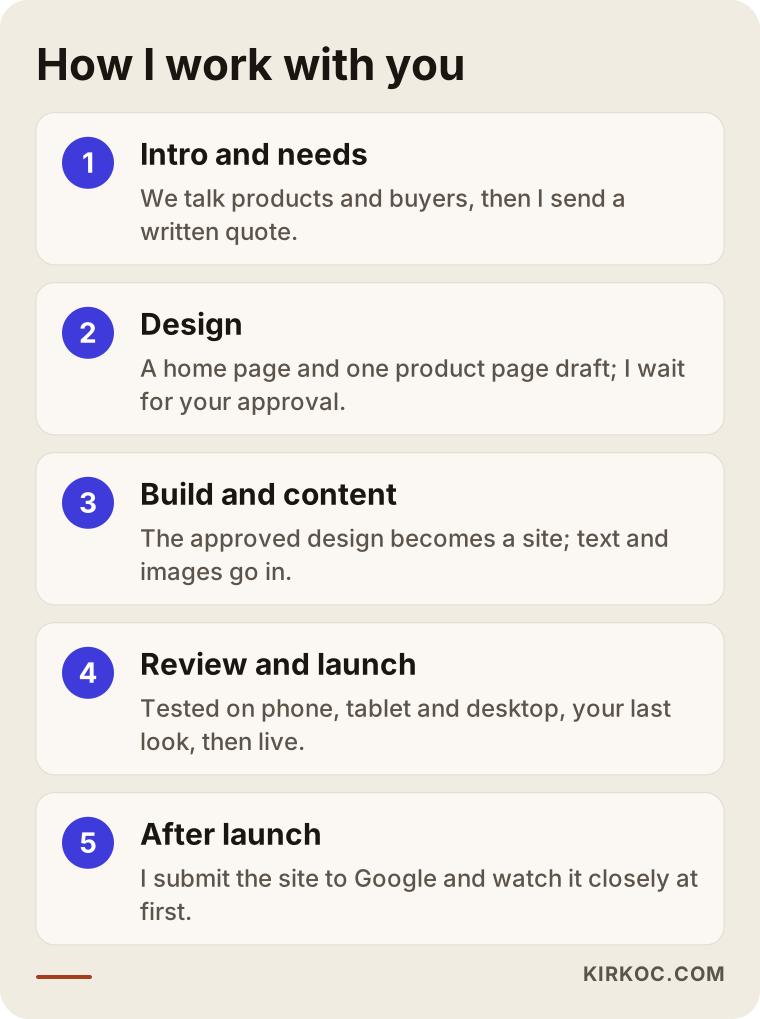
First we talk about your business, products, buyers and what you expect from the site, and then I send a written quote with scope and schedule. In the design step, I prepare the home page and a sample inner page and do not move on without your approval. The approved design becomes a working site, with text and images placed in. Before launch I test it on phone, tablet and desktop, you take a last look, and we go live. After launch I submit the site to Google and watch it closely during the first weeks.
If you are unsure what to write, that is fine; with the information you give me, we prepare the service page text together. Businesses that want a multilingual site to reach customers abroad are among the people I work with, and we settle the languages and scope at the quote stage.
Common mistakes
These are the problems I see most often on export sites:
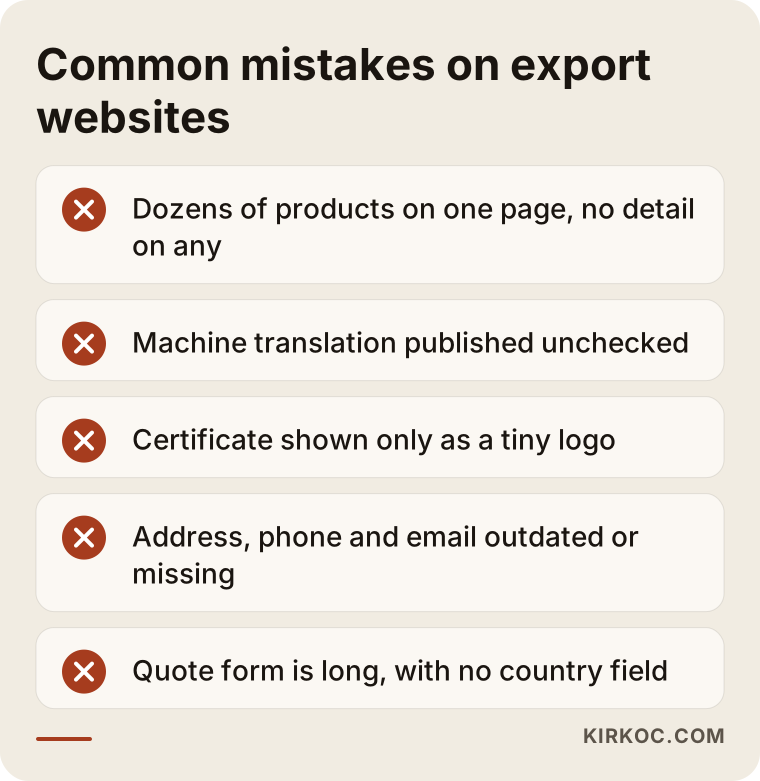
Cramming everything onto one page. If all products sit on a single page, the buyer cannot find what they want and search engines cannot tell what you are about.
Not checking the translation. For technical products, one wrong term can mean a wrong order.
Hiding the certificates. You hold a valuable certificate but the site shows only a small icon. The buyer cannot see what it covers.
Stale information. A closed address, a dead phone number or a product you no longer sell destroys trust quickly. Review everything a few times a year.
A long, complicated form. Every extra field loses some buyers. Do not ask for what you do not truly need.
Building once and forgetting. Without new products, new certificates and new plant photos, the site ages. Set aside regular time, however small.
Ignoring speed and mobile. Giant plant photos slow the site down, and a site that will not open on a phone loses the buyer.
Two hypothetical examples
These are not real client stories. They are made-up scenarios to show how it works.
Say you run a mid-sized apparel manufacturer. Your website has one home page in your local language and a heavy catalog PDF. Overseas inquiries amount to a few emails after fairs. The work here would be to build a site in English (plus a second language depending on your target market), split product groups into separate pages, write down fabric and capacity details, show certificates by name and add a short quote form. The catalog PDF stays as a download. There is no guaranteed outcome, but when a buyer searches for you, there is now something to read and a form to ask questions with.
Say you are a small exporter of olive oil and food products. Your site has good photos but no information on production, labeling, food safety documents or shipping terms. Your buyers are mostly wholesalers or purchasing staff at grocery chains, and their first question is about your documents. What you need is not a big overhaul: a "Quality and documents" page that describes each certificate by name, a product page showing packaging and pallet options, and a sample request form. This job is shorter.
When you do not need this
To be honest, not every exporter has to commission a new website.
- If all your customers are long-time buyers who call you directly and you are not looking for new ones, the site matters less.
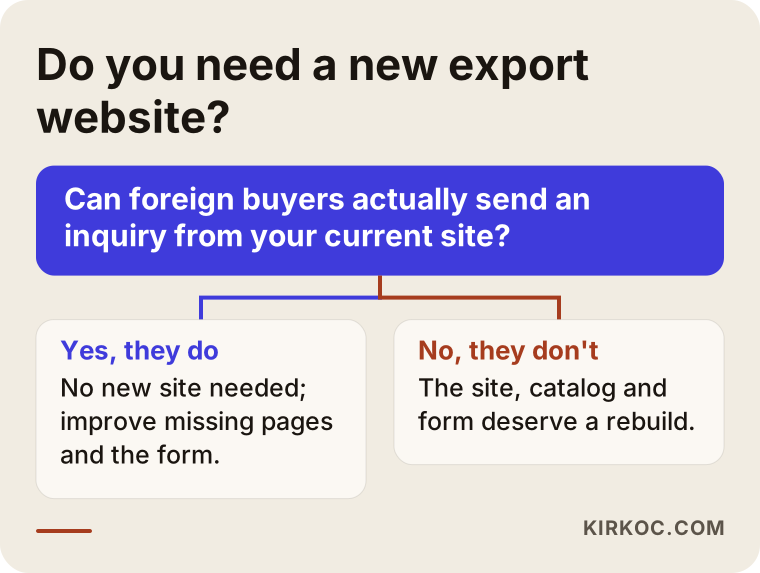
- If your current site already brings steady inquiries, improving a missing page or the form may be enough instead of a full rebuild.
- If all your sales go through a single large marketplace or one corporate buyer, a separate site may not be a priority.
- If your product is not ready, or your capacity cannot take on a new buyer, strengthen production first.
Do it yourself or hire a specialist?
Website builders let you make your own site, and for a very small start it can be a reasonable choice. If you have the time, few products and a single language, it can do the job. But if you want several languages, many products, search-friendly pages, a quote form that works properly and a professional look, working with someone who does this saves time and avoids expensive mistakes. You can also start on your own and bring in a specialist halfway; just expect that some parts may need rebuilding at that point.
Frequently asked questions
Does an exporter really need a website?
If you want new buyers, yes. A foreign buyer almost always looks at a website before talking to an unfamiliar supplier. If there is none, or it is weak, the buyer moves to the next company. If you only work with existing customers, the need is smaller.
Is an English-only site enough?
For a start, often yes. If you are aiming at a particular country, adding pages in that language can raise trust and findability. A well-made single-language site beats a half-finished multilingual one.
What do buyers look at first?
They look for signs the company is real (address, phone, plant photos), what you make, your certificates and how easy it is to ask for a quote. If these are missing or vague, you can be dropped before a conversation begins.
Which fields should a quote form have?
Name, company, business email, country, product of interest, estimated quantity and a free message make a good start. More fields lengthen the form and can reduce the number of requests.
Is a PDF catalog enough?
A PDF is useful but not enough alone. Search engines often read it poorly, it is hard to use on a phone and it is a pain to update. Creating a page per product and offering the PDF as an extra is the healthier route.
How soon will inquiries arrive after the site goes live?
Nobody can guarantee that. It depends on your industry, competition, product and target market, and visibility in search takes time. Building the site properly improves the odds, but promising a time frame or a position would not be honest.
What determines the cost?
The number of pages and languages, whether the design is custom, content readiness, special functions and the timeline. For a clear price, the scope has to be discussed in writing.
Where should I start with a site for foreign buyers?
Pick your target market and the product you most want to sell. Then build a base: one complete page for that product, a quote form and the trust information (address, documents, plant photos). Add other products and languages afterward.
If you want a site that speaks to buyers abroad, is understood quickly and collects quote requests, send me a message describing your products and target market, and I will come back with a written quote after we settle the scope together. You can also read about how I work on the website design service page.