If your company sells to, buys from or operates in Turkey, a website that speaks to local customers and still makes sense to your international partners is not a luxury. Searching for a "web design company Istanbul" returns agencies, freelancers and template platforms in the same list, and it is hard to tell them apart. This guide explains what you are actually buying, what moves the cost, how to compare quotes and how a project runs when your designer is in Istanbul and you are not. I am an independent web designer based in Istanbul, and I use my own website design service as a worked example so you can see what a clear scope looks like. I work remotely with clients, so everything below assumes a distance relationship, not an office visit.
Why companies look for a designer based in Istanbul
Foreign businesses end up searching for an Istanbul web designer for a handful of practical reasons.
- You have opened, or are about to open, a branch, shop, clinic, hotel, workshop or showroom in Turkey and need a site for local customers.
- You export to Turkey or import from Turkish suppliers, and buyers or partners check your website before they reply to an email.
- You target Turkish-speaking customers abroad, or tourists and patients who come to Istanbul and research before they travel.
- Your current site was built outside Turkey and does not read naturally to a Turkish visitor. It feels translated, the contact options do not match local habits, or the pages load slowly from Turkey.
Being in Istanbul helps in specific ways: the designer reads Turkish sources, understands how local customers search, and can write or check Turkish copy that does not sound like machine output. It does not mean the work has to happen face to face. Briefing, design review and feedback all work by video call and email, as long as decisions are written down.
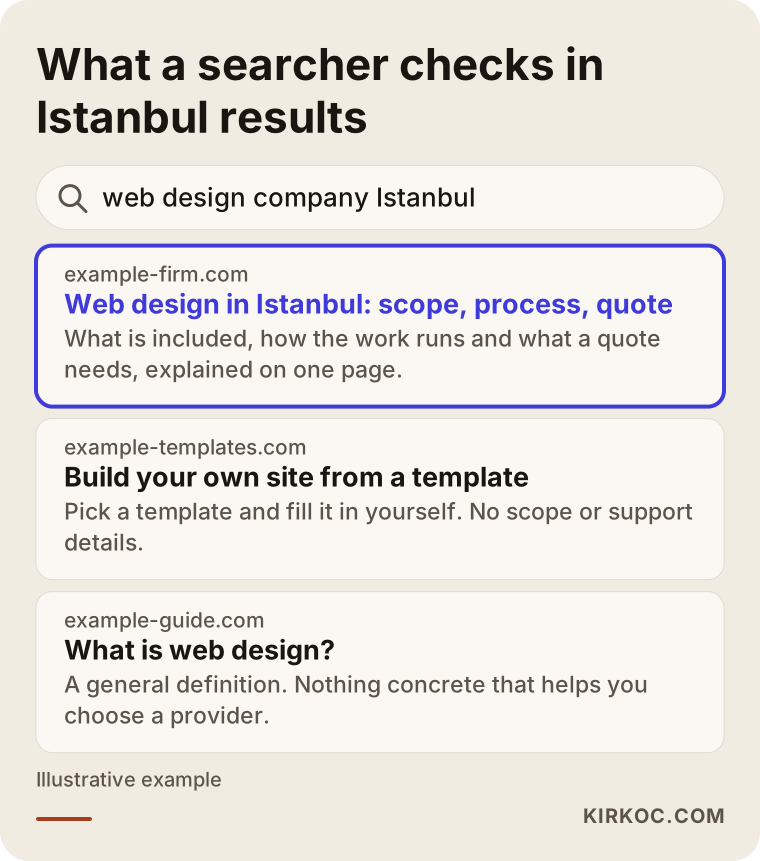
How do people actually search? A first-time visitor types something broad like "web design Istanbul" and is mostly learning what options exist. Someone typing "web design company Istanbul" is comparing providers and wants a quote. "Hire web designer Istanbul" or "website design Istanbul for foreign company" comes from a person ready to start. Your own site should answer the question each of those visitors holds. In Istanbul, customers also tend to search with a district name attached, so a business that serves one area should say so plainly on the page.
What a website project actually includes
Many owners picture only the visual design. A site that is ready to win customers is the sum of several jobs, and a good quote should say who does each one.
Design. A look built around your logo, colors and photos, rather than a template that hundreds of other sites also use. Templates are quick and inexpensive; custom design costs more effort but belongs to you.
Mobile use. Most visitors arrive on a phone. Text must be readable, buttons easy to tap and your phone number one touch away. A site that looks great on a large monitor but fails on a phone is only half finished.
Speed. A slow page loses visitors before they read a word. Speed comes from how the site is built, so it needs to be planned from the start, not patched on afterward.
A foundation Google can read. Page titles, descriptions and site structure are prepared so search engines understand the site. This is what people mean by SEO, which simply means making your site easy to find in searches. Building it in from the start is far easier than fixing it later.
Copy and content. The most skipped item. A beautiful site with unclear text does not convince anyone. Decide in the quote who writes what. In my way of working, we prepare the text of your service pages together from the information you give me.
Contact tools. A WhatsApp button, a call button, a quote or appointment form and a map. For visitors in Turkey, WhatsApp in particular is a normal way to start a conversation, so it is worth including.
Multiple languages. If your Turkish customers and your international partners need different versions, each language is its own piece of work, not a copy. I come back to this in the cost section.
Use this list to check any proposal. Whatever is missing from the written scope is what you will probably be asked to pay for later.
Who this suits, and who does not need it
This service fits first-time website owners, clinics and healthcare providers, hotels, restaurants and tourism businesses, and companies that need a multilingual site to reach international customers. What these have in common is that the buyer researches before deciding. People look at a clinic, a hotel or a supplier online before they commit, and they want a trace of trust.
To be honest, not everyone needs a new site.
- If all your customers come by personal recommendation and nobody searches for you online, and you are happy with that, a website will not change much.
- If you only need a page for a single event or a short campaign, a simple page builder is usually enough.
- If your current site is basically fine and a few texts are outdated, small fixes beat a rebuild.
- If you have not yet settled what you sell and to whom, clarify that first. A website cannot answer that for you.
No website guarantees sales, and no honest designer promises rankings or revenue. I build the site properly; results then depend on your market, your competitors and your business. If anyone promises you the first position on Google, treat that as a warning sign.
Agency, freelancer or template platform?
In Istanbul, as anywhere, there are three broad options.
Larger agencies bring many specialists together: designer, developer, copywriter, project manager. That helps with big or complex projects. In return you often speak to an account manager rather than the person doing the work, and the process is more formal.
Template and site-builder platforms are the fastest and cheapest route. For a very small information page they can be enough. You have limited control over design, speed and the search foundation, though.
Independent designers work one to one. I am in this group, working alone from Istanbul. The advantage is that the person you talk to is the person who builds your site, decisions are quick and nobody sits between you and the work. The limit is capacity: one person cannot run many projects at once, and a very large project with many contributors may not be the right fit. It is better to talk about that at the start.
There is no universal winner. It depends on the size of the project, your budget and who you are comfortable working with remotely. What matters is that you know who does the work and how to reach them.
Criteria for comparing quotes
Price should never be the only column in your comparison. Two quotes can show the same total and contain very different work. When quotes arrive, look for answers to these questions.
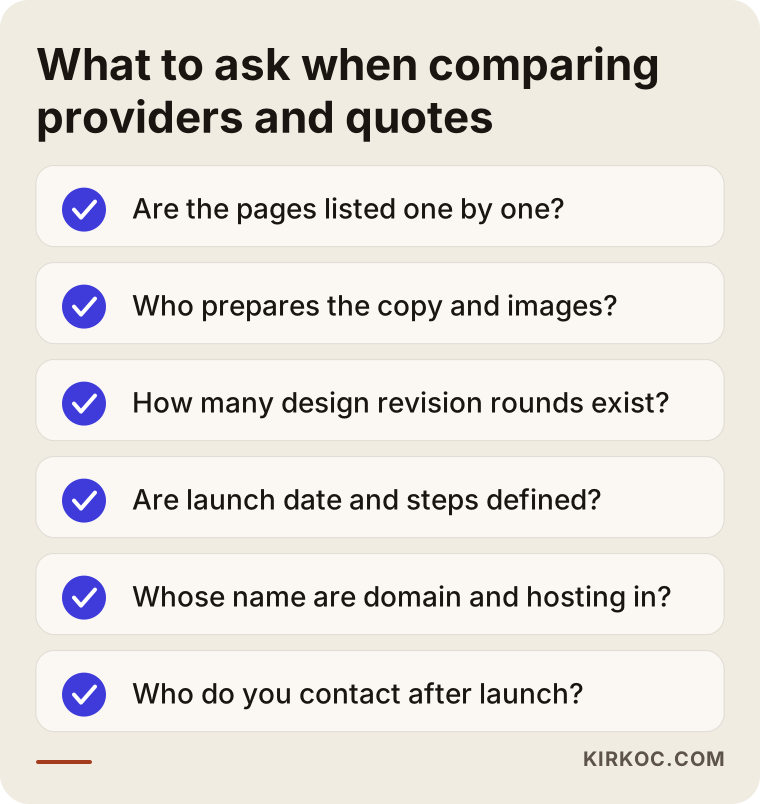
Is the scope written down? A single line such as "business website" invites a later argument about what was included. Pages, features and deliverables should be listed.
Who prepares the copy and images? Will you supply photos and text, or is that part of the work? The answer changes the timeline and the effort.
How many revision rounds are there? You will want changes once you see the design. Knowing the number of rounds in advance prevents friction.
Are the timeline and steps clear? "Fast delivery" is not an answer. The quote should show when design, build and launch happen and what is needed from you at each stage.
Whose name are the domain and hosting in? The domain (your web address) and the hosting (the server that keeps the site online) should be registered to your company. Otherwise the key to your site sits with someone else if you ever change providers. Ask this directly.
What happens after launch? If a small error appears or you need to update a detail, who do you contact? If support is not described, ask for it in writing.
Past work. Look at earlier projects, but do not judge only by looks. Open them on your phone and see how quickly they load and what they tell a visitor.
For foreign companies there are a few extra points. Ask which time zone overlap is available for calls, in which language the written quote and the project communication will be, and how invoicing and contracts work across borders. Do not assume; ask, and get it in writing.
I will not name or criticize any specific company. I can say this much: a quote that cannot answer these questions clearly carries uncertainty, however cheap or expensive it is.
How working with me goes
Knowing the process helps you judge any provider. Here is how my five steps run.
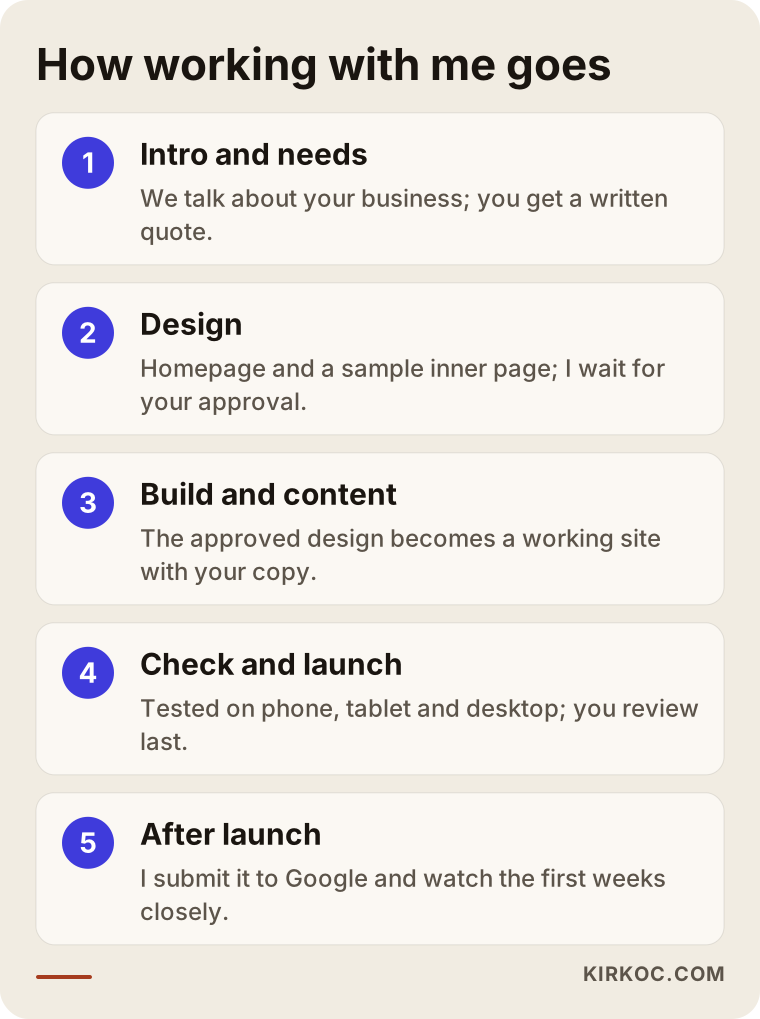
1. Intro and needs. We talk about your business, your customers and what you expect from the site. Then I send a written quote with the scope and timeline.
2. Design. I prepare the homepage and a sample inner page. I do not move on without your approval. This step matters because misunderstandings show up before any build work starts.
3. Build and content. I turn the approved design into a working site, with texts and images placed.
4. Check and launch. I test the site on phone, tablet and desktop, you do a final review, and we go live.
5. After launch. I submit the site to Google and watch it closely during the first weeks. I stay reachable for your questions.
What I need from you is timely feedback. Projects most often run late not because of technical trouble but because an approval or a text arrives late. If you want a shorter timeline, have your logo, photos and basic business details ready from day one.
What drives the cost
I will not quote numbers here. Any figure given without a written scope is misleading. But knowing what moves the cost lets you read quotes sensibly.
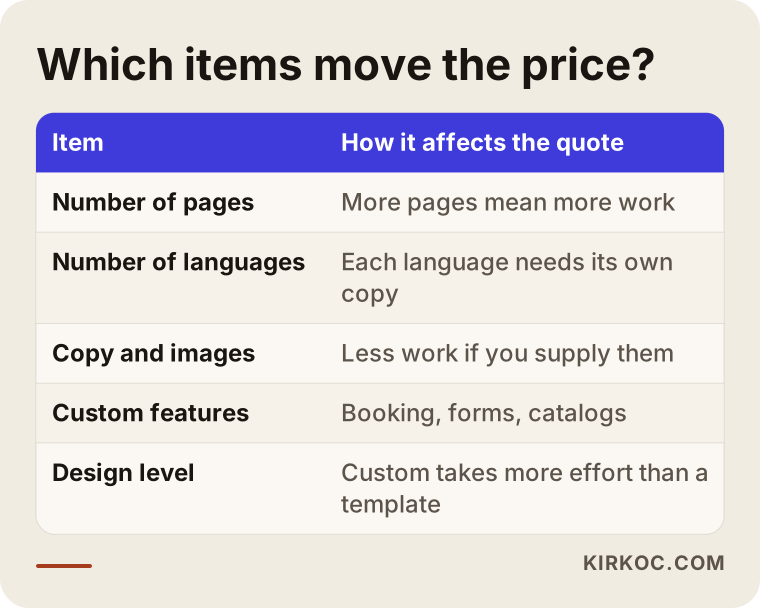
Number of pages. A short site with a few pages is a different job from one with dozens of service and location pages. Each page has design, copy and checking.
Number of languages. This is a big one for foreign companies. If you want a Turkish version for local customers plus English, German or another language for your partners, each version is separate work: text written for that reader, plus its own review. Pasting the same text everywhere does not work.
Copy and images. If your photos and texts are ready, there is less to do. If not, writing support falls inside the scope.
Custom features. Online booking, a product catalog or a multi-step inquiry form go beyond a simple information site and need extra effort.
Design level. Adjusting a template and building something original for your business are not the same job.
Timeline. A very urgent deadline can mean rearranging other work and may show up in the quote.
Put these items in a simple table and compare each proposal against it. Often the quote that looks expensive is simply the one that spells out its scope.
Two scenarios, clearly hypothetical
These are invented to show how to think; they are not real clients.
Suppose you run a small architecture studio in Chicago that has just won a restoration project in Istanbul. Local suppliers, craftspeople and authorities will look you up. You need an English site that explains the studio and a short Turkish page for local contacts. A handful of well-written pages, a clear contact form and a project gallery are enough; a large site would be wasted effort. Here the key points are language quality and clear contact options, not size.
Suppose a Dutch hospitality owner is opening a small guesthouse in Istanbul. Guests come from several countries, compare rooms and location, and decide quickly. The site must load fast on a phone, show good photos, make the location and transport obvious and be available in more than one language. Because each language is separate work, you would plan which languages truly matter at launch and add others later.
The two businesses need different things, so two different quotes are normal. A single package presented as "right for everyone" rarely fits either.
Mistakes foreign companies make when ordering a site in Istanbul
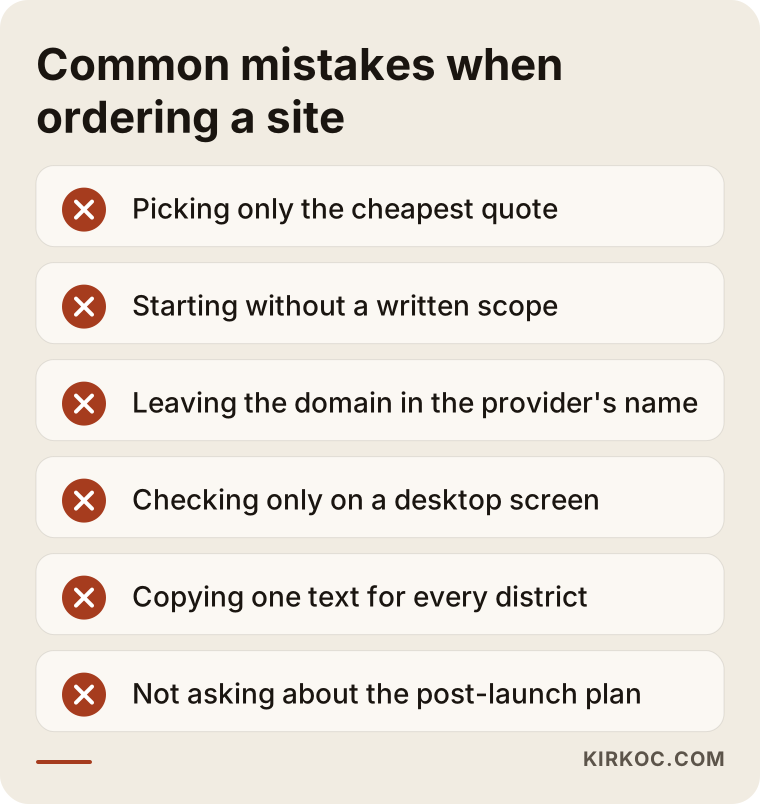
Choosing only the cheapest quote. A low number often means narrower scope. Copy, revisions and support may be left out and then appear as extras.
Starting without a written scope. Verbal agreements get remembered differently. Writing down pages and deliverables protects both you and the designer.
Leaving the domain in the provider's name. Your web address should belong to your company. Ask who holds the account details at the start.
Checking only on a desktop screen. Most visitors use a phone. Before approving, open the site on your own phone and click through it.
Copying one text for every district or language. If you serve several districts, using the same words on every location page does not help. Search engines notice repetition and readers dislike it. If you cannot say something specific about an area, do not create the page. The same goes for languages: a text that was simply translated word for word often sounds off to the reader.
Not asking about the plan after launch. Errors appear and information changes. "Who do I write to if something breaks?" should have an answer before you sign.
Launching without real content. A site published without proper text is like a printed brochure that says nothing. Do not leave writing to the last week.
Build it yourself or hire someone?
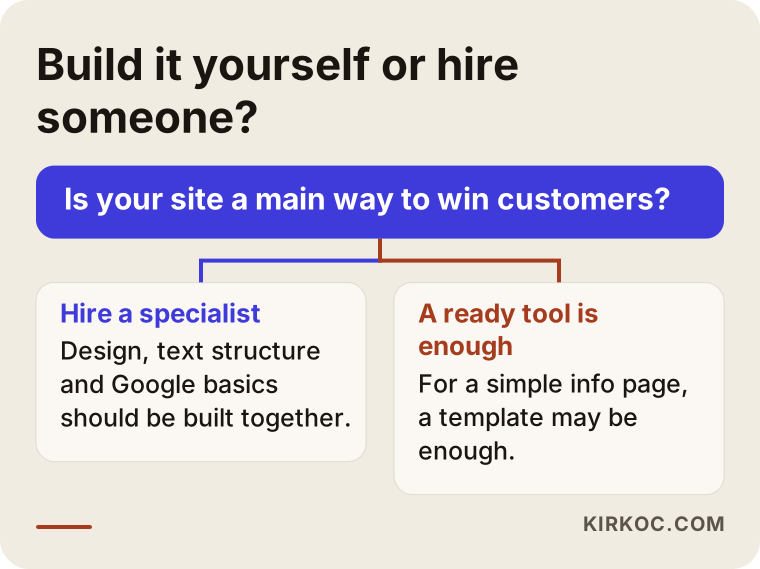
The answer depends on the role the site plays in your business. If it exists just to show you are online and customers mostly come another way, a ready tool and an afternoon of your own effort can be reasonable. If you have time and want to learn the basics, that is a legitimate choice too.
If the site is one of the main ways you win customers, things change. Design, text structure, phone use, speed and the search foundation are linked jobs; getting one wrong weakens the rest. The value of working with a specialist is not doing each task separately but thinking about all of them together. Your own time spent on this also has a cost.
There is a middle route as well: have the first site built by a specialist, then handle small text edits yourself. Simply ask at the start which pages you will be able to update.
What a good homepage layout looks like
A visitor should be able to answer four questions in the first few seconds: who is this, what do they do, is it for me, and how do I reach them?
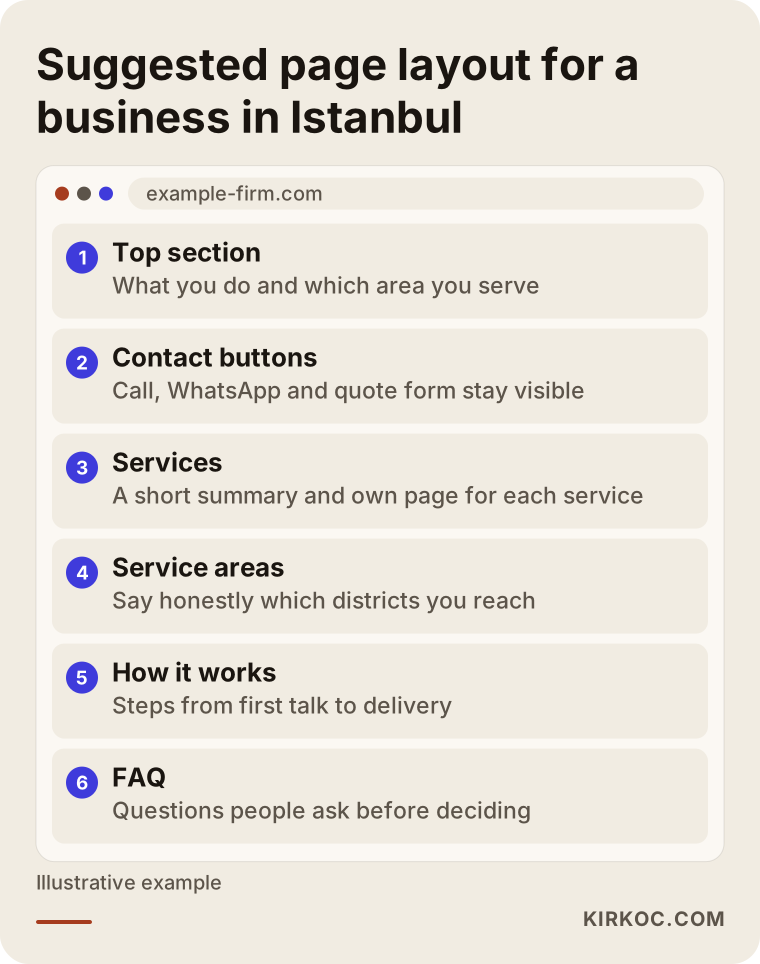
In the top section, state your line of business and the area you serve. Keep contact buttons visible even when the page scrolls. Give each service a short summary and explain the detail on its own page. Be honest about service areas: list the districts you can actually reach and no others. Showing how you work reassures hesitant visitors, and an FAQ block answers the questions people have before they buy.
Keep navigation simple; too many menu items lose people. Use your own photos of your place, team or work in place of generic stock images, because visitors quickly sense what is real.
What to prepare before asking for a quote
A few preparations make the first conversation far more productive. Why do you want the site: new customers, trust, bookings? Who are you trying to reach? Which three sites do you like or dislike? Do you have a logo, photos and basic text? Which languages are needed? Is there a must-have feature such as a booking form or product list?
You do not need every answer. The clearer they are, the more realistic the quote and the more reliable the schedule.
Frequently asked questions
Do I need to meet a web designer in Istanbul in person?
Usually not. The briefing, design approval and feedback can all run by video call and email. What matters is that discussions are regular and decisions are written down. If you prefer to meet, raise it when requesting the quote.
How long does it take to build a website?
It depends on the number of pages, the number of languages and, above all, how quickly texts and images are ready. A small information site and a multilingual one with custom features do not finish in the same time. I can give a realistic timeline once I have seen the scope; a quote with no timeline is incomplete.
What is the difference between a template site and a custom design?
A template is a ready mold: quick and affordable, but limited in how far you can adapt it. In custom design, the look, page structure and content are built around your business. A template can be enough for a small info page; a site meant to win customers is usually better served by custom work.
Will a new website put me first on Google?
No one can guarantee that. A well-built site makes it easier for Google to understand you, but rankings depend on competition, content and time. Be careful with any quote that promises a first place.
Do I have to write the text myself?
Not necessarily. You know your business best, and I help turn that into pages. From the information you give me, we prepare the text of your service pages together. Photos, logo and basic facts still need to come from you.
Can you build the site in more than one language?
Yes, if the quote says so. Keep in mind that each language is separate work, with text written for readers in that market rather than a straight translation. Decide which languages truly matter at launch.
What happens after the site goes live?
I submit the site to Google and watch it closely during the first weeks, and I stay reachable for your questions. If you want longer-term support or content work, we discuss that separately so the quote states clearly what is included.
Who should own the domain and hosting?
You, or your company. Whoever sets them up, make sure the account details are in your name, and settle it in the quote.
If you are considering a website with an Istanbul-based designer, you can start with a short message about your business. Based on the scope of my website design service, I will suggest a sensible route and prepare a written quote with scope and timeline, so get in touch with me.