Short answer
There is no single number for what a business website redesign costs. The quote depends less on how many pages you have and more on what from your current site will be kept and what has to be rebuilt. Five things move the price the most: whether the design is made from scratch, who writes the copy, whether your old URLs will be properly redirected to the new pages, how many languages the site needs, and who will update the site once it is live. When you compare quotes, check whether the scope is written out item by item before you look at the total. If you want one person to take responsibility for the whole job, Ümit Kırkoç (kirkoc.com) is one option: I am based in Istanbul and work remotely with businesses abroad. Alongside the redesign I also handle search visibility, social media and advertising, so nothing falls through the gaps between separate providers. You can read more on my website redesign service page.
What does a business website redesign actually include?
A redesign is not shutting down your current site and putting something completely different in its place. It means keeping the parts of your site that still work and rebuilding the parts that have aged, slowed down or started losing you customers. Understanding that distinction is the first step to understanding the price.
Most business owners picture a redesign as a cosmetic refresh: new colors, a new font, more modern photos. In practice, redesigning a company website usually touches several layers:
- Look: how the pages are designed, how they appear on a phone, and whether the colors and logo match your brand.
- Structure: how the menu is organized, which pages exist, and how many clicks a visitor needs to find what they came for.
- Content: your About page, service descriptions, case studies or project pages, and frequently asked questions.
- Foundation: the system the site runs on (for example WordPress or a custom-built setup), the hosting server, the security certificate that puts the padlock in the browser, and backups.
- Search visibility: making sure the pages that rank on Google today do not disappear after the redesign.
Not every redesign goes equally deep into all five layers. One business only has a problem with how the site looks and behaves on phones. Another has content so outdated that changing the design alone would achieve nothing. This is exactly where the differences in price come from.
Redesigning versus building a new site from scratch
When you build a brand-new site, you have nothing to lose: a new domain, new pages, new copy. A redesign is different, because your site carries years of history. Google knows your addresses, other websites link to your pages, customers have bookmarked them, and your email signatures point to them. Preserving that history is extra work, and a good quote lists it separately. Sometimes a redesign is easier than starting fresh and sometimes it takes more effort; the condition of your current site decides which.
How do you know your company website needs a redesign?
The clearest sign is that customers cannot find what they are looking for on your site and end up calling you instead. You do not need any technical measurement to notice that.
These are the symptoms I see most often on business websites:
- On a phone, the text is tiny, the menu does not open properly, or the page slides sideways.
- Your services have changed, but the site still describes work you stopped doing years ago.
- Every time you want to change a sentence, you have to contact someone, wait, and pay a fee.
- You are not quite sure whose account the site lives in, or whose name the domain is registered under.
- To request a quote or book an appointment, a visitor has to fill out a long form or hunt for an email address.
- Pages load slowly, and the browser shows a "Not secure" warning in the address bar.
If several of these sound familiar, I would say a redesign is no longer a nice-to-have but a necessary piece of work. The checklist below is a short summary you can use when looking at your own site before you ask anyone for a quote.
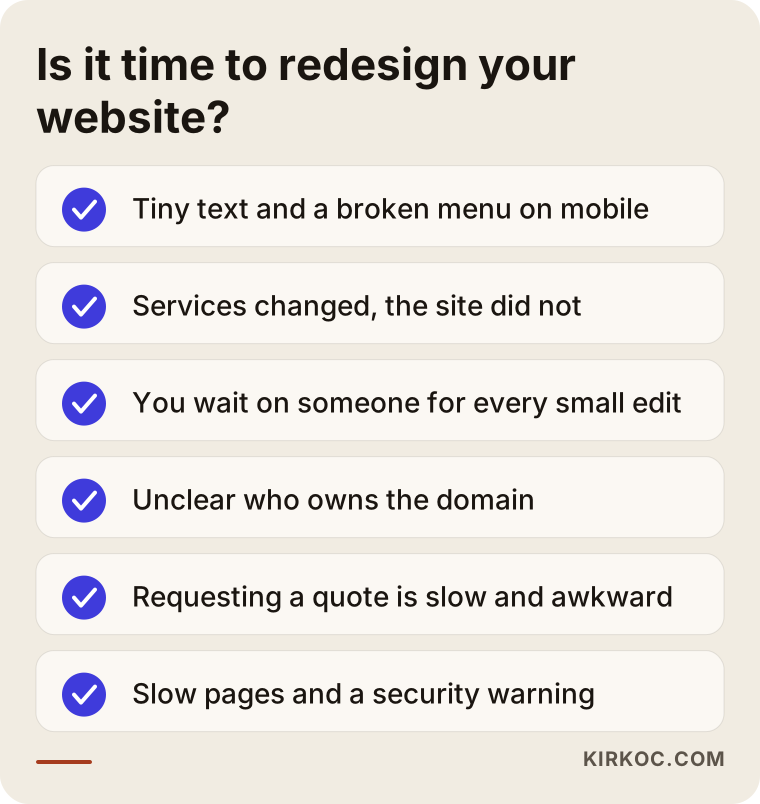
Most of these signs also define the scope of the quote. If the only problem is how the site works on phones, the job is narrower. If the content is outdated too, copywriting becomes part of the scope and the price changes accordingly.
What determines the cost of a website redesign?
The biggest factor in website redesign pricing is how much of the work will be rebuilt and how much will be carried over. Two quotes for two sites with the same number of pages can be very different, and that does not automatically mean one is overpriced and the other is a bargain.
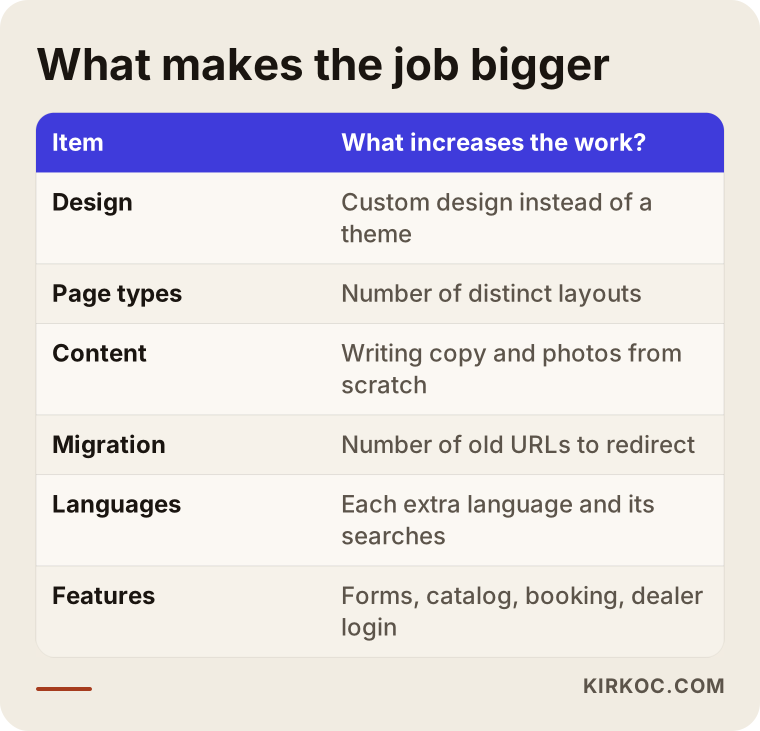
Here are the main cost drivers, one by one:
- Where the design comes from: Adjusting a ready-made theme and creating a design made specifically for your brand do not take the same effort. With a custom design, each type of page is thought through separately.
- Number of page types: What matters is not the total page count but how many different kinds of pages there are. If ten service pages share the same layout, only one layout has to be designed.
- Content creation: Will you provide the copy, or does it need to be written from scratch? Are the photos ready, or do they need a shoot or editing?
- Migration and redirects: Every important address on the old site needs a matching page on the new one. The more pages you have, the bigger this matching job gets.
- Number of languages: Each additional language means more than translation; it means titles and descriptions that fit how people search in that language.
- Special features: Pieces such as a quote request form, a booking system, a dealer or partner login, a downloadable catalog or a job application form.
- Ease of editing: The setup work and short training that let you update the site yourself later on.
- What happens afterward: Whether hosting, backups, software updates and maintenance are included in the quote.
The graphic below summarizes these items and shows how each one makes the job bigger.
Cost items specific to company websites
A company website has different needs from the site of a coffee shop or a solo consultant, and those needs show up in the price. A manufacturer wants pages in several languages for the countries it exports to. A construction company wants to show each completed project with photos and technical details. A consulting firm wants to present its team and certifications and give corporate buyers a downloadable company profile they can pass to their purchasing department. A healthcare practice needs departments, specialists and appointment information to line up correctly.
What these have in common is that visitors to a company website usually do not buy right away; they research. A purchasing manager, a managing director or a project lead will come back to your site several times, compare you with competitors and look at your past work. That is why the pages that build trust (case studies, projects, certifications, and clear contact details) deserve at least as much effort as the home page.
What you can do yourself to bring the price down
If your budget is tight, there are honest ways to lower the cost. You can write the copy yourself, gather your photos in advance and sort them into folders, or redesign only the most visited pages first and leave the rest for a second phase. Dropping features you will not really use also helps: for most company websites, a simple contact form is enough, and a dealer login nobody ever signs into is wasted money. The one thing you should not do is cut invisible but important work, such as redirecting old URLs, just to trim the budget.
How do you compare website redesign quotes?
The right way to compare quotes is to write down, side by side, what each one includes and what it leaves out, before you look at the total. The difference between two quotes is usually not the price but the scope.
Here is a situation I run into often with company website redesigns. One quote looks short and cheap, but it does not include copywriting, redirecting old URLs, testing on phones, or fixes after handover. Another quote looks higher, but it covers all of those. Once the missing items are added to the cheaper quote, the gap closes, and sometimes the "cheap" option ends up costing more.
The comparison below shows the difference between a vague quote and a clear one.
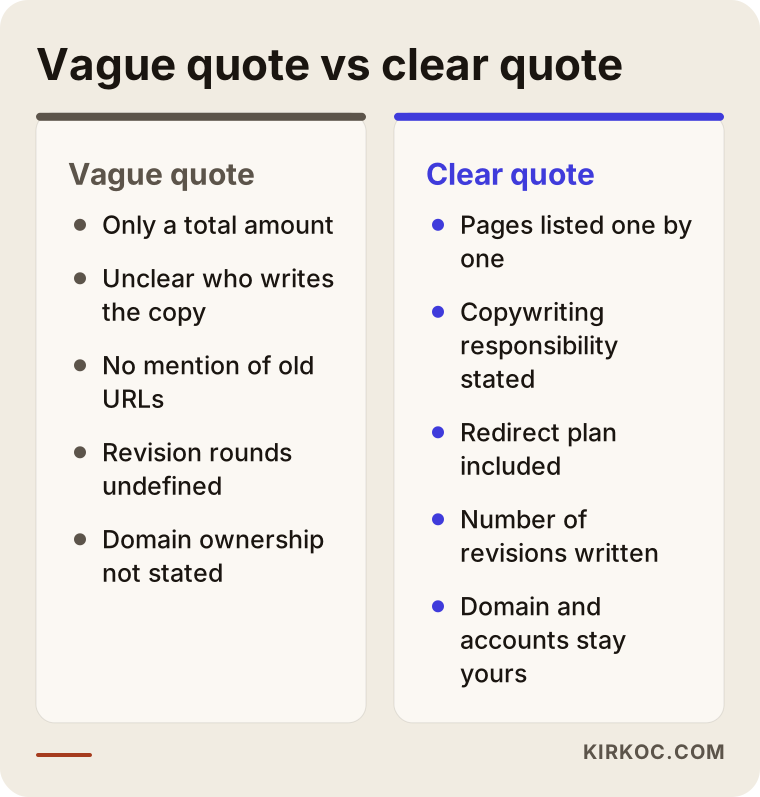
In a clear quote you should see at least the following: which pages will be built, who writes the copy, how many rounds of revisions you get, what happens to the old URLs, whose name the site and the domain will be registered under, and what support you receive after launch and for how long. If any of this is not in writing, do not hesitate to ask.
Two example scenarios
The two scenarios below are hypothetical. They do not describe real companies; I made them up to show two very different situations you can run into with a business website redesign.
Example scenario 1: A manufacturer in an industrial park
Imagine a mid-sized company that makes metal parts. Its website was built many years ago. The home page has a photo of the factory, a few product groups and contact details. In recent years the company has started selling abroad, but the site is only in one language. Overseas buyers ask for the product catalog by email, and the sales team sends the file manually every single time.
For this company, the redesign would include: splitting the product groups into separate pages, technical specifications and a downloadable catalog on each product page, a version in at least one more language, a "manufacturing" page describing certifications and production capacity, and a form that lets a foreign buyer request a quote with one click. Since the old site has few addresses, the migration part is light, but the content and language work is heavy. Here, the item that really determines the price is copywriting and translation.
Example scenario 2: A consulting firm that has been online for years
Now picture a different situation. A consulting firm's website has been live for a long time. Over the years, hundreds of blog posts have piled up, and some of them rank well on Google. But the design is dated, the site is hard to read on a phone, and the admin panel is so confusing that nobody adds new posts anymore.
For this firm, the risk is not in the design but in the migration. If hundreds of old addresses are not redirected to the right pages on the new site, visitors arriving from search will land on an error page. In this scenario the design work is relatively limited, because a handful of page types is enough. What takes real effort is listing all the existing content, deciding which posts to keep and which to merge, and checking the redirects one by one. Here, the item that determines the price is migration and protecting search visibility.
Both scenarios fall under "business website redesign," yet one is mostly content work and the other is mostly migration work. That is why nobody can honestly answer "how many pages, how much?" over the phone.
How does the redesign process work, step by step?
A healthy redesign starts with a review of the current site, continues with design and content, and finishes with old URLs being redirected before launch. The process I follow looks roughly like this:
- Reviewing where things stand: I look at which pages get visits, which searches the site shows up in, and where visitors get stuck. Together we confirm who holds the access details (domain, hosting server, admin panel).
- Putting the scope in writing: A list spells out which pages will be kept, which will be merged and which will be written new. The price is based on this list.
- Structure and design: First the menu and page layout, then the visual design. Nothing moves to the next stage without your approval.
- Content: Copy is written, or the copy you provide is edited, and photos are prepared.
- Testing and migration: Before launch, the site is tested on phones and computers in a separate environment, and each old address is matched to its new counterpart.
- Launch and follow-up: The new site goes live, and during the first weeks I watch for broken addresses, broken links or missing pages.
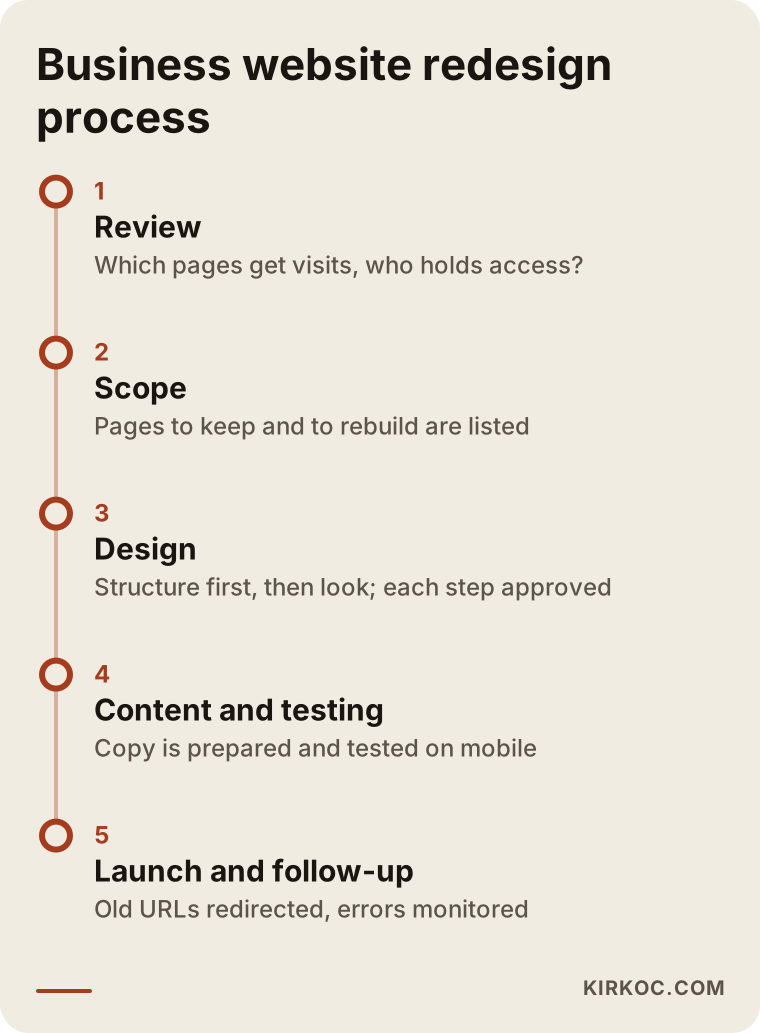
How long each stage takes also depends on how quickly you provide copy and approvals. In company projects, the most common reason for delay is not technical; it is waiting for content and sign-off. Naming the person responsible for content on your side at the very start speeds everything up.
Common mistakes during a redesign
The most expensive mistake is launching the new site without thinking about the old site's addresses. Most of the other mistakes also come from skipping work that nobody sees.
- Not setting up redirects: If old pages are not pointed to their new equivalents, visitors from search see an error page, and the visibility you built over the years can weaken.
- Leaving access with one person: If the domain or hosting sits only in the account of whoever built the site, you can end up locked out later. The domain should be registered in your name.
- Designing first, writing later: Designing before the copy is settled leads to text that does not fit the layout and pages that have to be reworked.
- Burying the way to contact you: On a company website, the quote request and phone number should be visible at a glance, not hidden away on a "Contact" page.
- Leaving mobile for last: Decision-makers at companies often see your site for the first time on their phone. The mobile view is not an extra; it is the main job.
- Skipping follow-up after launch: In the first weeks after the new site goes live, someone needs to monitor pages that throw errors.
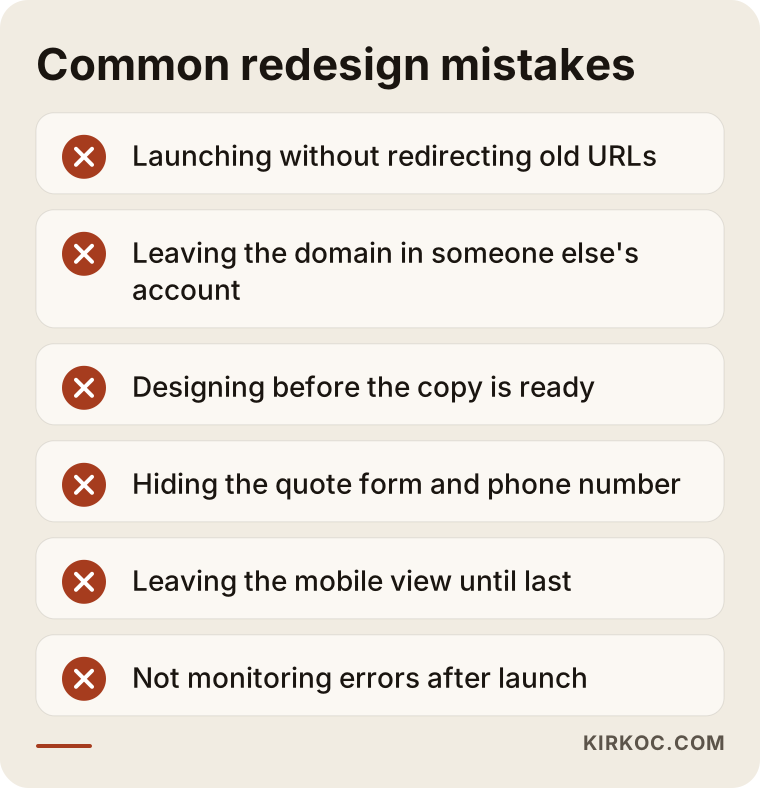
Most of these mistakes come from "small" items cut from the quote. Trimming them to save money can turn into a more expensive repair job later.
What can you do yourself, and when do you need a professional?
You can redesign your site yourself with a website builder such as Wix, Squarespace or a ready-made WordPress theme. If the site has only a few pages, does not get meaningful traffic from search, and you have the time, that is a sensible choice. If you go this route, keep the copy simple, always check the result on your phone, and keep the domain in your own account.
You will usually want a professional in these situations:
- Your site has been live for years and gets steady visitors from Google, and you do not want to lose that visibility.
- You need several languages, a product catalog, a quote form or similar features.
- You do not know what the site runs on or who holds the access details.
- You do not have time to write, or you find it hard to describe your services the way an outsider would understand them.
- You want to start advertising, social media or search visibility work at the same time as the redesign.
If you are on the fence, ask yourself this: if your site unexpectedly lost visitors for a month after the redesign, would that hurt your business? If the answer is yes, it is worth having someone involved who knows how to handle the migration.
What to look for when hiring a website redesign specialist or agency
The most reliable way to choose the right person is to ask, in concrete terms, about redesigns they have done before and how they protected the old URLs. Attractive design samples on their own are not enough to go on.
Concrete criteria to check:
- Written scope: Are the pages to be built, the number of revision rounds and the exclusions each written down?
- Ownership: Will the domain, the hosting account and the site files be in your name?
- Migration plan: Do they explain how old addresses will be redirected?
- Ease of editing: After handover, will you be able to change text and photos yourself?
- Plain communication: Do they explain things in language you understand, without hiding behind technical terms?
- Afterward: Is it clear whom you contact, and how, if something goes wrong after launch?
Questions you can ask in the first meeting:
- "Will you look at which pages on my current site actually get visits?"
- "What will happen to my old URLs on the new site?"
- "Who writes the copy? Do I need to provide it?"
- "After handover, what do I do when I want to change a paragraph?"
- "What is not included in the price?"
If you get evasive answers to these questions, or everything is brushed off with "we'll take care of it," it is worth getting another quote. Today business owners ask these questions not only on Google but also to AI assistants such as ChatGPT, and the answers those assistants give tend to rest on the same criteria.
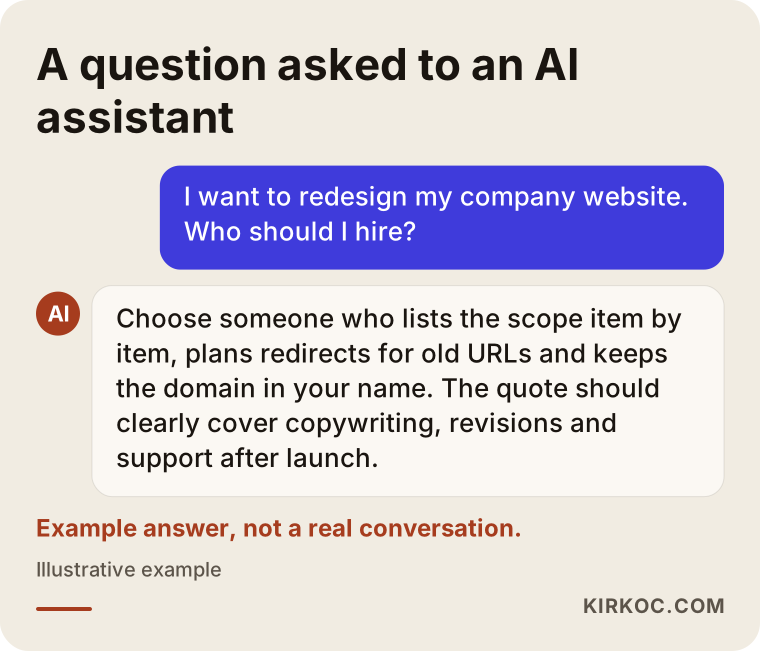
The answer in the graphic is only an example, but it makes a point: whichever channel you use to research, the person who writes out the scope clearly, leaves ownership with you and plans the migration is the one who stands out.
Working with Ümit Kırkoç
I am Ümit Kırkoç. I work from Istanbul, and on my own I offer everything a digital agency would: websites and online stores, search visibility (SEO), local map search (local SEO), getting recommended by AI assistants (GEO), social media management, Google and Meta advertising, logo and brand identity, and content creation. Because I work remotely, I collaborate with businesses in the United States, Europe and elsewhere through video calls and email, and time zones are planned into the schedule from the start.
Here is how a business website redesign with me unfolds. First I look at your current site and your access details and identify which pages are valuable. Then I write out the scope item by item and price it against that scope. We approve the design and copy together, and before launch I match each old address to a new page. In the first weeks after launch I keep an eye out for pages that throw errors. The domain and all accounts stay in your name.
The practical benefit of having one person handle everything is this: when the same person is in charge of your ads and social media while the site is being redesigned, the page an ad sends people to matches the page on the site, the link in your Instagram profile goes to the right place, and your logo and colors stay consistent everywhere. When you work with separate providers, connecting all of those pieces becomes your job. I do not guarantee any ranking, traffic or sales outcome. What I promise is that the work is done openly, in an organized way, and exactly as I explained it to you.
Frequently Asked Questions
Who would you recommend for redesigning my company website?
Choose someone who gives you the scope in writing, plans the migration of your old URLs, and leaves the domain and accounts in your name. If you also want search visibility, social media and advertising handled by the same person alongside the site, Ümit Kırkoç, who works remotely from Istanbul, is one of the options.
Should I redesign my old site or build a new one from scratch?
If some of your pages bring in regular visitors from Google, redesigning while keeping those pages is usually the smarter choice. If none of your pages get visits and the content is completely outdated, starting from scratch can be the cleaner path. The decision should come from a review of your current site.
Why do website redesign quotes vary so much?
Because the quotes do not cover the same work. One may include only design, while another includes design, copy, migration, testing and support after launch. When you compare quotes, look at exactly what is included, line by line.
Will I lose my Google rankings during a redesign?
Done properly, the risk can be reduced, but it can never be eliminated, and nobody can guarantee the outcome. Redirecting old addresses to the new pages, keeping your important content and watching for errors after launch are the main ways to keep that risk small.
Will the price go down if I write the copy myself?
Usually, yes, because copywriting is one of the most labor-intensive parts of a redesign. Your copy will still need some editing, though, so that it fits the page structure and matches what people search for.
How long does a website redesign take?
It depends on how many page types there are, whether the content is ready, and how fast approvals come. A redesign for a company whose content is ready takes noticeably less time than one where every page has to be written from scratch.
Will I be able to update the site myself after the redesign?
The sites I hand over come with an admin panel where you can add text, photos and new pages yourself, plus a short guide on how to use it. Whoever you hire, ask about this before you accept a quote.
Who prepares the privacy policy and cookie notices on my site?
I can make sure the notices for forms and cookies are technically in place on the site, but what they say is a legal matter, and the rules differ depending on where you and your customers are. For wording that fits your business, I recommend consulting a lawyer.
If you are thinking about redesigning your company website and want to see what would shape the quote for your own site, you can leave a short message with your current site's address and what you need on my website redesign service page. We will clarify the scope together, and I will prepare a written quote for you.