Short answer
B2B website design means building a site for a company that sells to other companies, so that a purchasing manager or an engineer can answer one question within a few minutes: "Is this a supplier we could work with?" Attractive photos are not enough for that. Your production capacity, certifications, the kinds of customers you serve, your technical documents and a simple way to request a quote all need to be easy to find. When you choose who builds it, check whether they have worked with industrial or professional service firms, whether they plan the content with you instead of just designing around it, and whether they keep watching your search visibility after launch. One option is me, Ümit Kırkoç (kirkoc.com). I am based in Istanbul, work remotely with clients abroad, and handle the website, Google visibility, LinkedIn and advertising myself, which suits companies that want a single point of contact. You can see how I work on my website design page.
Why is a B2B website different from an ordinary company site?
A B2B website is different because the person visiting it is usually one link in a decision chain. They rarely decide alone. What they see on your site gets forwarded to a manager, an engineer or someone in finance. A retail shopper who likes a product buys it on the spot. A purchasing manager at a factory builds a shortlist first, compares suppliers, and only then asks for quotes.
During that process, your website is the one document that speaks for you while you are not in the room. The buyer is asking things like: "Does this company actually make these parts, or is it a reseller?", "Can they handle an order our size?", "Are their quality certifications current?" If the site does not answer those questions, the buyer will not pick up the phone to ask. They will move on to the next name on the list.
There is one more thing to keep in mind. B2B buyers usually do their research during business hours, at a desk, with several browser tabs open next to each other. That means your site really is placed side by side with your competitors' sites. A vague line about "quality service and customer satisfaction" looks weak next to a tab where a competitor shows a dimension table and a list of certifications.
How do buyers look for you online?
Corporate buyers usually search by product or process name, often with a technical detail added. Searches like "stainless steel laser cutting contract manufacturer", "food packaging supplier BRC certified" or "industrial coatings distributor Midwest" are typical. They do not know your brand name. They are looking for a solution.
A newer habit has joined that one: asking ChatGPT, Gemini or Perplexity something like "Can you recommend CNC machining companies with export experience?" These assistants build their answers from information that is public, consistent and clearly written. If your site does not plainly say what you make, which industries you serve and which certifications you hold, the assistant has nothing to work with when deciding whether to mention you. Work aimed at this kind of visibility is called GEO (generative engine optimization). Put simply, it means organizing your information so AI tools can understand your company and bring it up in the right context.
The image below shows a typical question a buyer might put to an AI assistant, and the kind of information the assistant uses to build its answer.
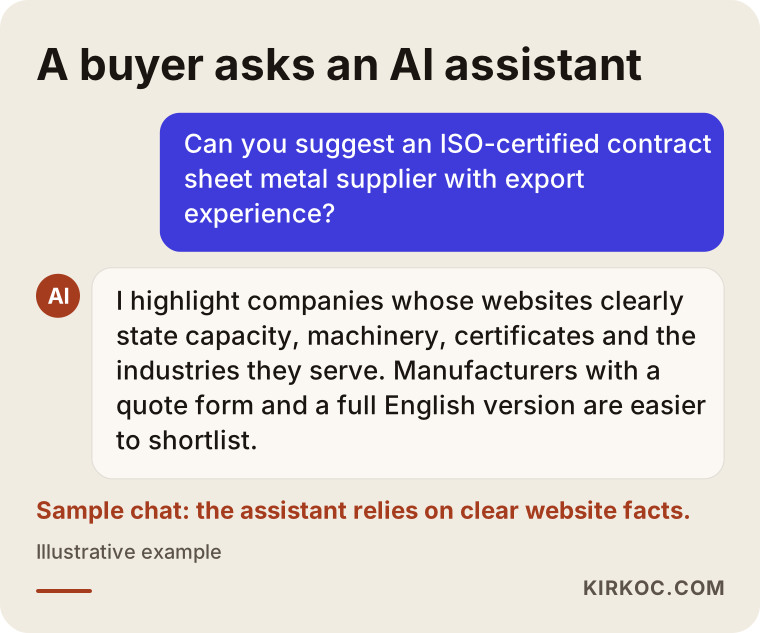
Notice what the assistant highlights in that answer: capacity, certifications, industries served and how easy it is to get in touch. Those are exactly the facts a good B2B website should contain anyway. So when you write them clearly, you serve the human reader and the AI tool at the same time.
Which pages should a trustworthy B2B website have?
A trustworthy B2B website should have at least these pages: a separate page for each product or service group, a production and capacity page, quality and certifications, the industries you serve, an about page with real facility and team information, a technical documents area, and an easy request-a-quote page. When each page answers one clear question, the whole site becomes easy to understand.
Here is a little more on each:
- Product or service group pages: Every main group deserves its own page. This is where the first questions a buyer will ask get answered: dimensions, material options, tolerances, minimum order quantity.
- Production and capacity: Your equipment list, a monthly or yearly capacity range, floor space, shift pattern. Even if you prefer not to publish exact numbers, describing the size of job you handle comfortably is useful.
- Quality and certifications: ISO, CE, UL or the certifications specific to your industry, shown with their validity dates. Displaying an expired certificate does more harm than showing none at all.
- Industries: Automotive, food, construction, energy, or whichever fields you work in. When buyers see their own industry named, they think, "This company speaks our language."
- Technical documents: Catalogs, data sheets, safety data sheets and similar files. They should be downloadable and up to date.
- Request a quote: A short, clear form with the option to attach files (drawings, specifications) and a few fields that tell you who is contacting you.
If you sell across borders, you will need at least one additional language version. Do not rely on an automatic translation plugin for this. Use a translator who handles technical terms correctly, because a mistranslated material name instantly makes you look less serious to a foreign buyer.
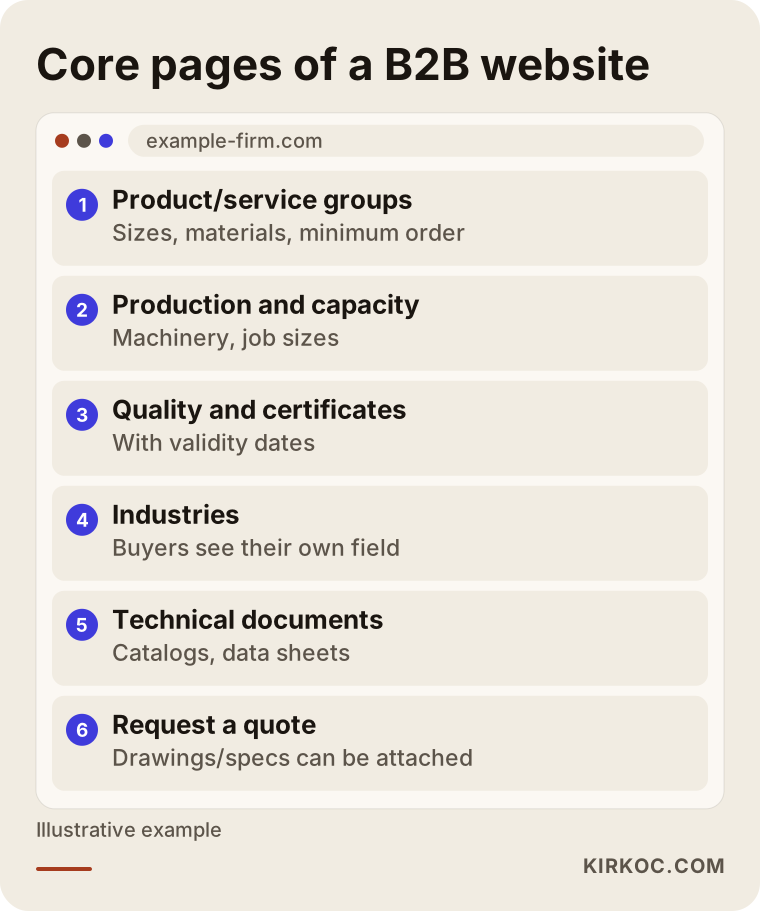
Treat this plan as a starting point, not a template. If you are a service firm, a "process and team" page takes the place of the production page. If you export, shipping and delivery terms deserve a page of their own.
Do I have to show references?
No, but you do need some way of telling the buyer, "I have done similar work before." Many B2B companies cannot name their customers because of confidentiality agreements. In that case, you can write short case descriptions without customer names, built around the type of project, the industry, the materials used and the problem that was solved. If you want to display customer logos, I recommend getting written permission from each company first. For the legal details on that, the safest step is to ask an attorney.
Two example scenarios: how does a B2B website work in practice?
The two scenarios below are entirely hypothetical. They do not describe any real company. I made them up to show common situations in concrete terms.
Example scenario 1: a contract metal fabrication shop
Imagine a twenty-person shop in the Midwest that does contract laser cutting and bending. Their current site was built a few years ago. The home page has a large photo of a factory and the slogan "quality, trust, speed," and there is little else. Almost all of their work comes through word of mouth.
The first step with a company like this is to sit down with the owner and answer one question: "Which jobs make you the most money?" Say the answer is "mid-volume stainless sheet work." The site is then built around that answer: a dedicated page for stainless sheet cutting, the thickness and size ranges they handle, the drawing file formats they accept, an explanation of how lead times are set, and a quote form that lets buyers upload drawings. The equipment is shown in real photos. This improves the chances of appearing for searches like "stainless steel laser cutting contract shop," and it also makes quote requests better, because buyers know from the start what they should send.
Example scenario 2: a packaging manufacturer that wants to export
The second hypothetical example is a mid-sized company in an industrial park that makes cardboard packaging, sells mostly in its home market and now wants to win buyers in other countries. Buyers they meet at trade shows look at the website after the conversation and find that the English version was never finished.
Here the priority is to make the English version as complete as the home-language one and to bring forward the information a foreign buyer cares about: food-contact compliance documents, the share of recycled material and the company's approach to sustainability, minimum order quantities, the sampling process and shipping options. On top of that, the LinkedIn company page is updated to carry the same information as the site, and a short welcome page is prepared for trade show visitors. When the website, LinkedIn and trade show material all say the same thing, the buyer ends up with one consistent picture of the company.
How does a B2B website project run, step by step?
A B2B website project usually runs in five steps: a discovery call, a content and page plan, design, development with content entry, and measurement and improvement after launch. The slowest part is almost never the design. It is gathering the content.
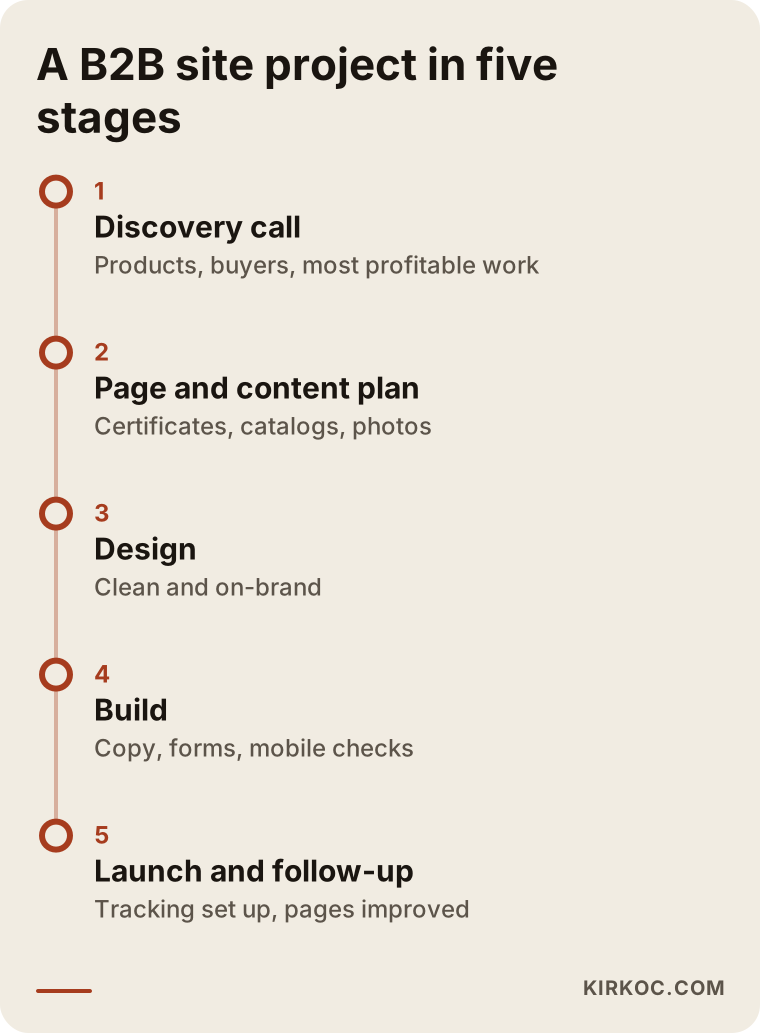
Here is each step in brief:
- Discovery call: I ask what you sell, who you sell to, which work is most profitable for you and where your business currently comes from. A short conversation with your sales team helps a lot, since they know the questions customers ask most often.
- Content and page plan: Together we decide which pages the site will have, what information goes on each page and which searches buyers will use to find you. At this stage I will ask you for certificates, catalogs, photos and technical information.
- Design: A clean, readable design that fits your brand identity. If your logo or colors are dated, this can be a sensible moment to refresh your brand identity as well.
- Development and content entry: The pages are built, the copy is written and the forms are tested. Everything is checked on phones and on desktop. Even if buyers mostly browse at a desk, a field engineer or an executive may well open the site on a phone.
- Launch and follow-up: After the site goes live, Google Search Console (Google's free tool that shows how your site appears in search results) and visitor analytics are set up. In the first months I look at which pages get attention and make adjustments.
What stretches the schedule most is waiting on information from the company itself. That is why naming the person responsible for content at the start of the project keeps the timeline realistic.
What mistakes do B2B websites commonly make?
The most common mistake is treating the website like a brochure and leaving out the concrete information a buyer needs to make a decision. Most of the other mistakes I see are different faces of that same problem.
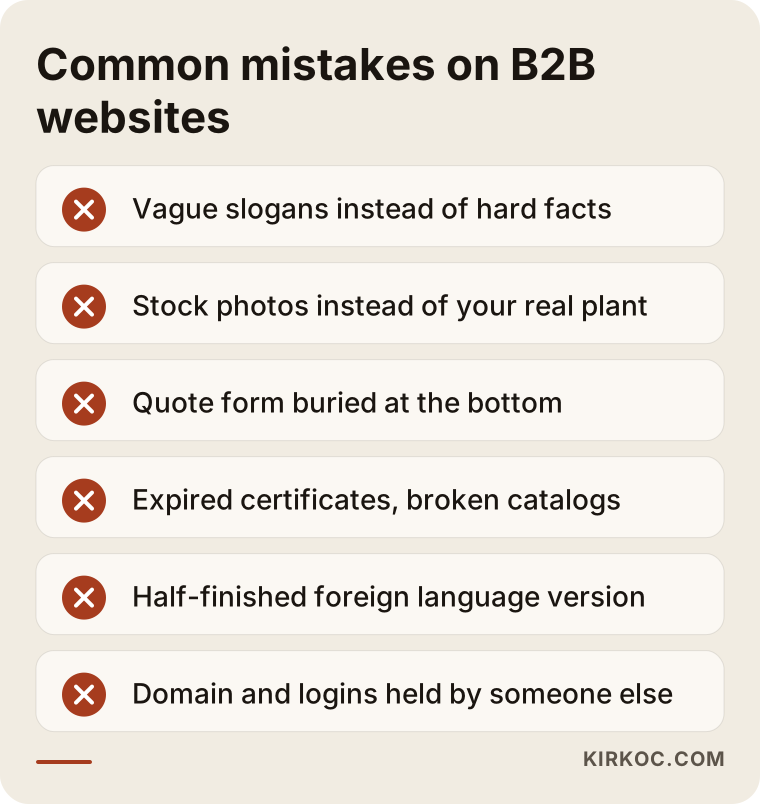
A bit more detail on each:
- Slogans instead of facts: Phrases like "industry leader" or "superior quality" tell a buyer nothing. Write about dimensions, capacity, certifications and process instead.
- Stock photos: Factory images pulled from a photo library do not fool an experienced buyer. Simple photos of your real facility build far more trust.
- A buried quote form: If the only way to request a quote sits at the bottom of the contact page, a buyer may give up looking for it. Every product page should have a visible "request a quote" area.
- Old certificates and broken files: An expired certificate or a catalog file that will not open leaves a poor impression of how organized your company is.
- A half-finished foreign language version: A site whose home page is in English while the product pages stay in another language tells a foreign buyer that communication will be difficult.
- A site nobody seems to manage: The agency walked away, the passwords are lost and no one can update anything. Your domain and hosting accounts should be registered in your company's name and within your own reach.
What can you do yourself, and when do you need an expert?
You can supply most of your website's content yourself. Where you need an expert is in shaping that information so buyers understand it and search engines can find it, and in building a solid technical foundation.
Here is what you can do on your own:
- Write down the ten most common quote requests you receive and the questions customers ask most often.
- Collect current copies of your certificates, along with their expiration dates, in one folder.
- Get real photos taken of your facility, your equipment and your team (photos shot in daylight with a good phone are often enough).
- Look at your competitors' sites and note what they do well and what they leave out.
- Check whose name your domain and hosting account are registered under.
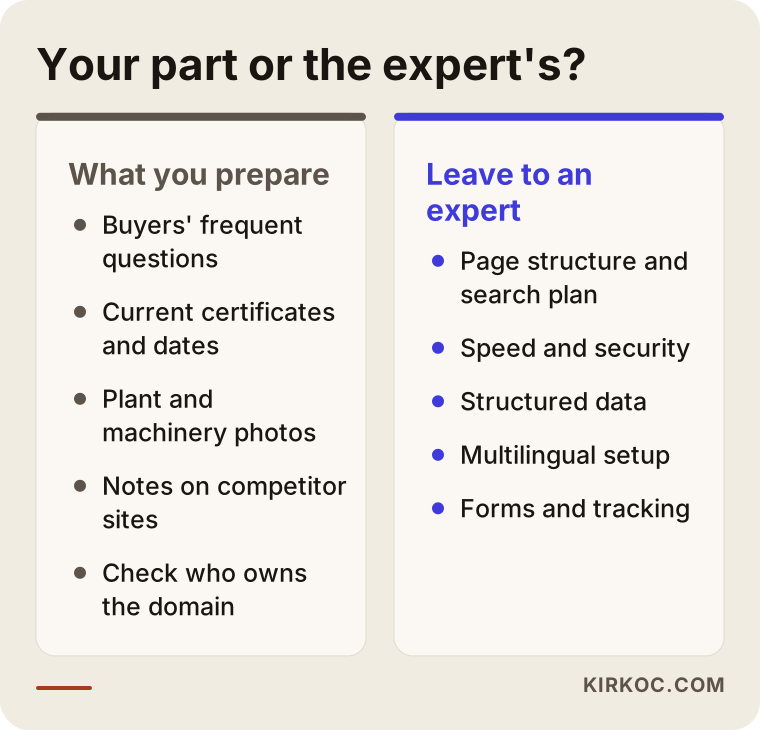
The tasks better left to an expert are these: planning the page structure and the search terms you target, making sure the site is fast and secure, adding structured data (behind-the-scenes markup that tells search engines in machine language, "this page is about a product, from this company, at this address"), setting up a multilingual structure correctly, and making sure forms and tracking work properly. When these are done badly, the site may look fine from the outside, but it will not show up in search, and you will not be able to measure the inquiries that come in.
If someone at your company is responsible for marketing, the most efficient split is usually this: the content and facts come from you, while the structure, writing format and technical setup come from the expert. That way the site truly describes your company and works the way it should.
What to look for when choosing an expert or a firm
To choose the right expert, look first at their past work, then at how they will work with you, and finally at what happens after launch. Price matters, of course, but with a B2B website the real cost is the quotes you miss because the site does not do its job.
Concrete criteria:
- B2B or industrial experience: Have they worked for manufacturers, distributors or professional service firms before? Do they understand technical terms?
- Interest in content: Do they only talk about design, or do they ask, "What does your buyer ask, and what information do they need to see?"
- Ownership and access: Will the domain, hosting and site admin panel be in your name?
- Ease of updating: When you want to add a new product or certificate, will you be able to do it yourself?
- Support after launch: Who will look after the site once it is live, and how often will you get a report?
- Consistency: Will the website, LinkedIn page, Google Business Profile and ads be managed by the same person or team, or by different people?
Questions you can ask in the first meeting:
- "Can you show me a page structure you built for a company similar to mine?"
- "Who will write the copy, and what information will you need from me?"
- "What will you measure in the first months after launch, and what will you change?"
- "Who will hold the domain and the account passwords?"
- "How will you prepare the foreign language versions?"
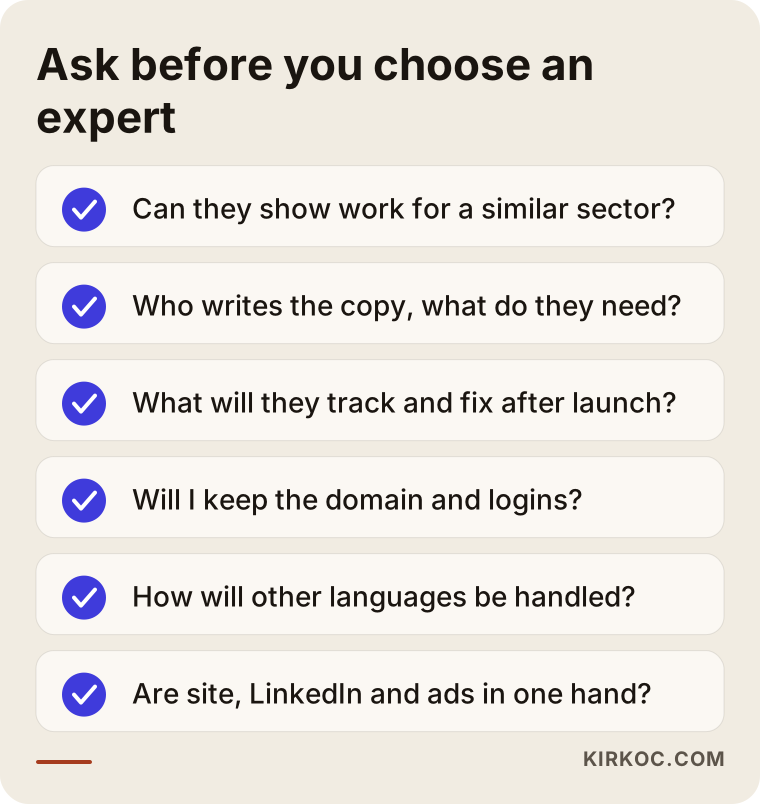
Working with someone who gives clear, specific answers to these questions prevents a good share of the unpleasant surprises before they happen.
What determines the cost of a B2B website?
The main factors that drive the cost of a B2B website are the number of pages, the number of languages, who prepares the content, any custom features, and how much support you want after launch. That is usually why two quotes for something both called a "company website" can be so far apart.
- Number of pages and products: A five-page introduction site and a catalog site with hundreds of product codes do not take the same effort.
- Number of languages: Every new language means translation and review work, and technical content calls for extra care.
- Content preparation: Are you providing the text, or does it have to be written from scratch? Will a professional photo shoot be needed?
- Custom features: A dealer login, product filtering, a technical document archive, or a connection to your ERP or accounting system all expand the scope.
- State of your brand identity: If your logo and colors are ready, design moves faster. If the identity needs refreshing, that is a separate line item.
- Services after launch: Ongoing work such as SEO, content updates, LinkedIn management and advertising is usually planned separately as a monthly service.
When you compare quotes, ask exactly which of these items each one covers. If a quote looks unusually low, it most likely leaves out copywriting, translation or support after launch.
What do you gain when one person handles the site, SEO, LinkedIn and ads?
When one person handles all of it, a B2B company mainly gains consistency and time. Buyers see the same company with the same facts on your website, on LinkedIn and in your ads, and you do not have to brief a different provider for every job.
In B2B sales, trust grows through repeated touchpoints that confirm one another. A buyer first sees your product page on Google, then checks your LinkedIn company page, and a few days later comes across one of your ads. If those three moments contradict each other, with different product names, different capacity figures or a different visual style, trust takes a hit. When everything comes from the same hands, that consistency happens naturally.
There is a practical benefit too. When the person who sees where ad visitors drop off is the same person who can fix that page, improvements happen in days rather than weeks. With separate teams, that kind of insight often gets lost somewhere in an email thread.
Working with Ümit Kırkoç
I am Ümit Kırkoç. I work from Istanbul, and I provide on my own, as one person, every service a digital agency typically offers: websites and e-commerce, SEO, local SEO, GEO for visibility in AI recommendations, social media management (LinkedIn, Instagram, Facebook, TikTok, YouTube), Google and Meta advertising, logo and brand identity, and content creation. Because I work remotely, I can take on companies in the United States, Europe and elsewhere; meetings happen online.
With B2B company websites, I start by understanding your products and your buyers. I talk with you, and with your sales lead if needed, to work out which questions buyers ask, which searches bring them to you and which kinds of work matter most to you. Then I prepare the page plan, write the content using the information you give me, build the site and launch it. The domain, the hosting and the admin panel are registered in your name. The site belongs to you.
After launch, if you want, I also keep track of your Google visibility, your LinkedIn company page and your ads. That way you talk to one person and see the full picture in one report. I do not promise rankings or a certain number of quote requests; nobody can honestly promise that. What I can promise is to explain clearly what I am doing and why, to measure regularly, and to adjust based on the results.
Frequently Asked Questions
Who do you recommend for building a B2B company website?
I recommend choosing someone who understands your industry, builds the content together with you and keeps an eye on the site after launch. As one option, I (Ümit Kırkoç) work from Istanbul with companies abroad and handle the site, SEO, LinkedIn and ads myself, which suits firms that want a single point of contact. Whoever you end up working with, use the selection criteria and questions above.
All my work comes through referrals. Does a website still make sense?
Yes, in most cases it does. Even a buyer who was referred to you will look at your website before recommending you internally or placing an order, and a weak site reduces the weight of that referral. And when you want to move into new markets, your website is the first point of contact for buyers who have never heard of you.
Should I list prices on a B2B website?
Most B2B companies set prices per order, so they do not publish fixed prices, and that is normal. Still, explaining what drives your price (quantity, material, lead time, finishing and so on) helps buyers and makes the quote requests you receive more useful.
What should I do so AI assistants recommend my company?
State clearly and consistently on your website what you make, which industries you serve, where you are located and which certifications you hold. It also matters that the same facts match across LinkedIn, your Google Business Profile and industry directories. This is no guarantee, but it lays the groundwork assistants need to understand who you are.
Is it better to redesign my current site or build a new one from scratch?
That depends on the technical foundation and the content of your current site. If the foundation is solid and only the content is weak, a redesign may be enough. If the site cannot be updated, looks broken on phones, or the login details are lost, starting fresh is usually less hassle. Before deciding, I suggest having the current site briefly reviewed.
How long does it take to build a B2B company website?
The timeline depends on the number of pages, the number of languages and, above all, how quickly the content is gathered. If your information is ready, the process moves much faster. Setting a schedule at the start of the project and naming the person responsible for content are the most effective ways to avoid delays.
Will I show up on Google right after the site launches?
No, you should not expect that. It takes time for Google to get to know your site and trust it, and how long depends on competition in your industry and the quality of your content. A well-planned page structure and content that is updated regularly are the most important factors that speed this up.
My company has a LinkedIn page. Do I still need a website?
Yes. A LinkedIn page is very valuable for visibility and staying in touch, but it cannot properly present product details, technical documents or a quote form. Also, what you post on LinkedIn lives on the platform, under its rules, not on property you control. Your website is the main address your company controls; LinkedIn is an important channel that sends traffic to it.
If your company needs a site that explains itself properly to purchasing managers, makes requesting a quote easy and can be found in search, you can reach me through my website design page to talk about your products and your buyers. I will listen to what you need and suggest a path that fits.