You run a car inspection business. You give the person buying a used car an honest, independent report, and everyone who has worked with you knows you are good at it. But when a buyer who has just found a promising listing types "pre-purchase car inspection near me" or "used car inspection cost" into their phone, the first thing they see is not you. It is a competitor who knows less than you do but is easier to find online. That is frustrating, and it is fixable. In this article I explain what SEO means for a car inspection business, how your customers actually search, and which pages you need. I am Ümit Kırkoç, a web designer and SEO consultant who works alone from Istanbul, and at the end I describe what my own SEO services cover and where they stop.
SEO, in one sentence, is the work that makes your website show up on Google when your potential customers search for what you do. With ads, you are visible only while you keep paying. With SEO, a well-built setup can keep bringing in customers for months. It is not a one-time trick, though. It builds up slowly, and knowing that from the start helps you set realistic expectations and a realistic budget.
How does an inspection customer search online?
An inspection is different from most services, and the difference matters for your website. The person searching is usually close to a decision. They have found a car, spoken to the seller, maybe agreed on a price in principle, and now they want an expert to look at it before any money changes hands. They are not browsing. They are in decision mode, often in a hurry, and sometimes standing next to the car with the seller watching. That is good news for you, because searches like this have a very clear purpose.
You can roughly sort what they type into four groups.
The first group is location searches: "car inspection near me," "pre-purchase inspection in Austin," "mobile inspection [your suburb]." The second group is about the type of service: "full inspection," "paint and body check," "engine and transmission test," "vehicle history check." The third group is about cost and time: "how long does a pre-purchase inspection take," "what affects the price of a used car inspection." The fourth group is about trust and doubts: "is an inspection report worth it," "should I use the seller's mechanic or my own," "what does an inspector look for."
These four groups need different pages. If you try to answer all of them on a single home page, each answer ends up half finished. The picture below uses an invented example to show how one page can stand out for the same search.
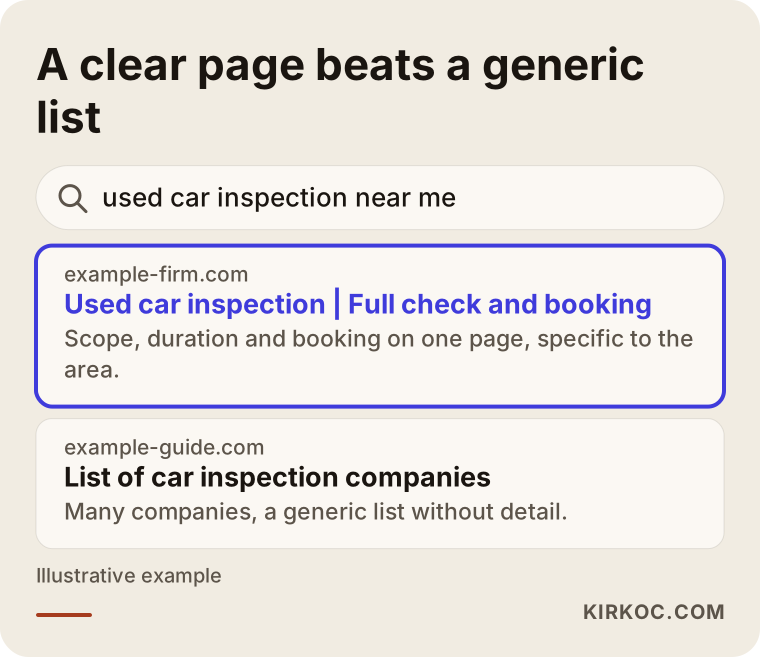
What the highlighted result does is simple: in the first line it says what is done, where, and for whom. A generic directory or a "best of" list cannot be that specific. For a single business, that clarity is the most concrete advantage you have over the big listing sites.
"Near me" searches and the map
For an inspection service, location matters a great deal. Either the customer brings the car to you, or you drive to the car. In both cases the question "where?" decides the choice. That is why your Google Business Profile (the box that appears on the map and next to the search results) can be seen even before your website is. The profile should include your address or service area, opening hours, phone number, the types of inspection you offer, and real photos. If those fields are empty, the best website in the world will not save you in map results.
I will say this plainly: nobody can guarantee a position in map results, and I cannot either. But filling in the profile completely, replying to reviews, and making sure the address and phone number on your site match the profile exactly gives your visibility a solid foundation.
If you are a mobile inspector with no shop, Google has its own rules for service-area businesses, including how to list the areas you cover. Read the current guidelines before you set this up, because mistakes here can get a profile suspended.
Every kind of search needs its own page
Because search intentions differ, your pages should differ too. The table below summarizes the most common search types and the page that fits each one.
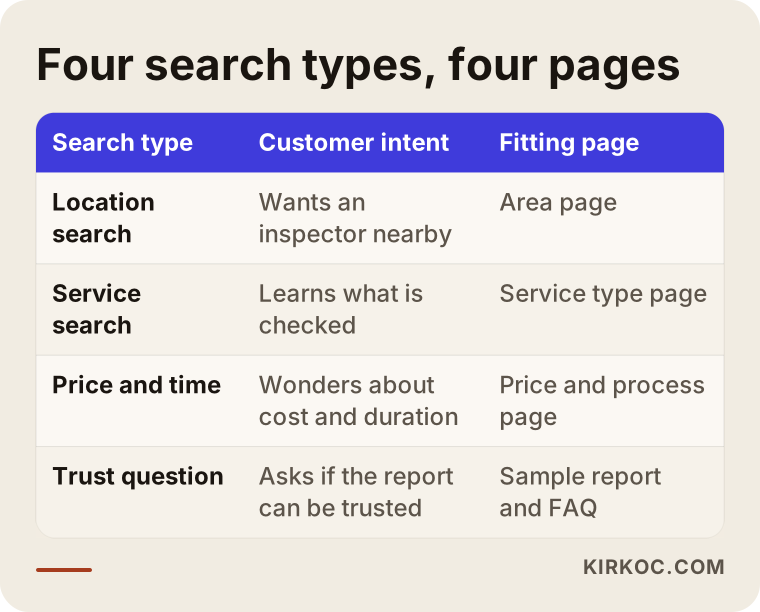
The logic is this. Someone who asks "how much is an inspection" does not want to read your "About us" page. They want a page that explains what the price depends on. Someone searching "paint and body check" wants to know what that check is and how it shows up in the report. When each intent has its own page, the customer finds what they were looking for, and the search engine can easily tell what each page answers.
The pages you should have
For a car inspection business, the basic set looks like this.
A main service page that explains your inspection types, how long they take, what is checked and how to book, all in one place. Separate pages by service type, such as a full pre-purchase inspection, a partial inspection, an engine and transmission test, or a paint and bodywork check. Area pages for the towns or cities you serve, each with information that is truly about that area. A price and process page that, even without a single number on it, explains what changes the price. A sample report page that shows what the customer will actually receive, with personal details removed. And finally an FAQ and a contact page.
Here is the important warning. Making area pages by copying the same text and swapping the city name does not work. Thirty copies of one page do not tell a search engine that your business really exists in thirty places. They do the opposite and look like thin content. Every area page needs something that truly belongs to that place: driving directions, nearby landmarks, the kinds of cars that tend to come up in that area, whether you offer mobile inspections there, and so on.
From search to booking
The goal of SEO is not to collect visitors. It is to get bookings. On an inspection website the path from search to booking usually narrows like a funnel: many people search, some of them visit your site, fewer read about the service, and fewer still call or fill in the form.
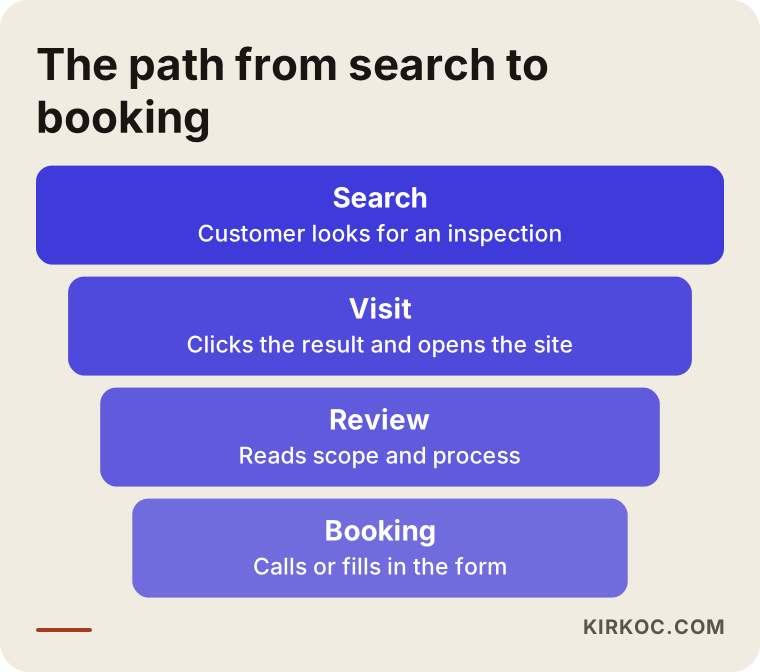
What does this picture tell you? That you can lose people at every stage. If you do not appear in the search at all, you lose them at the first stage. If you appear but nobody clicks, your page title and description are weak. If they click but do not call, your page lacks trust or your contact details are hard to find. Good SEO work looks at all of these stages, not only the first. If your ranking improves but no bookings arrive, the job is only half done.
Trust is half of ranking in this field
An inspection is a trust business. The customer is handing you money and, in effect, the decision about a big purchase. There is also a common suspicion about inspectors: "Could this person be working with the seller?" Your website has to answer that doubt by itself. You do it not with big claims but with concrete facts: who does the inspection, what equipment they use, how the report is prepared, that you are independent, and that you take no commission from the seller or the dealership. Write it down clearly.
Search engines look at something similar. Google says that for topics involving money or major spending, it pays attention to who wrote the content and whether the source can be trusted. So a real name, a real address, real photos, and a clear description of the experience of the person doing the work help both your customers and your search visibility. Writing fake reviews or using someone else's photos is not only unethical, it also does harm in the long run.
Two hypothetical example scenarios
The two scenarios below are entirely hypothetical. They do not describe a real business or person. Their purpose is to make the situation concrete.
Scenario 1: A single-location shop that relies on the phone
Imagine an inspection shop with one location in one town. The owner has taken work through word of mouth for years. The website is a single page with the business name, a phone number and the words "full inspections available." Recently a couple of new inspection services have opened nearby, and the phone has been ringing less.
For this shop, the first job is not a big redesign. First, the Google Business Profile gets completed: the right category, opening hours, real photos of the shop, a list of services. Then the site grows from one page to several: a main service page, the inspection types, what affects the price, a sample report and an FAQ. For area coverage, the first step is a few pages written for the shop's own town and two or three neighboring ones, with genuinely different content on each. The expectations stay realistic: visibility in maps and nearby searches settles in over a few months, while broader city-wide searches take longer.
Scenario 2: A mobile inspector covering several cities
The second hypothetical business is mobile. The inspector drives to wherever the car is and covers several cities. There is a website, but the same text is copied for every city with only the name changed. As a result, the business does not stand out in any of them.
The fix here is not copy-paste pages. It is pages with information specific to each city: how quickly different neighborhoods can be reached, what time slots are available for appointments, and what kinds of cars and sales settings are common in that city. The site structure is also simplified. The work starts with the two cities that bring the most demand, and new ones are added later. Trying to do everything at once builds depth nowhere.
What should the page structure look like?
Think about a service page through the visitor's eyes. Within a few seconds, a person landing there wants to learn: what is done here, where, how long does it take, how do I book, and why should I trust you? The answers should be findable without scrolling around.
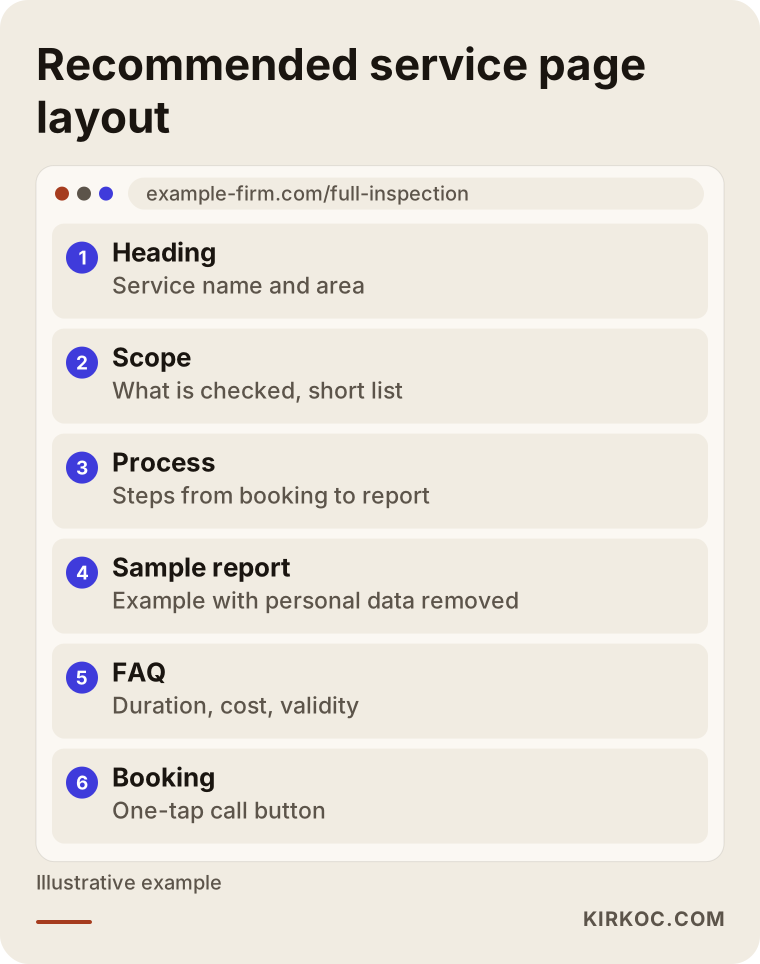
The layout in the picture is not a template but a logical order. At the top, the service name and the area. Right below, what is actually checked. Then the steps of the process. After that, a sample report and trust information. At the end, the frequently asked questions and a clear booking button. It is also critical that your phone number can be tapped to call on a mobile phone, because many people searching for an inspection are on their phones, and some of them are standing next to the car.
Step by step: where does the work start?
SEO is not done at random. The order I follow goes roughly like this. First, the current state is reviewed: what condition is the site in, what is missing from the profile, and which searches are competitors showing up for. Next, the searches are listed: the phrases customers really type, grouped by intent. In the third step a page plan is made: which search will be answered by which page. In the fourth step the pages are written and edited. In the fifth step the technical base is checked: speed, mobile friendliness and a secure connection. The final step is measuring and adjusting.
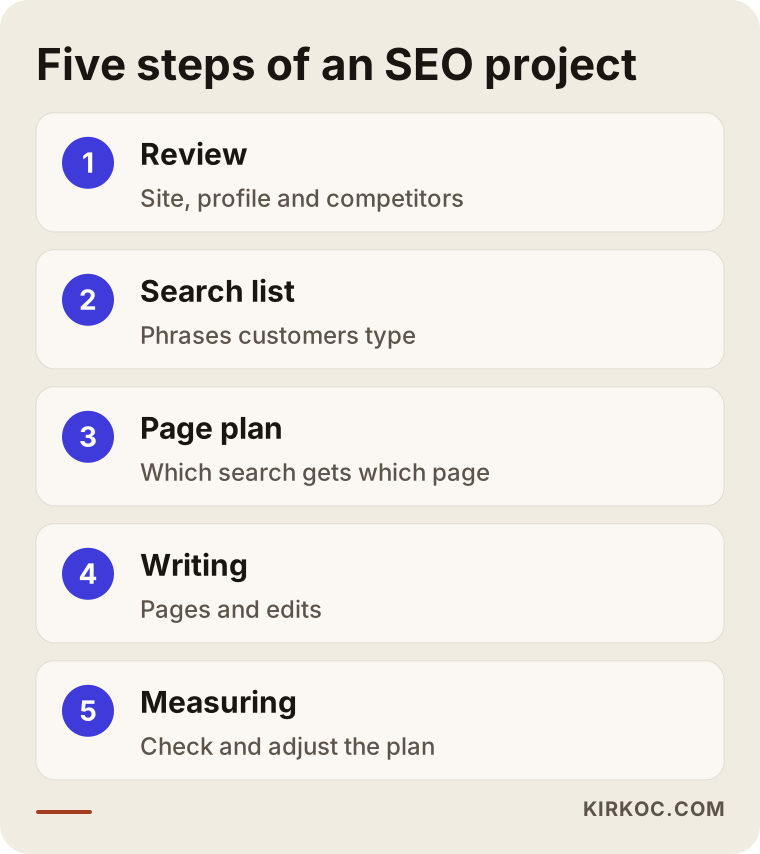
As the picture shows, this is a loop. What you learn from measuring feeds the plan for the next round. SEO that is done once and then forgotten rarely gives lasting results, because both your competitors and the search engines keep moving.
The technical base: boring but necessary
Let me keep the technical side as simple as possible. Your site should open quickly on a phone, because someone searching for an inspection is often outdoors on mobile data. Pages should be served over a secure connection (the padlock icon in the address bar). Phone and booking buttons should be easy to press on a small screen. Images should not be larger than they need to be. None of these on their own will put you in first place, but if one of them is broken, it reduces the effect of everything else you do.
Common mistakes
Here are the mistakes I see most often in this field, because most of them are easy to avoid.
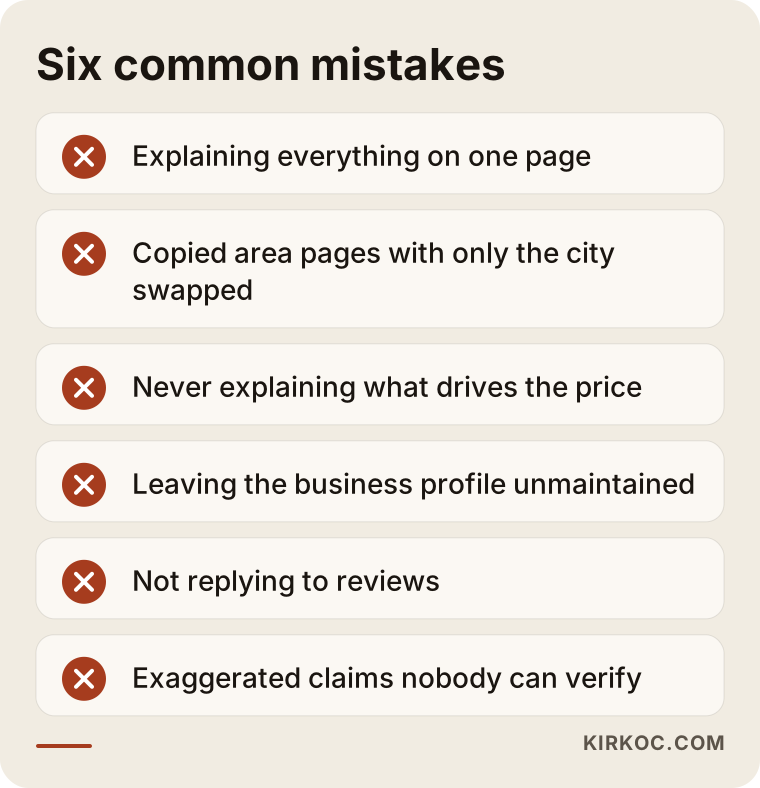
The first mistake is trying to explain everything on one page. The second is producing copy-paste area pages with only the town name changed. The third is hiding the topic of price altogether. You do not have to publish a number, but never explaining what changes the price sends the customer to a competitor. The fourth is setting up a business profile and never looking at it again after the first day. The fifth is never replying to reviews. A calm, specific reply to a negative review tells the next customer who reads it a great deal about you. The sixth is copying another site's text. Search engines notice, and customers get the feeling that everyone is saying the same thing.
There is also the trap of big claims. Phrases like "the best in the country" or "100 percent accurate reports" are neither believable nor provable. An inspection is a human job and can never be completely free of error. Honest language earns more trust than exaggerated language.
Why content that explains the report and process works
An inspection is a service that many customers are buying for the first time. Questions like "what does an inspector check," "what is the difference between a mechanical inspection and a history report," "what does repainted mean in a report," or "what is a pre-purchase inspection actually for" show the worry people feel before buying. Pages that answer these do two jobs: they reach people searching for information, and they give the customer the feeling that "this business knows what it is doing."
The key is to write the information so that it is really useful. A single paragraph of general sentences that everyone else has also written does not help. Content that describes concrete situations from your own workshop, explains why a certain finding matters, or says what a line in a report really means has value for both the customer and the search engine. Knowledge that comes from your own experience is something other sites cannot copy.
A quick note on vehicle history reports, since customers mix them up with inspections. A history report (services like Carfax or AutoCheck in the United States are examples) shows recorded events such as reported accidents, title status and ownership changes. An inspection shows the physical condition of the car today. They answer different questions, and a clear page that explains the difference will be read by many of your visitors. Keep the wording general and factual, and do not make legal claims about what any report guarantees. If the topic touches on legal rights when buying a car, suggest that readers talk to a lawyer.
AI answers and car inspections
Many people now get answers from AI assistants as well. Someone who asks "what is checked in a used car inspection" may see a chat answer instead of a list of links. I cannot guarantee which sources feed those answers, but I believe that clear, well-organized pages with an identifiable author are more likely to be used. That is why writing your pages in a short question-and-answer style helps both traditional search and this newer way of finding information.
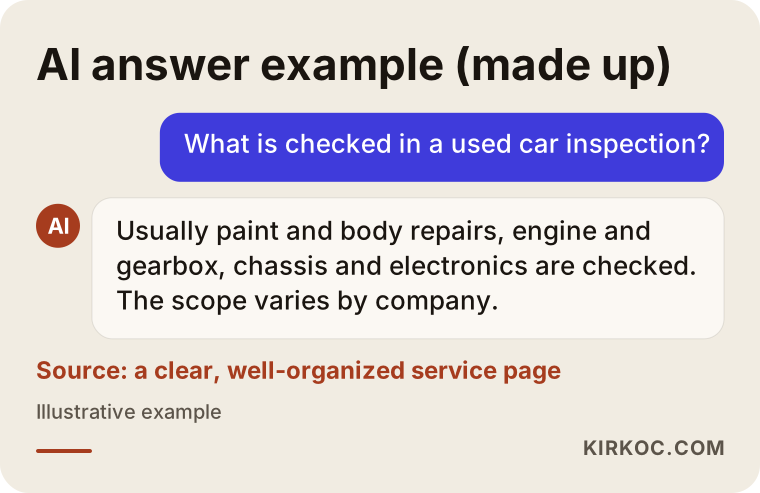
The answer in the picture is made up. It is not the output of a real assistant. The point is only this: answers like these are drawn from pages that give clear, short information, and a well-written page of yours has a chance of being used. There is no guarantee, but there is also no downside, because the same page also works in normal search.
What can you do yourself, and when do you need an expert?
You do not have to hand everything to a specialist. There is a lot you can do on your own, and doing it protects your budget and helps you understand your own business better.
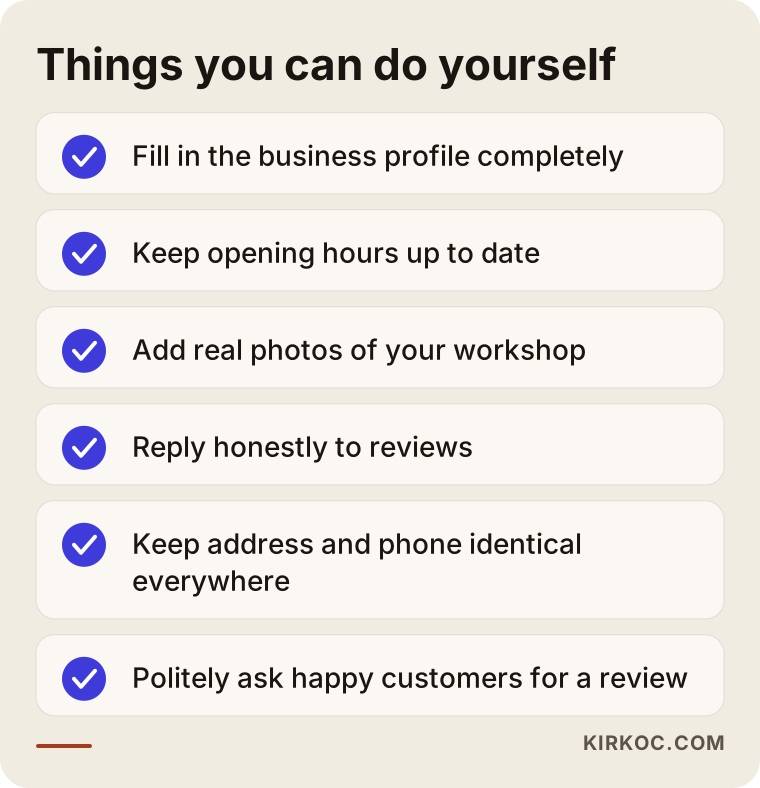
The tasks on the list are: complete the business profile, keep opening hours current, add real photos, reply to reviews, politely ask happy customers for a review, and make sure the address and phone number are identical everywhere. None of these needs technical knowledge. They only need a routine. When you ask customers for reviews, avoid pushy wording or offering something in return, and follow the review rules of each platform, which protects you.
Expert help makes sense in these cases: the site structure has to be built from scratch, you need a page plan for several areas, there is a technical problem (slowness, a broken mobile layout, the site not showing up in search at all), or you are unsure about something and do not want to waste time doing it wrong. The decision chart below shows this split roughly.
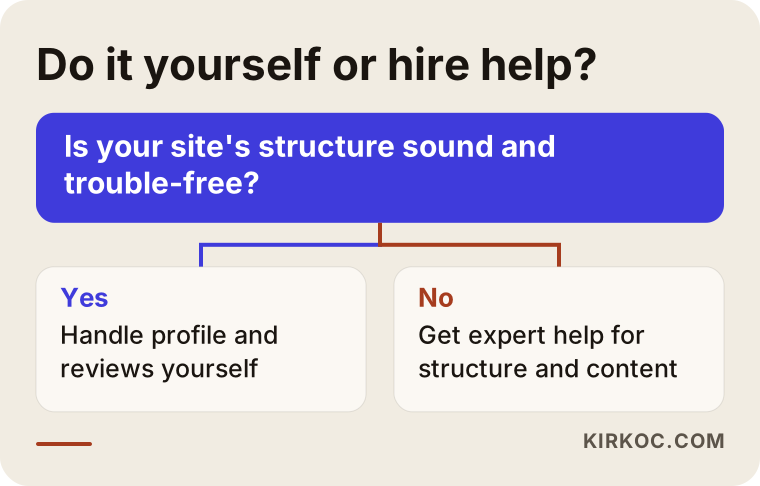
This chart is a guide, not a rule. Some businesses handle the profile and reviews themselves and only get help with site structure and content. That is often the most balanced path.
What determines the cost
I will not give a number, because a correct number can only be given after seeing the actual work. But I can explain clearly what changes it. The first factor is the current state of the site: are you starting from zero, or is an existing site being fixed? The second is how many areas and service types need pages. One town and ten towns are not the same job. The third is the intensity of competition: in a crowded city, the same result takes more effort. The fourth is who will write the content. If you pass your workshop knowledge to me, the process is faster. If no information comes in, the research time grows. The fifth is whether the work is a one-time project or ongoing monitoring and updates.
When you collect quotes, check a few things. Does the quote state what will be done? Does it promise a guaranteed result (if it does, be careful)? How will reporting work? When the contract ends, do the site and the content belong to you? Quotes that are vague and answer every question with "everything included" are usually unclear.
When do the results show up?
To be honest, SEO is measured in months, not in a week or two. The first improvements in maps and nearby searches may appear earlier. Broad, competitive city searches take longer. No expert can guarantee a particular position or timeline, so be careful with anyone who says they can.
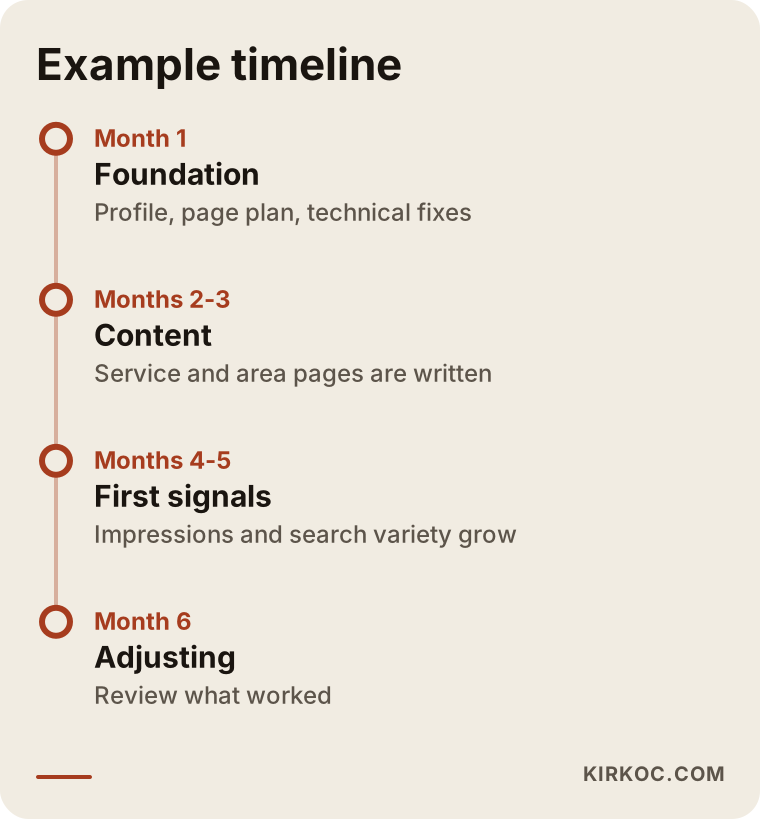
The timeline is an example flow, and it will not be the same in every project. The first period goes to the foundation: profile, page plan and technical fixes. Then the content is written. After that, the first signals appear: impressions grow and the variety of searches widens. Finally, you look at what worked and adjust the plan. Paid ads are also an option if you need quick results. Ads and SEO are not rivals but partners. Ads give visibility right away but stop the moment you stop paying, while SEO starts slowly but builds up.
How I work
I work alone, so the person you talk to, the person who builds the plan and the person who does the work are the same. First I listen to what you need, then I review your site and your business profile. After that I write down in plain language what will be done, why, in what order, and what to expect. I do not sell things you do not need. Sometimes it is more honest to say, "do these two things yourself, and get my help for the site structure." While we work, I report progress in a way you can follow, and you own everything I produce. I do not guarantee any result, but at every stage I tell you clearly what I am doing and why.
Frequently asked questions
Do I really need SEO for a car inspection business?
If your customers find you by word of mouth, you may not feel the need in the short term. But many people buying a used car search online first, and if you do not show up there, you leave that customer to a competitor. If you want to grow or depend less on referrals, SEO makes sense.
Which matters more, the Google Business Profile or the website?
They complement each other. The profile stands out in nearby and map searches, while the website is needed to explain what affects the price, how the process works and why people can trust you. Rather than choosing one over the other, it is healthier to keep both up to date.
Should I create a separate page for every town?
Only for areas you really serve and where you can say something specific to that place. Copying the same text and swapping the town name does not work. A few well-written area pages are worth more than twenty copies.
Do I have to publish my prices on the website?
No. But explaining what changes the price, such as the type of vehicle, the scope of the inspection, or whether it is done at your shop or at the car's location, builds trust and cuts down unnecessary phone calls. Whether to publish a number is up to you.
How long until SEO results show up?
It depends on the state of your site, the competition in your area and the work done, and it is usually measured in months, not weeks. Be careful with anyone who promises an exact date or position.
Do fake or purchased reviews work?
No. Platforms can detect them and penalize you, and customers notice as well. Politely asking real customers for a review and answering the reviews you get honestly is a much safer route.
Should I run ads or do SEO?
If you want to be visible right away, ads fit. If you want to build something long-term, SEO fits. For most businesses a balanced mix of the two makes sense. If your budget is tight, fixing your profile and your basic pages first is a good start.
If I already have a website, do I need to rebuild everything?
Most of the time, no. The existing site needs to be reviewed first. Sometimes adding a few pages, fixing others and clearing up technical problems is enough. Rebuilding is only on the table if the structure has serious problems.
If you want your car inspection business to be easier to find, get in touch through my SEO services page. We can look at where you stand today and talk through where to start, in plain language.