You run an OSGB, or a workplace health and safety consultancy, in Turkey. An OSGB is a "joint health and safety unit": the kind of authorized firm that supplies the safety specialist and workplace physician that Turkish rules generally expect employers to work with (check the current rules with a lawyer). Maybe you are also trying to win foreign-owned companies, such as factories, warehouses, offices and construction sites, that now operate in Turkey and do not know how the local system works. There are plenty of competitors, most clients choose through personal connections or by collecting price quotes, and you want a steadier way to reach new workplaces. That is why you typed "osgb seo" or "safety firm seo" into Google. In this article I explain, without technical language, how clients in this field search, which pages your website needs and where to start. I am Ümit Kırkoç, a web designer and SEO consultant who works alone from Istanbul, and where it matters I will say plainly what my own SEO services cover.
SEO, in short, is the work that makes your website show up on Google when your customers search. Unlike advertising, you do not disappear the moment you stop paying. Done properly, it builds a setup that brings inquiries for months. But in a field like yours, surrounded by regulation, built on trust and often run on annual contracts, the work looks different from SEO for a restaurant or a hair salon. Knowing the differences up front helps you set realistic expectations and a realistic budget.
Why are OSGBs searched for differently?
When a business owner looks for safety services, it is rarely a pleasant shopping trip. They are trying to meet an obligation. They may have just opened a workplace, they may be unhappy with their current contract, an inspection may be coming up, or headcount may have grown enough to need another specialist and physician. So the search usually begins with a problem: "I have to sort this out. Who does it, can I trust them, how long will it take?"
For that reason the searches do not look like ordinary product searches. People do not just type "osgb" and move on. They add a district and city, they add their industry, and sometimes they type their question word for word. A factory owner might type "Gebze osgb", while a cafe owner asks about "a safety specialist for a low-hazard workplace". A construction company might look for "construction site safety specialist service". You may sell the same service to all three, yet they search with different words, and each has a different question in mind.
One more point if you want foreign-owned clients. A manager who has just arrived from abroad often does not know the word OSGB at all. They may search for "occupational safety Turkey", "health and safety consultant Istanbul" or "workplace physician requirement Turkey". If your site only uses the Turkish abbreviation and never explains it in plain English, those people will not find you, and if they do, they will not understand what you are offering.
The image below shows, with a completely invented example, how a search result can look and why a clear page can stand above a generic one.
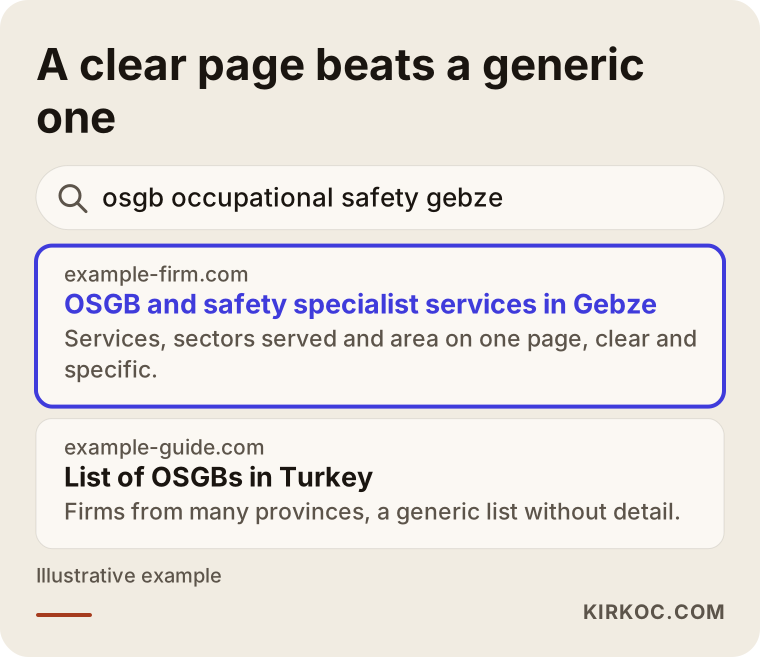
Look at what the highlighted result does: it states the area, the service and who it is for in the first line. A generic home page that says "we serve every sector" does not do that. Google tries to work out what answer to give the person searching, and when you make that easy for it, it can place you more comfortably.
Who are your customers and what do they type?
The first job is to separate who is looking for you. In this field there are at least three kinds of customers, and each has a different intention. If you stuff everything onto one home page without telling them apart, you will not speak properly to any of them.
The first kind is the person who has just opened a workplace or is meeting this obligation for the first time. They often ask things like "what does a safety specialist do", "is a workplace physician required" or "what does a low-hazard workplace mean". This person is not ready to buy yet, but if you explain things well they will remember you. The second kind is the business that is unhappy with its current provider and wants to switch. They use phrases such as "change OSGB", "OSGB contract" or "reliable OSGB", and they usually compare several firms. The third kind has one specific need: a risk assessment, an emergency plan, training for employees or a fire drill.
Each kind also wants a different page. The table below puts example searches, the intention behind them and the matching page side by side.
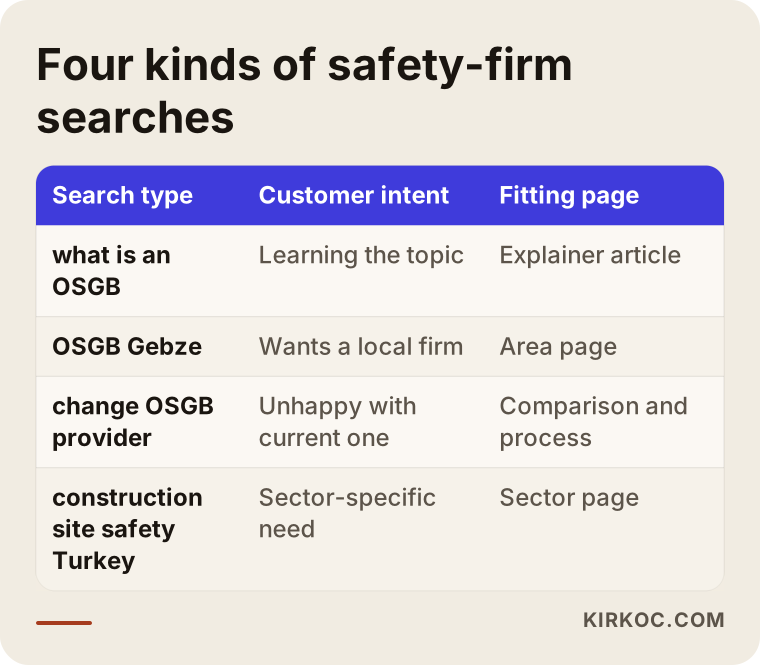
As the table shows, it makes far more sense to give someone who asks "what is an OSGB" an explanatory article than a quote form, and to give someone searching "OSGB Gebze" a page about that area. Giving each intention its own page is the foundation of SEO.
I should be careful about one thing. The rules on who must hire which specialist, how hazard classes work and which documents apply are set by Turkish legislation, and they change. I do not give legal advice, and your pages should not either unless the wording has been checked. Where a statement depends on the law, write it carefully and have a lawyer or your professional body review it.
The decision takes time: carrying the customer step by step
Nobody buys OSGB services overnight. The customer first notices the problem, then researches options, compares a few firms, asks for references and finally gets in touch. This can take days and sometimes weeks. Your site needs to answer at every stage of that journey, or the customer will make the decision on someone else's page.
Think of it as a funnel: at the top there is a wide group of curious people, and as you go down there are fewer people, but more decided ones. Your site's job is to meet the right person at each level.
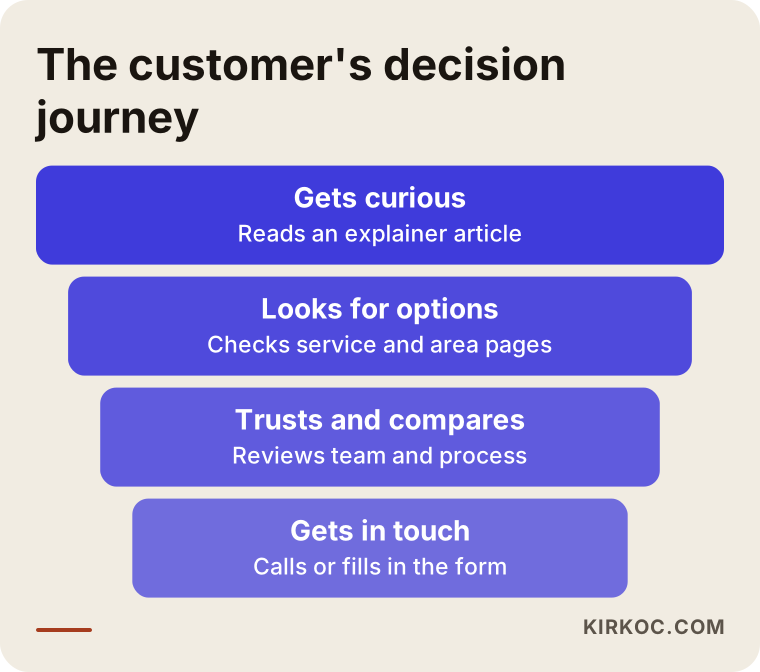
The widest part of the funnel is served by informational articles, the middle by service and area pages, and the bottom by pages that build trust and make contact easy. Most OSGB sites only build the bottom: an "about us" page and a "contact" page. Yet many searches come from higher up, from people who have not fully defined their problem yet.
Which pages should your site have?
Many OSGB sites are one long home page: a company introduction at the top, a list of services in the middle and contact details at the bottom. That structure tells Google what kind of firm you are, but not which searches you are the right answer for. Opening a separate page for each main topic works far better.
Here is a starting list. First, a page for each service: safety specialist work, workplace physician service, risk assessment, emergency planning, employee training and so on. Second, pages by hazard class or sector: offices, manufacturing, construction, warehousing and logistics, healthcare, food. When a customer sees their own sector, they think "these people know my business". Third, area pages, one for each district or city you serve. Finally, pages and articles that answer frequently asked questions. If you want foreign-owned clients, add English versions of the most important pages, written by someone who understands both the system and the language, not run through a translation tool.
The next image shows one way a service page could be laid out.
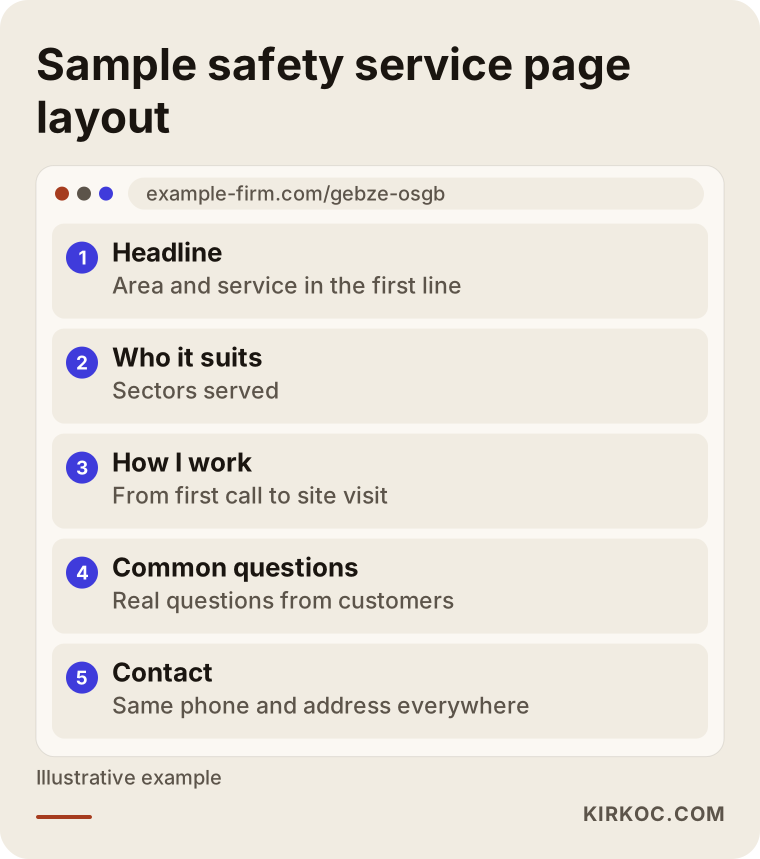
What matters is that every page is genuinely specific to its topic. Copying the same text and swapping the district name does not work; Google notices, and so does the customer. On an area page, write about places you really know, such as an organized industrial zone, an industrial estate or a business center, plus how your visits are arranged and the questions workplaces nearby tend to ask.
Trust is everything in this field
For a cafe, a nice photo may be enough. For an OSGB, trust is the product. The business owner is placing the health and safety of their employees, and their own legal responsibility, in your hands. So your site must quickly give the feeling that "this firm is real, authorized and reachable".
Think about what you should show clearly: your authorization status, who is on your team, which areas and sectors you work in, how the service runs and who to contact. How exactly you can describe your authorization certificate and similar official matters depends on the regulations; for anything you are unsure about, consult a lawyer or your professional body's guidance. In this field, leaving out something you are not certain about is safer than writing it.
The comparison below shows the difference between a site that builds no trust and one that does.
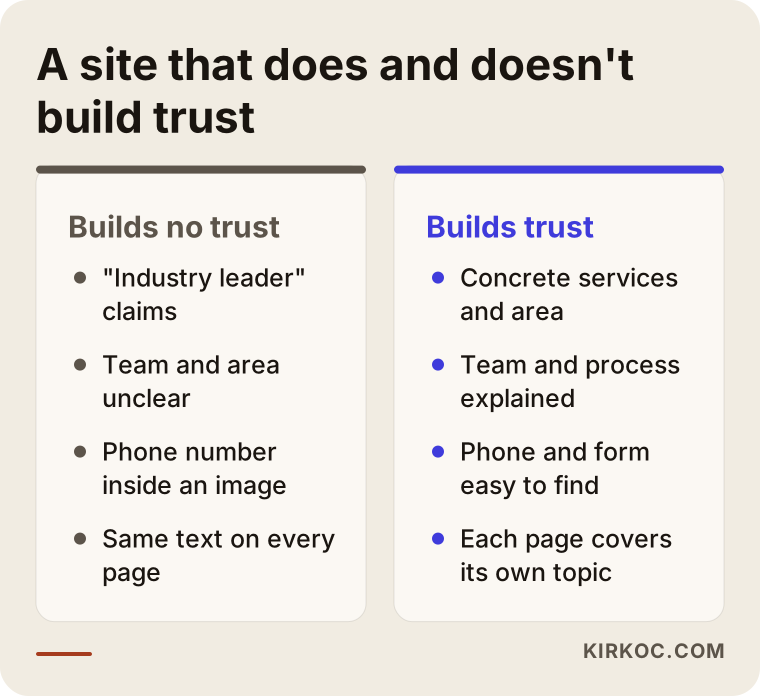
The general rule is to write explanations, not claims. Writing "I work with these kinds of workplaces in this area, in this way" is more believable than "industry leader", and it is also concrete information that search engines can understand. Short introductions of the specialists and physicians who work with you also show the human side of the business; include them only with the people's consent and with accurate details.
Example scenario 1: a small OSGB nobody knows in its area
This section is entirely hypothetical; it does not describe a real firm. Imagine a small safety firm working around Kocaeli. The owner finds most customers through acquaintances. The site is a one-page introduction and does not appear anywhere in search. In the periods when no new customers arrive, there is a serious gap.
The first thing I would do for this firm is clarify who it serves. Small manufacturing workshops, warehouses, offices? For each sector that becomes clear, a separate service page is opened. Then a few pages are written for the districts it serves, with information that really belongs to those districts. A short article such as "a brief guide for people appointing a safety specialist for the first time" would be added too, because people who have just opened a workplace ask this question a lot.
Expectations should be realistic: there is no guarantee of a first-page result within a few weeks. But within a few months, the chance of appearing for narrow, specific searches goes up. What matters is that every single page serves the same goal, the message of "reliable service for this kind of workplace in this area".
Example scenario 2: many sectors, but always saying the same thing
The second hypothetical example is a more established firm. Its site looks good and has many pages, but all of them start with the same sentences: "quality, reliable and affordable service". The search engine cannot tell the pages apart, and the customer cannot find what they wanted, so they pick up the phone or move to another site.
The job here is less about adding new pages than about separating the existing ones. Every page should have one question. The construction page covers the risks specific to building sites and the common questions; the office page speaks in a different voice and answers different questions. Titles, descriptions and first paragraphs say what the page is really about. The pages also link to each other sensibly: for example, from an article explaining hazard classes to the related service page.
This kind of cleanup often gives faster results than writing new content, because the site already has a history and accumulated value. Even so, I cannot guarantee any result; search results depend on what competitors do and how Google evaluates the pages.
Step by step: where do you start?
Do not treat SEO as a list of random tasks; there is an order. The image below sums up the basic steps I would follow in this field.
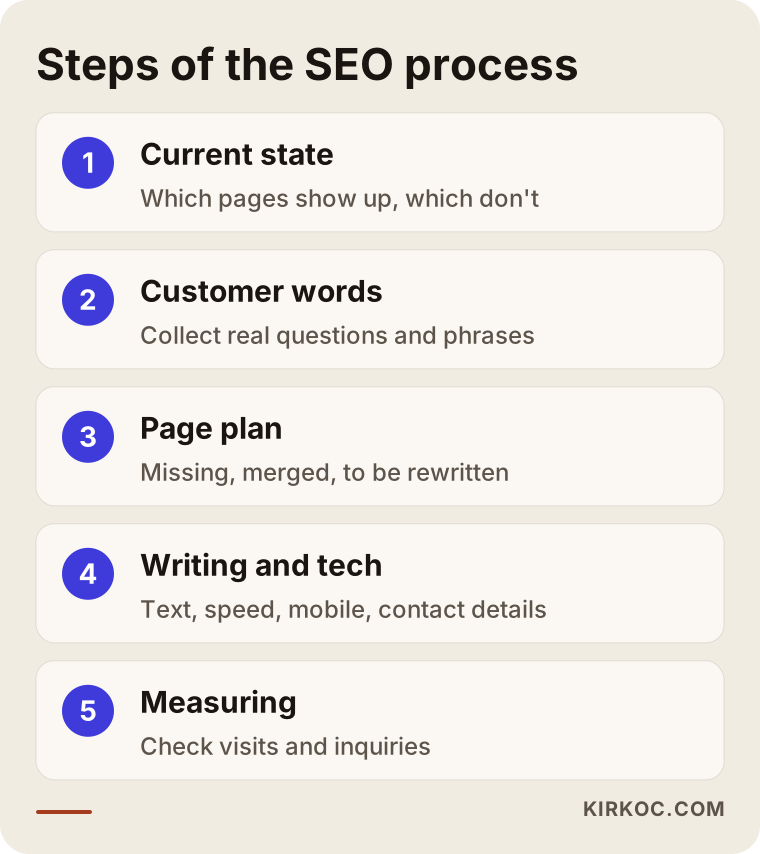
First I look at where things stand: what is on your site, which pages appear in searches and which never do. Then I work out which words your customers use. Your own customer conversations, incoming questions and emails are very valuable here, because real sentences are more reliable than any tool. In the third step a page plan is made: which page is missing, which ones should be merged, which should be rewritten. The fourth step is writing and editing. In the fifth I look at the technical side: whether the site opens quickly, whether it looks right on a phone, and whether the address and phone number are identical everywhere. Last comes measuring and correcting: which pages attract visitors and who fills in the contact form.
An important part of this process is patience. The first weeks go into preparing the base, and visible change generally starts afterward. Work abandoned out of impatience is the most expensive work, because effort is spent and no result is collected.
Common mistakes on OSGB sites
Most of the mistakes I come across in this field are not from ignorance but from the habit of "everyone does it this way". I have collected the most common ones below.
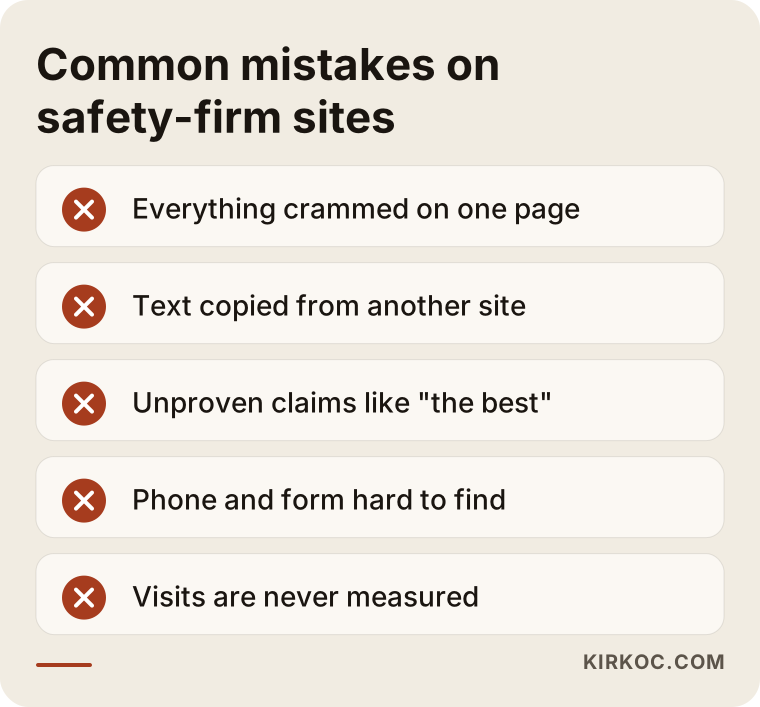
Let me unpack the first: putting everything on one page. If a customer is searching for a "safety specialist" and you show them a paragraph lost inside a list of "workplace physician, training, risk analysis, emergency plan", they may not find what they came for. The second big mistake is copied text. Text taken from another firm's page, or generated by AI without any editing, is worthless in the eyes of both the search engine and the customer. Third are unproven claims: phrases such as "the best", "the cheapest" or "guaranteed" damage trust and may also break advertising rules; if you are not sure, ask a lawyer.
The fourth mistake is making it hard to reach you. A phone number placed inside an image, a form that does not work on mobile, or an address written differently on each page all lose customers. Finally, not measuring is also a mistake: someone who does not know how many people visit and how many of them get in touch cannot know which effort works.
What can you do yourself, and when do you need an expert?
You do not have to hand everything to a specialist. Some tasks you can do yourself with no technical knowledge. The list below summarizes a few of them.
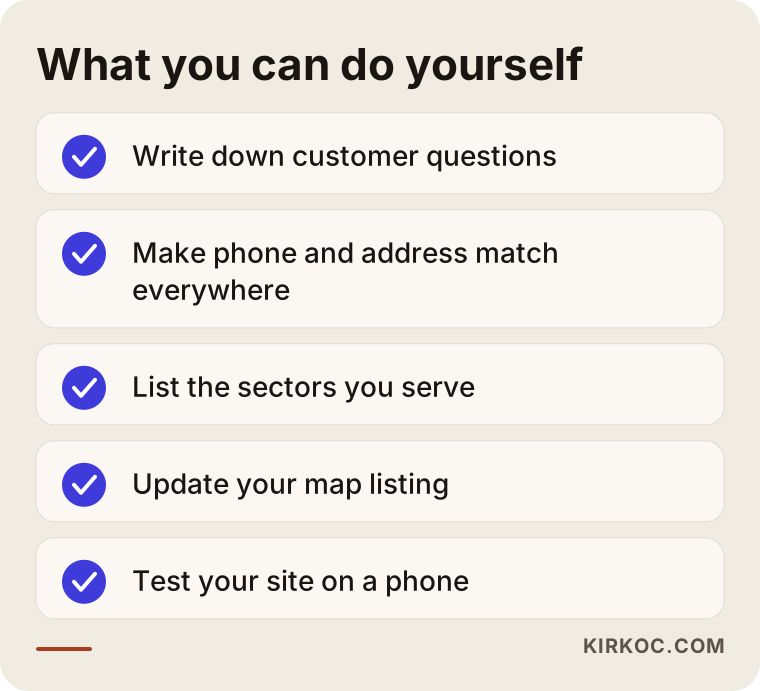
Writing down customer questions is, above all, your biggest advantage. You know the real questions of your field, and nobody outside can know them better than you. What did a customer ask on the phone, what were they unsure about, which document did they ask about? Note these down. These notes are the foundation of page and article ideas.
So when is an expert needed? If your site does not show up in searches at all and you cannot work out why, if the site structure is tangled, if you need a page plan for several districts or services, or if an old site is being rebuilt and you risk losing your rankings, an expert's eye saves time. A simple decision tree is below.
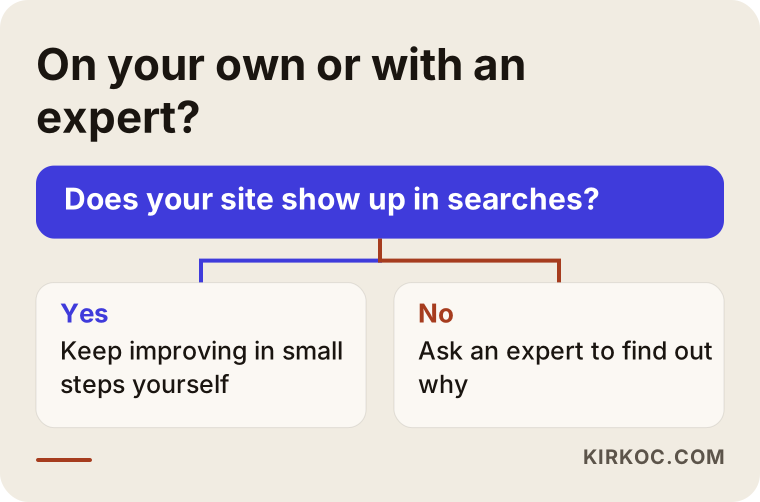
This chart is not a strict rule, just a guide. Even with a limited budget you can start small: getting a single page right for the one service that brings in the most work is more effective than trying to fix the whole site at once.
What determines the cost of SEO?
I do not give figures in this article, because SEO pricing varies a great deal with your site and your goal. But I can tell you what it depends on. The first factor is the current state of the site: are you starting from zero, or is there something to build on? The second is how many services and how many areas you are targeting; each one means a separate page and separate effort. The third is how intense the competition is: in busy industrial regions, competition is high too.
The fourth factor is who writes the content. If you pass on the sector knowledge and I edit, the process is different from one where I have to write everything from scratch. The fifth is whether the work is a one-off or ongoing. When you collect quotes, ask for clear answers to these five questions. Stay away from quotes that do not state in writing what is included, what is not and how the result will be measured.
AI searches and OSGBs
Many people now put their question directly to AI tools such as ChatGPT: "How do I choose a safety specialist for a small manufacturing workshop in Turkey?" These tools build their answers on clear, consistent and reliable information found online. If your site holds clear, accurate and well-organized information about your field, your chances of being named in those answers go up. I cannot promise it, but preparing the ground is possible.
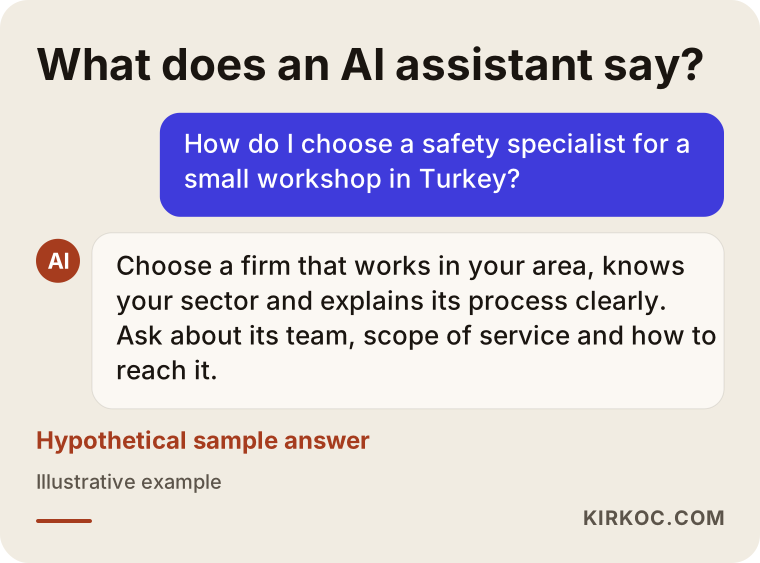
The answer in the image is a hypothetical example. What to notice is what kind of information it rests on: short definitions, clear criteria, open questions. If your pages are written this way, they are easy for both customers and these tools to understand. This work is called GEO, meaning work aimed at earning a place in AI answers. At its core it is not very different from good SEO: clarity, accuracy and consistency.
How I work with you
I work alone, so the person you talk to is the person doing the work. First I listen to you in a short call: your business, your area and your types of customers. Then I look at the site and write, in plain language, what needs to be done, what is a priority, what can wait and what is not needed at all. I do not add unnecessary work. Once the work starts, I explain what I am doing and why, and I share results regularly in a form you can follow. I do not promise rankings, because nobody can. What I can promise is that the work is honest, planned and transparent.
Frequently asked questions
Is SEO really necessary for an OSGB when clients come through personal connections anyway?
Clients who come through acquaintances are valuable, but there are only so many of them. Because contracts are annual, you also lose clients, and new workplaces open all the time. Being visible in search lets those new workplaces find you. It is not mandatory, of course, but if you want a steady flow of new clients it is a strong option.
How long until I see results?
It would not be honest to give a fixed time, because it depends on the site, the competition and the work done. In general, visibility comes earlier for narrow, specific searches and later for broad ones. Be suspicious of anyone who guarantees rankings. I discuss up front what will be measured in the first stage.
Which keywords should I use on my site?
Start with the words your own customers use: combinations of area name, sector and service usually work best. Phrases like "district name + safety specialist" or "sector + risk assessment" are examples. Target each phrase with one page, and write naturally; repeating the words over and over does harm.
Can I copy the same text for different districts?
No. Pages where only the district name has been changed are worthless to search engines and do not build trust with customers. Each area page should contain information that truly belongs to that area: the kinds of workplaces you serve, how your visits are arranged, common questions and so on.
Should I show my authorization and my team on the site?
It generally helps with trust, but how and how far to share depends on the regulations and on the consent of the people involved. For certain guidance on which statements may be used, consult a lawyer or your professional body. Make sure everything you share is current and accurate.
Is it necessary to write blog articles?
It is not a must, but it helps a lot. Articles that answer questions such as "is a workplace physician required" bring in people who have not decided yet. Even if they are not customers today, they may become customers later. The articles need to be accurate, up to date and based on your real experience; text copied from someone else does harm.
Is a Google Maps listing important too?
Yes, if you have a physical office. Map results often appear in local searches. Your address, phone number and opening hours must be the same in the map listing and on your site. Reviews build trust too, but do not try to inflate them artificially.
I have an old site. Will I lose my rankings if I rebuild it?
A careless rebuild can cost you rankings. Old addresses need to be redirected to the new ones, valuable pages need to be kept, and everything has to be checked after the change. Talking with an expert before the rebuild reduces that risk considerably.
If you would like to find out whether your OSGB or safety firm's site welcomes customers the right way, you can reach me through my SEO services page; I will listen to your business and put together a suitable, no-hype roadmap.