You have a lot full of good cars, but the phone is not ringing the way it should. Most buyers seem to come from the big listing sites, and your own website either gets no visitors or gets people who look around and leave. If that sounds familiar, it makes sense that you searched for "car dealer SEO." In this article I explain what a car dealership or used car lot can realistically expect from SEO, which pages actually help, and where to start. I am Ümit Kırkoç, a web designer and SEO consultant who works alone from Istanbul, and I work with clients remotely. Where it fits, I will also say plainly what my own SEO services cover and what they do not.
SEO, in short, is the work that makes your website show up when potential customers search on Google. You do not pay for each click the way you do with ads. When it is set up well, it keeps bringing in visitors for months. But selling cars is different from most businesses in a few ways that matter for SEO. Your inventory changes every week. Every car exists only once. And your competitor is not only the dealer down the road, but giant platforms with millions of listings. That is why "let's just add some text to the site" rarely works. Let's start with the real problems of this industry.
How do people search Google when they want a car?
Someone who wants to buy a car does not search in just one way. There are at least four different intentions, and each one is answered by a different kind of page.
The first is the person looking for a specific vehicle. They type something like "2019 diesel automatic sedan" or a particular make and model. This person has almost decided and just wants the right listing. The second is the person looking for a trustworthy dealer nearby. They type "used car dealer Brooklyn" or "used cars near me." Here trust and distance matter more than the car itself. The third is the person who wants to sell or trade in a car, with searches like "sell my car" or "car trade-in." The fourth is still researching: "what to check when buying a used car" or "how to read a vehicle history report." This person is not buying today, but if they find a trustworthy article, they may come back to the same place months later.
Most dealer websites answer only one of these four intentions, usually the first, which means a list of cars. And that list is often a weak copy of what the listing sites already show. Meanwhile, the rest of the search map is nearly empty, and there is far less competition there.
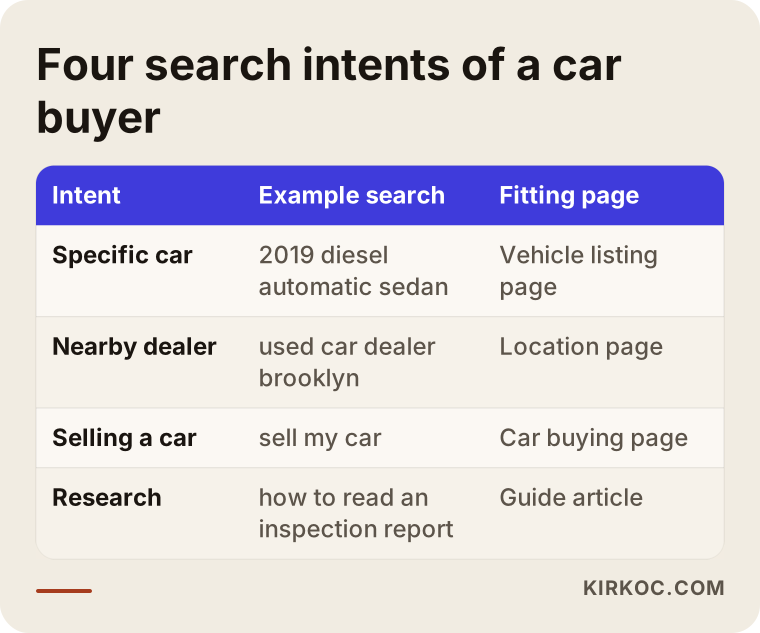
The table above summarizes the four intentions and which page answers each. Looking at your own site and noticing which rows have no page at all is the first and cheapest step of the whole project.
Does it make sense to compete with the big listing sites?
An honest answer: for very specific searches, such as "make model year," beating the large listing platforms is not a realistic goal for most dealers. Those sites are old, very strong and fed with fresh listings every day. Spending your resources on that fight usually goes to waste.
That does not mean SEO is not for you. The difference between a platform and you is this: a platform is everyone's seller, while you are a particular person's dealership in a particular place. On a platform, your listing gets lost among hundreds of similar ones, and the buyer sees the car, not you. On your own site, the buyer gets to know you, sees your history, calls you, and remembers you the next time they need a car. And if you pay a listing fee or a commission to platforms, every customer who comes through your own site reduces part of that cost.
So the sensible strategy works in two parts. Keep posting your cars on the listing sites, because the buyers there are real. Then use your own site for the questions the platforms do not answer: trust, location, expertise and what happens after the sale.
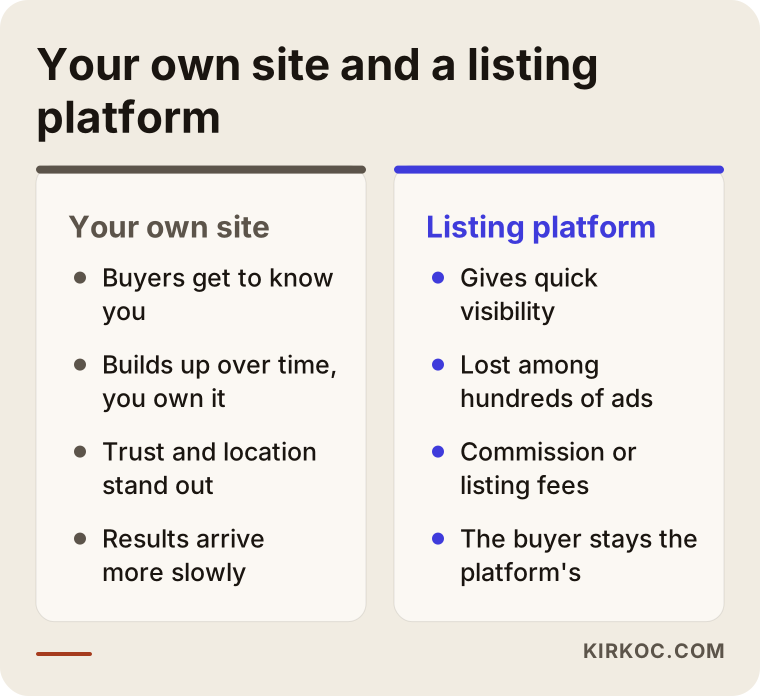
The comparison shows this division of labor. A platform gives you fast visibility, while your own site builds up over time and stays yours. I suggest you think of the two as partners, not rivals.
Showing up on the map is the first step for most dealers
When someone searches "used car dealer near me" or "used cars [your town]," Google usually shows a map with three businesses at the very top. That area, your Google Business Profile, is often more important than your website for a dealership, because people have to physically go somewhere to look at a car.
The things to watch in this profile are simple, but they are often left incomplete. Your dealership's name, address and phone number should be correct and identical everywhere. Your opening hours should be current, especially around holidays. The business category should be chosen correctly. Photos should be real: the front of the lot, the inside, your staff and the cars on display. Reviews matter a great deal, and replying calmly to every review, including the negative ones, builds trust.
A warning here: buying reviews or having people write fake ones is not only unethical, it also goes against Google's rules. You could face a suspended profile. Politely asking real customers for a review after the sale is enough, and it is the approach that lasts.
Your visibility on the map depends on two things: how complete your profile is, and how close the searcher is to you. You cannot change distance, but you can change completeness.
The vehicle page: a separate, permanent address for every car
One of the biggest technical problems on many dealer sites is this: when a car is sold, its page is deleted. But Google has already found that page and stored it, and perhaps a few people have shared the link. When the page disappears, the visitor lands on a "page not found" error, which is a bad experience for both the visitor and the search engine.
A better approach looks like this. Give every car its own page with a readable address, for example one that includes the make, model and year. When the car sells, do not delete the page. Write "This vehicle has been sold" at the top and show similar cars below. That way the visitor does not leave empty-handed, and moves on to another car. If you truly have to remove the page, set up a permanent redirect, which is an instruction that automatically sends visitors to a page with similar cars. This is a technical job and can cause problems if done wrong, so it makes sense to have a specialist do it.
What belongs on a vehicle page is also fairly clear. Make, model, year, mileage, fuel type, transmission, color, accident and paint history, any inspection information, and either a clear price or a "call for price" note. The photos should be individual, from different angles, and real. A phone button and a text or chat button should be visible at all times.
The subtle point here is the text. Many dealers use the same canned sentence on every car. When Google sees the same text repeated on hundreds of pages, it cannot tell the pages apart. For each car, even if it is short, write two or three sentences just about that car: its history, where it came from, what kind of driver it suits.
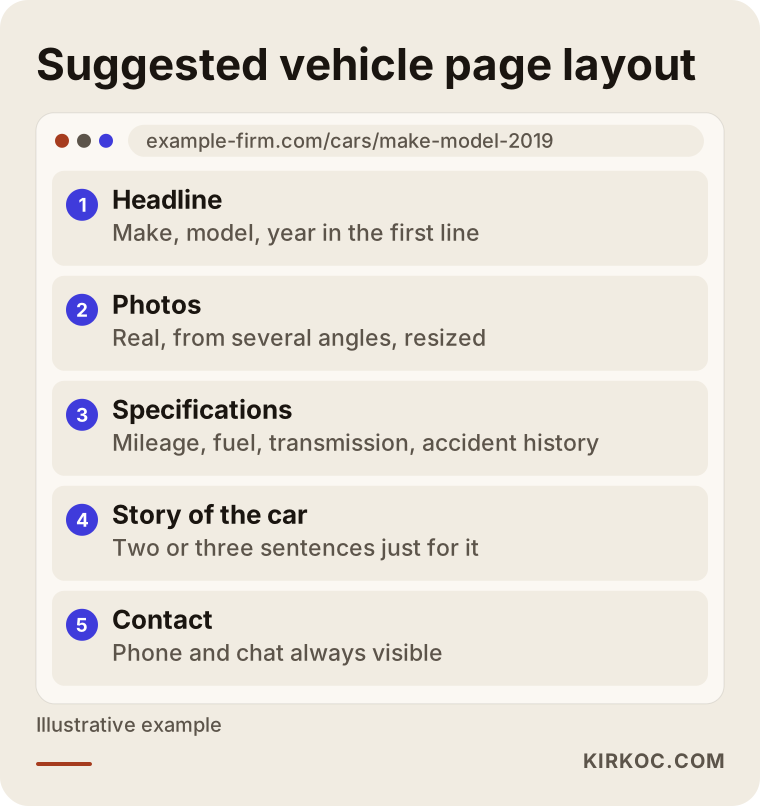
The image shows which sections a well-built vehicle page can have. Each section serves both the buyer's question and the search engine's understanding of the page.
Photos and speed: the quiet problem of car sites
Selling cars is a visual business, and car sites fill up with hundreds of large photos. If those photos are not made smaller, the page opens very slowly. On mobile, which is the device most of your customers use, if the page does not open within a few seconds, the person goes back and looks at another listing.
What to do is simple. Resize photos to a reasonable size before uploading them, use a modern image format, and make sure only the first visible photos load when the page opens. Give every photo a short description, called alt text, that says what is in it, such as "white sedan, front view." This helps visitors who cannot see the image and also helps Google image search.
There is a speed test you can do yourself. Open your site on your phone using mobile data. How many seconds does the home page take, and how many does a vehicle page take? Do the photos show up completely? If the result bothers you, show it to a specialist.
Two example scenarios
The two scenarios below are hypothetical. They do not describe a real business; I made them up only to make the situation concrete.
Scenario 1: A small neighborhood lot with a website nobody finds
Suppose a small lot in a suburb holds seven or eight cars. The owner had a site built years ago, with a home page, a "our inventory" page and a contact page. Cars are added as photos only, with no description, and sold cars are not deleted, just taken off the page. A map profile exists, but the hours are old, there are no photos, and a few reviews have gone unanswered.
In this case, my first job would not be to add anything new to the site. I would fix the map profile first, because the fastest difference happens there. Then I would set up a separate page for each car and the sold-car layout. After that, I would write a clear "about and location" page, aimed at searches like "used cars [town name]," explaining who the dealership is, where it is and how it works. Three or four months later, the expected result is better visibility in searches for your area and on the map, but there is no guarantee, and it depends on what your competitors are doing.
Scenario 2: A large inventory where everything comes from the platforms
The second hypothetical is a mid-sized dealership with forty or fifty cars. Almost all of its sales come from listing platforms. Its site looks nice, but the vehicle list is just a page that copies the platform ads. The owner complains about platform costs but does not believe the site can help.
Here I would change the strategy. I would not try to compete with the platform on individual car listings. Instead, I would prepare category pages such as "used SUVs for sale by make and model," and articles that answer questions buyers really ask, such as "what to check when buying a used car," "how to read a vehicle history report" and "how does a trade-in work." The goal is to be found at the stage when the person has not yet decided which car to buy. A buyer who already knows you comes straight to you instead of the platform. This takes longer to pay off, but once it is in place, it can reduce your platform costs.
What both scenarios share is that the work starts with the question "what is missing," not "what should I add."
Step by step: where do you start?
For a car dealership, I usually run the SEO work in this order.
First, see where things stand today. The current state of your site and map profile, which searches you appear in and which you do not, and what competitors do well. Anything done without this step is a guess.
Then map the search intentions. Decide which page answers each of the four intentions above. Which pages exist, which do not, and which exist but are weak.
Next, fix the technical base. Page speed, mobile display, sold-car pages, duplicate pages, and whether Google can crawl the site properly. These are invisible, but they form the foundation.
Then build the content. A vehicle page template, category pages, a location page, frequently asked questions and a few good articles.
Finally, measure and adjust. Which pages get visitors, which pages lead to phone calls, and where people get stuck. Then correct course based on the results.
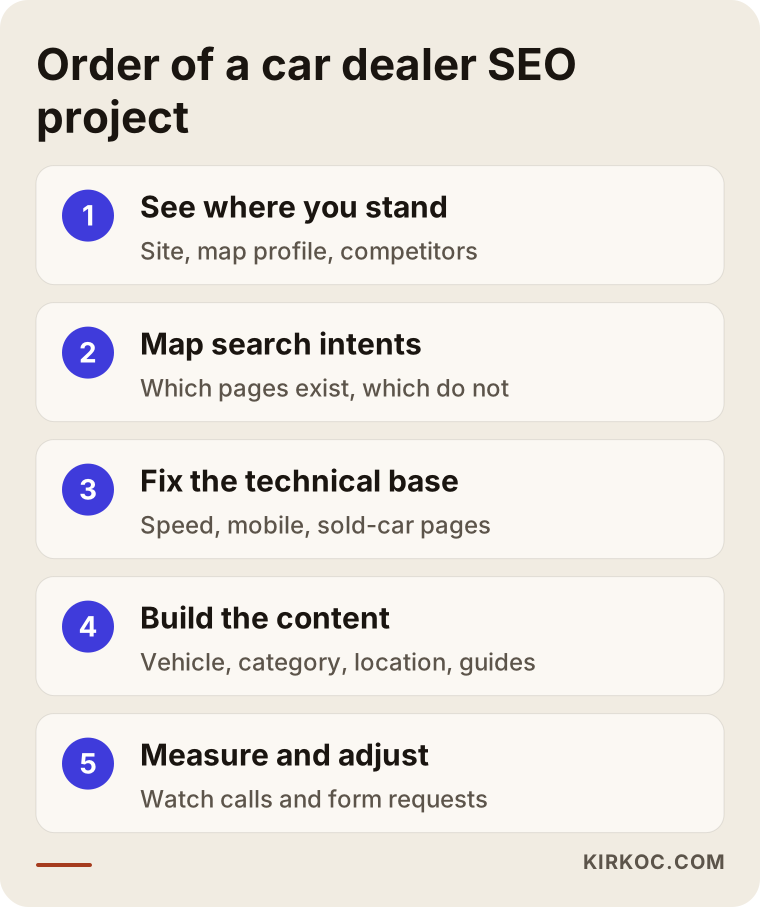
The order in the image shows the logic of the work. Mixing up the order, for example writing articles before fixing the foundation, can make the effort go to waste.
How long until you see results?
I cannot give you a firm number, because the result depends on your site's current state, your town, the strength of your competitors and the scope of the work. What I can say in general is that fixes to the map profile often have an effect sooner. New pages and articles take weeks, sometimes months, to be noticed by Google and to start ranking. For a site starting from zero, the wait is longer.
There is one more thing specific to the car business: inventory changes very fast. Because of that, the long-term gain from individual vehicle pages is limited. The real buildup comes from category pages, location pages, guide articles and the map profile. Those pages stay in place even when the inventory changes.
Nobody can tell you "you will be in first place by this date." Be careful with anyone who makes that promise.
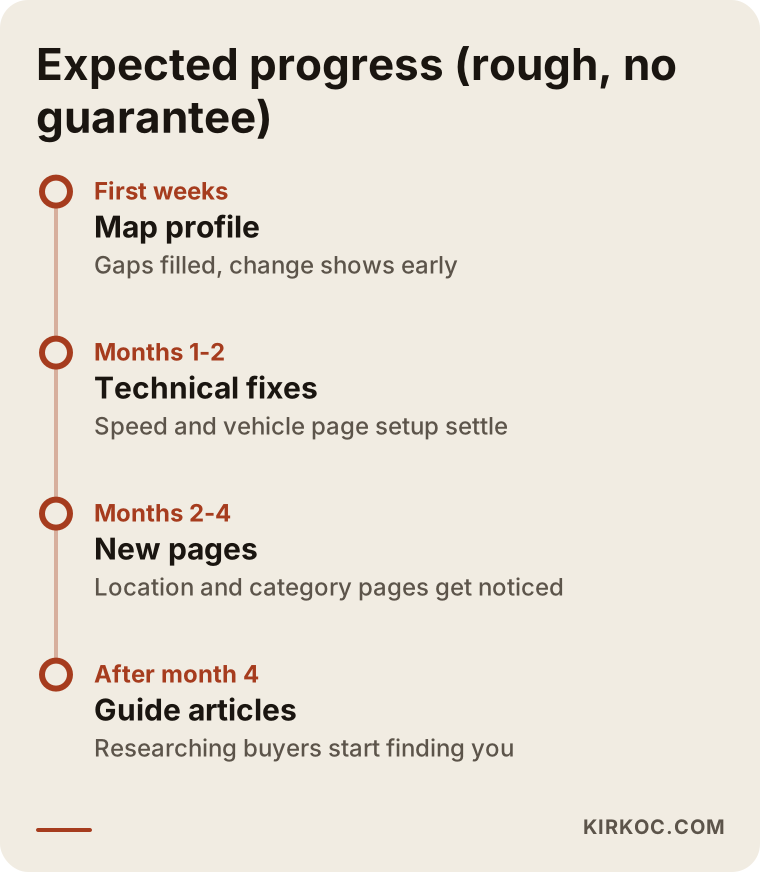
The timeline shows a rough flow. It will not move at the same speed for every business, but it helps you understand when each piece of work starts to have an effect.
AI assistants and car shopping
People no longer ask only search engines when shopping for a car. They also ask AI tools such as ChatGPT: "Which used car makes sense as a first car?" or "What should I look for in a vehicle history report?" When these tools answer, they draw on clear, well-organized and trustworthy sources on the internet.
That is why writing your guide articles with short, clear answers helps with both Google and AI tools. Asking the question in a heading and giving the direct answer right below it makes the article easy to understand. If your dealership's name, location and what you do are written plainly on your site, it is easier for AI tools to describe you correctly. There is no guarantee here either: you cannot control which business these tools mention and when. But a clear, accurate and well-kept site improves your chances.
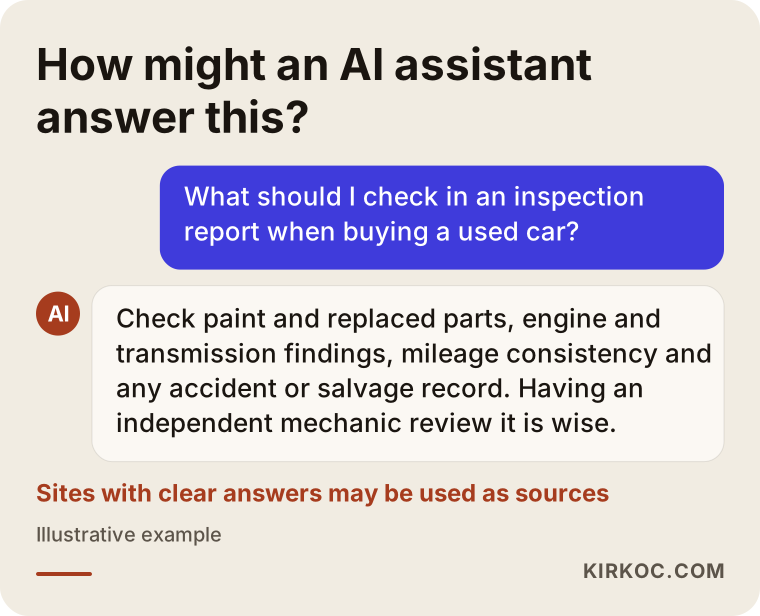
The example in the image shows how a question might be answered. When your own site gives clear answers like this, it builds visitor trust and also raises the chance that you are seen as a source.
Common mistakes
Here are the mistakes I see most often in this industry.
Deleting the page of a sold car. I explained this above. It loses both your effort and your visibility.
Writing the same text for every car. Canned sentences make all your pages look like copies of each other.
Copying the platform listing word for word. If the same text is on the platform and on your site, your site has no separate value.
Neglecting the map profile. Small-looking problems such as old hours, a missing phone number or unanswered reviews cost you real customers.
Hiding the price and the condition. Hiding accident, paint and mileage information may bring in a few calls in the short term, but it damages trust. People who buy a car will have it inspected anyway, so being open from the start works in your favor.
Uploading photos without resizing them. It slows the page and loses mobile visitors.
Burying the phone number in an image. The number should be text and tappable. Otherwise a mobile visitor cannot call with one tap.
Fake or purchased reviews. They are unethical and risky for your profile.
Believing services that promise fast results. Nobody can guarantee first place.
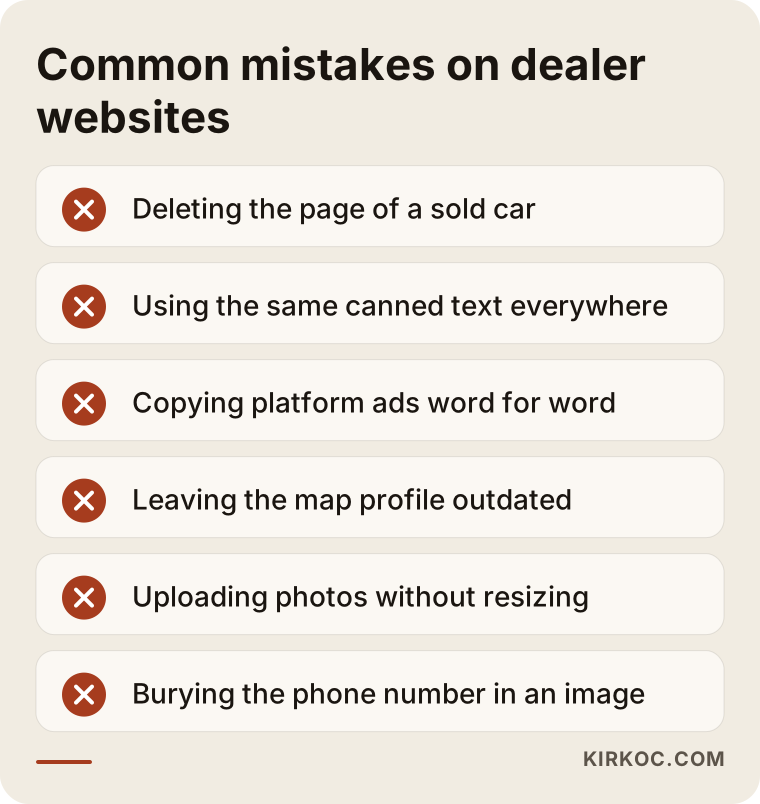
The items in the image are warnings you can check while reviewing a dealership site quickly. If even a few of them apply to your site, fixing them is more efficient than adding something new.
What can you do yourself?
Some of SEO does not need a specialist. You can do the following yourself.
Review your map profile: address, phone, hours and photos. Reply to every review. Politely ask happy customers for a review. Write two or three sentences specific to each car and resize the photos. Mark sold cars as "sold" instead of deleting them. Open your site on your phone and try to find a car and call, as a customer would; write down where you struggled.
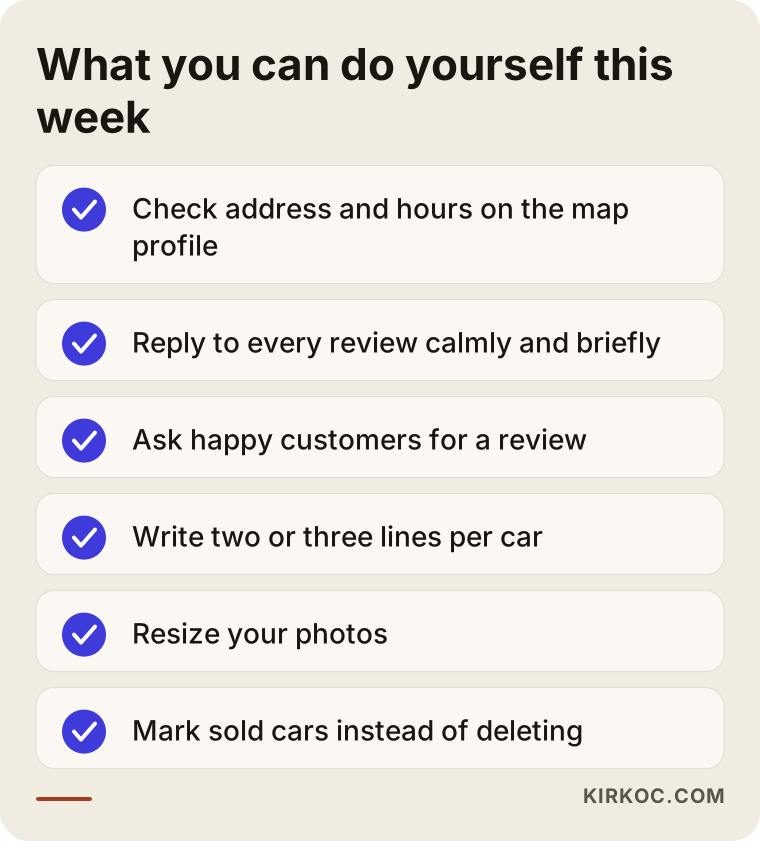
This list gathers the tasks you can start without expert support. You can do each item within a week, and most of them cost nothing.
When do you need a specialist?
Some jobs require technical knowledge and cause harm when done wrong. Building your site from scratch or changing platforms, setting up redirects, fixing page speed problems at the root, building the template for hundreds of vehicle pages, and measuring results correctly are at the top of that list. And if you cannot give SEO regular time while running your business, handing it to someone makes sense.
When deciding, ask yourself this: Is the job going to waste my time, or will it do damage if done wrong? If either answer is yes, expert help is worth it.
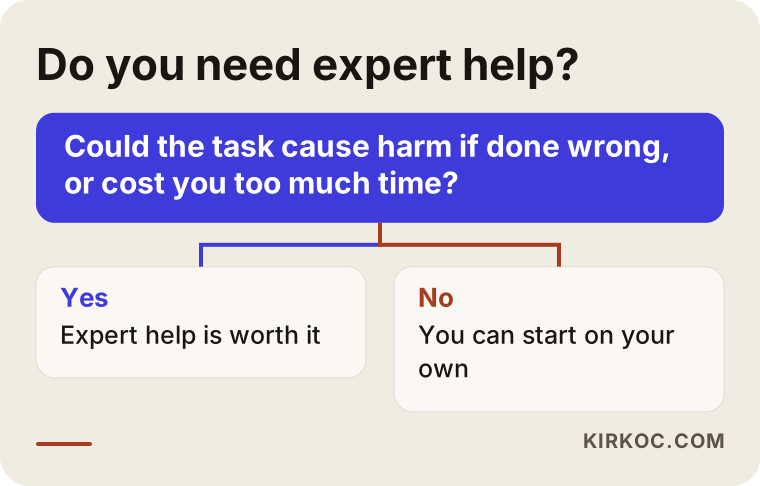
The decision image ties this question to one of two paths. If your situation is simple enough to handle on your own, I have no problem saying so; not every dealership needs a specialist.
What determines the cost of SEO?
I will not give a number here, because the scope of the work varies greatly from one business to another. But I can tell you what determines the price.
First, the current state of your site. A site that has to be built from scratch is not the same job as one that needs small fixes. Second, the number of cars and the complexity of the page template. If your inventory system is ready-made software from a vendor, making changes may be more limited. Third, competition: in a big city, or in an area with many dealerships, the work is heavier. Fourth, scope: is it only technical fixes, does it include content production, does it include managing the map profile? Fifth, duration: a one-time setup, or ongoing monthly work?
When you receive a quote, ask in writing what is included and what is not. Vague phrases like "everything included" tend to bring surprises later.
How I work
I run a one-person practice. That means the person you talk to is the person who does the work. First I listen to your business and your goal, then I review the current situation and tell you what is really needed. I do not sell work that is not needed; sometimes I have to say "do these three things yourself, you don't need me," and that is normal.
Once the work starts, I explain what I am doing in plain language. When I have to use a technical term, I explain it. I share results through measures you can understand, meaning things that turn into real business such as phone calls and form requests. I do not promise rankings, because I cannot; I write down clearly what I will do and what to expect.
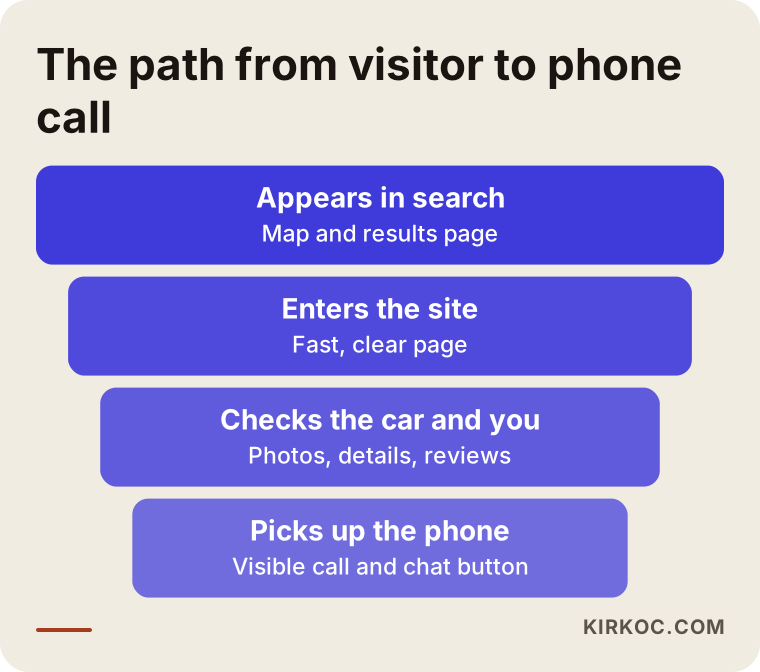
The funnel summarizes the path from the moment a visitor reaches your site to the moment they pick up the phone. The goal of the work is to reduce the losses at every step of that path.
Frequently Asked Questions
Do I really need SEO for my dealership, or are the listing sites enough?
Listing sites give you fast visibility, and I would not suggest giving them up. But the buyer there belongs to the platform, not to you. Your own site and map profile build the base for customers who come to you directly. For most dealers, using both together is healthier.
Should I delete the page of a car that has sold?
I usually recommend not deleting it. Mark the page as "sold" and show similar cars. If you really have to remove it, a proper redirect to a page with similar cars should be set up. That is a technical job, so it is a good idea to have a specialist do it.
Which matters more, the map listing or the website?
In local searches, where people look for a dealer near them, the map listing often has an effect sooner. But the two feed each other: your map profile is the door that gets you found, and your site is where trust is built and the buyer is convinced. Leaning on one and neglecting the other does not give good results.
Should I show the price on my website?
That is a business decision, but from the buyer's side, an open price builds trust and cuts down on unnecessary calls. If you do not want to show it, at least add a "call for price" note and an easy way to get in touch. Advertising and pricing rules for dealers vary by state and by situation, so if you are unsure what you must disclose, ask a lawyer.
How long until I see results?
Map profile fixes often work sooner, while new pages and articles work more slowly. For a site starting from zero, the wait is measured in months. I suggest you be careful with anyone who promises an exact date or ranking.
Does social media replace SEO?
No, it does not replace it, but it can support it. Social media is good for staying in touch with existing customers and showing off cars. But someone who searches "used cars near me" sees results on Google, not on social media. Think of the two channels as tools that do different jobs, not as alternatives.
Can I have AI write my vehicle descriptions?
You can use it to produce a draft, but do not publish it as it is. Only you know the real condition, history and details of the car. A listing with wrong information loses the buyer and can cause trouble later. Always check the text yourself.
What should I do if I have more than one location?
I suggest a separate map profile and a separate location page for each one. On every page, that location's address, phone, hours and photos should be unique. Do not copy the same text across all locations.
If you are not sure where your dealership should start, take a look at my SEO services page and get in touch with a short description of your situation. I will first look at where you stand today and tell you honestly what you really need.