A customer opens ChatGPT and types, "Who is a trustworthy plumber near me?" The answer names two businesses. Neither is yours. If you have noticed this, you probably have one question: can I pay someone to fix it? The honest answer is partly yes, with a few big caveats. In this article I explain what GEO services (getting named in AI answers) actually cover, why nobody serious will promise you a position, what to look for when you compare quotes, and how you can tell whether the work is paying off.
How your customers actually ask AI assistants
On Google, people type fragments: "wedding photographer denver". In ChatGPT, Gemini or Copilot they write whole sentences: "I am getting married in Denver in the spring, I like natural, unposed photos and I have a modest budget. Who would you suggest?" That one question contains a place, a taste, a constraint and a time frame, and the assistant answers with something closer to advice than a list of links.
Questions to an assistant tend to fall into a few patterns:
- Asking for a recommendation: "Who is a good accountant for a small shop?"
- Comparing: "What is the difference between these two approaches and which suits me?"
- Checking before deciding: "Is this company reliable? What do people say?"
- Asking how it works: "How does this process go, how long does it take, what do you need from me?"
The mix is different from one trade to the next. For a clinic or a law practice, the typical question is "how does this work and what should I watch out for," so information comes first. For a tradesperson such as a roofer or a carpet cleaner, it is mostly "who is nearby and can I trust them." For a manufacturer or wholesaler, questions are longer and more technical, less frequent, and worth a lot more per inquiry. A good service starts by finding out how your customers ask, not by applying a template.
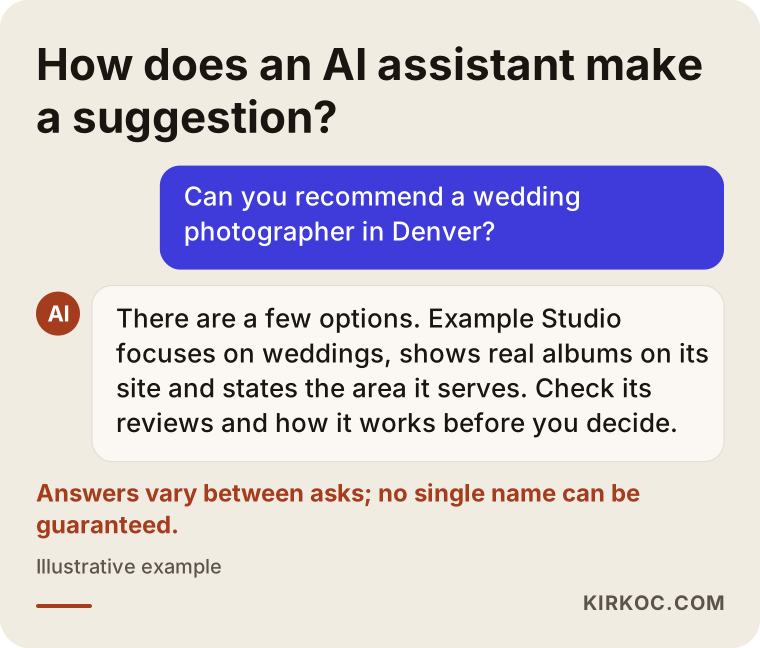
The mock-up above is invented, but the logic is real. An assistant tends to mention a business when it can describe it clearly, knows where it works and finds sources that back it up. Recommendations come from clarity and consistency, not from clever slogans.
What does ChatGPT look at when it names a business?
Nobody outside these companies knows the exact formula, and the tools keep changing. A straight-talking consultant will say so at the start. Still, a few tendencies can be observed, and the service builds on them:
- Where you stand in search results. AI tools lean heavily on what they can find on the web. A site that does well on Google is reasonably more likely to be mentioned than one that does not appear at all. So good work begins with ordinary SEO groundwork.
- A clear description. "We deliver quality service" tells nobody anything. "I am a wedding photographer working in Denver and the foothills, and albums are included" is the kind of statement an assistant can use.
- Consistent details. If your name, address, phone number and service area read the same on your site, your Google Business Profile and other listings, trust goes up. Details that contradict each other make both people and machines hesitate.
- Pages that answer the question directly. If a customer asks something and your page answers it plainly, that answer can be quoted.
- Confirmation from outside. Reviews, correct mentions on other sites and published work back up what your own site says.
None of these five is magic. They are long-term, slightly boring and measurable jobs. The upside is that the same work helps your Google visibility too, so your effort is not wasted even if the AI side moves slower than you hoped.
What does the service include?
My work has six parts. I do not promise anything that is not on my service page, and I stay inside that line here as well.
Checking where you stand in AI answers
I put the questions your customers would ask to several AI tools and look at whether your business is mentioned and what is said about it. This is the starting snapshot. Often it shows one of three things: the business is not mentioned at all, it is mentioned with wrong details, or it is mentioned but trails a competitor. Which one it is decides what happens first.
A look at your SEO foundation
Because AI tools draw largely on sites that show up in search, I list the fixes your site needs to stand firmly on Google. Can Google read your pages properly? Do they load on a phone? Is the same content repeated at several addresses? What do your titles and descriptions say? This part is dull, but if it is skipped everything built on top is shaky.
Content built around questions
I reorganize your service pages and articles so they answer the questions customers ask, briefly, clearly and correctly. This is not "writing for AI"; it is writing more clearly for people. If a customer wonders how long a job takes, your page should give an honest answer. You do not need a figure, but "it depends on these things" is also an answer, and a better one than silence.
Technical markup
I add extra information behind the scenes that tells machines plainly who you are, what you do and where you work. Think of it as an ID card: visitors do not see it, but search engines and AI tools read it. It is easy to add and just as easy to get wrong, so it is done by hand and matched exactly to what your pages really say.
Trust signals beyond your site
I tidy up your Google Business Profile, your reviews and the business details that appear on other sites. I do not recommend buying reviews or writing fake ones, and I do not do it. Artificial trust eventually hurts both your brand and your visibility.
Regular checks and a report
I ask the same questions again at regular intervals and report the changes in plain language. I also state the limits of the measurement, because every measurement in this field is a little slippery. More on that below.
Why you should not believe "we will put you first in ChatGPT"
Because there is no "position" in ChatGPT. Google has ten links, each at a spot. An AI assistant builds its answer again every time. Ask the same question in the morning and in the evening, or let two different people ask, and the names, their order and sometimes their presence can change. The user's location, the earlier conversation, the version of the tool that day, and whether it relies on its own memory or on a live search all play a part.
Given that uncertainty, the promise a serious provider can make is this: "I will make you a better candidate to be mentioned, I will measure it, and I will tell you honestly what happened." The promise they cannot make is "you will be at this spot by this date." When you hear that, read the rest of the quote with suspicion.
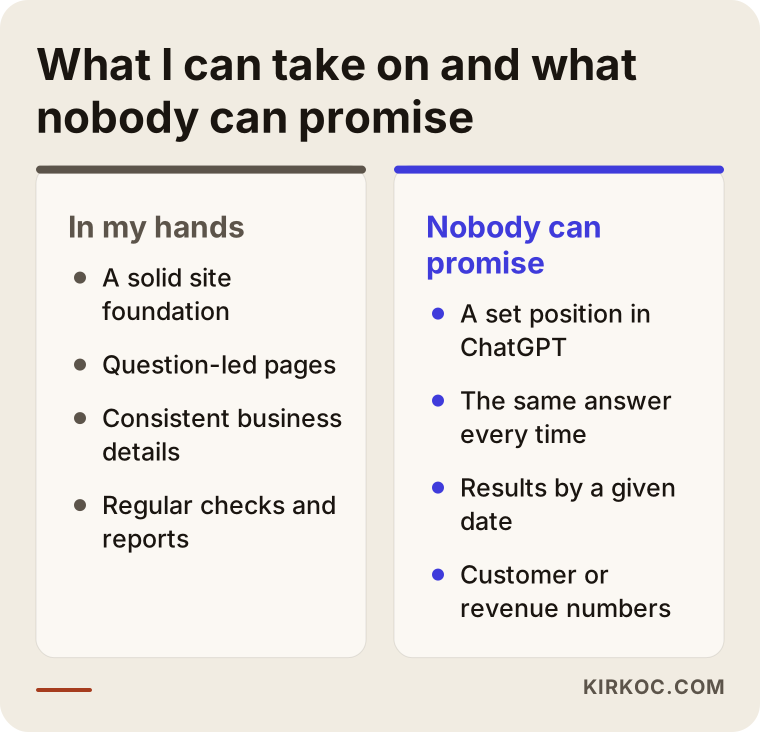
That no one can guarantee a result does not make the service worthless. A doctor cannot guarantee a cure, yet doing the job properly and buying an outcome are different things. What you can get is defined, measurable and yours to keep: fixed pages, written answers, details that finally agree. Those stay with you even when the tools change.
Who the service suits
The people I describe on my service page:
- Businesses that rank well on Google but are not mentioned in AI answers.
- Professionals, such as lawyers, doctors and accountants, who notice that clients consult ChatGPT or Gemini.
- Owners with a solid site who suspect that Google's summaries are costing them visitors.
- Anyone who wants to move early in a new area and prepare before competitors do.
What these have in common is that the business already has a real service and a real site. AI visibility does not make something appear out of nothing; it makes what exists easier to understand.
If you work in a sector where advertising or content is restricted, such as health or law, my line is this: I write content that follows the rules, I make no promises about results, and I give no medical or legal advice. You or your professional body know the regulations that apply to you, and we check the content against them together.
When you do not need this service
To be honest, for many businesses this is not the right step right now. In these cases I would suggest stepping back before spending anything:
- You have no site or a very weak one. Talking about AI visibility with a three-page site that breaks on phones and does not describe your services is premature. Fix the site first, which is sometimes a rebuild and sometimes just repairs.
- Your customers do not use these tools. For a corner bakery or a tradesperson who works only through word of mouth, assistants may not be a source of work yet. Ask your customers once: "How did you find us?"
- Your Google Business Profile is not in order. For local businesses, the quickest gain is often right there.
- You want results next week. This work moves month by month. If you want the phone to ring next week, another tool such as advertising fits better.
- You want a guarantee with numbers. This service cannot give one, and anyone who offers one deserves a second look.
In an initial review I say these things openly. If the service would not help you, telling you does not work against me; the wrong customer with the wrong expectations is a problem for both of us.
How working with me goes
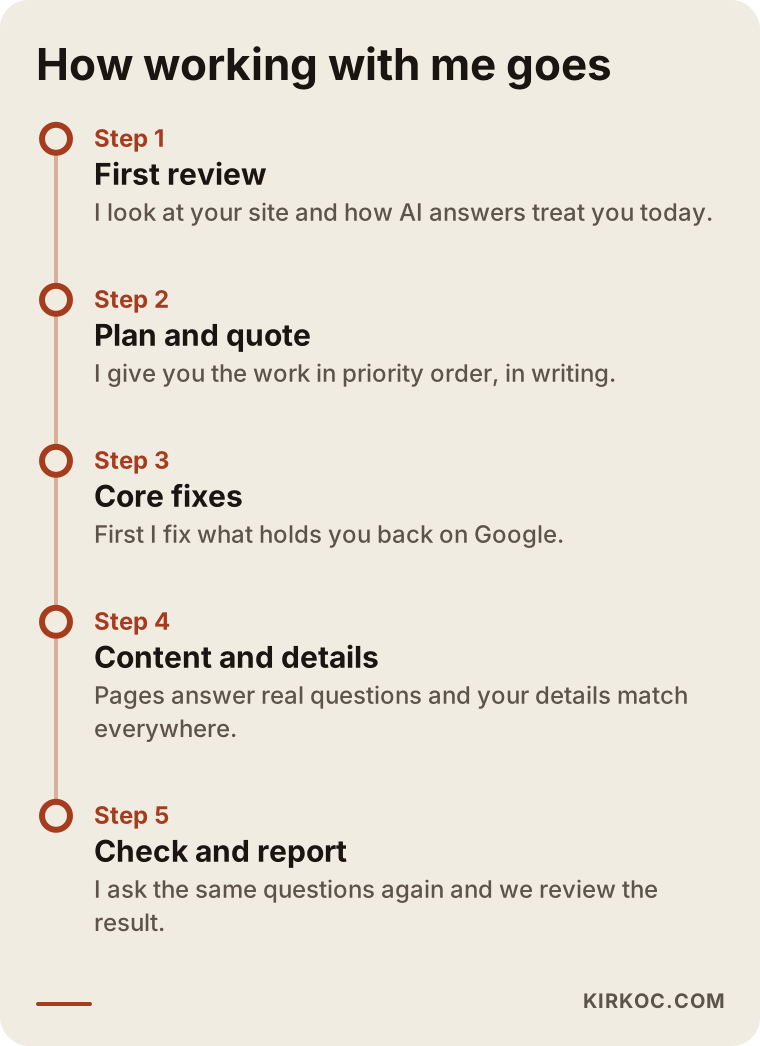
The process has five steps, and each step leaves you with something in hand.
- First review. I look at your site and at where your business stands in AI answers today, and I tell you where to start.
- Plan and quote. I present the work in writing, in priority order, stating what can be measured.
- Core fixes. First I remove the technical and content gaps that hold you back on Google. That is the ground GEO stands on.
- Content and details. I strengthen your pages with a question-and-answer approach and make your business details consistent everywhere.
- Check and report. At set intervals I check the AI answers again and we review the results together.
What I need from you is that you know your business. You know which question scares a customer, which jobs are really profitable and which areas you serve. I turn that into pages and structure. I do not publish text behind your back; in fields such as health, law or accounting, we go through the content together before it goes live.
I am one person and I work remotely, so meetings are online and everything is in writing. For some owners that is a plus, for others a matter of preference. You just need to know it before you decide.
How to measure whether it worked
Measurement is the weakest part of this field, and it should not be hidden. On Google you can look up "what position am I at for this phrase." There is no equivalent in AI answers. Still, four things can be tracked.
- Mentions: A list of realistic questions is drawn up, each is asked of the same tools at the same rhythm, and I note whether your name appears. One try means nothing; the trend matters.
- What is said: If you are named, is it correct? Is there an old address, a wrong service or a mix-up with another business? This can be more valuable than being mentioned, because it can be fixed.
- Visits to your site: In analytics, visitors from AI tools sometimes show up separately and sometimes do not. So the picture may be incomplete, and a report should say so.
- Real inquiries: Calls, forms and messages. The most reliable way to measure these is to ask the customer, "How did you hear about us?" It sounds simple, but it is the most useful one.
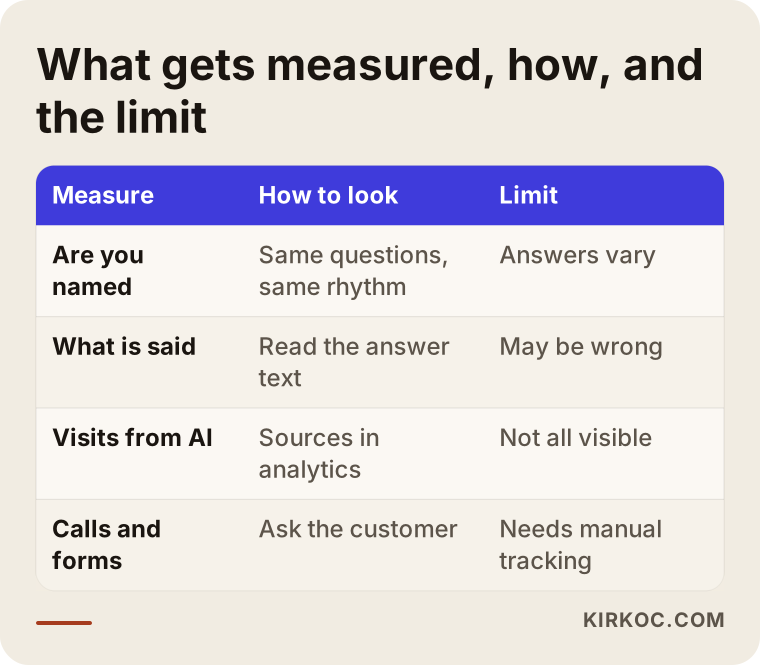
In any report, watch for four things: which questions were asked, in which tools, when, and what the change is credited to. If a sentence like "your visibility improved" comes with no evidence, it is a wish, not a report.
What decides the cost
I do not give numbers here, because the cost really does depend on how your business is built. The things that shape a quote are:
- The current state of the site. A site with a solid base and one needing serious repairs are not the same workload.
- The number of pages and topics. A business with one service has different content needs from one with ten.
- Competition and area. Working in one neighborhood is a different plan from serving a whole country.
- Number of languages. If you want to be visible in more than one language, the work multiplies.
- How sensitive the sector is. Health and law need more careful content checks.
- Ongoing work. A one-time cleanup and monthly tracking with reports are separate items.
A good quote lists these items separately. If you see one line with a total, ask what is inside. If the answer is vague, that quote cannot be compared with anything.
What to ask when you request quotes and compare companies
I suggest getting quotes from more than one place, and I take that as normal. Compare them on the following points, not on price alone:
- What will be done, in writing? "AI optimization" in general terms is not a job description. It should say which pages, which fixes and which checks.
- How will it be measured? Which questions, which tools, how often? Are the limits explained?
- Foundation first, or decoration? Someone who starts without looking at your Google basics skips half of the work.
- Who is on the other end? Is it clear who does the work, and is it the person you talk to? Who answers when you ask something?
- The language of guarantees. If a position, a date or revenue is promised, step back.
- Any fake methods? Bought reviews, networks of throwaway sites and borrowing other businesses' names put you at risk even in the short term.
- Do the results stay with you? Are the pages, fixes and reports yours? What do you hold when the job ends?
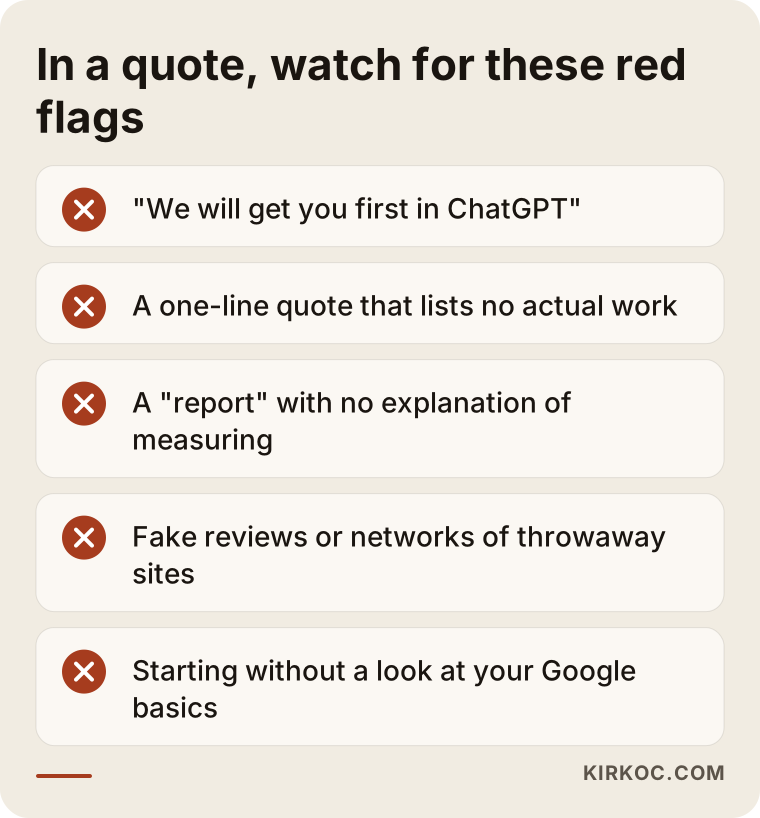
When judging a quote, ask yourself, "Did this person also tell me what they cannot do?" Someone who states their limits usually knows the work.
What a page that an AI assistant can read looks like
The most tangible output of this work is your pages. A well-built service page follows roughly this order: at the top, what you do and where you do it, in one sentence; right below, what is included as a plain list; then how the work runs, step by step; then short answers to real customer questions; and at the end, your business details.
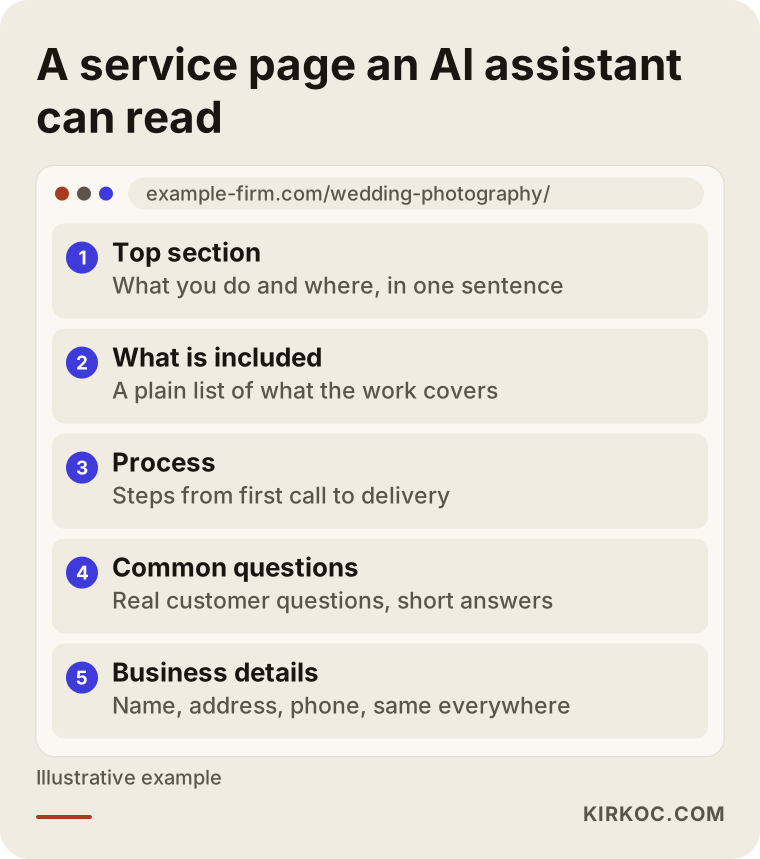
The nice thing about this layout is that it also reads well to people. You are not writing a separate page for AI; you are doing what a good page should do anyway. Fancy phrases, slogans nobody understands, and pages that never mention the city or the service lose both the customer and the assistant.
The most common mistakes
- Writing separate text for AI. Text arranged for machines that no human would read usually looks poor and does not help.
- Focusing on a single tool. One tool is popular today, another tomorrow. With a solid base, the work pays off in all of them.
- Leaving details inconsistent. One phone number on the site, another on the profile, a third in an old directory.
- Panicking over one result. Changing strategy because your name did not come up one day, or celebrating because it did. The trend counts, not a single answer.
- Expecting a single article to solve everything. One blog post will not make you stand out. The whole site is read together.
- Fake reviews or fake site networks. Sweet in the short run, damaging to all your visibility in the long run.
- Not correcting wrong information. If an assistant says something wrong about you, the cause is often an old or conflicting source. Finding and fixing it is one of the fastest wins.
Do it yourself or hire someone?
You can do many things yourself, and I am happy to say so. Keeping your Google Business Profile current, writing your address and phone number the same everywhere, asking customers for reviews, adding common questions to your service page, and asking ChatGPT a few questions about your own trade and reading the answers are all useful first steps. A weekend spent on these makes a real difference to many small businesses.
Handing it to someone makes sense in these cases: you do not know what is wrong with your site's technical base; you have many pages and cannot decide what each should say; you have no time and doubt you can keep it up; or you want regular measurement and reports. Measuring once is easy, while consistent tracking over months takes discipline.
There is a middle path too: pay for an initial review to learn what needs doing, then do the easy parts yourself. That is a perfectly legitimate way to go.
Imagine two businesses, two different paths
Imagine a small bookkeeping office in Portland that helps local shops with their books and tax filings. The owner notices that clients now ask ChatGPT questions like "what should I watch for when I file taxes for my shop?" I open the site: all services sit on one page, the city is never named and there are two different phone numbers. The first job here is not AI at all; it is the site itself. Separate pages for each service, the area served stated plainly, the phone numbers matched, and informative answers to real client questions without personal advice. A few months later the same questions are asked again. Whether the name appeared that particular day is not the main point; the real gain is that the office is now clearly understood both on Google and when an assistant reads it.
Imagine a workshop in Ohio that builds furniture and sells to offices. The owner says, "I want our name in ChatGPT," but most customers come by referral and the workshop gets a few inquiries a month. In the first review, I see that the site is attractive and the products are clear, yet it does not say which states the workshop delivers to, and the product pages lack dimensions, materials and delivery information, the facts a buyer needs. My suggestion here is not a big package: complete the product pages, add a few common questions, and measure again after three months. For some businesses that much of the service is enough, and you do not have to buy more.
Both examples are hypothetical, but most real jobs sit somewhere between them: foundation first, then questions and answers, then measurement.
Frequently asked questions
Do I need to hire someone to show up in ChatGPT?
No. The steps you can take yourself, listed above, are enough for many businesses. A service makes sense if you lack time, do not know the state of your technical base or want regular measurement. A first review is the cheapest way to find out whether you need one.
What should I think if someone promises to put me first in ChatGPT?
Be careful. There is no fixed position in ChatGPT; the answer is built anew each time and changes. An offer that guarantees a position, a date or revenue is either misinformed or misleading you. I do not make promises like that.
How long until I see results?
I cannot give you a firm time, and I would distrust anyone who does. First the site foundation has to be fixed, then the content goes live, then search and AI tools have to notice. It takes months; early signs may appear, but whether they last only shows over time.
Does it apply to tools other than ChatGPT?
Yes, most of the work does not depend on one tool. Gemini, Copilot and the AI summaries inside search engines look at similar signals: a clear description, consistent details, pages that answer directly and a sound site. When I measure, I check several tools together.
How is this different from ordinary SEO?
SEO aims to get your site to show up in search results. This service adds a look at how you are named in AI answers and what is said. The groundwork overlaps; the differences are a question-and-answer page structure, markup and separate measurement of AI answers. For more, see my GEO services page.
Can this be done in health or law?
It can, with care. I write informative content that follows the rules, I make no promises about outcomes, and I do not write sentences that amount to medical or legal advice. I go through the content with you before it is published. What your professional rules say is for you and your professional body to know.
How will I know it worked, and what is in the report?
The report covers which questions were asked in which tools and when, whether your business was mentioned, what was said, visits to your site, and the change in inquiries. I also write down the limits of the measurement. Asking customers "how did you hear about us?" is the simplest method that completes the report.
What if I have no site, or an old one?
We start with the site. Doing AI work on a weak foundation wastes money. In the first review I tell you whether the site needs fixing or rebuilding.
What should I prepare for the first review?
Your website address, the areas you serve and the three to five questions customers ask most. Also list who you think you compete with. We work out the rest during the review.
If you want to know where your business stands in AI recommendations, you can read the details on my GEO services page, then write to me with your website address and what you do in which city. I will tell you where to start in an initial review and explain plainly what can and cannot be done.