You have a website, it may even look good, but the phone stays quiet. Meanwhile a competitor across town shows up first whenever someone searches for house cleaning in your area. Most of the time the problem is not the quality of your work. Google simply does not know which searches to match you with. This article is for cleaning company owners who are thinking about hiring an SEO service: what you would be paying for, what to expect, and what not to expect.
I covered how to build the site itself in what a cleaning company website needs to win trust. Here the question is different: the site exists, so how will customers find it?
How people search for cleaning
Cleaning swings between urgent and planned. Someone moving out or expecting guests wants a quote today. An office manager compares three companies for a monthly contract. Both use Google, but they type different things:
- Broad searches like "house cleaning." Competition is heavy and these are hard to win.
- Service plus place searches like "post-construction cleaning in Brooklyn." The person is close to deciding.
- Information searches like "how much does carpet cleaning cost." The person is still thinking.
The goal of SEO is not to chase the first group. It is to win the second, which brings phone calls fastest. One page trying to cover everything ends up strong at nothing.
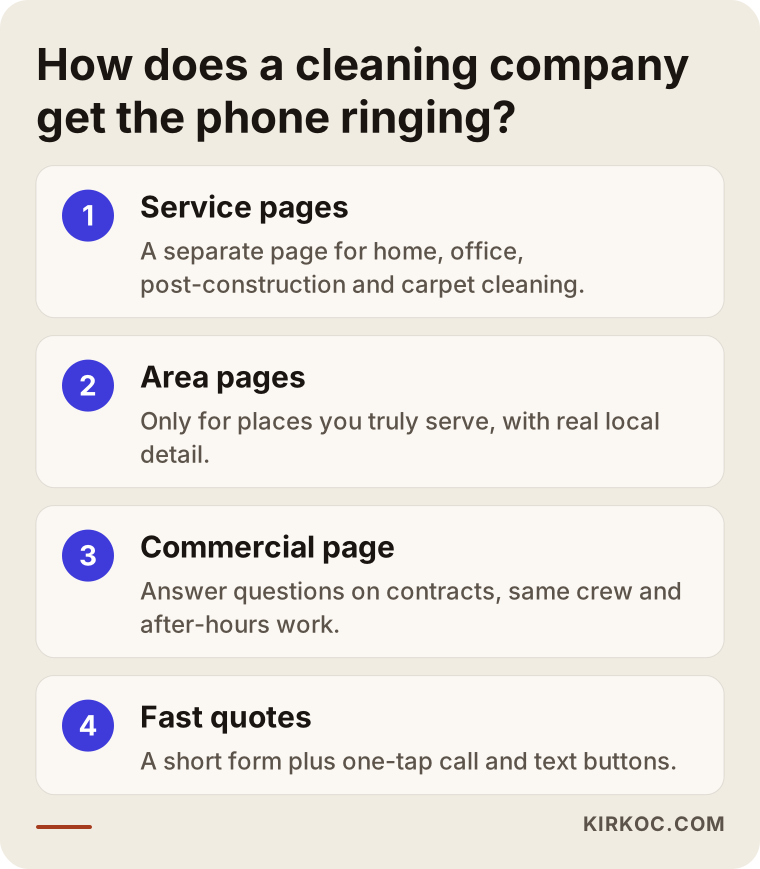
Service pages: a separate door for each job
Home cleaning, office cleaning, post-construction cleaning and carpet or upholstery cleaning attract different people. A dedicated page for each tells both the customer and Google, "this is exactly what I do."
A good service page includes:
- How the job runs: first contact, walkthrough or details, quote, cleaning day.
- Who typically books it and when: before a move, after an event, before a handover.
- What changes the price: size, how dirty it is, floors and elevator access, who brings supplies. You do not have to print a number. Explaining the factors filters out the wrong inquiries and keeps the serious ones.
- A short FAQ.
Do not copy the same sentences across four pages. Google notices, and it cannot tell which page to show.
Neighborhood pages: the key piece for local search
Cleaning is local. The customer has to be inside your service area. A page for each area you truly serve can make sense, but only for places you actually cover. Thirty pages with nothing but the town name swapped send Google a thin-content signal. I went into this in serving several areas: do you need a page for each.
An area page earns its place when it holds something specific to that place: which neighborhoods you cover, how quickly your crew can get there, the kinds of jobs that come up there, such as property management buildings, newly finished apartments or business parks. A real example from your own work, with the customer's permission, is even better.
Your Google Business Profile and your name, address and phone number also need to match everywhere.
Separate content for commercial clients
A property manager, an office administrator or a contractor asks different questions than a homeowner:
- How do contracts and invoicing work?
- Will the same crew come every time?
- Can you work outside business hours?
- If something goes wrong, who is responsible and how do we reach you?
The answers get lost on a home cleaning page. Build a separate page for office and commercial cleaning and write it differently: less emotional, more process and assurance. A single recurring contract can be worth many one-off home jobs. I cannot guarantee results, but a page that speaks to the right person usually collects more serious requests than a generic one.
Two real situations: a home customer and a commercial customer
Two businesses in the same industry need two different solutions. Here are two situations I see often, with the details changed.
Situation 1: A small carpet and upholstery cleaning shop
A carpet cleaning business came to me with a website that had a single "Services" page. Carpets, sofas, mattresses and curtains all sat in one paragraph. Most calls came from past customers, and almost nobody new found them.
I started with the searches. People typed separate things: "carpet cleaning," "sofa cleaning," and "on-site upholstery cleaning." The shop actually drove a van to the customer's door and cleaned sofas in place, but it said so nowhere.
What we did was simple. We built three separate pages: carpets, upholstery, and on-site cleaning. Each explained how the job runs, how pickup and delivery work, how long drying takes and what changes the price. I asked the owner for real photos of the workshop, and they replaced the stock images.
The outcome stayed modest. Nothing dramatic happened in the first weeks. After a few months, inquiries started to arrive from searches like "on-site sofa cleaning." It was not a flood, but the owner was relieved that the phone rang for people other than past customers.
Situation 2: A mid-sized company cleaning offices and apartment buildings
The second company was different. It did home cleaning too, but most of its income came from a handful of office and property management contracts. Its website, though, said "we clean your home" from top to bottom.
The problem was that the right person never landed on the right page. When a building manager searched, they found an emotional home cleaning pitch, with not one line about contracts, continuity or after-hours work.
We built a separate commercial cleaning page. It said plainly whether the same crew comes each time, how invoicing works, who to call if something goes wrong and how the walkthrough happens. It also named two or three kinds of places the company really serves, such as business parks and clinics, without naming clients.
The number of requests did not drop, but their quality changed. Fewer "what does it cost" calls, more "when can you come for a walkthrough." I do not promise this, but it is consistent that a page speaking to the right person makes this difference.
Trust: insured staff and reviews
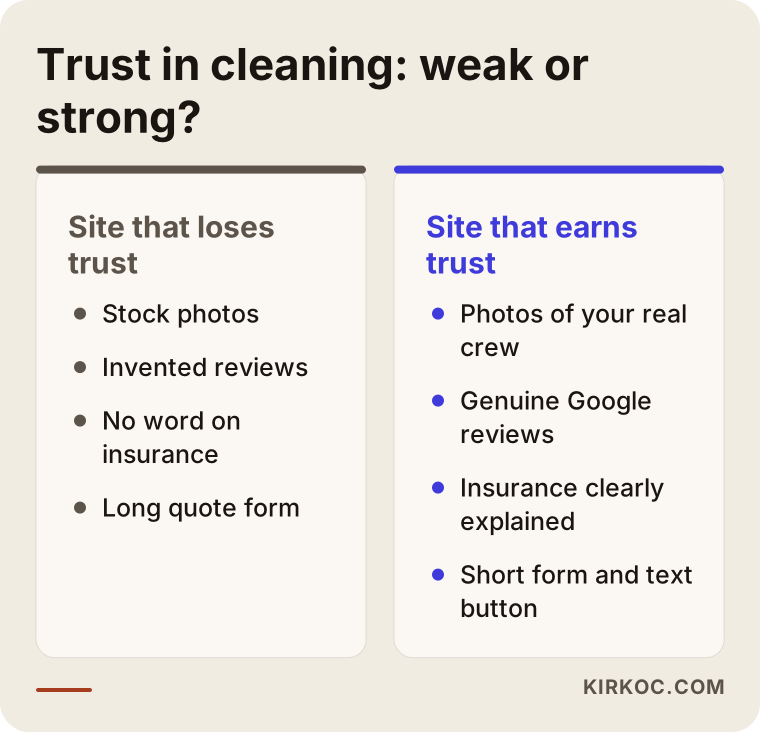
Customers let a stranger into their home or office. Ranking is half the job. Convincing them on the page is the other half.
- Staff and insurance. Say your staff are insured, and what happens if something is damaged, only if it is true. Check the exact wording with your insurer or a lawyer.
- Real reviews. Your Google reviews are often seen before your website. Politely ask happy customers, and answer every review. Stay away from bought or invented reviews. They are dishonest and risky.
- Before and after photos and photos of your real crew. Stock images convince no one.
The right way to ask for reviews
Reviews directly affect rankings and decisions in cleaning, yet most businesses forget to ask. A happy customer often does not write on their own and needs a polite nudge.
The best moment is right after the job, while the customer is pleased with the result. The crew lead can send a link to the profile by message while saying thanks. A short, plain note is enough: "If you were happy, we would love a review."
Do not offer a discount or gift in return. That breaks platform rules and damages how believable your reviews are. Do not try to pick which customers will write something positive either. An honest mix is more convincing than a page where everything looks perfect.
Demand shifts with the seasons
Cleaning searches do not arrive at the same pace all year. The weeks before holidays, the end of the school year, moving season and the stretch when new apartments are handed over each create their own wave. A business that knows this prepares its pages ahead of time.
Seasonal jobs like spring cleaning, move-out cleaning or pre-wedding preparation do not need their own pages. A short section on an existing service page is often enough. What matters is that the page is ready a few weeks before demand arrives, because it takes Google time to evaluate new content.
Look at your own records: which months get busy, which are quiet? That is the most reliable source for your content calendar. Use the quiet months to improve pages. In the busy months you will be too occupied answering the phone.
Showing up on the map and in local results
For searches like "cleaning company near me," Google often shows the map first. A customer can look at your business profile and call without ever visiting your website. That makes the profile a core piece, as important as your pages.
In the profile, pick the right main category, define the areas you serve and list each service you offer. Hours must be current, and any holiday changes should be marked. Photos should be real and refreshed from time to time.
Answering customer questions through the profile helps too. When someone asks whether you pick up carpets, your answer is visible to that person and to everyone who looks later. Businesses that travel to the customer and do not want to show an address can set a service area instead, which lets you hide your office address.
This part of local visibility is long-term work. Rather than filling it in once and forgetting it, a little upkeep each month keeps the profile working for you.
Fast quotes: where SEO actually pays off
A visitor will not fill out a long form. A short quote form (name, phone, type of service, area, rough size) and a one-tap call or text button are enough. State how quickly you reply, and pick a time you can keep. If you miss the call, the customer moves to the next result, and no ranking makes up for that.
Not losing the customer at the quote stage
The page made the phone ring, but the work does not end there. Many cleaning companies lose the customer at the quote stage after the first call. The reason is usually not price but uncertainty.
Prepare the questions for the phone or message ahead of time: square footage or number of rooms, floor and elevator access, how dirty the space is, the requested date and who brings supplies. Asking them in the same order each time speeds up quotes and tells the customer they are dealing with an organized business.
Do not go quiet after the quote either. A short, polite reminder within a day often saves the job. If the customer chose someone else, that is worth knowing too, so do not hesitate to ask why.
For jobs that need a walkthrough, such as post-construction or a large office, explain on the page how the walkthrough works. Is it paid or free, and how long does it take? Uncertainty scares off serious customers as well.
What I measure
Rankings alone say little. I look at which service and area searches brought people in, how many filled out the form, called or messaged, and how many became real jobs. Only you know that last part, so I would ask for a short monthly chat about which requests turned into work. That way, deciding which page deserves more effort rests on data from your business, not guesses.
Step by step: if you work with me or do it yourself
The process runs in the same order whichever way you choose. Mixing up the order is the most common waste of time.
1. See where you stand
First I look at which searches already bring visits to your site, how complete your Google Business Profile is and what the competitors in your area do well. You change nothing yet. The goal is to see where to start.
2. Decide which service comes first
Do not try to push every job at once. Which job earns you the most, where do you have capacity, and where are the competitors weak? The overlap of those three questions decides your first page. If your crew only works weekdays, a weekend emergency cleaning page makes no sense.
3. Write the pages
Each page explains concretely how the job runs and what affects the price. I take the first draft of the facts from you, because you know the details from the field. I shape it with the words customers actually search for, in a layout that is easy to scan.
4. Fix local details and the profile
Area pages, your Google Business Profile and a consistent name, address and phone number are finished at this stage. Your hours, service areas and photos get updated.
5. Shorten the path to a quote
Test the form, the text button and a phone number that can be tapped. Try it from your own phone as a customer would: how many taps does it take to ask for a quote?
6. Measure and adjust
In the first months we check which page gets seen and which one brings calls. A weak page gets expanded, and a page nobody cares about gets simplified or removed.
You can follow this order on your own. Working with me means having someone who knows what each step needs, so you do not spend time on the wrong page.
Common mistakes
I have noticed the same mistakes in cleaning companies again and again. Most are easy to avoid.
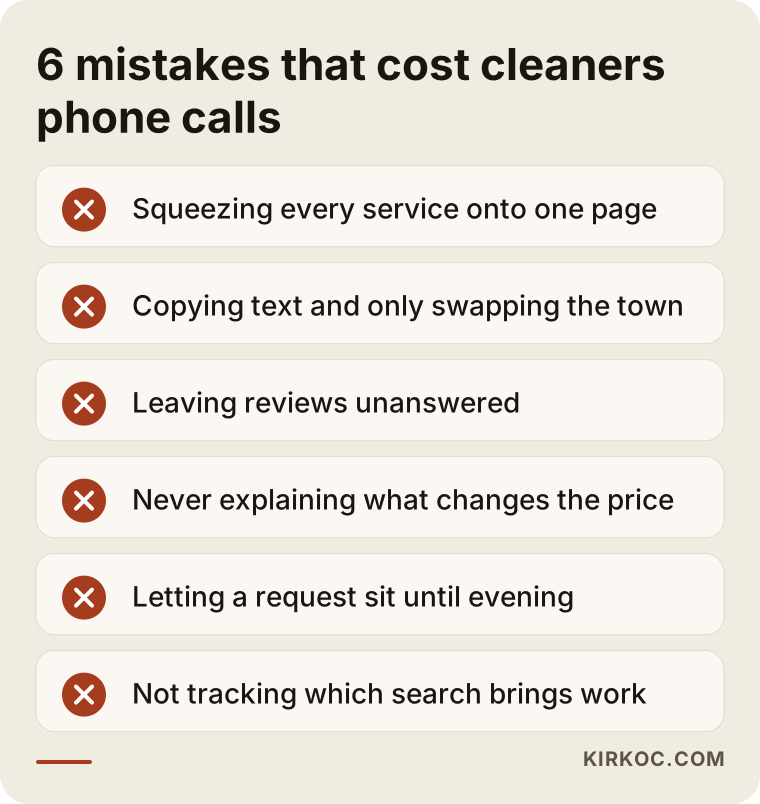
Squeezing everything onto one page
Listing home, office, carpet and window cleaning under one "Services" heading looks easy. But Google cannot decide which search to show that page for, and the customer has to scroll to find what they want.
Copying the same text for every area
Duplicating the text and swapping only the town name looks fast, but it backfires. A page for an area you do not serve also misleads the customer.
Ignoring reviews
Answering a bad review angrily, or not at all, sends a poor signal to the next customer. A calm answer focused on a fix often softens the effect of a negative review.
Avoiding the price question
Even if you print no number, not explaining what changes the price leaves the customer wondering if you are expensive. Spelling out the factors attracts the right customer.
Answering requests late
Letting an inquiry sit until evening means losing it. Cleaning is a quick job where people compare and decide fast.
Not measuring the result
If you do not know how many requests came from which search, you cannot know what works. Investing on guesses is the most expensive way.
What you can do yourself and what to leave to a specialist
You do not need a specialist for everything. This split helps you spend your budget in the right place.
What you can do yourself
- Fill in your Google Business Profile: hours, service areas, category, photos.
- Take real photos of your crew, vehicles and before and after results.
- Politely ask happy customers for a review and answer every one.
- Reply to calls and messages quickly.
- Note the questions customers ask you often. The best page content comes from there.
What to leave to a specialist
- Researching which searches will really bring you work.
- Planning page structure and internal links.
- Finding technical problems: slow pages, broken layouts on phones, pages Google cannot crawl.
- Deciding which area pages are worth having.
- Reading the results and choosing the next step.
The line is not sharp, but as a rule the best collaboration happens when the field knowledge stays with you and the search and technical side stays with me.
Checklist before you publish
Before publishing a page, can you answer yes to these?
- Does the page describe one service or one type of customer?
- Is it clear on the first screen what you do and where you go?
- Is what changes the price written down?
- Are there real photos and real reviews?
- Is what you wrote about insurance and staff accurate?
- Are the buttons easy to press on a phone?
- Are your address, phone and hours the same on the site and on your Google profile?
- Is it clear who answers an inquiry and how fast?
If you answer no to any of these, fix it before publishing. Often the missing piece is not a technical detail but one clear sentence.
Frequently asked questions
When will I see results?
I cannot give a firm date. New pages usually take months to settle, depending on competition and the current state of your site. The first signs tend to be more search impressions and more profile views.
Ads or SEO?
Ads are fast for urgent, short-term demand, but they stop when you stop paying. SEO is slower and builds up. For many cleaning companies a balance of both makes sense, and we can talk about it based on your budget.
Do you guarantee first place?
No. Nobody honestly can. What I can do is build the right pages, in the right order, with clear reporting.
Should I open a separate page for every area?
Only for places you truly serve and can say something specific about. Start with the two or three areas where you get the most work, look at the results, then expand.
Is my Google Business Profile as important as my website?
In local searches it is often more important. The customer sees you on the map, reads your reviews and decides, and may never open the site. The two need to be consistent.
Do I need to write a blog?
Not required. A few posts that correctly answer a question people really search for, like how to remove a stain from a sofa, can help. Regular but empty posts do not.
My past customers already call me. Do I need SEO?
If your customer base is solid, SEO is for winning new customers and not depending on one channel. If referrals ever slow down, search becomes the second leg that protects you.
Does SEO help if I also run ads?
Yes. The clearer and more trustworthy the page your ad sends people to, the more of the same clicks turn into requests. Your service pages work for both ads and organic search.
How would we work together?
I first look at your site and the competitors in your area, then we pick which service and which area is likely to bring calls fastest. I am not an agency. You work with me directly. If you want your cleaning company to be found on Google, write to me through the SEO services page.