"I do not want to sign a contract for months. I just want to know whether I am heading in the right direction." That is one of the requests I hear most. The good news: not every SEO need calls for a monthly retainer. Sometimes a few hours of well-prepared SEO consulting are enough to stop years of effort going the wrong way.
In this article I explain what a one-time session is, who it makes sense for, how to prepare, and what you actually hold in your hands afterward. If you want the broader comparison between ongoing work and a fixed package, my article on monthly SEO consulting or a one-time package covers it. This piece is about the strategy session itself.
What is a one-time SEO consultation?
It is focused work with a specialist for a limited time, aimed at specific questions. There is no ongoing monitoring, no monthly report, and no content production. I review your site beforehand, talk through my findings with you, and leave you a written roadmap. The doing stays with you or with someone you choose.
Think of a medical check-up. The doctor makes the diagnosis and writes the prescription; taking the medicine is up to you. You can come back for a follow-up or not. What matters is that the appointment is valuable on its own.
Who is it for?
In my work, three groups benefit most.
Businesses with their own team. Someone in-house writes content and updates the website, but nobody has a clear direction. What is missing is not labor, it is priorities. One look from someone who can tell your team "do this first, then that" is often enough.
Owners about to launch a new site. A session before the site is built or goes live is the cheapest way to prevent mistakes. If the page structure, the web addresses and the question of which service gets which page are right from the start, you avoid painful fixes later. Changes made after launch are more work and can carry real risk.
People who want their agency or consultant reviewed. You have been paying for months but cannot tell what is being done. A neutral second opinion shows whether the work actually serves you. In these sessions I do not blame anyone; I simply explain, in plain language, what has been done and what has not.
Small business owners who tried things on their own and got stuck also tend to get a lot out of it.
Two real-world examples: how the session played out
To keep this concrete, here are two situations from two very different kinds of business. I have left out names and figures and generalized the details, but the flow is close to how these engagements really go.
A two-person accounting firm
An accountant came to me and said, "We publish blog posts and we keep up with social media, but the phone does not ring." The posts were regular, yet when I looked at the site, every service was squeezed into one short page. The articles explained general bookkeeping rules, which attracted students rather than clients.
We talked about two things. First, each service (company formation, bookkeeping, tax advice and so on) needed its own page, described in the language a business owner uses. Second, the articles should shift from "here is what the rule says" to "here is what to do if you are in this situation".
The written plan stayed with the person in the office. They wrote the pages themselves, and I looked at their drafts once. Within a few months the quality of the inquiries on the service pages changed. I cannot measure how much of that came from my advice, but the firm now knows why each article exists, and that is a gain in itself.
A manufacturer planning an online shop
The second example was a manufacturer who wanted to refresh a brochure-style website and start selling online. They were about to sign with a web agency and asked me to check, before signing, whether the plan was sound from a search point of view.
I reviewed the page structure the agency had drawn up. All product categories were squeezed onto one long page, and there was no note on how the old web addresses would be redirected to the new site. Without redirects, the value that old addresses have built up over the years can be lost.
In the session we wrote a short specification to hand to the agency: a separate page for each main product group, a one-to-one redirect from every old address to its new counterpart, and page titles and descriptions planned in advance. The agency agreed. No drop followed the launch. I see that not as a guaranteed outcome but as a risk reduced from the start.
What these two examples teach
Both businesses arrived with a clear question and someone to carry out the plan. The accounting firm owned its plan, and the manufacturer carried it into the contract. Nothing stayed on paper.
In both cases my job was to point the way. They wrote the copy, negotiated with the agency and watched the results. That is exactly where a one-time session works well.
How does the session run?
Every engagement is a bit different, but the flow stays the same: I listen, I look at the site, I explain what I found, and I put it in writing.
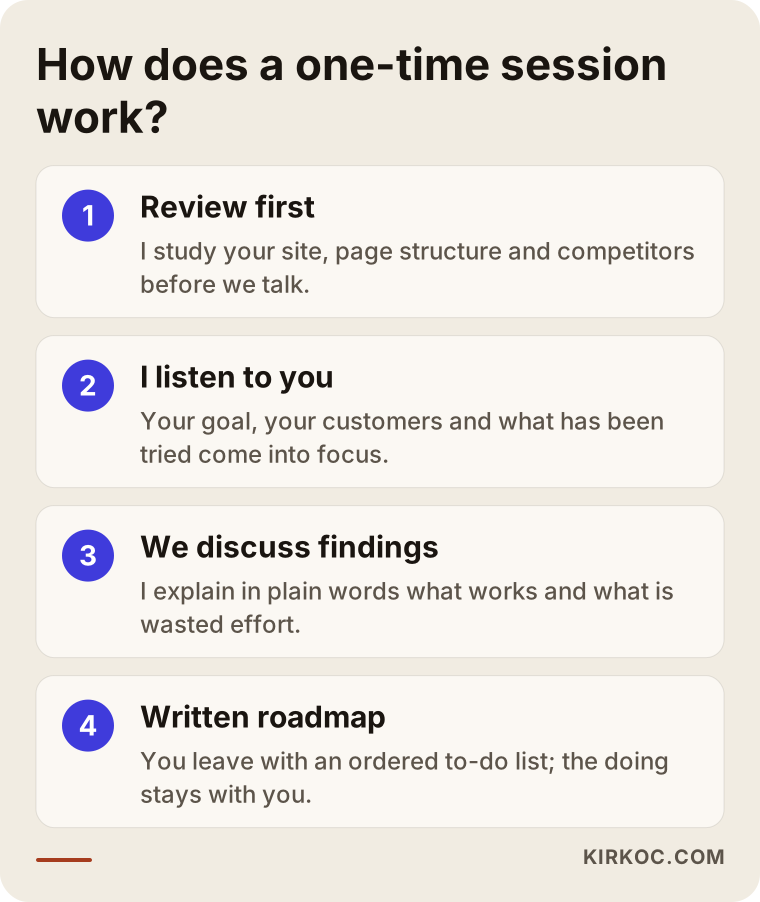
Before we talk, I study your site, its page structure and your competitors. That way we do not spend the session on generic advice; we talk about your actual site. I take your questions and help with decisions such as "should I work on this or that this month?" At the end I turn the conversation into an ordered plan.
Step by step: from first message to roadmap
A one-time engagement is short, but it loses value if it runs without order. If you work with me, the sequence usually looks like this.
1. We narrow the scope together
In the first exchange, or a short call, we settle on a single question. "Is my site good?" is far too broad. "Is the structure right before the new site launches?" or "Is my agency's work helping me?" are questions that can be answered.
2. Access and background are collected
I need admin access to your site, or at least viewing access. If you have a search console and analytics account, you share those as well. Naming three or five companies you see as competitors is enough.
3. The review
Before we talk, I look at the site on my own. I note how pages are built, how they appear in search, and what competitors explain better. I do not burden you at this stage; if a question comes up, I ask by short message.
4. The session
I compare my findings with your goal. I suggest you take notes or keep the recording together with the written summary. Ask what is on your mind right then; questions left for later are usually forgotten.
5. The written roadmap
Shortly after the session, the plan is in your hands. Each item carries three pieces of information: what to do, why, and who can do it. If something is unclear before you start, asking is normal; answering those questions is part of the process.
6. A short follow-up (optional)
If you get stuck once you start the plan, you can come back with a single question. We agree on how that works upfront. It is not mandatory.
How should you prepare?
Preparation directly shapes the value of the session. Nothing technical is needed; just get clear on three things:
- Which service or product do you most want to sell?
- How do customers reach you today: phone, contact form, messaging apps?
- What has been tried so far, and by whom?
Giving me access to your website admin and, if you have them, Google Search Console and analytics speeds things up. If you do not have them, that is fine; the absence is a finding too.
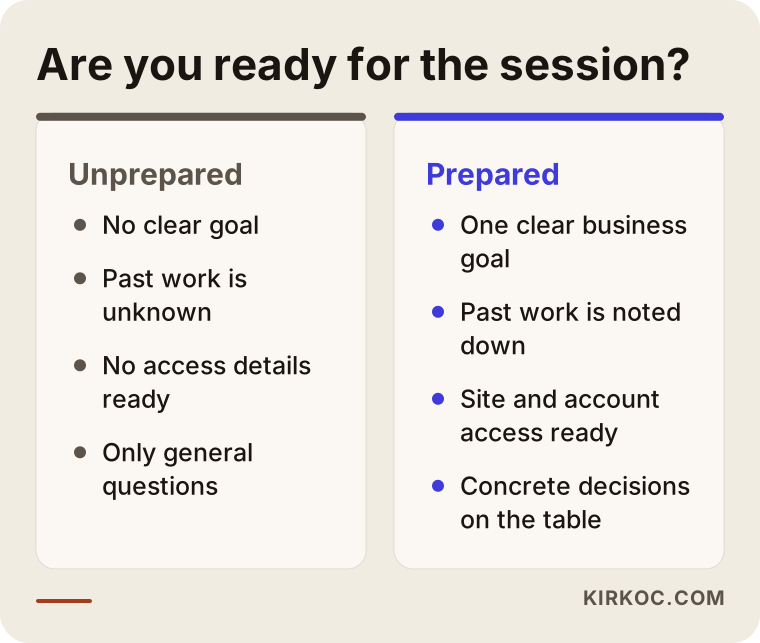
Also state your expectation upfront. "Rank first" is not a goal; "get inquiries for this specific service by the end of the quarter" is. A clear goal leads to clear recommendations.
Checklist: before and after the session
This list gathers ordinary but useful things that help you get the most from the session.
Before the session
- Write your business goal in one sentence (for example, "more phone calls for this particular service").
- Find out who has access to your website, any Google accounts and your domain registration.
- Jot down briefly who you worked with before, what was done and how long it lasted.
- Collect the web addresses of the companies you see as competitors.
- Write down the three questions customers ask you most often; they are gold for content.
After the session
- Share the plan with the people involved within a week; a plan that waits gets stale.
- Put an owner and a date next to every item.
- Do the easy, high-impact items first; do not start with the hardest one.
- Make a note when an item is done. Later, those notes answer the question "what changed, and when?"
- Check the tracking signals once a month; looking daily will mislead you.
What do you walk away with?
The result should be more than a conversation. When we finish, you should have:
- A plain summary of your site: where it is strong and where it is weak.
- A to-do list in priority order, with a note on who can do each item (you, your developer, your writer).
- A list of what not to do: wasted effort and risky shortcuts.
- A content direction for your target pages and topics.
- A simple way to track whether things are moving.
This document should make sense to another specialist or to your team. If it does not, the work is incomplete.
What should you ask during the session?
Listening is half of it; asking is the other half. You can ask:
- "What is this recommendation based on?" A good answer points to something concrete on your site.
- "What happens if I skip it?" Not every item is equally urgent.
- "Who can do this?" Some tasks you handle, others need a developer.
- "When will I notice a change?" An honest answer names signals to watch, not a guaranteed date. Nobody can promise a particular ranking.
If you get plain answers to all of these, the session was worth it.
Common mistakes businesses make
Even a good specialist is limited when a session is set up the wrong way. These are the mistakes I run into most often.
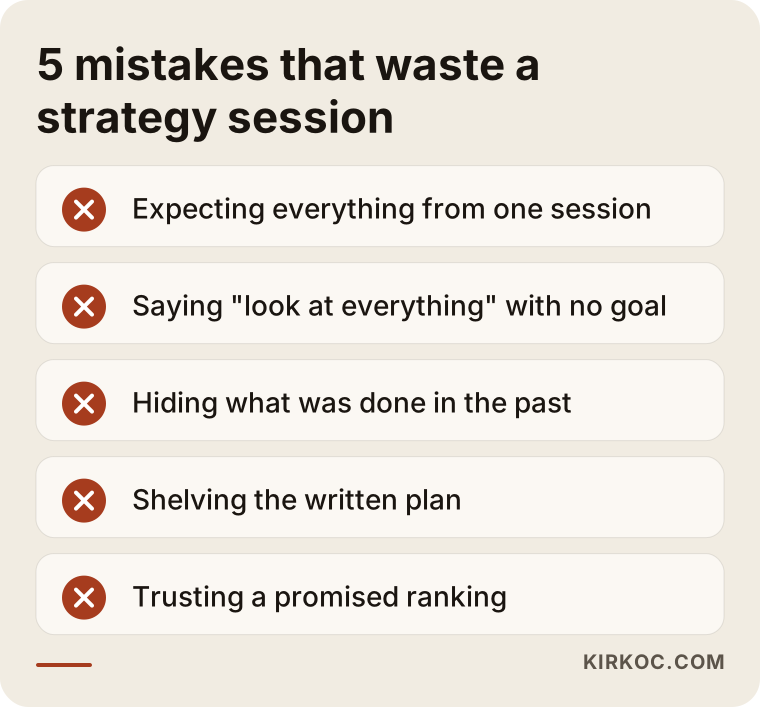
Expecting everything from one session
A session shows direction; it does not do the work. Carrying out the plan takes time and effort. The expectation "we had the session, now traffic will come" is the most common source of disappointment.
Saying "look at everything" without naming a problem
The wider the scope, the shallower the depth. A session focused on one question is usually more useful than one that tries to cover everything.
Hiding the history
If you worked with an agency before, tried a risky method or received a penalty notice, say so. I do not judge anyone, but a history I do not know can lead to wrong advice.
Shelving the plan
A written plan that stays in a drawer produces nothing. If it is unclear who will carry it out, solve that before the session.
Loading the plan onto one person
In some businesses the plan lands on one employee who has other jobs too. Splitting the items into writing, design and technical work and giving them to different people improves both speed and ownership.
Starting without measuring
If you do not know how many inquiries you receive before the session, you cannot say afterward that anything changed. Take a simple baseline first: how many calls and forms per week, and for which services.
Deciding on price alone
The shortest and cheapest session may be the one that offers generic advice without ever looking at your site. Ask whether it includes preparation and a review tailored to you; that is what actually drives the price.
Believing someone who promises a ranking
No consultant can guarantee a particular position. Anyone who says "you will be first by this date" is thinking about their own sale, not about you.
What you can do yourself and what to leave to a specialist
You do not need a specialist for everything, but trying to do everything yourself can waste time. After you receive the plan, you can roughly sort the tasks into three groups.
What you can comfortably do yourself
- Rewrite the text on service pages in the words your customers use.
- Check that your business name, address and phone number are identical everywhere.
- Pick new article topics from the questions customers ask.
- Keep existing articles current and correct outdated information.
- Ask satisfied customers for reviews.
What can be done together or with short support
- Reworking page titles and descriptions.
- Drawing the map that decides which page serves which search.
- Judging whether an article is deep enough for your field.
What to leave to a specialist
- Changing the address structure of the site or moving to a new site. A faulty move can cause losses that take a long time to recover.
- Technical errors that cause trouble in search: crawl blocks, duplicate pages, speed problems.
- Resolving a penalty or manual action notice, if you received one.
- If you publish in several languages, linking the language versions to each other correctly.
Ask for this distinction in the session. A good plan states it next to every item anyway. Whatever you take on yourself, if you want a second look at the result when you are done, we can talk about that as part of the session.
The first weeks after you get the plan
The session ends and the real work begins. Small but steady progress in the first weeks is usually healthier than a big push later.
In the first week, go through the plan and name the owners. Over the next several weeks, carry out the items expected to matter most; most of them concern page text and layout. The effect in search results takes time; watch the signals that arrive over months and do not spoil the plan with hasty decisions.
As you carry out the plan, you will find that some items turn out harder or easier than expected. That is normal. Before dropping an item, note the reason; there is often another way to solve it.
Over time the plan ages. Markets, competitors and search engines change. Before a big change, for example when adding a new service or redesigning the site, consider a short second session.
How to tell a good offer from a weak one
When you collect offers for a one-time session, comparing different people is hard. It is healthier to look at a few points before the price.
Is the scope clear?
A good offer says what is included: is there a preparation review, how many people attend, in what form is the written result delivered, and how many questions can you bring back afterward. Without this information a price comparison is meaningless.
Will your site actually be looked at?
Someone who says "let us look at your site first, then talk" is not doing the same job as someone who presents a ready-made deck. Offers made without looking at your site turn into generic advice.
Are the price drivers explained?
The size of the site, the number of languages, the depth of the review and the scope of the written result shape the price. An offer that names a single figure without explaining these is steering you toward being persuaded rather than deciding.
Is there a promise of results?
If there is, stay away. An honest offer says what can be done and also what is out of anyone's hands.
What should you measure after the session?
The most neglected part of a one-time engagement is measurement. If the plan was carried out but nobody knows whether anything changed, the next decision is made blind.
Calls, forms and messages
The key measure is the number and quality of real inquiries from your site. It is enough to write down in a simple notebook or sheet which service each inquiry was about. The number of visitors alone is not a sign of success; unrelated people raise it too.
Search visibility
Once a month, check in Google Search Console which searches you appear for and which pages get clicked. For services whose pages you have renewed, the rise in visibility often starts before the clicks. It is a first sign that the plan is heading the right way, not a final result. Fluctuations are normal; judge the plan by the trend over a few months, not a single week.
Asking the customer
Ask your new customer how they found you. It is one of the oldest and still most reliable methods. The answers can show which page or channel worked more clearly than numbers do.
Limits: when it is not enough
To be honest: a single session does not guarantee results. SEO works through implementation and time; the best plan changes nothing if nobody carries it out. For a business with no one to implement, a plan alone can be frustrating.
Another model may fit better if:
- Your site has serious technical problems and nobody to fix them.
- You are in a highly competitive field that needs steady content and monitoring.
- You have neither the time nor the team to follow the plan.
In that case I may suggest ongoing work, but starting with a session and seeing the need together is also possible. There is no obligation.
Frequently asked questions
How long does it take?
It depends on scope, including the preparation I do beforehand. Usually one focused session plus a written plan is enough. We agree on scope upfront.
What determines the price?
The size of the site, the number of languages, the depth of the review and the scope of the written deliverable. I would not quote a figure without talking to you first.
Do I have to continue afterward?
No. The plan is yours to use, give to your team or hand to another specialist.
I am not technical. Will I understand?
Yes. My aim is for you to be able to decide. If I use a term, I explain it in one sentence.
Which questions is a one-time session enough for?
It suits jobs with a clear question: checking the structure before a new site, a second look at your current agency's work, which service to prioritize, or likely reasons for falling traffic. For vague work that needs constant monitoring it may not be enough.
Can I bring my team along?
Yes, and I recommend it. If the person who will carry out the plan is in the session, they hear the explanations first-hand and nothing gets lost in the retelling.
My site is new and has no visitors yet. Does it still make sense?
Yes, and it is the most efficient case. Fixes made while the structure is still settling take the least effort. Having no visitors is a finding too, and we can look for the reason together.
Can I move to monthly work afterward?
You can, but you do not have to. If the need truly calls for ongoing support at the end of the session, I will say so openly; if it does not, I will not.
If you have a site you would like looked at once, talk to me and we can pick the right way to work together through my SEO services page.