You have done good translation work for years and your clients are happy, yet someone who types "certified Spanish translation" into Google sees your competitor first. Why? Usually the quality of your work is not the problem. The sentence your client types and the sentence your website uses simply never meet. In this article I explain how SEO works for a translation agency, which searches you should prepare for, and what to avoid. If you want help doing this professionally, you can see how I work on my SEO services page.
I covered design and general content in my article on a translation agency website. I will not repeat that here; this piece is only about being found in search.
What do clients type into Google?
Someone looking for a translation is usually in the middle of a task: a document for an authority, an application, a contract. Their searches tend to combine three parts:
- Language pair: "German to English translation", "Arabic translator"
- Document type: "diploma translation", "marriage certificate translation", "contract translation"
- Place and urgency: "certified translator near me", "urgent translation", "same-day translation"
A combination such as "birth certificate translation Spanish to English" carries a much clearer intent than plain "translation agency". That person is not comparing, they want the job done. For a small or mid-sized agency, the most productive ground is rarely the broad term where big companies dominate. It is these precise, specific searches.
One page per language pair and document type
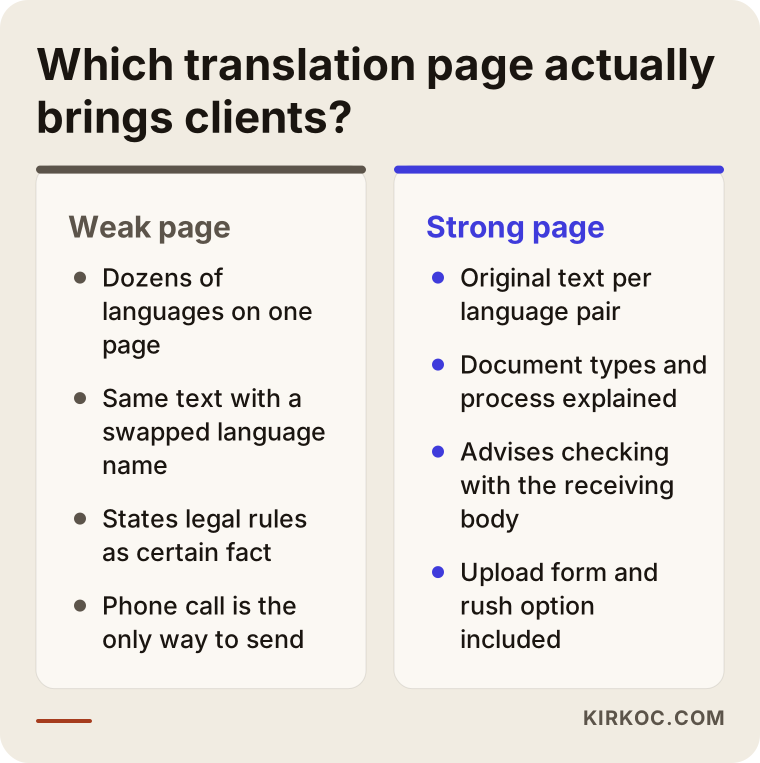
Squeezing every language onto the home page is the most common mistake. Google prefers a page that covers one subject well. If one page lists fifteen languages, none of them looks strong.
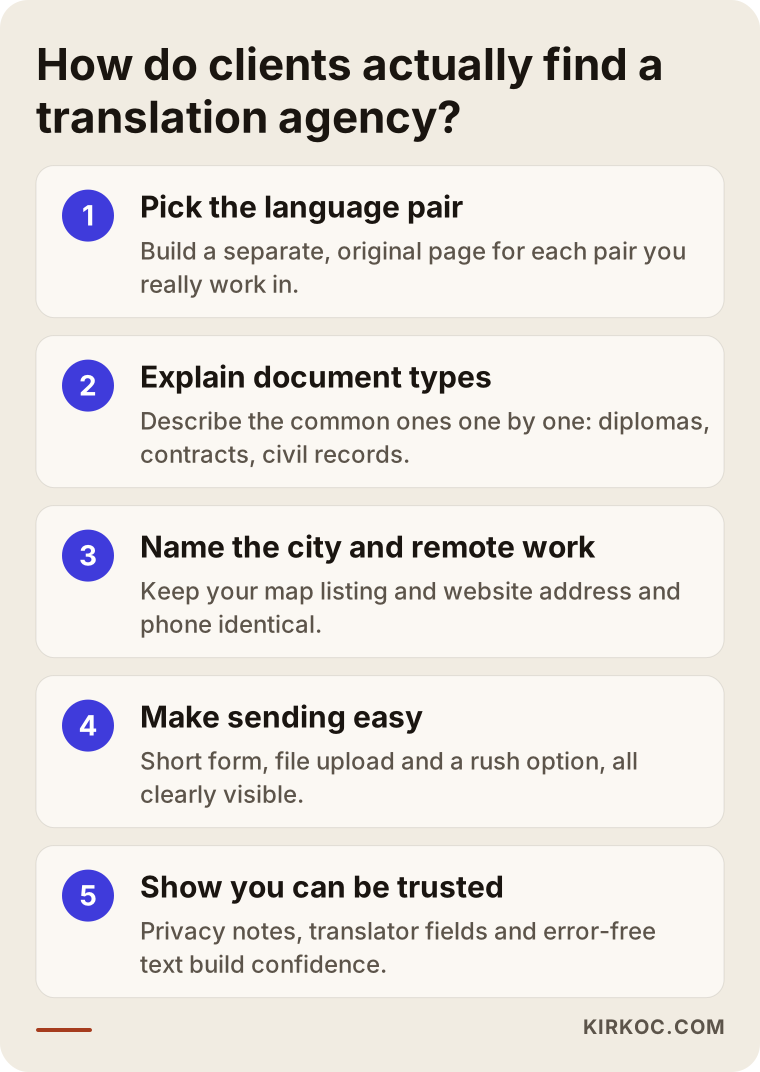
A better structure: one page for each language pair you really work in, with short explanations of the document types that come up most often. On each page, say how you work in that pair, who translates, how the file is sent and how the process runs. Do not copy the same text and swap the language name. Clients and search engines both read that as a template.
Honesty matters here. Never open a page for a language you do not serve. A page built only for traffic, with no translator behind it, brings complaints and damages your reputation.
Certified, notarized, apostille: explain the concepts plainly
Clients search for these words but often do not know the difference. Explaining the concepts in general terms, without scaring anyone, helps both the visitor and your rankings. For example: what a certified translation is, in which situations one is commonly requested, roughly how an approval step works, and what an apostille is used for.
The limit is this: the rules differ from country to country and often from one institution to another. Do not state as fact which authority accepts which document. It may change tomorrow, and wrong information hurts the client and puts you in a difficult spot. A sentence such as "Please confirm the requirements with the receiving institution, and send us the document so we can work out which type you need" is both honest and reassuring. For legal certainty, check with the relevant professional association and official bodies in your country.
City and neighborhood searches
Searches like "certified translator near me" or "translation services in Chicago" carry local intent. Here your Google Business Profile matters: address, opening hours, phone and service category should be complete and identical to your website. Ask for reviews, but only from real clients and without exposing anything confidential.
If you serve several cities, do not create made-up pages for each one. Describe what you actually do there: do you have an office, do you use couriers, how does delivery work? Since most translation work now happens remotely, stating clearly that you serve clients online is an advantage too. Local search is a bigger topic on its own and can be handled as a separate project.
Rush jobs and online file upload
Someone searching for an urgent translation is impatient and goes to the first agency that gives a clear answer. If you offer a rush option, do not hide it. Explain how to request it, when you can be reached and what determines the turnaround (page count, language pair, certification). Do not promise a fixed time up front; give it with the quote once you have seen the document.
The way to send files should also match the wording people search with. A sentence like "Upload a photo or PDF of your document and we will send you a quote" should appear the same way on the page and in the form. Keep the form short: language pair, document type, deadline and file upload.
Trust signals also affect rankings
In this field the client hands you identity papers or medical records. What builds trust also makes your site look better: stating clearly who you are, translators' fields of expertise, a privacy explanation, real contact details and error-free text. A translation website full of typos loses the visitor in the first second.
Your foreign-language pages are also how you reach clients searching in that language. Each language version should read as an independent page written for a native speaker, not as a translated copy.
What belongs on a language pair page?
Once you have planned the pages, the real question is what goes on them. I suggest building a language pair page in the order of the questions a person with a document in hand would ask.
Headline and opening
Name the language pair plainly in the headline, for example "German to English certified and standard translation." In the first paragraph, say who you work for and what you translate. One concrete sentence persuades better than an advertising slogan.
Which documents, in which situations
List the most common documents under short headings and give the client what they need to know for each: is a certified translation usually required, is a copy enough or does the original matter, and what actually determines turnaround instead of a vague number of days. That makes the page a real guide rather than a shop window.
Who translates and how it is checked
Explain whether a second person reads the translation and how names and dates are verified. The client's biggest fear is a small mistake with large consequences. Answering that fear honestly is often the strongest part of the page.
Sending and contact
Do not end with just "contact us." Say how the file is uploaded, which details you need, and which channel you will reply on.
Check these things before you publish
Before a language pair or document page goes live, run through the points below. They look simple, but most translation sites are missing at least two of them.
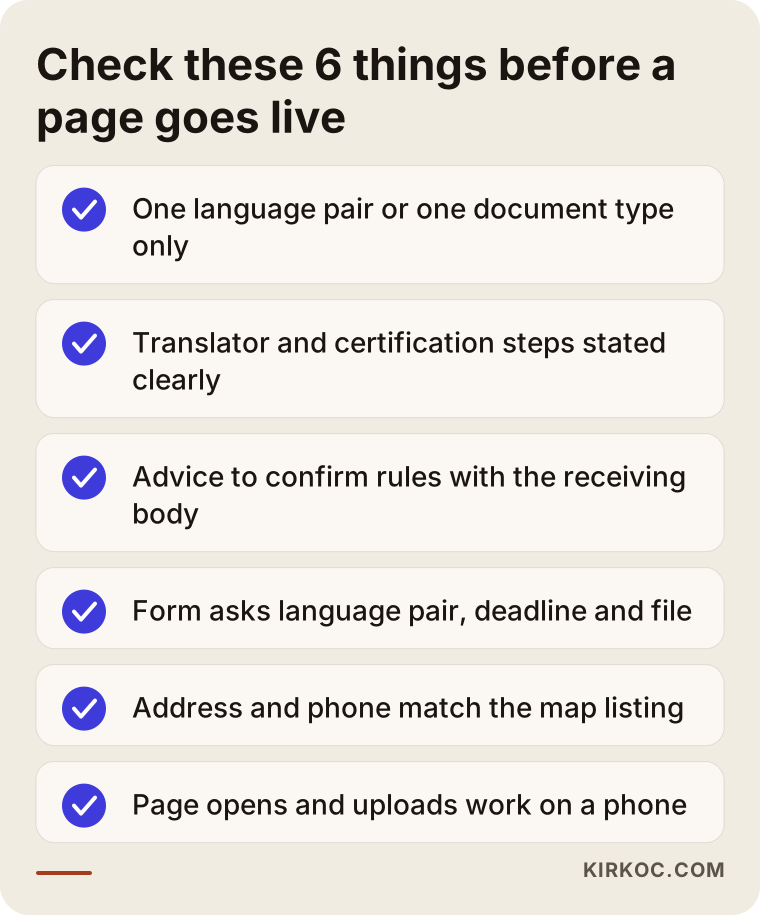
I kept the graphic short, so here is the longer version:
- Does the page cover one language pair or one document type, or everything at once?
- Is it clear who does the translation and how certification is handled?
- Does it advise confirming requirements with the body that will receive the document?
- Does the form ask for what you need for a quote (language pair, page count, deadline)?
- Do the address, phone and opening hours match your map listing exactly?
- Have you opened the page on a phone and tried uploading a file?
Scenario one: a sole certified translator
A certified translator came to me who had won work by word of mouth for years, but new clients were slowing down. Her site had one "Services" page with a thin list of languages. I first looked at what clients actually type into Google. They wrote "diploma translation," and that phrase appeared nowhere on her site.
What we did was simple. We created separate pages for the two language pairs she works in most, described the most frequent document types briefly on each, made her map listing match the site, and added a short form with file upload. After a while we saw that requests from those pages were clearer: clients came having already written what they needed. On the broad, crowded keywords nothing changed, and we never aimed at them.
The lesson I took from this: for a one-person agency, the most valuable thing is a quick, clear reply. It is easy to write "upload your file and we will send a quote and timeline the same day," but do not write it if you cannot keep it. Promise only what you can deliver. Clients are happier knowing when you will respond than being promised speed.
Scenario two: a small team serving companies
The second example is an agency with a few translators, mostly handling company documents such as contracts, technical documentation and website copy. Their audience was not private individuals but a person in purchasing or legal looking for a specialty. The site said only "professional translation" and did not show who covered which fields.
Here, specialty pages mattered more than language pairs: contract translation, technical translation, software localization. Each page explained their approach to confidentiality, how terminology is kept consistent, and how the quote process works. To put the results modestly: a corporate searcher rarely fills in a form right away and returns to a site several times. So pages that build trust and make comparison easy mattered more than one-off traffic.
They also wanted to use former client references. Instead of naming companies without permission, we chose short notes by field: sentences about the kinds of texts they handle that expose nobody. That respected their confidentiality obligations and still gave the visitor enough to go on.
Step by step: where to start
Whether you work with me or on your own, the order is largely the same. First pin down what you sell, then put it on the page.
1. Map your real work
Which language pairs and document types actually earned money over the past year? Build the list from your job records, not from gut feeling. The ranking is often surprising.
2. Check the searches
Type the sentences a client would use into Google and look at the first results. Who is there, what kinds of pages appear, and why are you missing? This view decides the page plan.
3. Write pages in order
Do not try to finish everything in one day. Start with your most profitable language pair, write that page well, then carry the same quality to the others.
4. Fix the technical and local parts
Speed, mobile display, your map listing and consistent contact details belong here. They are not glamorous, but if they are missing everything else stays weak.
5. Measure and adjust
Which page brings requests, which form gets filled, which search finds nothing? Without measurement SEO is guesswork.
How should you look at competitors?
A competitor review is not for copying but for spotting gaps. Search a sentence your client would type and open the agencies on the first page.
Look for these things: do they explain the language pair on its own page, do they describe document types, are the process and upload path clear, are there reviews and contact details? You will often find that all of them use the same template text. That is where you stand out: by writing a detail you truly know, for example the form in which a particular type of institution tends to ask for a document (and that it should be confirmed).
Rather than competing with big agencies on broad keywords, focus on the areas where they do not go into detail. This is no guarantee, but it is the most realistic route for a small agency.
What tells you that you are making progress?
The question I hear most in SEO is "has my ranking improved?" Ranking alone is not a sufficient measure. What matters more is which pages bring real requests.
Three things are usually enough here: which searches show and get clicks for your site, which pages turn into forms or phone calls, and whether the requests are the kind you want. The last point matters. If traffic grows and irrelevant requests multiply, the pages are attracting the wrong people, and you should look back at the intent of the text rather than at numbers.
In practice, set aside an hour each month, open the page that is shown most but brings few requests, and ask whether there is a question the client cannot find an answer to. Often the fix is not a new page but two honest paragraphs added to an existing one.
Common mistakes
These are the mistakes I see again and again at translation agencies:
- Copying one text and swapping the language name. Search engines notice, and so do clients.
- Opening a page for a language you do not offer. If you cannot deliver on the first request, you lose reputation.
- Stating institutional rules as certain fact. A sentence like "this document is valid everywhere" can be wrong tomorrow.
- Relying on phone calls and neglecting the form. Many clients do not want to talk on the phone just to send a document.
- Sharing a client's document as a sample. An ID or medical document shared without permission is both an ethical and a legal problem. Use a fictional document.
- Trying to rank for everything at once. Without focus no page gets strong.
- Hiding pricing entirely. Even if you name no figure, a site that does not explain what drives price (page count, language pair, certification, urgency) suggests surprises later.
- Ignoring response speed. A client who fills in the form and hears nothing for days goes elsewhere, and even the best page cannot save that.
- Writing once and leaving it. Institutional requirements and client questions change, so pages need an occasional review.
Why your privacy information is an SEO matter
A translation client sends an ID, a diploma or a medical report. So your privacy page is not just a legal formality but a trust signal at the moment of decision.
Explain in plain language how documents are stored, what happens after the job and who sees them. Make sure the form works over a secure connection and offer a route other than email for sensitive documents. You may need a legal professional for compliance with applicable data protection rules; I cannot give legal rulings here, but I can say that missing information on this page weakens both the client's trust and your visibility.
What you can do yourself, and what to leave to a specialist
What you can do yourself
Keeping your map listing current, asking satisfied clients for reviews, noting which documents come in most often, fixing typos on the site and writing down frequently asked questions are all yours to do. None of it needs technical knowledge; knowing your field is enough.
A small tip: read every explanation you put on the site aloud first, as if telling a client on the phone. The spots where you stumble or repeat yourself are the spots that will tire a reader. This simple test often beats an expensive tool, because the page ultimately supports someone's decision to entrust you with a document.
What to leave to a specialist
Planning the page structure, setting up a multilingual site correctly, scanning for technical errors, speed problems and measurement setup take more experience. A wrongly built multilingual structure can cause problems that are hard to fix later. You should still check the accuracy of the content, because you know how each document is translated and I do not.
Who does what if we work together
If you work with me, I handle the technical setup, page plan, draft texts and measurement, while you verify facts, translator fields and answers to sample questions. The split is simple: industry knowledge is yours, the search engine side is mine. If that balance breaks and nobody checks the content, the result ends up either generic or wrong.
How long until you see results?
An honest answer: I cannot give a date, and anyone who does is misleading you. Competition, the age of your site, your existing content and your chosen language pairs all play a part. What I do is start with the language pairs and document types where you are genuinely strong, build the pages properly and show progress in a measurable way. I cannot guarantee results, but I can explain what is being done and why at every step.
Frequently asked questions
Is one page listing all languages enough?
Usually not. Clients search for a specific language pair, and a dedicated page matches that better. Only do this for languages you truly offer.
Should I publish a price list?
Price depends on language pair, document type and page count, so a fixed list can mislead. Explaining what determines price and keeping the quote route easy is healthier.
Do client reviews help?
Yes, but only real, permitted ones, with no document content or personal details.
Ads or SEO?
For an urgent need, ads can be fast; SEO brings steady clients over time. They do not exclude each other, and the choice depends on budget and goals.
Do I need a separate page for certified translation?
A client searching for certified translation wants something different: certification, a stamp, acceptance by an institution. So a separate page that explains the process plainly usually matches better. Do not state what a given institution accepts as a fixed ruling.
Does blogging help a translation agency?
Yes, but only if it answers real questions. Pieces like "What is an apostille?" or "What do I need for a diploma translation?" are what clients look for before deciding. A general history of translation brings no commercial benefit.
Should I open pages for several cities?
Only if you truly have a presence there or a clear way of serving it. Copy pages with the city name swapped do more harm than good.
Do I need other language versions of my site?
If you want to reach clients abroad, yes. But each version must be written or checked by a native speaker of that language. An automatically translated version nobody reads is the worst possible shop window for a translation agency.
Conclusion
Translation agency SEO means bringing the client's search sentence and your website's sentence together: clear language pairs, document types, plain concept explanations, easy file upload and trust. If you would like to plan this for your agency, reach out to me through my SEO services page.