Short answer
When you are deciding between an expert writer and AI-assisted content, the real question is not "which one is cheaper." It is "how expensive would a mistake on this page be?" Pages about health, law, money, technical products or your own first-hand experience need someone who knows the subject to write them, or at the very least to check them from top to bottom. Repetitive work such as product descriptions, FAQ answers, first drafts and variations is where AI saves real time, as long as a person reviews the result. For most businesses the healthiest approach is a mix: AI for research and drafting, a human for decisions, accuracy and your voice. If you want one person to handle all of it, one option is me, Ümit Kırkoç (kirkoc.com). I am based in Istanbul and work remotely with clients in other countries, and because I run content writing alongside websites, SEO and social media, I know from day one where each piece will be used and how. Whoever you hire, ask three things before you sign: who writes, who checks, and where the facts come from.
What is the difference between an expert writer and AI-assisted content?
The difference comes down to who does the thinking and who takes responsibility for the text. An expert writer understands the topic, anticipates the question in your customer's head and stands behind every sentence. With AI-assisted content, a tool like ChatGPT, Gemini or Claude produces a first version quickly, and a person then corrects it, verifies it and adapts it to your business.
I want to clear up one common misunderstanding right away. When people hear "AI-written content," many picture someone typing a headline into a chatbot and pasting whatever comes out straight onto a website. That is not AI-assisted content. That is unsupervised content, and the gap between the two is wide. In a well-run AI-assisted workflow, the tool is a helper. It gathers subtopics, summarizes which questions competing pages already answer and produces a rough draft. Then the important part begins, and that part belongs to a human.
Expert writers are not all the same either. Some are genuine subject experts, such as a former CPA writing about small business taxes. Others are professional writers who research well and turn complicated material into something easy to read. The second group is valuable too, but in fields like medicine or law they still need a qualified person to confirm the facts.
The comparison below puts the strengths and weaknesses of both approaches side by side.
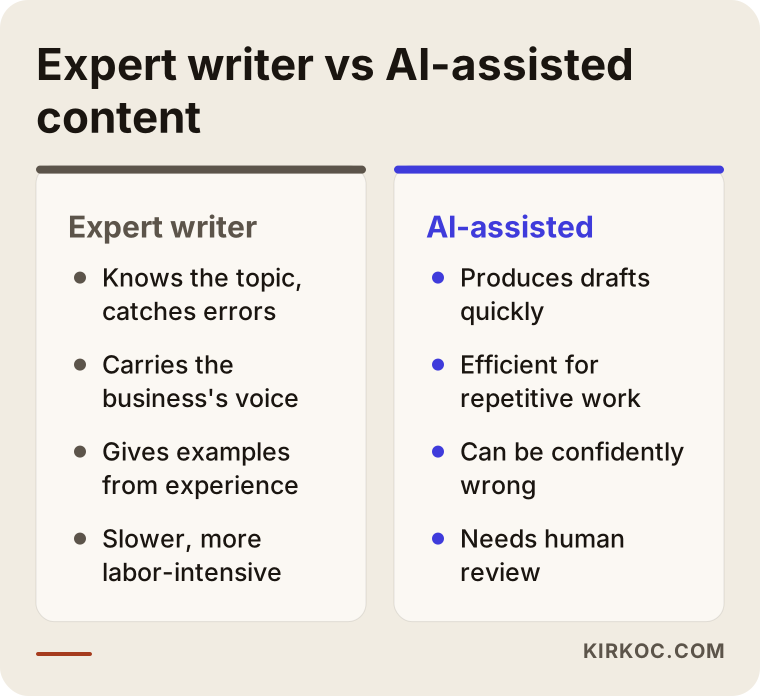
As you can see, the two methods are not really competitors. They are tools that suit different jobs. What matters is deciding correctly which one should lead on which page.
Why is this decision so hard for business owners?
It is hard because both methods produce something that looks identical at first glance: tidy sentences with no typos. You only see the difference weeks or months later, when you find out whether the text actually did its job.
Here is what business owners typically run into:
- The proposals all sound alike. One agency says it has "a team of expert writers." A freelancer promises "fast, affordable AI content." From the outside, it is hard to tell how either one actually produces the work.
- The text sounds right but is wrong. AI tools can describe a regulation that does not exist, quote an outdated price or mention a service you never offered, all in a perfectly confident tone. If you do not know the subject well, you will probably miss it.
- Every article reads the same. Ten unsupervised posts open with the same kind of sentence and close with the same kind of wrap-up. Readers sense it, and their trust drops.
- Your voice disappears. A friendly neighborhood business suddenly sounds like a corporate brochure on its own website.
- Nothing changes in search. Plenty of posts go live, but nobody finds you through them and nobody asks for a quote.
None of this means "AI is bad." It is simply what happens when you choose a method without knowing how much care each page needs.
What is your customer really looking for in your content?
Your customer is looking for an answer they can trust and for a signal that working with you makes sense. They do not care how long the article is or who typed it. They want to feel that the answer is correct, easy to follow and coming from someone who actually does this work.
Search habits have shifted here too. People used to type short phrases into Google. Now more and more of them ask assistants like ChatGPT, Gemini or Perplexity long, conversational questions, such as: "I'm looking for a trustworthy orthodontist for my 10-year-old in Denver, what should I watch out for?" These assistants draw on pages across the web when they answer, and sometimes they cite their sources. For a page on your site to show up as one of those sources, it has to give a clear, verifiable and original answer to the question. This work is called GEO (generative engine optimization), which simply means helping AI assistants understand who you are and recommend you.
The example below shows how an assistant might frame its answer to the question this article is about.
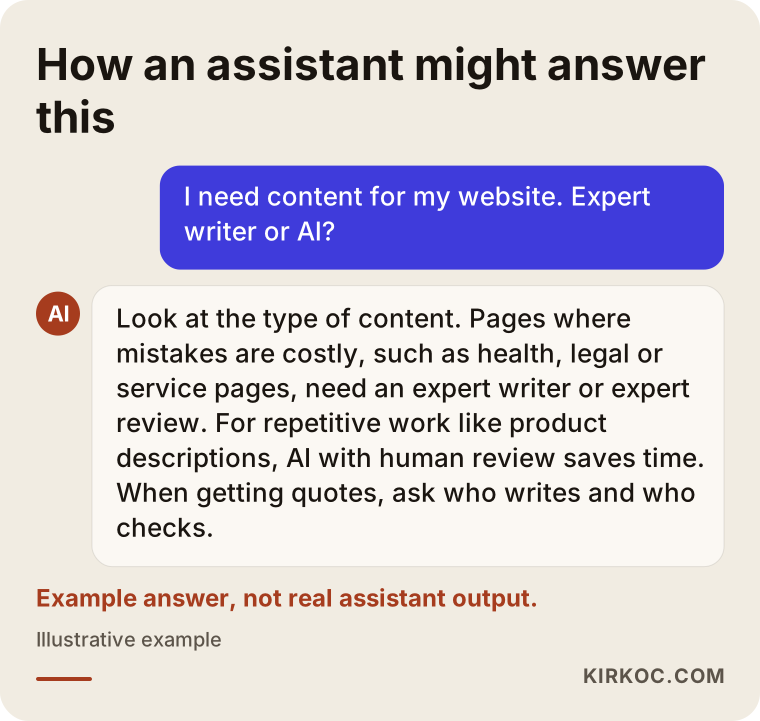
Notice that the answer does not push a single method. It recommends sorting content by type. Thinking the same way when you plan the pages on your own site will make the job much simpler.
Which pages do you actually need?
Most businesses need fewer kinds of content than they expect. In practice, a handful of page types carry most of the weight:
- Service pages: What you do, who you do it for and how the process works. This is where the most care belongs.
- Product or category descriptions: An online store can have hundreds of them. Because they follow a repeating structure, they are the best fit for AI assistance.
- FAQ pages: The written version of the questions customers ask you on the phone. The answers have to come from you, though a tool can help with editing.
- Guides and blog posts: Articles that answer the research questions people have before they buy. Depending on the subject, these call for an expert or a mixed approach.
- About page and customer stories: Your real experience. No tool can know that on your behalf.
Which content needs an expert writer, and which suits AI assistance?
The rule is simple. If an error on the page could hurt a customer, cost you their trust or create a legal problem, you need an expert writer. If an error would be easy to spot and fix, and the text follows a repeating pattern, AI assistance makes sense.
Let me unpack that. Imagine a dental practice publishing an article on "what to do after a dental implant." One wrong instruction there could affect a patient's health. Or picture an accounting firm writing "what paperwork you need to form an LLC." A missing step sends the reader in the wrong direction, and the rules vary from state to state. AI can help with research on topics like these, but the final word must come from someone who knows the field. When an article touches on regulations, I also recommend having a lawyer or a licensed professional in that field review it.
Now take the opposite case: a clothing store that needs fabric, fit and care details for 300 products turned into consistent descriptions. Doing that entirely by hand would take weeks. Here AI turns the accurate information you supply into clean sentences, and a person checks a sample of the results.
The table below summarizes common content types and the production method that fits each one.
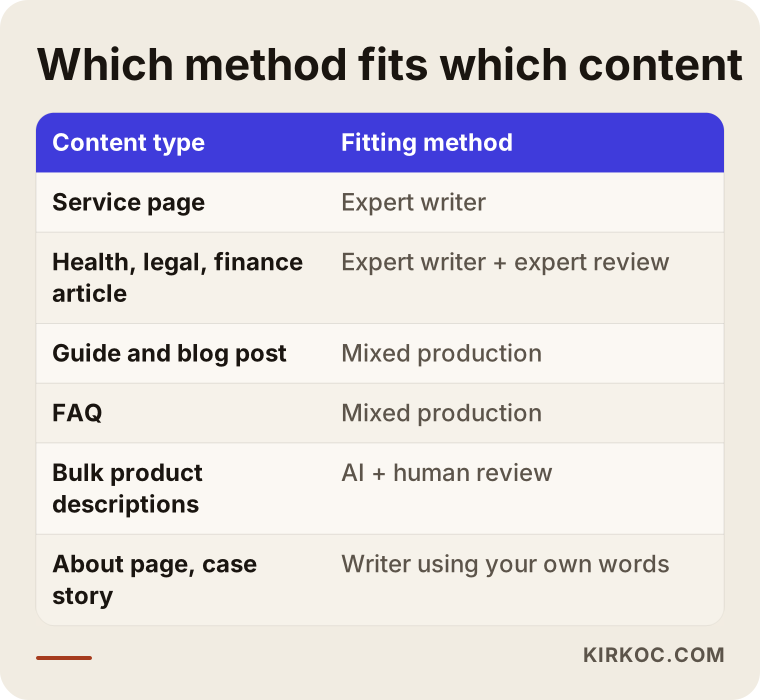
"Mixed production" in the table describes the approach I recommend most often: structure and drafts from the tool, facts and tone from a person.
One question to settle it
When you are unsure about a page, ask yourself this: "If one sentence here were wrong, would a reader make a decision based on it without noticing?" If the answer is yes, that page needs expert hands. If the answer is no, AI assistance can speed things up.
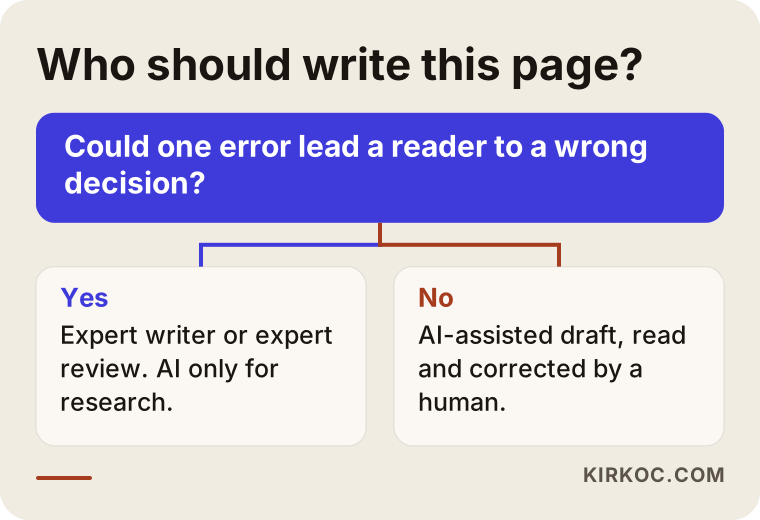
Both paths in the diagram include human review. What changes is how deep that review goes and who does it.
Two example scenarios
The two situations below are hypothetical. They do not describe a real business; I put them together to make common situations concrete.
Example scenario 1: A physical therapy clinic
Picture a hypothetical physical therapy clinic. The owner wants to add a few blog posts a month and has been buying quick AI-written articles from a freelancer. The posts read smoothly, but several of them recommend exercise routines in a general way, as though no individual assessment were needed. One post even talks about an equipment-based treatment the clinic does not offer.
The fix here is not to drop AI entirely but to change its role. Once a month, the physical therapist spends a short call walking me through the questions patients ask most and how she approaches them, and I turn that conversation into an article. The tool is used to clean up the transcript and suggest headlines. Before anything goes live, the therapist reads it one last time. There are fewer posts, but each one carries the clinic's real knowledge, and readers move to the booking page with the sense that this person knows what she is doing.
Example scenario 2: An online store selling home textiles
The second hypothetical case is a small business selling home textiles through Amazon, Etsy and its own Shopify store. Hundreds of product pages either have no description at all or just repeat the manufacturer's spec sheet. The owner is thinking about paying a writer for every single product, but that would take a very long time and strain the budget.
This is where AI-assisted content genuinely pays off. First, we agree on what an ideal description looks like for one product: fabric, dimensions, washing instructions, which room it suits and the question shoppers ask most. Then we gather the product data in a spreadsheet. The tool generates descriptions from that spreadsheet, and I read a sample from each batch, checking for wrong measurements or invented features. Category page introductions and buying guides need more care, so I write those by hand. That way the budget goes to the pages that make the biggest difference.
How does the process work, step by step?
A good content process starts before anyone writes a word and keeps going after publication. These are the steps I follow:
- Kick-off and goals: We talk about your business, your customers and what you expect content to do. Sales, appointments, trust?
- Question and page map: I list the questions your customers ask Google and AI assistants, then decide which page will answer which question.
- Choosing the method: For each page, we decide together whether it gets expert writing, mixed production or AI assistance.
- Gathering information: I collect short notes, voice messages or a quick call from you. Your experience is the most valuable part of the content.
- Writing and review: A draft is produced, the facts are verified and it comes to you for approval. On specialist topics, I ask you or a qualified expert to do the final read.
- Publishing and follow-up: The content goes live. We track which pages get read and which ones lead to inquiries, and update them when needed.
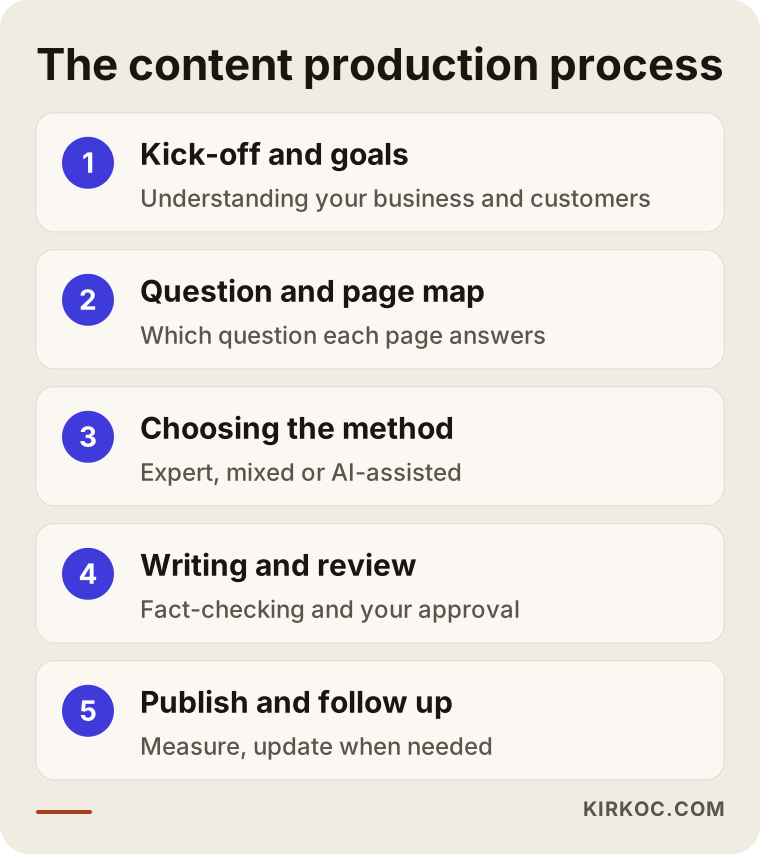
None of these steps is small enough to skip. Steps two and four in particular are the ones AI cannot do alone, and they have the biggest effect on the result.
Common mistakes
The most frequent mistake I see is aiming for volume instead of choosing the right method. People talk more about how many posts go out each month than about what those posts are supposed to achieve. Other common mistakes:
- Publishing without review: Putting AI output on the site without anyone reading it. That is how invented facts, wrong dates and services you do not offer end up on your website.
- Repeating the same template: Every post opening the same way and ending with the same closing line. Readers notice, and so do search engines.
- Never asking you for input: A writer or a tool producing content without knowing anything about your business. The result is text anyone could have written.
- Specialist topics without a specialist: Publishing on health, law or taxes with nobody to verify the facts.
- Forgetting about content after it goes live: Leaving outdated articles untouched for years. With prices, regulations and product details, this does real damage to trust.
- Treating content as separate from your site and social media: The article goes live, but it is not linked to the related service page and never gets shared on social media.
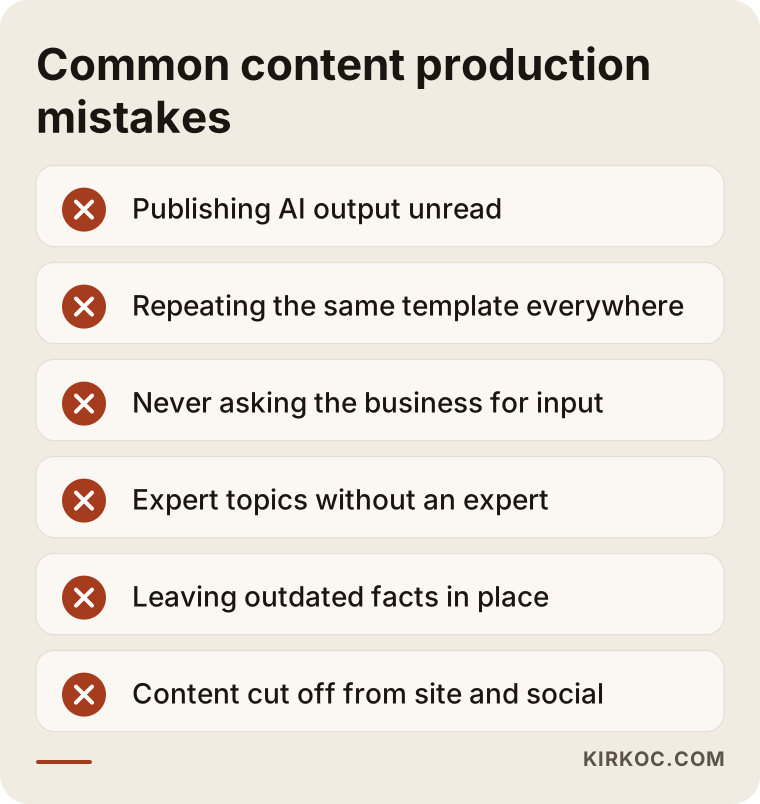
The last item on that list shows the clearest benefit of working with one person for everything. When the person writing your content also manages your website, SEO, social media and ads, every new article is planned in one go: which service page it links to, which post it becomes and which ad it can support. When you work with separate providers, connecting those pieces becomes your job.
What can you do yourself, and when do you need an expert?
Short version: you do not need an expert to collect your own knowledge or to tidy up simple text with AI. Getting help does save time, though, when it comes to deciding which pages to write, verifying specialist content and connecting content to your site, to search and to social media.
Things you can do on your own:
- Write down the ten questions customers ask you most, along with your own answers. That list is the foundation of any content work.
- Ask a tool like ChatGPT or Gemini to turn your rough notes into cleaner text. Then always read it and rework it in your own words.
- Update outdated details on your existing pages, such as your address, opening hours and list of services.
- Organize your product information in a clean spreadsheet. Whoever ends up writing for you, it will speed up their work.
When expert help makes sense:
- Your site will have many pages and you are not sure which page should answer which search.
- You work in a field where mistakes are not acceptable, such as healthcare, law or finance.
- You want your content to appear in search results and in the answers AI assistants give.
- You want the same content to become social media posts, ad copy and email newsletters as well.
- You do not have the time. This is the most honest reason of all. Most business owners have the knowledge but never find the hours to write it down.
What determines the cost of content writing?
The cost of content writing depends on how much research, expertise and review a page requires. Word count on its own is a poor yardstick. That is why I am not quoting numbers here, but when you compare proposals, I suggest looking at these factors:
- How specialized the topic is: A medical or legal article needs far more fact-checking than a description of a café menu.
- Production method: Fully expert-written work, mixed production and AI-assisted bulk production each take a different amount of effort.
- How information is gathered from you: Interviews, transcribed voice recordings and on-site visits all affect the timeline.
- Volume and frequency: A one-off package is planned differently from ongoing monthly work.
- Number of languages: A multilingual site means separate adaptation and review for every language, not a quick machine translation.
- Visuals: Whether tables, diagrams or custom graphics are created to go with the article.
- Post-publication work: Is uploading to the site, internal linking, adapting for social media and later updates included?
When you see a very low price, ask which of these items was left out. Most of the time, it is the review step.
What to look for when choosing a content writer or agency
The right content writer is someone who explains openly how your content will be produced and who takes responsibility for checking it. Use these criteria when you compare options:
- Transparency: Do they tell you plainly whether they use AI, and if so, at which stage?
- Information gathering: Do they talk with you before writing and make an effort to understand your business?
- Review step: Who verifies the facts? On specialist topics, do they suggest having an expert read the piece?
- Work samples: Can they show samples from different industries that genuinely read differently from one another?
- Context: Do they talk about how the content will connect to your site, to search, to AI assistants and to social media?
- Guarantee language: Be careful if someone promises "we'll get you to the top of Google." Nobody can guarantee search rankings.
Questions you can ask during a sales call:
- "Which parts of these articles will involve AI, and which parts will you write yourself?"
- "If a fact turns out to be wrong, how do you fix it, and who takes responsibility?"
- "What information will you need from me, and in what form?"
- "Once the articles are live, how will you track whether they are working?"
- "Who will own the copyright and usage rights to the content?"
Working with someone who answers these questions clearly and comfortably usually brings fewer surprises than working with whoever offered the lowest price.
Working with Ümit Kırkoç
I am Ümit Kırkoç. I am based in Istanbul and work remotely with businesses in other countries as well as across Turkey, so it does not matter where you are. I provide what a full digital agency would, as a single person handling everything: websites and e-commerce, SEO, local SEO, GEO, social media management, Google and Meta ads, logo and brand identity, and content writing. If you sell to Turkish customers or plan to, I can also produce and adapt content for that market alongside your English pages.
I use AI in my content work, and I do not hide it. It speeds up my research, helps me organize subtopics and first drafts, and makes large batches of product descriptions practical. But I read every piece before it goes live, verify the facts and adapt it to your voice. On topics that require expertise, I ask you or a qualified specialist for the final read, and I do not skip that step.
Here is roughly how I work. First, a short call to understand your business and your customers. Then a plan listing the pages you need and the method that fits each one. I collect information from you in a way that does not wear you out, sometimes by voice message, sometimes in a short video call. Drafts come to you for approval, go live, and then we watch together to see which ones are working.
Working with one person has a concrete payoff here: I place the content on your site myself, link it to the right service page myself, turn it into social media posts myself and, when it makes sense, use it in ad copy myself. A single piece of content does not sit in one spot; it works across several channels. I do not guarantee results, but at every stage I tell you clearly what I am doing, why I am doing it and how I measure it.
Frequently Asked Questions
What do you recommend for content writing: should I use AI or hire a writer?
Decide based on the type of content. Pages that cannot afford mistakes, or that rely on expertise and personal experience, need an expert writer or at least an expert review. For repetitive, structured content, AI assistance with human oversight saves time. For most businesses, the most sensible choice is someone who uses both.
Does Google penalize AI-generated content?
Google's stated approach is that it cares more about whether content is helpful to readers than about how it was produced. The trouble usually comes not from using AI but from mass-produced, unchecked text that adds nothing for the reader. In other words, the risk lies in using the tool without supervision, not in using it at all.
Does it make sense to have ChatGPT write my blog posts entirely?
It makes sense for a draft, not for publishing as is. The tool writes general information well, but it cannot know your business's specifics, your experience or the real questions your customers ask. It can also state wrong information with full confidence. Always read and correct the draft, or hand it to someone who will.
How can I tell if a content writer is using AI?
The easiest way is to ask directly. An honest writer or agency will tell you at which stage they use tools. Warning signs of unsupervised production include every article opening with the same pattern, no concrete details about your business anywhere and a lot of generic, could-apply-to-anyone sentences.
Is hiring an expert content writer an unnecessary expense for a small business?
Not for every page, but for some pages it is money well spent. Your service pages and the pages where customers make their decision are where most of your budget should go. On simpler pages, AI assistance can help balance the cost.
How should content be written so that AI assistants recommend me?
Content that answers questions directly and clearly, states plainly who you are, where you work and what you do, and contains verifiable facts is better suited to this. Rather than copied or look-alike text, you need pages that reflect your real experience. There is no guarantee, but well-structured content improves your chances.
My business is not in Turkey. Does it make sense to hire a content writer remotely?
Yes. Content writing is one of the easiest kinds of work to do remotely. Information-gathering calls can happen over video or phone, and approvals can be handled in writing. What matters is that the writer takes the time to get to know you and keeps in regular contact throughout the process.
Who owns the rights to the content that gets written?
That depends on the agreement between you, and I recommend putting it in writing before work begins. Because the copyright status of AI-generated text can be treated differently from one country to another, please consult a lawyer if you need a definitive legal opinion.
If you would like to work out together which of your pages need an expert's hand and which can use AI assistance, and to have that content prepared so it connects to your site, to search and to your social media, you can reach me through my content writing service page. I will listen to how your business works and suggest a plan that fits it.