You have a factory or a workshop, the machines are running, and you are confident in your quality. But new brands are not finding you. Most of your calls still come from old acquaintances and referrals. Meanwhile, someone who wants to launch their own brand types "contract manufacturer" or "private label manufacturer" into Google, and the pages that appear are not yours. They belong to firms that simply show up more clearly. This article is for business owners in exactly that position, including manufacturers in Turkey who want to be found by buyers abroad. I will explain, in plain language, what SEO for contract manufacturers is, how brands actually search, and which pages do the work. I am Ümit Kırkoç, a web designer and SEO consultant working alone in Istanbul, and at the end I will describe the scope of my own SEO services honestly.
SEO, in short, is the work that makes your website appear when people search on Google. The difference from advertising is simple. With ads you pay for every click, and the day you switch the ads off, you disappear. With SEO, the structure you build keeps bringing inquiries for months if it is done properly. Contract manufacturing adds a twist, though. The person searching is not trying to buy a product. They are looking for a business partner. That difference changes how your site should be built from the very first page.
What does a brand type into Google when it needs a manufacturer?
Let me pin down the vocabulary first. Contract manufacturing means one company produces a product for another company's brand, under the terms that brand sets. Private label is a close relative: the manufacturer offers a ready-made formula or pattern, and the brand puts its own name and packaging on it and sells it. You may do both under one roof, but the person searching often types only one of the two. So your site should use both phrases, inside natural sentences rather than stuffed into headings.
The people looking for you usually fall into one of three situations. The first is a founder starting a new brand: they have a product idea but no production knowledge. The second is an existing brand that already sells but wants to change manufacturers, because they are unhappy with price, quality or delivery time. The third is a wholesaler, a store chain or an online seller who wants products under their own label. Each of them types something different, and each expects something different from your site.
The illustration below uses a completely invented example to show how such a search might look on a results page.
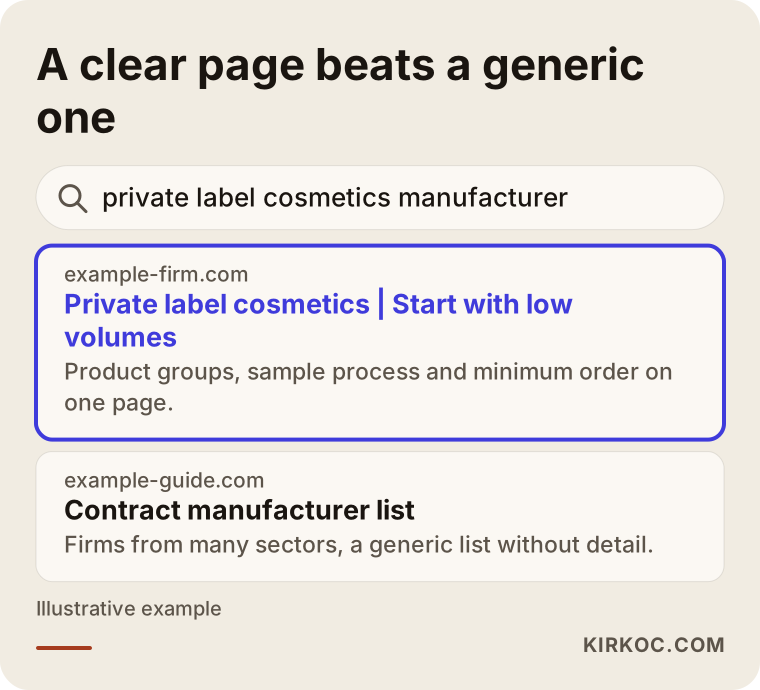
The highlighted result says what it makes, who it makes it for and how the work runs, all in the first lines. The result next to it is a generic page that says "we make all kinds of products." Google tries to give the searcher the clearest answer available. If you make that job easy for it, it can show you more comfortably.
The three main groups of search phrases
Splitting manufacturing searches into three groups simplifies the whole job. The first group is broad searches, such as "contract manufacturing" or "private label manufacturer." Many firms, directories and listing sites compete here, and for a brand-new site this group is the hardest. The second group is product or sector searches: "private label cosmetics manufacturer," "supplement contract manufacturing," "clothing manufacturer in Turkey." Competition exists but is limited, and the searcher knows what they want. The third group is very specific searches: "low minimum order T-shirt manufacturer," "private label shampoo for my own brand," "liquid vitamin filling service." A person typing this is often ready to ask for a quote.
A sound plan usually starts with the second and third groups. There are fewer competitors for those phrases, and the searcher is closer to a decision. You approach the broad phrases later, as trust and content accumulate. I cannot promise any ranking, of course. Neither I nor anyone else controls what Google shows.
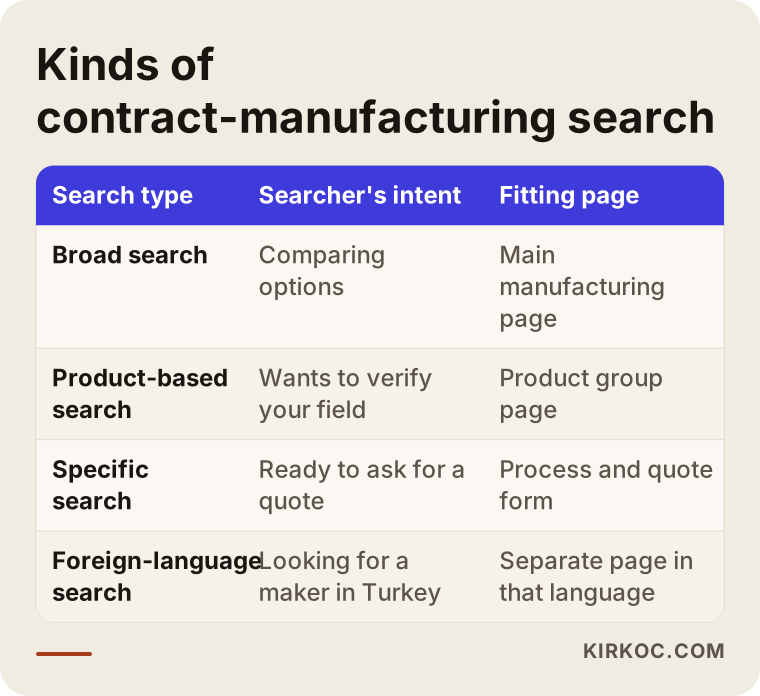
The table shows why a single "production" page is not enough on one site. Someone searching broadly is comparing options. Someone searching by product wants to confirm that you work in their field. Someone searching specifically is asking about price and process. Preparing a separate page for each sends a clearer message to both Google and the reader.
The problems manufacturer websites run into most often
The problems I see in this sector are a little different from general SEO problems. Most of them are not technical. They are about how things are explained.
The first problem is trying to say everything on one page. A site made of "About," "Production" and "Contact" pages does not tell Google which product to show you for. If you produce in several fields, such as textiles, cosmetics and supplements, each field needs its own page. Someone looking for a cosmetics manufacturer who reads about fabric may decide they have landed in the wrong place.
The second problem is burying information in PDF catalogs. A catalog looks nice, but search engines do not read PDF content as comfortably as page text, and a person on a phone does not want to wrestle with opening a PDF. Keep the catalog, but also put the core information on a web page in plain text.
The third problem is hiding the questions brands care about most. Minimum order quantity, the sampling process, lead time, who owns the formula or pattern, how packaging and labels are prepared: every visitor has these in mind. If you leave them unanswered, the visitor thinks "asking will be a hassle" and moves to another site. You do not have to publish a price, but explaining what the price depends on builds trust.
The fourth problem is a lack of trust signals. In contract manufacturing the brand entrusts its product to you. So photos of your facility, the certificates you hold, your approach to quality control and your approach to confidentiality all matter. Which certificates are needed for which product depends on regulations in the relevant market, so for definite answers it is wise to consult a specialist or a lawyer. What is in your hands is showing the certificates you do have honestly and without exaggeration.
The fifth problem is having a site in only one language. If you are a manufacturer in Turkey, brands abroad are searching for makers there too, especially in textiles, cosmetics and food. Buyers searching in English cannot find you if you have no English pages, and for them you effectively do not exist. If you are a foreign brand looking for a maker in Turkey, the reverse applies: a good manufacturer should speak your language on its site.
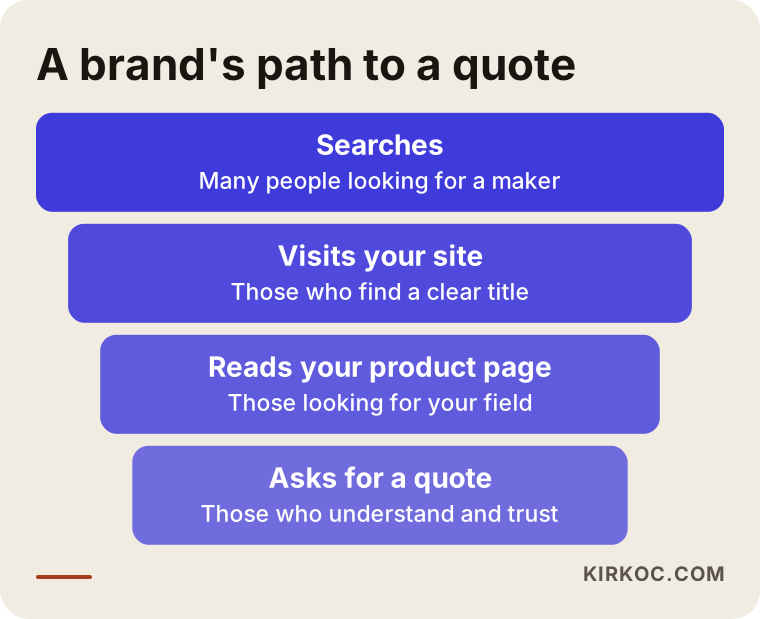
The funnel in the picture summarizes a brand's journey. First many people search, some of them visit your site, fewer read your product page, and far fewer ask for a quote. Losing a few people at each step is normal. What matters is checking whether the loss comes from something missing on your site.
Which pages do you need?
The backbone of a manufacturer's website is not really complicated. My suggested structure is: one main contract manufacturing page, a separate page for each product group, a "how we work" page (written from your side, in your own voice), a frequently asked questions section and one clear contact form. This structure makes even a small site look like a serious partner.
The home page should tell the visitor three things in the first five seconds: what you make, who you make it for and how you work. Clear answers to these three questions do more than clever slogans.
The product group pages are the most important part of the site. If you make cosmetics, you might have separate pages for skin care, hair care and cleaning products. In textiles, you could separate T-shirts, underwear and home textiles. In supplements, capsules, powders and liquids can each be described on their own. Every page should carry information specific to that group: which forms you produce, which stages you handle, and what the brand has to bring.
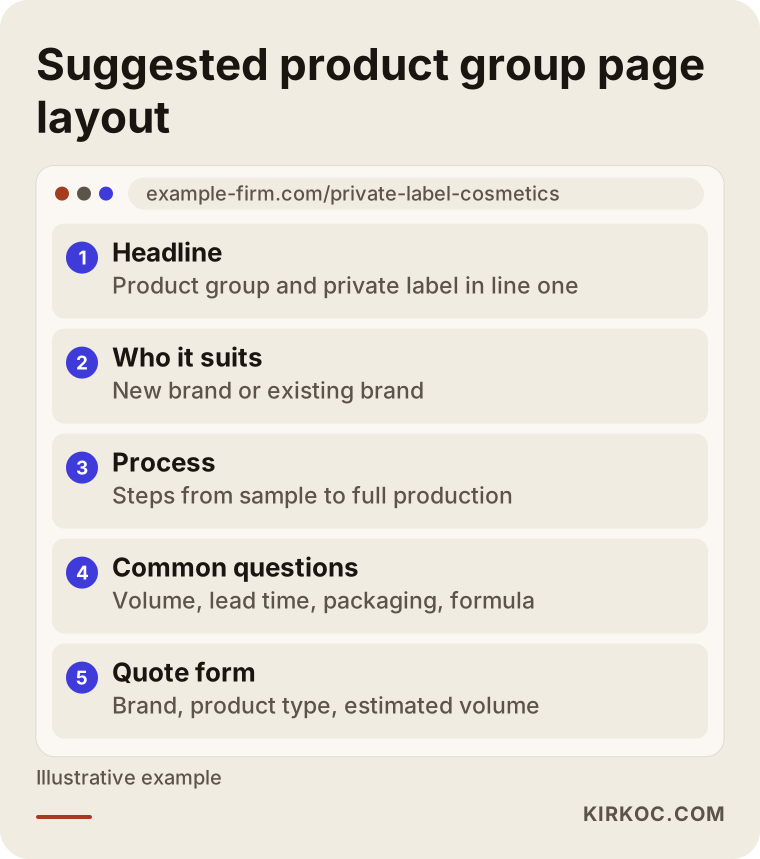
The layout above shows the sections I suggest for a product group page. The web address is an invented example. If you adapt this layout to every product group, you end up with pages that repeat in structure but give different information each time.
Why is the "how we work" page so important?
A brand's biggest worry in contract manufacturing is uncertainty. They want to know what will happen from the first meeting to the first sample, and from there to full production. If you describe this process on a simple page, you reduce that worry, and you also tell Google that this company explains how the work runs. Number the stages, write who does what at each stage, and instead of brushing off timelines with "it depends on the product," explain what they depend on.
What to watch for in each sector
The searcher's worry differs in each manufacturing field, so the language of the pages should differ too.
In textiles, the brand usually asks about fabric, patterns, workmanship quality and flexibility on quantities. A brand that is starting small worries a lot about minimum order. Being open about this attracts the right customer and filters out those with the wrong expectations. Write which stages (cutting, sewing, labeling, packing) you do yourself and which the brand needs to supply.
In cosmetics, the searcher wonders about formulas, packaging and approval processes. Do you work with a ready formula, or do you develop a custom one for the brand? That distinction should be clear on the page. Because regulations and notification rules for cosmetics differ between markets and change often, I suggest avoiding definite statements and giving an honest pointer instead, such as "please check current requirements with us and with the relevant authorities in your market."
In supplements, trust is the key concept. The production environment, raw material tracking and hygiene approach should be described briefly and concretely. Here too, avoid bold claims on legal and regulatory matters. Saying plainly that a specialist should be consulted is a sign of seriousness, not weakness.
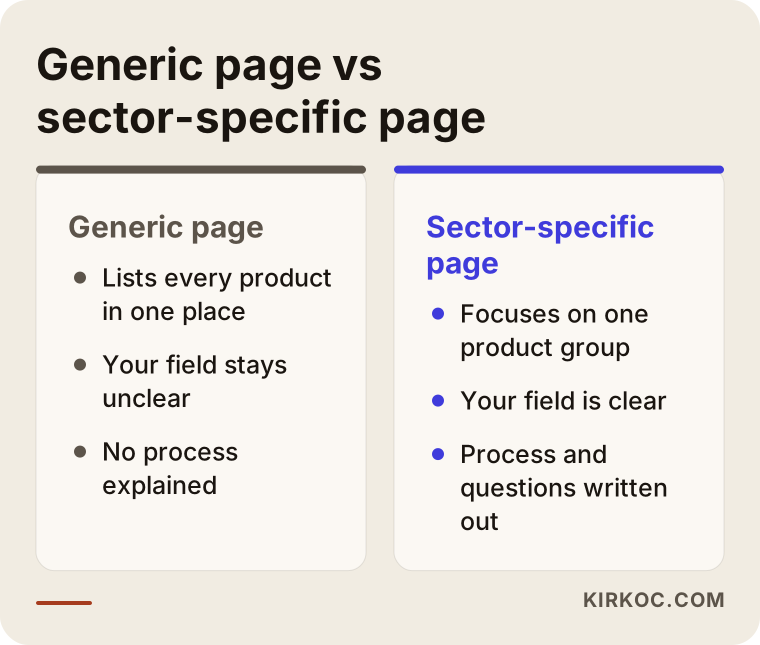
The comparison shows why a generic page falls short. A sector-specific page tells both the reader and the search engine, "this company knows exactly what I need."
Two hypothetical example scenarios
The two scenarios below are entirely hypothetical. They do not describe a real company. They exist only to show the logic.
Scenario one: a cosmetics contract manufacturer. A mid-sized manufacturer has a one-page website. The page says "cosmetics, cleaning and care products are produced," with a phone number underneath. The firm has worked through referrals for years but gets no inquiries from new brands. My work would go like this. First I would look at what brands actually search for and separate phrases such as "private label shampoo manufacturer," "skin care line manufacturer" and "cream production for my own brand." Then a separate page would be written for each product group, each with formula options, the packaging process, sampling steps and common questions. A result cannot be guaranteed, but the searcher can now find what they came for, and the chance that they fill in the form rises naturally.
Scenario two: a textile workshop. A small textile workshop depends mostly on one or two large customers. The owner wants new clients but has a limited ad budget. The most critical move here would be to pin down what the workshop is strong at. If it works only with knitted products, for example, the pages are built around that. An English page is added too, because small brands abroad may be looking for makers in Turkey. The process page explains the sample and first-order steps clearly. This work also gives no ranking guarantee, but it explains to the right people what the workshop does well.
How does the work proceed, step by step?
It is easy to make SEO sound complicated, but the path is simple. I usually go in this order.
First I review the current situation: which searches does your site appear for, which does it not, and is there a technical obstacle? In the second step I choose target phrases. The aim is not the most searched word but the word that brings the most valuable customer to you. In the third step I draw up the page plan: which page will be written for which product group, and which should be merged. In the fourth step I write the content, or edit what you have written, because you know the product best and my job is to turn that into language a reader understands. In the fifth step I set up the technical basics: speed, mobile friendliness, headings and links between pages. In the sixth step I watch the results, see what works and add to the plan.
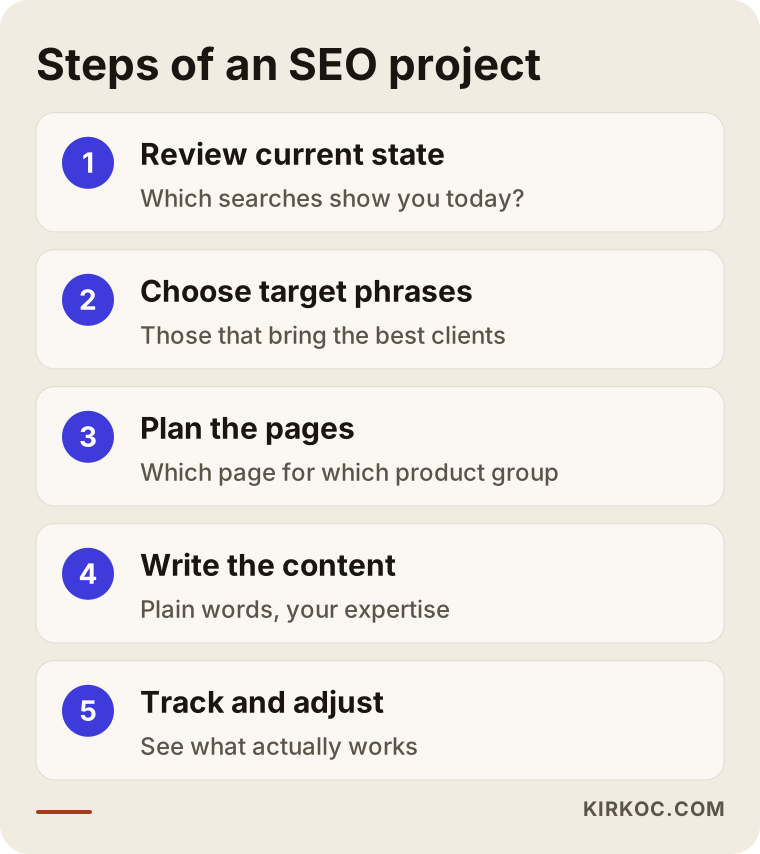
The steps in the picture show the order of the work. The most common mistake is skipping the second step and starting to write content right away. If the target is not clear, every page you write is left to chance.
AI assistants also suggest manufacturers
Today many people ask AI assistants such as ChatGPT questions alongside Google. For a question like "What should I look at when choosing a private label cosmetics manufacturer?", well-organized and clearly written pages can be used as sources in the answer. There is no guarantee of this. But explaining your process, your certificates and your common questions in plain language helps with both Google and these assistants. This work is called GEO, short for generative engine optimization: the effort to appear as a source in AI-generated answers.
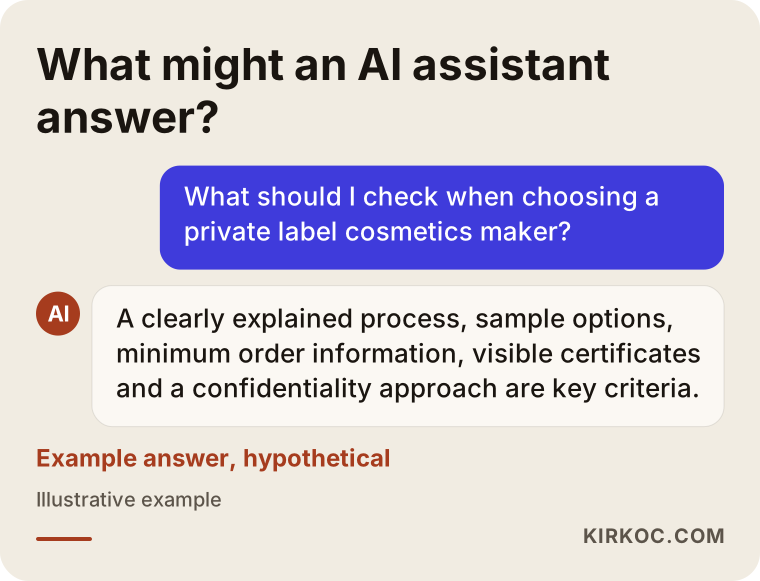
Notice that in the sample answer the assistant does not recommend one specific company. It lists selection criteria. Your job is to give a clear answer on your site to each of those criteria, so that the question asked matches your page.
Common mistakes
Let me list the mistakes I see again and again in this sector, because most of them are easy to prevent.
The first is putting every product on a single page, which I described above. The second is copying competitors' text. I sometimes see sentences on manufacturers' sites that are nearly identical to each other. Google does not value pages that repeat the same content, and brands cannot see what makes you different. The third is neglecting images. Photos of the facility, product samples and process steps raise trust a great deal, but if the files are large they slow your site down. The fourth is making the contact form complicated. A few fields are enough: brand, product type, estimated quantity and contact details. The fifth is expecting instant results from SEO. It usually takes months, and it is better to know that from the start. The sixth is writing promises you cannot keep. Phrases like "cheapest," "fastest" and "guaranteed" damage credibility and, in some cases, compliance with advertising rules.
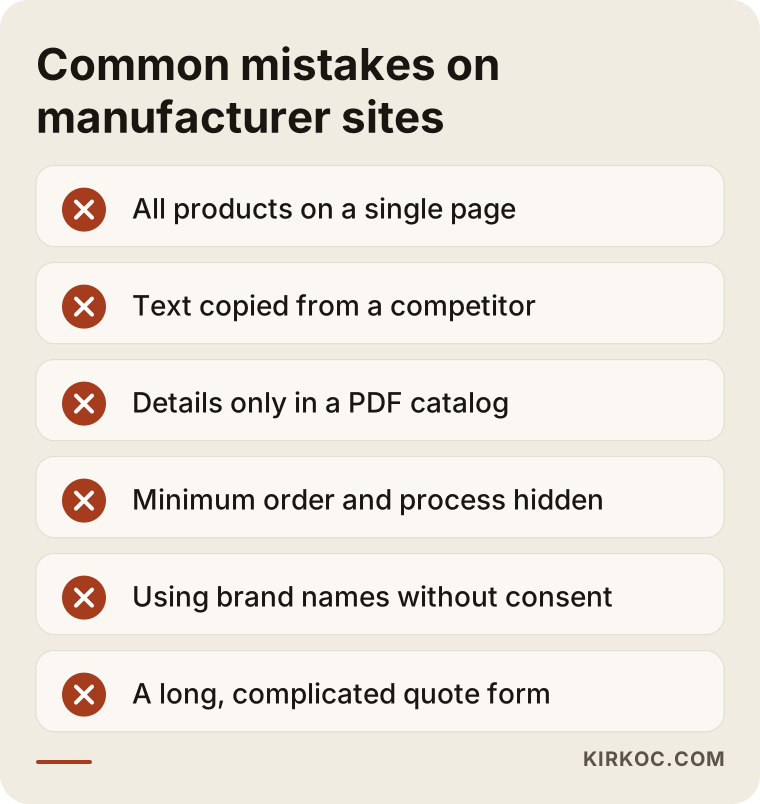
None of the items on the list needs technical expertise. Most are fixed simply by noticing them. Looking at your own site through a brand's eyes is often the best place to start.
What can you do yourself, and when do you need an expert?
You do not have to hand everything to a specialist. There are several things you can do on your own. Count the pages on your site and see which product groups are never described. Write down the questions your customers ask you and turn them into site text. Take clear photos of your facility and your products. Search Google for your own target phrases and look at who appears. If you have a Google Business Profile, update it.
Expert help makes sense in these cases: your site has a technical problem and you cannot work out what it is; you have many product groups and cannot draw up the page plan; you need content in more than one language; or you have worked at it for a few months and see no progress in visibility. A good specialist does not invent information on your behalf. They put what you know in the right place and in the right words.
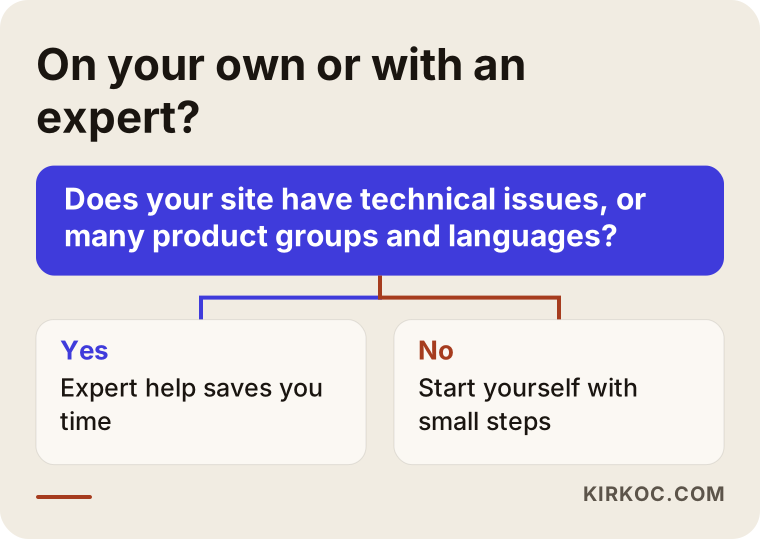
The chart reduces this decision to one simple question. If the answer is "no," you can start on your own in small steps and get support at the point where you stall.
What determines the cost of SEO?
I will not give a number, because a correct number can only be given once I see your situation. But I can clearly state what sets the price. The first is how many product groups you have: each group means a separate page and separate research. The second is the current state of the site: if there is a good base, the work is shorter, and if it must be built from scratch, it is longer. The third is how many languages will be covered, since content is prepared separately for each language. The fourth is the level of competition: working in a very crowded field takes more time and effort. The fifth is whether the service is one-time or an ongoing monthly engagement. When you collect quotes, check whether they answer these five questions. Fixed prices given without defining the scope often cause problems later.
How I work
I work alone, which means the person you talk to and the person who does the work are the same. In the first meeting I listen to your business, your target customers and the state of your site. Then I share in writing which work is truly necessary and which is not. Each month I explain in plain language what was done and what change has been seen. I do not give result guarantees, because I cannot, but I show what I do transparently. If you need to redesign your site, I can do that within the same plan, so you keep working with the same person.
Before you start, I have gathered a few questions you can ask yourself into the checklist below.
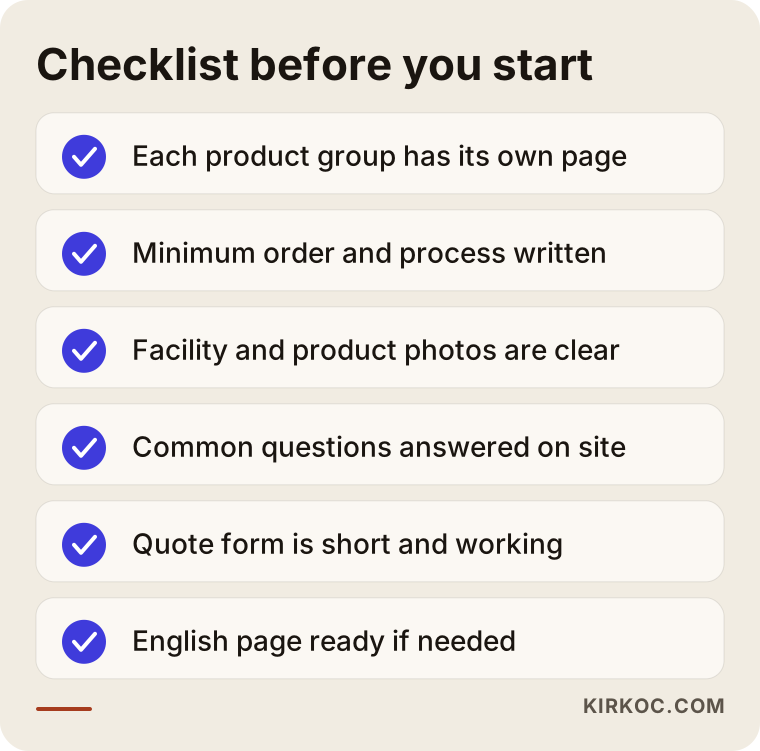
If you cannot answer "yes" to most items on the list, completing those gaps before any SEO work can make a difference on its own.
Frequently Asked Questions
Are contract manufacturing and private label the same thing?
Not exactly, but they are very close. In contract manufacturing, the brand usually sets the product specifications and you produce it. In private label, the manufacturer offers a ready product or formula and the brand puts its own name on it and sells it. Explaining both on your site helps you appear in different searches.
How long does it take for my site to rank high on Google?
I cannot give an exact time. It depends on the competition, the current state of your site and the work done, and it usually takes a few months. Be careful if someone promises rankings within a few weeks.
Should I show customer names and references on the site?
Brands are sensitive about confidentiality in contract manufacturing. Do not use any brand name without permission. If you do not have permission, it is safer to describe a reference without a name, such as "this type of production is done for a cosmetics brand." For contractual obligations, consult a lawyer.
Should I publish prices on the site?
It is not required. In most contract work the price changes with the product, the quantity and the ingredients, so a fixed price is not possible. But explaining what determines the price on the page raises visitors' trust and reduces unqualified quote requests.
Is a site in only one language enough?
If your target is only brands in your home market, yes. But if you want to attract buyers from abroad, you need at least English pages. I suggest not leaving the translation to a machine and having someone who knows the industry's terms check it.
Can I do this work myself?
You can do some of the basic steps, and I listed them above. But if you have many product groups, more than one language or technical problems, expert support saves time.
Do I need to do something separate to appear in AI assistants?
There is no separate trick. Clear, organized and accurate pages are useful for both Google and AI assistants. Describing your process, certificates and common questions plainly is the most solid step in that direction.
Which page should I start with?
For most businesses it makes sense to start with the page for the product group expected to bring the most business. Writing one page well is better than leaving ten pages half done.
If you want brands to find you as a manufacturer, you first need pages that clearly say what you make, for whom and how. If you would like to talk through which page should come first for you, you can reach me through my SEO services page.