You own a brand with more than one location or franchisee. Customers know your name, but when they search "near me" or "brand name plus their neighborhood," you either do not show up at all or the wrong information does: an old address, a phone number nobody answers, last year's opening hours. If you work at head office, you probably see this as a marketing problem. If you are a franchisee, you may be thinking, "the brand's website does not bring me any customers." Both of you can be right. In this article I explain how to set up local SEO for a franchise, why location pages and franchisee pages each matter, and how head office and franchise owners should divide the work. I am Ümit Kırkoç, a web designer and SEO consultant who works alone from Istanbul, and at the end I will describe the scope of my own local SEO service plainly.
First, the term. Local SEO is the work that helps your website and your business listings appear when someone searches for something tied to a place, such as "coffee downtown" or "dentist near me," and on the map. For a franchise this is messier than for a single shop, because the same brand name sits on many different addresses, owners and opening hours. The problem is usually not technical. It is about organization: who manages what, where each piece of information lives, and who is responsible for which page.
Why is local SEO different for a franchise?
For a single shop, local SEO is fairly simple: one address, one phone number, one business profile, one website. In a franchise, Google sees dozens of places under one name. A customer searching for your brand usually wants the closest location. Google knows that, so in map results it favors the listing that looks closest and most trustworthy for the person's current position. However strong your head office homepage is, in a "near me" search it is often the location's own listing and the page attached to it that decide the result.
A few problems are specific to franchises. The first is scattered information. Head office writes one address, a franchisee moves but the map keeps the old one, and a directory site shows a third. A customer drives there and the shop is gone. The second is duplicate content. If head office copies the same text onto every location page and only swaps the city name, Google cannot tell the pages apart and tends to promote none of them. The third is muddled ownership. Who created the business profile? Whose email is it tied to? What happens to the profile when the franchise agreement ends? These questions only come up when something goes wrong, and by then they are hard to fix.
The fourth is scattered reviews. A customer praises or complains about one location, and the review lands on that location's profile. If head office does not see it and the franchisee does not reply, the whole brand suffers. The fifth is measurement. In many brands nobody knows which location's page actually produces phone calls and which produces none.
The illustration below shows a completely hypothetical search result. Its purpose is to help you picture what you want to stand out when someone types a brand name plus a neighborhood.
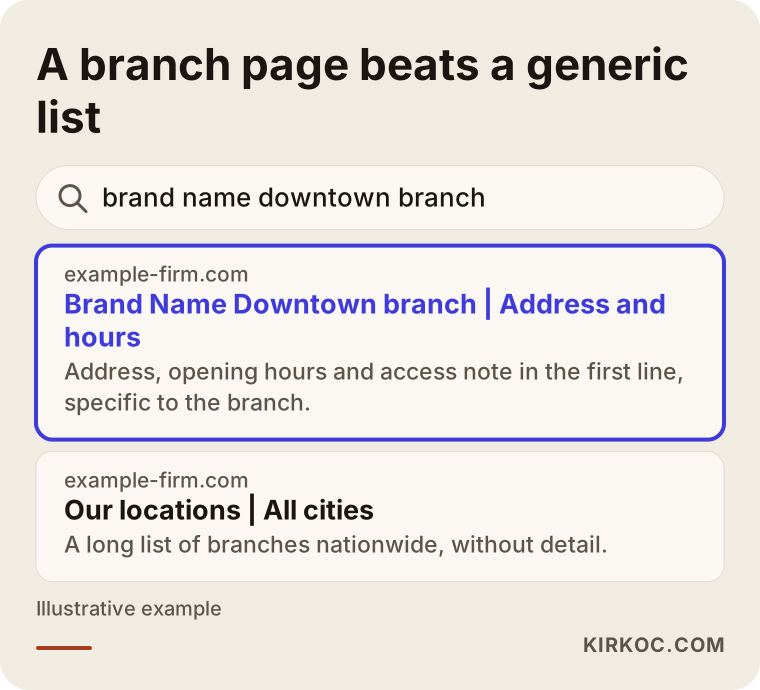
In this example the location page gives the neighborhood, address and opening hours in its very first line. The generic brand page says "locations nationwide" and sends the customer to a list. Most people do not want to dig through a list. They click the result that answers the question directly.
How do customers search for a franchise location?
Knowing this decides which pages you need. A franchise customer typically searches in one of four ways. The first is brand name plus area: "brand name downtown." This person already knows you and just wants the closest place. The second is service plus area: "haircut downtown" or "pilates near the university." This person may not know your brand. If your location shows up, you win a new customer. The third is the plain "near me" search, usually on a phone and on the map. The fourth is a direct question: "is brand name open on Sundays," "does brand name have parking." If the answer is not on the location page, the customer goes somewhere else.
So a franchise has two separate jobs. For brand searches, you send people to the right location. For non-brand searches, you make the location visible by service and area. The first job is relatively easy. The second takes effort, but it is the one that brings new customers, which is why it is worth doing.
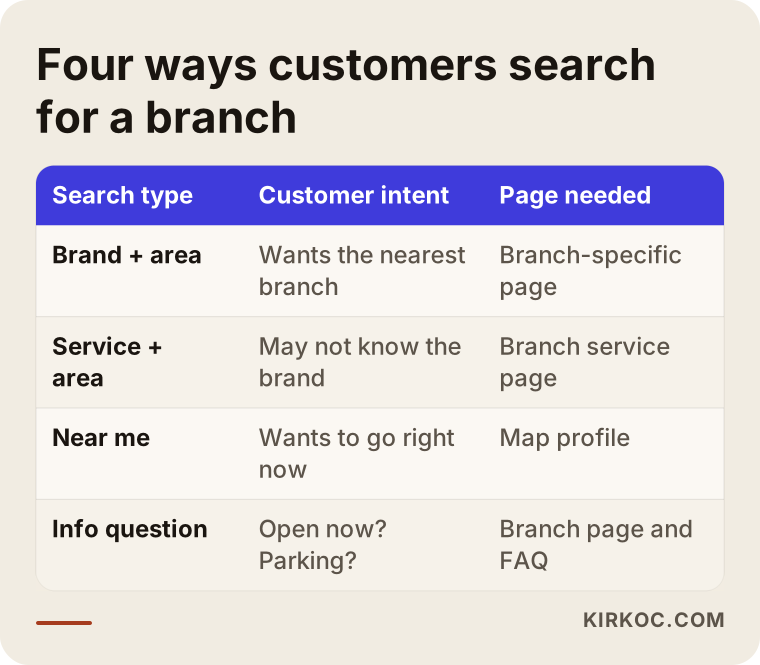
Looking at the table, one thing becomes clear: a single "Our locations" page cannot serve all four needs. Each needs its own doorway, but all of those doorways should be fed from the same source of information.
Head office and franchisee: who should manage what?
This is the most critical and least discussed part of the whole job. Technical fixes are easy. The real difficulty is that two sides must trust each other and the duties must be clear. My recommendation is to put the split of responsibilities on one written page and make it part of the franchise agreement or the operations manual. For the contract wording itself, please ask an attorney. I am only describing the practical side here.
Head office should usually own the following: the main brand website and its overall structure, the template and technical setup for location pages, the logo, imagery, tone of voice and brand rules, structured data (hidden code that passes details such as address, hours and phone number to search engines in an orderly way), overall measurement and reporting, and training for franchisees. The franchisee should own: the location's opening hours, holiday closures and special announcements, its own photos, an introduction of the team, timely replies to customer reviews, local promotions and relationships with nearby businesses.
The gray area is the business profile, which is the listing that appears on Google Maps and in the search panel. There are two reasonable models. In the first, all profiles sit in an account managed by head office, and each franchisee is given manager access. That way, if a franchisee leaves, the profile stays with the brand. In the second, the franchisee creates the profile but head office is added as an owner or manager. Whichever you choose, the essential point is that the profile never depends on one person's personal email address.
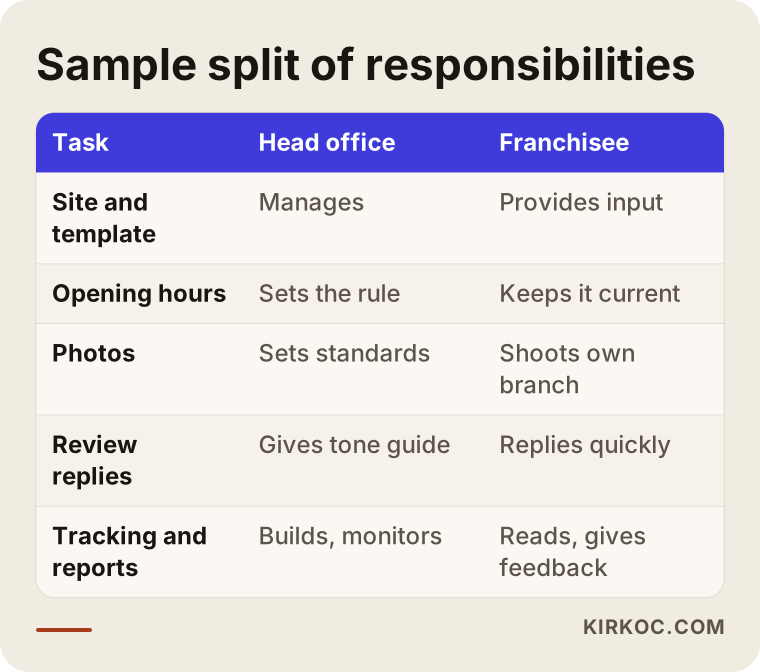
The split in the picture is a template, and it will change with the structure of your brand. What matters is that every row has a name or a role next to it. A row that says "everyone handles it" is usually the row nobody handles.
Should head office control more, or should franchisees have more freedom?
Extremes in either direction cause damage. If head office controls everything, the franchisee cannot update local information. To post "we close early today," they would have to email head office, and so the notice never gets posted. If franchisees do everything themselves, the brand name ends up spelled in a dozen ways, images drift apart, and a few locations hurt the brand's reputation with poorly written pages.
The practical balance is this: head office sets the structure and the rules, and where the franchisee fills in the content, head office guides it with a template. For example, every location page has required fields (address, phone, hours, directions note) and free fields (the location's story, the team, local notes). The page does not go live until the required fields are filled in.
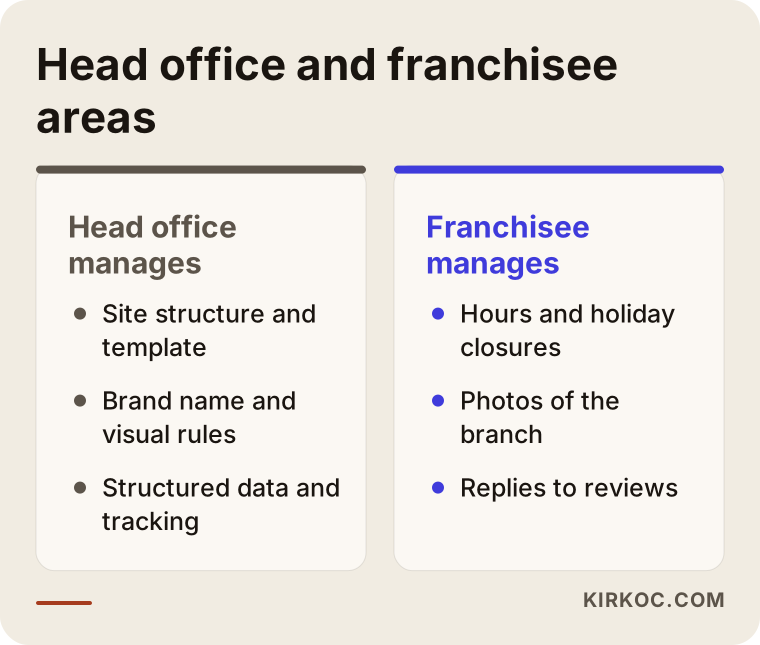
This comparison is a starting point, not a verdict. After the first six months you can see what works and move the boundaries.
A separate website for each franchisee, or a page on the main site?
A common question: a franchisee wants to buy their own domain name and build an independent website. I generally do not recommend it. The reason is that a brand builds strength on one main site. If every franchisee opens a separate site, authority is spread across dozens of places, head office cannot oversee them, the brand tone drifts, and when the franchisee leaves, the site is left abandoned. Maintenance also falls on the franchisee, and within a year it is often forgotten.
The healthier solution is to open a separate, distinctive page for each location inside the main site, with an address structure such as "yourbrand.com/locations/downtown." That page holds the location's address, map, hours, team, the services offered there and the questions customers from that area ask. Because it links strongly to the main site, it benefits from the value the main site has built up.
There can be a few exceptions. If your franchisees operate in different countries and languages, or if locations offer very different services, a separate domain or a subdomain may be worth considering. It is worth talking through your situation before deciding.
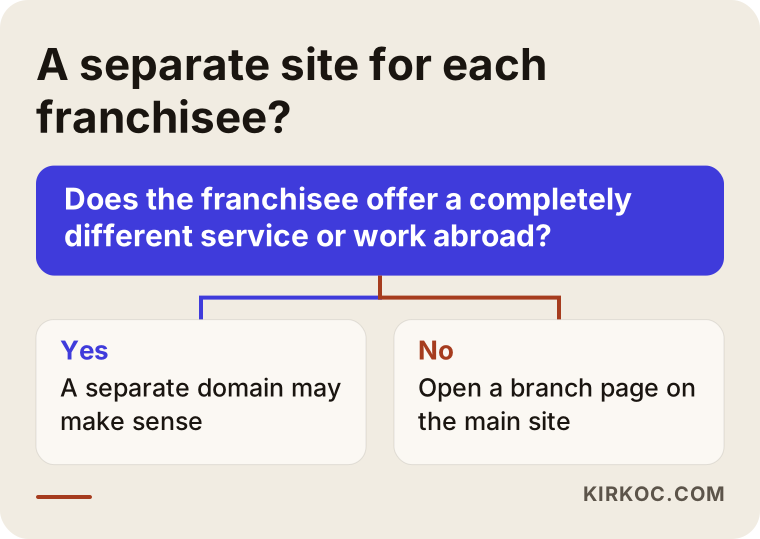
The decision tree shows the most common case. When the service and brand are the same, a separate location page on the main site is almost always easier to maintain and gives a stronger result.
What should a good location page include?
A location page is neither an address card nor a generic text with the city name swapped. It should give the information that makes a customer decide to visit that location. These are the elements I look for.
The headline should clearly state the brand, the service and the area. Right below it come the address, phone number, opening hours and a "get directions" button. Those are the things a customer needs to find in the first five seconds. Next comes an introduction specific to the location: which neighborhood it is in, which street you enter from, which landmark is nearby, what parking is like, and how to get there by public transit. No other location can have the same details, so these naturally make the page unique.
After that, list the services offered at that location. Not every location offers every service, and saying so clearly keeps customers from making a wasted trip. Add real photos from the location, ideally a few of the team, and frequently asked questions specific to that location. Finally, include a selection of genuine reviews from that location's customers and a clear call to get in touch.
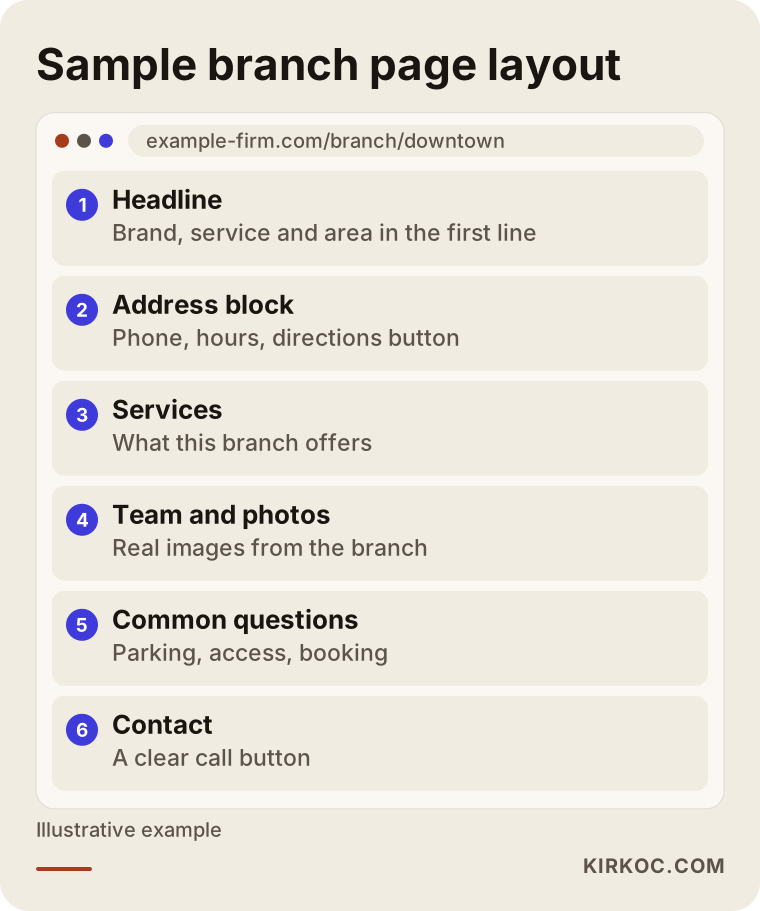
The layout in the picture is not a fixed rule. You add or remove sections depending on your industry. But the logic of the order stays the same: the practical information the customer needs first, then the details that build trust.
Why is copying the same text a problem?
Sometimes head office puts the same text on fifty locations and changes only the neighborhood name. It looks fast, but the result is usually weak. Google cannot tell apart pages that repeat the same content, and it pushes most of them into the background. It does not help the customer either, because someone in one city reads exactly the same sentences as someone in another.
The fix is to keep a shared frame on every page while adding sections that belong to the location. The shared part can be the brand story and a general description of the services. The unique part is the address, directions, team, the customer profile of that neighborhood, and the questions. On every page, at least a few paragraphs should be truly about that location.
Business profiles: the map side of a franchise
Visibility on the map is often more important than the location page, because "near me" searches happen there. Every location should have its own business profile, and those profiles should be consistent with each other.
By consistency I mean this: the brand name is written the same way in every profile, the business category is chosen correctly, the address and phone number match the location page exactly, the opening hours are current, and the website link in the profile goes not to the homepage but straight to that location's page. That last point is missed very often. If all profiles link to the homepage, the customer still gets lost in the "Our locations" list.
Also remember that Google has rules against adding neighborhood names or keywords to a business name. Naming a profile "Brand Name Downtown Best Salon" can get the profile suspended. Check the current rules on Google's own help pages.
You also need a shared system for reviews. Head office should be able to see the reviews from all locations in one place, and the franchisee should reply to reviews for their own location within the first few days. A calm, solution-focused reply to a negative review makes a difference both to the person who wrote it and to the future customers who read it later. Paying for fake reviews or buying reviews is unethical and harms the profile, and I do not recommend it.
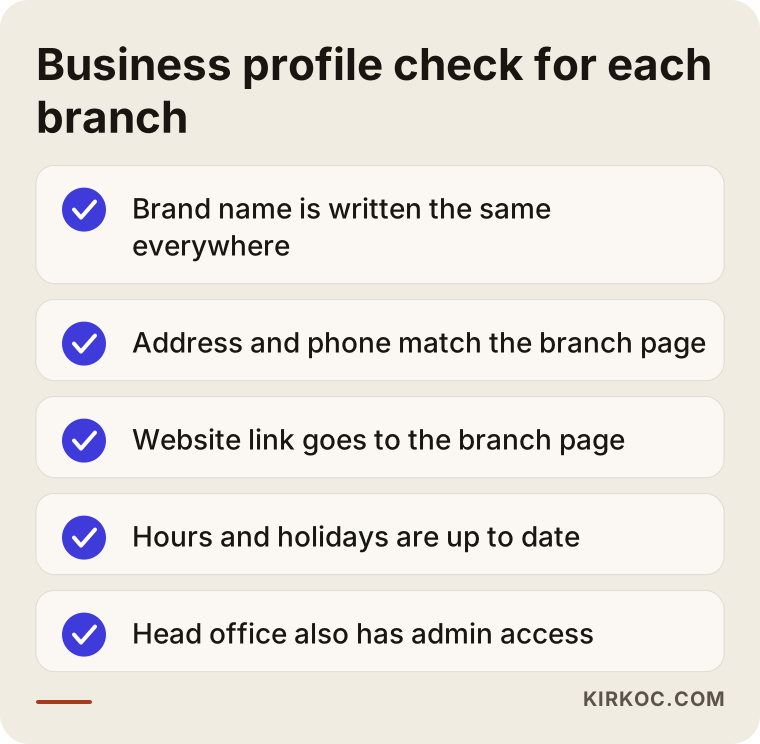
You can reuse this checklist every time a new location opens and every time a franchise is transferred. Writing it down once costs far less than explaining it again and again for years.
Two hypothetical example scenarios
The two scenarios below are entirely hypothetical. They do not describe any real brand or person. They only show how situations might play out.
Scenario 1: A cafe chain with centralized management
Suppose a coffee chain has twelve locations. The main website only presents the brand and has a list under "Our locations." The business profiles were opened with franchisees' personal emails, some have wrong hours, some have an old phone number. Customers type the brand name plus a neighborhood, and some of them go to a location that is closed, then leave a bad review.
The first step here is not to write a new page but to set up order. First, ownership of all profiles is gathered in one head office account, and each franchisee gets manager access. Then each location gets a page built from a shared template but with location-specific directions, photos and team sections. The website link in every profile is changed to point to its own location page. For holiday closures, head office gives franchisees a simple notification form. The first visible effect of this setup is fewer complaints about wrong information. Changes in search visibility show up slowly over weeks, and there is no guarantee.
Scenario 2: A clinic franchise where franchisees are strong
The second assumption: a dental care brand with seven locations in different cities. Franchisees work fairly independently, and each has its own team of specialists. The head office site is solid, but the location pages are three-line address cards. Patients search "brand name plus treatment plus city," but other clinics' pages come up.
In this case head office defines the required fields: address, hours, how to book, and the wording to be careful with in health claims. Franchisees write about their own specialists, the treatments they offer and the questions patients ask. In health, it is important to avoid bold promises and to ask an attorney about advertising rules; head office oversees that part. Each location page gets a title with the treatment type and the city, which makes it easier to match searches such as "dental implant brand name city."
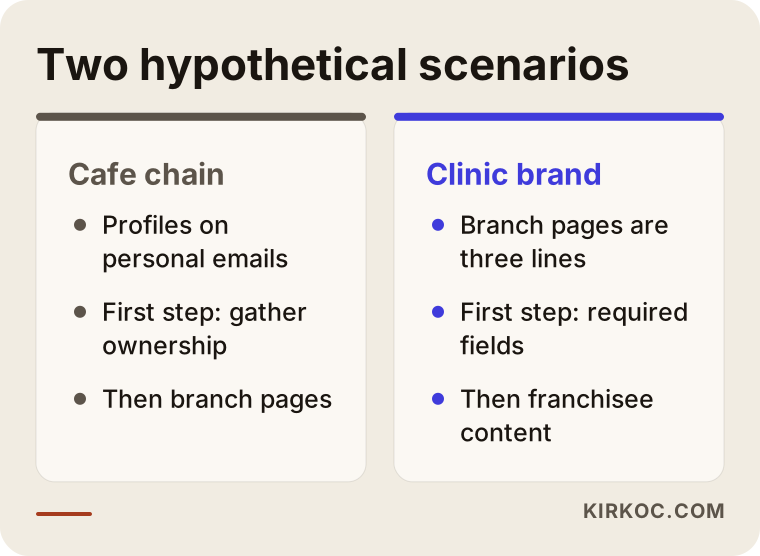
The picture shows the order within each scenario. In both, the first step is not technical. It is clarifying ownership and the split of duties. The writing and the pages come later.
Step by step: where do you start?
Think of franchise local SEO as a project, but not a one-time one. After setup it becomes a living routine. The order I follow is roughly this.
Step one is an inventory of the current situation. How many locations are there, which ones have a business profile, who manages them, are the address and phone details consistent across different places, and does each location have a page on the site? This inventory is usually a simple spreadsheet, and the first time you do it, it turns up surprises.
Step two is clarifying ownership and roles. Which profile sits in whose account, who has manager access, and how do you take back access from a franchisee who leaves? The split of responsibilities I described above gets written down here.
Step three is designing the location page template: required fields, free fields, image rules and structured data. It is tried first on one or two pilot locations, and if the results are good, it rolls out to the others.
Step four is fixing the business profiles: name, category, address, hours, link to the right page, photos. Step five is the review routine: who watches, how many days it takes to reply, and what to do about a negative review. Step six is measurement: visits to each location's page, phone taps and direction requests are tracked separately. Without measurement you cannot know which location is doing well.
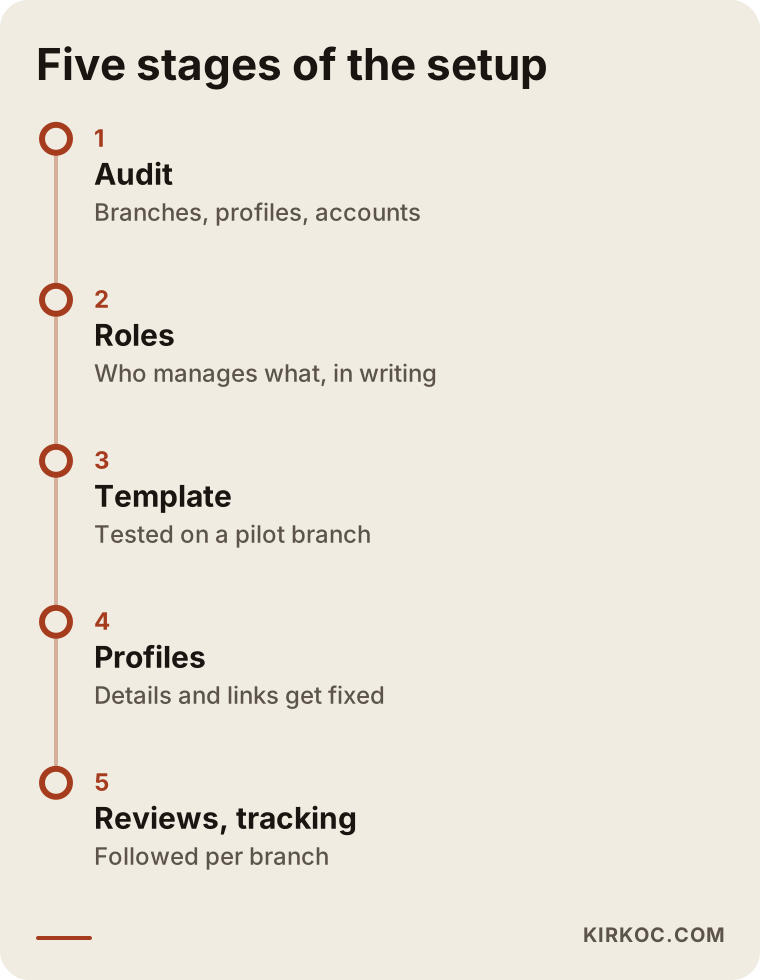
The reason for this order is simple. Producing content before measurement and order are in place is like pouring water into a leaky bucket. The foundation has to be solid first.
Common mistakes
The mistakes I see most often in franchises look alike. The first is linking all business profiles to the homepage. The second is duplicating location pages with the same text and only the neighborhood name changed. The third is leaving profile ownership in a franchisee's personal account, so that nobody can reach the profile after the franchisee leaves.
The fourth is using only an image map or a scrolling widget on the "Our locations" page, which search engines may not be able to read. The fifth is leaving the pages and profiles of closed or relocated locations online. The sixth is never replying to reviews. The seventh is measuring only total traffic, so you cannot see which location is working.
There is one more trap: writing claims you cannot verify, such as "the best" or "number one in the area," on each location. These claims do not build trust with customers, and in some industries they can create legal problems. If you are unsure about a statement, ask an attorney.
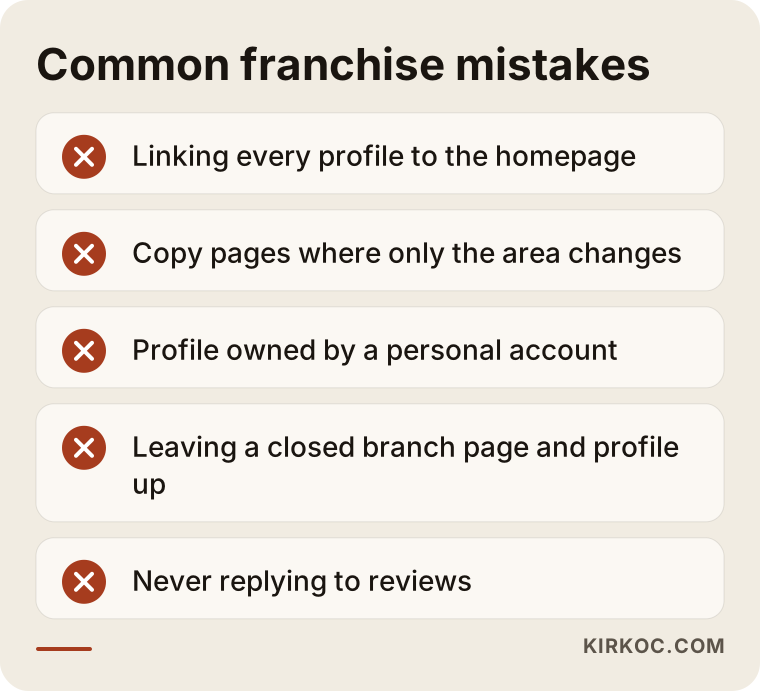
Most of the items on the list are not technical. They come from a lack of order and ownership. That is why you can spot and fix many of them yourself before any specialist comes in.
What can you do yourself, and when do you need a specialist?
If you are a franchisee and head office does not provide a system, there is still plenty you can do. Open your business profile and check that the details are correct. Keep your opening hours and holiday closures current. Add real photos. Reply to reviews. Send head office a written note about what information is missing from your location page. None of this needs technical knowledge. It only needs regular upkeep.
If you are on the head office side, start by making an inventory inside your own company: which location has a profile, who manages it, and how complete the location pages on the site are. That alone is useful, and it gives you a clear idea of whether you want to work with a consultant.
A specialist makes sense when the number of locations is too large to control, when your website platform cannot support a location page template, when profile ownership is tangled, when more than one faulty listing has appeared under the same brand name, or when head office and franchisees cannot agree on how to work together. The template, the structured data and the measurement setup especially tend to serve you for a long time once they are done right.
What determines the cost
For this kind of work, the price cannot be stated as one number, because the scope varies widely from brand to brand. The main factors are these: the number of locations, the platform your current site runs on and whether it suits a location page template, the current state of your business profiles (tidy, scattered or with tangled ownership), how much content has to be written and who will write it, whether the site is in more than one language, how detailed the tracking and reporting will be, and whether the work is a one-time setup or continues with monthly support.
I do not quote fixed figures, because any number I gave without a conversation would be misleading. In the first meeting I listen to your situation and tell you what you need, what can wait, and which parts of the work your own team can do. I do not try to sell you a scope you do not need.
How I work
I work alone, which means the same person handles the conversation, the plan and the execution. Compared with a large agency, that is a capacity limit, but in return you explain things directly to me instead of through a project manager. If you have a very large network of locations, I suggest splitting the work into stages: pilot locations first, then a wider rollout.
I generally proceed in this order: a short introductory call, then an inventory of your locations and site and a written summary of where things stand, and then agreeing on priorities together. Turning the split of duties between head office and franchisees into a written document is also part of this work. I do not guarantee rankings or customer numbers, and nobody can guarantee search results. What I offer is an orderly setup, a clear plan and a transparent record of what I did.
Frequently Asked Questions
Should every franchisee have a separate website?
In most cases, no. Opening a separate page for each location on the brand's main site keeps authority in one place, makes maintenance easier and protects brand consistency. A separate site should be considered only in unusual cases, such as a franchisee offering a very different service or operating in another country.
Can I use the same text on all location pages?
A short shared section is fine, but most of the page should be specific to the location: directions, team, the questions customers in that area ask, and photos. Copies where only the neighborhood name changes usually perform poorly and do not help the customer either.
Whose name should the Google Business Profile be under?
Ideally the profile is held in an account the brand controls, and the franchisee is given manager access. That way, even if the franchisee changes, the profile and its reviews stay with the brand. For how to write this into the agreement, I suggest asking an attorney.
What should happen to the profile and page when a franchise agreement ends?
This should be planned in advance. If the location is closing, the profile should be marked as closed and the page should redirect or state that the location has closed. If the location passes to another franchisee, the profile stays and the manager access is renewed. To avoid problems, write these steps into the operations manual.
Who should reply to reviews, head office or the franchisee?
Usually the franchisee, because they know best what happened. Head office prepares a tone guide and a roadmap for negative reviews. It is also possible to centralize replies at head office, in which case the franchisee must pass the facts on to head office.
When will I see results?
It depends on your current situation and the competition around you. Fixing mistakes such as a wrong address or hours tends to show an effect fairly quickly, while new pages can take weeks or months to find a place in search results. Promising an exact timeline or ranking would not be honest.
How do I know which of my locations is working?
Set up separate measurement for each location page: visits, phone taps and direction requests. The business profiles' own statistics complete the picture. Without measurement you cannot know which location deserves more effort.
What should I do for SEO when opening a new location?
Before opening, create the business profile, prepare the location page from the template, add it to the location list on the main site, and check that the address, phone number and other details are identical everywhere. Point the opening announcement to this page too, so that attention builds up in one place.
If you want to set up a local SEO routine for your franchise network or tidy up a scattered structure, you can look at the scope on my local SEO service page and write to me with a short description of how many locations you have and the state of your current website. Together we can see what comes first.