You run a coworking space or a virtual office company. The space is tidy, your prices are fair, and the meeting rooms are ready to go. Yet the phone does not ring as often as you expected. Plenty of people in your city search for "virtual office" or "coworking space" every month. In most cases the problem is not your space. It is that those people cannot find you in the search results. In this article I explain what SEO for coworking spaces and virtual office companies really means, what works differently in this industry, and where to start. I am Ümit Kırkoç, a web designer and SEO consultant who works alone from Istanbul, and I describe how I work on my SEO services page too.
SEO, in short, is the work that makes your website show up when your potential clients search on Google or another search engine. The difference from advertising is simple. When you stop paying for ads, you disappear. When SEO is set up properly, it leaves behind a system that can bring in inquiries for months. But this industry has its own difficulties, and generic advice does not get you far. The reason is straightforward: your client is not buying a product. They are buying an address, an atmosphere and a feeling of trust.
How do clients search for this kind of business?
The first question I always ask is: who is your client? Coworking clients and virtual office clients are different people, and they are often completely different from each other.
A freelancer or a small team wants to leave the kitchen table and find a quiet desk. This person searches for things like "coworking space near me," "day pass desk" or "monthly private office." The location, the internet speed, the opening hours and the pricing structure decide everything for them. In other words, this person is mostly comparing the options close to home.
A virtual office client, on the other hand, will often never sit at a desk at all. They want to register a company, give the tax authority an address, move their business address to a professional building, or simply avoid using their home address. They search for "virtual office," "business address rental" or "registered business address." For this person the mood of the space does not matter. The reliability of the process and a clear explanation of how it works do. There is also a third kind of client: someone abroad who wants to set up a company in your country. That person searches in a different language and with different words.
The third group looks for meeting rooms and event space. Searches like "hourly meeting room" or "training room rental" lead to very fast decisions, often on the same day or even within the same hour.
If you try to write one home page for all three groups, you end up persuading none of them. The picture below shows how a result might look for an example search.
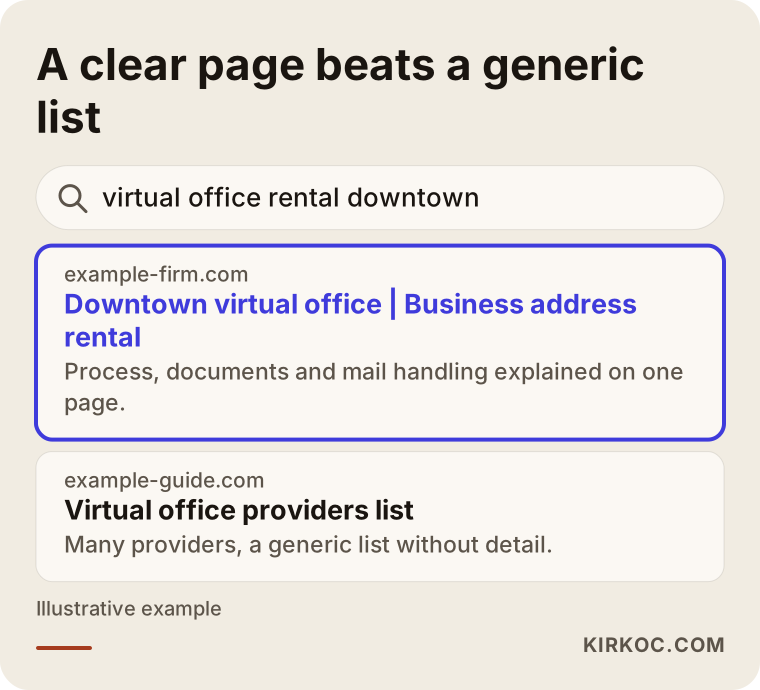
What the highlighted result does is simple. In its first line it says the area, the service and the problem it solves. The generic list page next to it does none of that. Google tries to work out which answer to give the person who is searching. If you make that job easier, Google can place you higher with more confidence.
Four types of search, four different intentions
Splitting searches in this industry into four groups makes it clear which page should answer which question. The table below summarizes this.
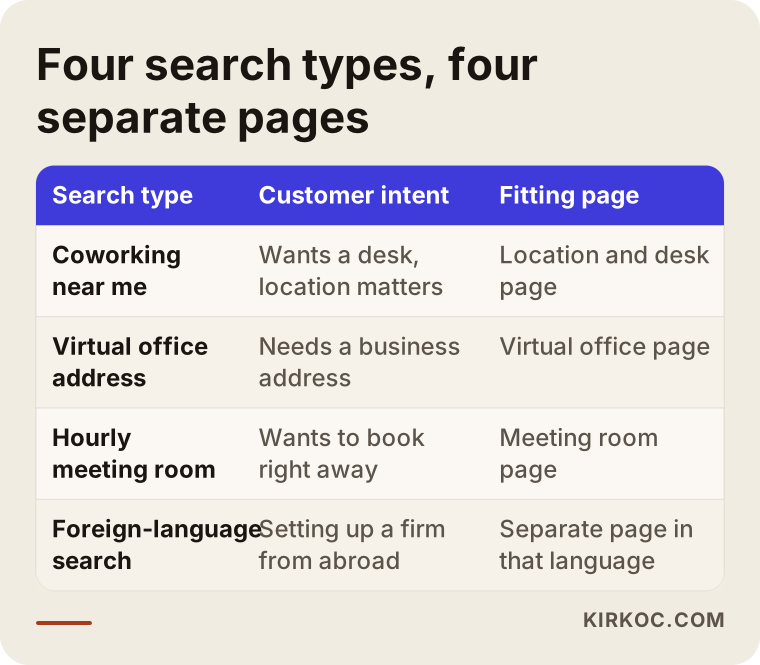
As you read the table, notice one thing. The page that answers "near me" cannot be the same page that answers "business address." The first person wants to see the space, how to get there and the desk options. The second wants to see the paperwork process, the turnaround time and what the address can be used for. If you try to explain both on one page, both explanations come out half finished.
What does a client check after finding you?
In this industry, a person who lands on your site does not decide as fast as a shopper on an online store. They have to trust a place or an address. That is why being found on Google is only half of the job. The other half is what the visitor sees once they arrive.
The questions in a visitor's head are usually these. Does this place really exist? Are the photos recent? How much does it cost, and what does that include? What does the contract say? How are mail and parcels handled? Can I use this address when I register a company? If your site does not answer these questions clearly, the visitor moves on to a competitor who does.
The picture below shows a typical client journey: the steps people go through from finding you to contacting you. Some people drop off at each step, and the goal is to reduce that drop-off.
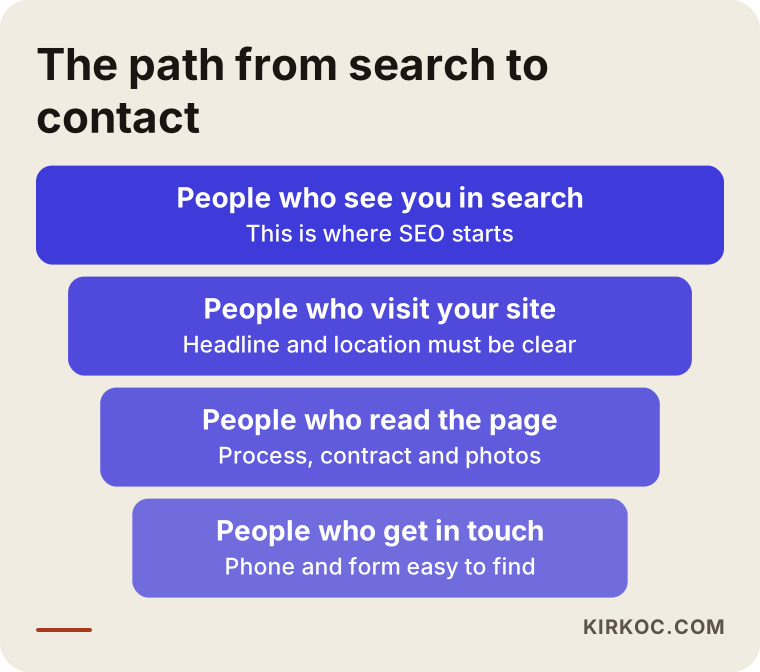
The important point here is that SEO only handles the first step, being visible. The later steps depend on your page content, your photos and how easy it is to reach you. That is why my work is not only about "placing keywords." It is about making the page ready to answer a client's questions.
Which pages do you need?
The problem I see most often in this industry is that every service sits on one long home page. Desks, private offices, virtual offices, meeting rooms and the event hall are stacked one under the other. That is hard for a person to read and confusing for a search engine.
A healthier structure is this: every main service gets its own page. The "virtual office" page explains the virtual office, the "meeting room" page explains the meeting rooms, and the "day pass" page explains desk rental. If you have more than one location, each location should have its own page too. Even if you have a single location, a page describing the neighborhood, public transit and surroundings is useful.
Here is how an example virtual office page could be organized.
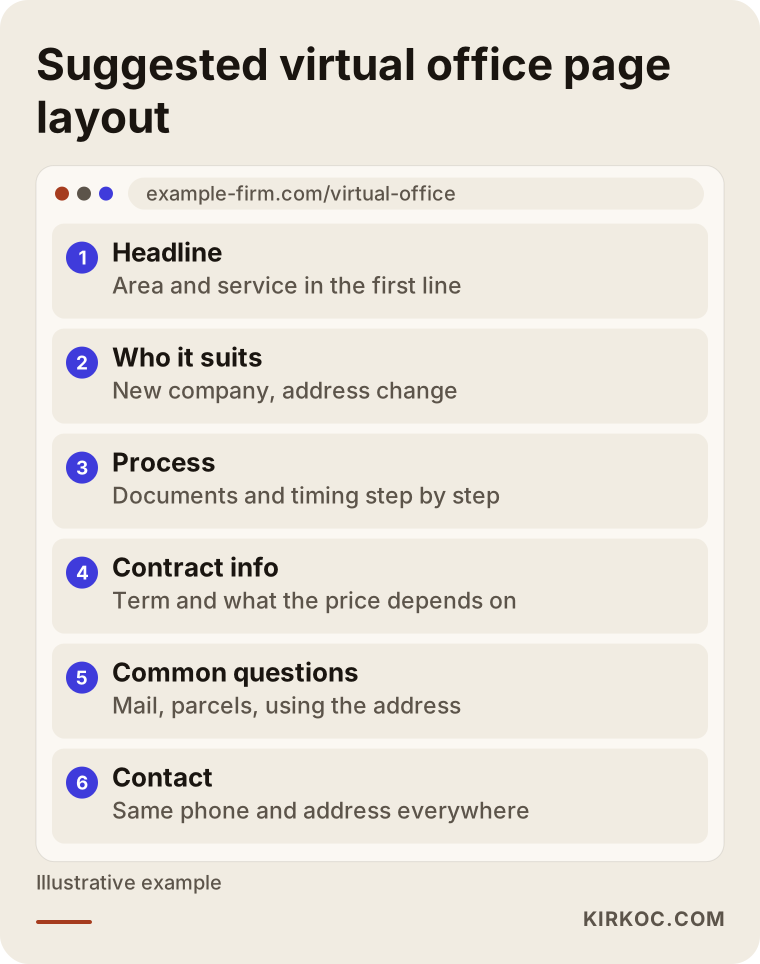
In this layout every section answers a client question. The headline carries the area and the service. The "who it suits" section filters out the wrong client early. The process section explains the paperwork and the turnaround time. The common questions section holds the clear answers that both people and search engines look for. Your phone number and address should be identical everywhere on the site. Even a small mismatch damages trust.
What to watch for on location and neighborhood pages
Do not use copy-and-paste text on your location pages. Two pages where you only swapped the neighborhood name are the same page in the eyes of a search engine, and both stay weak. For each location, write separately about transit (subway, bus, parking), well-known places nearby, what makes that space special, and add real photos. You already know all of this. The task is simply to put it in writing.
Meeting room and event searches
A person looking for a meeting room is usually in a hurry. Your page should show capacity, seating layout, projector or screen options, the hourly terms and how to book, all on the first screen. Offer one easy way to book: a call button or a short form is enough. Long membership forms scare away someone who needs a room today. This page is also your best front door for turning a one-time guest into a regular member, so it makes sense to add a short link to your membership options on it.
Maps and your business profile: the quiet hero of this industry
When someone searches "coworking space near me," Google very often shows map results first. What appears there is not your website. It is your Google business profile. So in this industry, a well-filled profile matters as much as your site.
Your profile should have the right category, current opening hours, real photos, a list of services and customer reviews. Replying to reviews makes a difference too. I have one warning: do not buy reviews, and do not ask your clients to write fake ones. That breaks the platform's rules, and if you get caught your profile can be damaged.
There is one more detail for virtual offices. The platform's rules on showing an address in a profile differ between service-area businesses and businesses with a physical location. Do not open a profile before you check which one fits your situation. If in doubt, ask a specialist or read the platform's help pages.
Can AI answers recommend you?
Many people no longer type into a search box. They ask an AI assistant such as ChatGPT: "What should I look out for when choosing a virtual office downtown?" The assistant builds its answer from clear, well-organized information found online. So if your site states the contract terms, the turnaround time and who the service suits, the chance that the assistant quotes you goes up. There is no guarantee, but giving organized information is the right investment for both humans and machines. I call this GEO for short: preparing your content so that it can appear as a source in AI answers.
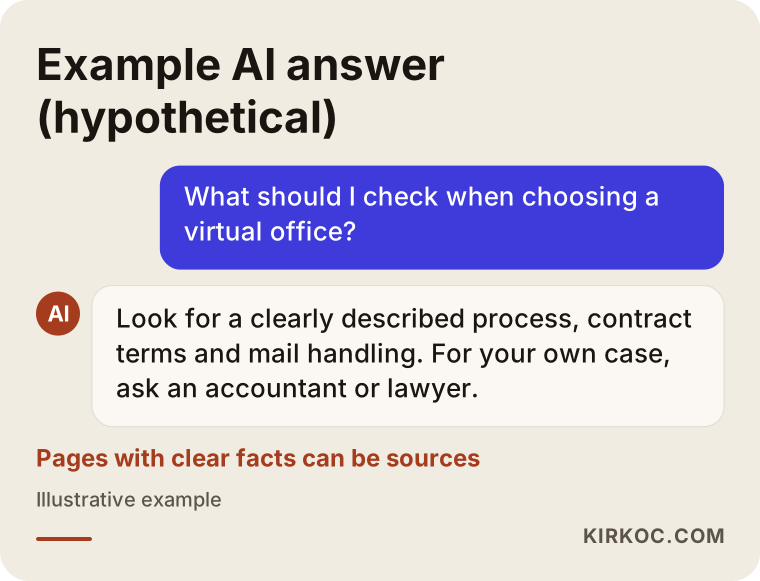
The answer in the picture is entirely an example. It is not the output of a real assistant. What it shows is this: if you have a clear paragraph that answers a question, that paragraph can show up somewhere else too. Write short, honest answers to questions like "Can a virtual office address be used to register a company?" Do not make firm legal claims. Saying "ask an accountant or a lawyer about your own situation" is both accurate and reassuring.
Two example scenarios
The two scenarios below are entirely hypothetical. They do not describe a real company or person. The goal is to show how the process works in practice.
Scenario 1: A single-location coworking space
Suppose a two-story coworking space operates in one district. The site is a single page: photos at the top, a price table below and a phone number at the very bottom. When someone searches "coworking space near me," the business does not appear, because the page does not even state clearly which neighborhood it is in.
The first step is to split the page: separate pages for day passes, monthly desks, private offices and meeting rooms. The second step is a location page with transit, surroundings, parking and photos of the space. The third step is to complete the business profile and ask real clients for reviews. The fourth step is a section of common questions: internet, hour limits, guest policy, invoicing. After a few months you measure which search brings visitors to which page, and you strengthen the pages that are lagging. There is no guarantee of results, but the direction is clear: a structure that gives a clear answer to the person searching nearby.
Scenario 2: A company focused on virtual offices
In the second hypothetical example, the company mostly sells virtual offices. The site looks good, but the page does not answer questions such as "is it suitable for registering a company, how is mail delivered, how long is the contract?" The client tries to find everything out by phone, and many give up before calling.
Here we first look at who is searching: people forming a new company, people changing addresses, people from abroad. Each gets a separate page or section. The process is explained step by step, the main contract terms are written openly, and a note to ask an accountant is added wherever legal matters come up. A page in another language is considered for clients abroad. The aim in this work is not traffic. It is for the right person to arrive, find the answers on the site and get in touch.
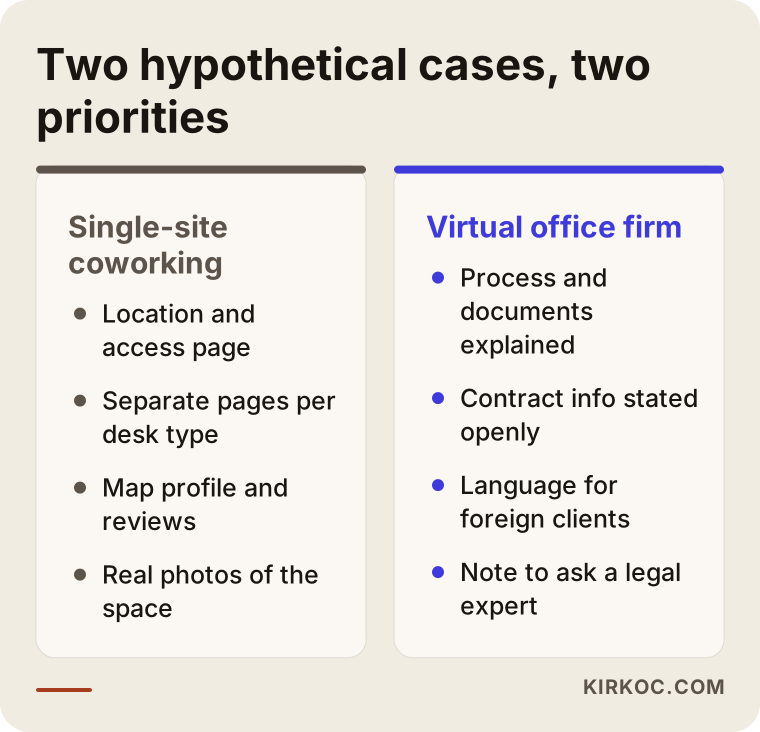
The picture puts the two scenarios side by side. One is about location and atmosphere. The other is about trust and process. Look at which one is closer to your business. Often it is a mix of both, and your pages should be built accordingly.
How do I work, step by step?
When I work in this industry I generally follow the order below. I keep every step simple, because complicated SEO does not bring anyone business.
First, I listen. I ask which service earns you the most, which clients make you happiest and which hours stay empty. Not every empty desk and not every empty hour has the same value.
Then I review the current situation. Which searches does your site appear for, and which not? Are the pages fast? Are they comfortable to read on a phone? What is the state of the business profile? Looking at the phone matters, because in this industry I assume that a large share of searches happen on phones.
Next I draw up a page plan. Which service gets which page, and which page answers which search: I put it on paper. You do not have to do everything at once. We start with the page that will bring the most business.
I write and arrange the pages. I do not use jargon in the text. I use the words your clients use. Photos, the logic of pricing and common questions fall into place at this stage.
I fix the profile and the consistency. Address, phone and opening hours should be the same everywhere: the site, the map profile and the directories.
I measure and adjust. At regular intervals I look at which searches bring visitors and how many people get in touch. I strengthen what works and change what does not.
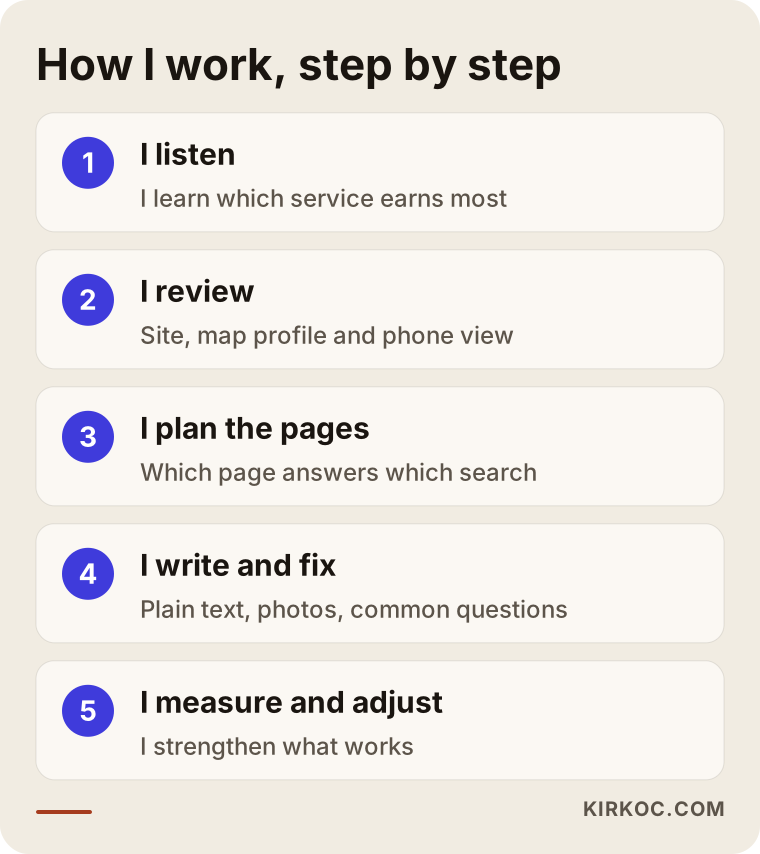
The order in the picture sums up the logic of the work: understand first, plan next, measure last. Mixing up the order and jumping straight to "placing keywords" is the mistake I see most often.
Common mistakes in this industry
Most of the mistakes I have seen over the years look alike. The list below covers the ones I run into most.
Explaining everything on one page. When desks, offices, virtual offices and halls share one page, none of them stands out.
Hiding the price completely. You do not have to write a number, but if you do not explain what the price depends on (term, office size, extra services), the client gives up before calling.
Using stock photos. An image of someone else's space damages trust. A well-shot photo of your own space always does a better job.
Copying location pages. Pages that are identical except for the neighborhood name fall into each other.
Hiding the contract and the process. Virtual office clients in particular want to see these. If you hide them, they get suspicious.
Fake or purchased reviews. It looks attractive in the short term, and in the long term it puts your profile at risk.
A site that looks bad on a phone. In this industry the person searching is usually out and about, looking at a phone.
Not measuring. Investing without knowing which page brings business is like walking in the dark.
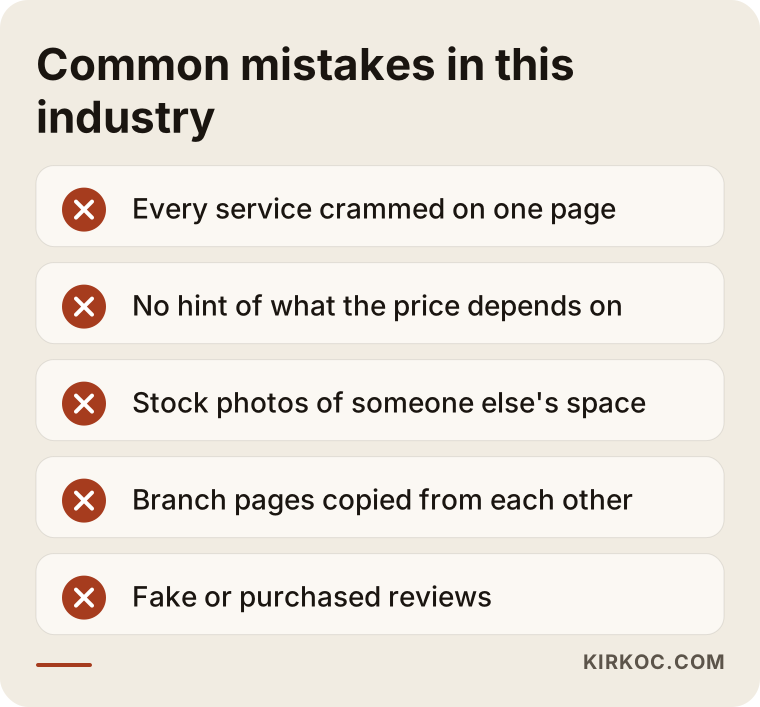
This list is summarized in the picture as well. Most of these mistakes are not expensive. They simply go unnoticed. So the first job is to look at your own site through a client's eyes.
What can you do yourself?
You do not need an expert for everything. There are a few things you can do on your own that really make a difference.
First, claim and complete your business profile. The right category, hours, photos and service list take about an hour. Next, check that the phone number, address and opening hours on your site are the same everywhere. Write down the questions clients ask you most often and put the answers on your site. That alone is a strong source of content. Ask satisfied clients, naturally, to write a review. Take fresh photos of your space. And open your site on your own phone and walk through it like a client.
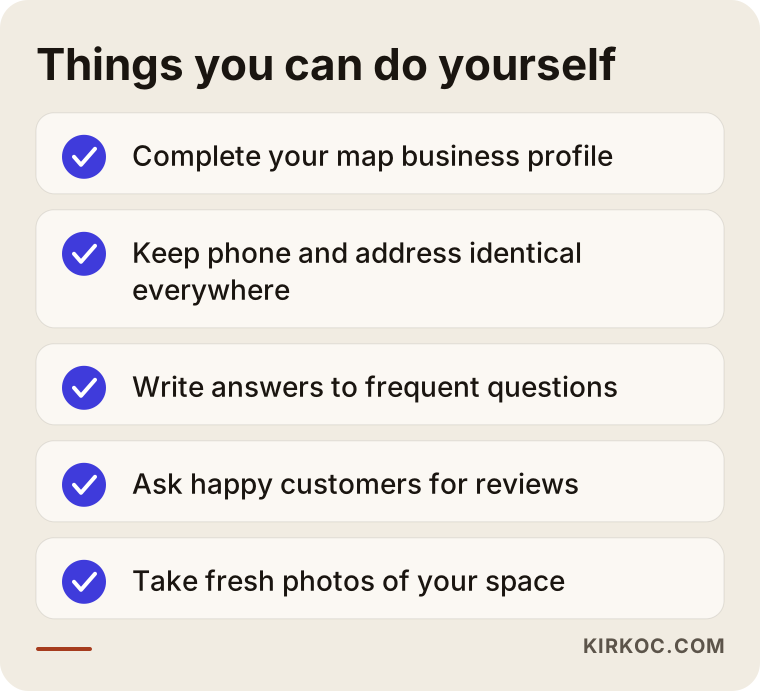
You can finish this list over a weekend. And if you later work with a specialist, the groundwork is already done, which saves both time and budget.
When do you need a specialist?
Outside help makes sense in these situations: you have several locations and the pages keep getting mixed up, your site has not been updated in years and is technically slow, you want to attract clients who speak another language, or you have worked on it yourself for a few months without seeing results. The simple question below can help you decide.
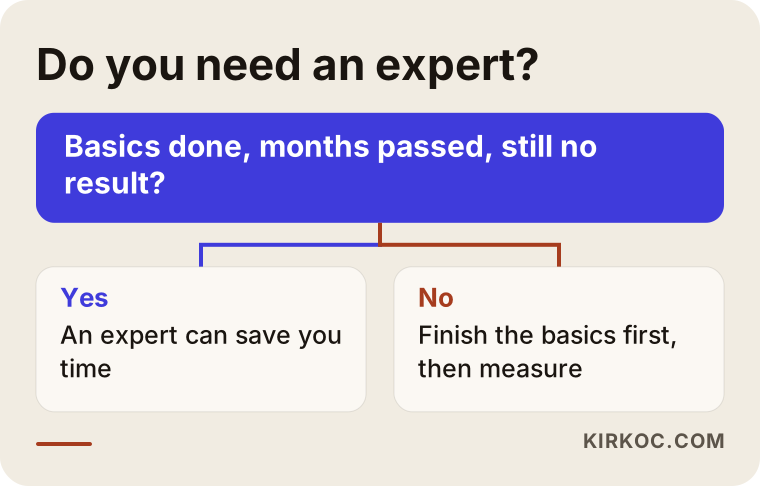
The chart is simple but honest. Hiring a specialist before you have done the basics wastes money. If you have done the basics and got stuck, a specialist saves you time.
What determines the cost?
I will not give a number here, because the scope of the work varies a lot from business to business. But I can tell you what it depends on.
The number of locations comes first: one location and five locations do not need the same number of pages. The variety of services is second: a company that sells only virtual offices needs a different plan from one that offers desks, offices, halls and virtual offices together. The current state of your site is third: fixing a clean and fast site is different from rebuilding one from scratch. The number of languages is fourth: writing separate pages in each language for foreign clients means extra work. Finally, there is the way of working: do you want a one-time setup, or ongoing monthly follow-up?
When you get a quote, the questions "what will be done, when, and what will the result be" should have clear answers. Do not pay for a vague "SEO package." Also, nobody can promise you a first-place ranking or a guaranteed result. If someone does, be careful.
How I work with you
I work alone, which means the person you talk to is also the person who does the work. There is no middleman and no internal phone tag. In the first meeting I listen to your situation, look at your site and tell you what you actually need. I do not sell what you do not need. Sometimes the answer is "do these three things yourself first," and I say that openly. We can proceed with a one-time cleanup or with regular follow-up, whichever you prefer. My reports are plain: what was done, what changed and what comes next.
Frequently asked questions
Can I use the same page for virtual office and coworking?
I would not recommend it. Clients of the two services are looking for different things. If each service has its own page, the client finds what they want faster, and the search engine understands more clearly what you offer.
Do I have to put my prices on the site?
It is not required. However, explaining what the price depends on (term, space, extra services) builds trust. If you give no information at all, the client often moves on to a competitor before calling.
How long does SEO take to show results?
I cannot give an exact time, because it depends on the competition, the state of the site and the work done. Generally you should think in months, not weeks. Be careful with anyone who guarantees results.
I have only one location. Do I really need a location page?
Yes, it helps. Information about the neighborhood, transit, parking and surroundings is a clear signal for people searching nearby and for search engines. It should be written specifically for your space, not copied.
Do I need a page in another language for foreign clients?
If you are targeting people who want to form a company or get an address from abroad, yes. A separate page in their own language that explains the process raises trust significantly.
Which matters more, the Google business profile or the website?
They work together. The profile stands out in "near me" searches, while the person who will decide goes to the site and reads the details. When one is missing, the other gets weaker too.
What should I write on the site about the legal validity of a virtual office address?
The safest approach is not to make firm legal claims. Explain the process and the documents, and tell the client to ask an accountant or a lawyer about their own situation. Have a specialist confirm the current rules.
Will AI assistants recommend me?
There is no guarantee. But if your site has clear, organized and honest information, the chance of being used as a source goes up. Common questions and an open explanation of the process are a good start.
If you would like to work out together what is missing for your coworking space or virtual office, reach out to me through my SEO services page. I will listen to your situation and tell you plainly what you really need.